Category: consciousness

Oregon and the wolf

Sharing a beautiful aspect of this new home State of ours.

Let’s face it, Jean and I know as much about Oregon as we know about Timbuktu! A house and property requiring much love and care and 10 dogs, 5 cats and 2 miniature horses does rather cramp one’s style!  Actually, let me be honest.  We just adore the grounds that surround the house.  Almost every single walk around the property with or without a few dogs brings some new discovery.  Thus we are not lusting to get out.

Just by way of example, yesterday we discovered that the dam built across our creek, just upstream of the bridge, was used in days long ago for creating flood irrigation.  That’s the dam in the picture below.  The old plank and steel work are still in the undergrowth alongside the creek; to the right of the picture.

Irrigation dam on Bummer Ck.

OK, to the point of this post.

Shortly after we arrived here in Merlin, Oregon we joined Oregon Wild.  Their Mission Statement says: Oregon Wild works to protect and restore Oregon’s wildlands, wildlife and waters as an enduring legacy for all Oregonians.  Can’t argue with that!

Last December a press release was issued about Bringing Wolves Back Home to Oregon.  Here’s part of that release.

Wolves in Oregon:

Gray wolves (Canis lupus) were once common in Oregon, occupying most of the state. However, a deliberate effort to eradicate the species was successful by the late 1940s.

Trouble for wolves began before Oregon even became a state. In 1843 the first wolf bounty was established and Oregon’s first legislative session was called in part to address the “problem of marauding wolves”. By 1913, people could collect a $5 state bounty and an Oregon State Game Commission bounty of $20. The last recorded wolf bounty was paid out in 1947.

After an absence of over half a century, wolves began to take their first tentative steps towards recovery. Having dispersed from Idaho, the native species is once again trying to make a home in Oregon. One of the first sightings came in 1999 when a lone wolf was captured near the middle fork of the John Day River, put in a crate and quickly returned to Idaho. In 2000, two wolves were found dead – one killed by a car, the other illegally shot.

In 2006, a flurry of sightings led state wildlife biologists to believe that a number of wild wolves were living in Northeast Oregon near the Wallowa Mountains and the Eagle Cap Wilderness. In May of 2007 a wolf was found shot to death near La Grande, OR.

As I explain on this blog, there is a deep connection between dogs and wolves:

Dogs are part of the Canidae, a family including wolves, coyotes and foxes, thought to have evolved 60 million years ago.  There is no hard evidence about when dogs and man came together but dogs were certainly around when man developed speech and set out from Africa, about 50,000 years ago.  See an interesting article by Dr. George Johnson.

Back to Oregon Wild.  Just three weeks ago came this update.

State Announces Wolf Recovery Numbers

With the state’s wolf killing program on hold, conservationists celebrate recent success, express concern for the future.

SALEM, OR Jan 16, 2013

Today the Oregon Department of Fish and Wildlife (ODFW) announced the state’s wolf population has risen to at least 53 animals and as many as five breeding pairs. Though still mostly confined to the Northeastern corner of the state, the news was welcomed by conservationists.

The confirmation of wolf numbers comes on the heels of a number of announcements of new wolf pups, interbreeding between packs, and new science demonstrating the important and irreplaceable role wolves and other native hunters play on the landscape.

The announcement also comes on the heels of the one-year anniversary of another great wolf recovery story. On December 28, 2011, a wolf known as Journey (OR-7) crossed the Oregon border to become the first wolf in California in nearly a century. The story was celebrated around the world.

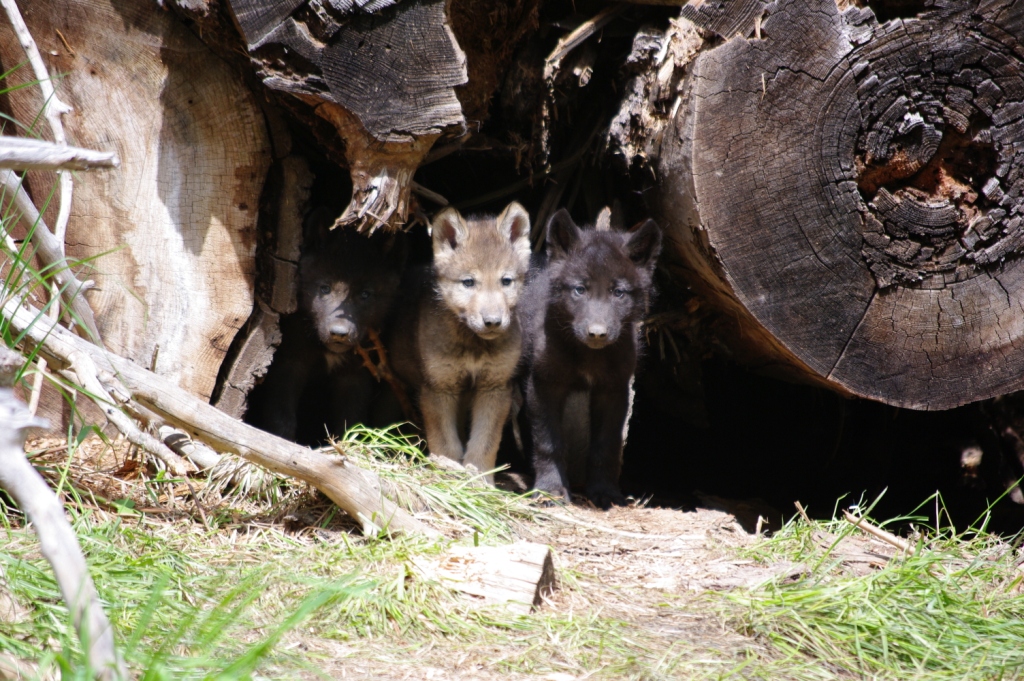
Read the rest of this good news story here.  But I couldn’t resist showing you this photograph that appeared in that story.

These wolf pups born to the Wenaha Pack in 2012 helped get recovery back on track. But their future remains tenuous (photo courtesy ODFW)

Let me close with these two videos.

Imnaha alpha female wolf, July 2011

Snake River Wolf Pack howling

Published on Aug 1, 2012

On July 25, 2012, an ODFW wolf biologist on a survey for wolf pups took this video of a Snake River wolf pack pup howling. The video was taken in the Summit Ridge area within the Snake River Wildlife Management Unit, in Wallowa County.

In the video, the pup howls three times. A low returning howl is heard and the pup gets up. Then, other members of the wolf pack (not seen in the video) return the pup’s howls.

Wolves are highly social animals and howling is a common behavior that help packs communicate and stay together. Wolf howls can be heard from several miles away.

More information on wolves in Oregon can be found at http://www.dfw.state.or.us/wolves.

What is this thing called love?

The discovery of love.

love

Through the wonderful world of web connections, I came to this topic by first reading Jeremy Nathan Mark’s blog The Sand County. Highly recommended.

Jeremy had written a post under the intriguing title of Blogging as Virtual Love-Making, And the Science Behind It.  Blogging; Love-Making; have I really just read those words!  In fact, Jeremy had reposted an article written by Deborah J. on her blog Living on the Edge of the Wild; another great find out there in this virtual world.  So with Deborah’s kind permission here it is reposted on Learning from Dogs.

oooOOOooo

Blogging as Virtual Love-Making, And the Science Behind It

dj1Often when I leave comments on a blog post that moved me, I write “I love this post” or “I love the way you do [this]” or “I love that quotation.” Lately I’ve been wondering if I’m overusing the word “love”.

Am I really feeling this strong emotional attachment, or am I just being lazy, unwilling to take the time to precisely articulate what strikes me about a particular piece?

After reading a recent article in The Atlantic  on the science behind love, I’m inclined to believe that, more often than not, I use the word “love” because that’s what I’m actually feeling– a “micro-moment of positivity resonance.”   That’s how Barbara Fredrickson defines love in her new book Love 2.0: How Our Supreme Emotion Affects Everything We Feel, Think, Do.

In The Atlantic article “There’s No Such Thing as Everlasting Love (According to Science), author Emily Esfahani Smith writes:

Fredrickson, a leading researcher of positive emotions at the University of North Carolina at Chapel Hill, presents scientific evidence to argue that love is not what we think it is. It is not a long-lasting, continually present emotion that sustains a marriage; it is not the yearning and passion that characterizes young love; and it is not the blood-tie of kinship.

Rather, it is what she calls a “micro-moment of positivity resonance.” She means that love is a connection, characterized by a flood of positive emotions, which you share with another person—any other person—whom you happen to connect with in the course of your day. You can experience these micro-moments with your romantic partner, child, or close friend. But you can also fall in love, however momentarily, with less likely candidates, like a stranger on the street, a colleague at work, or an attendant at a grocery store. Louis Armstrong put it best in “It’s a Wonderful World” when he sang, “I see friends shaking hands, sayin ’how do you do?’ / They’re really sayin’, ‘I love you.”

PenguinsSo when I say I “love” Louis Armstrong’s song, now I know why—because I feel such a strong positive connection to what he’s saying, as well as with how he says it, and the music he says it with, that I experience a triple love-whammy!

What I feel when reading things by fellow bloggers, or see the images they’ve created, is similar—a deeply-felt resonating connection, often on several levels.

Smith writes:

When you experience love, your brain mirrors the person’s you are connecting with in a special way,” and then she goes on to explain how “[t]he mutual understanding and shared emotions” between a story-teller and a listener “generated a micro-moment of love, which ‘is a single act, performed by two brains,’ as Fredrickson writes in her book.

Flower in Vase Pa-ta San-JenThis can happen between a writer and reader as well, or between an artist and viewer. In his book “Tao and Creativity” Chang Chung-yuan describes this connection between poet and reader as a “spiritual rhythm.”  It is the means by which the reader participates in the inner experience of the poet. He writes:

In other words, the reader is carried into the rhythmic flux and is brought to the depth of original indeterminacy from which the poetic pattern emerges.  The reader is directly confronted with the objective reality which the poet originally faced. The subjectivity of the reader and the objective reality of the poem interfuse . . . .

This is very interesting because Fredrickson discovers a similar phenomenon when she compares the brainwaves of a storyteller and listeners. Smith describes this in her article:

What they found was remarkable. In some cases, the brain patterns of the listener mirrored those of the storyteller after a short time gap. The listener needed time to process the story after all. In other cases, the brain activity was almost perfectly synchronized; there was no time lag at all between the speaker and the listener. But in some rare cases, if the listener was particularly tuned in to the story—if he was hanging on to every word of the story and really got it—his brain activity actually anticipated the story-teller’s in some cortical areas.

The mutual understanding and shared emotions, especially in that third category of listener, generated a micro-moment of love, which ‘is a single act, performed by two brains,’ as Fredrickson writes in her book.

Big Sur and Mothers Day picnic 111Fredrickson also discovered that the capacity to experience these daily love connections in our lives can be increased through simple loving-kindness meditations, where, as Smith describes, “you sit in silence for a period of time and cultivate feelings of tenderness, warmth, and compassion for another person by repeating a series of phrases to yourself wishing them love, peace, strength, and general well-being.”

“Fredrickson likes to call love a nutrient,” Smith writes.  “If you are getting enough of the nutrient, then the health benefits of love can dramatically alter your biochemistry in ways that perpetuate more micro-moments of love in your life, and which ultimately contribute to your health, well-being, and longevity.”

public domain beeSo remember, fellow readers, as you go meandering from one blog site to another like busy little bees, making those “micro-moment” connections with people whose work you admire, that you are engaged in a kind of virtual love-making.  You are distributing a pollen-like “nutrient” that nurtures others, as well as yourself.

As Louis says, “what a wonderful world” we live in!

oooOOOooo

Deborah concludes with Louis Armstrong singing ‘What a Wonderful World’.

However, for me the song that really resonates with this fascinating article is Ella Fitzgerald’s rendition of What Is This Thing Called Love.  Take it away Ella.

A big thank you to Jeremy and Deborah.  Finally, to all those that enjoyed (loved?) this post, do go and read The Atlantic article in full; it’s fascinating.

Plus ça change – sequel

Plus ça change, plus c’est la même chose (“the more it changes, the more it’s the same thing”).

As I wrote yesterday, “… out of curiosity I wondered what I had published a year ago, in early February 2012.  To my amazement what was published was as fresh and relevant as if it had been published today.

So here’s the second part of that trilogy of posts from February, 2012.  (It reads in its original form with the links and references unchanged.)

oooOOOooo

Climate, truth and integrity, part two

Continuing from Part One last Friday.

Last Friday I started re-publishing the wonderful comments that had appeared on Climate Sight in response to a question that I had raised, namely,

While in every way that I can think of, I support the premise of mankind affecting global climate, I would love to hear from someone who could reconcile the Post above with these recent items:” and then included the links to the WSJ and Daily Mail items.

If you are not familiar with those WSJ and Daily Mail items, then you will need to go back to Friday’s Post.

So moving on.

The third response was from chrisd3, here’s what he wrote,

Paul, here is the Met Office’s response, which begins, “[The Daily Mail] article includes numerous errors in the reporting of published peer reviewed science undertaken by the Met Office Hadley Centre and for Mr. Rose to suggest that the latest global temperatures available show no warming in the last 15 years is entirely misleading.”

Here is Deltoid taking David Rose apart on some earlier pieces:

And NASA never said anything about the Thames freezing over. Rose just made that bit up.

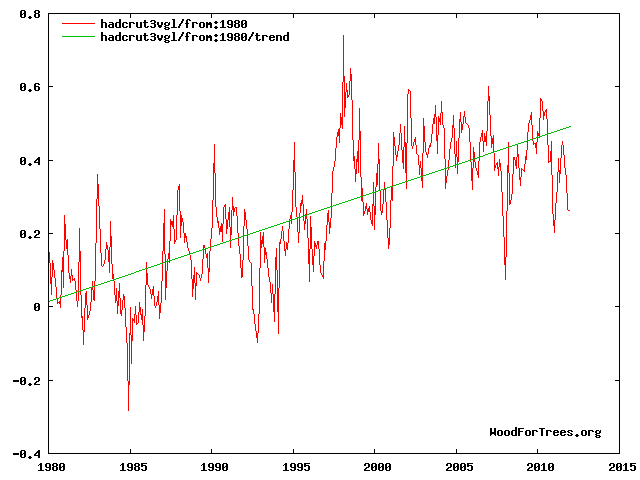
Finally, here is a chart of global temps from HadCRU:

From this, it is pretty clear why Rose chooses 15 years as his starting point: 1997-1998 was the time of the largest El Nino ever recorded, resulting in a huge temperature spike. Using that as the starting point for a temperature comparison is absolutely classic cherry-picking.

And in any event, you can’t say anything about trends in noisy data by simply comparing two arbitrary points. That is not a valid way to analyze the data (especially if you pick an obvious outlier as your starting point!). It is like trying to say whether the tide is coming in or going out by looking at the height of two waves. It just doesn’t work that way. You have to look at the long-term trend to remove the noise.

Let me take you to that Met Office response (and I’m republishing it in full).

Met Office in the Media: 29 January 2012

Today the Mail on Sunday published a story written by David Rose entitled “Forget global warming – it’s Cycle 25 we need to worry about”.

This article includes numerous errors in the reporting of published peer reviewed science undertaken by the Met Office Hadley Centre and for Mr. Rose to suggest that the latest global temperatures available show no warming in the last 15 years is entirely misleading.

Despite the Met Office having spoken to David Rose ahead of the publication of the story, he has chosen to not fully include the answers we gave him to questions around decadal projections produced by the Met Office or his belief that we have seen no warming since 1997.

For clarity I have included our full response to David Rose below:A spokesman for the Met Office said: “The ten year projection remains groundbreaking science. The complete period for the original projection is not over yet and these projections are regularly updated to take account of the most recent data.

“The projections are probabilistic in nature, and no individual forecast should be taken in isolation. Instead, several decades of data will be needed to assess the robustness of the projections.

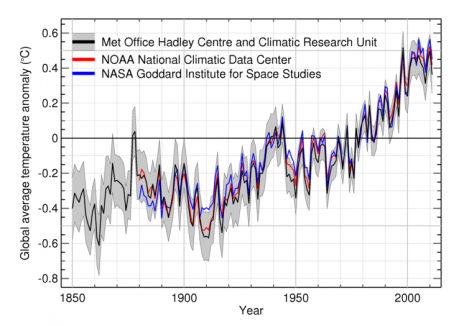
“However, what is absolutely clear is that we have continued to see a trend of warming, with the decade of 2000-2009 being clearly the warmest in the instrumental record going back to 1850. Depending on which temperature records you use, 2010 was the warmest year on record  for NOAA NCDC and NASA GISS, and the second warmest on record in HadCRUT3.”

Global average temperatures from 1850 to 2011 from the three individual global temperature datasets (Met Office/UEA HadCRUT3, NASA GISS and NOAA NCDC)

Furthermore despite criticism of a paper published by the Met Office he chose not to ask us to respond to his misconceptions. The study in question, supported by many others, provides an insight into the sensitivity of our climate to changes in the output of the sun.

It confirmed that although solar output is likely to reduce over the next 90 years this will not substantially delay expected increases in global temperatures caused by greenhouse gases. The study found that the expected decrease in solar activity would only most likely cause a reduction in global temperatures of 0.08 °C. This compares to an expected warming of about 2.5 °C over the same period due to greenhouse gases (according to the IPCC’s B2 scenario for greenhouse gas emissions that does not involve efforts to mitigate emissions).  In addition the study also showed that if solar output reduced below that seen in the Maunder Minimum – a period between 1645 and 1715 when solar activity was at its lowest observed level – the global temperature reduction would be 0.13C.

Back to that response from chrisd3.  He offered this, “Finally, here is a chart of global temps from HadCRU.”  Here is that chart, remember we are looking at Global temperatures.

Global temperature trend

OK, between this Post and my Post last Friday, you probably get the message!  There were many other contributions and I could go on and on quoting the great responses I got, all of them uniformly saying there IS global warming unprecedented in recent years.  The message is crystal clear and those who wish to deny the evidence … well, I can’t come up with a polite term, so will just leave it at that!

My final contribution is from Martin Lack, author of the Blog Lack of Environment, and a good friend of Learning from Dogs.  Here is what he wrote in a recent email,

You may have seen my latest response to How much is most?

When I eventually saw your earlier comment, I was surprised and disappointed in equal measure because I almost feel that I have failed in some way. Let me explain:  Unlike ClimateSight and SkepticalScience, which both do an excellent job of focusing on the science of climate change, my blog is deliberately focused on the politics underlying the denial of all environmental our problems; including 2 key aspects to my MA dissertation, namely the political misuse of scepticism; and the psychology of denial.  See my How to be a Climate Change ‘Sceptic’  for more detail.

Therefore, although not specifically categorised as such, just about everything I have posted is traceable back to Paul and Anne Ehrlich’sBetrayal of Science and Reason (1996) and/or Naomi Oreskes and Erik Conway’s Merchants of Doubt (2010).  For someone who does not currently go to any Church, I am remarkably fond of quoting Scripture so, if necessary, please forgive me but, as the Good Book says:  “What has been will be again, what has been done will be done again; there is nothing new under the sun” (Ecclesiastes 1:9).

Therefore, I do not think you should be surprised by the amount of misinformation and misrepresentation contained in the original WSJ Sixteen’s article; and/or the fact that denialist arguments are repeated no matter how many times they have been shown to be false.  Furthermore, I would warn against trying to summarise it all on Learning from Dogs.  This is definitely Book territory and, in addition to the two mentioned above, the market is already saturated by the likes of Climate Change Cover-up by James Hoggan and Climate Change Denial by Haydn Washington and John Cook.

With very best wishes for a fog-free future,

What to say to close these two Posts off?  Frankly, it’s difficult to know how to pitch it.  The science seems clear beyond reasonable doubt.  But if you are reading this and disagree, then PLEASE offer the science to refute the conclusions presented here.  I promise you that I will present it on Learning from Dogs.

So let me end with a simple photograph.

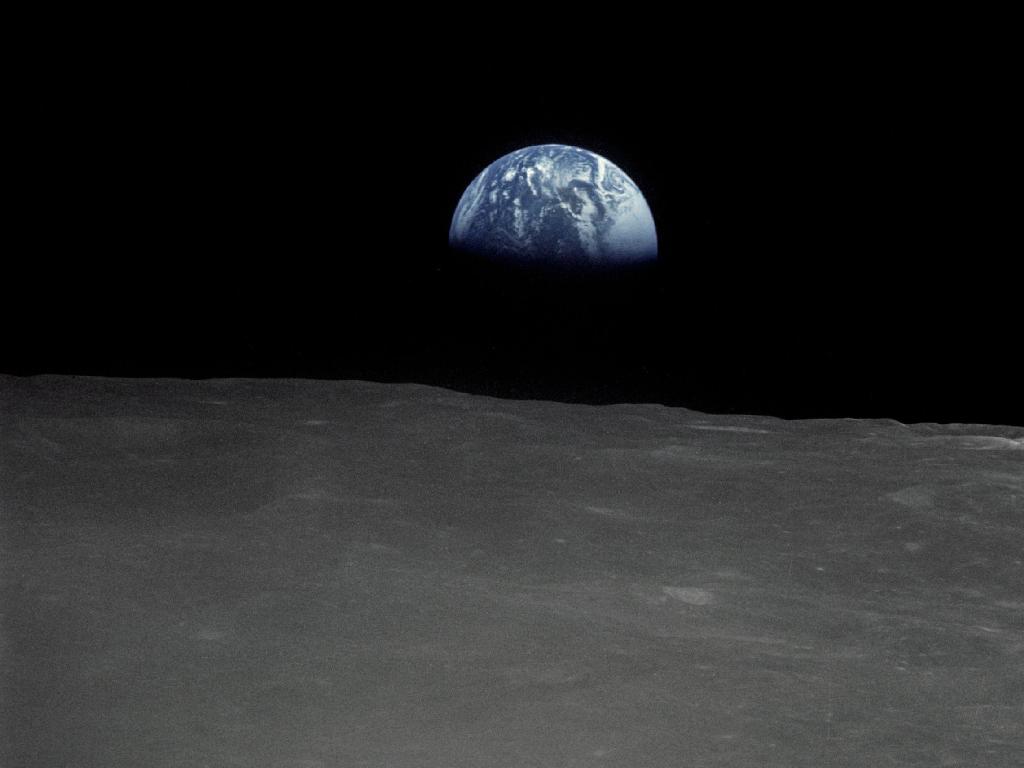
Earthrise

This is the photograph that wilderness photographer Galen Rowell called, “the most influential environmental photograph ever taken.”

The now world-famous photograph was taken by Astronaut William Anders from Apollo 8, the first manned mission to the Moon, a little over 43 years ago on December 24th, 1968.

As the Earth rose above the horizon of the moon, NASA astronaut Frank Borman uttered the words, “Oh my God! Look at that picture over there! Here’s the Earth coming up. Wow, is that pretty.”  Bill Anders then took the ‘unscheduled’ photograph.

Now project forward 43 years to the year 2055 and play with the idea of what ‘pretty‘ planet Earth will be like for mankind and so many other species, including our longest companion, the dog, if we don’t get our act together pretty soon!

Time and tide wait for no man.

Two delightful contributions about the ageing journey.

First from Cynthia, a very brave Californian lady, who recently sent me these:

oooOOOooo

Couple in their nineties are both having problems remembering things. During a check-up, the doctor tells them that they’re physically okay, but they might want to start writing things down to help them remember ..

Later that night, while watching TV, the old man gets up from his chair. ‘Want anything while I’m in the kitchen?’ he asks.

‘Will you get me a bowl of ice cream?’

‘Sure.’

‘Don’t you think you should write it down so you can remember it?’ she asks.

‘No, I can remember it.’

‘Well, I’d like some strawberries on top, too. Maybe you should write it down, so as not to forget it?’

He says, ‘I can remember that. You want a bowl of ice cream with strawberries.’

‘I’d also like whipped cream. I’m certain you’ll forget that, write it down?’ she asks.

Irritated, he says, ‘I don’t need to write it down, I can remember it! Ice cream with strawberries and whipped cream – I got it, for goodness sake!’

Then he toddles into the kitchen. After about 20 minutes, the old man returns from the kitchen and hands his wife a plate of bacon and eggs. She stares at the plate for a moment.

‘Where’s my toast?’

oooo

An elderly couple had dinner at another couple’s house, and after eating, the wives left the table and went into the kitchen.

The two gentlemen were talking, and one said, ‘Last night we went out to a new restaurant and it was really great. I would recommend it very highly.’

The other man said, ‘What is the name of the restaurant?’

The first man thought and thought and finally said, ‘What’s the name of that flower you give to someone you love? You know, the one that’s red and has thorns.’

‘Do you mean a rose?’

‘Yes, that’s the one,’ replied the man. He then turned towards the kitchen and yelled, ‘Rose, what’s the name of that restaurant we went to last night?’

oooo

A senior citizen said to his eighty-year old buddy:

‘So I hear you’re getting married?’

‘Yep!’

‘Do I know her?’

‘Nope!’

‘This woman, is she good looking?’

‘Not really.’

‘Is she a good cook?’

‘Naw, she can’t cook too well.’

‘Does she have lots of money?’

‘Nope! Poor as a church mouse.’

‘Well, then, is she good in bed?’

‘I don’t know.’

‘Why in the world do you want to marry her then?’

‘Because she can still drive!’

oooo

A man was telling his neighbor, ‘I just bought a new hearing aid. It cost me four thousand dollars, but it’s state of the art. It’s perfect.’

‘Really,’ answered the neighbor. ‘What kind is it?’

‘Twelve thirty.’

oooo

Morris, an 82 year-old man, went to the doctor to get a physical.

A few days later, the doctor saw Morris walking down the street with a gorgeous young woman on his arm.

A couple of days later, the doctor spoke to Morris and said, ‘You’re really doing great, aren’t you?’

Morris replied, ‘Just doing what you said, Doc: ‘Get a hot mamma and be cheerful.”

The doctor said, ‘I didn’t say that.. I said, ‘You’ve got a heart murmur; be careful.’

oooo

Last one!

A little old man shuffled slowly into an ice cream parlour and pulled himself slowly, painfully, up onto a stool… After catching his breath, he ordered a banana split.

The waitress asked kindly, ‘Crushed nuts?’

‘No,’ he replied, ‘Arthritis.’

Now, before you ‘forget ‘, send them on to some other folks you know who could use a good laugh!!

oooOOOooo

The second contribution comes from dear friend, MaryAnne.

julieandrews

To commemorate her birthday, actress/vocalist, Julie Andrews made a special appearance at Manhattan’s Radio City Music Hall for the benefit of the AARP.  One of the musical numbers she performed was ‘My Favorite Things’ from the legendary movie ‘Sound Of Music’. Here are the slightly modified lyrics she used:

(If you sing it, it’s especially hysterical!!!)

Botox and nose drops and needles for knitting,
Walkers and handrails and new dental fittings,
Bundles of magazines tied up in string,
These are a few of my favorite things.

Cadillacs and cataracts, hearing aids and glasses,
Polident and Fixodent and false teeth in glasses,
Pacemakers, golf carts and porches with swings,
These are a few of my favorite things.

When the pipes leak, When the bones creak,
When the knees go bad,
I simply remember my favorite things,
And then I don’t feel so bad.

Hot tea and crumpets and corn pads for bunions,
No spicy hot food or food cooked with onions,
Bathrobes and heating pads and hot meals they bring,
These are a few of my favorite things.

Back pain, confused brains and no need for sinnin’,
Thin bones and fractures and hair that is thinnin’,
And we won’t mention our short shrunken frames,
When we remember our favorite things.

When the joints ache, When the hips break,
When the eyes grow dim,
Then I remember the great life I’ve had,
And then I don’t feel so bad.

(Ms. Andrews received a standing ovation from the crowd that lasted over four minutes and repeated encores.)

oooOOOooo

So there you are.  This old Englishman, vintage 1944, celebrates Cynthia, MaryAnne and Ms. Andrews and all the other wonderful women in this world who refuse to let age or life’s circumstances get in the way.

Nostalgic musings

Early days in London

In my recent post Electrosensitivity, I wrote about “spending a number of years studying for a Diploma in Electrical Engineering at Faraday House, Southampton Row, London and becoming a UK Radio Amateur at the age of 17 (G3PUK)“.

In reverse order, I shall start with becoming a UK Radio Amateur, now rather back in the mists of time!

After my father died in 1956 my mother subsequently remarried.  Her new husband was Richard Mills and he was very knowledgeable about radio matters; he was a technical author in the radio-communications industry.  It was Richard, my step-dad, who showed me how to make a crystal set and I started listening to the strange world of wireless radio.  It fascinated me and motivated me to save up my pennies and buy an ex-military radio receiver known as a R1155.

r1155

I had joined the Harrow Radio Society who, amazingly, are still active today, as their website demonstrates.

Under the fabulous tutelage of many of the older ‘hams’ I went on to sit my exams and on Valentine’s Day 1962 was awarded the Postmaster-General’s Amateur Radio Certificate.  I applied for a call-sign and was allocated G3PUK.  I was just 17 years old!

G3PUK0001

oooOOOooo

Now some memories of Faraday House.  I can do no better than refer you to an article that appeared on the Electrical Review website in the UK.  As the article was published over three years ago, I think republishing it on Learning from Dogs isn’t being too naughty.

faradayhouseplaque

Faraday House Association closes after 105 years

FRIDAY, 29 JANUARY 2010

It is with sadness we report the Faraday House Old Students Association (FHOSA) is to close after operating continuously over the last 105 years. It had been host to thousands of chartered electrical engineers. The Association membership is derived from old students of Faraday House.

In 1888 the revised Electric Lighting Act encouraged many local authorities to apply for Parliamentary Powers to establish generating stations to transmit power. Faraday House was founded to train engineers in this new practice. The college started life as the Electrical Standardising, Testing and Training Institution at Charing Cross but in June 1890 used the name Faraday House. It was located in the Charing Cross area, and fees were 100 guineas per annum. The first Faraday House Dinner was held in 1895 – it was free and some 170 attended. In 1905 the FHOSA was formed and 100 old students joined. A move was then made to Southampton Row. By now the college had 110 students.

In 1909 Dr Russell was appointed principal, and pioneered the sandwich course. This meant students had a year or so of theory and then experienced work in industry, returning again to more theory. By 1914 many old students joined up and a crash course was started to aid the war effort. By 1919 some 350 had been in the services and 34 had died. In 1920 the fees had risen to 300 guineas.

By 1928 1000 students had joined the Old Students Association and in 1929 a 40th anniversary dinner was held. In 1939 a discussion with the governors resulted in a decision to evacuate the college to Thurlestone in Devon. A new principal, Dr WRC Coode-Adams, took over from Dr Russell. Faraday House took over the Links Hotel. Staff and students who were married lived in the hotel or in houses that had been taken over by the college.

In 1942 the college returned to Southampton Row. After the war Faraday House had difficulty in recruiting, students were lured to other colleges and universities by grants. In 1957 Mr GH Randolph Martin was appointed Principal. He had been a lecturer at the college since 1948. The college closed its doors in 1967 as losses were now running at £20,000 per year.

During its lifetime Faraday House produced a succession of engineers who attained the most senior positions in industry and electrical supply in many countries, and six old students have been president of the Institution of Electrical Engineers (now the IET).

The Old Students Association has a membership that is steadily growing older and shrinking as members die. The closure was inevitable without younger people coming forward to run it. The FHOSA will shut its doors finally after the Annual General Meeting in March 2010.

Here’s the front of the building.

Faraday House, London

How the years have flown by!

EMF safety

From knowledge to awareness and then to protection.

Yesterday, I dipped into the subject of electro-magnetic radiation.  As hopefully made clear, I was writing in response to the film Beings of Frequency that was presented the previous day.

If you haven’t yet watched the film, then do.  To be frank, the posts of yesterday and today are that much more valuable after the film has been watched.

Brain-Tumor-Report-Cover-Image

In terms of reducing the effects of EMF, then a quick ‘Google’ search will bring up teems of websites.  Many of them are selling filters, consultancy, EMF surveys, and more.  While in no way impugning those services, my instinct is to be drawn to those websites and blogs motivated by the desire to be informational alone.  At this stage of my research anyway.

Take EMF Damage for example, from which I quote:

There is a connection between electromagnetic fields and some cancers including leukemia

EMFDamage.com is online for these reasons:
1. To let you know there are serious health risks involved in living or working too close to power lines. I am certain the power line behind my home is the direct cause of my diagnosis of chronic lymphocytic leukemia. Electromagnetic fields (EMFs) have also been linked to other adult leukemias, childhood leukemia and brain cancer.

2. In addition to EMFs from power lines, you may also be exposed to unhealthy levels of EMFs from sources inside your home and workplace. These fields are easier to control and correct.

3. There are many ways to detect and measure the EMF levels at your home and at work.

4. You can reduce high EMF levels to reduce your risk of exposure.

We sell nothing on this web site and have no affiliations with any of the linked businesses or organizations. The purpose of this web site is purely informational.

That gets my vote.

So too does the website The EI Wellspring.  On their ‘About‘ page they write:

This website’s primary purpose is to provide practical information for people with severe multiple chemical sensitivity (MCS) and electromagnetic hypersensitivity (EHS/ES). MCS and EHS are closely related illnesses, which together are referred to as Environmental Illness (EI).

This is not a commercial site. Vendors and products are mentioned in some articles, but there are no paid product endorsements. Recommendations are based on the experiences of the authors and do not necessarily reflect the opinions of this site or its management.

The information presented reflects the experience and opinions of individuals who wish to help others. Naturally, what works for one person may not work for another. The reader should evaluate the suggestions in the context of his or her own situation, and apply good judgment and common sense before following suggestions presented.

So at this time, I don’t have the awareness of just what levels of EMF radiation we are exposed to here at home.  But I’m going to undertake an investigation and, if we have a problem, work to a ‘cleaner’ house.

I shall be writing about this journey at regular intervals and explaining clearly why we did or did not do this or that.

What I would be delighted to publish on Learning from Dogs are accounts from others who have made similar journeys or know that they have been affected by EMF radiation.  Do please drop me an email.

Interconnectedness

All and every thing is connected on Planet Earth.

I must share the feelings of millions of others across the world when I admit to going through periods of quiet despair about where ‘modern man’ has got himself. (I don’t intend to be gender specific!)

It goes way beyond the disbelief at some of the things happening today; way beyond the anger that is generated by so many examples of greed and corruption.  It goes to a point where I just want to snuggle down with Jean, curl up with the dogs and kiss the rest of the world good-bye!

The expression that comes to mind is the one about the last person to leave the planet please switch the lights off!

(As if to demonstrate how sensitive dogs are to the feelings of us humans, Cleo just came into the room where I am writing this and laid her head across my left thigh.  I stroked her head and then she wandered back to our bed next door – I then took the following photograph)

P1120525

So what’s feeding my feelings?

Well, as many of you know yesterday and Sunday had posts about saving the Ecuadorian Jaguar and the African Lion.  In the case of the former, it’s:

The president of Ecuador claims to stand for indigenous rights and the environment, but he has just come up with a new plan to bring oil speculators in to 4 million hectares of jungle.  (That’s 9.9 million acres in old money!)

In the case of the African Lion, it’s:

In the past fifty years, the African lion population declined by as much as 90%. Many of the lion prides that do exist today are so genetically weak from being small and isolated by international borders that they can’t promise a future for African lions ….. two thirds of the African lions killed by trophy hunters end up in the U.S. That’s thousands of lions!

Last Friday I wrote about how community living for wolves and dogs had given those species “group survival and well-being“ that we humans couldn’t even dream about.

Then over at Liberated Way, Alex Jones recently wrote:

I attended a lecture at Essex University Colchester last Wednesday on the plight of indigenous indians in Canada, specifically those in Labrador. The Canadian government has embarked on a scheme to disenfranchise the indians of all their land, wipe out all their rights forever, and place them in perpetual bondage. Underlying this horror was what has happened to the indians themselves, a people tainted with mental illness, alcoholism and high suicide rates.

I asked the lecturer why it is that it appears all indigenous people across the globe share this common trait of high levels of abuse, mental illness, suicide and alcoholism. The answer given was that outsiders desired to force their alien world views upon these people destroying their sense of personal identity. For example many of these people see land as a shared resource, the capitalist ideas of land ownership is at odds with their world view. All Native American problem solving is through talking, and everyone has choice, whereas outsiders prefer to impose solutions and intellectualise with clever words.

Just read that last paragraph carefully again and note “outsiders desired to force their alien world views upon these people destroying their sense of personal identity.”

Back closer to home, the struggles of the North American Indians are well-known.

So no nice, neat solution to this place that I’m in just now other than to put down my pen and let the music from the following two videos wash over me.

If you read this far, thank you for suffering the ramblings of this silly old fart!

—-

Staying with the African Lion

Listing African Lions as an endangered species – you have until 11:59 pm Eastern Time today to so do.

african lions

Yesterday, at 08:25 Pacific Standard Time, I published a second post under the title of  “Yet another vital cause – the African Lion“.

Rather than repeat the plea to support the petition please go here and do all you can to “Save African lions from extinction by listing them as an endangered species.”  As that petition explains:

We’ve lost more than 80-90% of the world’s lion population in recent decades due to massive habitat loss, disease, trophy hunters and the exotic animal trade. Two thirds of lion trophies have ended up in the United States over the last ten years! If listed as endangered, hunters will no longer be able to bring lion trophies into the US therefore saving a large number of the lion population.This is our chance to give these iconic animals the protections they need before they disappear forever.

We only have until the end of the day on Monday, January 28th to tell the government we support endangered species protections for lions!

Please sign my petition in support of listing lions under the Endangered Species Act. Once you’ve signed, I also encourage you to leave a comment on the official proposal at https://www.federalregister.gov/articles/2012/11/27/2012-28310/endangered-and-threatened-wildlife-and-plants-90-day-finding-on-a-petition-to-list-the-african-lion#table_of_contents You will find the comment area on the upper right hand of the page.

To pick up on the deadline again, from that Federal Register website one can read this:

To allow us adequate time to conduct this review, we request that we receive information on or before January 28, 2013. The deadline for submitting an electronic comment using the Federal eRulemaking Portal (see ADDRESSES section, below) is 11:59 p.m. Eastern Time on this date [my emphasis].

So the deadline is as follows:

11:59 pm USA Eastern Time

10:59 pm USA Central Time

9:59 pm USA Mountain Time

8:59 pm USA Pacific Time

4:59 am on the 29th UK time

You don’t have to be resident in the USA in order to sign the petition.

Thank you, good people!

Yet another vital cause – the African Lion

Please save the African Lion from extinction by listing them as an endangered species!

This came into my email in-box earlier this morning US Pacific time.  There is a deadline associated with the petition, hence me publishing this straight away.  While it is primarily aimed at those living in the USA, I believe that for those elsewhere there is still good to be had from supporting this urgent campaign.

First that email.

I think I’m starting to be known as “that Lion Lady”. First, I started a petition to get a restaurant in Kansas to stop serving lion meat (we won!), and then I started another to get the FDA to ban lion meat throughout the country. But I can’t help it — I do this all because lions’ very existence is at risk.

Now, I’m ecstatic: we have an unprecedented chance tosave African lions by getting them on the Endangered Species List. Listing them would not only keep lion meat off American plates but would save thousands of lions by addressing one of the biggest threats to the African lion population — trophy hunting. 

But just like restaurateurs opposed my petition to get lion meat out of a Kansas restaurant, wealthy American hunters are fighting to keep African lions off the Endangered Species List so they can continue to bring their bodies home as trophies. Our time is short — the government body in charge of the list is factoring public opinion into its decision and the public comment period ends on Monday.

In the past fifty years, the African lion population declined by as much as 90%. Many of the lion prides that do exist today are so genetically weak from being small and isolated by international borders that they can’t promise a future for African lions.

Legal trophy hunting is a major cause of African lions’ decline — and two thirds of the African lions killed by trophy hunters end up in the U.S. That’s thousands of lions!

Americans hold the key to saving the African lion. An Endangered Species listing would ban any lion parts or bodies from being imported into the U.S. — a huge deterrent to hunters who want to go on safari and bring back a trophy — as well as stop the sale of lion meat nationwide.

Click here to sign my petition, calling on the U.S. Fish and Wildlife Service to designate the African lion as an endangered species now before its public comment period ends on Monday.

Thank you.

Cheryl Semcer (aka “The Lion Lady”!)
Hoboken, New Jersey

That petition link takes you here.  Here’s what you will read:

African lion

Petitioning Ken Salazar

Save African lions from extinction by listing them as an endangered species

Petition by Cheryl Semcer

Many people already think African lions are protected as an endangered species, but they aren’t listed under the Endangered Species Act. That means the US government doesn’t protect them, and it’s legal to import lion trophies and lion parts and to serve lion meat at restaurants here in the states.

I’ve been to Africa to volunteer with these amazing, social and family oriented animals and it worries me that they might disappear in my lifetime. But there’s hope: Right now, the U.S. Fish and Wildlife Service is considering adding African lions to the endangered species list.

We’ve lost more than 80-90% of the world’s lion population in recent decades due to massive habitat loss, disease, trophy hunters and the exotic animal trade. Two thirds of lion trophies have ended up in the United States over the last ten years! If listed as endangered, hunters will no longer be able to bring lion trophies into the US therefore saving a large number of the lion population.This is our chance to give these iconic animals the protections they need before they disappear forever.

We only have until the end of the day on Monday, January 28th to tell the government we support endangered species protections for lions!

Please sign my petition in support of listing lions under the Endangered Species Act. Once you’ve signed, I also encourage you to leave a comment on the official proposal at https://www.federalregister.gov/articles/2012/11/27/2012-28310/endangered-and-threatened-wildlife-and-plants-90-day-finding-on-a-petition-to-list-the-african-lion#table_of_contents You will find the comment area on the upper right hand of the page.

To:
Ken Salazar, Secretary of Interior
US Fish and Wildlife Service
Dear USFWS,Thank you for reviewing the status of African lions. I strongly urge you to list the African lion as “endangered” under the U.S. Endangered Species Act. (Docket No. FWS-R9-ES-2012-0025)

African lions are among the most iconic animals on the planet and I worry that they might disappear in my lifetime. I’ve read about their devastating habitat loss and threats from disease and hunters. We have lost 80%-90% of the worlds lion population in less than 50 years. It’s especially disturbing to see lion parts and lion meat sold in the United States, when this species has lost so much of its wild population in recent years.

The United States has a huge role to play, as a world leader and a major market for lions and lion parts. Please give African lions the protections they deserve and need by granting them Endangered Species Act protections.

Thank you.

Sincerely,
[Your name]

oooOOOooo

So please, please don’t delay.  Go here and support this vital petition.  While I am unable to access the link, there is a link alongside the address panel for those living outside the US.

Thank you.

UPDATE

If you go to the Federal Register link, this one, you can enter a comment via a Comment button at the top right-hand corner of the webpage.  You will be required to leave your name and address and comments are being accepted from other countries.

So as well as signing the petition, please go to that link:

https://www.federalregister.gov/articles/2012/11/27/2012-28310/endangered-and-threatened-wildlife-and-plants-90-day-finding-on-a-petition-to-list-the-african-lion#table_of_contents

A Chomsky afterthought.

Dogs wouldn’t treat other members of their pack like this.

(I realise how the heading and the sub-heading don’t appear to have any correlation but stay with me please!)

It’s widely known, I’m sure, that the wolf, from which the wild dog and the domesticated dog evolved, lives in packs of around 50 animals.  The size of the pack offers a cohesive, stable structure for the wolf, and other pack species, ensuring group survival and well-being. In a very real sense the way that wolves live is a fabulous example of the power of community.

Just be sidetracked a moment by the following graph, presented on the Berkeley University website:

hominid_graph
My understanding of early hominids is pretty basic but if ‘Homo habilis‘ represents the evolution of modern man then our species goes back less than 3 million years.

Compare that with canids. The website WolfWeb states,

The Dog linage began 37 million years ago in North America in predators that had distinctive pairs of shearing teeth and ran down prey. Early canids reached Europe seven million years ago.

Thirty-seven million years!  Now that’s what I call an example of  “group survival and well-being“.  The power of community.

As stated elsewhere on this blog,

Dogs are part of the Canidae, a family including wolves, coyotes and foxes, thought to have evolved 60 million years ago.  There is no hard evidence about when dogs and man came together but dogs were certainly around when man developed speech and set out from Africa, about 50,000 years ago.  See an interesting article by Dr. George Johnson.

The ten dogs we have here at home are split into two groups of five.  What we call the bedroom group: Pharaoh, Cleo, Sweeny, Hazel and Dhalia, and the kitchen group consisting of Lily, Casey, Ruby, Paloma and Loopy.  Both groups are separated by wooden fences so are more than aware of each other.

Something that is clear is that whenever one of the dogs is hurt, all the other dogs take notice. Others in the same group will come up to their hurt ‘buddy’ and offer comfort in a variety of ways.  Sadly, I can’t give you a better example than our poor Loopy who is suffering badly from the dog equivalent of dementia.

Here’s a picture taken of Loopy on Wednesday afternoon.  You will notice the strange sleeping position that she frequently adopts.  That’s an aspect of her dementia.

P1120522

The other dogs in her group all give her special attention.  Such as not grabbing her sleeping bed, not pushing or shoving near her, giving her a wide space in general.  The other dogs sense there is something badly awry with Loopy and accommodate that.

So what on earth has this to do with yesterday’s post Who owns the World?  Keep hanging in there!

A recent link in Naked Capitalism‘s daily news summary was to a story in the British Guardian newspaper.  Written by the Guardian’s Kevin McKenna, it was about the likelihood of Scotland breaking away from the United Kingdom.

Scottish independence is fast becoming the only option

Even to a unionist like me, an Alex Salmond-led government is preferable to one that rewards greed and corruption

It’s an interesting article and I recommend you read it directly.  But what jumped off the page at me were these paragraphs.  Please focus deeply on the words and ponder on how foreign they are to the concept of community.

Yet we conveniently overlook the fact that London has already broken away from the United Kingdom and now exists as a world super-state governed by the greed of unhindered capitalism and recognisable as British only by its taxis and bad service. As the world’s most newly minted oligarchs continue to colonise the independent state of London, it becomes almost impossible for families on less than £250k to live decently there. Poor London families made homeless by the coalition benefit cuts are being evacuated as far north as Middlesbrough.

Last week, Goldman Sachs, one of the banks with its fingers in the till when global economic meltdown occurred, awarded an average bonus of £250,000 to each of its employees. The gap between the richest in our society and the poorest stretched a little more and we were reminded yet again that the UK government, despite its promises, allows greed, incompetence and corruption to be rewarded. (How many people do you think will go to jail for the Libor rate-fixing scandal?) Meanwhile, Westminster politicians are dividing the poor into categories marked “deserving” and “scum”.

Think a dog is just a cuddly animal that gives you a chance to do some dog-walking?  Again, written elsewhere on Learning from Dogs.

Dogs:

  • are integrous (a score of 210 according to Dr David Hawkins)
  • don’t cheat or lie
  • don’t have hidden agendas
  • are loyal and faithful
  • forgive
  • love unconditionally
  • value and cherish the ‘present’ in a way that humans can only dream of achieving
  • are, by eons of time, a more successful species than man.

Now compare that with the last sentence in Noam Chomsky’s essay from yesterday, “As long as the general population is passive, apathetic, diverted to consumerism or hatred of the vulnerable, then the powerful can do as they please, and those who survive will be left to contemplate the outcome.

Hatred of the vulnerable“; “those who survive will be left to contemplate the outcome” are not expressions that resonate with the values of loving communities.  If we humans want “group survival and well-being” we had better learn from species lupus and canid. Pronto!

wolf_pack