Category: consciousness

Be in grace.

In memory of my elder sister, Corinne Grace Joiner, nee Handover, who died peacefully in her sleep at 7am yesterday, UK time.

The following video was sent to me a few days ago by John Hurlburt before me hearing the sad news of my sister’s graceful release from extreme dementia.  The video seemed a most fitting tribute to Corinne who was a loving friend to me for well over 60 years.

Published on May 5, 2012

Video by Scott Mckinley Productions, Produced for Rocky Mountain Elk Foundation for Ad campaign. Licensed music by Kenny G.. This short video won Best of Category at the International Wildlife Film Festival in Missoula Montana! The majority was shot on location in Yellowstone National Park, Grand Teton National Park and The National Elk Refuge in Jackson Hole, Wyoming.

Summer solstice

As old as time itself!

holding-the-sun

The point at which the sun reaches its farthest point north of the equator is the Summer Solstice, well it is for the Northern Hemisphere. This occurs annually on June 20 or June 21, depending on your time zone.

Here in Southern Oregon, the moment of the Summer Solstice will be 22:04 Pacific Daylight Time (PDT) on the evening of June 20th and at 05:04 GMT/UTC on June 21 2013 in the United Kingdom.

A quick web ‘look-up’ finds that the word solstice is from the Latin solstitium, from sol (sun) and stitium (to stop), reflecting the fact that the Sun appears to stop at this time, albeit momentarily.

At the ancient stone circle of Stonehenge in Southern England, the prehistoric monument that took Neolithic builders an estimated 1,500 years to erect, for many years the Druids have celebrated the Solstice and, undoubtedly, will be doing so again.

AMESBURY, UNITED KINGDOM - JUNE 21:  A man stands on top of Stonehenge as the sun rises over Salisbury Plain on June 21, 2006 in Amesbury, England.  Police estimated around 17,000 people travelled to watch the sun rise ove the 5,000 year old stone circle to start the longest day of the year. The all-night party to celebrate the Summer Solstice passed with only four arrests being made. (Photo by Daniel Berehulak/Getty Images)
AMESBURY, UNITED KINGDOM – JUNE 21: A man stands on top of Stonehenge as the sun rises over Salisbury Plain on June 21, 2006 in Amesbury, England. Police estimated around 17,000 people travelled to watch the sun rise over the 5,000 year old stone circle to start the longest day of the year. (Photo by Daniel Berehulak/Getty Images)

AGW – summing up.

“If there’s any doubt, there’s no doubt!”

I opened the first post on Monday with the sub-heading: “Certainty is perfect knowledge secure from error or doubt.” going on to write that, “Whatever your views on the effect of man’s behaviours on our planet’s climate, it’s a long way from the logical idea of ‘2 + 2‘!”

Within that very strict definition, I remain unmoved.  The argument that mankind is the cause of the present change in the climate of Planet Earth is not certain!

However, if only life was that simple! The change in our planet’s atmosphere is possibly the most emotionally-laden topic of all time.  For some reason that quotation attributed to Hiram Johnson comes to mind, “The first casualty when war comes is truth.” because the supporters and deniers of AGW are engaged in what amounts to a verbal war.

Each side can draw on much information.

For example, a very recent article in The New York Times by their Justin Gillis offered this:

The rise in the surface temperature of earth has been markedly slower over the last 15 years than in the 20 years before that. And that lull in warming has occurred even as greenhouse gases have accumulated in the atmosphere at a record pace.

The slowdown is a bit of a mystery to climate scientists. True, the basic theory that predicts a warming of the planet in response to human emissions does not suggest that warming should be smooth and continuous. To the contrary, in a climate system still dominated by natural variability, there is every reason to think the warming will proceed in fits and starts.

But given how much is riding on the scientific forecast, the practitioners of climate science would like to understand exactly what is going on. They admit that they do not, even though some potential mechanisms of the slowdown have been suggested. The situation highlights important gaps in our knowledge of the climate system, some of which cannot be closed until we get better measurements from high in space and from deep in the ocean.

As you might imagine, those dismissive of climate-change concerns have made much of this warming plateau. They typically argue that “global warming stopped 15 years ago” or some similar statement, and then assert that this disproves the whole notion that greenhouse gases are causing warming.

Rarely do they mention that most of the warmest years in the historical record have occurred recently. Moreover, their claim depends on careful selection of the starting and ending points. The starting point is almost always 1998, a particularly warm year because of a strong El Niño weather pattern.

Dan Gomez, a long-time friend of over 40 years and a regular contributor to items on Learning from Dogs, wrote in a recent email,

I’m not sure what is meant by “believer”, Paul.  The Universe unfolds as it should.  Because many have been led to “believe” that AGW is inevitable and that all the facts are the ‘Truth”, we’ve created a religious substitute, almost a new “industry” with significant “tithing” obligations, etc. (e.g. Cap and Trade). Presumptions and facts are being manipulated to fulfill the prophecy.

Interesting to note in our daily lives, that weather prediction is very good 24-36 hrs out.  This drops precipitously just a few days out.  More than 7-10 days is nearly impossible. Even though both Europe and the USA have decreased CO2 levels by multiple percentage points over the last 20 years, the rest of the world does not care and the impact is very problematic.  Recently, CO2 gas has increased overall but heat has not. In the past, warming has occurred followed by CO2 levels increasing. Global politics and redistribution of wealth schemes continue to interfere with common sense.

Let’s just deal with the facts as Science reveals its secrets. New information is discovered every day about the interaction of the  Earth/Sun/Atmosphere/Lithosphere/Hydrosphere. New information is learned every day about the Universe.  These are not closed subjects. Climatology, meteorology, geology and solar system dynamics will continue to shape the Earth’s future for millennia to come whether Man is involved or not.

There is much in what Dan writes that has me nodding my head; stimulates my recollection of what Luther Haave and Derek Alker wrote in 2009:

With the explosion of knowledge, particularly in the past 100 years, each of us has found it a requirement for being successful, and to being able to earn a living, to concentrate our knowledge in an ever increasingly narrow field. Just as we have come to expect others to defer to our expertise in our narrow area, we have come to assume that we need to defer to others who have a deeper comprehension of seemingly complex topics such as the science related to climate change. [Apologies, can’t find the web link for this.]

However, if we broaden the perspective from that tight definition of certainty to an analysis of probabilities, then it all changes for me and I can embrace the views so strongly put forward by Martin Lack.

For example, Martin left a comment on Monday, “ACD is not a matter of opinion or belief; it is a matter of probability. As such, all that matters now is the extremely high probability that the scientific consensus is real, reasonable and reliable.”  That comment included a link to a discussion on the website Skeptical Science, Is the science settled? Let me quote from that:

Some aspects of the science of AGW are known with near 100% certainty. The greenhouse effect itself is as established a phenomenon as any: it was discovered in the 1820s and the basic physics was essentially understood by the 1950s. There is no reasonable doubt that the global climate is warming. And there is also a clear trail of evidence leading to the conclusion that it’s caused by our greenhouse gas emissions. Some aspects are less certain; for example, the net effect of aerosol pollution is known to be negative, but the exact value needs to be better constrained.

What about the remaining uncertainties? Shouldn’t we wait for 100% certainty before taking action? Outside of logic and mathematics, we do not live in a world of certainties. Science comes to tentative conclusions based on the balance of evidence. The more independent lines of evidence are found to support a scientific theory, the closer it is likely to be to the truth. Just because some details are still not well understood should not cast into doubt our understanding of the big picture: humans are causing global warming.

In most aspects of our lives, we think it rational to make decisions based on incomplete information. We will take out insurance when there is even a slight probability that we will need it. Why should our planet’s climate be any different?

That, ultimately, delivers for me what truly counts.

I am not a scientist; just a Brit living in Southern Oregon trying to make sense of the world while I still have a functioning head and body – time is not on my side! 😉  The powerful common-sense in the sentence, “Outside of logic and mathematics, we do not live in a world of certainties.” is beyond argument.

In the year 2012, the total number of passengers carried by US Airlines and other carriers in and out of the USA was a staggering 815 million people. 815,000,000 people!

Remember the sub-heading from the start of this post!  “If there’s any doubt, there’s no doubt!” Years ago I heard that from Bob Derham, a long-time friend and a commercial airline Captain since the time God was a boy!  It’s that cautious, safety-focused attitude that has made airline transport such an amazing mode of transport for all those millions of passengers.

Should we not travel with the same cautious, safety-focused attitude on the ‘vehicle’ that carries every man, woman and child; every animal, plant and living thing: Planet Earth!

The answer is obvious – more than obvious!

Please don’t forget the wolves!

Time is not on the side of the wolves and for all those who care for them.

It’s unusual for me to publish a post at this time of the day. However, following my recent post I cry for the wolves I wanted to circulate two recent emails received from the Center for Biological Diversity.  Here they are in their original format.

Feel free to forward this post as far and wide as you would like to.

Thank you,

Paul and Jean.

oooOOOOoo

Center for Biological Diversity

Dear Paul,

Gray wolf

Last week the Obama administration issued a sweeping delisting plan to remove protections for wolves across the lower 48 states. The plan only maintains protections for the small population of Mexican gray wolves in Arizona and New Mexico.

If finalized this proposal will mean the premature end of decades of work to restore wolves to the American landscape — even though wolves currently occupy a mere 5 percent of their historic range.

The proposal also means that states will hold the reins of wolf management across most of the country. We’ve already seen what state management entails for wolves in the northern Rocky Mountains and Great Lakes, where protections were removed in the past two years — in short, aggressive trapping and hunting seasons designed to drastically reduce populations, resulting in at least 1,600 wolves killed.

Please take action now to halt this delisting plan before it’s too late: Tell the U.S. Fish and Wildlife Service not to turn its back on America’s wolves.

Click here to take action and get more information.

If you can’t open the link, go to http://action.biologicaldiversity.org/p/dia/action3/common/public/?action_KEY=13725.

oooOOOooo

Center for Biological Diversity

Dear Paul,


Donate Now

Help Save America's Wolves.

Wolves Stripped of Protection —
Don’t Let it Happen.

The future of America’s wolves is at stake right now: The Obama administration just announced its plans to strip Endangered Species Act protections from nearly all wolves in the lower 48 states.

We need your help. A generous member is matching all emergency gifts to our Wolf Defense Fund until tomorrow. Please give right now.

This announcement means the U.S. Fish and Wildlife Service is gutting 40 years of wolf conservation and recovery.

And when wolves lose federal protections, they die. Too often they’re hunted, trapped and ruthlessly persecuted with the same vicious attitude that nearly drove them extinct a century ago.

It also means that wolves — absent today from 95 percent of their historic habitat in the continental United States — are virtually guaranteed never to fully recover in places like the Northeast, California, and most of the Rocky Mountains and Pacific Northwest.

The Center for Biological Diversity’s expert legal team is already working to get into court right away to stop this terrible plan.

The Center has an amazing track record of saving wolves. We’ve overturned illegal wolf-killing decisions in Idaho, Montana, Wyoming, Minnesota and Wisconsin. Wolves in Oregon today are protected by a court injunction won by the Center. But this will be the biggest wolf case yet, and we need your help to win it.

The entire U.S. wolf recovery program hangs in the balance.

If this decision stands, wolves will never be reintroduced to California, the Northeast or the southern Rocky Mountains. Killing of the small population in Oregon and Washington will ramp up, preventing it from ever recovering. Make no mistake: Despite the government’s warm and fuzzy PR spin, this decision is about ending wolf recovery in the United States once and for all.

Our team of scientists, lawyers and activists has been preparing for this terrible decision, and now — with your help — they’ll begin the biggest legal battle of the decade.

If you’re as sickened as I am by the killing, please help us stop it. Donate to the Wolf Defense Fund today.

For the wolves,

Kierán Suckling
Kierán Suckling
Executive Director
Center for Biological Diversity

P.S. Because this is an emergency, one of our members will match every gift made by tomorrow, Sunday, June 16. Help us take advantage of this extraordinary offer by donating as much as you can to the Center’s Wolf Defense Fund and passing this appeal on to your friends and social media networks.

P.P.S. If you have problems with the links above, please cut and paste this into your browser: https://org.salsalabs.com/o/2167/p/salsa/donation/common/public/?donate_page_KEY=9994&track=E1305G2

oooOOOooo

A new word for love – Kabang!

The story of the Philippine dog, Kabang.

This has been very widely reported but nevertheless it’s a great story about the devotion of dogs to humans, and in return, the way that so many people recognised the need for help for the badly injured dog.

Readers will recall that the dog, Kabang, suffered massive injuries back in December 2011 when she jumped into the path of a motorcycle, stopping it from running over her owner’s daughter and niece in Zamboanga, a city in the Southern Philippines.

Here’s a video that was published back in October last year that explores the circumstances of the dog’s actions and the public’s response.

“A dog who became an international cause celebre after her snout was sliced off saving two young girls in the Philippines was examined by veterinarians Thursday at UC Davis, a milestone event in a remarkable humanitarian effort to help a canine heroine.

The mixed-breed dog, named Kabang, became an unlikely star in the Philippines after she reportedly threw herself into the path of a speeding motorcycle just as it was about to hit two young girls crossing a roadway in Zamboanga City.

The lunge, by all accounts, saved the lives of the daughter and niece of Kabang’s owner, but cost the dog her snout and upper jaw, which was sheared off when she got tangled in the motorcycle’s spokes. The gruesome injury puts her in grave danger of developing an infection. At minimum, the gaping wound must be closed, a delicate procedure that is beyond the capability of veterinarians in the Philippines.”* Would you prolong your dog’s life even if it were that costly? Ana Kasparian, John Iadarola, and Jayar Jackson break it down.

Then on June 3rd, CBS Sacramento News reported:

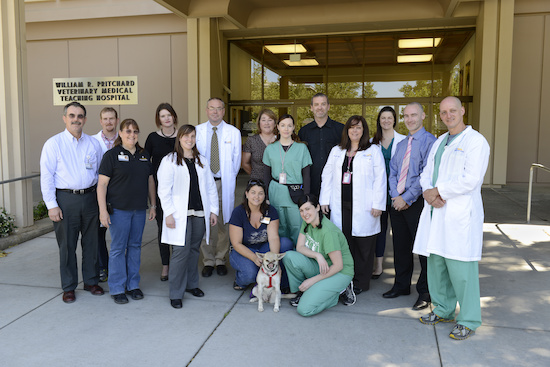
The clinicians, staff and caregivers that treated and cared for Kabang, the snoutless mutt from the Philippines credited with saving the lives of two young girls last year. Kabang has been treated and will be heading back to the Philippines in the near future. Kabang arrived at the UC Davis Veterinary Medical Teaching Hospital on October 11, 2012 after a long journey from her native Philippines. She presented with pre-existing health conditions that significantly delayed her dental and facial surgeries. As the treatments for those conditions were successfully completed in February 2013, she proceeded on to her dental and facial surgeries in March 2013. Kabang came through both of those surgeries successfully and is currently recovering under the watchful eye of the UC Davis VMTH faculty and staff. Photo by Don Preisler/UCDavis © 2013 UC Regents
The clinicians, staff and caregivers that treated and cared for Kabang, the snoutless mutt from the Philippines credited with saving the lives of two young girls last year. Kabang has been treated and will be heading back to the Philippines in the near future.
Kabang arrived at the UC Davis Veterinary Medical Teaching Hospital on October 11, 2012 after a long journey from her native Philippines. She presented with pre-existing health conditions that significantly delayed her dental and facial surgeries. As the treatments for those conditions were successfully completed in February 2013, she proceeded on to her dental and facial surgeries in March 2013. Kabang came through both of those surgeries successfully and is currently recovering under the watchful eye of the UC Davis VMTH faculty and staff.
Photo by Don Preisler/UCDavis
© 2013 UC Regents

DAVIS (CBS13) – Kabang, the Philippine dog that suffered a severely injured snout and upper-jaw while saving two girls from being hit by a motorcycle, has been released from the hospital.

The dog was brought to the veterinary medicine teaching hospital at UC Davis in October 2012 to be treated for the injury that left her with a gaping wound where her snout had been. But veterinarians found she had heartworm disease and a type of infectious cancer. A team of UC Davis veterinarians specializing in oncology; infectious diseases; dental, oral and soft-tissue surgery; internal medicine; and outpatient care was assembled to treat Kabang, according to the UC Davis News Service.

“We were able to treat all of the complications that arose with the best specialists available,” Verstraete said Professor Frank Verstraete, chief of the hospital’s dentistry and oral surgery service.

Finally, a video of Kabang’s return home.

G8 madness!

If it wasn’t so serious, it would be so funny!

I read a recent article posted by Rob Hopkins on the Transition Culture blogsite, a blog that I subscribe to.  Those who are unfamiliar with Rob, the Transition Culture site has his background, from which I quote this snippet:

Rob Hopkins, with a familiar Totnes building in the background.

Rob Hopkins brings humour, imagination and vision to the great challenges of our time, and argues that what is needed, above all else, at this time in history, is “engaged optimism”.  The rapidly-spreading Transition movement which he was pivotal in establishing, is an embodiment of that.  Nicholas Crane, presenter of BBC2’s recent ‘Town’ series, recently referred to Transition as “the biggest urban brainwave of the century”.

He is the co-founder of Transition Town Totnes and of the Transition Network. This grew out of many years experience in education, teaching permaculture and natural building, and setting up the first 2 year full-time permaculture course in the world, at Kinsale Further Education College in Ireland, as well as co-ordinating the first eco-village development in Ireland to be granted planning permission.

Anyway, back to the article.  It struck me as so absurd that I tried my hand at asking Rob for permission to republish.  Back, almost immediately, came his positive reply. Thank you, Rob.

Oh, and before going to Rob’s article, for those that, like me, are a bit rusty on the composition of the G8, here’s a Wikipedia extract:

The Group of Eight (G8) is a forum for the governments of the world’s eight wealthiest countries. The forum originated with a 1975 summit hosted by France that brought together representatives of six governments: France, West Germany, Italy, Japan, the United Kingdom, and the United States, thus leading to the name Group of Six or G6. The summit became known as the Group of Seven or G7 the following year with the addition of Canada. The G7, that is active even after the creation of the G8, is composed by 7 of 8 of the wealthiest countries on Earth (as net wealth and not GDP). In 1997, Russia was added to the group which then became known as the G8. The European Union is represented within the G8 but cannot host or chair summits.

Now without any further ado, here is that article.

oooOOOooo

12 Jun 2013

Why even the G8 prefer vibrant, diverse local economies really …

shop

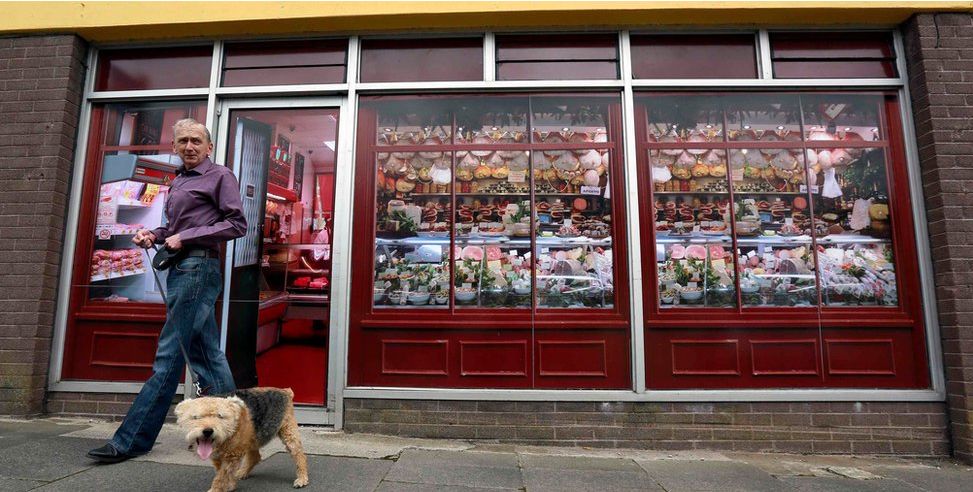
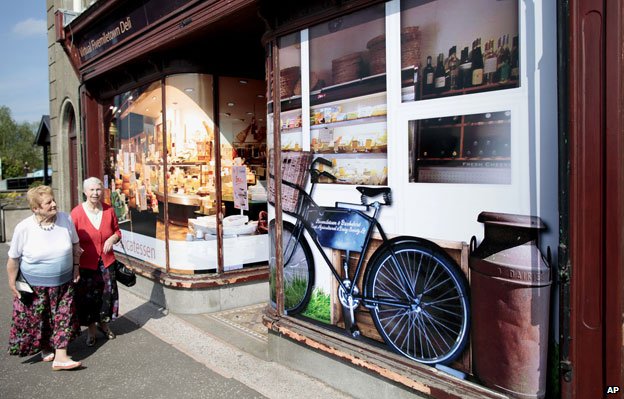
If there was one picture that captured the times we are living through it is this.  It appeared on the BBC website recently with the following caption:

Kevin McGuire walks his dog past a vacant shop in Belcoo, Northern Ireland.  The empty shop is one of a number that have had graphics placed on the windows to make them look like working shops ahead of the G8 summit which takes place nearby later this month.  

Let’s take that a bit more slowly.  Here is a shop, one of many that has gone out of business due, among other things, to the growth-fixated policies of the G8, situated in a place G8 ministers will be driven past en route to their summit.  Rather than their being able to see how things are actually unfolding in the real world, the division and misery being caused by their approach to the economy, the windows have been plastered with stickers that present it as a fully-stocked, thriving shop.  As singer/comic Mitch Benn put it on BBC Radio 4′s The Now Show on Friday,  ”the last thing you’d want would be for a bunch of people meeting to fix the economy to see how bad the economy’s got”.

The BBC reported the story, giving a bit more information about it:

County Fermanagh’s district council sanctioned the fake retail units as part of a £1m makeover before it hosts the G8 summit. The event takes place on 17 and 18 June at the Lough Erne golf resort near Enniskillen.  The chief executive of Fermanagh District Council has defended the optical illusion.

“It was aimed at undeveloped sites at the entrance to the town and then right throughout the county in terms of the other towns and villages, looking at those vacant properties and really just trying to make them look better and more aesthetically pleasing,” says Brendan Hegarty

Here’s the thing that fascinated me most though.  It’s the kind of shop they chose to portray it as.  They didn’t print up large stickers that would present the shop as being a Tesco Metro, a Sainsbury’s Local, an Aldi perhaps, or even branch of one of the banks that contributed significantly to our getting into this mess in the first place.  They didn’t make one huge sticker, one false façade, that showed a new shopping precinct, glittering with all the usual chain stores that dominate every such precinct.  Or a Travelodge perhaps.  Rather they set out deliberately and in considerable detail to portray the kind of vibrant, local, independent business that has either become extinct, or which survives in spite of, rather than because of, the policies of the G8.  Here’s another one…

_68047523_oldladies

The windows are hung with delicious-looking hams, the display features meats and a whole range of delicious local produce, beautifully arranged.  Although the cut-and-paste nature of the graphic design rather gives the game away (the same arrangements of hams appear two or three times), what they are trying to portray here is that most endangered of species, the local, independent butcher.

In the mid-1990s there were 22,000 butchers in the UK, by 2010 there were just 6,553.  The independent butcher is making something of a spirited fightback though, although certainly not aided, in any sense, by the G8.  The butcher that would have occupied that shop no longer exists, most likely because a supermarket opened nearby and completely shifted the balance of the Belcoo economy (any readers from Belcoo who might like to write in and tell us what led to this shop’s demise would be most welcome).

The other day I spoke to Nick Sherwood of REconomy Herefordshire, who has co-ordinated the Herefordshire Economic Evaluation (the second such piece of work, the Totnes one already being published, and Brixton’s coming soon).  Our conversation will be published here soon, but one of the things that really struck me was the following:

We estimate that the top five major supermarkets in Herefordshire account for between 71% – 83% of all household expenditure on ‘brought home’ food and drink, or up to £180m annually. In addition, around £30m per year is spent in the smaller ‘chain’ supermarkets.

Herefordshire-EB-cover-198x300Their conclusion is that the true ‘local spend’ figure, i.e through local, independent businesses in Herefordshire, could be around 16% of the total.  In terms of a national version of that figure, the best I can find is the figure from the Portas Review that states that 8,000 supermarkets now account for over 97% of all UK grocery sales.  Although clearly other smaller supermarkets account for some of the remaining sales, let’s assume, for argument’s sake, that nationally, 3% of what we spend on groceries goes out through local and independent businesses.

I would imagine that everyone seeks an economy that is able to provide jobs, economic activity, stronger and happier communities and community resilience, while also skilfully reducing its carbon emissions on the scale required.  The question of our times though, as far as I’m concerned, is whether that is best achieved by expanding the 97% of our economy currently dominated by huge supermarkets, the kinds of enterprise that the UK government and the G8 see as leading the push for growth, or protecting and enhancing the 3%?

It’s a vital question, because at the moment the push to eradicate the 3% altogether, or at least squeeze it a lot harder, continues apace.  Yet that 3% is better suited to meeting those core needs of ours.  As the recent report by Localise West Midlands on ‘community economic development’ states:

Our research has found strong evidence that local economies with higher levels of SMEs and local ownership perform better in terms of employment growth (especially disadvantaged and peripheral areas), the local multiplier effect, social and economic inclusion, income redistribution, health, civic engagement and well-being than places heavily reliant on inward investment where there are fewer, larger, remotely owned employers.

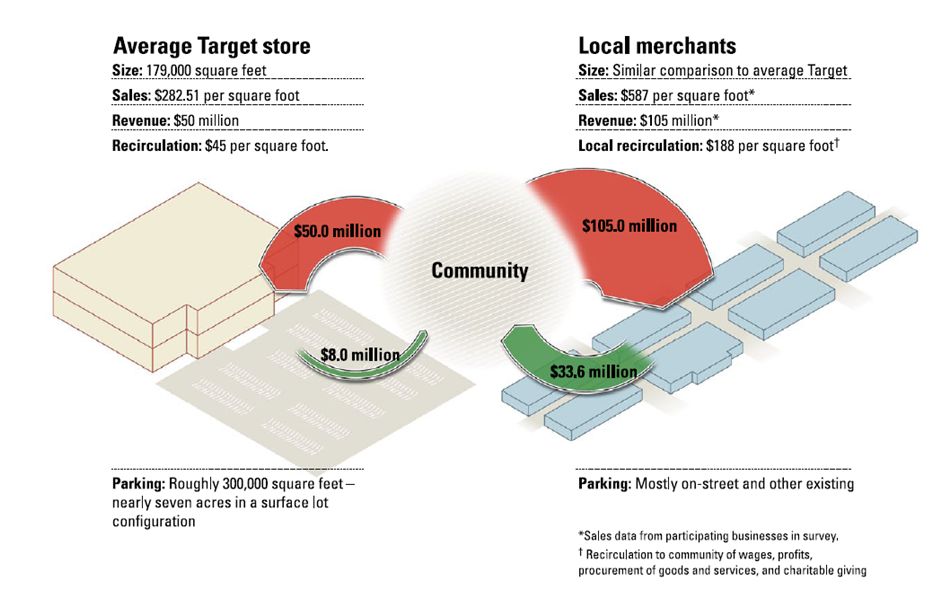
A study focusing on New Orleans compared 179,000 square feet of retail space that is home to 100 independent businesses to the same-sized space that is home to a single supermarket. The former generated $105 million in sales with $34 million staying in the local economy, while the latter generated $50 million in sales with just $8 million staying locally, and necessitated 300,000 square feet of parking space (see graphic below).

shops

Santander’s ‘Market of Hope’ which I wrote about here last year is a great example of how a city can be fed by looking at large retail spaces in such a way that they boost and support the local independent economy rather than undermine it. When Sir Terry Leahy, CEO of Tesco, was asked whether there was any alternative to supermarkets, replied:

“… queueing at one store than trudging down Watford High Street in the rain to another shop … is this what people actually want to go back to?”

But no, it’s not about “going back”, rather about going forward in a way that meets our needs rather than those of the City of London.  What we now know is that even G8 ministers would rather pass through High Streets populated with small, independent butchers, bakers, grocers, would rather see shop windows overflowing with delicious food,  trusting that the relationship they have built up with the shopkeeper over many years will mean that he/she stocks the best produce they can find.  It feels right.  It’s human scale.  It makes sense.  It’s an economy that is ours, it belongs to local people, to the local economy.  Even G8 ministers would now appear to prefer a shopping experience that actually involves interacting with other human beings rather than wandering anonymously around a superstore and then cashing yourself out at the end.

The core argument of The Power of Just Doing Stuff, published on Friday, is that if we really want to achieve our goals of jobs, economic activity, stronger and happier communities and community resilience, while also skilfully reducing our carbon emissions on the scale required, we’d be better off focusing on growing the 3% rather than the 97%.  It’s a pretty simple idea, and, to me at least, a blindingly obvious one, but that doesn’t mean it’s easy.

However, the experience is that this fightback has already begun.  The explosion of new bakeries, pop-up shops, community renewable energy projects, craft breweries, independent record shops, complementary currencies and communities acquiring their own assets is already happening around us, but it needs us to get behind it, to put our shoulders, our spending power, our sheer bloody will, to making it 10%, 30% 70%.  If we want a stable climate, reduced energy vulnerability, economic stability, and a healthy human culture, we really have no choice.  As Maria van der Hoeven of the IEA said recently at the launch of a World Energy Outlook Special Report, Redrawing the Energy-Climate Map, ”the path we are currently on is more likely to result in a temperature increase of between 3.6 °C and 5.3 °C”.

Fortunately, it’s a push that is life-enhancing, thrill-generating and in which we discover a resourcefulness, a kindness and a passion in ourselves that we may have forgotten was there.  I’ll leave you with a quote from the book, from Helen Cunningham of DE4 Food, a social enterprise food hub in Derbyshire that grew out of Transition Matlock.  The project grew from helping a local farmer with lambing and has grown into an innovative new business:

“Never in my life did I imagine that I’d be able to bring lambs into the world! It wasn’t a skill I ever expected to have. It was such a different thing from what we were doing in the rest of our lives, and I think from then we’ve all thought “OK, we can learn these new skills, we can learn how to lamb, we can learn how to grow vegetables and learn how to do Excel Profit and Loss sheets and whatever.” I think we all just really wanted to change the way we live, and change our own personal lives and to change things and live different lives ourselves as well as a different life in our community”.

You can pre-order your copy of The Power of Just Doing Stuff here.

oooOOOooo

As has been said before, and undoubtedly will be said many times more, it really is a very strange world we live in!

Common-sense from HRH The Prince of Wales

Reinforcing my long-time respect for Prince Charles.

HRH The Prince of Wales, more familiarly known as Prince Charles, is a man I have longed admired and respected.

Many years ago, I worked as a volunteer teacher/mentor with what was then known as The Prince’s Youth Business Trust (PYBT).  Later, it became incorporated into The Prince’s Trust.  The PYBT enjoyed passionate and active support from HRH, and with good cause.  Essentially, the PYBT offered socially-disadvantaged youngsters, who had very little chance of getting a job, the opportunity to be mentored on the skills of being an entrepreneur.  Many of those youngsters went on to get decent jobs and many others started their own businesses, some with considerable success.  Simply because thinking like an entrepreneur is impossible if you don’t have faith in your own abilities.  That self-confidence shows in so many walks of life, especially when one is going through a job interview!

The Prince has also long been known for his concerns over the way we treat our planet, going right back to the days when it was regarded rather quaint by the mainstream media.  But as Wikipedia reveals, “He has long championed organic farming and sought to raise world awareness of the dangers facing the natural environment, such as climate change. As an environmentalist, he has received numerous awards and recognition from environmental groups around the world.”

So it was lovely, but no great surprise, to see how well a recent speech was received on the subject of Regional Food Security given at Langenburg Castle in Baden-Wurttenberg, Germany.  The full text is available on The Prince of Wales website.  Let me give you a taste (whoops, pun unintended!) of what The Prince said,

Prinz Charles Langenburg

Ladies and Gentlemen, if I may say so, this is a very important conference. I am sure what you have heard so far about the problems we face and the obstacles to tackling them has given you a clear context in which to be able to consider what comes next this afternoon.

The aim here is to think through how we might create a much more local model of food production and distribution. But also, how that might fit with producing healthy food using far more sustainable methods and how we might do all of this without damaging business. Indeed, how this could improve business.

As you have heard, the urgency for this comes from the fact that there is not sufficient resilience in the system as it currently stands. It may appear that things are well. Big global corporations may appear to be prospering out of operating on a global monocultural scale but, as I hope you have seen, if you drill down into what is actually happening, things are not so healthy. Our present approach is rapidly mining resilience out of our food system and threatening to leave it ever more vulnerable to the various external shocks that are becoming more varied, extreme and frequent.

Some of the stories about food that have been making the news are simply disgraceful, if not downright madness.  Take this one: Meat scrap leftovers now being reprocessed into ice cream: The dismal future of food!

Or try this one: GMO feed turns pig stomachs to mush! Shocking photos reveal severe damage caused by GM soy and corn.

So see the relevance of The Prince’s speech as he continued:

The drive to make food cheaper for consumers and to earn companies bigger profits is sucking real value out of the food production system – value that is critical to its sustainability. I am talking here about obvious things like the vitality of the soil and local eco-systems, the quality and availability of fresh water and so on, but also about less obvious things, like local employment and people’s health. It is, as I fear you know only too well, a complex business.

The aggressive search for cheaper food has been described as a “drive to the bottom”, which I am afraid is taking the farmers with it. They are being driven into the ground by the prices they are forced to expect for their produce and this has led to some very worrying short cuts. The recent horsemeat scandals are surely just one example, revealing a disturbing situation where even the biggest retailers seem not to know where their supplies are coming from. And it has also led to a very destructive effect on farming. We are losing farmers fast. Young people do not want to go into such an unrewarding profession. In the U.K., I have been warning of this for some time and recently set up apprenticeship schemes to try to alleviate the problem; but the fact remains that at the moment the average age of British farmers is fifty-eight, and rising.

One more extract from the speech:

In the U.K., as elsewhere – but particularly I think in the U.S. – the consequences of this are ever more apparent in the deteriorating state of our public health. We all know that Type 2 Diabetes and other obesity-related conditions are rapidly on the increase. The public bill for dealing with these is already massive and I am told it could become completely unaffordable if we do not see a shift in emphasis. And, of course, it will be cities that carry the heaviest part of that burden. It is a peculiar trend.

Am I alone, ladies and gentlemen, in wondering how it is that those who are farming according to organic, or agro-ecological principles – in other words, sustainably, for the long-term, by operating in a way that reduces pollution and contamination of the natural environment to a minimum and maximizes the health of soil, biodiverse ecosystems and humanity – are then penalized? They find that their produce is considered too expensive and too “niche market” to be available to everyone. How is it, then, that systems of farming which do precisely the opposite – with increasingly dire and damaging effects on both the terrestrial and marine environments, not to mention long-term human health – are able to sell their products in mass markets at prices that in no way reflect the immense and damaging cost to the environment and human health? A cost that then has to be paid for over and over again elsewhere – chiefly, in all probability, by our unfortunate children and grandchildren, whose welfare I happen to care about. Surely this is a truly perverse situation which, you would have thought, could be turned on its head to make genuinely sustainably-produced food accessible to everyone, and the polluter to pay the real costs for the side effects of industrialized food? It is to be wondered at how this state of affairs persists – and yet to suggest standing it on its head and transforming the situation is to invite the predictable chorus of vitriolic accusations that you are anti-science, anti-progress, out of touch with commercial pressures and not living in the “real world.”

The full speech may be read here, and please do!

Well done, Sir!  As someone once said, “We are what we eat!

I cry for the wolves.

This is so wrong.

Like thousands of others I have been supporting the efforts to ensure that the US Government did not proceed with the proposal to remove wolves from endangered species protection.

Wolves are the animals that enabled early man to ‘progress’ from hunter-gatherer to the life of farming, and thence to our modern world.  As I write elsewhere on Learning from Dogs,

There is no hard evidence about when dogs and man came together but dogs were certainly around when man developed speech and set out from Africa, about 50,000 years ago.

So it utterly breaks my heart to republish a recent post on The Sand County, Jeremy Nathan Marks wonderful and evocative blog.  Here it is, republished with Jeremy’s kind permission.

oooOOOooo

I used to believe

As some of you may have heard, late last week the Obama Administration officially delisted gray wolves from endangered species protection. This means that 40 years of wolf recovery efforts have come to an end. Wolves only occupy a tiny fraction of their former habitat and with anti-wolf governments occupying the state houses in the few places that still have wolf populations, states like Montana, Wyoming, Idaho and Wisconsin, it is hard to imagine that wolves have a bright future in the lower 48 states.

I am deeply, profoundly saddened by this decision. I have learned over time how wolves -like so many other species- just don’t register on the list of national concerns and priorities. A great many people oppose the delisting, in fact one gets the impression that the effort to remove these protections has consistently been guided by political pressures and a political agenda and not by a true commitment to a sustainable and enduring wolf recovery. I know that I am hardly alone in registering my disappointment and voice of protest.

I cannot let this sad milestone pass without acknowledging it here on this blog. If you do not like wolves -if you feel hatred or resentment towards them or are pleased at what has recently transpired, I respectfully request that you refrain from sharing your feelings here. I seldom offer any “directives” like this, but if you are a reader of this blog then you know how strongly I feel about this issue. I am sharing these thoughts because I want to not only draw attention to what has happened, but also because I feel the need to mourn it. I tremble at the thought of a United States -or a North America- without wolves. Defenders of the administration and the Department of Interior’s position will say that the United States Government is committed to protecting wolves and ensuring their future but I am afraid I see things quite differently. This is not a partisan political issue: Democratic and Republican administrations alike are behind this stance towards wolves.

I would like to share a poem which I feel is very incomplete and does not begin to adequately draw upon the well of feelings, concerns and thoughts I have on this subject. But I would be remiss I think if I did not mark what has just happened.

I used to believe

I used to believe that one day
I might live carefully, cooperatively
beside the wolves

I would go to them but respect their
space; wait for their return and tend
my garden with local mind, open my windows

When they moved off I would wait
and make a space; I would lock my guns
in bolted cabinets to honor and not to intrude

I used to believe that there was a chance
of this because there were others who saw
in wolves the same uncertainties and histories

And we, a new community, would redraw
the map, eradicate “the frontier” and perhaps
expunge that word altogether from our plans

It is ironic really how a word, a concept,
one invisible line can have more tendrils
and seeds than a weed, more pups than a pack.

Jeremy Nathan Marks

oooOOOooo

The Center for Biological Diversity has been incredibly active in fighting for the continued protection of the wolf. The Press Release about the loss of protection is here.  Do read it and do everything you can to help. PLEASE!

Let me share some of my special feelings about wolves.

Back in September, 2009, I wrote about An amazing true story of a relationship between a wild wolf and a man, from which this picture is taken.

Luna, the wild wolf, sleeping with Tim and Tim's dog, taken in 2006.
Luna, the wild wolf, with Tim and Tim’s dog; taken in 2006.

Then in February this year, I wrote about Oregon and the wolf.  The following picture was in that Post.

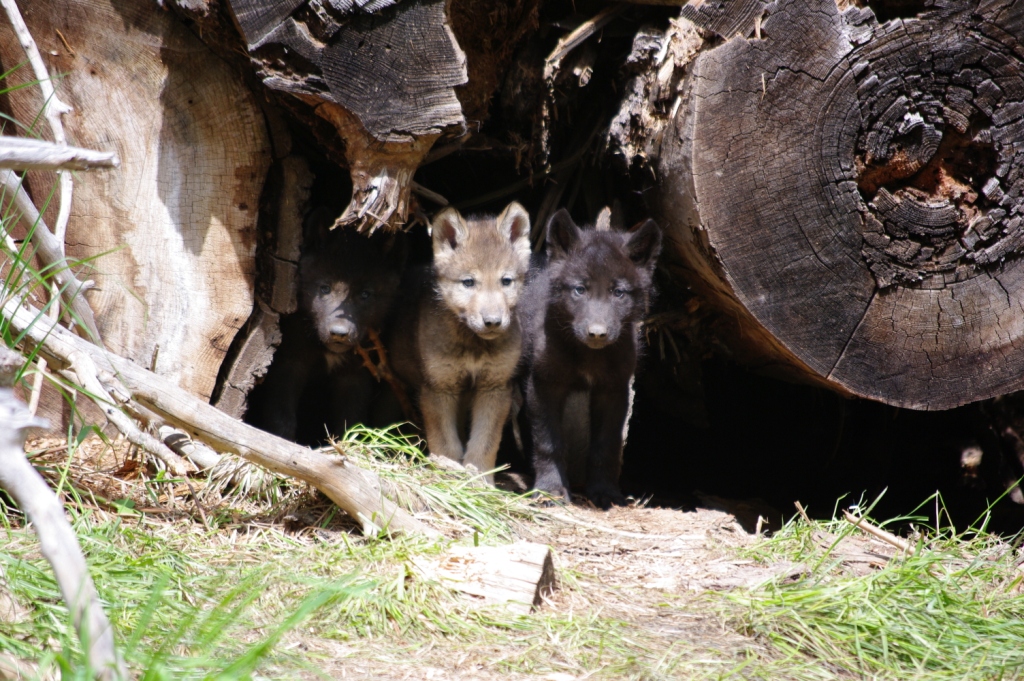
These wolf pups born to the Wenaha Pack in 2012 helped get recovery back on track. But their future remains tenuous (photo courtesy ODFW)

Please now listen to this:

So you can see that I have written frequently about wolves; indeed just a few days ago did so and included this photograph.

Wolf greets man.
Wolf greets man.

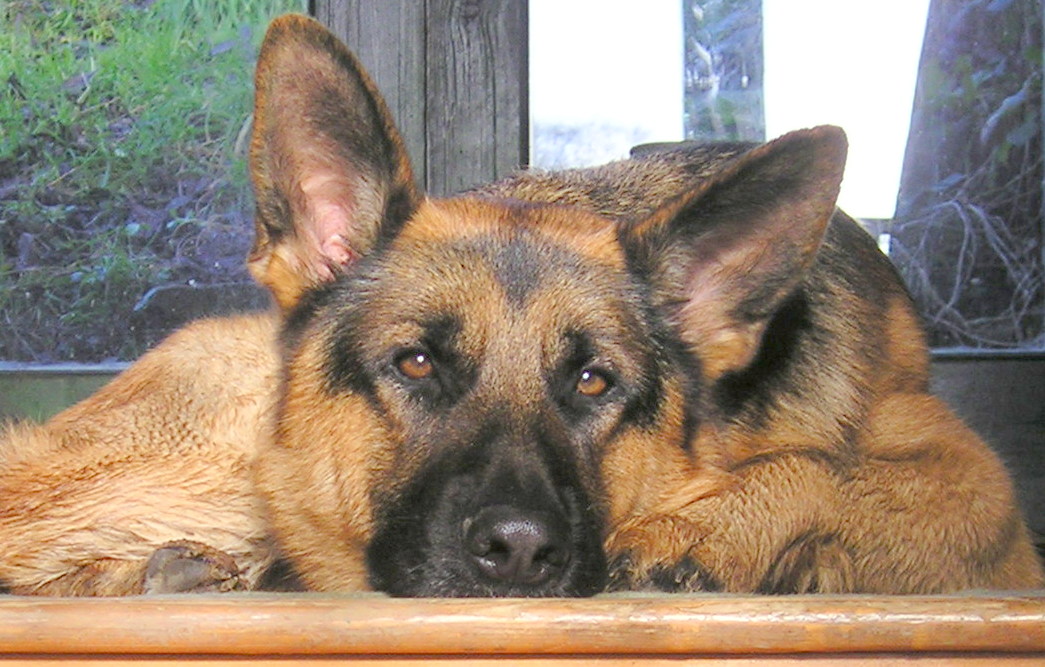
Now just look at those eyes of the Grey Wolf above and compare them to the eyes of the German Shepherd dog below and tell me that wolves aren’t as close to man as dogs.

OLYMPUS DIGITAL CAMERA

Finally, feel free to share this post as far and wide as you can.  Learning from Dogs is published under a Creative Commons License. This link covers how to share my material.

Please do something to help these ancient animals who, more than any other creature, helped put mankind ‘on the map’.

Thank you.

Very, very long odds!

Looks like being a Dan Gomez weekend.

Dan sent me an email with a link to a most astounding video.  But before we get to that, just take a look at these images.  Here are the first three from the set of eight.

Eight breathtaking images of baby stars

MNN1

1. Beautiful newborns

In a universe of fantastic images, a newborn star is a mystical masterpiece. Cradled within the dusty arms of a nebula, a baby star seems to blink its way to a new life. The lifespan of a star is a series of sequences. A star may spend most of its life in a “main sequence phase” where nuclear fusion of hydrogen into helium is happening in its core. But before this happens, it lives as a protostar, or baby star.

Thanks to NASA’s advanced infrared space telescopes such as Hubble and Spitzer, we are able to view these star births as never before. Pictured here are newborn stars peeking out “from beneath their natal blanket of dust” in the Rho Ophiuchi dark cloud as seen by the Spitzer Space Telescope. (Text: Katherine Butler)

MNN2

2. Young stars in Serpens

Here the Spitzer Space Telescope reveals the Serpens South star cluster, in which 50 or so young stars exist. They are seen as the “green, yellow, and orange-tinted specks sitting atop the black dust lane.” A supernova or galaxy collision can cause a star to form when huge clouds of hydrogen and helium collapse under mutual gravity. As the cloud collapses, it heats up and starts to spin. Since protostars are covered in dust, they can be seen only through infrared telescopes like Hubble and Spitzer. As Universe Today writes, “After about 100,000 years or so, the protostar stops growing and the disk of material surrounding it is destroyed by radiation.” Then this star, now called a T Tauri or pre-main sequence star, is visible from Earth.

MNN3

3. Bubbly little star

We are used to images of babies blowing bubbles, and it looks like the infants of the cosmos do the same. This image, taken by the Spitzer Space Telescope, shows the HH 46/47 baby star blowing bubbles into space via powerful jets of gas. Located about 1,140 light-years from Earth, HH 46/47 is the bright white star at the middle of the image. Two bubbles reach out in opposite directions and are formed when the jets collide with the dust and gas surrounding the star. As Universe Today reports, “Astronomers think that young stars accumulate material by gravitationally pulling in gas and dust. This process ends when the star gets large enough to create these jets. Any further material is just blown away into space.”

Go and view the remaining five stunning images here.

Now to what was sent by Dan.

Check out this mind-bending video that talks about the “Hubble Ultra Deep Field” image captured by NASA astronomers nearly a decade ago — a photograph that some call “the most important image ever taken.”

It all started back in 1996 when a group of astronomers pointed the Hubble Space Telescope at an empty patch in the sky close to the Big Dipper in hopes of seeing something, anything. At the time, it was considered to be a risky move, given that demand for use of the telescope was so high. What if the experiment yielded no results? What if nothing but an empty image was the final result?

After ten full days of exposing the telescope’s CCD camera sensor to this seemingly vacuous patch of sky, a breathtaking image was produced. Over three thousand galaxies appeared in one image — some as dots, others as spirals. It was a visual reminder of just how big our universe really is. The photo is called the “Hubble Deep Field“:

A Mind Bending Look at the Hubble Ultra Deep Field Photo of the Universe hdf

In 2004, astronomers pointed Hubble near constellation Orion and opened the shutter for a whopping 11 days. Using sensitive detectors and specialized filters, the telescope was able to capture an image with over 10,000 galaxies. This image became known as the “Hubble Ultra Deep Field.”

A Mind Bending Look at the Hubble Ultra Deep Field Photo of the Universe hudf

Scientists later used redshift calculations of the galaxies to turn the photograph into a “fly-thru” view of the photo:

It didn’t end there. Last year, NASA scientists created the Hubble Extreme Deep Field, which has an equivalent exposure time to 23 days and features. It’s the “deepest image of the sky ever obtained” that reveals “the faintest and most distant galaxies ever seen”:

A Mind Bending Look at the Hubble Ultra Deep Field Photo of the Universe deepest

And just think: scientists created these photos by pointing their mega-camera at a tiny speck of the night sky that appears to be completely devoid of visible stars!

oooOOOooo

… a tiny speck of the night sky that appears to be completely devoid of visible stars!

Dan said in his email, “Are we really here?  What are the chances?”

You really have to wonder!  Incredibly long odds.  Both to us being here and to us being the only conscious, intelligent species in the universe.

From small acorns do great oaks grow.

Reflections on the launch of George Monbiot’s new book Feral.

In my recent post, Dealing with Madness, where I referred to the launch of this new book there were comments from Jules that included him saying:

George is appearing at the Hay Festival to sell his book and do a talk this Saturday and it is only a few miles away so may be I will pop in and buy the book.

all the best

Jules

Jules, who has his own blog Bollocks2012, did go across to the Hay Festival and most generously agreed to write up his visit as a guest post.

So I am delighted to offer you Jules’ report today.

oooOOOooo

George at Hay

by Jules Bywater-Lees, 1st June, 2013

The small Welsh border town of Hay-on-Wye in Powys is just a few miles from where I live. It went from a little backwater with a failing rural economy to become, in the words of Bill Clinton, ‘the Woodstock of the mind’.  All through the vision of eccentrics!

Hay-on-Wye
Hay-on-Wye

The town of Hay-on-Wye is pretty.  It is set in the most beautiful Welsh countryside and even has its own tumble-down castle.  However, back in the 70’s, like so many other small market centres, the town was in decline.  That was until an eccentric bibliophile moved into the castle. The name of that eccentric was Richard Booth.

Richard Booth established a second-hand bookshop in town and, as a publicity stunt, on 1st April 1977 proclaimed himself King of Hay and Head of this new Independent Kingdom!  Hay-on-Wye subsequently became a magnet for the second-hand book lover and trader, and now every other shop is a bookshop giving the town a healthy economy serving the many visitors.

Books, books and more books!

The Hay Literary Festival was devised by Norman and Peter Florence in 1988 and had become sufficiently established internationally for the highlight of Bill Clinton being a speaking guest in 2001. It is rather a corporate festival now attracting big names but the town has developed fringe events, that are both cheaper and more fun.

The reason this back story is relevant is that Hay-on-Wye has always been a gateway town between the urban English and rural Welsh. It is only a few hours drive from London and the nearest ‘wilderness’ for day trippers and holiday makers. A few miles further west and the uplands, or mountains as we call them (few are higher than 1000 feet), are considered by most people to be wild.

George Monbiot lives another 60 miles away to the West on the coast in what is considered deepest Wales where the hills have a barren beauty and the locals speak Britain’s ancient first language. But it is not all that it seems; the moors and hilltops are not natural they are a product of over-grazing. They are the degraded shells of a natural ecosystem. A shadowland; a ghostly memory of a former landscape.

View from Hay Bluff
View from Hay Bluff, just a few miles from Hay-on-Wye, and a powerful example of a bald hill.

Back to this year’s Festival. I coughed up the £8 ticket price and went with friends to have a day of culture. Those friends who came to hear George Monbiot speak were sceptical; for them the hills are beautiful and it is the denuded ‘wildness’ and prancing Spring lambs that gives the landscape so much value.

George makes frequent appearances on television and is very much a leading commentator on the environment and climate change, and his Guardian articles, see postscript, cover his views well so I wasn’t expecting any surprises. If anything I felt sceptical! You see while in principle I agreed with Monbiot’s message of rewilding and supportive of his views on the wide range of subjects he covers, the concept of rewilding appeared to be woolly and vague and lacking the practicalities of how this vision would be achieved. I even prepared a question for the session after his presentation.

Britain is a little country and our national parks are not the same as those elsewhere in the world, a better description would be regulated areas of private ownership. There are a few parks in Wales notable Snowdonia, which amounts to 2,200 square Kilometres (850 square miles), Brecon Beacons, 1,300 Km2 (502 SqM) and larger ones in Scotland such as the Cairngorms of 4,500 Km2 (1,737 SqM). But all of these are tiny compared to Yellowstone National Park with its 9,000 km2 (3,475 SqM and about 100 wolves!). Is it possible to have viable populations of wild animals in such a small area?

My concern is that Britain actually does have a wild landscape of both international importance and scale, with mega fauna, diversity and rare ecosystems that put it on par with the rainforest. It is truly huge with a conservative estimate of 50 to 100 thousand Km2 in area (19,305 to 38,610 square miles) but it is hidden: It is the 31,000 Km (19,260 miles) of coastline and the waters that extend from it. Surely we should be concentrating on its protection rather than allowing the hill tops to grow pretty common native woodland that could support a few hundred wolves, Lynx and beavers at best?

George live, as it were, was a lot more engaging than his appearance on telly and his spoken words a lot more passionate than his written words. I was surprised, and interested.  Like all good story tellers he started off with a mystery. Why do British native trees appear to thrive when they are hacked about into hedges, why do blackthorn trees have thorns so tough and sharp they spike industrial leather gloves and why does the yew and holly have roots so extensive they could hold up a tree twice as big? The answer: Elephants!

Much of what he spoke about is found in his last three Guardian articles so I will spare you the detail but what struck me was his passion. Initially the cynic within wondered if George was just another celebrity seeking a cause.  But such thoughts were dispelled as soon as George started to speak. What was communicated resonated strongly with this idealistic former self who was sufficiently passionate about nature enough to have studied zoology and yearned a human desire for wilderness and, indeed, danger but whose life has otherwise been engaged in more civilised necessities.

Such was the passion expressed by Mr. Monbiot that even I could overlook the practicalities and details; they can be sorted out when they need to be. My friends were impressed and even they were able to see that letting the hills go wild or a least a few of them would enhance their appreciation of our countryside.

But I didn’t buy a signed copy of the book! At £20 for the hardback version I thought it best to order one from my local library or at least wait for the paperback edition on Amazon.

Postscript

Those Guardian articles mentioned are:

My manifesto for rewilding the world, Guardian Newspaper, 27th May.

Until modern humans arrived, every continent except Antarctica possessed a megafauna. In the Americas, alongside mastodons, mammoths, four-tusked and spiral-tusked elephants, there was a beaver the size of a black bear: eight feet from nose to tail. There were giant bison weighing two tonnes, which carried horns seven feet across.

Why Britain’s barren uplands have farming subsidies to blame, Guardian Newspaper, 22nd May

Even before you start reading the devastating State of Nature report, published today, you get an inkling of where the problem lies. It’s illustrated in the opening pages with two dramatic photographs of upland Britain (p6). They are supposed to represent the natural glories we’re losing. In neither of them (with the exception of some distant specks of scrub and leylandii in the second) is there a tree to be seen. The many square miles they cover contain nothing but grass and dead bracken. They could scarcely provide a better illustration of our uncanny ability to miss the big picture.

It’s time we challenged agricultural hegemony, Guardian Newspaper, 6th June

The dam is beginning to crack, faster than I would have believed possible. Britain, one of the world’s most zoophobic nations, is at last considering the return of some of its extinct and charismatic mammal species.

While wolves, lynx, bears, bison, moose, boar and beavers have been spreading across the continent for decades, into countries as developed and populous as ours, and while they have been widely welcomed in those places, here we have responded to this prospect with unjustified horror.

Why the lynx effect would send Scotland wild, Guardian Newspaper, 2nd June

As Edinburgh Zoo’s panda freakshow continues to captivate the witless and the infantile, a real Scottish animal has been allowed to die. Under the noses of Scottish Natural Heritage, which likes to be known as the nation’s leading conservation body, the Scottish wildcat has all but been extinguished from the Highlands. The importance of this news may be deemed worthy of a mere footnote on the schedule of important issues with which Scotland is grappling but it ought to rank much higher. For the wildcat’s demise seems to be part of the neutering and emasculating of our wildest places. That which was previously held to be a quintessential part of what Scotland was originally meant to look like and smell like and sound like is now, it seems, unimportant.

Britain’s paradise has been lost – but there’s still hope for our wildlife, Guardian Newspaper, 24th May

I never imagined being 52. As I grew up catching lizards and newts, rummaging through hedges to find birds’ nests, or prodding flattened hedgehogs with my scuffed Clarks lace-ups, the world was ripe with natural riches. Every scrap of wasteland revealed yet more gems: tadpoles, fox cubs and a confetti of butterflies. And when at the weekends the family Ford Anglia trundled off to the countryside, I strode in shorts into a wildlife nirvana, a utopia, and I explored what I imagined would be a never-ending world of beautiful and exotic creatures.

oooOOOooo

Finally, back to me and all I want to add is that the blogsite for more information on the book Feral is here.

So how to close?  Well having given this post the title of a well-known saying, let me close with one perhaps less familiar but, boy oh boy, so relevant.

“When the oak is felled the whole forest echoes with it fall, but a hundred acorns

are sown in silence by an unnoticed breeze.”

Thomas Carlyle