Reason I state that is, as of yesterday morning, some 19,070,066 viewings of the following video had taken place.
But so what!
That number shows that despite the advertising insertions, despite the video promoting a commercial concern at the close, there are plenty of us who want to be reminded of the power of words.
Whatever words we utter should be chosen with care
for people will hear them and be influenced by them
for good or ill.
Buddha.
Footnote:
Jean and I were pottering around yesterday afternoon getting everything ready for Ranger’s arrival planned for Tuesday. In the back of my mind was some self-criticism for just sticking today’s post up in front of you, in the sense that it was just too easy. Not that the message isn’t powerful but does it relate to the essence of this blog – exploring what we can learn from dogs?
Then it struck me as blindingly obvious! Of all the things that dogs offer us humans, the one key aspect of their integrity is their unconditional love. The way that dogs love us acknowledges our existence at a ‘being-to-being’ level.
That’s the power of that short video. That the passing lady stopped and acknowledged the existence of the blind beggar-man.
Last week, I wrote about Hazel. The week before Jean wrote about Casey. This week it’s back to Jean writing about the one little dog we have here at home: Sweeny.
ooOOoo
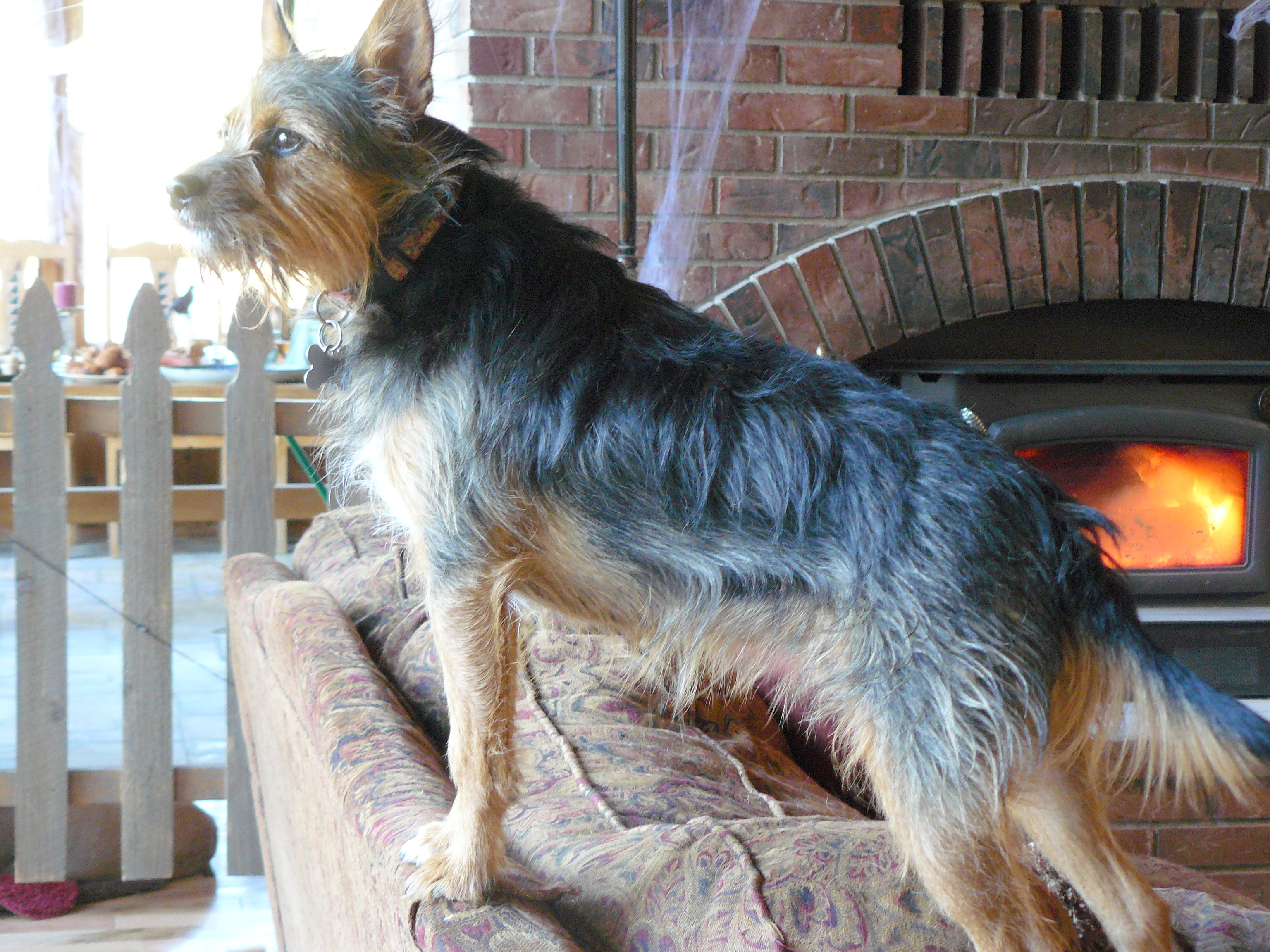
Sweeny
Sweeny – taken at the end of October, 2013, here in Oregon.
On that day we lost Poppy back in February, 2011, when we were still living in Payson, Arizona, it was as though she had been vaporised! Dear, sweet little Poppy. A ten-pound Poodle mix I had rescued in Mexico. She had been living in and around a Mexican construction site and when I rescued her she was very scrawny and without hair. But Poppy, as I named her, soon blossomed into a little, blonde, beauty and I grew to love her very much. Prior to Poppy, I had always liked the bigger dog but Poppy taught me the pleasures of a ‘lap’ dog that also happily slept under the covers at night with Paul and me.
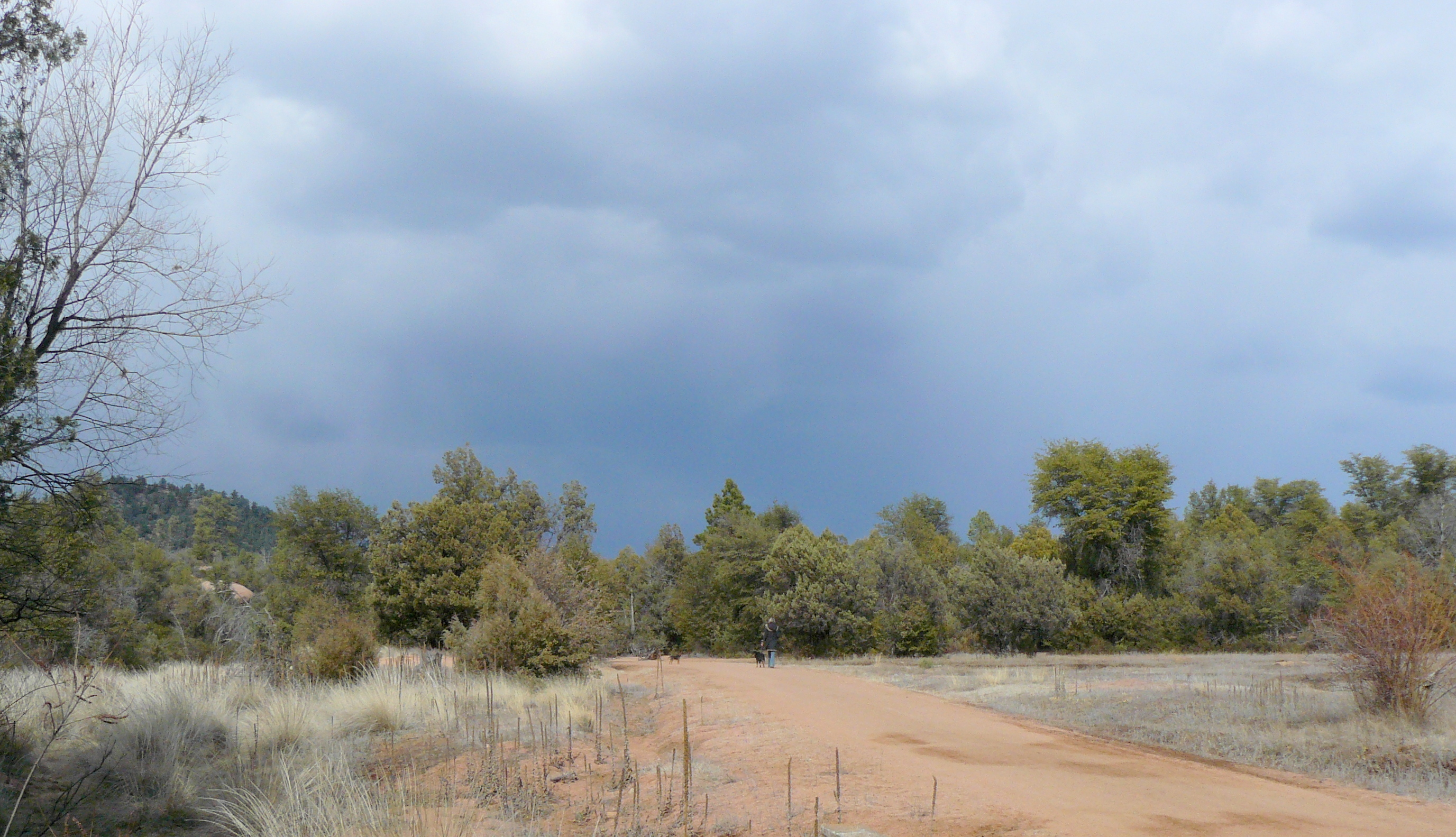
The Granite Dells, near Payson, AZ. Picture taken February, 2012.
Most afternoons in Payson, we took some of the dogs for a walk along a trail hike of about 2 miles. The dogs were allowed to be off-leash and loved it. Poppy always came and stayed with me, never leaving the trail as did the other, bigger dogs. That February, it was a chilly Winter’s day (Payson and area were at 5,000 feet above sea-level) and we were all dropping down into a dry wash when I glanced behind to check that Poppy was handling the slope. To my total horror, she wasn’t in sight. Indeed, Poppy was never seen again.
Despite days spent scouring the terrain, notices in Payson shops, radio announcements on the local radio station; it all came to nought. Poppy was gone! Locals that we spoke with and who knew the area of desert where the trails were, the Granite Dells, were all of the opinion that Poppy had been stalked by a coyote that would most likely have grabbed her in an instant. Such happenings had been known before.
I was inconsolable with guilt. I had let Poppy down by not giving her enough attention and it lay heavily upon me. For weeks and weeks I moped, missed her snuggles and that cute, little body crawling into the bed with me. One day, I broached the idea with Paul of adopting a small dog from the local Humane Society. Naturally, Paul agreed in an instant and in next to no time we had jumped in the car and were heading to the Society.
I wanted an older dog but the two small dogs that the Society had were really only suited for adoption into a one-dog household. The Society did, however, have two puppies from a mother that had been taken in by them when that dog was heavily pregnant. The pups had been born and raised at the shelter.
It was love at first sight when they handed me the puppy that was destined to become Sweeny. Sweeny Todd to give him his full name was a two-pound bundle of fluff.
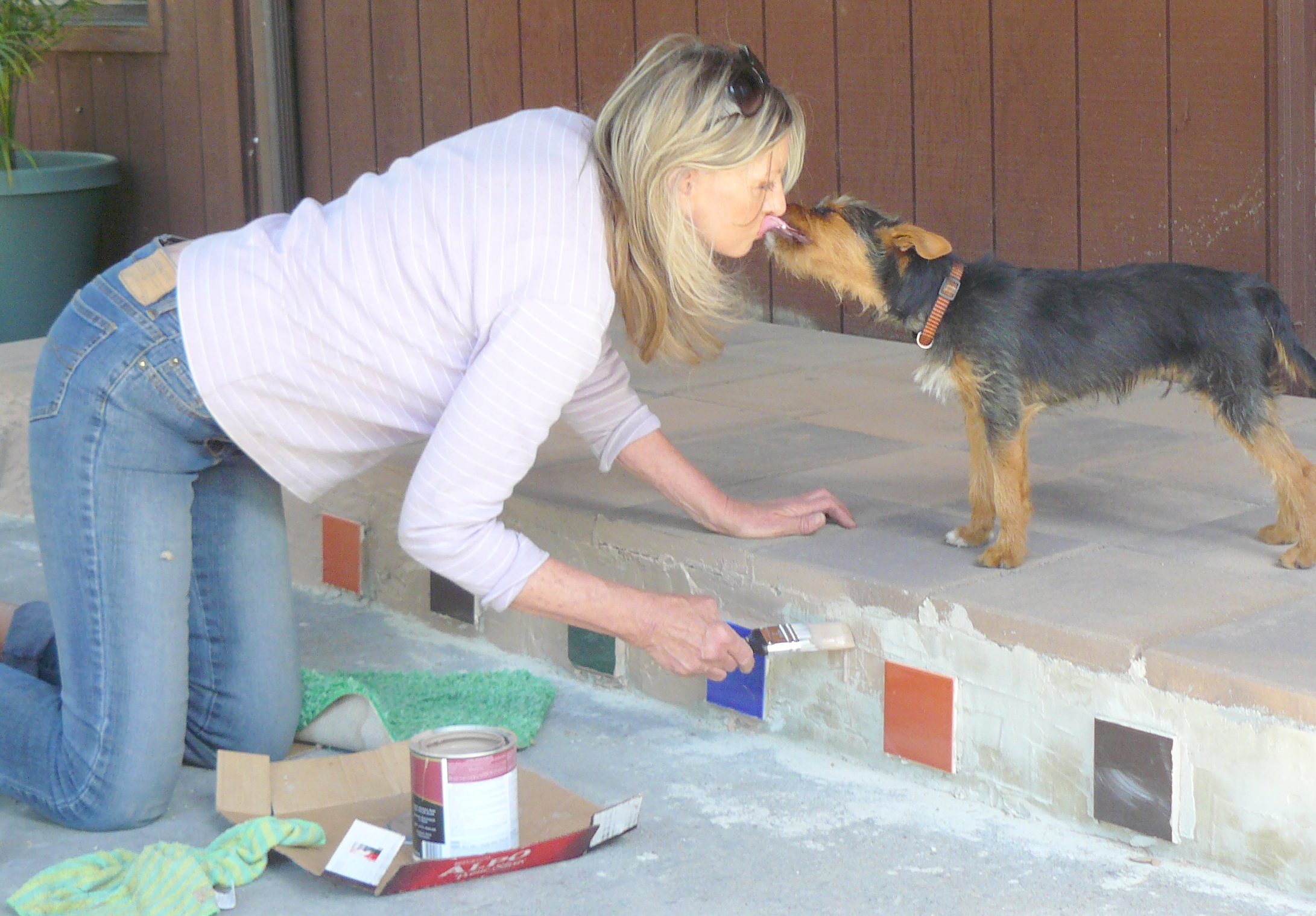
Sweeny loving Jeannie on the door-step of our Payson house; May, 2011.
Today, Sweeny is a twenty-pound terrier mix. A very ‘sassy’ little dog that is as much loved by his doggie brothers and sisters. Sweeny, too, sleeps on the bed, laying alongside me and the edge of the bed so that he isn’t between Paul and me. Sweeny has developed the habit of waking me in the morning by laying, full-bodied, over my face; to the point of me not being able to breathe. Guess I shouldn’t have called him Sweeny Todd! 😉
No dog will ever take the place of Poppy or fully assuage me of my guilt that I still feel to some extent. But ‘The Sween’ has helped beyond measure.
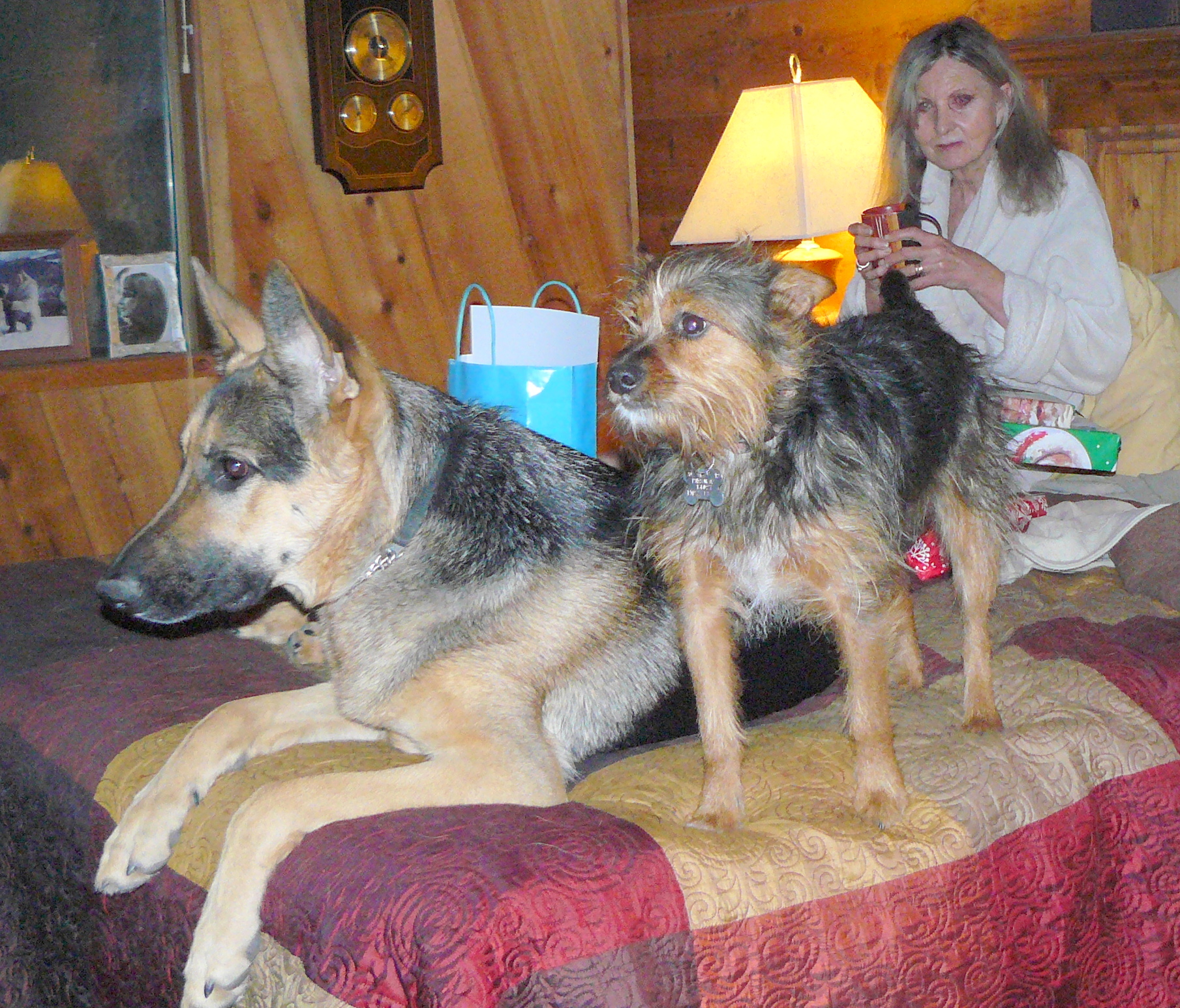
Cleo and Sweeny, 2013. Our first Christmas Day in our home here in Oregon.
After the run of eye-wateringly beautiful pictures of dogs and small children, the third and final set being a week ago, I was gently panicking as to how to follow that up. Then dear friend, Bob Derham, came to the rescue, the first seven of which are offered today.
A number of essays and items from a variety of sources have passed my screen in recent times that ….. well, you complete the sentence! Let me illustrate; in no particular order.
I have long been a follower of the writings of George Monbiot. Those who haven’t come across Mr. Monbiot before can avail themselves of his background and dip into his articles, many of which underscore my proposition that we really are a peculiar race. For example, just three days ago George Monbiot published an article under the title of The Benefits Claimants the Government Loves. It highlights one mad aspect of UK Policy.
Corrupt, irrational, destructive, counter-productive: this scarcely begins to describe our farming policy.
By George Monbiot, published in the Guardian 4th March 2014
Just as mad cow disease exposed us to horrors – feeding cattle on the carcasses of infected cattle – previously hidden in plain sight, so the recent floods have lifted the lid on the equally irrational treatment of the land. Just as BSE exposed dangerous levels of collusion between government and industry, so the floods have begun to expose similar cases of complicity and corruption. But we’ve heard so far just a fraction of the story.
You really do need to read the article in full to get your arms around the terrible state of affairs of the UK benefits scandal. But try this:
As a result of these multiple failures by the government, even Farmers’ Weekly warns that “British soils are reaching crisis point” (16). Last week a farmer sent me photos of his neighbours’ fields, where “the soil is so eroded it is like a rockery. I have the adjoining field … my soil is now at least 20 cm deeper than his.” In the catchment of the River Tamar in Devon, one study suggests, soil is being lost at the rate of five tonnes per hectare per year (17).
I could go on. I could describe the complete absence of enforceable regulations on the phosphates farmers spread on their fields, which cause eutrophication (blooms of algae which end up suffocating much of the freshwater ecosystem) when they run into the rivers. I could discuss the poorly-regulated use of metaldehyde, a pesticide that is impossible to remove from drinking water (18). I could expand on the way in which governments all over Europe have – while imposing a temporary ban for flowering crops – permitted the use of neonicotinoid insecticides for all other purposes, without any idea of what their impact might be on animals in the soil and the rivers into which they wash. The research so far suggests it is devastating, but they were licensed before any such investigation was conducted (19).
There is just one set of rules which are effective and widely deployed: those which enforce the destruction of the natural world. Buried in the cross-compliance regulations is a measure called GAEC 12 (20). This insists that, to receive their money, farmers must prevent “unwanted vegetation” from growing on their land. (The rest of us call it wildlife habitat). Even if their land is producing nothing, they must cut, graze or spray it with herbicides to get their money. Unlike soil erosion, compaction and pollution, breaches of this rule are easy to detect and enforce: if the inspectors see trees returning to the land, the subsidy can be cut off altogether.
Perhaps a clue to the extreme unfairness of who is in receipt of UK benefits can be explained by the fact expressed by George Monbiot above, “The biggest 174 landowners in England take £120m between them.”
With that in mind, let’s move on. Move on to a recent essay from Patrice Ayme: WAR MAKES HISTORY! To say it makes disturbing reading is, trust me, an understatement. But in the context of the UK’s rich landowners, as George Monbiot explained above, try this closing extract from Patrice’s essay:
We are a deeply equalitarian species. Out of equality rises our superior cultural performance. Plutocracy, the rule of the Dark Side, denies giving, love, and the equality which make us possible. Thus plutocracy is a denial of our species. Only an anger great enough to destroy it, will save us, and the biosphere. And there is hope: greed is neither as natural, nor as strong as anger.
It’s time to get angry against dictator Putin. Angry now is better than very sorry tomorrow.
War makes history. Of this we must think, if we want to make history better.
Patrice Aymé
Frankly, my own knowledge of these ‘dark forces’, of the influence of money and power, is practically zero. But the more that one looks at the madness of so many aspects of mankind’s existence, the more one thinks the truth, as Patrice writes it, is the real truth. Indeed, here’s how Patrice opens his essay:
WAR MAKES HISTORY
HERE WE GO AGAIN
The earlier unjustifiable, unprovoked fascism, greedy plutocracy, imperial overstretch, murderous paranoia and other aspects of the Dark Side get smashed, the better.
Such is the most basic lesson of the 1930s.
For the millions of us that live relatively comfortable lives, it’s easy to read this stuff, nod sagely, and wonder if the heating needs to be left on this coming night. But, pardon the pun, wake-up calls as to the approaching nightmares (sorry!) are not hard to find.
Try this from an interview with Elizabeth Kolbert, as recently published on Grist:
In “The Sixth Extinction,” Elizabeth Kolbert reports from the frontlines of a dying world
The New Yorker writer and acclaimed author Elizabeth Kolbert has a penchant for depressing topics. Her 2006 book, Field Notes from a Catastrophe, helped push climate change into the mainstream (with bonus points for not mincing words in the title).
Now that climate change is safely keeping most of us up at night, Kolbert turned her pen to another big bummer: the sixth extinction. We’re currently losing species at a rate of 1,000 to 10,000 times higher than unassisted nature wiping out the occasional newt. While humans weren’t responsible for the last five mass extinctions, our fingerprints are all over this one. Yep: We collectively have the force of an asteroid when it comes to erasing species (high five, guys!) and for the most part, our response has been classic Urkel.
That interview concludes:
Q. You also write about some efforts to save species. Could you share some of those?
A. I happened to go to the San Diego Zoo, where they have a very impressive conservation program. I was there to see something called the “frozen zoo.” It’s just a bunch of vats of liquid nitrogen with cell lines from, in many cases, highly endangered animals and, in one case, an animal that doesn’t exist anymore, a Hawaiian bird. The idea is pretty much what it sounds like: You have these cell lines, you’re going to keep them alive forever, and eventually people are going to figure out how to resurrect some of these species. Or maybe if you don’t want to go quite that sci-fi, we’ll take the cell lines, we’ll do a DNA analysis, we’ll try to figure out why this population is having trouble.
They took me to see this bird named Kinohi, one of the last Hawaiian crows. He’s “reluctant to part with his genetic material,” let’s put it that way. He had been taken from this breeding facility on Maui to San Diego, and he is ministered to by a PhD physiologist who is trying to, let’s say, pleasure this bird, so that he will give up some sperm, so she can artificially inseminate a bird back in Maui. When I visited he had not yet, you know, come through. She was literally preparing to try again — I don’t know if it has ever worked, I should call her.
That was really, to me, emblematic of this crazy situation we find ourselves in. We’re incredibly smart, we’ve figured out how to freeze cell lines and quite possibly bring back extinct animals — we’re willing to pleasure crows. And yet, the Hawaiian Islands are called the extinction capital of the planet — it’s an absolutely devastated ecosystem. Many, many birds are extinct already; those that aren’t are just clinging to existence. Those forces are not changing and, in fact, things are getting worse. There used to be no mosquitoes in Hawaii; there are now mosquitoes. They carry avian malaria, and as the climate warms, avian malaria is moving up the slopes so that even these refugees species that are high on the mountains are increasingly not there. A lot of birds are in terrible trouble there.
All of these things are happening at once and, once again, they’re all true. People are devoting a lot of time and energy and love to trying to preserve these species, and meanwhile the world is increasingly screwed up. So that is how I end the book: They can both be true; it’s not one or the other.
Did you notice the reference to yet another example of mankind’s madness? “That was really, to me, emblematic of this crazy situation we find ourselves in. We’re incredibly smart, we’ve figured out how to freeze cell lines and quite possibly bring back extinct animals — we’re willing to pleasure crows. And yet, the Hawaiian Islands are called the extinction capital of the planet — it’s an absolutely devastated ecosystem.“
I believe inherently that the great majority of individuals are good people. Take Kevin Richardson for instance. Not for him money and power. Just a passion to save lions. Oh, and hugging them! Just watch, and be moved.
Don’t know how to close this? Maybe using a quotation from Ernest Hemingway:
The world breaks everyone, and afterward many are strong at the broken places.
So in these broken times, let all the good people come out strong – stronger than those who are corrupt, irrational, destructive and counter-productive!
It is the ultimate time for hope and faith in the power of goodness!
Last week Jean wrote about Casey. Slight difference this week in the sense that both Jean and I equally know the story of how Hazel came into our lives. So you are stuck with me today for the story of Hazel.
ooOOoo
Hazel
Picture of Hazel taken in the last twenty-four hours.
I first met Jean in Mexico; namely, in San Carlos, Sonora, Mexico to be precise. Just a few days before Christmas, 2007. At that time, Jean had 16 dogs, all of them rescues off the streets in and around San Carlos. Jean was well-known for rescuing Mexican feral dogs.
In September, 2008 I travelled out to Mexico, via London-Los Angeles, with my Pharaoh. Jean and I have been together ever since. In February, 2010, because we wanted to be married and to be married in the USA, we moved from San Carlos to Payson, in Arizona; some 80 miles North-East of Phoenix.
One morning, just a few days before we were due permanently to leave San Carlos and move our animals and belongings the 513 miles (827 km) to Payson, AZ, Jean went outside the front of the San Carlos house to find a very lost and disorientated black dog alone on the dusty street. The dog was a female who in the last few weeks had given birth to puppies that had been weaned. Obvious to Jean because the dog’s teats were still somewhat extended.
The dog had been abandoned outside in the street. A not uncommon happening because many of the local Mexicans knew of Jean’s rescues over many years and when they wanted to abandon a dog it was done outside Jean’s house. The poor people of San Carlos sometimes resorted to selling the puppies for a few Pesos and casting the mother dog adrift.
Of course the dog was taken in and we named her Hazel. Right from Day One Hazel was the most delightful, loving dog and quickly attached herself to me.
The truest of love between a man and a dog!
Of all the dogs that we have here at home, and, trust me, many are extremely loving, my relationship with Hazel is precious beyond description. She is in Pharaoh’s ‘group’ (Pharaoh, Hazel, Cleo, Sweeny and Dhalia) so sleeps in our bedroom at night. Most nights Hazel is tucked up against me.
Plus frequently during the day Hazel will take an interest in what I am doing, as the next photograph illustrates.
Hazel taking an interest in my potterings.
Very little more that can be said without the risk of repeating myself.
If ever one wanted an example of the unconditional love that a dog can offer a human, then Hazel is that example.
Thank you hugely for the response to last week’s first set of photographs sent to me from Australia by Amanda. So without further ado, here is the next set.
oooo
oooo
oooo
oooo
oooo
oooo
oooo
oooo
Come back in a week’s time for the final set of nine photographs on the theme of why we have pets.
You will recall that yesterday I very briefly mentioned our trip to visit Strawberry Mountain Mustangs, our meeting with Darla and the outcome. Namely, that subject to an adoption agreement being signed and approved we hope to be able to adopt Ranger.
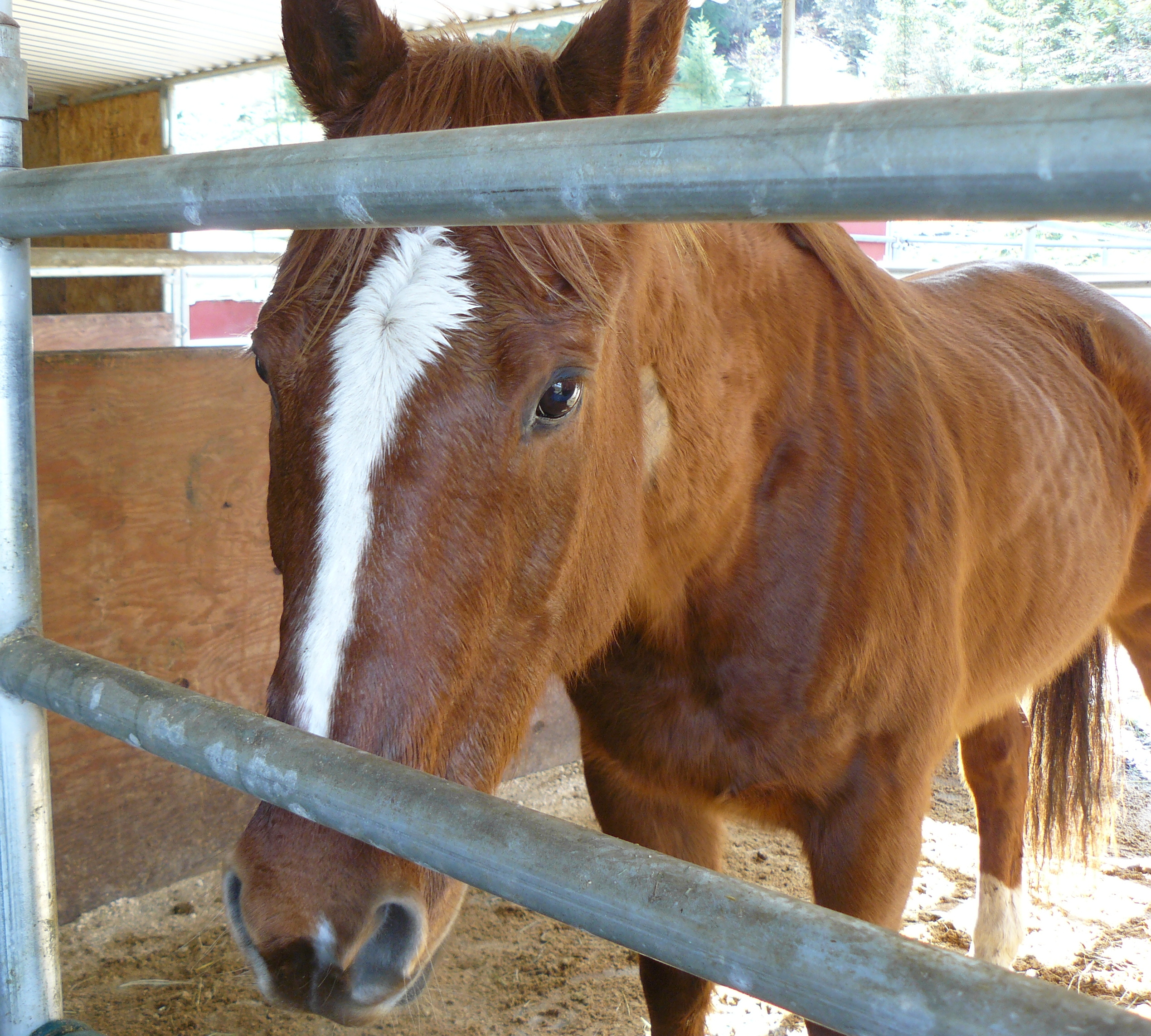
Here is Ranger’s story.
Ranger
Ranger is believed to be a quarter-horse (a quarter thoroughbred, as I now have learnt) that earlier on in his life was a roping and barrel-racing horse. Ranger is a little over 15 hands.
He has been abused in the past. Evidenced by the scars of previous ill-fitting saddles and from being wary of having his ears touched.
Originally Ranger came to Strawberry Mountain because he was found abandoned and starving in an Oregon forest. After he became a settled horse at Strawberry, he was adopted out to a family. But after some months of being ridden he threw his riders by spinning so quickly they came off.
He came back to Darla and eventually was adopted out to a different home. But after some months with his next owners, the habit of spinning riders off his back resurfaced.
Back he came to Darla but his age, he is about 15 years-old, and not being a secure riding horse were against him. Darla was unhopeful that he would ever be found a home.
Hallo, my name’s Jean. Will you come and live with us, Ranger?
But in our case, I don’t know how to ride and Jean is not interested in riding Ranger. His age is a bonus because it reduces the odds of Ranger outliving Jean and me. So Ranger seemed like a perfect match.
Jean and Ranger getting to know each other.
So that’s where we are just now. As we progress in getting our fencing done and our adoption approved (fingers crossed) then there will be more to report. We have come a long way from wild mustangs but this truly feels like the most sensible way to help given that our experience and facilities are not sufficient for us to handle a rescued Mustang.
P.S. the comments and the ‘Likes’ to yesterday’s post were wonderful. Both Jean and I are touched beyond measure.













 Learning from Dogs