Hot on the heels of yesterday’s post The power of hope comes this wonderful story about the increasing population of wolves in Europe. I can’t recall what led me to the item in the UK’s Guardian newspaper but this is what I read:
Incredible journey: one wolf’s migration across Europe
Slavc is a wolf. In 2011, he began an epic 2,000 kilometre migration across Europe from Slovenia to Italy via the Austrian Alps. Several months earlier, he had been fitted with a collar that allowed his movements to be tracked in incredible detail. I talked to Hubert Potočnik, the biologist whose work made this possible.
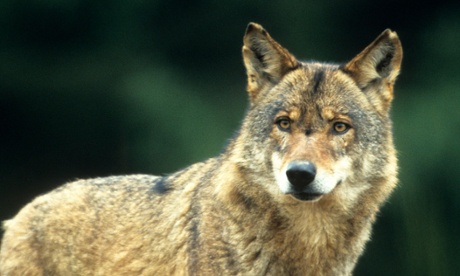
It has been estimated that there are now around 10,000 wolves in Europe. Photograph: tbkmedia.de/Alamy
Every year, Hubert Potočnik and his colleagues at the University of Ljubljana in Slovenia capture and collar a number of wolves in order to get a handle on the movements of these much-misunderstood creatures. In July 2011, he collared a young male that became known as Slavc. In June, I spoke to Potočnik for a feature that appears in New Scientist this week and he told me about Slavc’s extraordinary journey across Europe. What follows is an edited transcript of the interview …
HN: After you captured and collared Slavc in July 2011, he stayed with his pack for several months. Then, on 19 December 2011, he began to move. How did you know?
HP: We knew something was different because the GPS points showed that he had crossed two large motorways far outside of his natural territory.
Tell me about these collars. How do they work?
The collar is equipped with three types of different technology. It has a GPS receiver, a GSM modem to send SMS and also with a VHF radio transmitter as a back-up. We programme all our wolves to send a GPS signal every three hours, so we get about seven locations a day to give us continuous location sampling data.
Hubert Potočnik fits Slavc with the collar in July 2011, a device that will reveal the wolf’s incredible 2000-km migration from Slovenia to Italy. Photograph: Nina Ražen
To read the rest of this fascinating article then you will need to go here. Please do so as the article is breathtakingly interesting. It closes, thus:
HN: How would you sum up this experience?
There are lots of data about long-distance dispersal of wolves but there are very few cases where we have had the opportunity to follow an animal in such detail. Following Slavc across Europe offered a rare insight into the secret life of the wolf. It was one of the most amazing events in my life.
A quick web search came across this short but wonderful video; albeit without sound.
Published on Aug 26, 2013
Two wolf cubs were documented in Lessinia Regional Nature Park on August 7, 2013. At the end of the video it is possible to partially see an adult wolf, the mother of the cubs, that was recognized as Giulietta. Giulietta and Slavc became famous because they brought together two wolf populations that were separated for over 150 years. Wolf Slavc originates from the Dinaric-Balkan wolf population and was collared in Slovenia. He travelled over 1500km over Austria to Italy, where he met Giulietta, originating from the wolf population from the western Alps (Piemonte region).
Yesterday evening we had close friend Don Reeve staying with us. To put this into context, it was Don and his wife, Suzann, who in 2007 invited me to spend Christmas with them at their Winter home down in San Carlos, Mexico. That, in turn, led me to meeting Jean, Suzann’s best friend, and look where that got me! 🙂
(Can’t resist adding that Jean and I were born in London, some 23 miles from each other!)
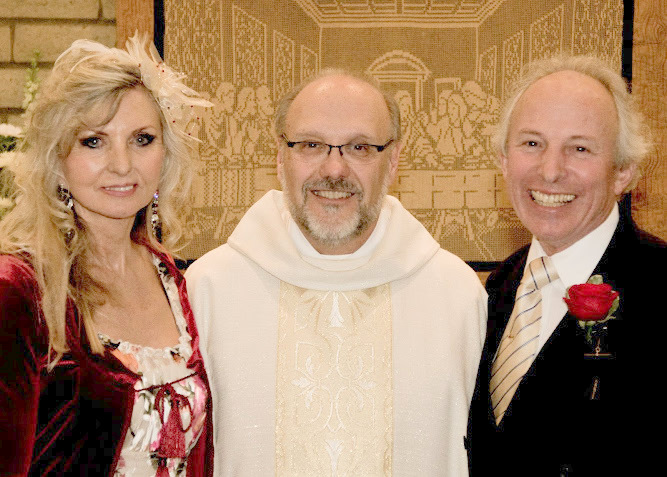
Fr. Dan Tantimonaco with the newly weds! Payson, AZ. November 20th., 2010.
Thus you can understand the pleasure it was for Jean and me again to see Don; albeit for a brief overnight stay.
What was an extra, unanticipated pleasure was meeting a young, rescue dog that Don had adopted in recent weeks. Her name is Margarita and she was found and rescued by Suzann from the streets in San Carlos. What was so glorious was to see the love and hope for a better future that flowed between Don and the sweet, young Margarita. It resonated so perfectly well with Suzan’s post published here on Monday: Rescued dogs are life-savers.
By the time I sat down at my desk yesterday, I was conscious of a) not having a clue as to what to write, and b) inspired by the sense of hope that dogs offer us humans. Serendipitously, the theme of hope led me to a post written by Jennifer Broudy de Hernandez over on her Transition Times blog. It was called Warriors for the Planet and was the most beautiful essay.
I’m delighted to reblog that here with Jennifer’s approval.
ooOOoo
Warriors for the Planet
Another summer, another war. I wonder how many summers there have been in the last 5,000 years when human beings were not occupied with killing each other?
Correction: not “human beings,” “men.”
Let’s be frank: even though there may be women in the armed forces of many countries now, war still remains a masculine activity and preoccupation. The women who serve as soldiers must adhere to the masculine warrior code and become honorary “bros,” for whom the worst insult is still be called a “girl” or a “pussy.”
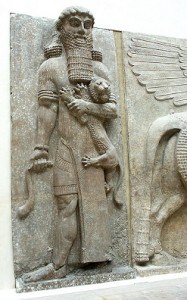
I have been reading Anne Baring’s magisterial book The Dream of the Cosmos, in which she gives a detailed account of the shift, around the time of Gilgamesh, from the ancient, goddess- and nature-worshipping “lunar cultures” to the contemporary era of solar, monotheistic, warrior-worshipping cultures.
In her elaboration of this shift, I read the tragedy of our time, enacted over and over again all over the planet, and not just by humans against humans, but also by humans against the other living beings with whom we share our world. I quote at length from Baring’s remarkable book:
“The archetype of the solar hero as warrior still exerts immense unconscious influence on the modern male psyche, in the battlefield of politics as well as that of corporate business and even the world of science and academia: the primary aim of the male is to achieve, to win and, if necessary, to defeat other males. The ideal of the warrior has become an unconscious part of every man’s identity from the time he is a small child.
“With the mythic theme of the cosmic battle between good and evil and the indoctrination of the warrior went the focus on war and territorial conquest. War has been endemic throughout the 4000 years of the solar era. The glorification of war and conquest and the exaltation of the warrior is a major theme of the solar era—still with us today in George W. Bush’s words in 2005: ‘We will accept no outcome except victory.’ This call to victory echoes down the centuries, ensuring that hecatombs of young warriors were sacrificed to the god of war, countless millions led into captivity and slavery, countless women raped and widows left destitute. It has sanctioned an ethos that strives for victory at no matter what cost in human lives and even today glorifies war and admires the warrior leader. This archaic model of tribal dominance and conquest has inflicted untold suffering on humanity and now threatens our very survival as a species.
“The cosmic battle between light and darkness was increasingly projected into the world and a fascination with territorial conquest gripped the imagination and led to the creation of vast empires. It is as if the heroic human ego, identified with the solar hero, had to seek out new territories to conquer, had to embody the myth in a literal sense and as it did so, channel the primitive territorial drives of the psyche into a Dionysian orgy of unbridled conquest, slaughter and destruction. We hear very little about the suffering generated by these conquests: the weeping widows, the mothers who lost sons, the orphaned children and the crops and patterns of sowing and harvesting devastated and disrupted by the foraging armies passing over them, the exquisite works of art pillaged and looted….The long chronicle of conquest and human sacrifice, of exultation in power and the subjugation of enemies might truly be named the dark shadow of the solar age” (118;124).
Like Baring, I see our time as a critical era in the long history of homo sapiens on the planet. There is still hope that enough of us will be able to detach ourselves from the pressures and busyness of our lives—will become conscious of what is happening to the planet and human civilization writ large—will understand that there are other ways to relate to each other and to the Earth, ways that will seem increasingly possible and obvious once we focus on them and begin to put our energies into manifesting our visions of a creative, collaborative, respectful mode of being.
Baring ends her disturbing chapter on the ascendancy of the solar warrior culture with a hopeful quote from The Passion of the Western Mind by Richard Tarnas, from which she springs into her own positive vision of the potential of our time.
“’We stand at the threshold of a revelation of the nature of reality that could shatter our most established beliefs about ourselves and the world. The very constriction we are experiencing is part of the dynamic of our imminent release. For the deepest passion of the Western mind has been to reunite with the ground of its being. The driving impulse of the West’s masculine consciousness has been its quest not only to realize itself, to forge its own autonomy, but also, finally, to recover its connection with the whole, to come to terms with the great feminine principle in life; to differentiate itself from but then rediscover and reunite with the feminine, with the mystery of life, of nature, of soul. And that reunion can now occur on a new and profoundly different level from that of the primordial unconscious unity, for the long evolution of human consciousness has prepared it to be capable at last of embracing the ground and matrix of its own being freely and consciously.’
“As this deep soul-impulse gathers momentum, the ‘marriage’ of the re-emerging lunar consciousness with the dominant solar one is beginning to change our perception of reality. This gives us hope for the future. If we can recover the values intrinsic to the ancient participatory way of knowing without losing the priceless evolutionary attainment of a strong and focused ego, together with all the discoveries we have made and the skills we have developed, we could heal both the fissure in our soul and our raped and vandalized planet” (130-131).
My heart aches for the suffering of the innocent civilians trapped in the crossfire in Gaza this summer, and for the grieving families of the passenger plane heinously shot down by warriors who were either poorly trained or just plain evil.
I am heartsick when I think about the holocaust that is overtaking living beings on every quadrant of our planet as humans continue to ravage the forests and seas, to melt the poles with our greenhouse gases, and to poison the aquifers and soil with our chemicals.
This is where the solar cultures, with their “great” warrior kings, have led us. And yet, as Baring says, they have also presided over the most amazing advances in science and technology that humans have ever known in our long history on the planet.
We don’t need or want to go back to the simple innocence of ancient lunar societies. We don’t have to bomb ourselves back into the Stone Age.
What we need is to go forward, wisely and joyously, into a new phase of consciousness, in which the masculine warrior spirit is used for protection and stewardship rather than destruction, and the Earth is honored as the Mother of all that she is.
Never let anyone tell you it can’t be done. It is already happening.
ooOOoo
May I tempt you to go back and re-read that penultimate paragraph. A sentence that I cannot resist emphasising:
What we need is to go forward, wisely and joyously, into a new phase of consciousness, in which the masculine warrior spirit is used for protection and stewardship rather than destruction, and the Earth is honored as the Mother of all that she is.
It is the differences between us that are to be praised.
On the 10th August, Alex Jones, he of The Liberated Way, published a post under the title of Wisdom comes out of calm. I read it and approved of the sentiments expressed. Here’s a flavour of what Alex wrote:
My attitude towards dogs, and everything I do, is it is better to act in harmony with my world than impose violent control upon it. Nature is my teacher, and calm is one of its teachings. Calm is the sister of patience and tolerance, letting nature flow at its own pace and in its own way. When I planted acorns, I was unable to force them to grow, they acted in their own timing, at their own pace. I am like a parent rather than the master of eight strong oak saplings. I provide my saplings with opportunity through water, sun and good soil; protecting them from caterpillar and fungus; they follow their own nature in becoming fast growing little trees.
Well, Paul, the entire essay answered why it’s wrong to equate calm with wisdom, as Alex does. If it was only him, it would be an interesting quirk. However, it’s pretty much a mass mood.
That philosophy of boiled vegetable leaves the plutocrats free to do a home run, home being, for them, hell. Part of the program is biospheric annihilation.
I didn’t agree with Patrice and my immediate reaction was try and take sides. Yet both writers were the authors of many fine essays. What to do? As I expressed to Alex:
I have read both posts and, frankly, are bemused. It feels as though each is describing something utterly different to the other. I have a number of hours of electrical work today but will also give the matter a ‘coating of thought’ while working and offer my humble conclusions later on.
Serendipitously, the answered then arrived.
I’m about a third of the way through an audio course on Building Great Sentences delivered by Professor Brooks Landon, Professor at the University of Iowa English Department. Professor Landon talks about style and how difficult it is to define a particular author’s style.
It was at that moment that a flashbulb went off in my mind. Wouldn’t literature be incredibly plain and boring if there were no real differences in the styles of all the many authors; past and present!
It brought me back to Patrice and Alex and, by default, hundreds of other authors of blogs right across the ‘blogosphere’. Of course they express themselves differently! Of course they hold different opinions! It is those differences that are critical, utterly so, to each and every reader coming to their own conclusions; conclusions to a wide range of subjects and topics.
This was hammered home to me as I watched our dogs playing so well together. The differences in each dog’s backgrounds and experiences contributed to the wonderful, unconditional way that they played and lived together. The power of their unconditional love.
It is those differences that offer us insight into our own beliefs and prejudices. It is those differences that allow us, and dogs, to make sense of ourselves. One might argue that it is the differences that deliver truth.
Jean would be the first to tell you that I’m always remarking to her how this funny old world of blogging creates links and friendships right across the world. Many of the kind people who follow Learning from Dogs are themselves the authors of blogs and in the vast majority of cases when I read their posts I sense a kindred spirit.
T.O.R.A Rescue shelter to close – Dogs need homes Foster or Adopt
TORA will close. This is indeed sad news for me but devastating for the dogs still left at the rescue shelter. My beautiful Annie came from there. Rescued off the street as a frightened puppy: Just look at her now.
Beautiful Annie.
TORA, like many other rescue shelters in Romania have been fighting against all odds to get dogs off the streets, and now out of the public shelters since the killing law has been passed. Dogs are in public shelters for only a short time before they are put to sleep. There are horrific stories and pictures around. Some may see it as practical, culling the population. That’s a valid opinion but not one I and thousands upon thousands of dog/animal lovers can share.
All TORA asks now though is for people to view the site on Facebook or contact them [Ed. via that Facebook link] and foster or adopt one of the remaining dogs. If there are dogs left in October when they must close, then they will be returned to the public shelter to receive their fate.
EVEN IF YOU CANNOT HAVE A DOG YOURSELF, please share, someone somewhere will, and for each one that does, another beautiful dog is safe. They didn’t ask to be thrown on the streets. They didn’t ask to be cast out like vermin. All they want is a chance to have a human family and a life of kindness.
ABOUT ASOCIATIA
T.O.R.A. is a small non-profit dog rescue organization that is based in Bistrita, North of Romania (Transylvania). TORA is dedicated to the rescue and placement of stray dogs.
We are an animal charity of 2-4 volunteers, with funds available only from public support, with a shelter of 20 spacious kennels, 11 indoor & outdoor and 9 only outdoors ones. We have a vet attending the dogs daily and a caretaker.
All of our dogs get neutered, (with the exception of puppies under the age of 6 months old and very old dogs), vaccinated, microchipped , defleed and dewormed prior to adoption.
T.O.R.A. shelter cares for the rescued dogs entirely from donations received from private people, that’s why there is a constant need of support whether its financial, material (food or medicine donations, beds, dog clothes, etc) or by sharing and promoting the dogs to find good homes so that space becomes available to help others .
T.O.R.A. helps an average of 40-60 animals at any given time.
Many who follow my scribblings know that of the nine dogs we have here at home, seven are rescues. When I first met Jean down in Mexico she was rescuing feral dogs off the streets and finding homes for them. Over the many years, Jean estimates that well over two-hundred stray dogs had been found loving homes. Indeed, when Jean and I moved from Mexico to Payson, AZ., we came with fourteen dogs of which thirteen were ex-rescues! Pharaoh being the notable exception!
Anyway, back to Mrs Skeats.
I was so moved by what I read on her blogsite that I implored her to write a guest post for you, dear reader. Suzan was gracious enough to agree and here is her post.
ooOOoo
Rescued dogs are life-savers.
by Suzan.
Paul asked if I would post as a “guest” after reading my post(s) about dogs that have been or need to be rescued from some quite awful conditions. “OH here we go again” some of you will say. Well, then it is your choice to read on or close the page.
I hope you read on as this is not about begging for funds or equipment or even a home for these lovely creatures. It’s about what THEY can offer you.
I love animals – not just dogs. I’ve cared for many in my time, but dogs have to be top of my list. Dogs love to love. They don’t know how to be any other way until they are mistreated in some way.
Dog’s are like having a permanent 3 years old around you, with the exception they don’t answer back (often) and are usually not quite so stubborn. I’ve had 7 children under my roof in the years (hence the menagerie at times) – I know.
Dogs look to their human companion as leader, feeder, soul mate, room mate, walker, talker, and all they want to do is to please …. literally their life is lived for you. But rescued dogs do this to a deeper level than dogs raised from a pup. Not just me but thousands of others find this.
Raised dogs are no less loyal, please don’t think I say different. There’s just something about a dog that has had a bad start, lonely, captured, mistreated … whatever. These dogs reach deeper into your heart and aim to please as if they are desperate to say thank you. Perhaps they have a fear that the person who has been so lovely will leave if they misbehave. I can’t say, I’m not a dog.
I do know as I have had both kinds; from a pup and rescued from kennels. My last ‘pup raised’ dog, Dizzi, was with me 18 years and a star in her own right, but my rescues … it’s hard to say, but they love me in a different way, unique to rescues.
Take Joe. Joe had been sold on Facebook and bought by dog-baiters, bitten so severely vets thought he would die. You’d think that’s turned him off to humans? But no! He was a beautiful 6yr-old Collie. He was awesome. He obeyed, loved and cherished us, giving cuddles, playing gently … I’ve never had such a beauty under my roof. [Ed: Joe’s early and tragic death will be the subject of tomorrow’s post.]
Annie is a Romanian street dog, rescued age 9 months from under a pile of pallets in the cold Romanian winter, never having had a home. Now two, and she too has a special love for us. I swear if we’re annoyed with her she cries (not the doggy whine – I mean from the heart) and she’ll do ANYTHING to get a hug from us. Not once has she ever messed in the house from day 1, she goes to bed when told, sits politely for treats or her lead and wags herself to death when we come in the front door. Very rarely has she “got it wrong” and is so sorrowful if she does, her worst misdemeanour being chewing her bedding when she was about 14 months old, and obviously bored.
I could go on, I’ve had 5 rescues and two from pups…..
All I’ll now say is if you’re looking for a dog to share your life with – consider very carefully as they love you warts and all for a long time – then get a rescued dog. Once you look into those soulful eyes, and hold that paw, you’ll connect and feel the love and be very humbled ……. but you won’t regret it.
ooOOoo
Please share the message as much as possible! These dogs need to find loving homes. Thank you.
Apologies again for today’s post being largely the republication of other essays but looking after our guests is, as it should be, taking first priority.
The first one was something I read on the Cliff Mass weather blogsite. It was a forecast as to which of the lower US 48 States would remain habitable. It opens:
Will the Pacific Northwest be a Climate Refuge Under Global Warming?
As global warming takes hold later in the century, where will be the best place in the lower 48 states to escape its worst effects?
A compelling case can be made that the Pacific Northwest will be one of the best places to live as the earth warms. A potential climate refuge.
and offers this conclusion:
So what conclusion does one inevitably reach by studying the IPCC reports, the U.S. Climate Assessment, and the climate literature?
The Northwest is the place to be during global warming.
Temperatures will rise more slowly than most of the nation due to the Pacific Ocean (see below)
We will have plenty of precipitation, although the amount falling as snow will decline (will fall as rain instead). But we can deal with that by building more reservoir and dam capacity (and some folks on the eastern slopes of the Cascades have proposed to do exactly that).
The Pacific Ocean will keep heat waves in check and we don’t get hurricanes.
Sea level rise is less of a problem for us due to our substantial terrain and the general elevation rise of our shorelines. Furthermore, some of our land is actually RISING relatively to the sea level because we are still recovering from the last ice age (the heavy ice sheets pushed the land down and now it is still rebounding).
There is no indication that our major storms…cyclone-based winds (like the Columbus Day Storm)… will increase under global warming.
Increased precipitation may produce more flooding, but that will be limited to river valleys and can be planned for with better river management and zoning.
The second item was this:
Antarctica’s Point of No Return
POTSDAM – Recent satellite observations have confirmed the accuracy of two independent computer simulations that show that the West Antarctic ice sheet has now entered a state of unstoppable collapse. The planet has entered a new era of irreversible consequences from climate change. The only question now is whether we will do enough to prevent similar developments elsewhere.
What the latest findings demonstrate is that crucial parts of the world’s climate system, though massive in size, are so fragile that they can be irremediably disrupted by human activity. It is inevitable that the warmer the world gets, the greater the risk that other parts of the Antarctic will reach a similar tipping point; in fact, we now know that the Wilkes Basin in East Antarctica, as big or even bigger than the ice sheet in the West, could be similarly vulnerable.
There are not many human activities whose impact can reasonably be predicted decades, centuries, or even millennia in advance. The fallout from nuclear waste is one; humans’ contribution to global warming through greenhouse-gas emissions from burning fossil fuels, and its impact on rising sea levels, is another.
Indeed, the latest Intergovernmental Panel on Climate Change (IPCC) report stated, in uncharacteristically strong terms, that the sea level is “virtually certain” to continue to rise in the coming centuries or millennia. Moreover, the greater our emissions, the higher the seas will rise.
Simply, because the quicker that the awareness of the critical challenges ahead becomes widespread knowledge, right around the world, the quicker that there will be political movements to change our relationship with our planet.
It’s never about not needing governments, it’s always about needing the right sort of governments.
A short film by Alan Watts and Terence McKenna. A film that makes a perfect postscript to yesterday’s post: The tracks we leave.
Published on Mar 3, 2013
Alan Watts and Terence McKenna talk about our need for a sense of unity as our global problems are getting worse and we have become enemies of our planet and each other.
My draft book of the same name as this blog is slowly coming together and I’m at the 30,000-word mark. A while ago, John Hurlburt, a good friend of this blog, was chatting to me and he spoke about the “interconnectedness of all conscious life”. It immediately appealed to me as a chapter in the book.
But while it was obvious to me that all conscious life is connected, for some time I struggled to achieve any clarity about what I wanted to write. Seeing that proverb kicked off the journey towards clarity.
Thus, today, I wanted to share the steps of that journey so far.
Over on the Skeptical Science blogsite there is a post, dated 15th April, 2010, with the title of Earth’s five mass extinction events. The author, John Cook, opens:
As climate changes, a major question is whether nature can adapt to the changing conditions? The answer lies in the past. Throughout Earth’s history, there have been periods where climate changed dramatically. The response was mass extinction events, when many species went extinct followed by a very slow recovery. The history of coral reefs gives us an insight into the nature of these events as reefs are so enduring and the fossil record of corals is relatively well known (Veron 2008). What we find is reefs were particularly impacted in mass extinctions, taking many millions of years to recover. These intervals are known as “reef gaps”.
Figure 1: Timeline of mass extinction events. The five named vertical bars indicate mass extinction events. Black rectangles (drawn to scale) represent global reef gaps and brick-pattern shapes show times of prolific reef growth (Veron 2008).
So what, one might ask?
Well, forget about millions of years ago. Just 12 days ago, there was a news item released by Stanford University. It read in full:
July 24, 2014
Stanford biologist warns of early stages of Earth’s 6th mass extinction event
Stanford Biology Professor Rodolfo Dirzo and his colleagues warn that this “defaunation” could have harmful downstream effects on human health.
The planet’s current biodiversity, the product of 3.5 billion years of evolutionary trial and error, is the highest in the history of life. But it may be reaching a tipping point.
In a new review of scientific literature and analysis of data published in Science, an international team of scientists cautions that the loss and decline of animals is contributing to what
Elephants and other large animals face an increased risk of extinction in what Stanford Biology Professor Rodolfo Dirzo terms “defaunation.” (Claudia Paulussen/Shutterstock)
appears to be the early days of the planet’s sixth mass biological extinction event.
Since 1500, more than 320 terrestrial vertebrates have become extinct. Populations of the remaining species show a 25 percent average decline in abundance. The situation is similarly dire for invertebrate animal life.
And while previous extinctions have been driven by natural planetary transformations or catastrophic asteroid strikes, the current die-off can be associated to human activity, a situation that the lead author Rodolfo Dirzo, a professor of biology at Stanford, designates an era of “Anthropocene defaunation.”
Across vertebrates, 16 to 33 percent of all species are estimated to be globally threatened or endangered. Large animals – described as megafauna and including elephants, rhinoceroses, polar bears and countless other species worldwide – face the highest rate of decline, a trend that matches previous extinction events.
Larger animals tend to have lower population growth rates and produce fewer offspring. They need larger habitat areas to maintain viable populations. Their size and meat mass make them easier and more attractive hunting targets for humans.
Although these species represent a relatively low percentage of the animals at risk, their loss would have trickle-down effects that could shake the stability of other species and, in some cases, even human health.
For instance, previous experiments conducted in Kenya have isolated patches of land from megafauna such as zebras, giraffes and elephants, and observed how an ecosystem reacts to the removal of its largest species. Rather quickly, these areas become overwhelmed with rodents. Grass and shrubs increase and the rate of soil compaction decreases. Seeds and shelter become more easily available, and the risk of predation drops.
Consequently, the number of rodents doubles – and so does the abundance of the disease-carrying ectoparasites that they harbor.
“Where human density is high, you get high rates of defaunation, high incidence of rodents, and thus high levels of pathogens, which increases the risks of disease transmission,” said Dirzo, who is also a senior fellow at the Stanford Woods Institute for the Environment. “Who would have thought that just defaunation would have all these dramatic consequences? But it can be a vicious circle.”
The scientists also detailed a troubling trend in invertebrate defaunation. Human population has doubled in the past 35 years; in the same period, the number of invertebrate animals – such as beetles, butterflies, spiders and worms – has decreased by 45 percent.
As with larger animals, the loss is driven primarily by loss of habitat and global climate disruption, and could have trickle-up effects in our everyday lives.
For instance, insects pollinate roughly 75 percent of the world’s food crops, an estimated 10 percent of the economic value of the world’s food supply. Insects also play a critical role in nutrient cycling and decomposing organic materials, which helps ensure ecosystem productivity. In the United States alone, the value of pest control by native predators is estimated at $4.5 billion annually.
Dirzo said that the solutions are complicated. Immediately reducing rates of habitat change and overexploitation would help, but these approaches need to be tailored to individual regions and situations. He said he hopes that raising awareness of the ongoing mass extinction – and not just of large, charismatic species – and its associated consequences will help spur change.
“We tend to think about extinction as loss of a species from the face of Earth, and that’s very important, but there’s a loss of critical ecosystem functioning in which animals play a central role that we need to pay attention to as well,” Dirzo said. “Ironically, we have long considered that defaunation is a cryptic phenomenon, but I think we will end up with a situation that is non-cryptic because of the increasingly obvious consequences to the planet and to human wellbeing.”
The coauthors on the report include Hillary S. Young, University of California, Santa Barbara; Mauro Galetti, Universidade Estadual Paulista in Brazil; Gerardo Ceballos, Universidad Nacional Autonoma de Mexico; Nick J.B. Isaac, of the Natural Environment Research Council Centre for Ecology and Hydrology in England; and Ben Collen, of University College London.
For more Stanford experts on ecology and other topics, visit Stanford Experts.
It hardly requires any imagination to realise that what we humans need in order to live, air, food, and clean water, is utterly dependant on us humans caring for the planet that sustains us. It’s all too easy just to take for granted that we will always have air, food and clean water. Now go back and read that last sentence from Professor Dirzo. [my emphasis]
We tend to think about extinction as loss of a species from the face of Earth, and that’s very important, but there’s a loss of critical ecosystem functioning in which animals play a central role that we need to pay attention to as well. Ironically, we have long considered that defaunation is a cryptic phenomenon, but I think we will end up with a situation that is non-cryptic because of the increasingly obvious consequences to the planet and to human wellbeing.
The tracks we leave! H’mmm.
Let me move on in my journey.
Over on the EarthSky blogsite there was an item about the mysterious giant crater that appeared suddenly in Siberia.
Mystery crater in Yamal peninsula probably caused by methane release
Thawing permafrost likely allowed methane gas to be released, creating the large hole in permafrost found in northern Russia, says the Russian team that investigated it.
UPDATE July 31, 2014.
Stories are popping up fast in various media this afternoon about a likely source of a reported, mysterious hole in permafrost in the Yamal region of northern Russia. This hole was
The first mysterious crater spotted by helicopter in the Yamal region of northern Russia. Image via Nature.
spotted by a helicopter pilot in mid-July; reindeer herders reported a second hole some days later. Eric Holthaus of Slate said that there is now:
… new (and definitive) evidence … that the Siberian holes were created via methane released from warming permafrost.
The evidence has come via the journal Nature, which published a story on its website today (July 31) featuring the findings of Andrei Plekhanov, a senior researcher at the Scientific Centre of Arctic Studies in Salekhard, Russia, and his team. This is the team that was sent in to investigate the first hole shortly after it was found. Holthaus said:
That team measured methane concentrations up to 50,000 times standard levels inside the crater.
The story in Nature said:
Air near the bottom of the crater contained unusually high concentrations of methane — up to 9.6% — in tests conducted at the site on 16 July … Plekhanov, who led an expedition to the crater, says that air normally contains just 0.000179% methane …
Plekhanov and his team believe that it is linked to the abnormally hot Yamal summers of 2012 and 2013, which were warmer than usual by an average of about 5°C. As temperatures rose, the researchers suggest, permafrost thawed and collapsed, releasing methane that had been trapped in the icy ground.
Holthaus pointed out:
Last week, the New York Times’ Andrew Revkin interviewed a Russian scientist who had also visited the hole and came to similar conclusions.
This newly reported evidence, just coming to light today, seems particularly scary given the story earlier this week about what the University of Stockholm called “vast methane plumes” found by scientists aboard the icebreaker Oden, which is now exploring and measuring methane release from the floor of the Arctic Ocean.
Build-up and release of gas from thawing permafrost most probable explanation, says Russian team.
My last step in the journey about our interconnectedness involves water.
Water scarcity may be the most underrated resource issue the world is facing today.
Seventy percent of world water use is for irrigation.
Each day we drink nearly 4 liters of water, but it takes some 2,000 liters of water — 500 times as much — to produce the food we consume.
1,000 tons of water is used to produce 1 ton of grain.
Between 1950 and 2000, the world’s irrigated area tripled to roughly 700 million acres. After several decades of rapid increase, however, the growth has slowed dramatically, expanding only 9 percent from 2000 to 2009. Given that governments are much more likely to report increases than decreases, the recent net growth may be even smaller.
The dramatic loss of momentum in irrigation expansion coupled with the depletion of underground water resources suggests that peak water may now be on our doorstep.
Today some 18 countries, containing half the world’s people, are overpumping their aquifers. Among these are the big three grain producers — China, India, and the United States.
Saudi Arabia is the first country to publicly predict how aquifer depletion will reduce its grain harvest. It will soon be totally dependent on imports from the world market or overseas farming projects for its grain.
While falling water tables are largely hidden, rivers that run dry or are reduced to a trickle before reaching the sea are highly visible. Among this group that has limited outflow during at least part of the year are the Colorado, the major river in the southwestern United States; the Yellow, the largest river in northern China; the Nile, the lifeline of Egypt; the Indus, which supplies most of Pakistan’s irrigation water; and the Ganges in India’s densely populated Gangetic basin.
(The rest of this important article including the many useful links may be read here.)
Now, despite the despondent theme of the contents of this post, I am not beating a ‘doom and gloom’ drum. What I am trying to point out is that we are all interconnected. Not just all of mankind but all conscious life. Ergo, the destruction of natural habitats, the loss of every species, even the unwarranted killing of a wild animal is, in a very real and tangible way, the destruction of our habitat, the loss of our species and the unwarranted killing of future generations of homo sapiens.
It seems that whichever way we look the interconnectedness of all conscious life is staring us full in the face. The utter madness of mankind’s group blindness is beyond comprehension.
It takes an ancient proverb from a people that lived in harmony with the planet to speak the truth. We ignore it at our peril.
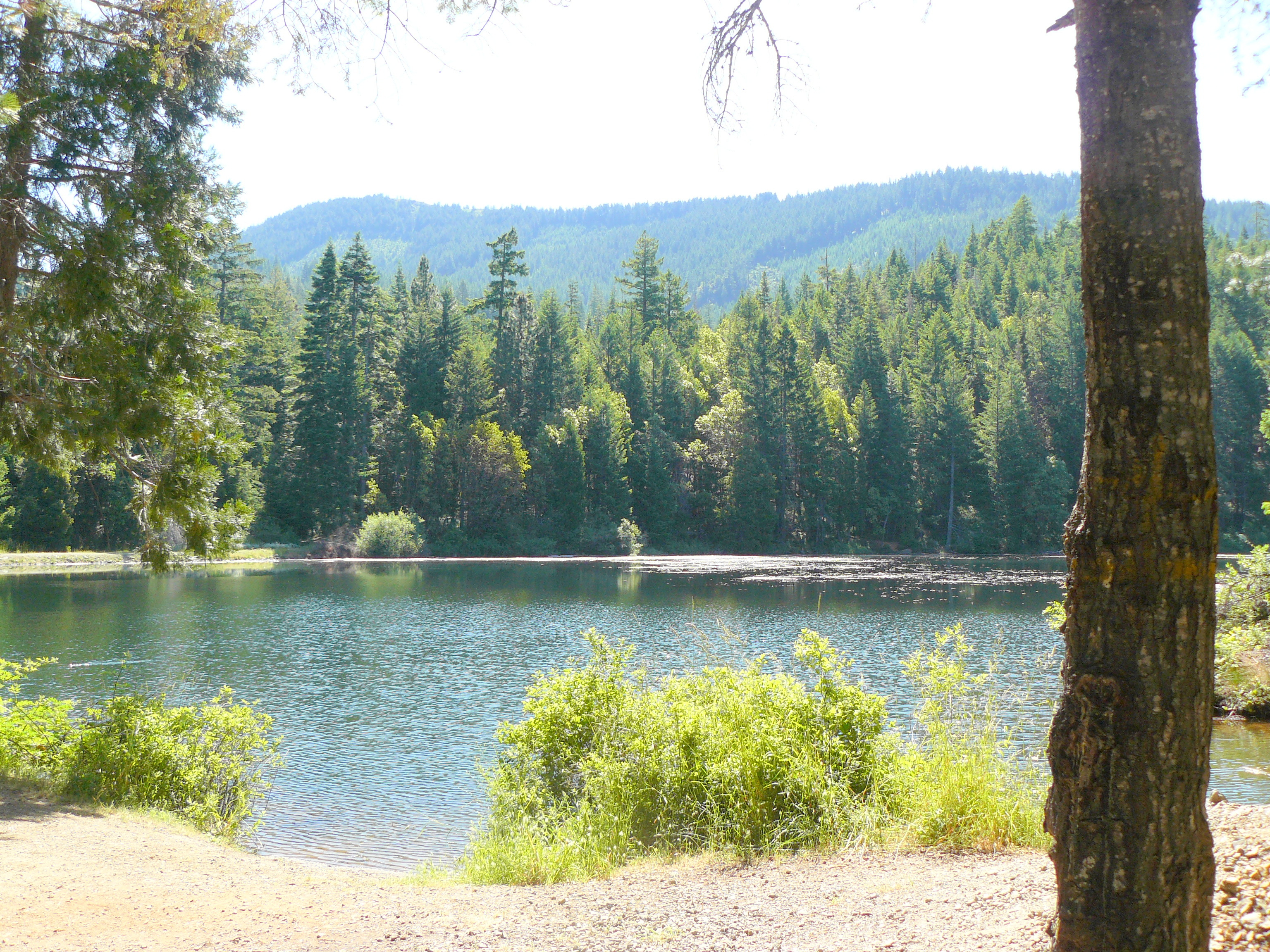
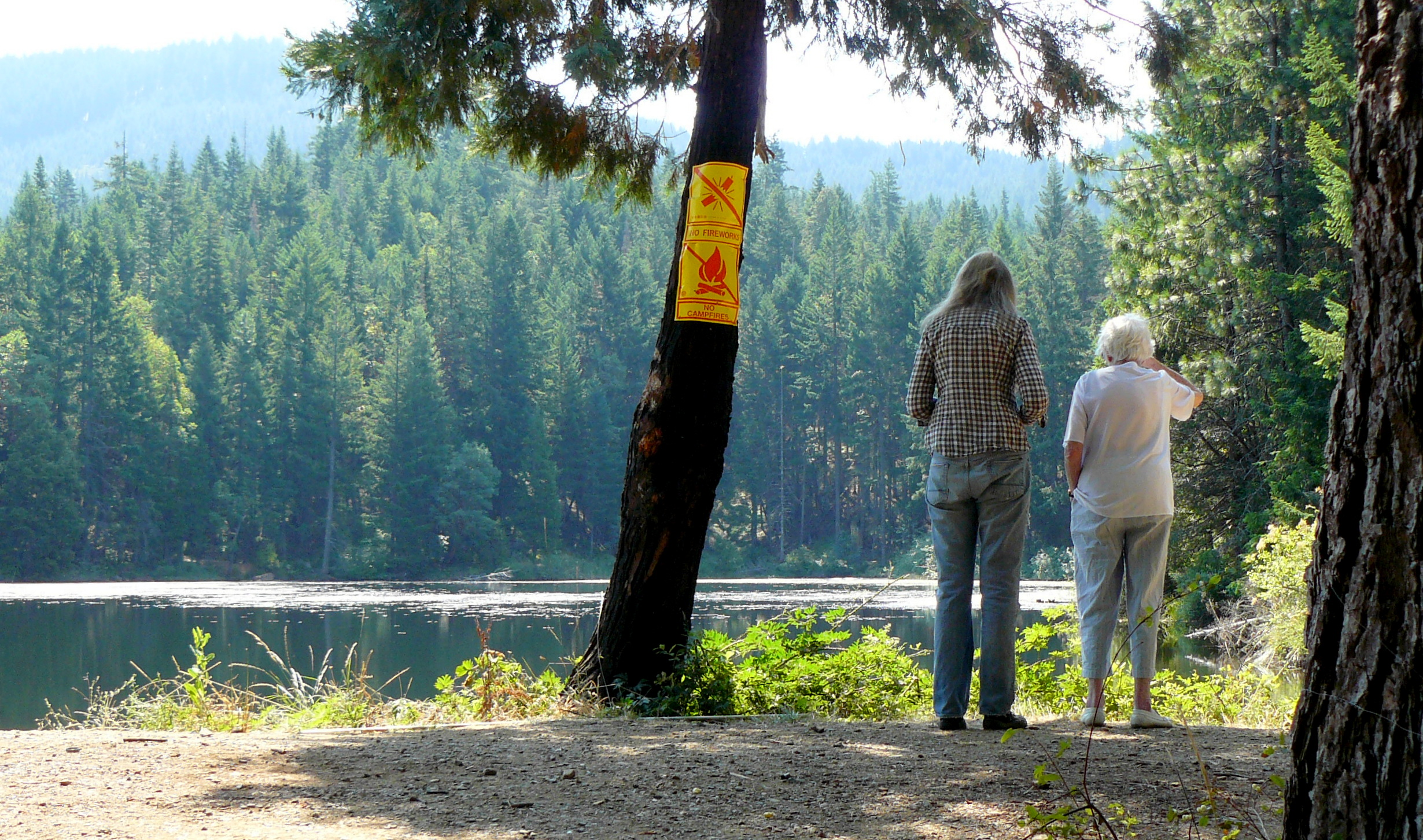
Many of you will know that Elizabeth, my mother from North-West London, is staying with us for a short while. Last Friday, it was decided to drive the 20 miles to the North and along Speaker Road into BLM land and thence up to Secesh Reservoir. This beautiful spot was previously written about in June when we first went to find Secesh. It seemed a perfect spot to take my mother.
Secesh Reservoir.
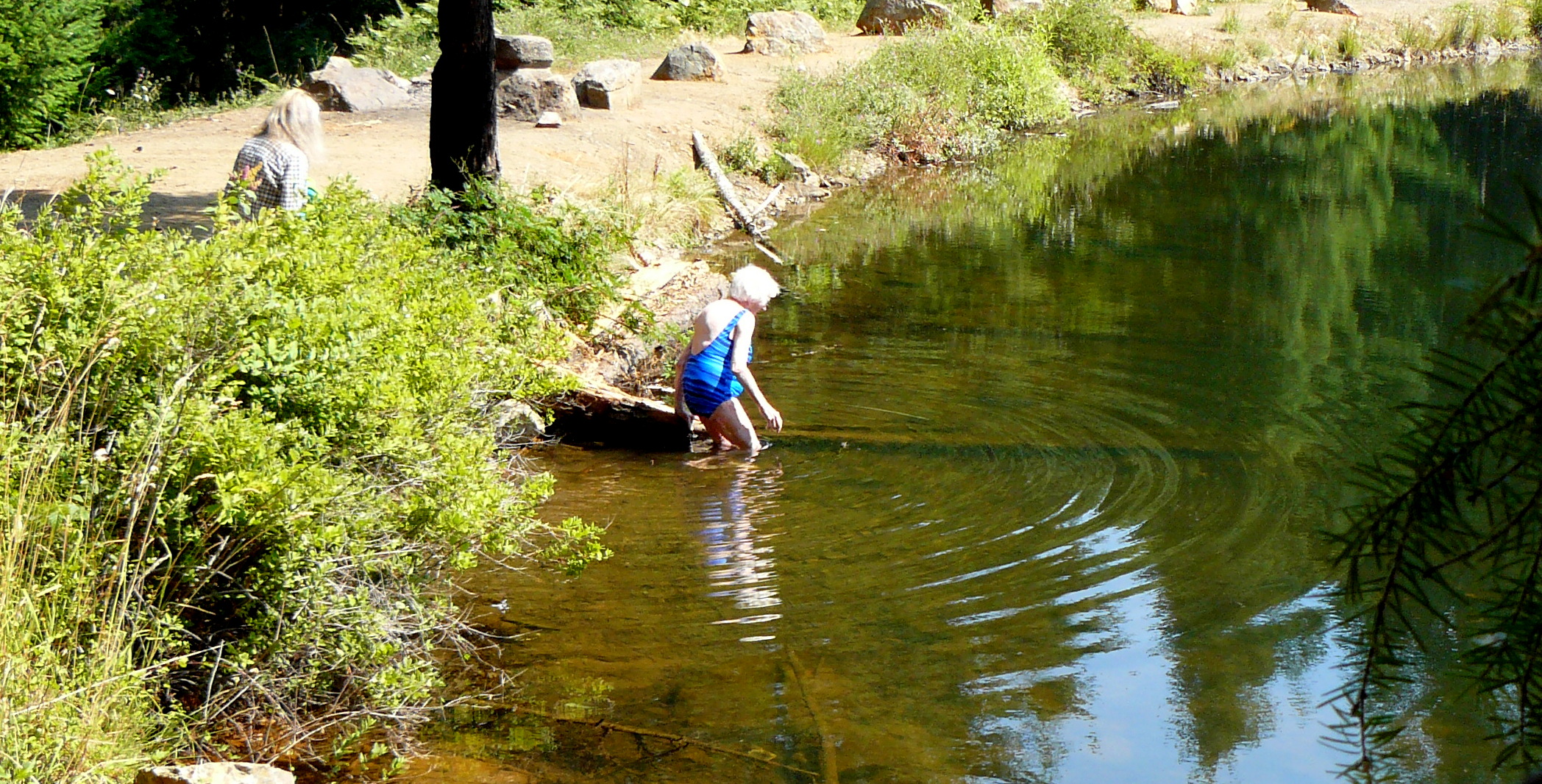
What neither Jean nor I had anticipated was that my mother was determined to swim in Secesh; the remote reservoir is at an altitude of 2,870 feet.
Checking out the best way in!
oooo
Gently does it!
oooo
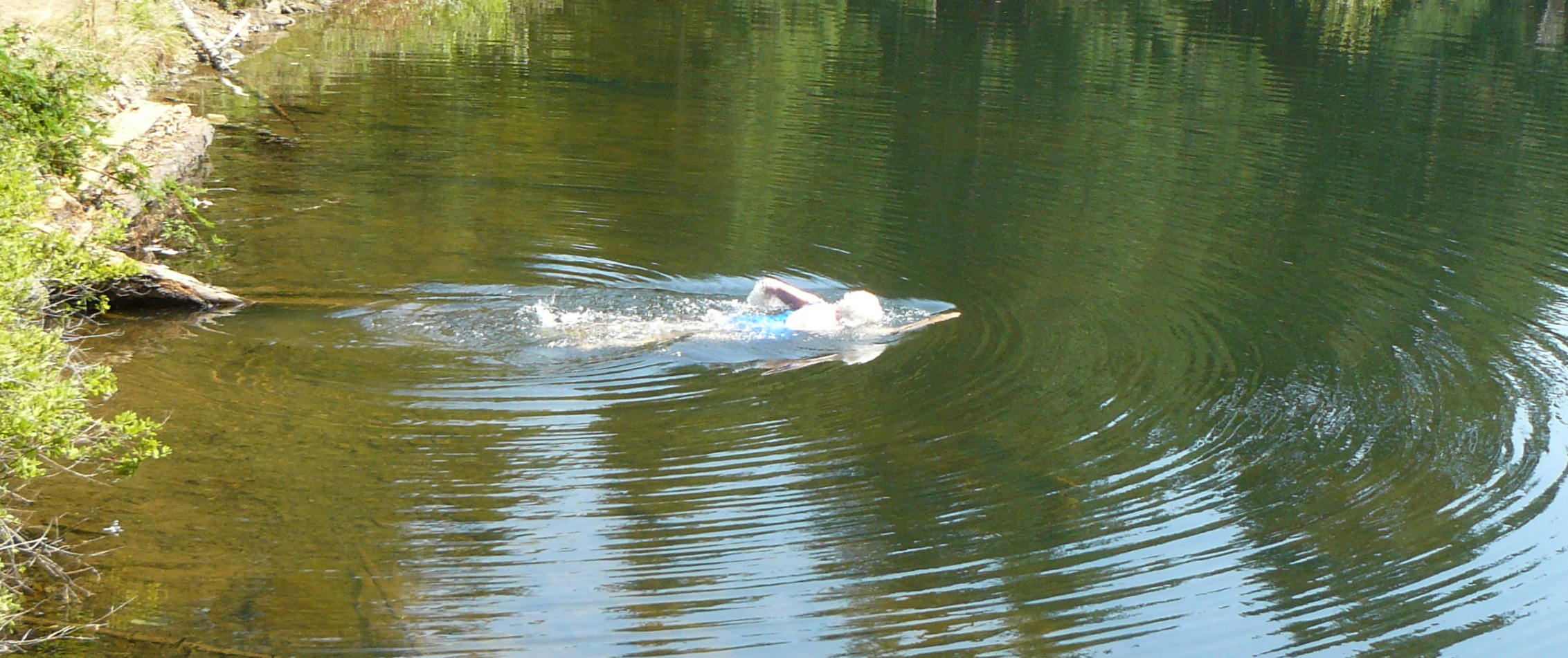
And away we go!
oooo
Fearless!
oooo
And safely back to the shore.
oooo
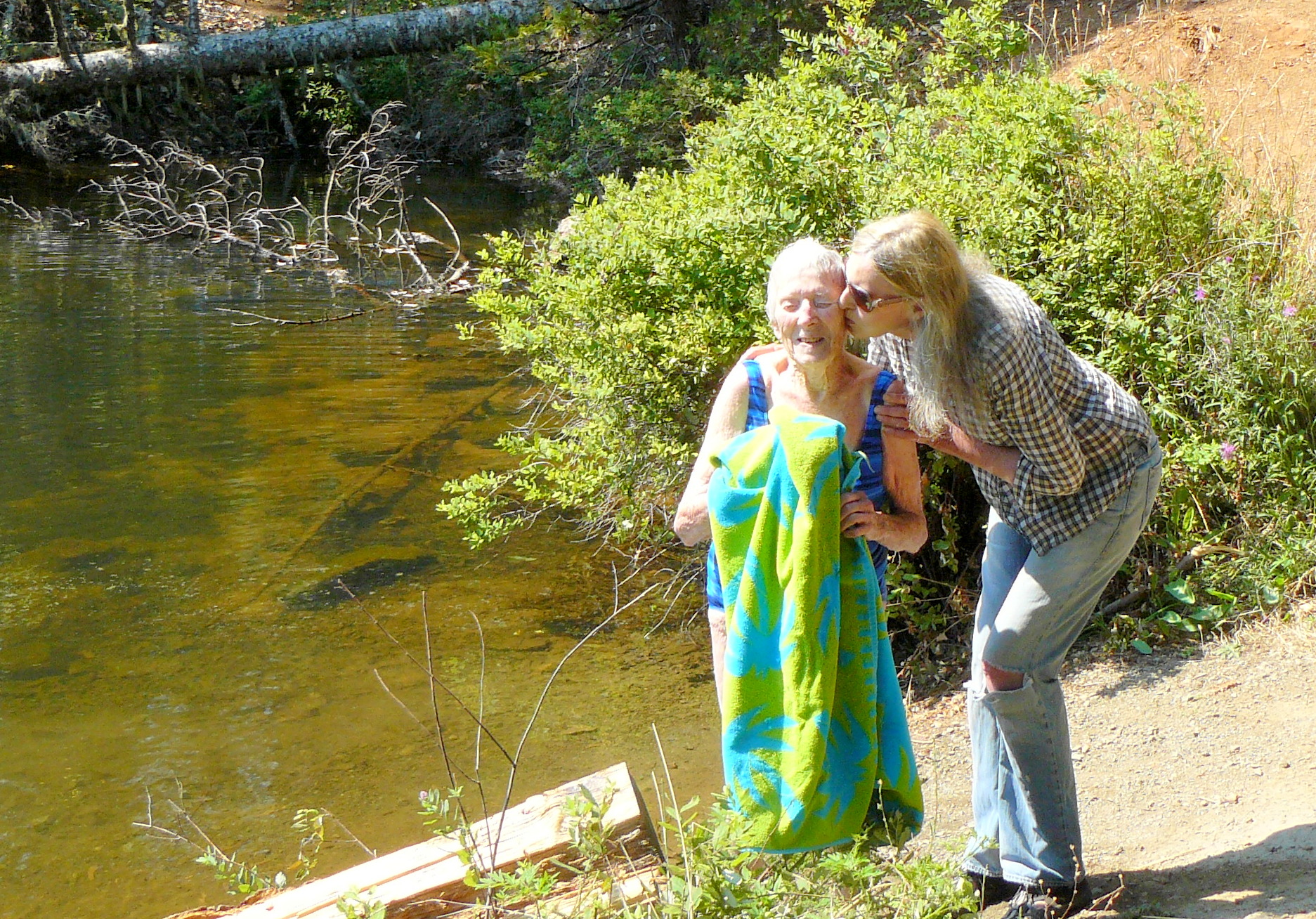
Jean expressing her love and admiration.
oooo
All good things come to a close.
oooo
Pity about the traffic noise! 😉
Oh, nearly forgot to mention that Elizabeth was born in 1919! That’s 94, by the way!
As I said in the sub-title, this takes some beating!
Just to put this into context, if you watched the George Monbiot speech that was the highlight of my post last Tuesday, The Goon Show, you might well have been forgiven for wondering if these are starting to feel like the end-times for species homo sapiens.
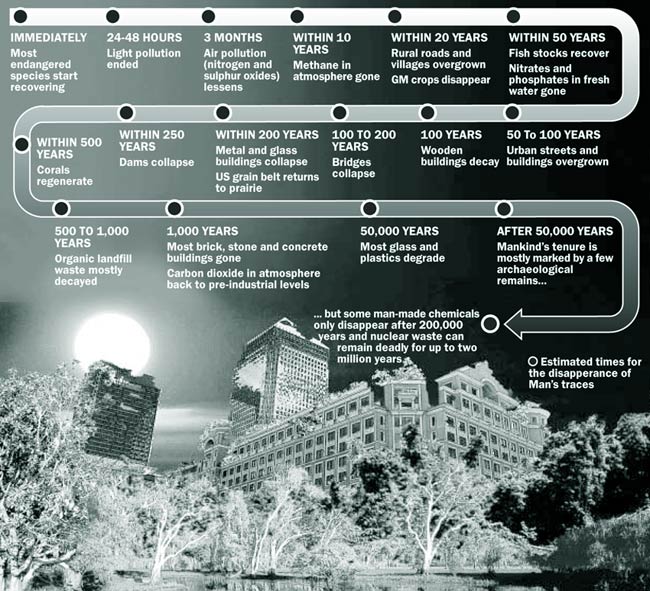
Almost perfectly on cue, on Monday, John Hurlburt down in Payson, AZ., sent me the following. It does make one think!
Time Required for the Earth to Heal if the Human Race Disappeared Today
Time Required for the Earth to Heal if the Human Race Disappeared Today.
(While John over the telephone read out the URL that was the source of this ‘chart’, I was unable to link to it. Thus apologies for not recognising the author.)
Then if you are up for more of the same theme, here’s a film that will ‘entertain’ you.
Published on Sep 2, 2012
What will happen when humans disappear from the face of the Earth? This movie will certain make you think about the impact we have made on this beautiful planet. But when humans are gone… Earth does continue.
Imagine if one minute from now, every single person on Earth disappeared. All 6.6 billion of us. What would happen to the world without humans?
How long would it be before our nuclear power plants erupted, skyscrapers crumbled and satellites dropped from the sky?
What would become of the household pets and farm animals? And could an ecosystem plagued with years of pollution ever recover?
Similar to the History Channel’s special Life After People (recommended), Aftermath features what scientists and others speculate the earth, animal life, and plant life might be like if humanity no longer existed, as well as the effect that humanity’s disappearance would have on the artefacts of civilisation.
FAIR USE NOTICE: The material on this channel is provided solely for educational and informational purposes. It may contain copyrighted material, the use of which has not been specifically authorized by the copyright owner. Infringement of copyright is not intended. The material is made available to help educate people about health related issues. It is believed that this constitutes a ‘FAIR USE’ of any such copyrighted material as provided for in Title 17, section 107 of the US Copyright Law. The material is distributed without profit to those who would like to use such material for research and educational purposes.
Undoubtedly, those of you that watched the George Monbiot speech in yesterday’s post will have been struck by at least two key aspects. The first being the utter absurdity in the way that we are being governed (UK and the USA) and the second that change can only come from people bonding at a local level. For it is within local communities that groups of people share their ideas and develop a vision for change that they can stand behind in an open and demonstrable manner.
The history of mankind is inseparable from the history of living in communities. It’s only in recent times that so many have chosen to live in cities and towns. Dogs, of course, offer a brilliant and wonderful example of the benefits of community life.
Back to George Monbiot. Here are some of Mr. Monbiot’s words towards the end of his speech. (My emphasis.)
As Lakoff has pointed out, these people are trying to do the right thing but they are completely failing to apply a frames analysis. A frame is a mental structure through which you understand an issue. Instead of framing the issue with our own values and describing and projecting our values – which is the only thing in the medium- to long-term that ever works – we are abandoning them and adopting instead the values of the people who are wrecking the environment. How could there be any long-term outcome other than more destruction?
There’s another way of looking at this, which says the same thing in different ways. All of us are somewhere along a spectrum between intrinsic values and extrinsic values. Extrinsic values are about reputation and image and money. They’re about driving down the street in your Ferrari and showing it to everyone. They are about requiring other people’s approbation for your own sense of well-being.
Intrinsic values are about being more comfortable with yourself and who you are. About being embedded in your family, your community, among your friends, and not needing to display to other people in order to demonstrate to yourself that you are worth something.
The desire for humans to belong to a community was highlighted in a recent article in Time Magazine under it’s Culture section (August 4th). The article was called Atheist “Churches” Gain Popularity—Even in the Bible Belt(again, my emphasis).
Jerry Dewitt (Left), A former Pentecostal minister, DeWitt now leads the secular Community Mission Chapel in Lake Charles, La. Mike Aus (Right), In September 2012, Aus began Houston Oasis, an atheist service that is considered a model for nonbelievers nationwide.
On a clear, Sunny July morning, as churchgoers all around Houston take to their pews, dozens of nonbelievers are finding seats inside a meeting room in a corporate conference center on the city’s west side to listen to a sermon about losing faith. But first there’s the weekly “community moment”–remarks on a chosen topic delivered by the group’s executive director, this time focused on how we’re hardwired to read sensationalized news–as well as announcements about an upcoming secular summer camp. In between, a musician sings softly of Albert Einstein.
The men speaking before the assembled gathering–executive director Mike Aus, who regularly leads the group, and Jerry DeWitt, a visitor who heads a similar gathering in Louisiana–are both deeply familiar with the idea of Sunday ritual.
Later in the article, Mike Aus (see picture above) goes on to say (once more, my emphasis):
There are a lot of people in the free-thought movement who say: Well, this is just mimicking church. But if we don’t offer regular human community and support for nonbelievers, it would be detrimental to the movement.
Whether we like it or not, change is being thrown at us by nature at an unprecedented scale; certainly unprecedented in the experience of homo sapiens. Our only hope is to turn away from the destructive agendas of our present governments all across the world and build change from the grassroots up.








 Learning from Dogs