I was researching for a chapter on Communities for my book and came across a wonderful essay by an Erik Kennedy. It was so brimful of common-sense that I wanted to share it with you.
We may be the pinnacle of millions of years of evolution, but we’re throwing our birthright straight out the window of our comfortable suburban homes. In this essay, we’re going to discuss walking across our family-sized lawn, climbing over our questionably large picket fence, and retrieving that birthright.
Then a little later on, Mr Kennedy writes (my emphasis):
The Tribe
Human beings are no strangers to group living. Call it a family trait. Our closest animal relatives spend a good bulk of their time eating bugs off of their friends’ back. While I’m overjoyed we’re not social in that manner, I’m less pleased that we’re not social more to that degree. In study after study, having and spending time with close friends is consistently correlated with happiness and well-being. And yet, the last few decades in America have seen a remarkable decline in many things associated with being in a tight-knit social circle—things like family and household size, club participation, and number of close friends. Conversely, we’ve seen an increase in things associated with being alone—TV, commutes, and the internet, for example.
This trend is quite unhealthy. It’s no surprise that humans are social animals—but it may be surprising that we’re such social animals that merely joining a club halves your chance of death in the next year—or that living in a close-knit town of three-generation homes can almost singlehandedly keep you safe from heart disease.
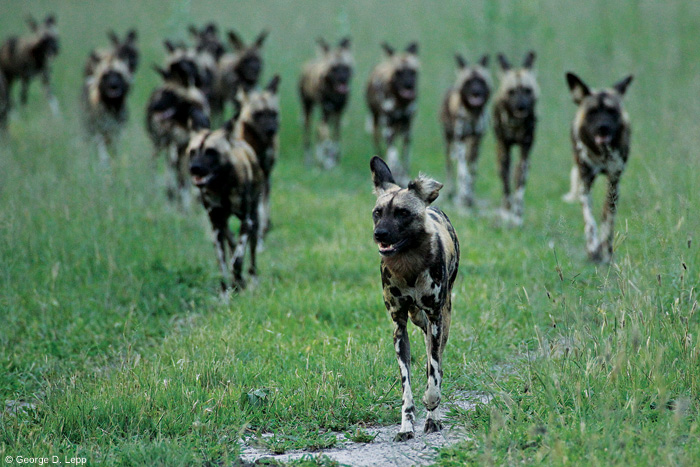
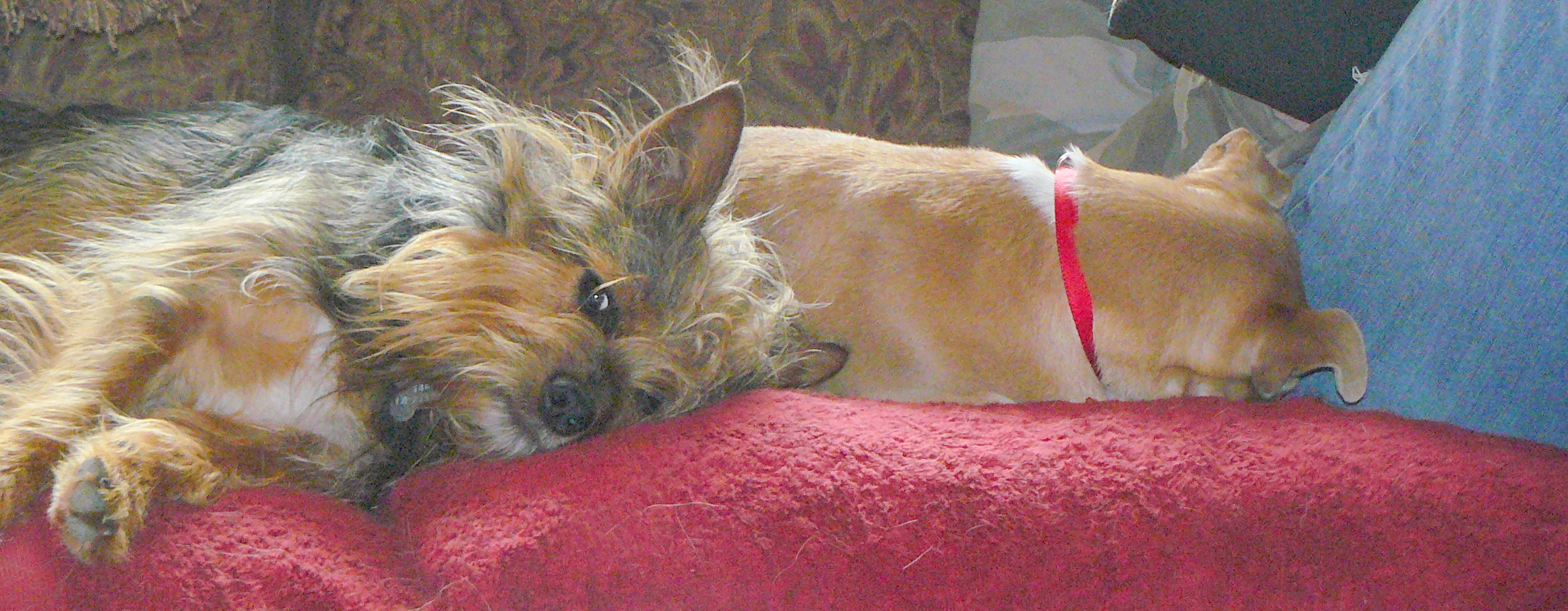
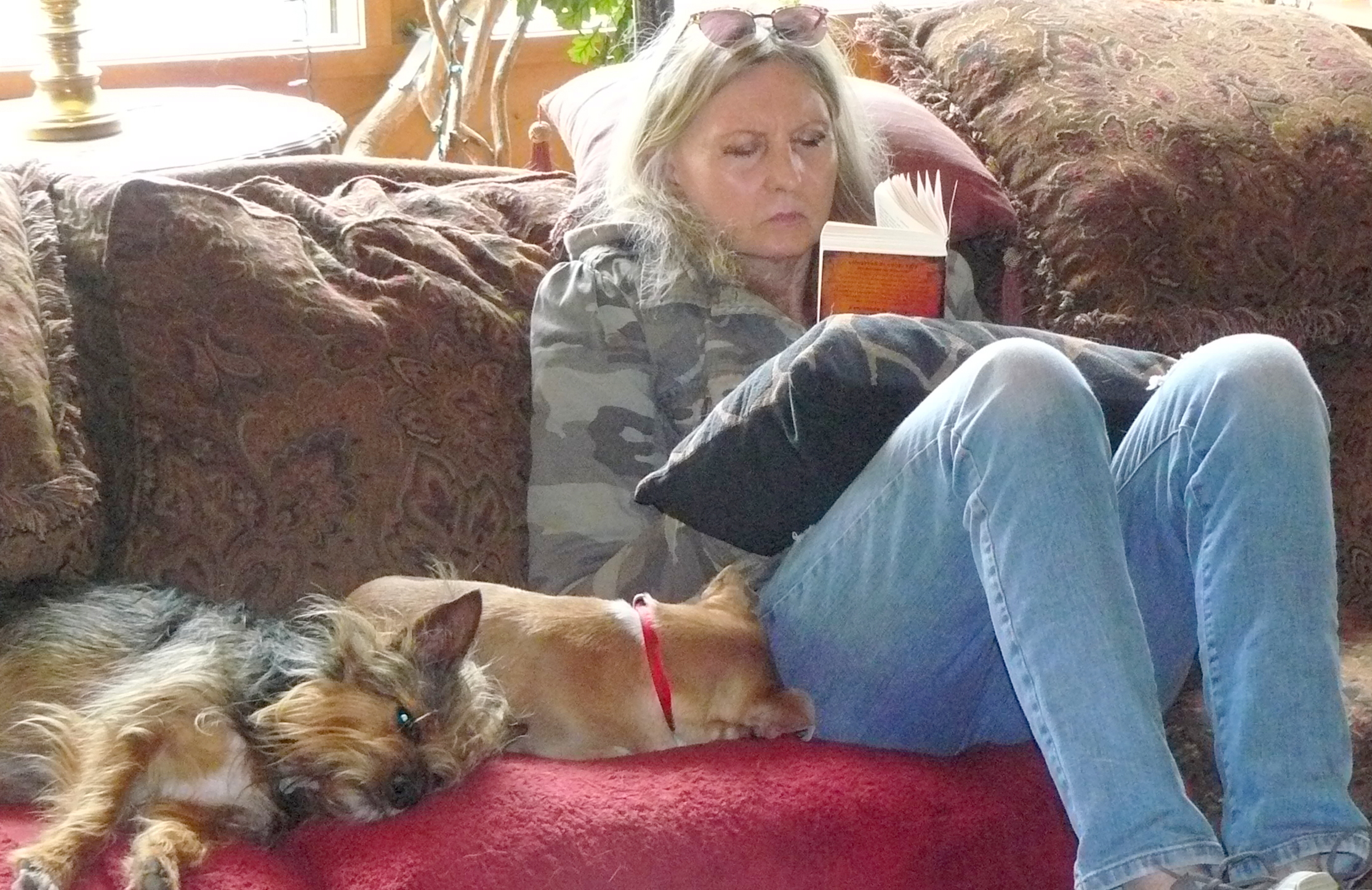
Any of you that have a few dogs around you at home know what wonderful close-knit groups they make. Frequently highlighted here on Learning from Dogs.
Group of wild dogs from a photograph taken by George Lepp.
Dogs offer many beautiful examples of the benefits of community. For the reason that their ancient genes, long before they became domesticated animals, still guide their behaviours. When dogs lived in the wild, their natural pack size was around fifty animals. There were just three dogs that had pack status; the alpha, beta and omega dogs. Or more usefully described as the Mentor, Minder and Nanny dogs. (As is still the case in wild dog pack families.)
As has been explained previously in this place, all three dogs of status, wild or domesticated, are born into their respective roles, with their ‘duties’ in their pack being instinctive. There was no such thing as competition for that role as all the other dogs in that natural pack grouping would be equal participants with no ambitions to be anything else.
One doesn’t need to reflect for very long before the obvious question arises: If fifty dogs is the optimum number for a pack of dogs, is there a limit to the number of people we can have in the human equivalent of a pack?
Well, says anthropologist Robin Dunbar, that number is about 150 persons. Robin Dunbar achieved fame by drawing a graph that plotted primates’ social group size as a function of their brain sizes. He inputted the average human brain size into his model, and up came the number 150. Beyond that number is past the upper bounds for both hunter-gatherer tribes and Palaeolithic farming villages. More than that, it appears that everything from startup employee counts to online social networks show this number as a fairly consistent maximum for creating and maintaining close social ties.
Once more, a great lesson from our dogs – wrap the strength of a community around you.
Reinforcing the need to move personhood beyond the human person.
Yesterday, I wrote about the moves to have the concept of personhood extended to chimpanzees. Here’s a small extract:
The order to show cause on the issue of habeas corpus is the first step in a process which Steven Wise and the Nonhuman Rights Project (NhRP) hope will secure Hercules and Leo’s bodily liberty and integrity. If the court were to find in their favour, the chimpanzees would no longer be kept for research and could be moved to a sanctuary in Florida.
Last Friday, George Monbiot published an essay that reinforced our need to regard our animals differently than hitherto; especially our larger animals. It is my pleasure to republish it with Mr. Monbiot’s permission.
ooOOoo
Megadeath
22nd May 2015
The destruction of some of the last of the huge animals that shaped us inflicts a great wound in our lives.
By George Monbiot, published on the Guardian’s website 22nd May 2015
When I read about the attacks on the world’s remaining elephants and rhinos, the first thought that enters my head is: “these creatures used to be everywhere”. Almost every area of land and sea, in every region of the world, had a megafauna. Elephants lived throughout Europe, Asia, Africa and America until very recently in ecological time (30,000 years ago in Europe, 14,000 years ago in the Americas). Rhinos lived across Africa, Asia and Europe. Temperate forest rhinos lived in Britain during previous interglacials, and woolly rhinos lived here in colder periods. Russia was haunted by two gigantic species: humpbacked rhinos the size of elephants, eight feet to the crest, weighing perhaps five tonnes.
Lions were everywhere except Australasia (that had a marsupial equivalent); tigers ranged to the borders of Europe; hippos wallowed in British rivers; hyaenas survived into the early Mesolithic in Britain and northern Europe. All this is easily forgotten in a world afflicted by Shifting Baseline Syndrome: our habit of conceptualising as natural and normal the ecosystems that prevailed in our own youth, unaware that they were, even then, in an extremely degraded state.
The places in which monsters remain are the last tiny redoubts of what was once a global population. Of the 42 species of terrestrial mammals weighing more than a tonne that existed on Earth when modern humans left Africa, just eight are left: the African and Asian elephants, the larger of the two hippopotamus species and the black, white, Indian, Javan and Sumatran rhinos. Seven of them are threatened and four are critically endangered.
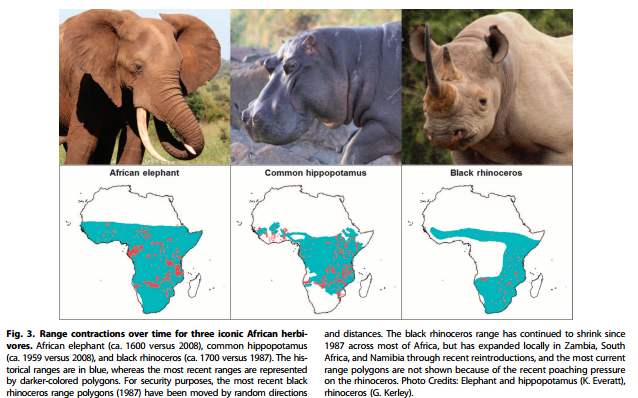
Even in the relatively recent past, the area of land over which these animals roamed has drastically declined. Maps published in a new paper in the journal Science Advances show that elephants, hippos and black rhinos occupied most of sub-Saharan Africa when their populations were first encountered by modern Europeans, but are now confined to a few tiny specks of land.
From William J. Ripple et al, 1st May 2015. Collapse of the world’s largest herbivores. Science Advances. 2015;1:e1400103
Why do the very large animals prove most susceptible to destruction? It’s partly because they reproduce slowly and partly because they require plenty of land and food for their survival, so the destruction of wild places tends to hit them sooner than it affects smaller species. But it’s also, I believe, because we have a deep-rooted urge to assert our status by killing them and owning their body parts. Even when people don’t do the killing themselves, possessing their skins, heads, tusks or horns has long been a means of acquiring bragging rights.
From the exquisite sculpture of two reindeer migrating across a river, carved from a piece of mammoth ivory 13,000 years ago and now housed in the British Museum, to the tiger skin rugs and heads of exotic beasts exhibited in stately homes today, bigging ourselves up by displaying our mastery of great beasts seems to be a fundamental human trait. Today’s aristocrats, some of whom are descendants of tribal chiefs, hang their ancestors on the wall to establish their genealogy and the heads of the animals they have killed beside them, to establish their prowess. Not much has changed in thousands of years.
Many of the world’s great sagas, tales of Ulysses, Sinbad, Sigurd, Beowulf, Cú Chulainn, St George, Arjuna, Lạc Long Quân and Glooskap, tell of struggles with megafauna real or imagined. Doubtless at least some of these stories originated in real battles with beasts whose true nature has been forgotten, as a result of their extinction. Think of Sinbad and the roc, which might be a garbled version of encounters with the elephant bird of Madagascar.
Today, some very rich people try to recreate these battles in ways that seem to me grotesque. They bid on the internet for the right to shoot a particular animal, sometimes paying tens of thousands of dollars, arrange a date, a time and a place, then fly over, in some cases with their taxidermists in tow, to bag the creature they have bought.
The animal is waiting for them – sometimes in an enclosure, sometimes just after being released from one, sometimes in the wild but already located by guides. There is no question about the outcome; otherwise the money would have to be repaid. I have heard that in some cases these people fly to a country for just a couple of days, during which they have booked the killing of several spectacular animals. Their diary secretaries arrange their schedules so that they can fit them all in. Once they have posed triumphantly with a foot on the beast they have just killed, they leave it for the taxidermist to process and move on to the next appointment with death.
This looks to me as dry and joyless as it is brutal and unsporting. Though I would struggle nowadays to bring myself to shoot a mammal or a bird (in my youth I killed and ate a few rabbits, squirrels and pigeons), I can understand the attraction of doing so in difficult circumstances, stalking and crawling and lying in wait much as a wild predator would. Canned, predetermined hunting of this kind seems empty of challenge and romance, bought rather than won. But such is the drive to establish dominion over the largest and most magnificent of beasts, and such is the obsession with conspicuous outcomes, that, for some people, none of this appears to matter.
Others are satisfied to remove themselves even further from contingency, by purchasing pieces of animals that have already been killed. My guess is that the use of rhino horn, tiger bones and other such body parts in traditional Chinese medicine, which are of course clinically useless, might be another manifestation of this deep-rooted drive, to make ourselves feel better by association with creatures larger or fiercer than ourselves.
You might have imagined that there were now plenty of alternative means of asserting our status and persuading ourselves of our own value, but traits that resonate with our evolutionary past – our ghost psyche – die hard.
So this great global tragedy continues. I know I should write about it more often. But I find it too upsetting.
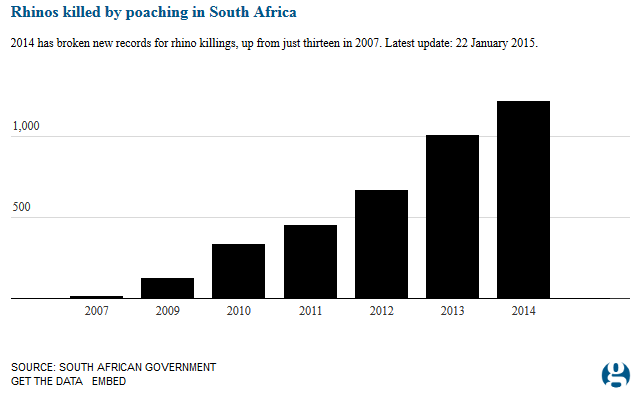
Until 2008, conservationists, in some places at least, appeared to be winning. But in that year the number of rhinos killed in South Africa rose (from 13 in 2007) to 83. By 2011, the horrible tally had risen to 448. It climbed to 668 in 2012, 1004 in 2013 and 1215 in 2014. In the first four months of this year, 393 rhinos have been killed there, which is 18% more than in the same period last year.
The reasons for this acceleration in the Great Global Polishing are complex and not always easy to tease out. But they appear to be connected to rising prosperity in Vietnam, the exhaustion of illegal stocks held by Chinese doctors and, possibly, speculative investment in a scarce and tangible asset during the financial crisis. Corruption and judicial failure help to keep the trade alive.
Already, the western black rhino is extinct (the declaration was made in 2011). The northern white rhino has been reduced to five animals: a male at the end of its anticipated lifespan and four females, scattered between Kenya, the US and the Czech Republic.
Similar stories can be told about some populations of elephants – in particular the forest elephants of West and central Africa.
It’s not just these wonderful, enchanting creatures that are destroyed by poaching, but also many of the living processes of the places they inhabit. Elephants and rhinos are ecological engineers, creating conditions that hundreds of other species have evolved to exploit.
As the paper in Science Advances notes, the great beasts maintain a constantly shifting mosaic of habitats through a cycle of browsing and toppling and trampling, followed by the regrowth of the trees and the other plants they eat. They open up glades for other herbivores, and spaces in which predators can hunt. They spread the seeds of trees that have no other means of dispersal (other animals are too small to swallow the seeds whole, and grind them up). Many trees in Africa and Asia are distributed exclusively by megaherbivores.
They transport nutrients from rich places to poor ones and in some places reduce the likelihood of major bushfires, by creating firebreaks and eating twigs and leaves that would otherwise accumulate as potential fuel on the ground. Many animal species have co-evolved with them: the birds that eat their ectoparasites, the fish that feed on hippos’ fighting wounds (some of these species, I believe, are now used for fish pedicures), the wide range of life that depends on their dung for food and moisture, on their wallows for habitats, on the fissures they create in trees for nesting holes.
Who knows what ecological processes the world has already lost through the retreat of the megafauna? Everywhere on earth, living systems have been radically altered by the loss of the great beasts. (I’ll be discussing the impacts of the extinction of European elephants in next month’s edition of BBC Wildlife magazine).
The destruction of some of the last populations of the animals that shaped us, as well as the natural world, inflicts, I feel, a great wound in our lives, diminishing the wonderful planet on which we evolved, shrinking imagination, crushing experience. All of us should have an interest in supporting those who seek to save these wonderful creatures.
Dear Reader, I don’t intend to cast you in some dark mental place with the republication of this dark essay from Mr. Monbiot. Yet if you care about the world that we are leaving for the next generation, and I’m certain that the majority, the vast majority, of you readers do so care, then these terrible aspects of humanity must be highlighted. For if just one person is moved to make a difference then the mental pain is a necessary step on that journey of making a difference.
“Always search for the rainbow – it’s there somewhere. If
I don’t know if my title to today’s post is part of a saying that is well-known in the USA. But back in dear old England the expression is widely used; the full expression being, “Lies, Damn Lies, and Politicians“.
So what’s got my ‘knickers in a twist’ about the various hues of ‘truth’ that we find amongst our politicians?
Before answering that question, perhaps I should answer a more fundamental question that might be arising in the minds of those followers who are relatively new to this place. (And each and every one of you has to understand the very great privilege you offer me by being a follower.) That question being what have integrity and politicians got to do with a blog about dogs?
The article seemed to articulate, in a measured and responsible fashion, what huge numbers of us sense subjectively: truth is rare to see in the world of power and politics.
I’m not going to republish it in full, including the tables, but will offer the first half with a link to the rest of the article. The author of the article is Dr. Ellis Jones, Assistant Professor of Sociology at the College of the Holy Cross in Worcester, MA.
How many ways can politicians ‘lie’? How a class led to a ‘truth’ report card for the 2016 election.
I regularly teach a course called The Sociology of Television & Media in which my students and I critically explore newscasts, entertainment programming and (both commercial and political) advertising. The theme that I use as a touchstone throughout the class is: What happens when, as a society, we begin to mix fantasy and reality together in mass media?
We discuss how a range of troubling outcomes emerge for a public that has difficulty telling truth from fiction. Max Horkheimer, a German-Jewish sociologist, argued that this is part of what led to the rise of Nazism in Germany.
Once we lose our ability to detect lies, we become vulnerable to demagogues.
Six categories of rhetoric
About halfway through the semester, I have students deconstruct political ads, and we discuss practical resources for navigating the web of truths, half-truths and outright lies that proliferate unhindered during each election cycle.
One resource that I offer is Politifact.org’s Truth-o-Meter. Students fact-check politicians’ statements to determine how much, if any, truth is contained therein (they actually won a Pulitzer Prize for their work fact-checking the 2008 election).
The first, and perhaps most important, takeaway from their work is that modern political statements cannot accurately be rated as simply “true” or “false.” So sophisticated has the art of mixing truth and lies become that the scale Politifact currently uses includes six separate categories of political rhetoric: true, mostly true, half true, mostly false, false and “pants on fire” (for statements that aren’t just false but also completely ludicrous – and yet still stated as truth).
In essence, while there is still but one way to tell the truth, there are now at least five times as many acceptable ways to lie.
Boehner’s team was apparently trying to compare global sales of antacids (including all seven billion people on the planet) to US spending on elections (about 320 million of us) – a false comparison.
On April 23 2015, Hillary Clinton provided a good illustration of a statement that rates as a “half truth.” When addressing the Women in the World Summit in New York City, Clinton asserted that the US ranks “65th out of 142 nations” when it comes to equal pay for women. The statistic comes from the World Economic Forum’s 2014 Global Gender Gap Report.
However, the primary measure generated by this report ranks the US 20th in gender equity. The ranking of 65th is taken from a subcategory in the report that relies on a survey of perceptions of executives rather than hard numbers. So, while it is technically true, it may actually be overstating the severity of the gender pay gap comparison.
Whom can we trust?
The second takeaway, though it may not be much of a surprise, is that there are no politicians in this country that exclusively tell the truth. Every single one, to a greater or lesser extent, spins, bends, twists or breaks the truth.
Perhaps this is the price of power in our modern democracy, but we should find it at least a little troubling.
So where does this leave us? Well, knowing that every one of our politicians lies, the most important question, in my mind, becomes: Who is most often telling the truth and who is lying to us repeatedly in order to gain our support?
In other words, whom can and whom can’t we trust?
With this question in mind, I had my students add up the raw numbers for 25 major politicians (based on Politifact’s fact-checking over the past eight years) and write the results up on the board in rank order from most to least honest based on the data. The results were intriguing.
While the prototype point system was not particularly sophisticated (two points for each true statement, one point for each mostly true statement, zero for half-truths, etc.), the numbers revealed that many well-known politicians were abusing the truth far more than they were embracing it.
When I asked the class what they thought of the results, one student raised her hand and replied, “I’m not shocked.” Many of the others immediately nodded their heads in agreement.
I wondered if we’ve become so accustomed to the bending and breaking of the truth that we no longer expect truth from our leaders. Now we’re teaching the next generation not to expect it either.
After seeing these preliminary results, I was hooked.
Please do read the rest of this fascinating and hugely helpful report. It names names in terms of the ‘good, bad and ugly’!
However, the closing paragraphs of Dr. Jones’ article are so wonderful that I can’t resist republishing them!
As teachers, caught up in our own subject matter, we easily forget that our students are hungry to apply what they’re being taught in our classes to something meaningful in their own lives.
It is our obligation to offer each generation a sense of social responsibility, hope for the future and the practical tools that will allow them to build it for themselves.
Something like a yearly Honesty Report Card might serve us well at this point in our democracy’s evolution. At the very least, let’s use this idea as a starting point for some kind of political unity in this country.
Whether you are liberal or conservative, can’t we at least agree that our politicians should start telling us the truth?
At this point in preparing today’s post, I wanted, wanted so much, something to take me away into some dreamy corner of my mind. For just a few minutes to be distracted from the present day realities of life.
I chose to do it by listening to this track from Chris Rea.
This could be the most important lesson we learn from our dear dogs.
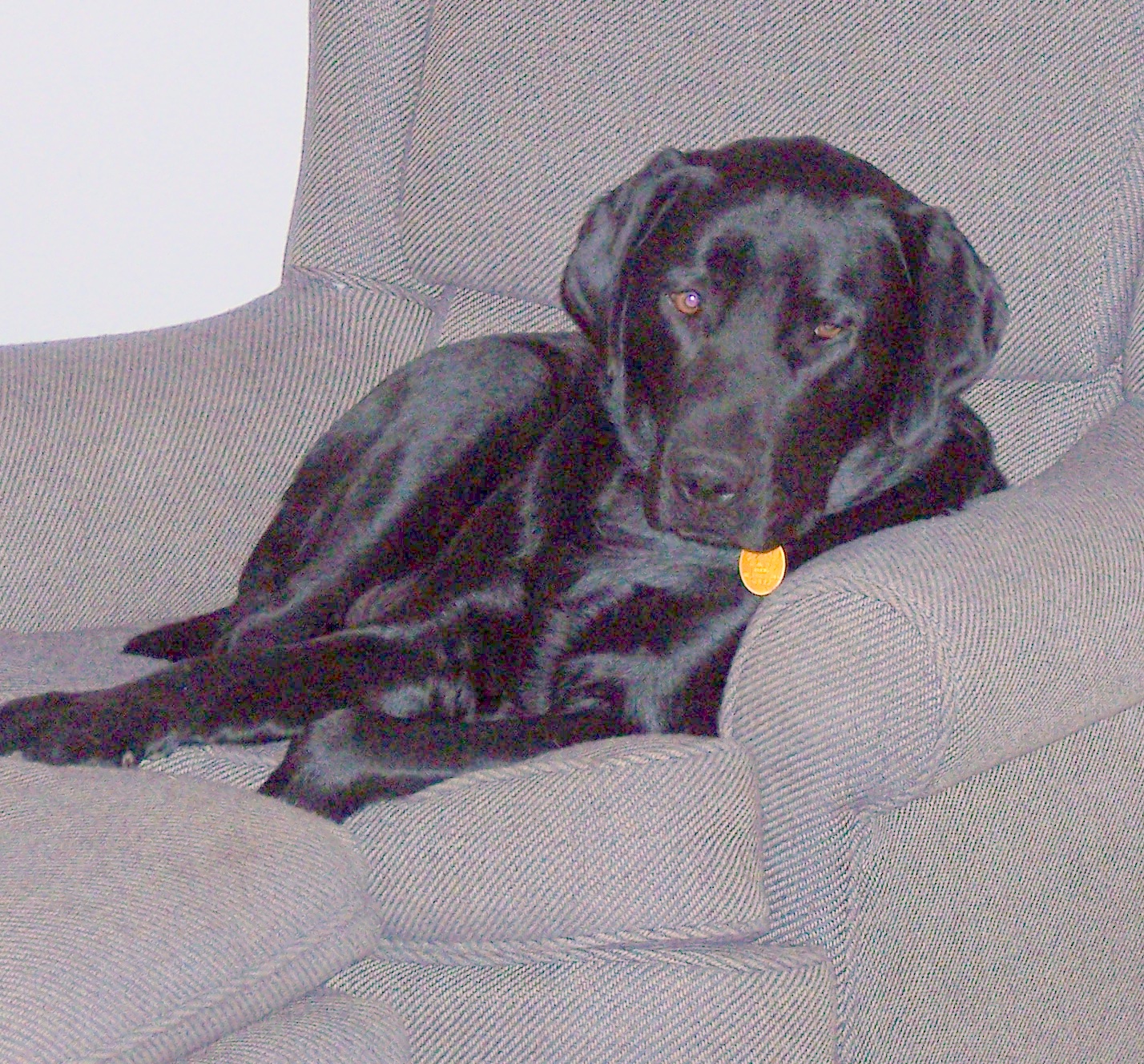
Reclining Clyde
Our immediate neighbours to the South of us, Larry and Janell, lost one of their dogs last Saturday. Here’s the email that was sent out by Larry:
Bad day at the ranch
We lost Clyde today. A neighbor who is a veterinarian came by this morning and did the deed. He had cancer in his shoulder, we had a tumor removed a couple of months ago but there must have been some left because his left front became totally unusable and then his left rear started to go too. We tried everything that the vets could come up with but it was starting to eat him up.
He was born in central South Dakota at a cattle ranch where I got him in April 2004, a six week old black bundle of wrinkles. He learned his manners from Barney, who we lost a little over 2 years ago from cancer as well. Barney and Clyde, what a GREAT pair!!
We still have Baxter the Aussie, who has pretty well recovered from getting hit by a car and severely injured the beginning of last month and Bob the cat.
I will miss Clyde terribly, just like I have ALL my labs! They are wonderful dogs. Just thinking that I’ll probably never have another big floppy eared pal like that makes me want to just cry my eyes out!!
One of the fondest memories of my life is/was going bird hunting, especially ducks, and having a well mannered lab as my partner!! I’ve shared time and my lunch with some good ones!! I so very much wish/hope that there really is a “RAINBOW BRIDGE”!!
Jean and I obviously knew Clyde and can confirm that he was the most gentle, kind-hearted dog one could find.
I wanted to treasure the memory of Clyde, on behalf of all the dear dogs in the world, and asked Larry and Janell if they would be comfortable with me publishing the email. They replied without hesitation that it was fine and then sent me some photographs of Clyde to include in this post.
———-
So the easy course for this post would be to leave it at this and move on. (And, please, if you are not up for a degree of introspection from yours truly, then do stop reading at this point!)
———-
But when I awoke this morning (Tuesday), a little after 5am, Jean still asleep next to me, three dogs likewise across the bed, and knowing I would be writing about Clyde later on in the day, I started to reflect on life and death and was there a lesson for us humans in the death of our beloved dogs. When Jean awoke an hour later, I asked her how many of her dogs had died over the years. She replied that there had been at least twenty dogs that had died and that she could remember each and every one of them.
That then opened up a much deeper reflection on death and whether our dogs really can offer us a lesson in this regard. For I’m not ashamed to admit that at times I feel scared about the future. I’m 70-years-old, seeing the signs of what the medics call ‘cognitive ageing’, have a few minor challenges in the areas of prostate, blood pressure, thyroid, and know how terribly unprepared I am for the second of life’s two certainties: death.
Jean’s view was that dogs have the ability to live so perfectly in the present that, except in very rare occasions, they don’t grieve for the loss of a loved one. Clearly, a significant difference between dogs and us humans.
Then it was clear that we humans only grieve for the death of someone we knew. That within the family that rarely extended back beyond our grand-parents. That seemed to offer some philosophical help. For if it comes down to the memories that others will have of us, after we have died, then it behoves us to live the best life we can, doing our best at every stage in our lives. Accepting that it is impossible not to make mistakes and end up with regrets, yet so long as we try to be true to ourselves then that’s all that matters.
It was then a very small onward step to love and the potential for the greatest learning from our dogs. For dogs so frequently show us the magic of unconditional love.
Back to Clyde.
Here are two other photographs of dear Clyde, separated by the words in Larry’s covering email.
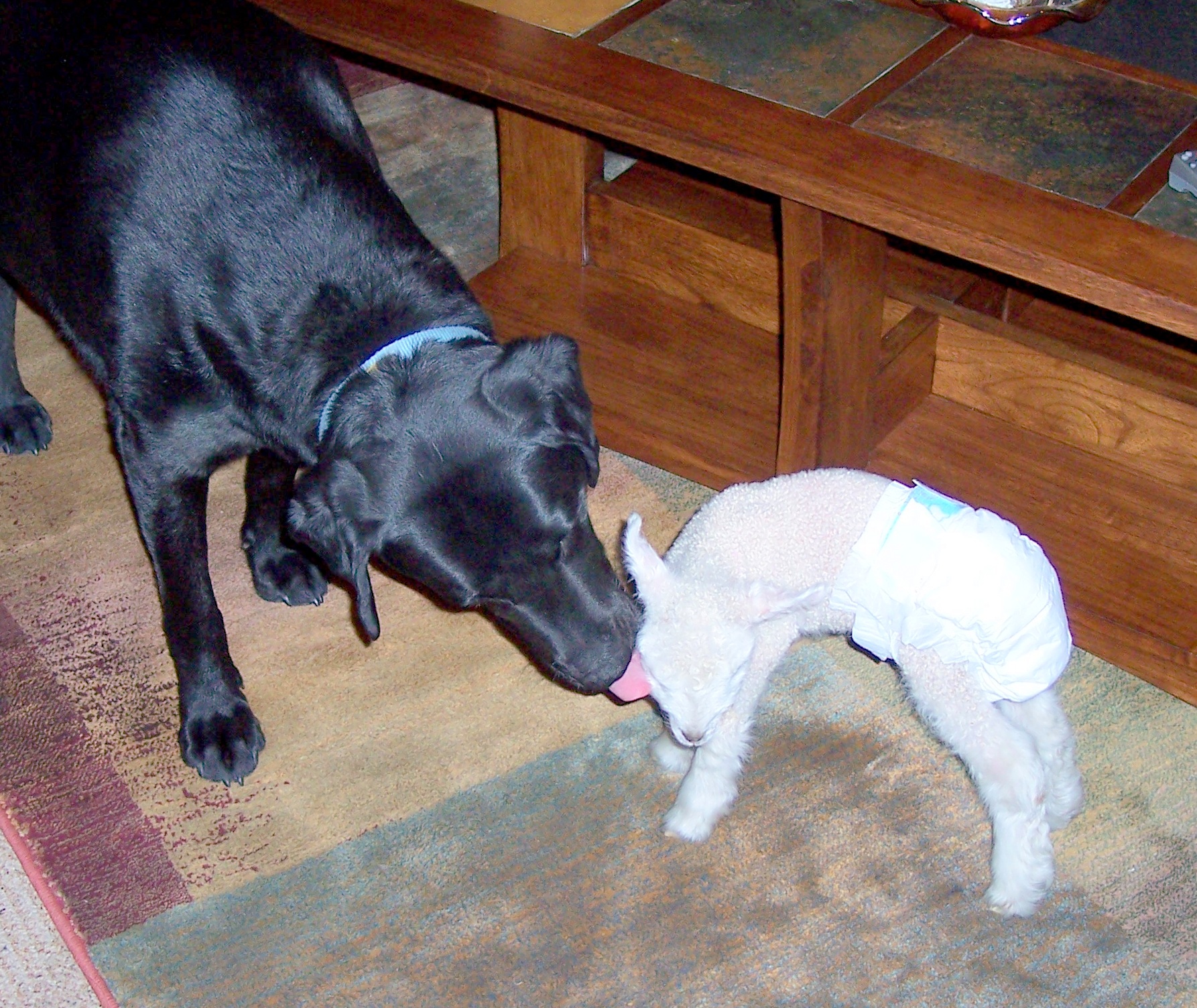
Clyde cleaning Pearl the lamb.
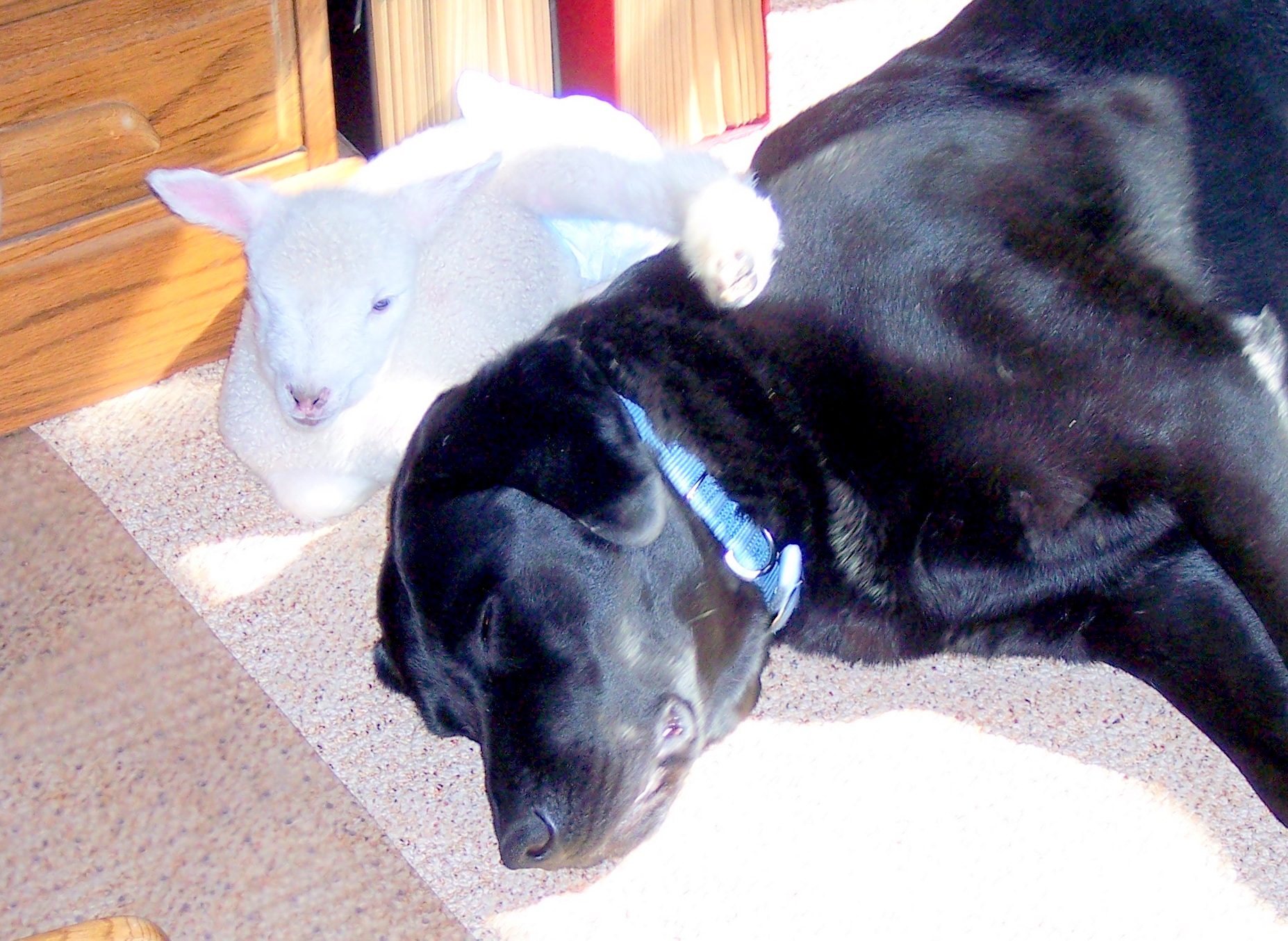
Paul, here are a few pictures of Clyde. Feel free to use what you like. We always said Clyde had a big heart, big stomach and no ambition as evidenced by these pictures! At one time we were nursing an orphan lamb in the house, Clyde adopted the lamb, Pearl, and looked after her, Larry.
Clyde and Pearl demonstrating a dear friendship.
I know that when our Lilly dies, she is 17, Jean will weep many tears.
I know that when our Pharaoh dies, he is soon to be 12, I will weep many tears.
But those pictures of Clyde remind all of us that it is in life that it is important to love. Important, almost beyond words, to be kind to others, to offer and receive love, and to treasure the present.
So, yes, we must shed a few tears of the heart yet thereafter we must treasure the memories.
“For if we cry at losing the sun, our tears will hide the light of the stars.”
Just a very beautiful true story. (And I am indebted to Suzann for sending it on to me.) One couldn’t ask for a better post to follow on from yesterday’s Picture Parade theme on parenting.
ooOOoo
The Greyhound
In 2003, police in Warwickshire, England, opened a garden shed and found a whimpering, cowering dog. The dog had been locked in the shed and abandoned. It was dirty and malnourished, and had quite clearly been abused.
In an act of kindness, the police took the dog, which was a female greyhound, to the Nuneaton Warwickshire Wildlife Sanctuary, which is run by a man named Geoff Gruecock, and known as a haven for animals abandoned, orphaned, or otherwise in need.
Geoff and the other sanctuary staff went to work with two aims: to restore the dog to full health, and to win her trust. It took several weeks, but eventually both goals were achieved. They named her Jasmine, and they started to think about finding her an adoptive home.
Jasmine
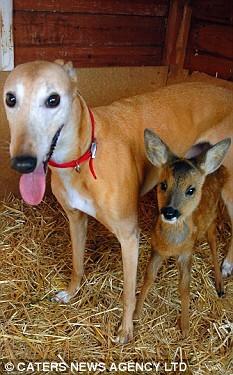
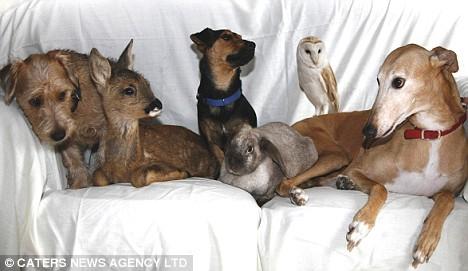
Jasmine, however, had other ideas. No one quite remembers how it came about, but Jasmine started welcoming all animal arrivals at the sanctuary. It would not matter if it were a puppy, a fox cub, a rabbit or, any other lost or hurting animal. Jasmine would just peer into the box or cage and, when and where possible, deliver a welcoming lick. Geoff relates one of the early incidents. “We had two puppies that had been abandoned by a nearby railway line. One was a Lakeland Terrier cross and another was a Jack Russell Doberman cross. They were tiny when they arrived at the centre, and Jasmine approached them and grabbed one by the scruff of the neck in her mouth and put him on the settee. Then she fetched the other one and sat down with them, cuddling them.” “But she is like that with all of our animals, even the rabbits. She takes all the stress out of them, and it helps them to not only feel close to her, but to settle into their new surroundings. She has done the same with the fox and badger cubs, she licks the rabbits and guinea pigs, and even lets the birds perch on the bridge of her nose.” Jasmine, the timid, abused, deserted waif, became the animal sanctuary’s resident surrogate mother, a role for which she might have been born. The list of orphaned and abandoned youngsters she has cared for comprises five fox cubs, four badger cubs, fifteen chicks, eight guinea pigs, two stray puppies and fifteen rabbits – and one roe deer fawn. Tiny Bramble, eleven weeks old, was found semi-conscious in a field. Upon arrival at the sanctuary, Jasmine cuddled up to her to keep her warm, and then went into the full foster-mum role. Jasmine the greyhound showers Bramble the roe deer with affection, and makes sure nothing is matted. “They are inseparable,” says Geoff. “Bramble walks between her legs, and they keep kissing each other. They walk together round the sanctuary. It’s a real treat to see them.” Jasmine will continue to care for Bramble until she is old enough to be returned to woodland life. When that happens, Jasmine will not be lonely. She will be too busy showering love and affection on the next orphan or victim of abuse. Pictured left to right are: “Toby”, a stray Lakeland dog; “Bramble”, orphaned roe deer; “Buster”, a stray Jack Russell; a dumped rabbit; “Sky”, an injured barn owl; and “Jasmine”. All told a mother’s heart doing best what a caring mother does.
ooOOoo
It was but a moment to find a video about Jasmine over on YouTube:
We are completely self funded. We receive no financial backing and so have to raise every single penny towards the upkeep of the sanctuary. It costs on average £360 per week to keep the sanctuary open, and a further £120 per week on food and bedding for the animals in our care. Please help us continue to rescue and rehabilitate Britain’s wildlife.
If you go to this link you can see what would be the best donation method for you. Plus, because the Sanctuary is not open for callers on Sundays I will call today (Monday) * and see if there are more details about the best way to offer support from those living outside the UK. Unconditional love is so perfectly demonstrated by our incredible dogs.
* I did call and speak with Catherine who recommended PayPal as the best means of donating to their cause, especially for those outside the UK.
36 golden retrievers rescued from streets of Turkey
Rescuers in Atlanta shower the lucky pups with love, medical attention and playtime.
By: Mary Jo DiLonardo
Tue, May 12, 2015 at 04:00 PM
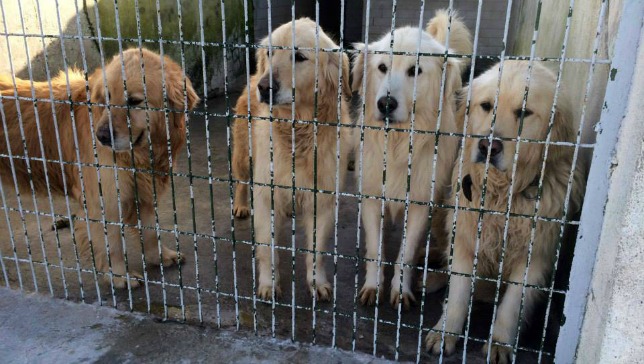
Golden retrievers are packed into an animal shelter in Turkey before being rescued and flown to Atlanta. (Photo: Adopt a Golden Atlanta/Facebook)
Three dozen abandoned golden retrievers made the long trek from the streets of Istanbul, Turkey, to an Atlanta suburb this week thanks to the efforts of an animal rescue group.
The dogs were discovered by an American living in Turkey, who said she saw them living on the streets and taking over shelters. The breed was once considered a status symbol, but as the dogs became more prolific, their popularity waned and the pets were quick to be discarded. On the harsh streets of Istanbul, the gentle dogs didn’t fare well against vicious feral dogs.
Adopt a Golden Atlanta arranged for 36 of the dogs to be flown to the U.S. where they’re now housed at the Pet Lodge Pet Resort in Alpharetta, an Atlanta suburb. They’ve been given medical attention, baths and lots of playtime. Although they don’t yet understand English commands, volunteers say they seem happy with all the attention — wagging tails all around.
[See footnote]
The goldens made a 12-hour flight and seven-hour layover to get to their new home. They range in age from 6 months to 10 years.
The pups should be available for adoption in a few weeks, and they already have names, says Adopt a Golden founder Lauren Genkinger, who spearheaded the rescue effort.
“They’re the freedom dogs and all of them have been given names, Freedom, Patriot, Liberty, Glory…” Genkinger told WXIA TV in the video above. “It wasn’t easy coming up with 36 patriotic names. The only thing missing from this story … is someone to call America in from the yard … to dinner.”
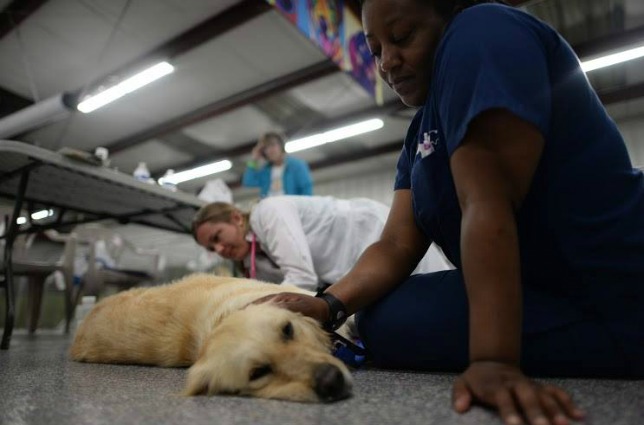
A golden retriever is examined in Atlanta after arriving from Turkey. (Photo: Adopt a Golden Atlanta)
ooOOoo
Footnote:
There is a two-minute video in the MNN version that I was unable to transport over to here. It may be watched here.
There was an item on the BBC News website yesterday morning that jumped out at me. The BBC headline is my sub-title for today. Here’s how the BBC opened that item:
Actor Johnny Depp has been told he has until Saturday to remove his dogs from Australia or they will be put down.
Depp and his wife Amber Heard are accused of not declaring Yorkshire Terriers Boo and Pistol to customs officials when they flew into Queensland by private jet last month.
Australia has strict animal quarantine laws to prevent importing infections.
Agriculture Minister Barnaby Joyce said he understood the dogs were being sent back to the US.
The dogs were discovered when a picture was posted of them at grooming parlour.
Later on that BBC report mentioned:
An online petition to save the “cute dogs” had received nearly 5,000 signatures by late on Thursday local time in Australia.
“Have a heart Barnaby! Don’t kill these cute puppies,” it appealed.
OK, Mr. Depp was a silly boy but his mistake must not be paid for with the lives of these wonderful dogs.
That petition is over on Change.org and here is the direct link. You will read these details.
There’s just 48 hours before Johnny Depp’s two puppies Boo & Pistol could be euthanised by Australian authorities. Please help save them!
Johnny Depp brought them to Australia with him to shoot the next Pirates of the Caribbean.
But today Agriculture Minister Barnaby Joyce has said that because he didn’t follow particular travel rules that he’ll seize and destroy them by the weekend if they’re not removed from Australia.
This seems so extreme and unnecessary. He shouldn’t kill these cute dogs simply because Depp didn’t follow particular rules.
Help me tell Barnaby Joyce not to kill or remove Johnny Depp’s dogs from Australia!
Have a heart Barnaby! Don’t kill these cute puppies.
On Monday I published a post Hope Has A Place. It was based upon the hauntingly beautiful track of the same name from Enya. Then yesterday, serendipitously, came The watering hole. Both of those posts, although miles apart in terms of content, nonetheless seemed to subscribe to a common theme. That being that the more that everyday people, good common folk from all around the world, share their feelings, the more likely that those self-same people will make a difference. A positive difference!
Now don’t get me wrong! By presenting these recent posts I am not setting myself up to be anything other than just another everyday person and dog lover who just happens to enjoy sharing stuff via this blog.
Regular readers of this place will recall that a week ago I celebrated Earth Day with a post called Our beautiful, life-giving trees. It included this picture:
We must sing for our trees.
Then on the following day in a post called Now life-giving geese (by the way, the five baby goslings are doing really well!) I included this photograph:
And sing for them at all ages!
Yesterday morning I received the latest post from Sue Dreamwalker. It was an impassioned plea to do something and to stop the madness. Sue, in turn, had republished the post that had appeared on Endless Light and Love.
The theme that seems to be developing this week, unplanned I should hasten to add, is that it is all too easy to be overwhelmed by the scale of change that has to take place, must take place, if this generation (I’m a 1944 baby) can die knowing that it will be alright in the end. Because it is my generation that has been responsible, has created the circumstances, for the end of life as we have all known it if nothing is done, and done in the next decade or two.
So to trees.
Our trees are both a symbol for and an indicator of the overall health of our planet.
To close off this part of my two-day post, please watch this short video.
Uploaded on Apr 1, 2015
Trees give us beauty, shade, food, clean water, oxegen, medicine, housing, fresh air, habitat and happiness. For the cost of a craft beer, or a couple of cups of coffee you can protect a specific threatened forest. Each Stand for Trees certificate offsets 1 ton of carbon from the atmosphere while providing income to local forest communities. Income that supports education, healthcare, clean water and sustainable livelihoods. Trees stand for us, isn’t it time we stand for trees?
Tomorrow, I will return to hope. Perhaps better written, return with hope.
Before you read any further please listen to Enya’s mesmerisingly beautiful track whilst reading the lyrics.
One look at love and you may see
It weaves a web over mystery,
All ravelled threads can rend apart
For hope has a place in the lover’s heart.
Hope has a place in a lover’s heart.
Whispering world, a sigh of sighs,
The ebb and the flow of the ocean tides.
One breath, one word may end or may start
A hope in a place of the lover’s heart.
Hope has a place in a lover’s heart.
Look to love you may dream,
And if it should leave then give it wings.
But if such a love is meant to be;
Hope is home, and the heart is free
Under the heavens we journey far,
On roads of life we’re the wanderers,
So let love rise, so let love depart,
Let hope have a place in the lover’s heart.
Hope has a place in a lover’s heart.
Look to love and you may dream,
And if it should leave then give it wings.
But if such a love is meant to be;
Hope is home, and the heart is free.
Hope is home, and the heart is free.
I have this notion in my head that we humans are predisposed to give priority to bad news over good news. I guess it does make sense especially when one reflects on likely times a few centuries back; or more.
However, I am certain that I am not alone in disliking intensely the predominance of ‘alarmist’ news headlines in all forms of media. We neither have broadcast television here at home nor subscribe to a daily newspaper although I do admit to dropping in regularly to the BBC News website.
The other morning I awoke a little before 5am and not wanting to awaken Jeannie decided to listen to some music using my iPod and earphones. I had a couple of Enya albums on the iPod and soon was listening to her album The Memory of Trees. Then up came track seven, Hope Has A Place, sung by Enya, composed by Roma Ryan.
I had forgotten how incredibly beautiful was the track.
Then my mind moved to reflecting on the life I have here at home with Jean and the dogs. There were three dogs sleeping on the bed while the track was playing: Hazel, Sweeny and Pedy.
How the love I receive from the dogs and the love I receive from Jean give me such freedom. Such emotional freedom to be the person I truly want to be. So perfectly expressed in the closing line of the lyrics: Hope is home, and the heart is free.
At this juncture I paused in writing this post, it was a little after 2pm yesterday, grabbed my camera and went into the living room. The two photographs below reinforce my message.
oooo
Sweeny, Pedy and Jeannie – bountiful, unconditional love!
The last two posts have offered two aspects of our bountiful Nature. First we had Earth Day and the celebration of our trees. Then yesterday we had the celebration of the birth of five Canada Geese goslings.
So it seemed appropriate to continue the theme for another day.
Earlier this month there was an article over on MNN that I saved for later use simply because the message it offered was counter-intuitive. Here’s how that article opened:
Deforestation vs. nature: The winner might surprise you
Large-scale tree-planting projects, abandoned farmland help balance out rain forest destruction.
By: Michael Graham Richard
Wed, Apr 08, 2015 at 10:11 AM
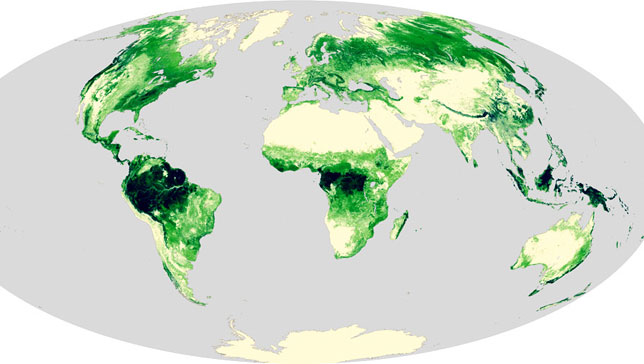
Forest canopy heights are highest near the equator and generally decrease the closer forests are to the poles. (Photo: NASA)
For decades, we’ve been hearing about how the world’s forests are under attack, how the equivalent of “36 football fields of the world’s forests are being cut every minute.” With all this pressure on nature, could the Earth possibly be getting greener? Not a chance, right? Surprisingly, that’s what a team of scientists discovered when they looked at two decades’ worth of data from satellites that use a technique called “passive microwave remote sensing,” which allows researchers to measure how much biomass, or living matter, is present on the surface of the planet.
The researchers found that despite ongoing deforestation in the rain forests of South America and Southeast Asia — a huge problem, regardless of what happens elsewhere — other regions outside the tropics, such as Africa and Australia, have been improving enough to offset the losses. Some of the more unexpected sources of this extra biomass are farmland abandoned after the fall of communism where forests have spontaneously regrown in the former Soviet republics, as well as in areas of China where large-scale tree planting projects took place.
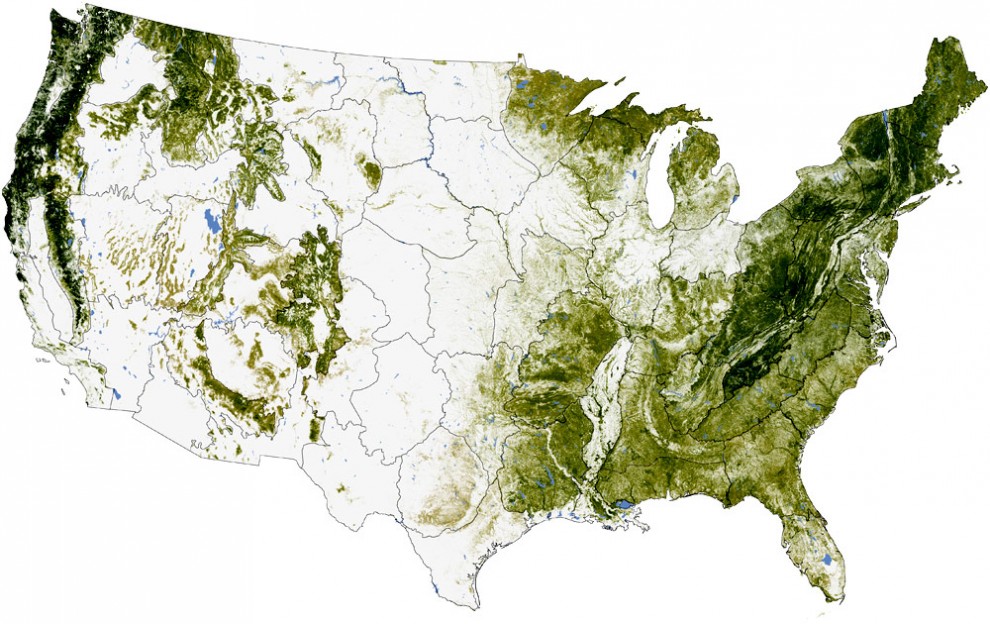
What really caught my eye was another photo from NASA that showed the biomass stored in trees in the USA.
The concentration of biomass stored in trees in the U.S. The darkest greens reveal the areas with the densest, tallest, and most robust forest growth. (Photo: NASA)
But as the article reminded readers:
We’re only talking about biomass quantities being offset, though; the loss of rain forests also mean the loss of many species of animals and plants, as well as unique habitats that can’t be replaced by other regions elsewhere, such as the savannah of Africa or the Australian Outback. So while this is good news, we can’t declare victory over deforestation just yet!
Nonetheless, I am sure that I am not the only one to welcome this reminder of the power of Nature. Or in the closing words of that MNN article:
In the period between 2003-2012, the total amount of vegetation above the ground has increased by about 4 billion tonnes of carbon. Any way you slice in, 4 billion tonnes is significant!
This is particularly important because around 25 percent of the CO2 that we release into the atmosphere by burning formerly buried hydrocarbons is absorbed by plants, so having more of them can help slow down (but not stop) climate change, and there’s a limit to plants’ rate of absorption. Still, it’s nice to get good news for a change …
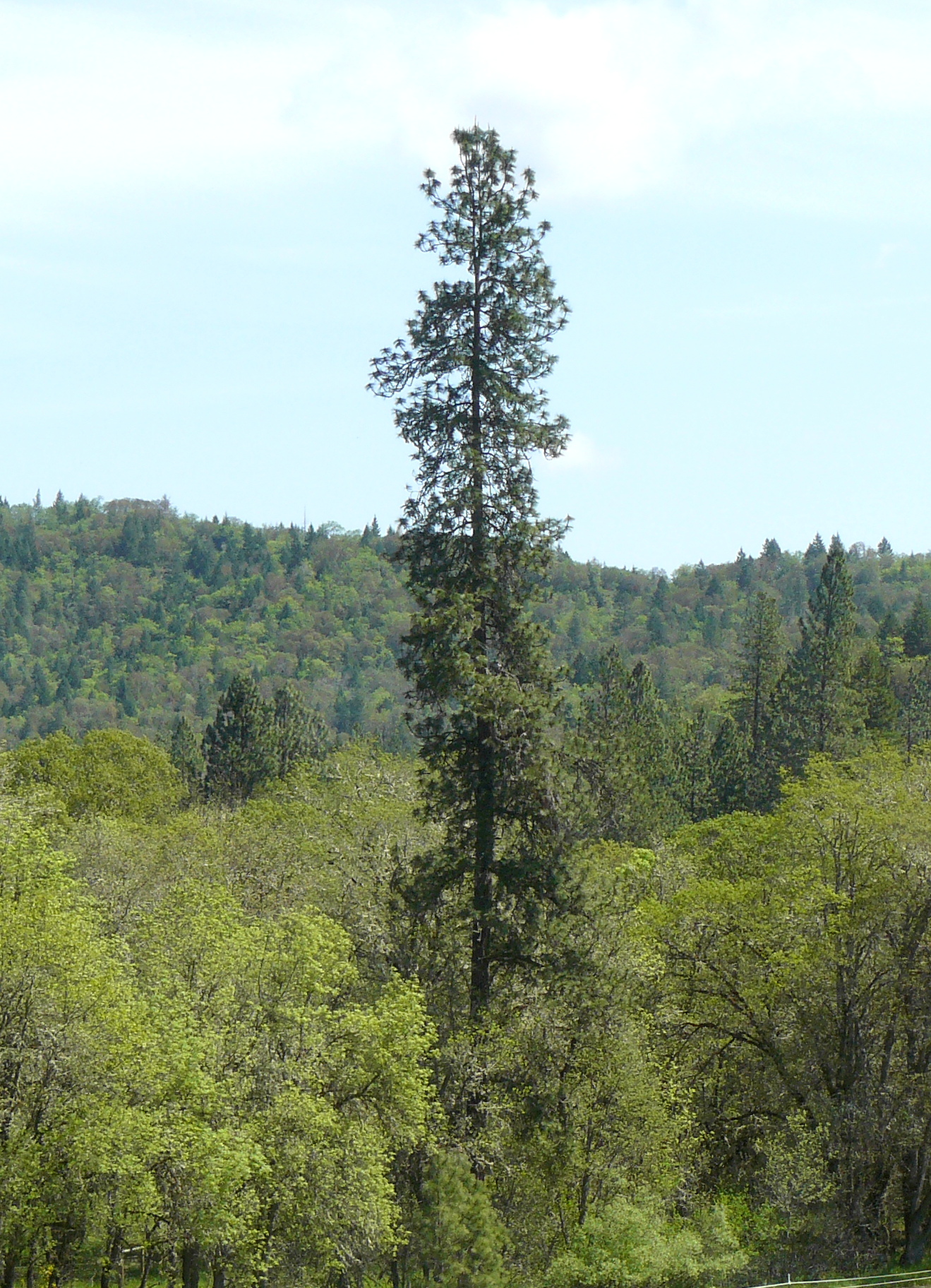
While it may be a long way yet from them being tonnes of carbon, let me close with three pictures of ‘increasing tree biomass‘ right here on Hugo Road in Merlin, Oregon.
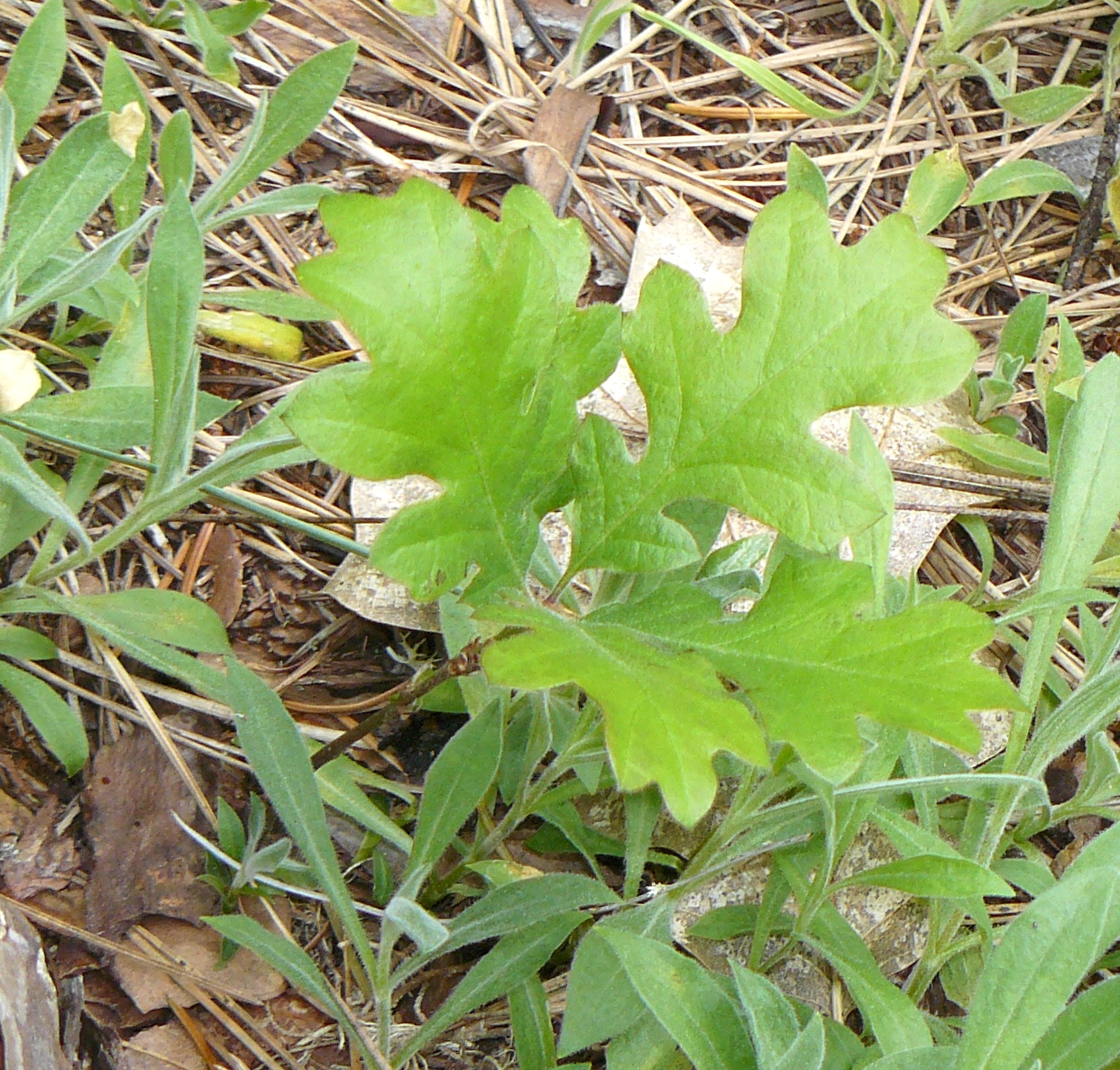
The oak.
oooo
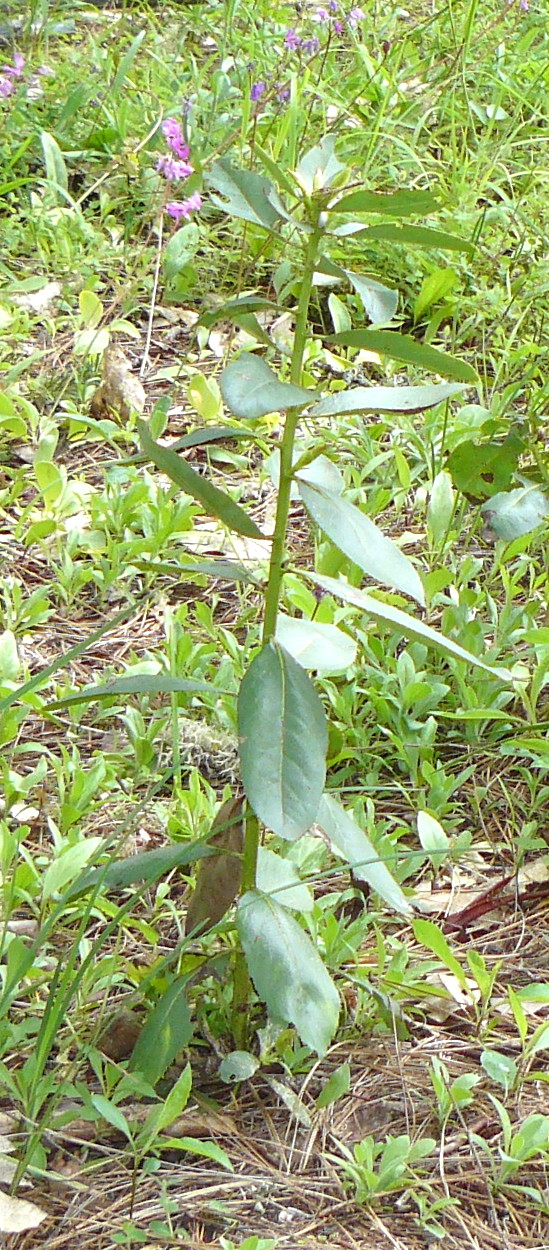
The madrone.
oooo
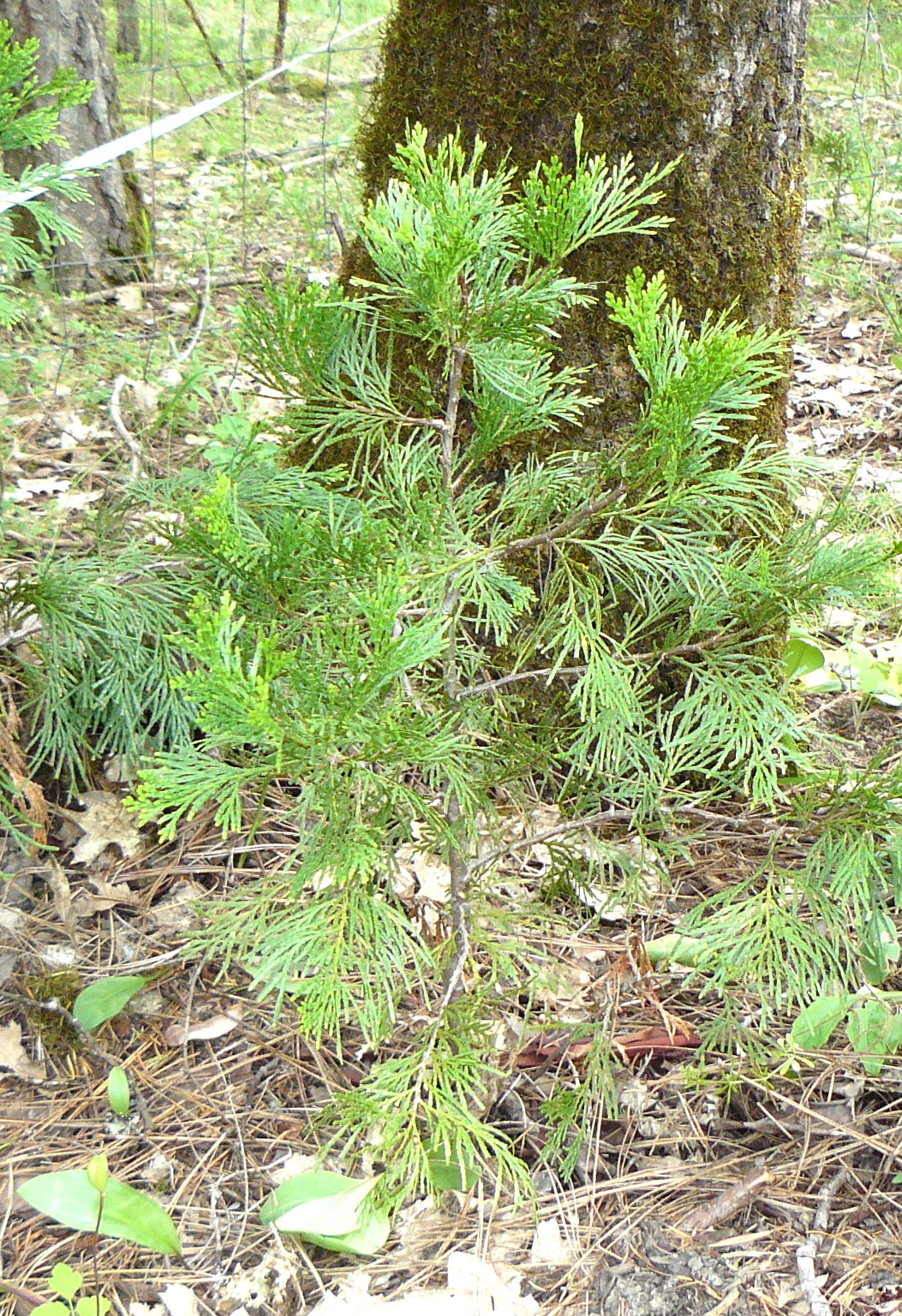
The cedar.
Nature really does have all the answers to man’s long-term survival.