Yesterday it was gliding, tomorrow it is going to be a celebration of Pharaoh’s 14th birthday and today it is about you!
Kadam Morten Clausen is a Buddhist teacher. Now I would be the first to stick up my arm and say that my understanding of Buddhism is pretty poor. But in the days many years back when I spent time exploring a number of Asian countries I found the culture surrounding Buddhism very appealing. (And I write as someone who is not a religious believer.)
Back to Morten Clausen.
The Kadampa Meditation Center in New York, where Kadam is a resident teacher, describe him as follows:
Kadam Morten met his teacher, Geshe Kelsang, while attending university in England. He taught widely throughout the UK and helped develop many Kadampa Centers in England. Kadam Morten has been teaching in the US for more than 20 years and has established centers throughout the New York area, as well as Washington DC, Virginia, and Puerto Rico. In addition to his local teaching responsibilities, he teaches and guides retreats regularly throughout the United States and Europe.
Kadam Morten is greatly admired as a meditation teacher and is especially known for his clarity, humor and inspirational presentation of Dharma. His teachings are always practical and easy to apply to everyday life. Through his gentle and joyful approach and his peaceful example, he has helped many people find true happiness in their hearts.
So what’s this all about when I say that today’s post is about you?
Evan Thompson of the University of British Columbia has verified the Buddhist belief of anatta, or not-self. Neuroscience has been interested in Buddhism since the late 1980s, when the Mind and Life Institute was created by HH Dalai Lama and a team of scientists. The science that came out of those first studies gave validation to what monks have known for years — if you train your mind, you can change your brain. As neuroscience has begun studying the mind, they have looked to those who have mastered the mind.
While Buddha didn’t teach anatta to lay people, thinking it might be too confusing, the concept is centered on the idea that there is no consistent self. The belief that we are the same one moment to the next, or one year to the next, is a delusion. Thompson says that “the brain and body is constantly in flux. There is nothing that corresponds to the sense that there’s an unchanging self.”
[W]hen there is no consistent self, it means that we don’t have to take everything so personally.
It is useful to look at a video of yourself from the past, or read something you wrote years ago. Your interests, perspective, beliefs, attachments, relationships, et al, have all changed in some way. Anatta doesn’t mean there’s no you; it just means that you are constantly changing, constantly evolving, and shape-shifting. Why is this important? Why does it matter if there’s no solid “you” or “me”?
Buddhist teacher Kadam Morten Clausen says Buddhism is a science of the mind:
Dr. Rick Hanson, author of Hardwiring Happiness and Buddha’s Brain, argues that when there is no consistent self, it means that we don’t have to take everything so personally. That is, our internal thoughts are only thoughts and don’t define us. External events are only external events and aren’t happening to us personally. Or as Tara Brach says, our thoughts are “real, but not true.”There is tremendous liberation in not identifying ourselves with thoughts, or a set idea of who we are.
It is then that we can grow and change, with the help of neuroplasticity. There is then hope that we can overcome our vices or bad habits (of mind and body), because if we aren’t stuck with the self-limiting beliefs inherent with a consistent self, we may orient ourselves toward becoming more of who we want to be.
The belief that we are the same one moment to the next, or one year to the next, is a delusion.
As science and Eastern thought continue to hang out with each other, there may be more 21st Century studies to back up 2,600-year-old thoughts. But, as HH Dalai Lama said, “Suppose that something is definitely proven through scientific investigation. … Suppose that that fact is incompatible with Buddhist theory. There is no doubt that we must accept the result of the scientific research.”Hearing a pro-science stance from a religious leader is a relief to many. In the end it seems Buddhism and neuroscience have similar goals: What is this thing we call the mind, and how can we use it to make ourselves a little less miserable and a little happier? Maybe even just 10 percent happier, as Dan Harris wrote. If there is no consistent self, it is at least my intention that my ever-changing self be equanimous and, well, 10 percent happier. No matter who I am.
—
Lori Chandler is a writer and comedian living in Brooklyn, NY, which is the most unoriginal sentence she has ever written. You can look at her silly drawings on Tumblr, Rad Drawings, or read her silly tweets @LilBoodleChild. Enough about her, she says: how are you?
PHOTO CREDIT: Chris McGrath/Getty Images
ooOOoo
So if there are times when you find yourself talking to yourself, perhaps the first thing to do is to ask if it is you! (Golly! I can feel a headache coming on!)
Couldn’t have a better story to follow yesterday’s news about Socks finding a new home.
I have lost count of the times that over the years I have featured on this blog the bond between a person and a dog. Yet that hasn’t blunted my mind or dulled my heart to hearing of new stories of this wonderful bond arriving over the ‘air waves’.
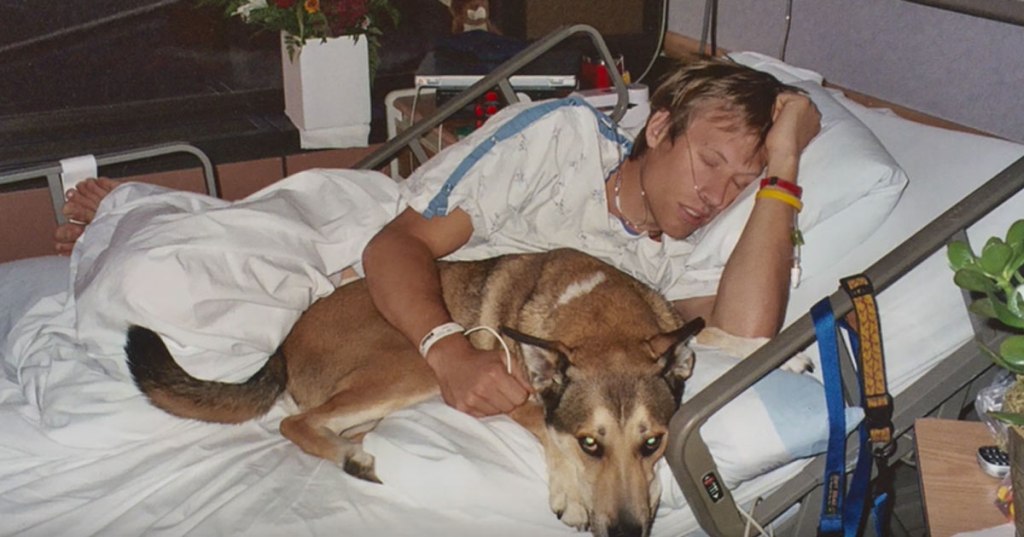
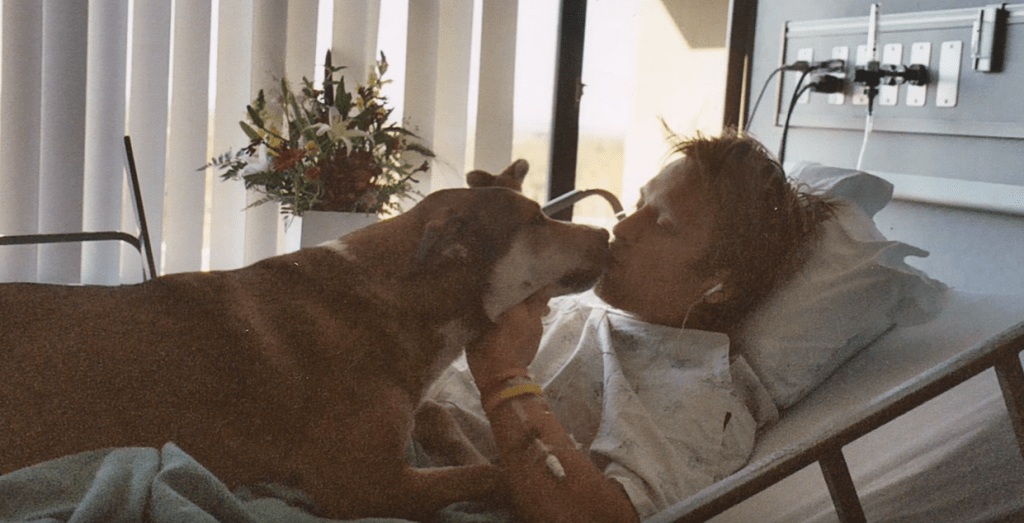
Doctor’s tell dog to leave owner’s hospital bed, but dog refuses and lays by his owner’s side
written by Jenny Brown on July 11th, 2016 There is the saying that a dog is a man’s best friend. It might be because a dog is by your side when you’re feeling down, is there to play catch when you feel like throwing around the frisbee, or simply there when you want some company.
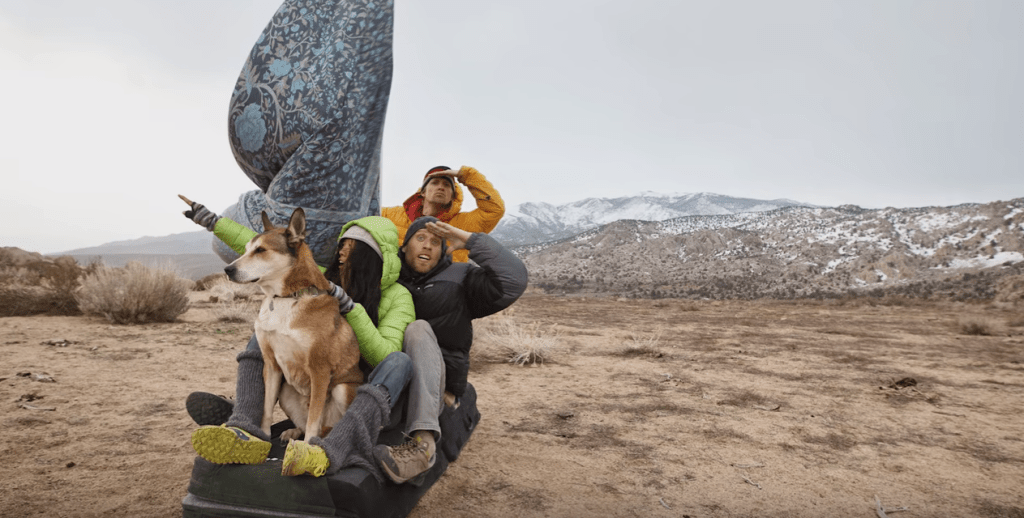
As dog-lovers we are grateful for the things dogs do for us, but do we consider how dogs might be as grateful for the things we do for them? In this video, the beautiful relationship between one man, Ben, and his dog is shown from the perspective of not the man, but his dog.
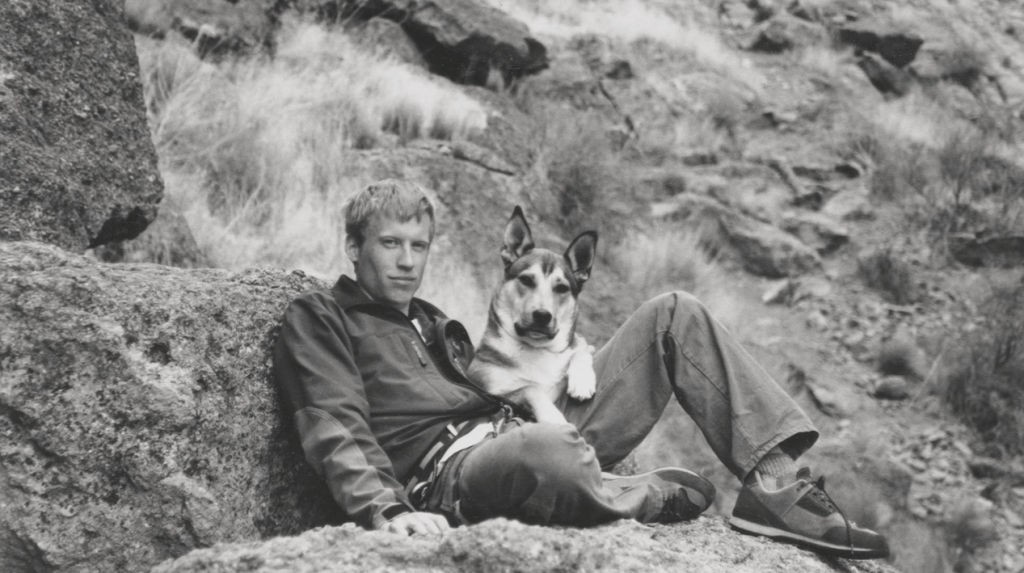
The relationship between Ben and his dog begins in their earlier years. The two of them travel around the world. From camping in the deserts to hiking in the mountains, they discover their favorite places to visit and make new friends along the way.
Source YouTube/Ben Moon
As the story continues, however, Ben develops cancer. While Ben must spend his time in a hospital and away from traveling, his dog continues to stay by his side, night and day. The relationship between Ben and his dog seems that it may worsen due to Ben’s obstacle, but instead, their relationship only strengthens.
Source YouTube/Ben Moon
The story progresses years later, as Ben overcomes his battle and the bond between him and his dog continues to grow. Through the highs and lows of their relationship, Ben and his dog remain the best of friends until the very end.
This touching video is a dedication made by Ben to his dog, for all the best moments they spent together. This video also shows what is truly the essence of friendship, between a man and his best friend, his dog.
Source YouTube/Ben Moon
Please SHARE this with your friends and family.
(Ed: Note that the dialogue in the following professionally shot film is the voice of the dog.)
ooOOoo
Friendship, as in true friendship, is very precious. That true friendship is rarely unconditional between humans. Not impossible, just rare.
For common examples of unconditional friendship, as in the unconditional love bond, we have to turn to our dogs.
I included a photo of Socks and wished him the very best of luck in finding a home.
Beautiful Socks!
Well, miracles of miracles, when I came to my emails last Saturday morning awaiting me was this email from John Zande.
Paul and Jean, Socks has a wonderful new home!
I really don’t want to jinx it by writing this email (I am the superstitious naked ape, after all), but the morning started out with not much hope as we drove and drove out into the countryside, wondering where on earth this petshop was that was hosting the adoption fair.
When we eventually found it, it was a tiny storefront, little more than a dog-bath business. We thought, “nothing is going to come from this.” They were just opening as we arrived and met the young girl who runs it. Lovely person. Literally two minutes later a family walk up the road dropping off their two dogs for a bath. We got to talking. They fell in love with Socks.
After a phone call to the woman’s husband (a serious, serious dog lover, we’re told, as she is too) we heard the words we did not think we’d hear: “If it’s OK, we’d love to give him a home.”
Ten minutes later we were in their house, which was about 50 meters down the road. Nice place, lots of room, and Socks has full run of the outside, and a huge enclosed laundry-come-Socks-home for the night. He won the lotto! Three young boys full of energy. He took to them like a champion. I still can’t believe it. It’s like this every time we find a home. It just doesn’t seem real.
Anyway, I’ve attached two short videos of Socks and his new home, and a photo. And yes, the family is keeping Jean’s name, Socks. They loved it. I’m sure G will write you later tonight, but you both played a huge role in this. Your help paid for his neutering, and for that we’re eternally grateful.
Here is that photo and those videos.
oooo
oooo
oooo
A little later on ‘G’, John’s nickname for his wife, sent me these further details:
Hello Paul and Jean – I guess you’ve been cheering since John’s e-mail, right? So have we, since this morning.
Well, I have to say I still can’t believe how lucky we (and Socks) have been. Virginia and Fabiano and their three boys: Lago (11 or 12 y.o, not sure); Marcos (turning 8 tomorrow, Sunday) and Raphael, 6. Lovely family, she invited us to go to their place (he was working), showed us around.
As I said at the outset: It doesn’t get more beautiful than this!
Yet despite it being so obvious it hadn’t crossed my mind before.
I’m referring to the wonderful idea of using those people, who through circumstance have found themselves homeless, to care for animals via an animal shelter.
Glenn Greenwald Unveils New Project to Build Animal Shelter in Brazil Staffed by Homeless People
Published on May 10, 2017
http://democracynow.org – Pulitzer Prize-winning journalist Glenn Greenwald unveils his plans to build an animal shelter in Brazil with his husband David Miranda, a city council member in Rio de Janeiro. The shelter will be staffed by homeless people who live on the streets with abandoned pets.
ooOOoo
If you, like me, needed to be reminded as to Mr. Greenwald’s background there’s plenty online.
Glenn Greenwald is one of three co-founding editors of The Intercept. He is a journalist, constitutional lawyer, and author of four New York Times best-selling books on politics and law. His most recent book, No Place to Hide, is about the U.S. surveillance state and his experiences reporting on the Snowden documents around the world. Prior to co-founding The Intercept, Glenn’s column was featured at The Guardian and Salon. He was the debut winner, along with Amy Goodman, of the Park Center I.F. Stone Award for Independent Journalism in 2008, and also received the 2010 Online Journalism Award for his investigative work on the abusive detention conditions of Chelsea Manning. For his 2013 NSA reporting, he received the George Polk award for National Security Reporting; the Gannett Foundation award for investigative journalism and the Gannett Foundation watchdog journalism award; the Esso Premio for Excellence in Investigative Reporting in Brazil (he was the first non-Brazilian to win), and the Electronic Frontier Foundation’s Pioneer Award. Along with Laura Poitras, Foreign Policy magazine named him one of the top 100 Global Thinkers for 2013. The NSA reporting he led for The Guardian was awarded the 2014 Pulitzer Prize for public service.
That article featured the former president of Iceland, Olafur Grimsson, and how he was encouraging new solutions to climate change. Primarily via a new organisation called RoadMap. (Did you sign up??)
There is change in the air. People are starting to make a better future. Cities across the USA (and elsewhere undoubtedly) are pledging to go 100 percent renewable. Here’s what Grist published on May 4th.
ooOOoo
Cities all over the U.S. are pledging to go 100 percent renewable.
Atlanta is the 27th city to make the pledge, according to the Sierra Club. These kinds of municipal promises have been popping up nationwide over the past few months. Here’s a recap:
Portland, Oregon, pledged in April to go 100 percent renewable by 2050. The surrounding Multnomah County got in on the plan, too.
South Lake Tahoe, California, committed to go renewable by 2032. Its initiative is, at least to begin, entirely volunteer-driven.
It’s not just the coasts: In March, Madison, Wisconsin became the biggest city in the Midwest to pledge to a community-wide switch to 100 percent renewable energy (though it hasn’t set a target date).
The tiny town of Abita Springs, Louisiana committed in March to transition to clean energy by 2030 — and its Republican mayor went to bat for it. That’s a big win in our books.
“We know that moving to clean energy will create good jobs, clean up our air and water, and lower our residents’ utility bills,” said Kwanza Hall, an Atlanta City Council member and mayoral candidate, in a statement. “We have to set an ambitious goal or we’re never going to get there.”
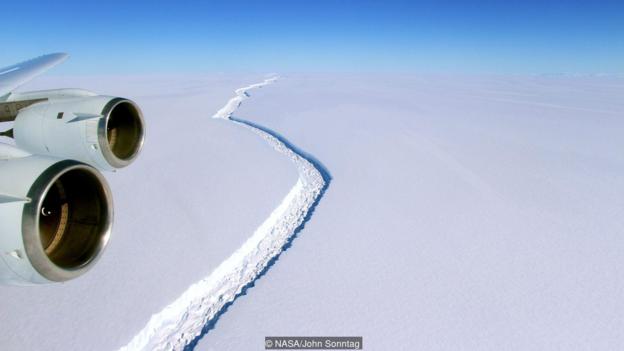
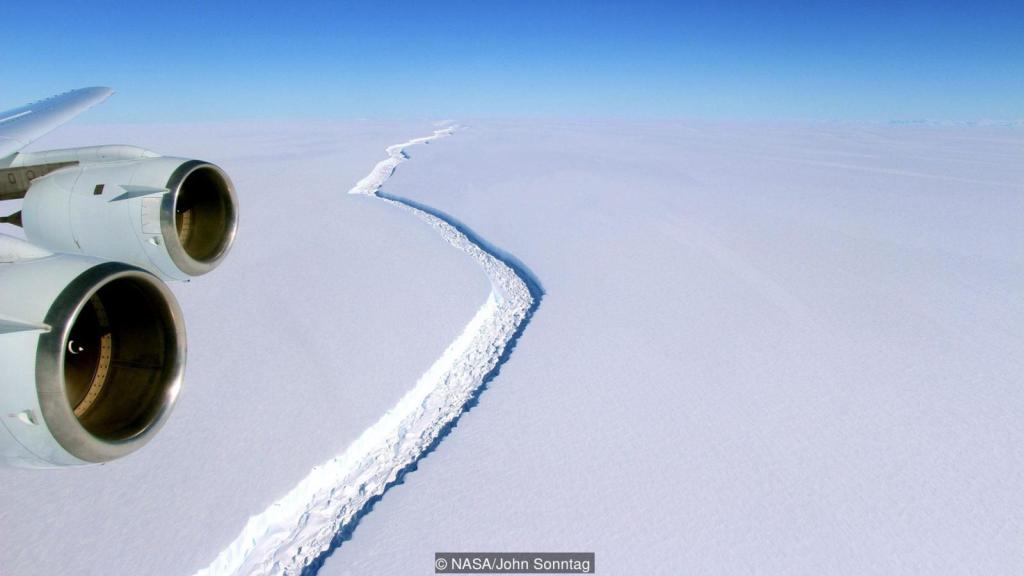
The shape of the world is hanging by a thread – or rather, according to experts, by a 110 mile-long (177km) rift. That’s the extent of a rapidly expanding crack in an enormous ice shelf in Antarctica. When the Larsen C shelf finally splits, the largest iceberg ever recorded (bigger than the US state of Rhode Island and a third the size of Wales) will snap off into the ocean. Widening each day by 3 ft (1 m), the groaning cleft is on the verge of dramatically redrawing the southern-most cartography of our planet and is likely to lead, climatologists predict, to an acceleration in the rise of sea levels globally.
An aerial photo of the frigid fissure, taken late last year when it was discovered that the pace of the icy tear was quickening, was suddenly back in the news this week with the announcement that a second rift in the shelf had been detected. The fracture leads our eye along a zig-zagging path – from the backward gaze of the plane’s right engines to the pristine polar blue of the horizon in the distance. The jaggedness of the cleft, which takes our vision on a journey whose ultimate destination is unfathomable, seems at once monumental and terrifyingly fragile. The photo intensifies our helplessness in the face of cataclysmic change. It freezes the potential destruction in the blink of a camera’s shutter, while at the same time hinting at a catastrophe that we can witness unfolding but are utterly powerless to stop.
A second rift was recently discovered in the Larsen C ice shelf on the Antarctic peninsula (Credit: NASA/John Sonntag)
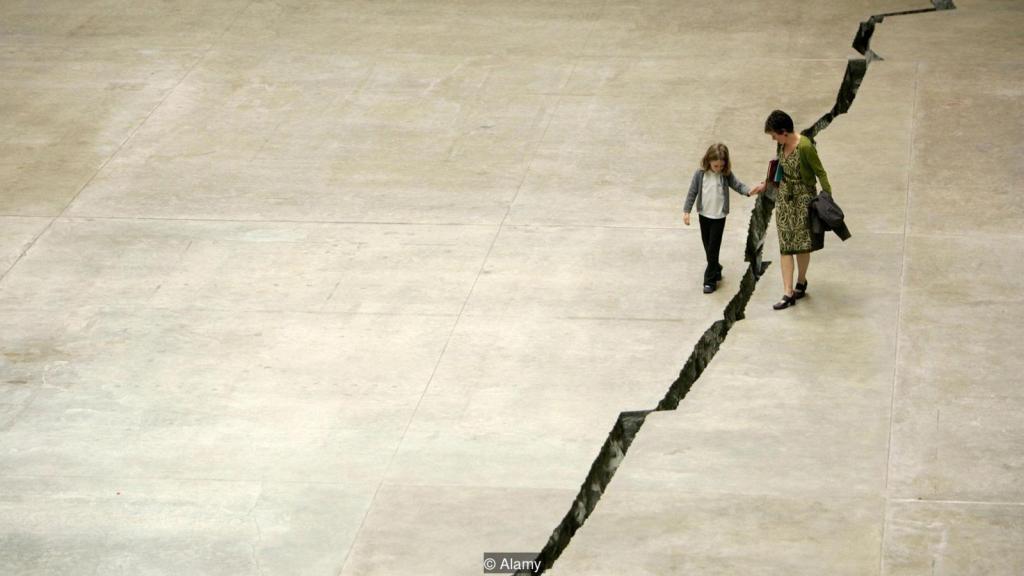
As a visual statement, the aerial photo of the Larsen C crack is, by definition, incomparable; never before has the world marked the glacial advance of such a sublime and fearsome fracture in its very fabric. Yet the reemergence of the image in the news anticipates the ten-year anniversary of one of the most intriguing and innovative large-scale works in contemporary art – a work whose power relies for its thought-provoking effect on the peculiar poetry of ruinous rifts. In October 2007, the Colombian-born artist Doris Salcedo unveiled in London an ambitious installation in the cavernous space of Tate Modern’s Turbine Hall – a piece that split reaction down the middle.
Inviting gallery-goers into the otherwise empty and austere interior of the former Bankside Power Station, Salcedo subverted expectations. Rather than offering visitors a hall of temporarily installed sculptures, she orchestrated the contemplation instead of a ragged subterranean breach that appeared to rip open the concrete floor of the structure – a crevice that extended from one end of the yawning space to the other.
For the Colombian artist Doris Salcedo’s 2007 work, Shibboleth, a giant crack was made in the concrete floor of Tate Modern’s Turbine Hall (Credit: Alamy)
Salcedo deepened the mystery of her bold and experimental conceptual work by giving to it the curious title Shibboleth – a biblical word which, when mispronounced, was said to have exposed the outsider status of individuals. Complicating matters still further, the artist insisted that her work was a comment not on the folly of material ambitions, but on racism – that deep cultural scar that tears at the foundations of humanity. Placed side-by-side, this week’s photo from Antarctica and the image captured a decade ago of Doris Salcedo’s challenging Shibboleth share both a brutal beauty and a common theme: the brittleness of being.
If you would like to comment on this story or anything else you have seen on BBC Culture, head over to our Facebook page or message us onTwitter.
And if you liked this story, sign up for the weekly bbc.com features newsletter, called “If You Only Read 6 Things This Week”. A handpicked selection of stories from BBC Future, Earth, Culture, Capital and Travel, delivered to your inbox every Friday.
ooOOoo
“the brittleness of being.”
Please, all of us, let’s make a positive difference so that we can soften the edges of that brittleness.
This is a guest post coming up today. A reflection on what any dog lover feels when their beloved dog dies. (I don’t even want to think about the end of Pharaoh that can’t be too many weeks off!) But as has been said before it is one the key lessons that we learn from our dogs.
Not too many days ago I received an email from Liz Nelson.
I wanted to submit a synopsis of how our fur babies have dealt with the loss of a friend and the addition of another one to see if you wanted to use it as a guest post.
There was no question that I wanted to publish Liz’s synopsis so it could be shared with you. Here it is.
ooOOoo
The death of Zeke
See footnote for details of this photograph.
A little over a year ago we lost our precious Rottweiler, Zeke, to bone cancer.
Zeke, a rescue who still had remnants of buckshot in his torso from his days living in the woods of Mississippi, was with our family for about 8 years. A gentler giant there never was. He and our cat were friends and Zeke frequently bathed the cat’s head and ears. Zeke and our Chow-mix (Fiona) were also very close. We joked he was in love with her because he let her collect all the toys and win at tug-a-war, despite the size difference.
Losing Zeke was a tremendous blow for our household. Both dogs and our 2 cats were visibly impacted by Zeke’s loss. Fiona took it the hardest. She became listless, fatigued, and generally out of sorts. She wasn’t interested in playing and she became an even pickier eater. She would skip several meals in a row and then eat everybody’s food at one time (including the cats’). She and the other animals refused to touch the dog bed in the living room that Zeke had used. She also refused to chew on a large rawhide we found that had once been Zeke’s. It felt like she was saving his things for when he came back to claim them. We noticed the hair under her eyes starting to go gray. She started to show and act all 9 of her years (she’s a rescue and special needs dog so we’re amazed we’ve had 9 years with her).
The vet said we could explore antidepressants but I wanted to see if we could let her try to work through it without medication. Though they remain an option if needed.
In January, my husband said he was ready to think about getting a puppy and several weeks later we adopted an adorable rescue named Pierce. The rescue told us he was part Husky and part Lab. Now that he’s older we think there’s a hefty dose of hound in there. After a few days of wariness and some growling, the older dogs decided to accept the puppy as part of the household. Fiona regained her energy and she was often seen in the yard with the puppy, teaching Pierce how to play fight or stalk birds. She would chase the puppy until they were both exhausted (which we were grateful for). Sometimes she got annoyed with the puppy but for the most part she took on a big sister role.
Fast forward a few months and the puppy is now the biggest dog in the house. While he really is a good dog, he’s still a puppy. Now when he is too energetic there is a lot more of him bouncing around a room. Fiona spends much of her time reinforcing her dominance by taking his toys and putting them under her chin where Pierce is afraid to attempt to retrieve them. She’s stopped running around the yard to play with him. Perhaps because it hurts when you collide with 45 lbs of speeding, clumsy puppy (just ask my husband)? She has gone back to spending most of her time looking pitiful. She will let me pet her though she acts as if it is an imposition.
We’re hoping that when the puppy matures a little more Fiona will regain interest in playing with him. Or at least his behavior won’t annoy her as much. I know that the puppy can never replace Zeke’s place in the family but I really hope Fiona doesn’t spend the rest of her dog life mourning Zeke and ignoring the new dog!
Liz Nelson
Footnote (re the photo above):
I have a great picture of our family with Zeke and Fiona in it (and my third dog). It’s one of our engagement photos and I’m so glad we included the pups. As you can see Zeke was super cuddly! It’s one of my favorite pictures. You can use any of the information in my about section for an introduction. I don’t have it very detailed (I only started this blog this week) so if there is any additional info you want to include please let me know. I looked around for a more recent photo of myself but all of my recent ones are from Halloweens and involve costumes. Not really an everyday look!
So I guess let’s stick with the family photo. Thank you Paul!
I am a supervisor at a small non-profit agency. I’m also in school part-time working on a doctorate. I’m a social worker so I’ve been working in non-profit agencies since I got my master’s degree around 8 years ago. I’ve been in management for around 5 years. I have had to deal with pretty intense social anxiety for as long as I can remember.
Another delightful travel account from Natalie Derham-Weston.
Albeit perhaps travels of a more inward nature.
ooOOoo
Travel Blog: Installment 3: Living on a boat.
Simple Peace
I fancied an interlude this week to share a morning I enjoyed over the weekend. It isn’t often that the chance arises to enjoy our local surroundings without time limits, overdue deadlines or inconvenient meetings. However, I had a day off Saturday; a concept becoming more and more valued having since started a new full-time job, which is quite demanding on my time. I have requested this high load of hours but after months of travelling and not having regular work, it is taking a while for me to adjust to the mental and physical demands.
Anyway, without going into the irrelevant details, I have been spending my time living on a boat in a marina in Lymington, a small sea side town in the New Forest on the South Coast of England. This means my commute to work is a 2 minute walk and although I do not know the first notion about sailing, I have quickly fallen for the lifestyle of boats and water. I have found it to be extremely sociable and relaxing and I have all I need around me. This includes a bicycle, a car, swimming facilities, work, grocery shops and a very modest yet comfortable boat.
So last Saturday, I woke up early, as I was already in the routine of being awake from my work shifts and saw the sun streaming in through the port hole windows. This immediately buoyed me and I pulled the curtains and opened the hatch to let in the fresh air. I had a few items on a to do list but I certainly didn’t intend on wasting the valuable time I had.
I did have an appointment I couldn’t shirk but made it as quick as possible and on the way back picked up some lunch items. Back on the boat, I had a quick tidy and clean as I firmly believe an orderly workspace leads to a clearer mind.
I pre-empt this by saying I am usually accompanied by my father on the boat but this specific day was the first time I had been left in solo charge and this gave me somewhat of an independent free feeling. So my next mission was to cook some eggs which I did on our very small gas camping stove. I took some cushions out on deck and had my lunch in the warm April sunshine. Our pontoon seems to be quite an active mooring site and there were people constantly wandering along it all day, carrying tools, bags and equipment back and forth. So although I was alone, I did not feel isolated.
I then left everything behind on the boat, including my phone and took my bicycle around the headland on a trail I had never been on before. The channel was extremely clear and I had a wonderful view over to the Isle of Wight and watched the bustle of boats going to and fro. I passed lots of families, dogs, bird watchers and couples but kept going at a steady pace along the gravel track headed towards Keyhaven, the next fishing village along.
There is no specific reason why I enjoyed this so much, just the whole atmosphere and surroundings made for a very encompassing uplifting day. I continued along the path, and had no care as to where I was or where I was going. I was confident enough that I knew I’d always find my way back somehow and so without that pre-conditioned feeling of panic, I cycled on along the back roads and hauled my bicycle over fences and gates.
Two hours later I cycled back in to the marina and abandoned the bike next to the boat. The boat is never locked, another aspect I really appreciate. I don’t think this would be possible everywhere, but it allows for a very open way of life. So I grabbed a cushion and headed to the bow of the boat, lying in the sun, drinking a beer, watching the world go by.
This just proved to me how easy it is to be happy sometimes. We need very little but that day will stay in my memory for a long time as a point in time where I was 100% content.
ooOOoo
I had the great fortune of living on a yacht Songbird of Kent, a Tradewind 33, for five years in the late ’80s early ’90s based out of Larnaca on the Greek side of Cyprus. I can fully vouch for the peace that Natalie has written about.
I wish I understood where my fascination with the night sky came from. Not that I am anything other than an amateur gazer (of the night sky, I should hasten to add!). I have never taken the trouble to gain any real knowledge.
Yet, some of the most serene moments of my life have been when I have been alone at sea under a night sky.
OK, that’s enough wallowing for anyone!
The last week has been an important one for those that take an interest in the planets in our solar system, or to be specific, take an interest in Jupiter.
Today – April 8, 2017 – the planet Jupiter is closest to Earth for this year.
Yet yesterday was Jupiter’s opposition, when Earth flew between Jupiter and the sun, placing Jupiter opposite the sun in our sky. You’d think Jupiter was closest to Earth for 2017 yesterday as well … and yet it wasn’t. It’s closest to Earth for 2017 today, April 8, coming to within 414 million miles (666 million km).
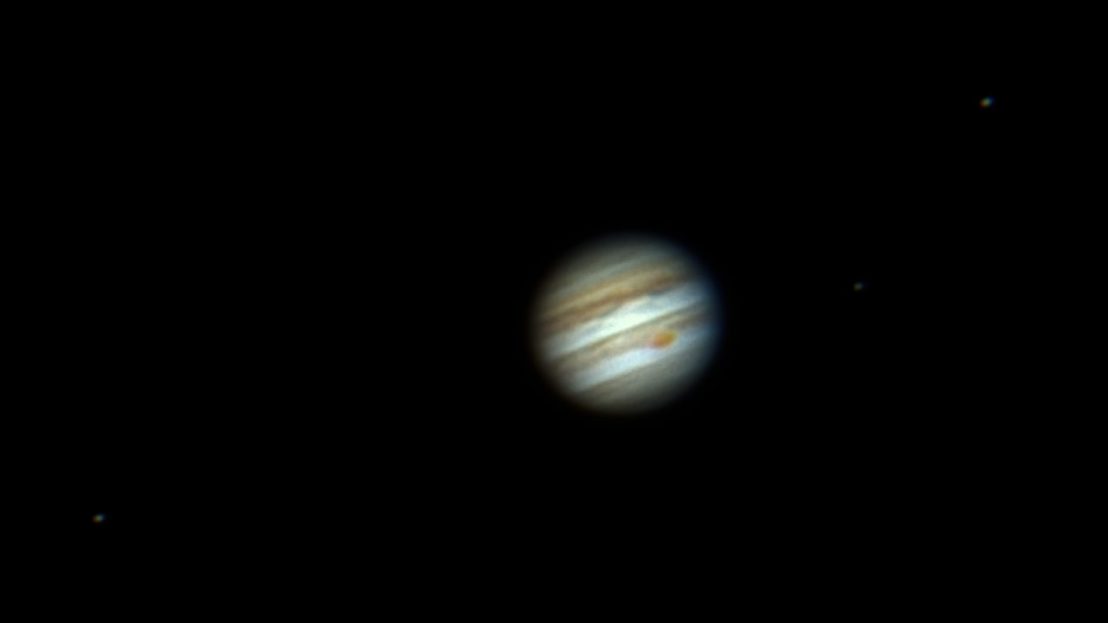
EarthSky also included this image:
Jupiter at its April 7, 2017 opposition with the Great Red Spot and moons Io, Europa, and Ganymede (L to R). Photo by Rob Pettengill in Austin, Texas.
During the month of April, Jupiter will be in opposition, meaning the planet is at its closest point to Earth. Thanks to the sun, it’s during this window that astronomers can enjoy a particularly close-up photo session that can help reveal how the planet’s atmosphere has changed over time by comparing it with previous such photos of the gas giant.
This photo of Jupiter was taken on April 3 by the Hubble Space Telescope when the enormous planet was 670 million kilometers (or about 416 million miles) from Earth. The photo shows the Great Red Spot, but it also shows something new: a weather feature called the Great Cold Spot, which is almost as large as its more well-known cousin.
“The Great Cold Spot is much more volatile than the slowly changing Great Red Spot, changing dramatically in shape and size over only a few days and weeks, but it has reappeared for as long as we have data to search for it, for over 15 years,” Tom Stallard, a planetary astronomer at the University of Leicester in the U.K. and lead author of the study, said in a statement.
The cold spot is nearly 15,000 miles by about 7,500 miles in size, and it’s dubbed the “cold” spot because it’s 200 degrees Kelvin (about 400 degrees Fahrenheit) cooler than the surrounding atmosphere.
The article included this stunning image of Jupiter.
Photo: A. Simon (GSFC)/NASA, ESA
Jaymi went on to write:
Here’s what some of the other details in the image mean:
The NASA/ESA Hubble Space Telescope reveals the intricate, detailed beauty of Jupiter’s clouds as arranged into bands of different latitudes. These bands are produced by air flowing in different directions at various latitudes. Lighter coloured areas, called zones, are high-pressure where the atmosphere rises. Darker low-pressure regions where air falls are called belts. Constantly stormy weather occurs where these opposing east-to-west and west-to-east flows interact. The planet’s trademark, the Great Red Spot, is a long-lived storm roughly the diameter of Earth. Much smaller storms appear as white or brown-coloured ovals. Such storms can last as little as a few hours or stretch on for centuries.
The Great Red Spot is an anticyclonic storm that is so large that Earth would fit inside it. That stormy spot — which is actually shrinking, though astronomers don’t know why — gives us a great perspective for understanding just how huge Jupiter is compared to our own blue dot in the solar system.
It’s been 27 years since the Hubble Space Telescope went into orbit, and the geriatric observatory is still going strong. When the telescope recently trained its sights on the solar system’s largest planet, the results were spectacular—proof that for the stellar spectator, age is but a number.
The image above is the latest picture of Jupiter. The snapshot was taken by Hubble on April 3 with the help of the telescope’s Wide Field Camera 3, a high-res instrument that lets the telescope observe using different wavelengths. It combines light on the visible, ultraviolet, and infrared spectrum to create an image of a massive planet in constant atmospheric flux.
In a press release, the European Space Agency, which co-runs Hubble with NASA, said that Hubble was able to take advantage of the planet’s current opposition with Earth to take the close-up. At the moment, Jupiter is lined up perfectly with the sun, and Earth is lined up with both the sun and Jupiter. Think of it as a truly heavenly photographic opportunity—a chance to look at the planet head-on. Better yet, Jupiter’s position relative to the sun means that it’s brighter than at any other time of year, which lets telescopes trained on the gigantic planet see even more detail than usual.
AsThe Washington Post’s Amy B. Wang notes, there were no new discoveries in the picture per se, but that doesn’t mean there’s nothing to look at. As ESA explains, scientists will compare the photo to previous views of the planet to hopefully learn more about the atmosphere. And for the rest of us, there’s a strangely soothing view of Jupiter’s layered cloud bands and impressive vortices.
The gas giant is thought to have sucked up most of the space debris left over after the sun formed, grabbing dust and gas with gravity. Scientists think it has two times as much debris as all of the other bodies in the solar system combined—and all of that material swirls through cloud layers in its quickly-rotating atmosphere.
Since Jupiter doesn’t exactly have a surface, it has nothing to slow the spots and vortices that appear in its atmosphere. The most famous, the Great Red Spot, is thought to have been swirling around for more than 150 years, and even though it’s unclear which gases give it that red hue, it’s the planet’s most recognizable feature. As NASA writes, the cloudiness of Jupiter’s atmosphere makes it hard to understand what might be contributing to it. But that doesn’t decrease its allure.
Want to delve even further into the mesmerizing bands of a huge planet’s atmosphere? A high-res version of the snapshot is available online. And if you prefer seeing things live, it’s a great time to check out Jupiter through in the night sky. You can find Jupiter in the east right after the sun goes down—a massive mystery that’s brighter than any star.
Namely, that the universe came into existence some 13.82 billion years ago. The power of natural evolution that came with that event eventually brought along homo sapiens some 200,000 years ago. 200,000 is 0.0000145 of 13.82 billion.
Or to put it another way, we humans have only been a part of this universe for 1/10th of 1% of the life of said universe! (Oh, and dogs came along 100,000 years ago!)
Yet another wonderful saving of a dog from a frozen lake!
One of the ‘generalist’ blogs that I follow is Mother Nature Network (MNN) and yesterday MNN published the account of a dog in Canada being rescued from icy cold water.
Winter hasn’t let go of some parts of North America just yet, including St. Albert, Alberta, in Canada. Cold temperatures keep the lakes frigid and icy, as a local man and his dog discovered recently.
A French bulldog named Cosmo plunged into a lake in a park in St. Albert — it was a leash-free area of the park — and was struggling to pull himself out of the thin ice that covered the lake. Cosmo’s owner, Duncan McIver, jumped in to save his pup.
McIver was able to push Cosmo onto the ice and then, while carrying Cosmo, slowly walked across the ice, but not without plunging into the freezing cold water once more.
In a bit of serendipity, a CTV news crew was already at the park, filming a report on ice safety, and caught the whole episode on camera.
“As soon as the ice broke, I just went right in,” McIver told CTV Edmonton, “I think most people would do the same for their dog.”
The saying goes that a dog is man’s best friend, but we think moments like this prove the feeling is mutual.
ooOOoo
Yes, picking up on that remark by Duncan McIver, most people really would do what Duncan did!
Stories like this make my toes curl with pleasure!
Less than two weeks ago I shared an item that I had read about the firefighters of Santa Monica, CA, saving the life of a ten-year-old dog.
When Santa Monica firefighters were called to a burning apartment, they found the lifeless body of a tiny dog overcome by the heat and smoke on the floor of a bedroom. They pulled out the dog, named Nalu, but he wasn’t breathing and didn’t have a pulse.
Then two days ago, courtesy of the Care2 Causes blogsite, along comes another fabulous example of the care, love and generosity shown by firefighters.
ooOOoo
Firefighters Rescue Golden Retriever From Icy Pond
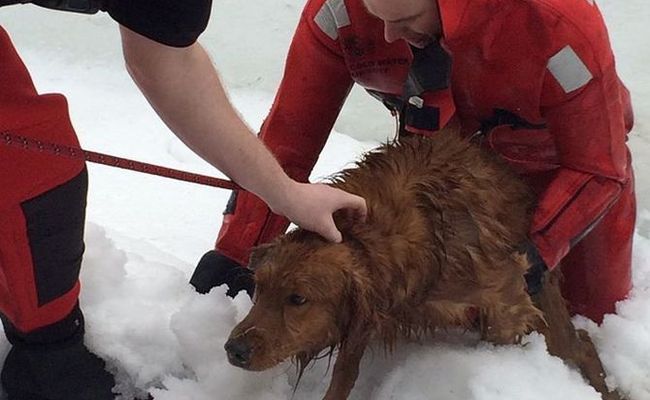
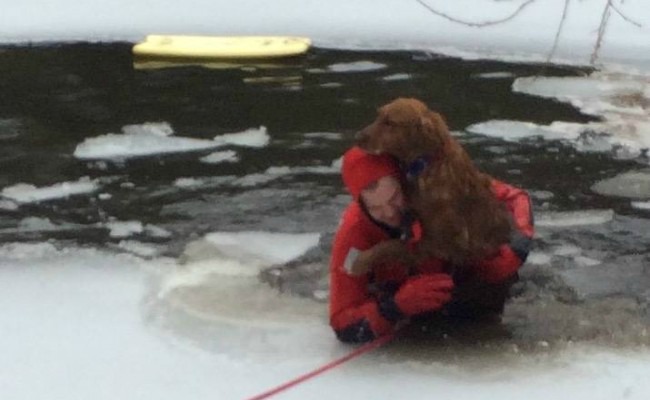
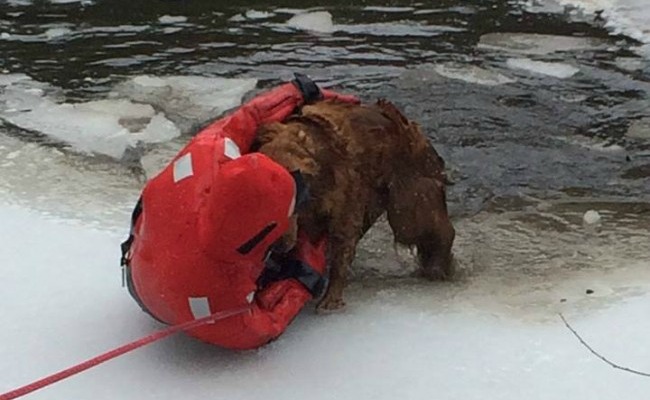
With perhaps just seconds to spare, North Hampton firefighter Will Taber barreled toward a dog who was barely clinging to thin ice last week in New Hampshire.
Photo Credit: North Hampton Professional Fire Fighters
Three-year-old Emmett ran out onto his family’s frozen backyard pond, suddenly falling through the ice. Although homeowner Kacey Eddinger started into the pond to rescue him, she had to turn back when she realized the water was simply too cold. Eddinger and her toddler son waited anxiously for help to arrive.
Photo Credit: North Hampton Professional Fire Fighters
The family isn’t certain exactly how long their golden retriever was in the water before they realized he’d fallen through, but by the time firefighters arrived, Emmett was exhausted and close to drowning.
In thermal ice rescue gear, firefighter Taber held a tethered line as he crossed the ice and entered the water. Once he reached Emmett, the other firefighters pulled the pair back to shore.
Photo Credit: North Hampton Professional Fire Fighters
“The canine was exhausted and scared and minutes from going completely under water and carried by the current under the ice,” the Fire Department posted on Facebook. “The rescue was made just in time where he was then immediately warmed, carried to a police cruiser and transported to North Hampton Animal Hospital.”
Though spring has officially arrived, ice rescues have escalated due to the thin ice that remains on some bodies of water.
Again and again, I find myself rating actions such as these from the North Hampton Fire Fighters (and not forgetting the Santa Monica Fighters) so gloriously uplifting. Again and again, they serve as a reminder that real people all around the world are so very often wonderful, generous and loving real people!