Category: consciousness

More inward thoughts.

Each of us must care and love ourselves before we can love others.

(Apologies if this post rambles around a bit!)

Dr. Kristin Neff, Ph.D. is widely recognized as one of the world’s leading experts on self-compassion. Dr. Neff has a website over at Self-Compassion.org. If you go to that site you will quickly read (And while I have copied and pasted it 100% as found on that webpage, I have modified the layout to make it easier to read from a visual point-of-view.):

Definition of Self-Compassion:

Having compassion for oneself is really no different than having compassion for others. Think about what the experience of compassion feels like.

First, to have compassion for others you must notice that they are suffering. If you ignore that homeless person on the street, you can’t feel compassion for how difficult his or her experience is.

Second, compassion involves feeling moved by others’ suffering so that your heart responds to their pain (the word compassion literally means to “suffer with”). When this occurs, you feel warmth, caring, and the desire to help the suffering person in some way. Having compassion also means that you offer understanding and kindness to others when they fail or make mistakes, rather than judging them harshly.

Finally, when you feel compassion for another (rather than mere pity), it means that you realize that suffering, failure, and imperfection is part of the shared human experience. “There but for fortune go I.”

Self-compassion involves acting the same way towards yourself when you are having a difficult time, fail, or notice something you don’t like about yourself. Instead of just ignoring your pain with a “stiff upper lip” mentality, you stop to tell yourself “this is really difficult right now,” how can I comfort and care for myself in this moment?

Instead of mercilessly judging and criticizing yourself for various inadequacies or shortcomings, self-compassion means you are kind and understanding when confronted with personal failings – after all, who ever said you were supposed to be perfect?

You may try to change in ways that allow you to be more healthy and happy, but this is done because you care about yourself, not because you are worthless or unacceptable as you are. Perhaps most importantly, having compassion for yourself means that you honor and accept your humanness. Things will not always go the way you want them to. You will encounter frustrations, losses will occur, you will make mistakes, bump up against your limitations, fall short of your ideals. This is the human condition, a reality shared by all of us. The more you open your heart to this reality instead of constantly fighting against it, the more you will be able to feel compassion for yourself and all your fellow humans in the experience of life.

Let me highlight a small section from this:

….having compassion for yourself means that you honor and accept your humanness. Things will not always go the way you want them to. You will encounter frustrations, losses will occur, you will make mistakes, bump up against your limitations, fall short of your ideals. This is the human condition, a reality shared by all of us.

This is the human condition; whatever one’s gender, status in life or age!

Moving on.

There is no question that I learnt something from my cycling accident last November 22nd and my subsequent emergency admission to hospital for sub-dural bleeding on December 24th. Something that I would not otherwise have understood so clearly and so starkly.

The remarkable power of the brain to heal itself; albeit very slowly compared with some minor physical injuries.

The BBC science series Horizon broadcast earlier this year the story of ‘Richard’. The full title was My Amazing Brain: Richard’s War.

Horizon follows the story of Richard Gray and his remarkable recovery from a life-changing, catastrophic stroke. Recorded by his documentary film-maker wife Fiona over four years, this film provides a rare account of the hard work that goes into post-stroke rehabilitation.

Initially bed bound and unable to do anything, including speak, the initial outlook was bleak, yet occasionally small glimmers of hope emerged. Armed always with her camera, Fiona captures the moment Richard moves his fingers for the first time, and then over months she documents his struggle to relearn how to walk again.

The story also features poignant footage delivered in a series of flashbacks, in which we see and hear Richard at his professional best. He was a peacekeeper with the United Nations, immersed in the brutal war in Sarajevo, Bosnia. We also hear from the surgeons and clinicians who were integral to Richard’s remarkable recovery, from describing life-saving, high-risk reconstructive surgery to intensive rehabilitation programmes that push the former soldier to his limits.

As the film starts, Fiona asks ‘will Richard, my Richard still be there?’ By the end the answer is clear.

Unfortunately unless you are in the UK it is not possible to watch the programme.

But Fiona, Richard’s wife, has produced a YouTube video. It so much deserves to be watched:

Moving on, yet again.

I am of no doubt that most, if not all, of us at some point in our lives wonder what on earth is the point in what we are doing or where we are at the stage in our own life’s journey. Certainly has applied to me in the past.

Frequently when we are a bit lost as to where on earth we are heading it helps enormously to hang on the shirt-tails of others.

Professor Clayton Christiansen has some really fabulous shirt-tails. For now just watch his presentation given at TEDx

“It’s actually really important that you succeed at what you’re succeeding at, but that isn’t going to be the measure of your life.”

For a slightly different perspective, watch Adam Leipzig.

Being human means a journey from birth through maturity and thence to death. It is likely that the last phase generates the greatest fear for us. But let’s not dwell on that for now!

Because I want to close my introspective journey by returning to self-compassion.

Or rather for our compassion for this beautiful planet that is the one and only home we have.

Dear Carl Sagan sums it up as perfectly as one could ever ask for.

Alright folks! I’m through!

Must go and hug a dog! (Or, more accurately, a dog memory!)
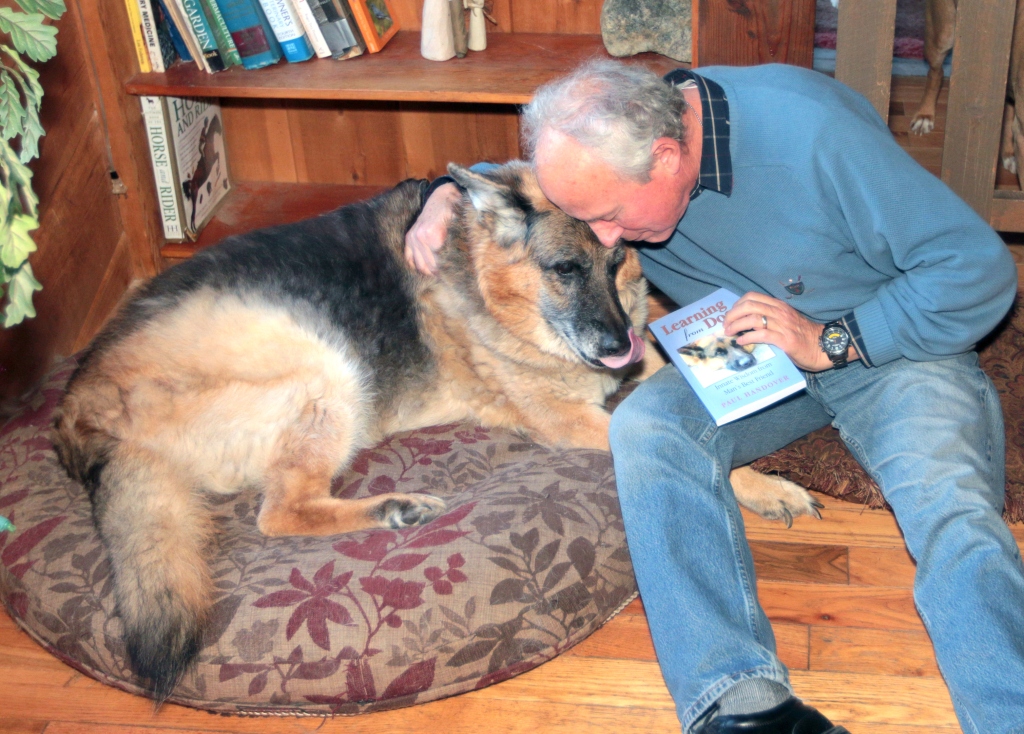
TIMOTHY BULLARD/Daily CourierPaul Handover with Pharaoh, a 12 year-old German Shepard that he uses on the cover of his new book about man’s best friend.

Tomorrow a clutch of dog recall advisories that have come in recently!

As they say a change is as good as a rest!

Once again I must say that I hold no qualifications whatsoever in the fields of psychiatry, psychology or any related disciplines. If you have found yourself to be affected to the point where you think you need proper counselling then, please, do seek help.

Inward thoughts.

Reflections on being gentle to yourself.

There are three reasons why I wrote this post. A post that runs across today and tomorrow.

Firstly, this post is inspired by love! The supreme love that I receive from my darling Jeannie and the love that I sense practically twenty-four hours a day that flows from the beautiful dogs that we have here. But also from the wonders of the rural world in which I live. From sights like the one below to being visited by wild deer every single morning when I go out to feed the horses.

The view from our bedroom window any cloudless morning. (This photo taken October 18th, 2015.)

The second reason for writing this post is a direct result of the love that flows in from so, so many of you precious readers. You are like one big online family that I live in. And, as one hopes to do within a family, from time to time you want to open up your inner feelings.

The third and final reason for this post is wanting to explore how one might find some peace from the chaos that seems to be spread so far and wide across this planet that we all call home.

It’s a very personal journey and I suggest that if this is not your ‘cup of tea’ that you call back another day!

OK! Now that’s off my chest, here we go!

Life’s beauty is inseparable from it’s fragility.

Pause awhile and just let those words float around your mind.

It is a quotation taken from a TED Talk that Jean and I watched a few days ago.

The speaker is Susan David and is described on that TED Talk page as follows:

Psychologist Susan David shares how the way we deal with our emotions shapes everything that matters: our actions, careers, relationships, health and happiness. In this deeply moving, humorous and potentially life-changing talk, she challenges a culture that prizes positivity over emotional truth and discusses the powerful strategies of emotional agility. A talk to share.
This talk was presented at an official TED conference, and was featured by our editors on the home page.

If you want to watch the talk it is a little over 16 minutes long and may be viewed on the TED Talk site here.

Let me return to that quotation. For there is no question that life, at whatever scale, from the personal to the global, is fragile. Fragile with a capital “F“!

Whether it’s the madness of our politics and governments, or nature presenting us with extreme hurricanes, volcanoes, earthquakes and floods, or the frustrations of life itself, especially when one is the wrong side of 65, or numerous other aspects of being human it’s terribly easy to become frustrated, or worse, with oneself.  I speak from a very personal perspective as my short-term recall is now pathetic!

STOP! (You see, I wrote the word “pathetic” without thinking. Demonstrating how  quickly I come down on myself. Without automatically and unconsciously being gentle on myself and being very grateful that this old Brit, born in 1944, is still able to string a few words together!)

One of the great, possibly the greatest, things that we can learn from our dogs is to be gentle on ourselves. So very often our dogs take time out to relax, to be happy and to spread their joy around the home. Look at the following photograph!

Oliver demonstrating the art of being very gentle on himself and on Pedi. (Picture taken November, 2015.)

Being gentle on yourself!

But for us humans that seems a great deal more easier to say than to practice!

Yet the argument for being gentle to yourself is compelling. And the first step in that personal journey towards being kinder to yourself is to be better aware of oneself when it comes to our emotions.

I shall be continuing this inward journey tomorrow but today, holding on to that idea of how we manage our emotions, I want to close with another TED Talk. Just 18 minutes long but invaluable to watch.

The talk is given by Professor Lisa Feldman Barrett, PhD who is Distinguished Professor of Psychology at Northeastern University,and has positions in psychiatry and radiology at Massachusetts General Hospital and Harvard Medical School.

As I was reading the draft of this post it did cross my mind that you do know I write from a purely personal perspective. I hold no qualifications whatsoever in the fields of psychiatry, psychology or any related disciplines. If you have found yourself to be affected to the point where you think you need proper counselling then, please, do seek help.
Part Two coming along tomorrow!

One paw in front of the other

A just delightful guest post!

Came from an online exchange.

ooOOoo

So today was the day for me. And I done it with the help of my wonderful dog.

I had been dreaming all night of running and depression and failing miserably.
I was woken at 6:30am by the sound of my dad coming back in after he had been for his normal morning walk around the village with our dog Riley. I was also disturbed by my boyfriend coughing and spluttering up god knows what, and I laid and tossed and turned as I thought oh my god today I’m going to go for a run, followed by don’t be so stupid of course your not you can’t even run down the stairs.

As the early morning light started to come in through the sides of my blinds, I pulled out my eye patches and fell back to a disturbed sleep until…. midday. I couldn’t believe it.

You lazy shit I thought, so much for your run, what a joke you are. Jumping out of bed at the thought of what my mother might say, I went downstairs and put the kettle on, I turned to my dog who had followed me down and said: “I’m going to take you out don’t worry.”

I couldn’t have put it off for any longer if I tried! I hoovered, steam cleaned, made tea, ate beans on toast, tidied my bedroom, anything but get ready to go for a run. Truth is I was terrified!

After not physically being able to tidy much more, I got ready, and put on my new Nike running shoes I had bought in the New Years sales. Riley stretched his tail wagging as he sensed that it was time.

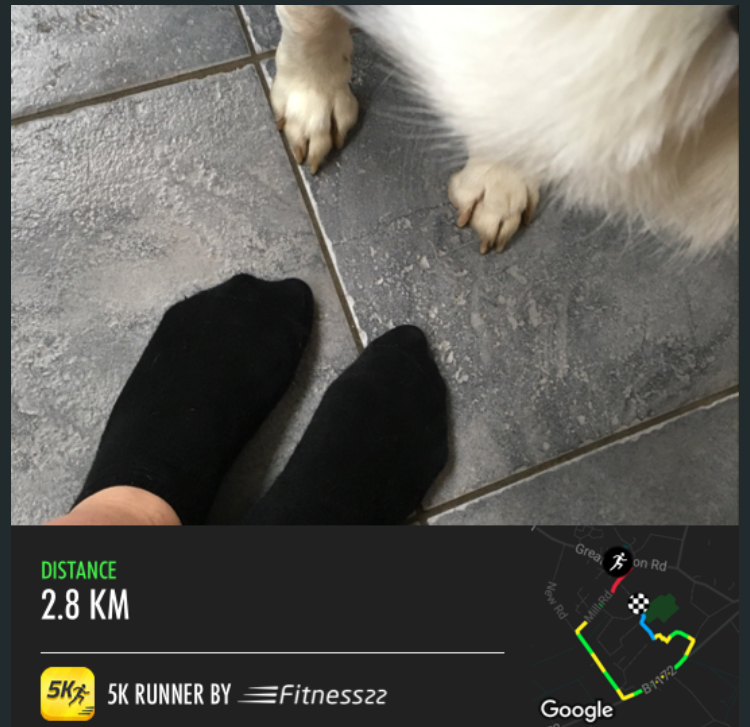
The next twenty or so minutes were the most emotional, and longest, twenty minutes of my life I have ever experienced. I put my new running band on with my phone and beats headphones, and a Spotify playlist that played the most god awful dubstep but I didn’t care. I downloaded the couch to 5k app as I have not really ran in years and pressed start and off me and Riley headed around the village.

The walking was fine, then the lady popped up in her American accent start to run, and so I did.  I started to develop a stitch in my stomach, pain in my chest and the most overwhelming urge to cry. I battled constant thoughts in my head that I could do it … blah! blah! blah!, but Riley was with me. We done it together.

Slow down and start to walk” the voice spoke. I was glad someone knew what I was doing as I didn’t have a clue. I suddenly became awfully aware of the cars going past and thoughts of people looking at me and what they might think: she doesn’t look great; she looks like she is struggling; she must be mad. So with my fave down unable to break a smile or lift my frown I carried on with lead in hand and my faithful dog by my side. I spoke to him, praised him at how well he was doing but I can’t bring to praise myself not yet.

The dubstep tracks blasting in my ears the lyrics started on this train with no destination. And I thought this is how depression and anxiety have made me feel, I have been on a slow and steady train down to rock bottom and I can’t seem to get back up, but I feel today was a start. A little positive I suppose that I can add to my negative.

As it started to snow I thought wow I really am mad, I can’t even run these twenty mins , let a lone a 5k, 10k or yet alone this bloody great north run.

Freezing cold and following my dog in front I made it home and put the kettle straight on and slumped down waiting to make my cup of tea.
For the first time in a long time, I think I see a little light, a little tiny speck of light at the end of my long dark tunnel!

ooOOoo

I asked Catherine for permission to republish this because I was very moved when I read it over at her place. It seemed to say to me that this very honest and open account of what Catherine was experiencing might resonate somewhere out there with you dear readers.

Thank you, Catherine!

More importantly, thank you, Riley. Dogs do so much for us. Even saving our souls!

The Role of Pets in Depression and Bullying in Kids

Another great guest post from Emily Ridgewell!

Both Emily’s previous guest posts were received very well by you. There was Four-legged Gardening, published here last October 24th, and Return To The Movies that came out on the 4th of that same month.

Now Emily writes about something that is never far away from us these days, irrespective of age: depression. And the strongly positive role of pets. Great guest post but first let me re-introduce you to Emily.

Emily Ridgewell is an arts professional and a pet enthusiast from sunny LA. Emily has a creative energy and an aesthetic sense of living, where everything beautiful is worth sharing. She loves her yorkie Olivia and writes original and fun articles on ways to learn and improve your pet-best friend’s life. She finds exciting new things to explore and experience! Don’t forget to connect with her on Twitter: @ridgewell_j

ooOOoo

The Role of Pets in Depression and Bullying in Kids

Kids today are faced with more stress and worry than ever, and childhood depression is on the rise because of it. Recent studies have shown almost 10% of children and adolescents experience depression. One of the main sources of depression among children is being the victim of bullying. Unfortunately, bullying doesn’t discriminate and can happen to boys and girls of any ethnic, racial, religious, or socio-economic background. Lasting effects of being bullied include having low self-esteem and negative self-image, unhappiness at school and difficulty focusing, and trouble establishing healthy relationships with peers.

Interestingly enough, these side effects are found in the bullies as well as their victims. Both are more likely to experience depressive symptoms than those who have never been involved in bullying. They also are more likely to have coexisting mental health issues, such as Oppositional Defiance Disorder, Attention Deficit Disorder, and Clinical Depression and Anxiety. If left unaddressed, these feeling of depression and low self-worth can lead to chronic levels of mental health issues, isolation, and even suicidal ideation.

The first line of defense for parents is arming themselves with strategies to help their children cope with feelings of depression and address them when they first appear. First and foremost, they need to recognize the signs of depression. Then they need to put their heads together and come up with a plan to help their child combat it. Use resources such as your pediatrician, teachers, and school counselors to help develop a long term plan. In the meantime, one of the most effective and immediate ways to help them at home is by getting a pet.

Pets have several benefits that help combat depression and help your child feel happier, more whole, and well connected. First of all, they offer uncomplicated, unconditional love. They don’t say hurtful things, get angry over petty misunderstandings, or hold grudges. They simply love and express joy every time they see their owners. They also offer constant companionship. Having a pet means never having to feel alone or isolated. Additionally, the act of petting a dog or cat (or any other pet, for that matter) offers physical touch and provides comfort, creating a soothing effect and releasing feel-good endorphins in the brain. In turn, this reduces stress and anxiety and helps your child feel calmer and more emotionally balanced.

Further, having a pet means your child will have an added responsibility. Contrary to what you may originally think, a new responsibility provides a distraction and offers a positive focus instead of what’s bothering him.. Plus, he’ll feel good about himself for taking care of something that needs him. He will feel capable, and this bolsters self-esteem and causes a ripple effect in all aspects of her life. It’s a win-win situation.

If you opt for a dog, part of the responsibilities will be walking it. This earns another point in the fight against depression for a couple of reasons. It will make your child be physically active, a well-known tool for negating depressive symptoms. It also is an excellent way to increase social interaction. People are always wanting to touch a puppy, and this leads to a natural conversation when they ask permission. Even if your child is anxious about talking to new people, dogs and pets are automatic ice breakers. Talking about their pet can easily guide the conversation with very little pressure on your child to generate small talk. If they are engaging in conversation, they are less likely to feel isolated and will benefit mentally from the interaction.

Of course, pet ownership isn’t something you should jump into lightly. Be sure to choose the right pet for your child and teach him the right way to handle and care for it. With care and supervision, your child and her pet will become fast friends in no time. While there is no quick fix for depression, owning a pet has multiple benefits which will show their impact quickly. Having an unconditional friend to love can work wonders for building confidence and self-esteem and combatting the negative effects of bullying and depression.

ooOOoo

Emily is spot on. Pets, especially dogs, are the epitome of loving us humans unconditionally and that connection is precious beyond words. Being able to hug or cuddle a dog, frequently as an ad-hoc impulse, is about as comforting a place that us humans, well certainly this human, can get.

Sitting in front of the television of an evening and having a cat snuggle up next to one and start purring is a very close second-best!

Great post from Emily!

The power of good food!

Connections: connections!

In my recent post Diet is so crucial to good health, published on the 11th January I opened it thus:

Sometime over the next few days I will write a post about an amazing connection that Jean made, via Richard in England, with Colin Potter. He is the founder of the site Fight Parkinson’s.

It is mentioned as an introduction to today’s post because Colin stresses the critical importance of the right diet for us humans.

Richard lives with his good lady, Julie, in Minety, a village in North Wiltshire. He and I go back many, many years and we have been close friends from the day that we first met. Richard was diagnosed with early-stage Parkinson’s Disease (PD) the same year and month as my Jeannie: December, 2015.

Last New Year’s Eve Richard and Julie were at a local party and the subject of PD came up. Richard subsequently told me that he was speaking to a fellow party guest who said that he was, in turn, an acquaintance of a Colin Potter. He went to add that Colin had also been diagnosed with PD but had decided not to ‘give in’ to the diagnosis but undertake comprehensive research into the causes and whether it was possible to go into remission. He later launched a website Fight Parkinsons.

This is Colin’s video that appears on the home page of Fight Parkinson’s.

Here’s some more of what Colin writes about on his website.

Parkinson’s RecoveryThis is where you find the answers to the causes of Parkinson’s and the actions you can take which may bring about a recovery.

There are actions that I’ve taken which have required guidance from a doctor (of Functional Medicine) or special practitioner. Other steps, such as changing to a better diet, I have done independently based upon my research.

Nowadays, there are so many ways that we fall foul of nature and the kind of life we are built to lead. Industrialisation and technology expose our bodies to so much stress and toxic substances, it’s no wonder that chronic disease arises. It also means that there are many things to put right.

This has been a journey of learning over several years and, with subsequent knowledge, there are some things I did at the start that I would do differently now. Nevertheless, I did them and can’t turn the clock back.

I share this with you because the chances are that you know someone who knows someone with PD. The information on the Fight Parkinson’s website is too important not to be shared as far and wide as possible.

The subscription price for signing up to all the information is just $5/GBP3.60 per month. Both Jeannie and Richard are subscribers.

Mercy For Animals

Sent to me by John Zande!

John, he of the blog site The Superstitious Naked Ape, recently sent me this appeal. I am very pleased to republish it here.

ooOOoo


Hello,
When I started Mercy For Animals nearly 20 years ago, I was a kid from the Midwest with a big dream and an unwavering determination to help animals. Building MFA was not easy. Our first meeting had three attendees. We had no money. But as we grew, I surrounded myself with incredible supporters like you, passionate volunteers, and committed colleagues.

MFA is the most meaningful endeavor of my life so far. My journey has been moving and inspiring. Working alongside such brilliant colleagues and implementing our shared vision of a kinder world for farmed animals has been an honor. Together, we have built MFA into the powerful organization it is today—one that achieves groundbreaking successes as the result of teamwork.

As MFA has grown in the past few years, I’ve found the personal and creative space to think about how I can best continue to shape our movement—and help more animals. This space led me to launch Circle V, the first vegan animal rights music festival, and to conceptualize and co-found The Good Food Institute, an organization that supports innovation in food and science to produce alternatives that are superior to animal products.

I’ve determined that I can be most effective right now by helping launch exciting new companies and initiatives. This means remaining in this creative, big-picture space and handing over much of the day-to-day operations at MFA to other skilled and respected leaders within the organization.
I’m proud to announce that our executive vice president, Matt Rice, has been promoted to president of MFA. I will continue to serve MFA as chair of the board of directors and will remain intimately involved in strategic decisions as the organization’s founder.

For more than 15 years, Matt Rice has been a central leader in the animal protection movement. He shares my vision for MFA and has implemented it with determination, tireless dedication, and compassion for animals and people.
Matt began in MFA’s New York office carrying out grassroots outreach before being promoted to director of operations. He later moved to Los Angeles to take over as director of investigations, working closely with our brave undercover investigators. Matt has overseen many of MFA’s biggest cases, most successful campaigns, and other victories. As executive vice president, he has overseen all departments.

Click below to watch a video about Matt and MFA’s priorities for 2018.


Matt is steadfast in his commitment to MFA. He is an ideal team player with sound judgment—a true powerhouse for animals. I trust him completely.

Matt is already working with other senior MFA leaders to implement new systems and structures, and we will launch compelling new campaigns this year. Matt is supported by a team of some of the best activists I’ve ever met.

I know that MFA will continue to break barriers and exceed expectations worldwide. Much remains to be done for animals, but we’ve proved time and again that for a movement built on love and persistence, no company is too powerful, no factory farm too big, and no government too mighty.

I’ve never been more optimistic about the future of MFA and our movement. Our greatest victories are still ahead.

Nathan Runkle
Founder

ooOOoo

Let me add that there is much information about the charity on WikiPedia, from which I quote a little:

Mercy For Animals (MFA) is an international non-profit organization dedicated to preventing cruelty to farmed animals and promoting compassionate food choices and policies, founded in October 1999. Nathan Runkle is the group’s executive director and founder.[1] Focusing primarily on advocacy on behalf of farmed animals, MFA runs a number of campaigns that aim to educate the public on animal protection issues and to encourage them to adopt a vegan diet.[2] It has engaged in several undercover investigations, primarily of egg farms, and has produced television commercials showing the treatment of animals in slaughterhouses and factory farms.[3] MFA is headquartered in Los Angeles.

Plus the charity’s website is here Mercy For Animals.

If you didn’t watch the video then, please, do it now.

Finally, please do what you can to support them.

Thank you, John, for sharing this with me.


Winter games

As seen through the eyes of an Australian shepherd dog.

Slowly perking up each day, so thought it would be good to share this short, delightful video with you all. As presented on the Mother Nature Network site.

ooOOoo

Australian shepherd loves to go sledding

NOEL KIRKPATRICK    January 3, 2018

When you think about dog sleds, you may think about a team of huskies pulling a sled across a snowy and icy landscape.

Perhaps you should change that image to an Australian shepherd confidently riding a sled down a hill.

Secret, a 3-year-old Aussie shepherd and the canine companion to 17-year-old human Mary, took advantage of there finally being enough snow to get some sledding in. And by “some” we mean around 50 shots down the hill, according to Mary’s Instagram caption. Secret drags her sled all the way to the top of the hill, hops on and gets her own snowy version of zoomies on as she slides down the hill. Once at the bottom, it’s right back up again, sled in mouth.

If only every day were a snow day for Secret.

ooOOoo

Well done, Secret. Gorgeous!

Another fabulous guest post from Rohit.

Three years have passed by; just like that!

In the first couple of weeks of the New Year in 2014 I received an email from Rohit Agawal asking if I would like to receive a guest post. Of course I said yes.

That started a wonderful series of guest posts coming in from Rohit.

Here is his latest.

ooOOoo

Five Questions to Ask Before Adopting a Dog
Dogs are like children in a broader sense and when you decide to adopt one, there are many things that you need to be responsible for. There is not much difference between adopting a dog and having a child as you will need to take responsibility for another living being by giving him the necessary care and support.

Therefore, adopting a dog is a huge decision and should not be taken on a random impulse. You need to be aware of all the pros and cons before taking your decision and a major part of estimating them involves asking yourself some important questions. To help you get ready for an important life changing decision, we have listed a couple of questions that you need to ask yourself before adopting a dog and therefore without any further ado, let us get started!

  1. Can You Afford to Buy and Maintain a Dog?

The first question that you need to add yourself is quite obvious because a dog will need constant love and support throughout its whole life. To give him the best, you will need to shell extra bucks. The expenses that are involved include adoption or buying fees, spraying (no needed if you are adopting a dog from any rescue shelter), dog food, dog accessories like collar, dog crates (you can visit this website to explore your options) etc and annual veterinarian checkups for your pet’s well being.

Additional expenses can also include monthly heartworm medicines and flea and tick prevention but these vary from dog to dog.

  1. Do you have the time?

Dogs are tactile beings and they need to be given a suitable amount of time. Young puppies without their mothers will need an extra touch and support. The amount of tactile contact is different for different breeds but all domesticated dogs do need their owner’s love and affection to survive. You would also need to dedicate some time to go on walks as a dog needs to out at least 8 hours a day. If you are busy with work the n employ dog walkers.

  1. Are you prepared to commit for a long time?

This is an important question that you need to ask yourself at every step of the process. Dogs can live up to 18 years and therefore you need to be prepared for a lifelong commitment and not change your mind after actually adopting one. Abandoned dogs are a common sight and this is even true with fancier and smaller breed that people adopt for certain reasons and wash their hands off their pets after a few years, citing reasons like job relocation, marriage etc. A dog deserves a stable home and if you can’t provide that for a long duration then it is better to not adopt.

  1. Select the Dog Breed That Suits Your Lifestyle

When you finally decide to adopt, the first thing that you need to select is the breed that you want. Now different types of breeds have different needs and wants. You need to know everything about the same before you select any breed and therefore concentrate on conducting an extensive research about the same.

Also make sure that the dog you adopt will be able to adapt to your lifestyle.

  1. Dogs get sick and are you ready to handle that?

Dogs are prone to sickness and you need to accept that you would need to shell out extra money for healthcare emergencies. It can be something simple as a weight issue or it can also be a serious condition that might require surgery. Pet insurance is a great option that dog owners can look into to cover any emergencies.

So these were some significant questions that you need to ask yourself when you adopt a dog. It might seem too much of work but the joy that a dog will bring in your life will be second to no other and I promise that you will never regret your decision if you take all the necessary steps.

ooOOoo

Author Bio: Rohit is a dog lover and pet enthusiast; he owns two adorable and wonderful dogs that include a German shepherd and a Labrador retriever. As work keeps him away from home, concerns arise about the safety and comfort of his pet friends, which made him try out various products that facilitate the same.

As Rohit makes so clear at the end, the joy that a dog will bring in your life will be second to none

Consuming the living planet.

The eating habits of us humans have to change!

Funny how things go!

For just two days ago I published a post under the heading of Meat is Heat. It featured an essay by Michael Greger. He of the website NutritionFacts.org. That essay promoted the message:

What we eat may have more of an impact on global warming than what we drive.

Just cutting out animal protein intake one day of the week could have a powerful effect. Meatless Mondays alone could beat out a whole week of working from home and not commuting.

Many of you read that post.

On the same day that I published that post, George Monbiot published an article in The Guardian newspaper that offered the same message, albeit coming at it from a different place but nonetheless just as critically important.

Here it is republished with Mr. Monbiot’s very kind permission.

ooOOoo

We Can’t Keep Eating Like This

This is the question everyone should be attending to – where is the food going to come from?

By George Monbiot, published in the Guardian 11th December 2017

Brexit; the crushing of democracy by billionaires; the next financial crash; a rogue US president: none of them keeps me awake at night. This is not because I don’t care – I care very much. It’s only because I have a bigger question on my mind. Where is the food going to come from?

By mid-century there will be two or three billion more people on Earth. Any one of the issues I am about to list could help precipitate mass starvation. And this is before you consider how they might interact.

The trouble begins where everything begins: with soil. The UN’s famous projection that, at current rates of soil loss, the world has 60 years of harvests left, appears to be supported by a new set of figures. Partly as a result of soil degradation, yields are already declining on 20% of the world’s croplands.

Now consider water loss. In places such as the North China Plain, the central United States, California and north-western India – among the world’s critical growing regions – levels of the groundwater used to irrigate crops are already reaching crisis point. Water in the Upper Ganges aquifer, for example, is being withdrawn at 50 times its recharge rate. But, to keep pace with food demand, farmers in South Asia expect to use between 80 and 200% more water by 2050. Where will it come from?

The next constraint is temperature. One study suggests that, all else being equal, with each degree Celsius of warming the global yield of rice drops by 3%, wheat by 6% and maize by 7%. This could be optimistic. Research published in the journal Agricultural & Environmental Letters finds that 4°C of warming in the US Corn Belt could reduce maize yields by between 84 and 100%.

The reason is that high temperatures at night disrupt the pollination process. But this describes just one component of the likely pollination crisis. Insectageddon, caused by the global deployment of scarcely-tested pesticides, will account for the rest. Already, in some parts of the world, workers are now pollinating plants by hand. But that’s viable only for the most expensive crops.

Then there are the structural factors. Because they tend to use more labour, grow a wider range of crops and work the land more carefully, small farmers, as a rule, grow more food per hectare than large ones. In the poorer regions of the world, people with less than 5 hectares own 30% of the farmland but produce 70% of the food. Since 2000, an area of fertile ground roughly twice the size of the United Kingdom has been seized by land grabbers and consolidated into large farms, generally growing crops for export rather than the food needed by the poor.

While these multiple disasters unfold on land, the seas are being sieved of everything but plastic. Despite a massive increase in effort (bigger boats, bigger engines, more gear), the worldwide fish catch is declining by roughly 1% a year, as populations collapse. The global land grab is mirrored by a global seagrab: small fishers are displaced by big corporations, exporting fish to those who need it less but pay more. Around 3 billion people depend to a large extent on fish and shellfish protein. Where will it come from?

All this would be hard enough. But as people’s incomes increase, their diet tends to shift from plant protein to animal protein. World meat production has quadrupled in 50 years, but global average consumption is still only half that of the UK – where we eat roughly our bodyweight in meat every year – and just over a third of the US level. Because of the way we eat, the UK’s farmland footprint (the land required to meet our demand) is 2.4 times the size of its agricultural area. If everyone aspires to this diet, how do we accommodate it?

The profligacy of livestock farming is astonishing. Already, 36% of the calories grown in the form of grain and pulses – and 53% of the protein – are used to feed farm animals. Two-thirds of this food is lost in conversion from plant to animal. A graph produced last week by Our World in Data suggests that, on average, you need 0.01m2 of land to produce a gram of protein from beans or peas, but 1m2 to produce it from beef cattle or sheep: a difference of 100-fold.

It’s true that much of the grazing land occupied by cattle and sheep cannot be used to grow crops. But it would otherwise have sustained wildlife and ecosystems. Instead, marshes are drained, trees are felled and their seedlings grazed out, predators are exterminated, wild herbivores fenced out and other lifeforms gradually erased as grazing systems intensify. Astonishing places – such as the rainforests of Madagascar and Brazil – are laid waste to make room for yet more cattle.

Because there is not enough land to meet both need and greed, a global transition to eating animals means snatching food from the mouths of the poor. It also means the ecological cleansing of almost every corner of the planet.

The shift in diets would be impossible to sustain even if there were no growth in the human population. But the greater the number of people, the greater the hunger meat eating will cause. From a baseline of 2010, the UN expects meat consumption to rise by 70% by 2030 (this is three times the rate of human population growth). Partly as a result, the global demand for crops could double (from the 2005 baseline) by 2050. The land required to grow them does not exist.

When I say this keeps me up at night, I mean it. I am plagued by visions of starving people seeking to escape from grey wastes, being beaten back by armed police. I see the last rich ecosystems snuffed out, the last of the global megafauna – lions, elephants, whales and tuna – vanishing. And when I wake, I cannot assure myself that it was just a nightmare.

Other people have different dreams: the fantasy of a feeding frenzy that need never end, the fairytale of reconciling continued economic growth with a living world. If humankind spirals into societal collapse, these dreams will be the cause.

There are no easy answers, but the crucial change is a shift from an animal to a plant-based diet. All else being equal, stopping both meat production and the use of farmland to grow biofuels could provide enough calories for another 4 billion people and double the protein available for human consumption. Artificial meat will help: one paper suggests it reduces water use by at least 82% and land use by 99%.

The next Green Revolution will not be like the last one. It will rely not on flogging the land to death, but on reconsidering how we use it and why. Can we do this, or do we – the richer people now consuming the living planet – find mass death easier to contemplate than changing our diet?

http://www.monbiot.com

ooOOoo

As many of you know Jeannie and I changed our diet to a vegan diet some four weeks ago. It was done more for personal health reasons than from an awareness of the difference that it made to the future of the planet. But over the last few weeks we have had our eyes opened to the broader benefits of not eating meat. George Monbiot spells out the urgency of change for all of us, especially the richer people in the richer countries.

Am I hopeful that there will be a mass awareness of the need to change? I truly just don’t know. I will close be repeating Mr. Monbiot’s closing sentence.

Can we do this, or do we – the richer people now consuming the living planet – find mass death easier to contemplate than changing our diet?

Interesting times!

Get lost in one’s dreams!

A very beautiful photograph.

I’m sure I have mentioned previously the fun, education and sheer enjoyment that I, and many, many others, get from the photography forum Ugly Hedgehog.  I drop into the forum several times a day.

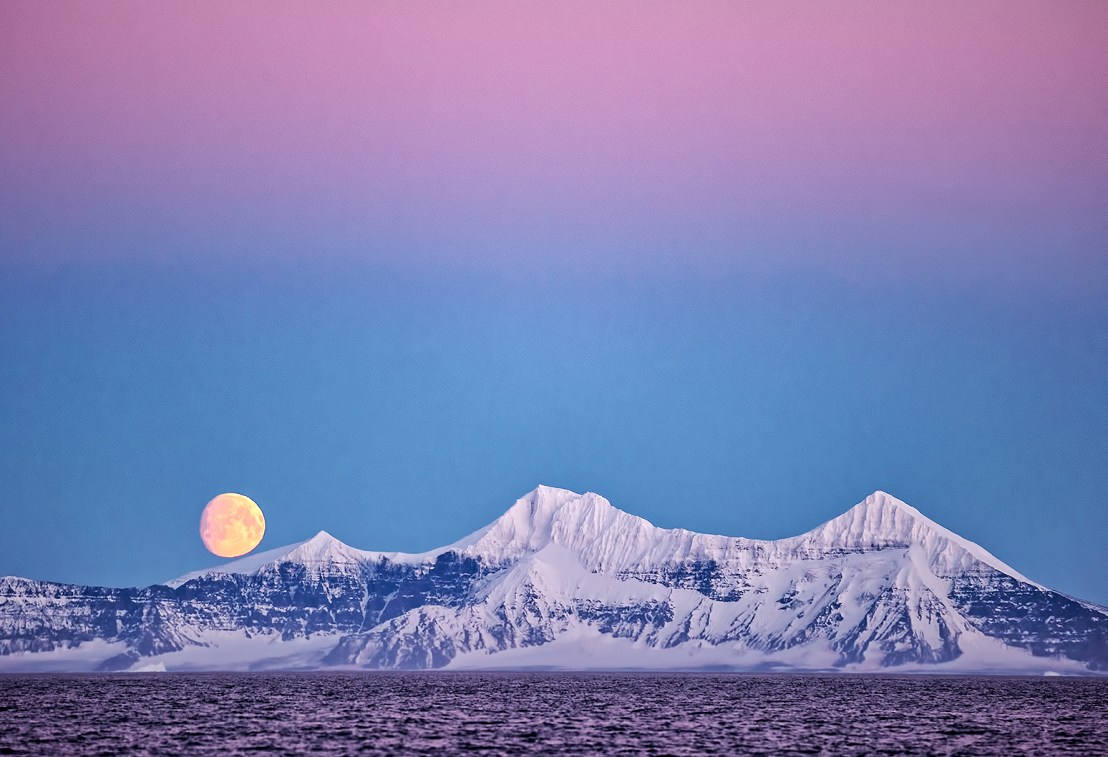
Thus it was that yesterday morning I went to an item posted by Kalina. It was called Moonset in Greenland.

This is the photograph that Kalina had shared on the forum:

And how that photograph was described by Kalina.

This is a moon, not a supermoon, not a fancy moon, not even a full moon, just a moon rising outside of Scoresby Sound, Greenland. What a magical place..

Later on, as I was seeking, and being given, permission to share the image with all you good people, Kalina answered my question as to what had brought her to Greenland. Her answer:

I love the absolute raw beauty in Greenland. I was on a schooner built in 1909 sailing through the largest fjord system in the world, words cannot describe the beauty. We never encountered another soul the entire time, there is no evidence of humans..polar bears and musk ox but no people. I will add that this image is not photoshopped..

Just go back to that image and get lost in it.

Get lost in one’s dreams!

Then when you return to your real world, go across to WikiPedia and read more about this magical place. Here’s an extract from that WikiPedia entry.

ooOOoo

Scoresby Sound

Scoresby Sund (Danish: Scoresby Sund, Greenlandic: Kangertittivaq) is a large fjord system of the Greenland Sea on the eastern coast of Greenland. It has a tree-like structure, with a main body approximately 110 km (68 mi)[2] long that branches into a system of fjords covering an area of about 38,000 km2 (14,700 sq mi). The longest of the fjords extends 340–350 km (210-216 mi) inland from the coastline.[1] The depth is 400–600 m (1,310-1,970 ft) in the main basin, but depths increase to up to 1,450 m (4,760 ft) in some fjords.[1] It is one of the largest and longest fjord systems in the world.[3][4][5]

On the northern side of the mouth of the Scoresby Sund stands Ittoqqortoormiit, the only permanent settlement in the region, with a population of 469 (in 2010). The name of the sound honours English explorer William Scoresby, who in 1822 mapped the fjord area in detail.

ooOOoo

Plus wanted to share another photograph of Scoresby Sund taken by Hannes Grobe, seen on that WikiPedia page.

Dr. Hannes Grobe 20:10, 16 December 2007 (UTC) – Own work

More details of Dr. Hannes Grobe may be read here.