Yes, more of the wonderful pictures from Dan Gomez.

oooo

oooo

oooo

oooo

oooo

We have one more set left for next Sunday. I shall miss them after that.
Dogs are animals of integrity. We have much to learn from them.
Category: Communication
Yes, more of the wonderful pictures from Dan Gomez.
oooo
oooo
oooo
oooo
oooo
We have one more set left for next Sunday. I shall miss them after that.
I thought it would be useful to publish this.
Here is the text of an email that was received yesterday morning.
ooOOoo
Dear Fellow Dog Lover,
Because you signed up on our website, I’m sending you this recall update report. If you no longer wish to receive these emails, please click the “unsubscribe” link at the bottom of this message.
Over the past 60 days, the FDA has announced 2 dog food recalls:
For details, please visit our Dog Food Recall Alerts Center.
Feeding Tip
Got a dog that’s 7 years… or older? Here are 5 of The Advisor’s Top 15 Best Senior Dog Foods for 2019:
Click here to see all 15 of The Dog Food Advisor’s top senior picks for May 2019.
Please feel free to share this recall update report with other dog lovers.
Mike Sagman, Editor
The Dog Food Advisor
P.S. Not already on our dog food recall notification list? Sign up to get critical dog food recall alerts by email. There’s no cost for this service. No spam. Cancel anytime.
ooOOoo
You are welcome to receive notifications via this web site but for a more reliable, long-term service then sign up to the email service.
Best wishes!
Hunting, and not for food!
We hate hunting. Period.
It’s sort of alright when the person needs to hunt to stay alive. But in the Western world the incidence of that is pretty remote.
So when author Jim wrote about coyotes and hunting I had to share it with you (and, for the record, both Jean and I are atheists). Published with Jim’s permission.
ooOOoo
How killing for fun is not only a Christian Right, but a value
By Jim, August 5th 2018.
Christian vulgarity has reigned it’s bullets down on the North American coyote for over 100 years. The longest standing extermination order in history has killed millions of coyotes and continues its bounty program in most states. Competitive hunts sponsored throughout the nation each year with cash prizes and trophies instill to our kids the right obligation to kill for fun.
“One morning in the late 1930s, the biologist Adolph Murie stood near a game trail in Yellowstone National Park and watched a passing coyote joyously toss a sprig of sagebrush in the air with its mouth, adroitly catch it, and repeat the act every few yards. At the time, Mr. Murie was conducting a federal study intended to prove, definitively, that the coyote was “the archpredator of our time.” But Mr. Murie, whose work ultimately exonerated the animals, was more impressed by that sprig-tossing — proof, he believed, of the joy a wild coyote took in being alive in the world” (1)
The majority of politicians have failed to address this with any passion, and being the good, high moral standard western value Christians that they are, continue the killing spree. A useless torture that drives the coyote without mercy and without effect. “Under persecution, the biologists argued, evolved colonizing mechanisms kicked in for coyotes. They have larger litters. If alpha females die, beta females breed. Pressured, they engage an adaptation called fission-fusion, with packs breaking up and pairs and individuals scattering to the winds and colonizing new areas. In full colonization mode, the scientists found, coyotes could withstand as much as a 70 percent yearly kill rate without suffering any decline in their total population”.

Hunters have their ultimate victim to hunt—one that can outbreed the continued onslaught. How fun is it? While the coyote is hunted for sport, they die in earnest. Leave them to experience their joy, and populations will mitigate in their own necessary way.
Christian values and morals once again are superior delayed in common decency and way off the mark—unless your talking killing for sport.
ooOOoo
I want to add a couple of comments that were left on the post:
Not many christians are bothered by this. Why should they, when you hear them quote from their holy book, that god commanded them to subdue the earth.
It is for this very reason that many christians are nonchalant when we talk about climate change
oooo
The price paid for pointlessly killing predators is a dear one. Moreover, all needless killing of animals is wrong, says the immoral, convinced atheist.
oooo
(to which Jim replied)
Part of the doctrine is to subdue and have dominion. To hell with inferior, soulless life. The ripple effect of what was once naturally flowing is tragic and painful.
Enough said!
A reflection on our dogs.
I was sorting out some stuff the other day and came across the following. It is the record of a talk I gave some time ago in connection with the publication of my book Learning from Dogs.
As much as I would have expected to have previously published this on the blog I cannot find an entry. So here you are!
ooOOoo
The concept of attributing dogs with human traits is nothing new. In fact the ancient Greeks came up with a fancy word for it around two thousand years ago: anthropomorphism.
As ever, the truth of the matter is not a case of black and white but subtle shades of grey. No doubt in another two thousand years as science advances and we discover more about DNA and the mysteries of the human and canine brains the picture will develop into sharper focus. In the meantime, we must satisfy ourselves with some basic observations.
Let’s start off on common ground. One thing that we all seem to agree on is that humans are at the top of the pile in terms of evolutionary sophistication. For obvious reasons we view ourselves as the being the highest life form (although there is increasing alarm that we have totally lost touch with our basic instincts, if not totally lost the plot, by endangering the very planet that sustains life as we know it).
But I digress – back to common ground. We agree that as children our mental capacity is not fully developed. We survive by our instincts and the basic needs to be fed, watered, sheltered and bonded in a family group where we defer to a natural hierarchy. When you think about it this is precisely how dogs survive.
Like children, dogs display the most basic instincts to rough and tumble, compete for toys and establish a natural pecking order. Inherent in this is the need for a parent or pack leader to set down boundaries and create order and stability out of chaos. Without this both child and dog feel insecure and may well grow to display anti-social behaviour.
You would responsibly bring a child up with love and discipline, have consistent boundaries, teach them what is safe and what is dangerous, what is sociable and what is unsociable.
Dogs too need love and discipline, consistent boundaries, and to learn what is safe and what is dangerous, what is sociable and what is unsociable.
Communicating with a child is not so very different from communicating with a dog. Young children, like dogs, do not have the power of speech so you have to work out alternative strategies to speech in order to get through to them. You will find that if you approach a dog in much the same way as you approach a child, life will be a whole lot easier for you. And the dog! Hopefully you will have realised that praise is a far stronger motivator that punishment.
A positive approach.
Take the example of the puppy that makes a puddle on the floor and the child that wets its bed. Each one of them have not learnt control of their bladder and are simply responding to the call of nature. Neither are being naughty nor are in the wrong.
Yelling at the child will only make it more stressed and, therefore, more likely to continue wetting the bed. In exactly the same way if a puppy has an accident on the carpet being harsh will make matters worse.
How many human ‘sports’ involve chasing a moving object? How many of these games also involve people working as a team to ‘catch’ these objects? Football, rugby, basketball, tennis, badminton, etc. I could go on but you get the idea.
Why do we enjoy these games? Is it not because we too are instinctively striving for a pecking order within the pack and following our predatory instincts.
“No, no no!’ I hear you say. ‘We are a civilised, sophisticated race who have created these games for our enjoyment. They are so different to the throw and fetch games our canine friends mindlessly enjoy.’
Don’t kid yourself. Look also how football supporters revert to uninhibited childlike behaviour. At worst becoming hooligans and behaving, almost literally, like savage animals when they find themselves challenged or threatened by an opposing pack.
Or on a much more positive note how hundreds of fans, unrehearsed, suddenly find one voice and break into a prefect, heart-stopping rendition of “You’ll Never Walk Alone”. Now that’s a perfect example of the ‘pack call’.
We all enjoy the close relationship we have with our dogs. Maybe sometimes we don’t realise quite how close we are.
ooOOoo
I can’t imagine life without our dogs.
They mean everything to Jeannie and me.

More from Dan’s email.

oooo

oooo

oooo
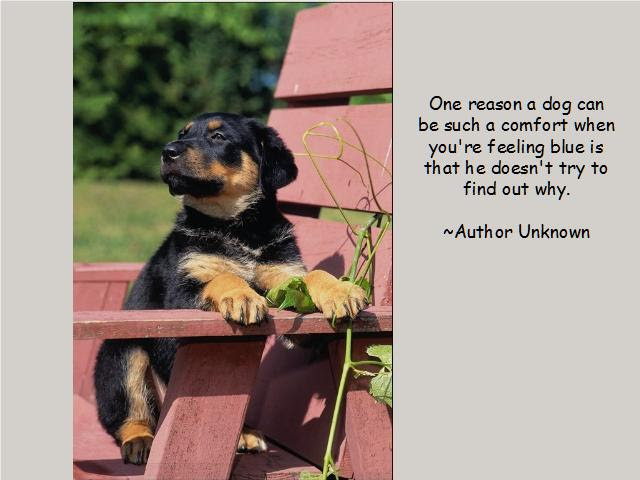
oooo
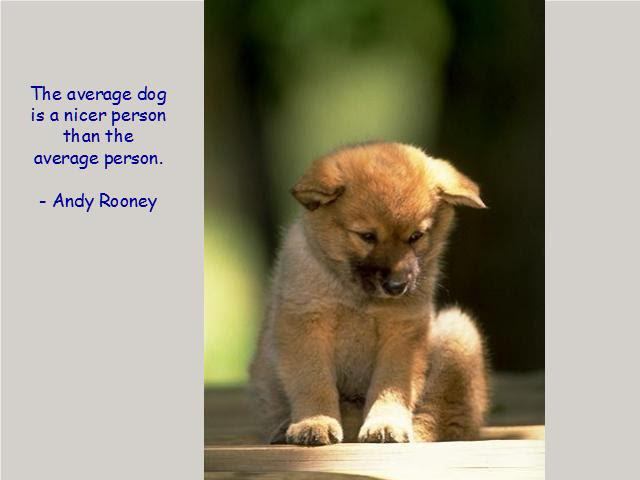
oooo

oooo

Perfect. A combination of wise sayings and lovely photographs. Plus, more in a week’s time!
Or is it the other way around?
A fascinating article about the domestication of the wolf to the domesticated dog appeared on the BBC back in March.
It was, in turn, based on a report issued by Nature and makes interesting reading. But for the shorter version, read on:
ooOOoo
By Helen Briggs, BBC News, Science and Environment
14 March 2019

Wolves lead and dogs follow – but both are equally capable of working with humans, according to research that adds a new twist in the tale of how one was domesticated from the other.
Dogs owe their cooperative nature to “the wolf within”, the study, of cubs raised alongside people, suggests.
But in the course of domestication, those that were submissive to humans were selected for breeding, which makes them the better pet today.
Scientific Reports published the study.
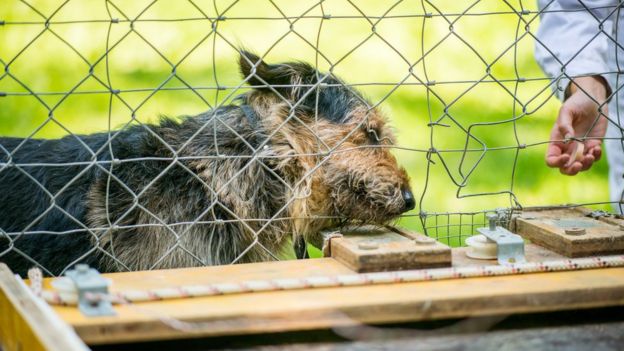

Grey wolves, at the Wolf Science Center in Vienna, were just as good as dogs at working with their trainers to drag a tray of food towards them by each taking one end of a rope.
But, unlike the dogs in the study, they were willing to try their own tactics as well – such as stealing the rope from the trainer.
Friederike Range, from the Konrad Lorenz Institute, at Vetmeduni Vienna university, said: “It shows that, while wolves tend to initiate behaviour and take the lead, dogs are more likely to wait and see what the human partner does and follow that behaviour.”
About 30,000 years ago, wolves moved to the edges of human camps to scavenge for leftovers.
The subsequent “taming” process of domestication and selective breeding then slowly began to alter their behaviour and genes and they eventually evolved into the dogs that we know today.
Follow Helen on Twitter.
ooOOoo
Now it seems no better way to end today’s post than by selecting a short Nat Geo video to watch. (Out of many videos on YouTube regarding wolves.)
Wonderful animals.
Read this for the sake of your dogs!
Belinda emailed me five days ago about this problem that affects the common bug control products.
She sent me a link to a feature on the Healthy Pets website, from where I take today’s post.
ooOOoo
Dogs explore the world with their noses and often, their mouths. In addition, most are indiscriminate eaters. This combination can lead to all sorts of challenges for dog parents — some funny, some gross, and unfortunately, some that are potentially deadly.
The latter category includes a long list of toxic substances found both indoors and out that most dogs will sniff and perhaps taste, given the chance. One of these poisons goes by a name many of you have probably never heard of: metaldehyde, a chemical used to kill slugs and snails.
Metaldehyde is highly toxic to mammals and birds and is the sixth most common substance veterinarians ask about when they call the 24-hour Veterinary Poisons Information Service, a worldwide emergency hotline. There is no known antidote for metaldehyde toxicosis, and supportive treatment is complicated and costly. Death occurs in approximately 25% of poisoning cases involving dogs.
Lucky for us, a team of veterinarians at the University of Munich became concerned about the number of poisonings and the prognosis for dogs with metaldehyde toxicity. They did some outside-the-box thinking and decided to see if a technique called hemodialysis-hemoperfusion — a procedure used to remove kidney toxins from the blood — might be an effective treatment.
The Morris Animal Foundation funded a grant that allowed the researchers to test their theory on plasma samples contaminated with metaldehyde. They were able to successfully reduce concentrations of the toxin in the samples, so the next step was to see if the technique would work on an actual dog.
Enter Jimbo, a Jack Russell Terrier who sampled slug bait containing metaldehyde. By the time he was brought to the university research team, Jimbo was having one seizure after another, without fully regaining consciousness. The team quickly performed hemodialysis on the dog, and within 24 hours he was back on his feet and on his way home.
As of this writing, the veterinary team has treated 10 dogs with their novel therapy and all 10 had a complete recovery. Their research findings will be published in the not-too-distant future for use by the global veterinary community.
As I mentioned earlier, metaldehyde is a chemical most commonly found in slug and snail baits. The baits usually come in granule form, but can also be found in liquid, powder, meal, gel/paste or pellet form. The baits are designed to release metaldehyde for about 10 days to two weeks under moderately moist conditions.
Bran or molasses is usually added to the baits to make them more attractive to snails and slugs, which also makes them appealing to dogs. Baits sold for home use in the U.S. generally contain between 2% and 5% metaldehyde. According to veterinarian Dr. Ahna G. Brutlag of the Pet Poison Helpline, the products most commonly reported to the hotline in this country include:1
Other U.S. brands include Antimilace, Cekumeta, Meta, Metason, OR-CAL, Slugger Snail & Slug Bait, Ortho Metaldehyde 4% Bait, Slug Pellets, Slugit Pellets and Slug-Tox. Surprisingly, in Europe, slug and snail baits can contain up to 50% metaldehyde. The chemical is also used in small heating systems (e.g., camping stoves) and lamps. The Japanese use metaldehyde in color flame tablets that are ignited for entertainment purposes.
Dogs typically eat slug bait either off the ground or from a container. We don’t yet know how metaldehyde causes toxicity, only that it’s extremely deadly. A 10-pound dog can show signs of poisoning after eating as little as 1 ounce of a typical bait containing 3 metaldehyde.2 The chemical is also toxic to cats, though cases of poisoning are rare. It can also affect wildlife.
If your pet ingests bait containing metaldehyde, signs of toxicity will develop quickly, typically within the hour. The first sign is usually vomiting, because the toxin irritates the lining of the stomach. Next come neurologic signs, which can include anxiousness, increased heart and respiratory rates, excessive drooling, a stiff or drunken gait, and in some cases, hypersensitivity to touch.
As the toxicity progresses, there are muscle tremors that often trigger a high fever that can lead to organ failure. Nystagmus (rapid back-and-forth movement of the eyes) may also occur.
Symptoms of metaldehyde toxicity continue to progress for several hours after the bait is ingested, ultimately resulting in lethargy and weakness, continuous muscle tremors or seizures, loss of consciousness and death if the dog doesn’t receive aggressive, appropriate treatment in time.
Diagnosis of metaldehyde toxicity is most often based on clinical signs and suspected exposure to slug bait. It’s possible to test the stomach contents for the presence of metaldehyde, but the results won’t be back quickly enough to be of any benefit in saving the dog.
Veterinarians typically run a number of diagnostic tests (i.e., complete blood cell count, serum chemistry profile, urinalysis, etc.) to rule out other possible causes for a pet’s symptoms, as well as to find possible complications resulting from the poisoning that also require treatment.
Veterinarians will induce vomiting in dogs brought to them within an hour of ingesting metaldehyde who aren’t showing any neurologic signs. They’ll also be given activated charcoal to bind the metaldehyde still in the intestines, decreasing further absorption. If you can’t get your dog to a clinic within an hour, your veterinarian may instruct you to induce vomiting at home before leaving.
In dogs whose conditions aren’t stable enough to safely induce vomiting, the stomach can be emptied using gastric lavage, a procedure requiring anesthesia and a tube that is passed through the esophagus to the stomach. The tube is used to drain the contents of the stomach, flush it with fluids and place activated charcoal in there to bind whatever metaldehyde remains.
Dogs who undergo gastric lavage will need to stay in the hospital for several hours to receive additional doses of activated charcoal and be closely monitored for signs of toxicity. If signs develop, a longer hospitalization will be required. Supportive care while hospitalized can help keep your dog comfortable and deal with certain effects of the toxin such as tremors, seizures and blood abnormalities. Intravenous (IV) fluids will be given and your pet’s body temperature will be closely monitored.
Most dogs with metaldehyde toxicity who receive early, aggressive, appropriate treatment recover fully within two to three days. However, treatment can be expensive, especially in severe cases requiring sedation or anesthesia. Since the cost of treatment can be prohibitive, and since metaldehyde poisoning isn’t something any loving pet parent wants their dog to endure, prevention should always be the goal.
My recommendation is to avoid using slug and snail baits containing metaldehyde and/or other toxic chemicals. If you want to protect your garden from the critters, consider using broken shells, lava rock or other alternatives to snail and slug bait.
Veterinarian Dr. Catherine Barnett of VCA Hospitals also suggests using copper bands around plants, or adding lavender, mint or rosemary plants to your garden. You can also fill shallow cans with beer to attract and drown slugs.3 You can find additional nontoxic solutions at this link.
– Sources and References
ooOOoo
It’s yet another reason why one should wherever possible keep the whole of one’s property clear of all chemical products. And try as hard as you can to stop your dogs and cats from ‘straying’ onto your neighbour’s land.
Thank you, Belinda.
An email that came in from Dan Gomez.
(And Happy Birthday to Dan.)
It had a collection of these images.

oooo

oooo

oooo

oooo

oooo

oooo

These are fabulous. More of them in a week’s time.
Good news to our earlier story.
On April 30th I published a story that had been on the BBC News website about a dog that had been rescued from the sea some 200+ kilometres from the Thai coast.
It drew a fair amount of replies.
Then Margaret from Tasmania left a reply that contained the link to an article in the Bangkok Post. It was very good news!
ooOOoo
29 Apr 2019
WRITER: GARY BOYLE
ORIGINAL SOURCE/WRITER: ASSAWIN PAKKAWAN

Seafaring dog Boonrod is heading to a new life in Khon Kaen with his new owner — one of the oil rig workers who rescued him from the ocean in a story that captured international attention.
“We’re leaving,” owner Vitisak Payalaw posted in a message on the Boonrod Facebook page on Saturday evening.
Mr Vitisak, an planner of Chevron Thailand Exploration and Production, met Boonrod — in Thai — on Saturday for the first time since the team found him to an oil platform in the Gulf of Thailand about 220km from the shore in Songkhla on April 12.
How Boonrod got there remains a mystery, but it is believed that he must have fallen off a trawler. After helping rescue the deepwater dog, Mr Vitisak offered to be his new owner.
The exhausted animal was brought ashore on April 15 and lodged at Dog Smile House, a shelter in Hat Yai district of the southern province, with financial support from the US oil firm and Watchdog Thailand, a non-profit group.
Boonrod appeared delighted to see Mr Vitisak and the other members of the oil rig team who rescued him.
Mr Vitisak said he was taking annual leave from his work at the oil platform to transport the dog to his home in Khon Kaen, almost 1,500km from Hat Yai. The house in the northeastern province has been prepared to accomodate a new resident, the Chevron employee added.
Mr Vitisak asked for privacy and requested that well-wishers not visit his new pet at his parents’ home in Khon Kaen. But fans are welcome to greet Boonrod when he walks the dog, he added.
He also encouraged other animal lovers to adopt pets if they can.
The story of Boonrod was carried by global news agencies, including CNN. He can be followed on his Facebook page.
ooOOoo
We love stories like that!
Good luck to Boonrod and to his new friends.
A rather depressing essay from Tom Englehardt.
The world is getting hotter. That’s a fact!
And no amount of stuffing one’s head under the pillow is going to change that fact.
We must take note of all the many articles and stories about the warming of the planet. Because we need to change the way we are responding. Not from climate change but to climate crisis.
I’m republishing a recent essay from Tom Engelhardt, with his permission, because he articulates perfectly where we are heading.
ooOOoo
As the Flames Began to Rise, the Arsonists Appeared
By Tom Engelhardt, April 25th, 2019
As Notre Dame burned, as the flames leapt from its roof of ancient timbers, many of us watched in grim horror. Hour after hour, on screen after screen, channel after channel, you could see that 850-year-old cathedral, a visiting spot for 13 million people annually, being gutted, its roof timbers flaring into the evening sky, its steeple collapsing in a ball of fire. It was dramatic and deeply disturbing — and, of course, unwilling to be left out of any headline-making event, President Trump promptly tweeted his advice to the French authorities: “Perhaps flying water tankers could be used to put it out. Must act quickly!” No matter that water from such planes would probably have taken the cathedral’s towers down and endangered lives as well — “the equivalent,” according to a French fire chief, “of dropping three tons of concrete at 250 kilometers per hour [on] the ancient monument.”
Still, who could doubt that watching such a monument to the human endeavor being transformed into a shell of its former self was a reminder that everything human is mortal; that, whether in a single lifetime or 850 years, even the most ancient of our artifacts, like those in Iraq and Syria recently, will sooner or later be scourged by the equivalent of (or even quite literally by) fire and sword; that nothing truly lasts, even the most seemingly permanent of things like, until now, Notre Dame?
That cathedral in flames, unlike so much else in our moment (including you-know-who in his every waking moment), deserved the front-and-center media attention it got. Historically speaking, it was a burning event of the first order. Still, it’s strange that the most unnerving, deeply terrifying burning underway today, not of that ancient place of worship that lived with humanity for so many tumultuous centuries but of the planet itself, remains largely in the background.
When the cathedral in which Napoleon briefly crowned himself emperor seemed likely to collapse, it was certifiably an event of headline importance. When, however, the cathedral (if you care to think of it that way) in which humanity has been nurtured all these tens of thousands of years, on which we spread, developed, and became what we are today — I mean, of course, the planet itself — is in danger of an unprecedented sort from fires we continue to set, that’s hardly news at all. It’s largely relegated to the back pages of our attention, lost any day of the week to headlines about a disturbed, suicidal young woman obsessed with the Columbine school massacre or an attorney general obsessed with protecting the president.
And let’s not kid ourselves, this planet of ours is beginning to burn — and not just last week or month either. It’s been smoldering for decades now. Last summer, for instance, amid global heat records (Ouargla, Algeria, 124 degrees Fahrenheit; Hong Kong, over 91 degrees Fahrenheit for 16 straight days; Nawabsha, Pakistan, 122 degrees Fahrenheit; Oslo, Norway, over 86 degrees Fahrenheit for 16 consecutive days; Los Angeles, 108 degrees Fahrenheit), wildfires raged inside the Arctic Circle. This March, in case you hadn’t noticed — and why would you, since it’s gotten so little attention? — the temperature in Alaska was, on average, 20 degrees (yes, that is not a misprint) above normal and typical ice roads between villages and towns across parts of that state were melting and collapsing with deaths ensuing.
Meanwhile, in the Antarctic, ice is melting at a rate startling to scientists. If the process accelerates, global sea levels could rise far faster than expected, beginning to drown coastal cities like Miami, New York, and Shanghai more quickly than previously imagined. Meanwhile, globally, the wildfire season is lengthening. Fearsome fires are on the rise, as are droughts, and that’s just to begin to paint a picture of a heating planet and its ever more extreme weather systems and storms, of (if you care to think of it that way) a Whole Earth version of Notre Dame.
The Arsonists Arrive
As was true with Notre Dame, when it comes to the planet, there were fire alarms before an actual blaze was fully noted. Take, for example, the advisory panel of scientists reporting to President Lyndon Johnson on the phenomenon of global warming back in 1965. They would, in fact, predict with remarkable accuracy how our world was going to change for the worse by this twenty-first-century moment. (And Johnson, in turn, would bring the subject up officially for perhaps the first time in a Special Message to Congress on February 5, 1965, 54 years before Alexandria Ocasio-Cortez’s Green New Deal proposal.) As that panel wrote at the time, “Through his worldwide industrial civilization, Man is unwittingly conducting a vast geophysical experiment. Within a few generations he is burning the fossil fuels that slowly accumulated in the earth over the past 500 million years…” In other words, the alarm was first sounded more than half a century ago.

When it comes to climate change, however, as the smoke began to appear and, in our own moment, the first flames began to leap — after all, the last four years have been the hottest on record and, despite the growth of ever less expensive alternative energy sources, carbon dioxide emissions into the atmosphere are still rising, not falling — no firemen arrived (just children). There were essentially no adults to put out the blaze. Yes, there was the Paris climate accord but it was largely an agreement in principle without enforcement power of any genuine sort.
In fact, across significant parts of the planet, those who appeared weren’t firefighters at all, but fire feeders who will likely prove to be the ultimate arsonists of human history. In a way, it’s been an extraordinary performance. Leaders who vied for, or actually gained, power not only refused to recognize the existence of climate change but were quite literally eager to aid and abet the phenomenon. This is true, for instance, of the new president of Brazil, Jair Bolsonaro, who came to power prepared to turn the already endangered carbon sink of the Amazon rain forest into a playground for corporate and agricultural destroyers. It is similarly true in Europe, where right-wing populist movements have begun to successfully oppose gestures toward dealing with climate change, gaining both attention and votes in the process. In Poland, for instance, just such a party led by President Andrzej Duda has come to power and the promotion of coal production has become the order of the day.
And none of that compared to developments in the richest, most powerful country of all, the one that historically has put more greenhouse gas emissions into the atmosphere than any other. On taking office, Donald Trump appointed more climate-change deniers to his cabinet than might have previously seemed possible and swore fealty to “American energy dominance,” while working to kneecap the development of alternative energy systems. He and his men tried to open new areas to oil and gas drilling, while in every way imaginable striving to remove what limits there had been on Big Energy, so that it could release its carbon emissions into the atmosphere unimpeded. And as the planetary cathedral began to burn, the president set the mood for the moment (at least for his vaunted “base”) by tweeting such things as “It’s really cold outside, they are calling it a major freeze, weeks ahead of normal. Man, we could use a big fat dose of global warming!” or, on alternative energy, “You would be doing wind, windmills, and if it doesn’t if it doesn’t blow you can forget about television for that night… Darling, I want to watch television. I’m sorry, the wind isn’t blowing.”
Among those who will someday be considered the greatest criminals in history, don’t forget the Big Energy CEOs who, knowing the truth about climate change from their own hired scientists, did everything they could to increase global doubts by funding climate-denying groups, while continuing to be among the most profitable companies around. They even hedged their bets by, among other things, investing in alternative energy and using it to more effectively drill for oil and natural gas.
Meanwhile, of course, the planet that had proven such a comfortable home for humanity was visibly going down. No, climate change won’t actually destroy the Earth itself, just the conditions under which humanity (and so many other species) thrived on it. Sooner or later, if the global temperature is indeed allowed to rise a catastrophic seven degrees Fahrenheit or four degrees Celsius, as an environmental impact statement from the Trump administration suggested it would by 2100, parts of the planet could become uninhabitable, hundreds of millions of human beings could be set in desperate motion, and the weather could intensify in ways that might be nearly unbearable for human habitation. Just read David Wallace-Wells’s The Uninhabitable Earth, if you doubt me.
This isn’t even contestable information anymore and yet it’s perfectly possible that Donald Trump could be elected to a second term in 2020. It’s perfectly possible that more right-wing populist movements could sweep into power in Europe. It’s perfectly possible that Vladimir Putin’s version of great powerdom — a sagging Russian petro-state — could continue on its present globally warming path well into the future.
Understand this: Trump, Bolsonaro, Duda, Putin, and the others are just part of human history. Sooner or later, they will be gone. Climate change, however, is not part of human history (whatever it may do to civilization as we know it). Its effects could, in human terms, last for almost unimaginable periods of time. It operates on a different time scale entirely, which means that, unlike the tragedies and nightmares of human history, it is not just a passing matter.
Of course, the planet will survive, as will some life forms (as would be true even if humanity were to succumb to that other possible path to an apocalypse, a nuclear holocaust resulting in “nuclear winter”). But that should be considered small consolation indeed.
Putting the Planet on a Suicide Watch
Consider global warming a story for the ages, one that should put Notre Dame’s near-destruction after almost nine centuries in grim perspective. And yet the planetary version of burning, which should be humanity’s crisis of all crises, has been met with a general lack of media attention, reflecting a lack of just about every other kind of attention in our world (except by those outraged children who know that they are going to inherit a degraded world and are increasingly making their displeasure about it felt).
To take just one example of that lack of obvious attention, the response of the mega-wealthy to the burning of Notre Dame was an almost instantaneous burst of giving. The euro equivalent of nearly a billion dollars was raised more or less overnight from the wealthiest of French families and other .01%ers. Remind me of the equivalent for climate change as the planet’s spire threatens to come down?
As for arsonists like Donald Trump and the matter of collusion, there’s not even a question mark on the subject. In the United States, such collusion with the destroyers of human life on Planet Earth is written all over their actions. It’s beyond evident in the appointment of former oil and gas lobbyists and fellow travelers to positions of power. Will there, however, be the equivalent of a Mueller investigation? Will the president be howling “witch hunt” again? Not a chance. When it comes to Donald Trump and climate change, there will be neither a Mueller Report, nor the need for a classic Barr defense. And yet collusion — hell, yeah! The evidence is beyond overwhelming.
We are, of course, talking about nothing short of the ultimate crime, but on any given day of our lives, you’d hardly notice that it was underway. Even for an old man like me, it’s a terrifying thing to watch humanity make a decision, however inchoate, to essentially commit suicide. In effect, there is now a suicide watch on Planet Earth. Let’s hope the kids can make a difference.
Tom Engelhardt is a co-founder of the American Empire Project and the author of a history of the Cold War, The End of Victory Culture. He runs TomDispatch.com and is a fellow of the Type Media Center. His sixth and latest book is A Nation Unmade by War (Dispatch Books).
Follow TomDispatch on Twitter and join us on Facebook. Check out the newest Dispatch Books, John Feffer’s new dystopian novel (the second in the Splinterlands series) Frostlands,Beverly Gologorsky’s novel Every Body Has a Story, and Tom Engelhardt’s A Nation Unmade by War, as well as Alfred McCoy’s In the Shadows of the American Century: The Rise and Decline of U.S. Global Power and John Dower’s The Violent American Century: War and Terror Since World War II.
Copyright 2019 Tom Engelhardt
ooOOoo
Tom and I are of the same age, give or take a year or two, and I have long been worried about the state of things. Part of me thinks that I won’t live long enough to experience the worst of this climate crisis and that my grandchild will have to sort it out. But then another part of me thinks that this is accelerating and we are already experiencing weather and climate that is strange and …..
I don’t know!
 Learning from Dogs