On this occasion it was the loss of our Pedi that had hearts ‘speaking’.
When it comes to dogs millions of people open their hearts to the love that exists between a dog and a dog’s close human. And I am not sure that I have cracked it yet; I know what is felt but putting it into words is more difficult.
So I shall turn to Jess and the guest post she sent to me. But just before sending me the story of Scruffy Jess sent me this email: “Sorry for the loss. Dogs have always been an important part of my life. I’ve cried like a baby every time I lost one. Truly man’s best friend. “
ooOOoo
Scruffy is getting up there in years and it breaks my heart to even think of losing him. He’s been my best friend for the past twelve years. He does everything that I do.
I never paint in my studio that he isn’t there beside me.
He will be 13 in February. I only hope that I can get a couple more years out of him. He is one of those special dogs. If someone said, “If there was one thing you would change about Scruffy, what would it be?” The only thing in this world I would change about him is to give him a longer life.
He minds me better than my kids ever minded and I’ve never laid an angry hand on him. I talk to him like I would a human, and he seems to understand everything that I say. I just bought another Schnauzer puppy, only four months old, hoping that some of Scruffy will rub off on him as he grows up. So far Scruffy is not too happy about sharing me with another dog, but hopefully time will change that.
So this is Scruffy at age 12. He still is full of life.
oooo
And this is Tux below, because of the Tuxedo that he always wears. He’s also a Miniature Schnauzer, but in an exotic color, and he has one blue eye that I love!
Yes, you should get another puppy to fill the hole in your heart. It seems, you are never sorry about it! You guys have a wonderful day! JESS
Poor Pedi finally succumbed to his failing liver at 5:30 pm yesterday.
It was also the reason why I didn’t have the stomach to post this for midnight yesterday.
On the 8th July, this year, Pedi was diagnosed with having diabetes and a failing liver. This was a photo taken at the time.
Pedi diagnosed on July 8th, 2022.
Dr Codd, of Lincoln Road Vet, suggested that Pedi might be put down immediately but Jean wouldn’t hear of it. Thus every day, at 06:30 and 18:30 (PDT), Jeannie applied an injection of Insulin; the amount depending on what Pedi had eaten.
Jeannie went beyond anything that I have ever seen before. This morning, the 27th, I was talking to her and Jean said that she had been rescuing dogs since 1980. That’s over 40 years! No wonder that Jean was taking this so very hard.
Now my opinion is that we should get a replacement for Pedi and keep the minimum number of dogs to four. But it is too soon to make that decision and part of the issue is that we are getting reasonably close, probably in the next ten years, to selling up and going into a care home of some sorts. We have seen a couple and we need to do a proper examination of the total market to find the right one.
In the meantime we both grieve for Pedi but Jean much, much more so than me. I shall have my guts kicked out of me when Oliver goes, but that’s for another time.
Penny wanted me to post this guest post from her a little earlier than the ‘chosen’ date. So, I am publishing it today!
ooOOoo
Tips and Tricks for Multistate Living with a Pet
As a senior, you get the best of both worlds by spending half the year in one state and half in another. But sometimes, things can get a little hectic along the way, especially when you own two homes in independent living communities and a pet on top of it. There may be days when your stress levels rise as you try to cope with everything. That’s why Learning from Dogs has assembled some handy tips and tricks to smooth out multistate living for you and your pet.
Saving Money
One of your first considerations may be to save some money as you switch from one home to the other. You might, for instance, register your cars and purchase auto insurance in a state that is less expensive. Do the same for health insurance and even pet insurance to save extra money. You might also stock up on nonperishable and freezer items for each house when your budget allows so that you’ll have supplies on hand when you transfer between homes. Finally, consider replacing double cable services with streaming options. This way, you can watch all your favorite shows whenever and wherever you want without paying for access in two states.
Staying Organized
It can be quite difficult to stay organized when you’re splitting your time between two different homes, but you can if you get in the habit of making lists. Keep a running tab of your possessions and current supplies, like food and cleaning products, at both homes. This way, you’ll know what you have and what you need to bring with you. If you find yourself overwhelmed by clutter, don’t be afraid to use a storage unit. There are plenty of self-storage options in San Diego, and you can check prices and reviews in advance.
When it comes to your pet’s needs, you might do well to have a set of care items like harnesses, crates, cat trees, and litter boxes at both homes. This way, you won’t have to drag things back and forth. When you’re shopping for pet supplies, be sure to read online reviews from customers but also from veterinarians and other animal experts so that you can ensure the quality of the products and the health and safety of your pet.
Keeping Your Pet Healthy
Dividing time between two homes in two different states can be stressful for your pet, so make sure you take care of your pet’s health. Find a trustworthy veterinarian in both locations, and take your pet for frequent checkups each time you settle into a new place. Make sure your pet has proper flea and tick prevention for both environments, and find a good pet sitter in both locations, too.
Also, consider pet insurance to help defray vet costs. One state may actually offer less expensive pet insurance policies than another — although you may find it more expensive in many ways — so shop around for the best policy. Research coverage options, prices, deductibles, limitations, and provider reputations before choosing a policy that is right for you and your pet.
Living Well in Two States
Multistate living can be a challenge, but it can also be a delightful experience for you and your pet. Use the tips above to save money, stay organized, keep your pet healthy, and enjoy the best of both worlds.
Learning from Dogs serves as a reminder of the values of life and the power of unconditional love – as so many, many dogs prove each and every day. Click here to get involved!
I have been a user of Facebook for some time. Persons in my family use it but not Jeannie. In fact, Jean is a very low user of all things computing and that has turned out to be a very good act.
Here is the summary of what the talk is all about:
Facebook’s role in Brexit — and the threat to democracy
In an unmissable talk, journalist Carole Cadwalladr digs into one of the most perplexing events in recent times: the UK’s super-close 2016 vote to leave the European Union. Tracking the result to a barrage of misleading Facebook ads targeted at vulnerable Brexit swing voters — and linking the same players and tactics to the 2016 US presidential election — Cadwalladr calls out the “gods of Silicon Valley” for being on the wrong side of history and asks: Are free and fair election…
Here is the talk:
So by the time you watch this I shall have deleted my Facebook account. Then it is on to finding a good alternative to WhatsApp!
Until Her Majesty is laid to rest next Monday it is impossible just to come up with a topic that has nothing to do with her. That’s my feeling (and I am sticking to it)! 😉
Voice of America is a website that I recently came across and they appear to allow the republication of their stories. On September 12th, they published an article about the the Queen and her Corgis and it is shared with you all.
ooOOoo
A Queen and Her Corgis: Elizabeth Loved Breed Since Childhood
Britain’s Queen Elizabeth II, left, looks at a Corgi dog as British television presenter Paul O’Grady, second right, looks on during a visit to Battersea Dogs and Cats Home in London on March 17, 2015.
LONDON —
For many people around the world, the word corgi is forever linked to Queen Elizabeth II.
Princess Diana once called them a “moving carpet” always by her mother-in-law’s side. Stubby, fluffy little dogs with a high-pitched bark, corgis were the late queen’s constant companions since she was a child. She owned nearly 30 throughout her life, and they enjoyed a life of privilege fit for a royal pet.
Elizabeth’s death last week has raised public concerns over who will care for her beloved dogs. But Sky News reported Sunday, according to a palace spokesman, the corgis will live with Prince Andrew and his ex-wife Sarah Ferguson.
“One of the intriguing things people are wondering about at the funeral is whether a corgi is going to be present,” said Robert Lacey, royal historian and author of “Majesty: Elizabeth II and the House of Windsor.” “The queen’s best friends were corgis, these short-legged, ill-tempered beasts with a yap that doesn’t appeal to many people in Britain but was absolutely crucial to the Queen.”
Puppy love
Elizabeth’s love for corgis began in 1933 when her father, King George VI, brought home a Pembroke Welsh corgi they named Dookie. Images of a young Elizabeth walking the dog outside their lavish London home would be the first among many to come over the decades.
When she was 18 she was given another and named it Susan, the first in a long line of corgis to come. Later there were dorgis — a dachshund and corgi crossbreed — owned by the queen. Eventually they came to accompany her in public appearances and became part of her persona.
Throughout Elizabeth’s 70 years on the throne, the corgis were by her side, accompanying her on official tours, reportedly sleeping in their own room at Buckingham Palace with daily sheet changes, and occasionally nipping the ankles of the odd visitor or royal family member.
Three of them even appeared alongside the queen as she climbed into James Bond’s waiting helicopter in the spoof video that opened the 2012 Summer Olympics in London.
Royal treatment
British author Penny Junor documented the dogs’ feisty lives in a 2018 biography “All the Queen’s Corgis.”
She writes that Elizabeth walked and fed the dogs, chose their names, and when they died, buried them with individual plaques. Care for the corgis had fallen largely on the queen’s trusted dressmaker and assistant Angela Kelly and her page Paul Whybrew.
The corgis were also present when the queen welcomed visitors at the palace, including distinguished statesmen and officials. When the conversation lulled, Elizabeth would often turn her attention to her dogs to fill the silence.
“She was also concerned about what would happen to her dogs when she is no longer around,” Junor wrote, noting that some royal family members did not share her fondness for the corgis.
After the death of her corgi Willow in 2018, it was reported that the queen would not be getting any more dogs.
But that changed during the illness of her late husband, Prince Philip, who died in 2021 at age 99. She turned once again to her beloved corgis for comfort. On what would have been Philip’s 100th birthday last year, the queen was given another dog.
In addition to her human family, Elizabeth is survived by two corgis, a dorgi, and a cocker spaniel.
ooOOo
It is clear from all the news and tributes presented following Her Majesty’s death on September 8th that she had a very special affection for her Corgis. As does Jean for all our dogs!
Next Saturday I am giving a talk to our local Freethinkers and Humanists group on climate change. As a result of this I was doing some research on the subject and I thought that I would share what I found with you.
But first may I say that the new King of the United Kingdom, King Charles III, may not have ages and ages on the throne but he is a committed environmentalist. In a recent VoA article the Prince of Wales, as he was then, reported that when Charles opened the COP26 climate summit, held in Scotland last year, and gave the opening speech, urging world leaders seated in front of him to redouble their efforts to confront global warming, he warned: “Time has quite literally run out.”
It is us!
The UN’s Intergovernmental Panel on Climate Change (IPCC) kicked off its 2021 report with the following statement: “It is unequivocal that human influence has warmed the atmosphere, ocean and land.”
A little later the article says: It took a while, but climate modelling is now refined enough to predict how things would go without human influence, within a margin of error. What we are observing today, however, is beyond that margin of error, therefore proving that we have driven the change.
It is getting hot
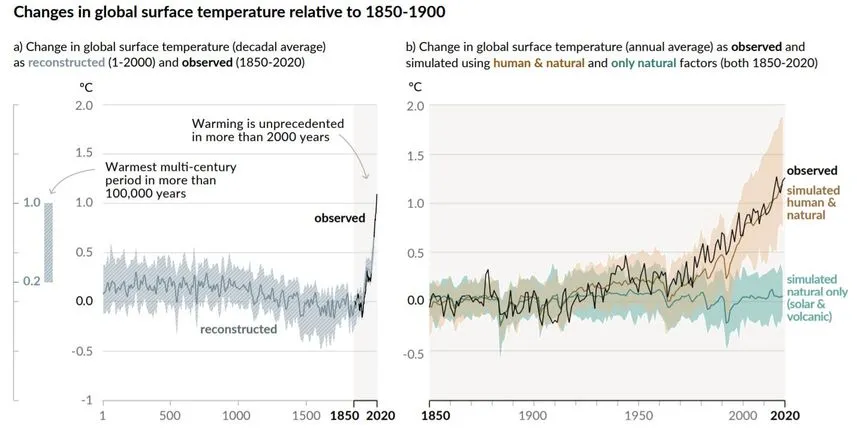
The last decade was the hottest in 125,000 years. There are a number of graphs to support this. Here is one:
The oceans
One of the facts of having a water world, 71% of the Earth’s surface is water-covered, and the oceans hold about 96.5% of all Earth’s water, is that a 2019 study found that oceans had sucked up 90% of the heat gained by the planet between 1971 and 2010. Another found that it absorbed 20 sextillion joules of heat in 2020 – equivalent to two Hiroshima bombs per second.
Carbon-dioxide
In fact CO2 levels are now the highest that they have been in 2 million years. Today, they stand at close to 420 parts per million (ppm). To put that into context pre-industrial levels, before 1750, had CO2 levels around 280 parts per million.
We are losing ice big time
I can do no better than to quote from Earth.org: Since the mid-1990s, we’ve lost around 28 trillion tons of ice, with today’s melt rate standing at 1.2 trillion tons a year. To help put that into perspective, the combined weight of all human-made things is 1.1 trillion tons. That’s about the same weight as all living things on earth.
I repeat: Every single year we are losing 1,200,000,000,000 tons of ice!
Extreme weather
We can now attribute natural disasters to human-driven climate change with certainty. We can now say with precision how much likelier we made things like the North American summer 2021 heatwave, which the World Weather Attribution says was “virtually impossible” without climate change as well as the Indian heatwave, which experts believe it was made 30 times more likely because of climate change.
Climate change mitigation
There is a long and comprehensive article on the above subject on WikiPedia. I will quote from the paragraph Needed emissions cuts.
If emissions remain on the current level of 42 GtCO2, the carbon budget for 1.5 °C could be exhausted in 2028. (That’s 42 gigatones, as in 1 gigaton is a unit of explosive force equal to one billion (109) tons of trinitrotoluene (TNT).
In 2022, the Intergovernmental Panel on Climate Change (IPCC) released its Sixth Assessment Report on climate change, warning that greenhouse gas emissions must peak before 2025 at the latest and decline 43% by 2030, in order to likely limit global warming to 1.5°C (2.7°F). Secretary-general of the United Nations, António Guterres, clarified that for this “Main emitters must drastically cut emissions starting this year”.
Then just before that paragraph WikiPedia reports that: The UNFCCC aims to stabilize greenhouse gas (GHG) concentrations in the atmosphere at a level where ecosystems can adapt naturally to climate change, food production is not threatened, and economic development can proceed in a sustainable fashion. Currently human activities are adding CO2 to the atmosphere faster than natural processes can remove it.
We need to act now, otherwise…
… it will be too late for billions of us.
This may be the most catastrophic of our climate change facts. As of now, only 0.8% of the planet’s land surface has mean annual temperatures above 29°C, mostly in the Sahara desert and Saudi Arabia (solid black in the map below).
A study by Xu et al. (2020) called “Future of the Human Niche” found that by 2070, under a high emissions scenario, these unbearable temperatures could expand to affect up to 3 billion people (dark brown areas).
Doing nothing is much worse than doing something
On the current path, climate change could end up costing us 11 to 14% of the global GDP by mid-century. Regression into a high emissions scenario would mean an 18% loss, while staying below 2°C would reduce the damage to only 4%.
It has been proposed that ending climate change would take between $300 billion and $50 trillion over the next two decades. Even if $50 trillion is the price tag, that comes down to $2.5 trillion a year, or just over 3% of the global GDP.
Climate change is an incredibly complex phenomenon, and there are many other things happening that were not covered above.
These are the facts. There is no disputing them. Jean and I are relatively immune from the effects, because of our ages, but not entirely so. The last few weeks with the imminent risk of our property being damaged by wildfires is one example. The last three winters being below average rainfall is another. But it is the youngsters I fear most for. On a personal note, my daughter and husband have a son and he is now 12. What sort of world is he growing up in?
So here is a view of the global population of young people.
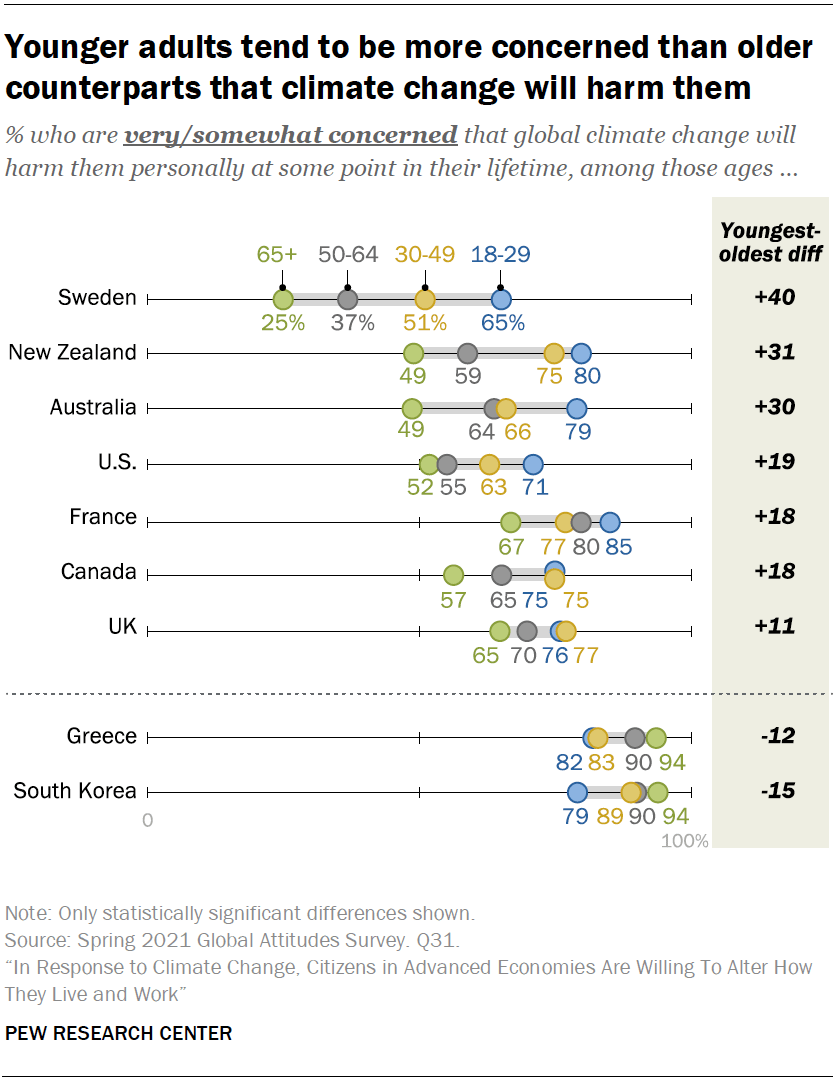
Just before I close let me show you my final chart. It goes to show our attitudes.
I am not a political animal. However I recognise that it is our leaders, globally, but especially in the top 10 countries in the world, who have to be leaders! Here are the top 10 countries.
So, please, dear leader, make this the number one priority for your country and for the world (areas of their country in square kilometres): Russia. 17,098,242, Canada. 9,984,670, United States. 9,826,675, China. 9,596,961, Brazil. 8,514,877, Australia. 7,741,220, India. 3,287,263 and Argentina. 2,780,400.