Philosopher Daniel Dennett offers a kind of self-help book for deep thinkers.
Those of you that are regular followers of Learning from Dogs know that I tend to offer posts for the week-end that are light-hearted. Certainly that’s easier for me, if you pardon me from saying, and hopefully a change for you, dear reader.
Well today’s offering is not exactly heavy but it is, nonetheless, not a typical Saturday topic.
However, trust you find it engaging.
Of the many blogs and websites that I follow, I enjoy the regular mental stimulation that flows from the blog Big Think. Recently there was a piece from Daniel Dennett that tickled my interest and I wanted to share it here.
While Silicon Valley and Silicon Alley busy themselves making every aspect of our lives more efficient (except, perhaps, for the process of discovering these new technologies, learning them, and integrating them into our lives), Daniel Dennett sits up at Tufts University in Massachusetts, philosophizing. His latest book, Intuition Pumps and Other Tools for Thinking is an attempt to make transparent some of the tricks of the philosopher’s trade. In an accelerating age, it’s a self-help book designed to slow the reader down and improve our ability to think things through.
The kinds of things Mr. Dennett likes to think about include the nature of consciousness, evolution, and religious belief. But the mind-training his new book offers is applicable to any problem you want to consider thoroughly. In an age of quick fixes and corner-cutting, we’re in constant danger of bad decision making – of overreliance on what cognitive psychologist Daniel Kahneman calls “system 1”, and what most of us call intuition. This rapid decision making channel of the brain is helpful when we are in mortal danger, or pressed for a quick decision within our areas of expertise. But for most decisions, the slower, more deliberate channel (system 2) is much more reliable. What Dennett offers, then, in Intuition Pumps, is a workout for system 2 – a series of thought experiments you can apply to puzzles real and imagined to bulk up the slower, wiser parts of your consciousness.
Some of the tools Dennett offers in the book are more familiar than others. Reductio ad absurdum arguments, for example, in which we test the validity of a claim by taking it to its most outrageous illogical extreme (a: “all living things have a right to liberty.” b: “so let me get this straight – a blade of grass has a right to liberty? What does that even mean?”). But the true delights of the book are the far-out exercises Dennett and his colleagues have dreamed up in the course of their work, such as “Swampman Meets A Cow-Shark”, from Donald Davidson, which begins:
Suppose lightning strikes a dead tree in a swamp; I am standing nearby. My body is reduced to its elements, while entirely by coincidence (and out of different molecules) the tree is turned into my physical replica. My replica, The Swampman, moves exactly as I did; according to its nature it departs the swamp, encounters and seems to recognize my friends, and appears to return their greetings in English.
Walking us through Davidson’s considerations about whether and to what extent the Swampman is anything like Davidson, and related ones about a cow that gives birth to something that looks exactly like a shark (yet has cow DNA in all of its cells), Dennett teaches us a surprising lesson about the utility of wild philosophical speculation.
Cloaked in the breezy, familiar trappings of a self-help book, Intuition Pumps is in actuality a dark mirror of that genre – a field of rabbit holes designed to leave the reader with more questions than answers, and wiser for the long and indirect journey.
Watch for Daniel Dennett’s Tools For Better Thinking – a Big Think Mentor workshop coming soon.
oooOOOooo
Don’t know about you but Daniel Dennett’s book looks like one that deserves reading. If you feel the same way the book is called Intuition Pumps And Other Tools for Thinking and here’s the link to Amazon.
Perhaps the last frontier, the one underneath our feet?
Can’t recall where I came across this BBC program but so what! The fact is that the BBC have had a long and well-deserved reputation for making some fabulous programmes on nature and wildlife. So it was with a recent programme from the BBC Nature stable. The one that caught my eye and the motivation for today’s LfD post was called The Burrowers: Animals Underground.
Here is the trailer.
Published on Aug 9, 2013 Discover with BBC Two the secret life of Rabbits, Badgers and Water Voles.
Offering us this:
The Burrowers: Animals Underground
Chris Packham continues his underground journey investigating the world of some of the UK’s most iconic burrowing animals. Filmmakers and scientists cannot investigate animal behaviour inside wild burrows without disturbing them so The Burrowers’ team found ingenious ways to film this secret world by recreating full-scale replicas. It’s now spring in the burrows and the new babies are having to grow up fast. The seven orphan badgers are learning to communicate with each other, young rabbits must take their first steps outside, and young water voles their first swim. Chris also meets the most elusive burrower of them all – an animal which almost never comes above ground – the mole. He reveals the moles’ survival techniques, its method of burrowing and the food it eats. Finally, the team unveils a science first: the excavation of a massive abandoned wild rabbit warren… Back in winter it was filled with concrete and left to set. Now a small army of volunteers and diggers have excavated it, revealing a three-dimensional model of a complex system of tunnels and chambers.
So despite it being at the other end of the scale compared to the cosmos, we still know so little about what goes on beneath our feet.
Mind you, that doesn’t stop some of us from trying to find out!
Sweeny digging in the ground after yesterday’s heavy rain!
Now don’t misunderstand me. There are huge numbers of people on this planet who have challenges and issues that I can’t even imagine handling. But whatever we are dealing with, it is at a personal ‘size’ proportional to scale of our lives. For example, I have a guest post coming out tomorrow from Tom Engelhardt about the nature of the American Empire. Frankly, it’s more than disturbing. But, or should I write that as BUT, it is about matters that are trivial and inconsequential in the larger scheme of things.
All of which is a little introduction to a YouTube link that Suzann sent me; the video below. It’s just about 2 1/2 minutes long, yet is incredible. Plus it has already been watched over 9 million times!
Warning! Today’s post has almost nothing to do with dogs plus if you are not into computing then you may want to come back tomorrow! 😉
A little over a week ago I ordered an Apple Mac computer.
So what, I hear you say.
Well one way or another, I have been associated with personal computing for too many years and with the Microsoft Windows operating system equally for a long time.
Here’s that history and, be warned, I do go on a tad!
In 1970 I joined the Office Products (OP) Division of IBM in the United Kingdom. I joined as an office products salesman and after my initial training was based at IBM OP’s London North branch in Whetstone in the London Borough of Barnet. I loved both the job (remember the Selectric ‘Golfball’ typewriter?) and the company and conspired to win the prize of top UK salesman for the year 1977. By that time, IBM was selling dedicated word-processing (WP) machines. They offered powerful benefits for companies of many sizes and, as an experienced WP salesman, I was enjoying the fruits of that success. Thus it was that in 1978 I attended IBM’s Golden Circle celebrations for 1977 country winners from all around the world. The Golden Circle celebrations were held in Hawaii!
I returned from Hawaii with the clear idea in my mind that this was the time to move on; my ego didn’t like the idea of not being number one again! So within a couple of days of returning to my sales branch, I announced to my manager, David Halley, that I wished to give three months notice. I can still recall David’s rather shocked response with him saying, “But I always thought Golden Circle was an incentive event!”
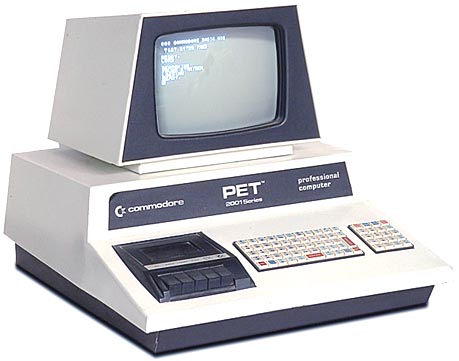
In those days New Scientist magazine was a regular read for me. During my time of working out my notice I read in the magazine about this new personal computer from Commodore Business Machines that had been launched in the UK. It was called the Commodore PET (Personal Electronic Transactor) and had been unveiled in 1977 at the US West Coast Computer Faire. I was captivated by what I had read.
I had casually mentioned it to Richard Maugham; a good friend and fellow office-products salesman working for Olivetti UK. Richard said that coincidentally a close friend of many years had just been appointed sales manager for CBM UK Ltd. That friend was Keith Hall and on making contact with Keith, I was invited to go and meet him and learn more about this funny device. What I hadn’t bargained for was that Keith was yet another smart salesman; Keith and Richard had met when they were both salesmen working for Olivetti.
When I asked Keith the retail price of the ‘PET”, his immediate reply was, “Well why don’t you become a dealer and I can sell you one for 30% less!” Like most salesmen, I was always a sucker to a good sales pitch! I signed the necessary paperwork. (It is very sad to say that Keith died a few years ago, at far too young an age.)
So it was that towards the end of 1978, I became the sixth Commodore computer dealer in the UK, opening my small store in what had once been a Barber’s shop in Church Street, off Head Street in the centre of Colchester, Essex. I called my business Dataview Limited.
Frankly, I hadn’t a clue as to what I was doing! If it hadn’t been for a gigantic stroke of luck I would not have lasted long!
That piece of luck was meeting someone who was a programmer for a large, traditional computing company, ICL, who had bought himself a Commodore PET and, just out of fun, was writing a word-processing program. Now if I didn’t know about computers, personal or otherwise, I certainly knew about word-processing. When I looked at what Peter D. had written I practically wet myself. Because, I was looking at a program that even incomplete already offered three-quarters, give or take, of the functionality of a £20,000 IBM Word Processor.
I offered to guide Peter in refining and honing his software which he graciously accepted. Then a few weeks later Peter casually asked me if I would like to sell the software. I jumped at the opportunity and in due course Wordcraft was launched under the Dataview umbrella. (And do see my footnote!)
But back to my Windows journey.
In 1981 IBM announced the release of their own personal computer.
IBM PC
With my love affair with IBM not even dimmed, becoming an IBM PC dealer was a must. An IBM PC version of Wordcraft was developed by Peter and now things were really rocking and rolling. Then in 1983 Microsoft announced the development of Windows, a graphical user interface (GUI) for the operating system MS-DOS. MS-DOS was the existing operating system on the IBM PC.
By the time I sold Dataview in 1986, Windows was well on its way to evolving into a full personal computer operating system and ever since that time my own PCs have been Windows based. (Difficult to imagine now how in those early years Windows didn’t achieve any popularity!)
OK, fast forward 27 years to my present machine running Windows 7, Google Chrome web browser and all the fancy ‘cloud’-based applications of today.
Much of my time spent writing and blogging relies on me being online. Like so many others, as soon as I turn on my computer it becomes an online PC. On average, I am working in front of my PC for about 3 to 4 hours per day. However, slowly but surely over the past few months I have become aware of a number of strange occurrences, the most annoying of which is the regular ‘hanging’ of my Chrome browser. This was happening at least on a daily basis and required the complete rebooting of my PC – a right pain in the posterior!
Muttering about this to friends who know a lot more about computing than I, raised my awareness that the privacy and security of one’s computer was no longer to be assumed. Then just recently, I read online,
“A Special Surveillance Chip”
According to leaked internal documents from the German Federal Office for Security in Information Technology (BSI) that Die Zeit obtained, IT experts figured out that Windows 8, the touch-screen enabled, super-duper, but sales-challenged Microsoft operating system is outright dangerous for data security. It allows Microsoft to control the computer remotely through a built-in backdoor. Keys to that backdoor are likely accessible to the NSA – and in an unintended ironic twist, perhaps even to the Chinese.
The backdoor is called “Trusted Computing,” developed and promoted by the Trusted Computing Group, founded a decade ago by the all-American tech companies AMD, Cisco, Hewlett-Packard, IBM, Intel, Microsoft, and Wave Systems. Its core element is a chip, the Trusted Platform Module (TPM), and an operating system designed for it, such as Windows 8. Trusted Computing Group has developed the specifications of how the chip and operating systems work together.
Its purpose is Digital Rights Management and computer security. The system decides what software had been legally obtained and would be allowed to run on the computer, and what software, such as illegal copies or viruses and Trojans, should be disabled. The whole process would be governed by Windows, and through remote access, by Microsoft.
Then a few paragraphs later:
It would be easy for Microsoft or chip manufacturers to pass the backdoor keys to the NSA and allow it to control those computers. NO, Microsoft would never do that, we protest. Alas, Microsoft, as we have learned from the constant flow of revelations, informs the US government of security holes in its products well before it issues fixes so that government agencies can take advantage of the holes and get what they’re looking for.
Now I’m using Windows 7 so imagine my angst when I then read:
Another document claims that Windows 8 with TPM 2.0 is “already” no longer usable. But Windows 7 can “be operated safely until 2020.” After that other solutions would have to be found for the IT systems of the Administration.
That did it for me – time to move on from Windows.
Many Apple-user friends said that I should switch to the Apple Mac; that it was the only logical way to go. I checked that all my important software applications that I used under Windows were compatible with the Apple Mac Operating System and thankfully they were. I was speaking of Open Office, WordPress, Scrivener, Picasa, Skype. Then I started to browse the Apple website. I was clear about wanting a desktop machine, an iMac, and pretty soon realised that my change of personal computing was going to cost me around $1,500, perhaps a little more.
Then Dan Gomez, both long-time friend and Apple user, in browsing the web came across the Mac mini. He called me and I took a look. For well under half the price of an iMac, I could get a great alternative to my Windows PC and use many of my existing peripherals.
A quick conversation with Zachary of the Apple Mac mini sales team and the deed was done! So all that remained was the great transition!
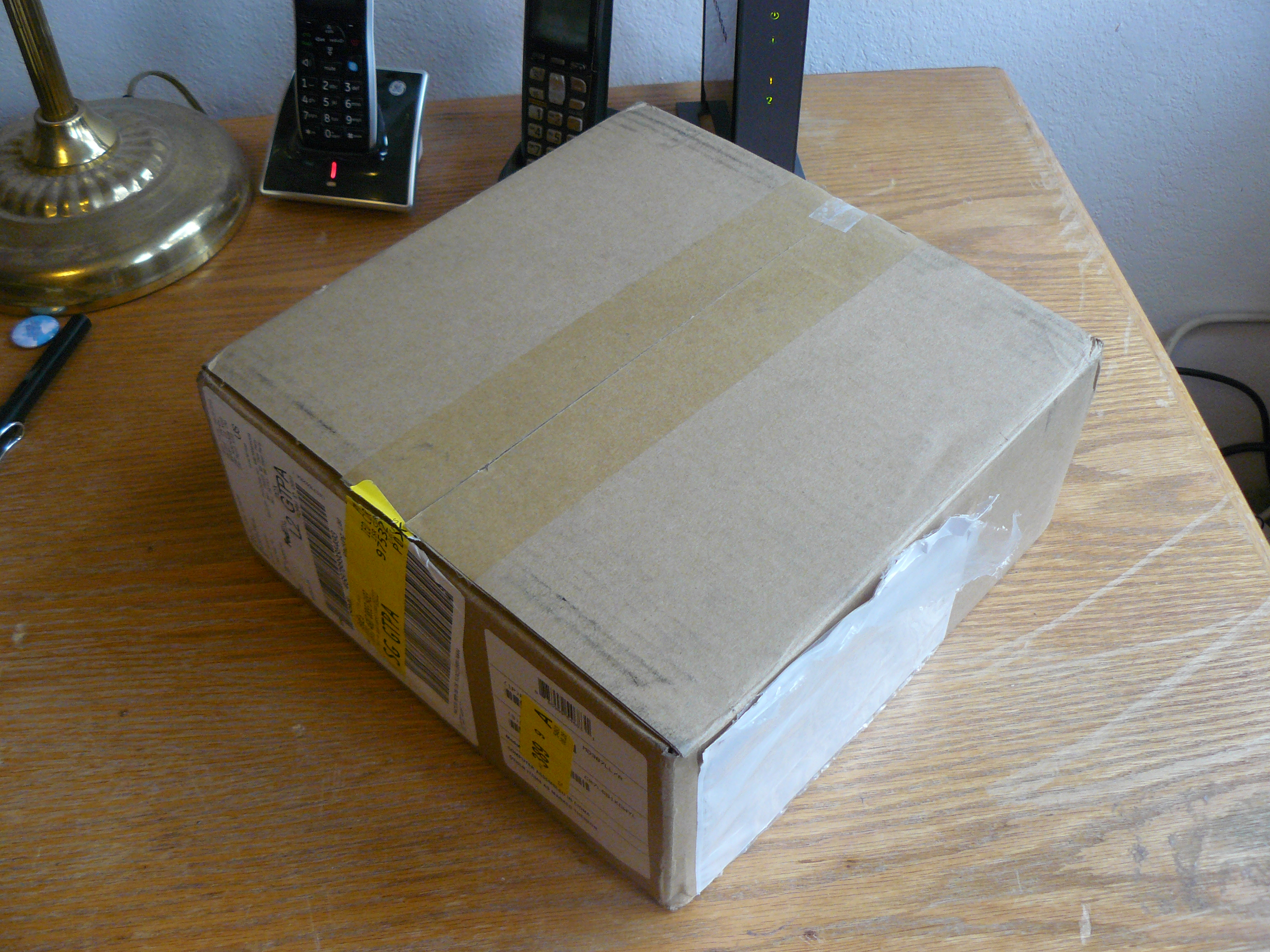
The box arrived last Wednesday.
Surely too small for a full-blooded personal computer?
I resisted opening the box until last Friday when I had some decent spare time.
This is a long, long way from the Commodore PET!
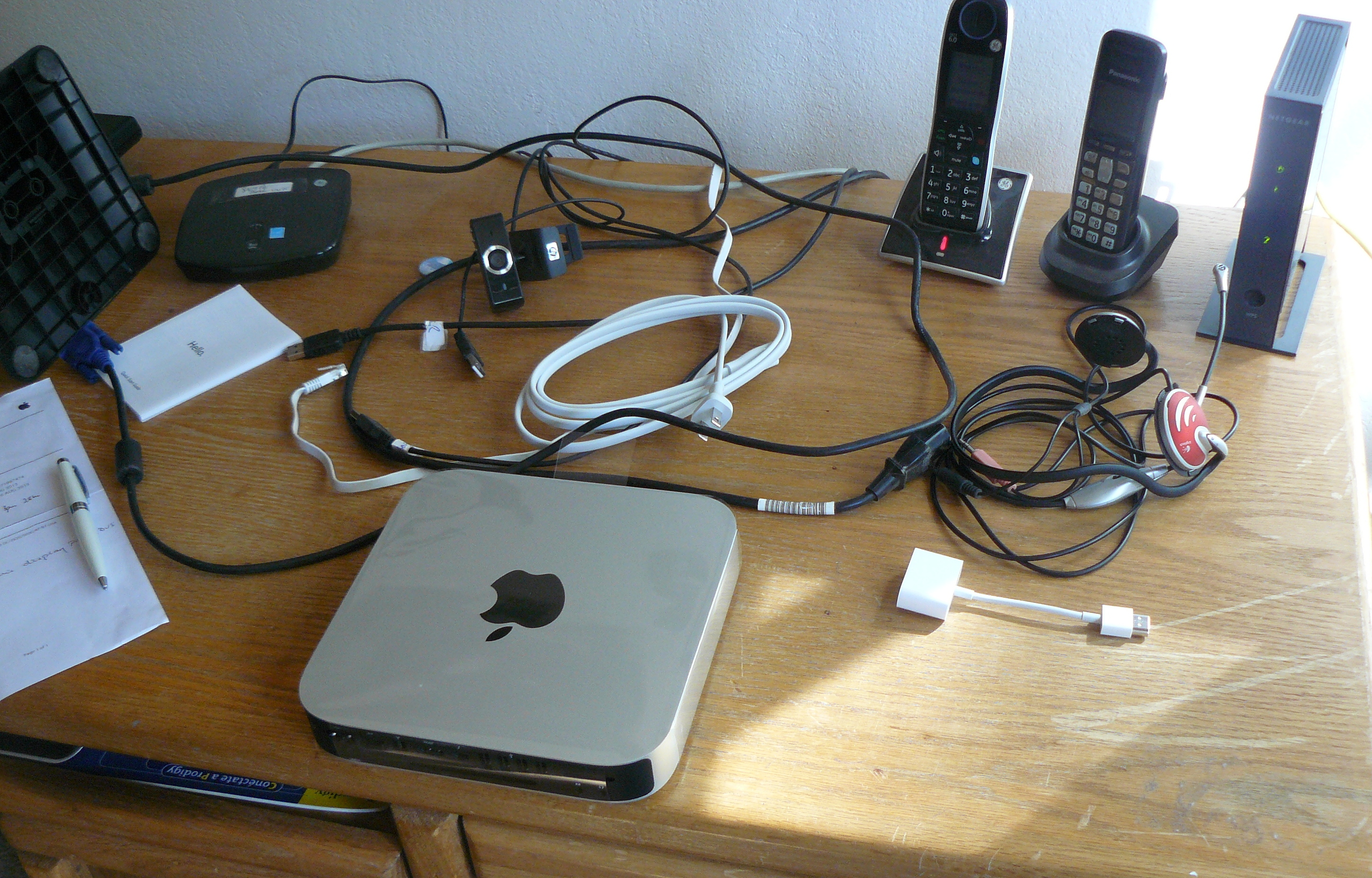
Plugging it all together was easier than I feared.
Just screen and keyboard/mouse and we are good to go!
Then the acid test. Could I even understand how to operate it? I put that off until Saturday!
The new Mac mini system on the right, all ready for me to play with!
I have to say that first impressions, especially of the elegance of the display and the icons, were great.
But this had to be a fully functional machine for me. Where to start? By downloading and installing the most critical of my software needs: Scrivener, my writing software.
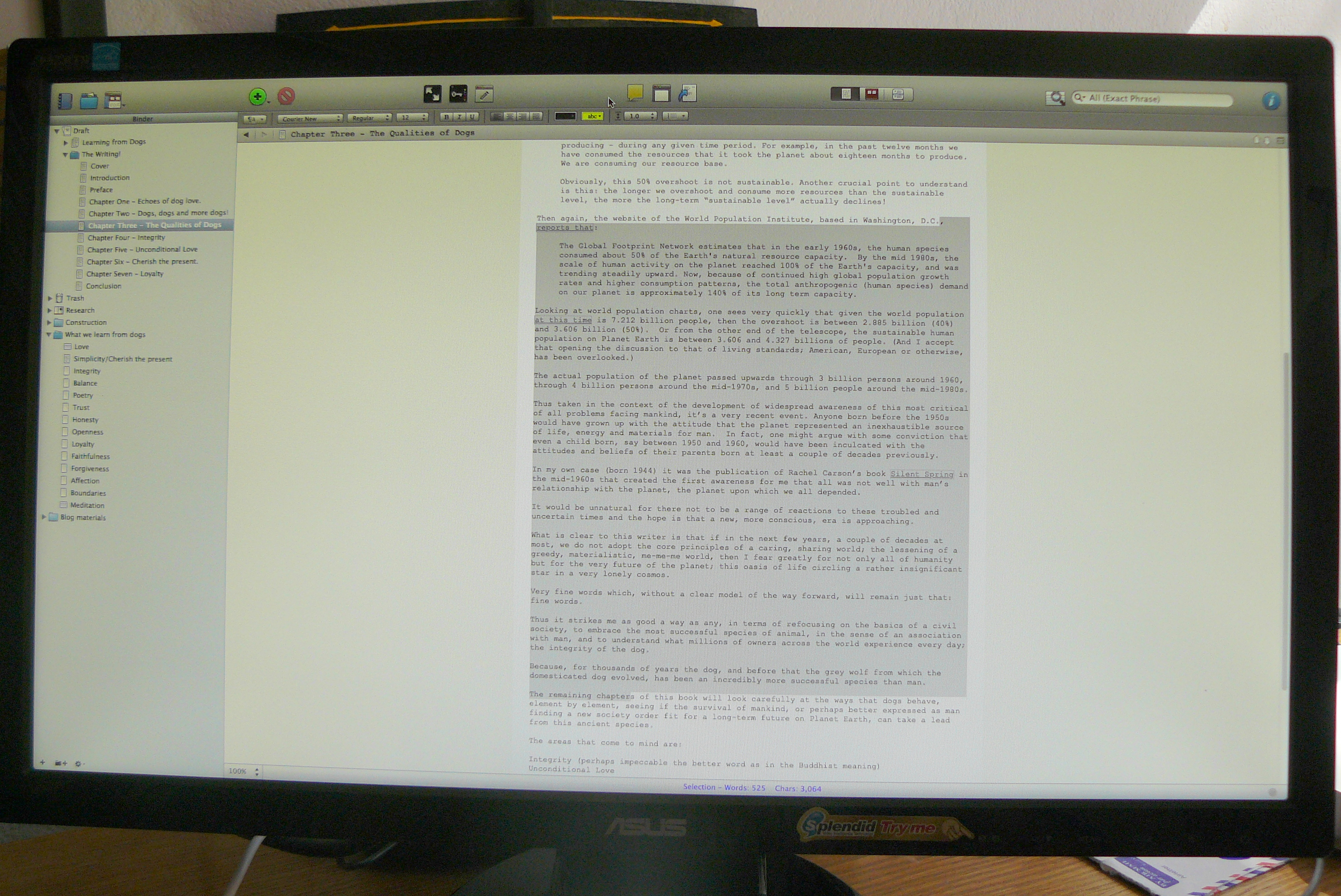
Imagine my great pleasure and huge relief when less than a couple of hours later, not only had I downloaded and installed Scrivener for Apple Mac OS but had passed the latest backup file across from my Windows PC and accessed it on the Apple.
My (very) draft book file installed and running on the Mac mini!
So, all in all, despite this being very early days, it’s starting to look like a great change.
However, I mustn’t close without thanking a few people:
Dan Gomez and John Hurlburt, friends and Apple users, and in John’s case experienced on both Windows and Apple systems. Guys, I couldn’t have made the decision to change without your kind, generous and supportive advice.
Zachary Brown of Apple sales, Mac mini team. Zach, I know it’s your job but nonetheless you did and said all the right things. (And the new screen is much better than my existing one!)
Last but not least, my dearest wife Jean, who just let me get on with things and even though I knew she didn’t have a clue as to what I kept muttering on about, never let on.
Footnote:
Earlier on I wrote about launching Wordcraft, the word-processing software for personal computers. That was in early 1979 and later that year I was invited to present Wordcraft at an international gathering of Commodore dealers held in Boston, Mass.
During my presentation, I used the word ‘fortnight’ unaware that Americans don’t know this common English word. Immediately, someone about 10 rows back in the audience called out, “Hey, Handover! What’s a fortnight?”
It released the presenter’s tension in me and I really hammed my response in saying, “Don’t be so silly, everybody knows the word fortnight.” Seem to remember asking the audience at large who else didn’t know the word. Of course, most raised their arms!
Now on a bit of a roll, I deliberately started using as many bizarre and archaic English words that came to me. Afterwards, the owner of the voice came introduced himself. He was Dan Gomez, a Californian based in Costa Mesa near Los Angeles and also involved in developing software for the Commodore.
Dan became my US West Coast distributor for Wordcraft and was very successful. When Dataview was sold, Dan and I continued to see each other regularly and I count him now as one of my dear friends. Through knowing Dan I got to know Dan’s sister Suzann and her husband Don. It was Su that invited me to spend Christmas 2007 with her and Don at their home in San Carlos, Mexico. Jean also lived in San Carlos and was close friends with Su. Together they had spent many years rescuing feral dogs from the streets of San Carlos and finding new homes for them.
Thus it was that I met Jean. Both Jean and I were born 20 miles apart in London!
So from ‘Hey, what’s a fortnight’ to living as happily as I have ever been in the rural countryside of Oregon. Funny old world!
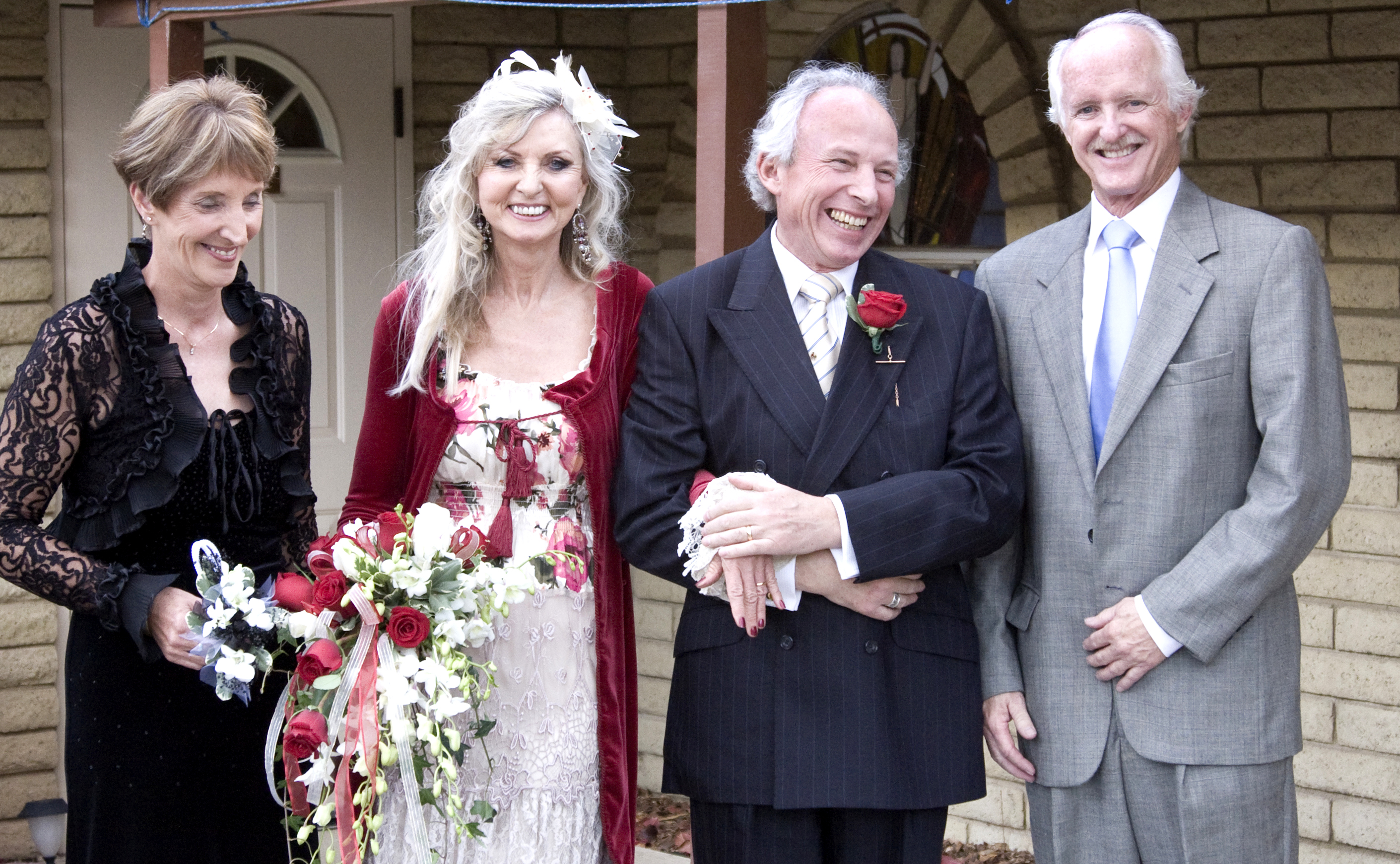
The ‘voice’ Dan Gomez – Best Man at the marriage of Jean and me, November 20th 2010.
I have often noticed how ideas come along and are then reinforced by other materials and comments. This struck me (again) as follows. In my post about the fabulous, loving bond between Jeff Guidry and his eagle Freedom one of the comments was from Patrice Ayme, and I quote:
Birds have completely different brains. Still, the smartest birds are more clever than most primates. And many parrots speak (although we have not learned their language yet).
Then going on to add:
Parrot language studies have progressed enough to tell us that there is something huge going on. They apparently use names, as dolphins do.
Certainly Jean would verify the amount of talking that goes on between our two budgerigars here at home!
Mr. Green and Mr. Blu!
Then in yesterday’s post The knowing of dogs, I referred to research that indicated that empathy between those that we know and trust, (a) can be measured, and (b) that “our minds are partly defined by their intersections with other minds.” I went on in that post to speculate that maybe dogs ‘reading’ the minds of humans that they know and trust wasn’t so far-fetched.
Wolves Howl Because They Care: Social Relationship Can Explain Variation in Vocal Production
Aug. 22, 2013 — When a member of the wolf pack leaves the group, the howling by those left behind isn’t a reflection of stress but of the quality of their relationships. So say researchers based on a study of nine wolves from two packs living at Austria’s Wolf Science Center that appears in Current Biology, a Cell Press publication, on August 22.
The findings shed important light on the degree to which animal vocal production can be considered as voluntary, the researchers say.
“Our results suggest the social relationship can explain more of the variation we see in howling behavior than the emotional state of the wolf,” says Friederike Range of the Messerli Research Institute at the University of Veterinary Medicine Vienna. “This suggests that wolves, to a certain extent, may be able to use their vocalizations in a flexible way.”
Scientists have known very little about why animals make the sounds that they do. Are they uncontrollable emotional responses? Or do animals have the ability to change those vocalizations based on their own understanding of the social context?
At the Wolf Science Center, human handlers typically take individual wolves out for walks on a leash, one at a time. On those occasions, they knew, the remaining pack mates always howl.
To better understand why, Range and her colleagues measured the wolves’ stress hormone levels. They also collected information on the wolves’ dominance status in the pack and their preferred partners. As they took individual wolves out for long walks, they recorded the reactions of each of their pack mates.
Those observations show that wolves howl more when a wolf they have a better relationship with leaves the group and when that individual is of high social rank. The amount of howling did not correspond to higher levels of the stress hormone cortisol.
“Our data suggest that howling is not a simple stress response to being separated from close associates but instead may be used more flexibly to maintain contact and perhaps to aid in reuniting with allies,” Range says.
For those that want to read the original research paper then it is available over at Current Biology, a Cell Press publication.
Wolf Howling Is Mediated by Relationship Quality Rather Than Underlying Emotional Stress
We investigated the influence of social and physiological factors on wolf howling
Wolves howl more to keep contact with affiliated partners and with pack leaders
Howling is mediated by the social relationship not cortisol level of the howlers
This pattern indicates that wolves have some voluntary control of their howling
Summary
While considerable research has addressed the function of animal vocalizations, the proximate mechanisms driving call production remain surprisingly unclear. Vocalizations may be driven by emotions and the physiological state evoked by changes in the social-ecological environment [1,2], or animals may have more control over their vocalizations, using them in flexible ways mediated by the animal’s understanding of its surrounding social world [3,4]. While both explanations are plausible and neither excludes the other, to date no study has attempted to experimentally investigate the influence of both emotional and cognitive factors on animal vocal usage. We aimed to disentangle the relative contribution of both mechanisms by examining howling in captive wolves. Using a separation experiment and by measuring cortisol levels, we specifically investigated whether howling is a physiological stress response to group fragmentation [5] and whether it is driven by social factors, particularly relationship quality [6,7]. Results showed that relationship quality between the howler and the leaving individual better predicted howling than did the current physiological state. Our findings shed important light on the degree to which animal vocal production can be considered as voluntary.
So, don’t know about you, but it all seems to be suggesting how little we know about how animals communicate with the world around them.
A fascinating study on human empathy strikes a chord with man and dog, perhaps.
Let me start with a true account from the evening of Monday, 19th August.
That evening, at 7pm, I had an appointment with my doctor in Grants Pass. Jean stayed at home looking after our guests and preparing the evening meal.
The journey from the doctor’s clinic back to home, a distance of 20 miles, takes a little over half-an-hour. The last 3 miles are along Hugo Road; about 6 minutes including opening and closing the gate across our driveway.
Anyway, according to Jean shortly after 8pm Pharaoh sprang up barking and went across to put his nose against one of the windows that looks out over our front drive and garden. Jeannie looked at the clock on the kitchen wall and made a note of the time: it was 8:10pm. She also came over to the window that Pharaoh was looking out of and searched for any reason for his outburst of barking: squirrels, deer, any kind of wildlife or other distraction. There was none.
A little before 8:20pm Jeannie saw the headlights of my car pull up and moments later I came in through the front door.
It appeared that Pharaoh had sensed the point where I had turned into Hugo Road.
One could easily dismiss this, perhaps by thinking that Jean had unconsciously signalled to Pharaoh that I was on my way home. But Jean had only the vaguest idea of when I might be back.
Or one could be drawn to the research undertaken by Dr. Rupert Sheldrake, as this extract from a post back in May, 2011 explains.
What an amazing book this is.
Amazing!
I have written about Dr Rupert Sheldrake a few times on Learning from Dogs for pretty obvious reasons! You can do a search on the Blog under ‘sheldrake’ but here are a couple of links. Serious Learning from Dogs on January 10th, 2011 and Time for a rethink on the 14th April, 2011.
Anyway, I am now well towards the end of Sheldrake’s revised book, Dogs That Know When Their Owners Are Coming Home and it is more than fascinating. Bit short of time just now so please forgive me if I do no more than show this video which sets out some of the background to the book. Sheldrake’s website is here, by the way.
Anyway, what’s this all leading up to?
I can’t recall where it was that I read about a report posted on the Forbes website about the new findings of the power of human empathy.
Study: To The Human Brain, Me Is We
A new study from University of Virginia researchers supports a finding that’s been gaining science-fueled momentum in recent years: the human brain is wired to connect with others so strongly that it experiences what they experience as if it’s happening to us.
This would seem the neural basis for empathy—the ability to feel what others feel—but it goes even deeper than that. Results from the latest study suggest that our brains don’t differentiate between what happens to someone emotionally close to us and ourselves, and also that we seem neurally incapable of generating anything close to that level of empathy for strangers.
The research revealed:
“The correlation between self and friend was remarkably similar,” said James Coan, a psychology professor in U.Va.’s College of Arts & Sciences who co-authored the study. “The finding shows the brain’s remarkable capacity to model self to others; that people close to us become a part of ourselves, and that is not just metaphor or poetry, it’s very real. Literally we are under threat when a friend is under threat. But not so when a stranger is under threat.”
The findings back up an assertion made by the progenitor and popularizer of “Interpersonal Neurobiology,” Dr. Daniel Siegel, who has convincingly argued that our minds are partly defined by their intersections with other minds. Said another way, we are wired to “sync” with others, and the more we sync (the more psycho-emotionally we connect), the less our brains acknowledge self-other distinctions.
Later in that Forbes article Professor Coan is reported:
“A threat to ourselves is a threat to our resources,” said Coan. “Threats can take things away from us. But when we develop friendships, people we can trust and rely on who in essence become we, then our resources are expanded, we gain. Your goal becomes my goal. It’s a part of our survivability.”
So if science is discovering that our subconscious minds are connecting “psycho-emotionally” with the minds of others whom we trust, then it doesn’t seem like too great a leap to embrace human minds psycho-emotionally connecting with the animals that we trust, and vice versa. Because for thousands upon thousands of years, the domesticated dog and man have depended on each other for food, protection, warmth, comfort and love.
Footnote.
References for those who wish to follow up on this article are:
Professor Robin Ian MacDonald Dunbar, British anthropologist, evolutionary psychologist and a specialist in primate behaviour. His theory known as Dunbar’s Numberexplained here.
Jon Lavin reflects on the Four Noble Truths of Buddhism.
Last week, I republished a number of Jon’s posts from way back and was delighted at how many of you enjoyed his writings. Jon and his family are taking a well-earned vacation which clearly includes reading posts on Learning from Dogs: Poor soul! This was made clear from an email Jon sent me yesterday afternoon.
Jon had read the essay from George Monbiot that was published three days ago under my post title of Dichlorodiphenyltrichloroethane (DDT) all over again? So hopefully, this introduction puts Jon’s email into proper context. The subject title of Jon’s email was DDT 2.0.
oooOOOooo
Hi Paul!
Hope you guys are well on your lovely farm! We’re in sunny Falmouth for the week staying in our Ben’s student flat slowly working our way through his food supplies.
In my current chilled state, I read your reproduced article and I got to thinking; so you might pick out the odd bit of coherence in these ramblings!
I am reminded of David Hawkins’ ‘Scale of Human Consciousness’. If 80 percent of us are below the level of Integrity, and therefore truth, and the average level of integrity in business is below this level, it is no wonder that money comes before the greater good. Think of the banking crisis as a good example.
I guess we move forward at the speed of the slowest. We certainly seem to learn through the pain and suffering of our own making. I can understand now why this world is perfect for our development and advancement. We are exposed to every opportunity to better ourselves and not everyone has enough of what it takes to hit the mark. We just have to keep going until we get it, even if this means pain and suffering.
The Four Noble Truths of Buddhism talk about suffering and how we create it.The First Noble Truth states that life is suffering. The 2nd Noble Truth talks about our craving for things: money, possessions, etc.; cravings that create suffering. The Third Noble Truth talks of a cure and a way out of hopelessness and suffering and finally, the Fourth Noble Truth gives guidance on walking the path out of suffering.
So, although your article is awful, it is to be expected that we keep being attracted to these sorts of schemes and are attracted to money. We have to learn through pain and suffering until we get it right.
People frequently ask, “What can I do to help?”. Unfortunately or fortunately, there is a way out! The best way to help is to work on ourselves! Sounds a bit silly but by working and developing ourselves we raise the overall level of human consciousness. This means that when companies and individuals attempt to do things that are not integrous, there is less likelihood of them being successful.
Heady stuff really and I wouldn’t describe myself as Buddhist but I have to admit there seems to be some truth in this.
I hope some of this makes sense.
Warm wishes,
Jon.
oooOOOooo
Well, of course it makes sense; perfect sense! Reminds me of the old adage that one cannot truly help another without first helping oneself.
Thus what I read in Jon’s words is that by living a life of integrity we help bring up the overall level of human consciousness, right across our planet. Let me stay with that for a moment longer. Jon mentioned David Hawkins’ ‘Scale of Human Consciousness’. It was included in a post in January 2012 The evolution of the domestic dog but to save you going there, here it is again:
Map of Consciousness, copyright Dr. David Hawkins
One might argue that the column headed ‘LEVEL’ is a pseudonym for ‘Behaviour’. In other words, those behaviours from Courage and up represent integrity.
So when Jon writes, “The best way to help is to work on ourselves!“, what he is saying that by consciously abandoning levels below 200 we open ourselves to being a force for good beyond ourselves. Just run your eye down the emotions from Ineffable to Affirmation and reflect on how others that offer those emotions affect us in such a positive and inspiring way. Indeed, no better than reflecting on how a dog makes us feel when offering unconditional love!
Of course it’s not easy! Nothing great ever is. There is so much around us that we can hate (score 150), so much to create anxiety (score 100), and so many examples of despair (score 50).
But remember the beginning of integrity is 200.
Which is why trust (score 250) and optimism (score 310) and forgiveness (score 350) and especially love (score 500) are truly the tools of healing our planet.
You can start right now by hugging a dog (dogs score 210!).
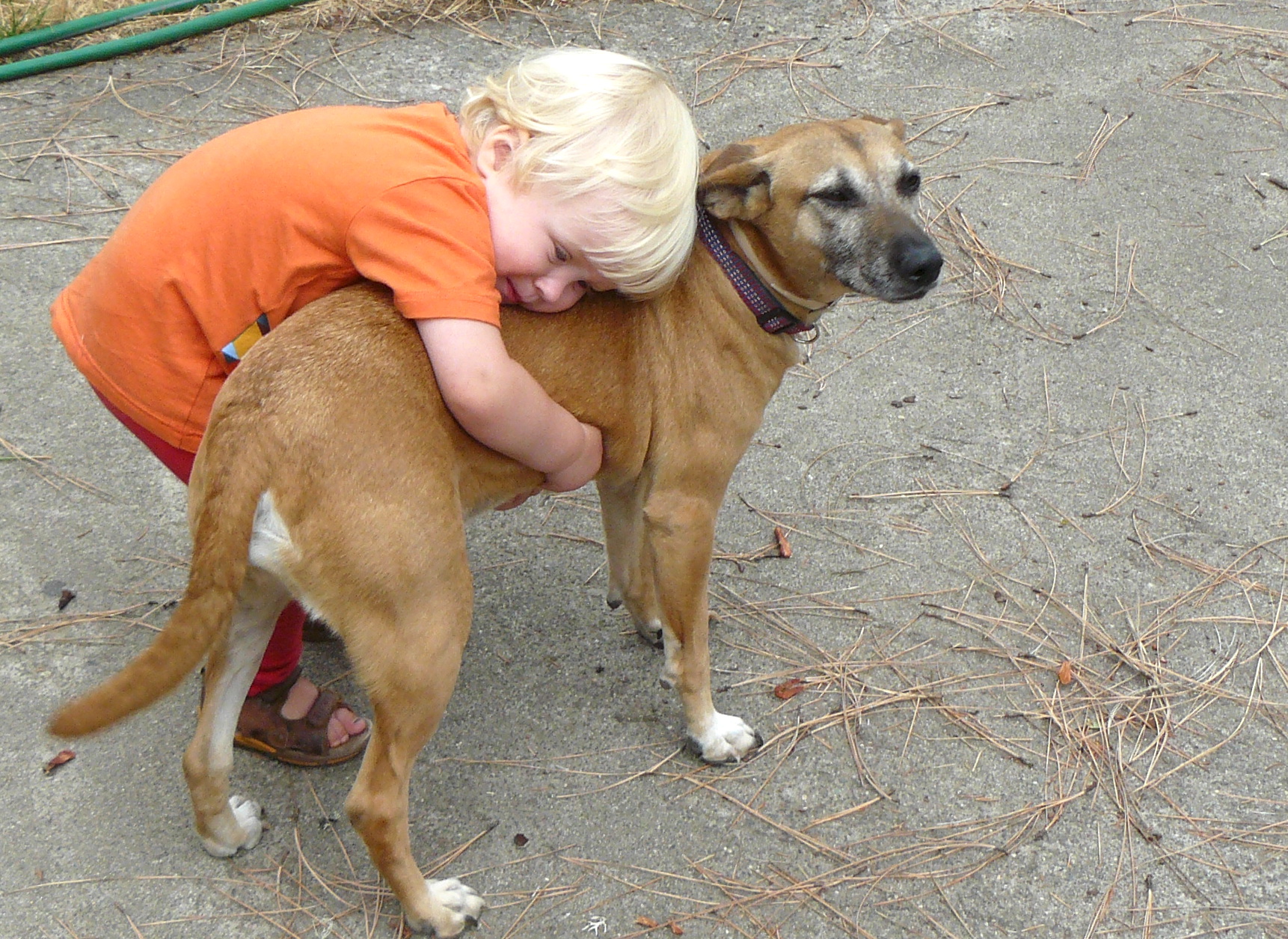
Love and Trust – Grandson Morten hugging Dhalia.
Thank you, Jon.
Some content on this page was disabled on August 23, 2017 as a result of a DMCA takedown notice from Susan Hawkins. You can learn more about the DMCA here:






Chris Packham continues his underground journey investigating the world of some of the UK’s most iconic burrowing animals. Filmmakers and scientists cannot investigate animal behaviour inside wild burrows without disturbing them so The Burrowers’ team found ingenious ways to film this secret world by recreating full-scale replicas. It’s now spring in the burrows and the new babies are having to grow up fast. The seven orphan badgers are learning to communicate with each other, young rabbits must take their first steps outside, and young water voles their first swim. Chris also meets the most elusive burrower of them all – an animal which almost never comes above ground – the mole. He reveals the moles’ survival techniques, its method of burrowing and the food it eats. Finally, the team unveils a science first: the excavation of a massive abandoned wild rabbit warren… Back in winter it was filled with concrete and left to set. Now a small army of volunteers and diggers have excavated it, revealing a three-dimensional model of a complex system of tunnels and chambers.