Apologies for the short intro but my internet connection is still not 100% and I didn’t want to fuss around and lose the window in which to present this fascinating article on ScienceAlert sent to me by Dan Gomez.
ooOOoo
Dogs give food to their ‘friends’ in first-of-its-kind study
Treats for everybody! But more for pals.
PETER DOCKRILL 17 DEC 2015
Voluntary acts of kindness and positive outward gestures without thought of reward are two of the more redeeming aspects of human society, but to what extent do these prosocial behaviours exist in other animals?
A new study by researchers in Austria suggests that dogs are prosocial among their own kind too, with an experiment involving the voluntary offering of food between the animals showing that dogs also understand the concept of giving.
“Dogs and their nearest relatives, the wolves, exhibit social and cooperative behaviour, so there are grounds to assume that these animals also behave prosocially toward conspecifics,” said Friederike Range, an ethnologist at the Messerli Research Institute. “Additionally, over thousands of years of domestication, dogs were selected for special social skills.”
But measuring prosocial behaviour in dogs isn’t easy, says Range, because they’re so very social with humans. It can be difficult to tell between seemingly prosocial acts and behaviours that could actually just be the dog obediently reacting to cues and unintended communications from researchers.
So to take people out of the equation as much as possible, Range and his colleagues conducted an experiment where two dogs were set up by themselves in cages side by side. One of the dogs, called the donor dog, had the ability to extend one of two trays toward a receiver dog, using its mouth to pull on a string.
One of these trays contained a treat, while the other was empty. The dogs had been trained over weeks to understand how the tray-pulling system worked, and the donor dog in each instance knew that it would receive nothing itself if it gave the treat to its fellow canine (other than the pleasure perhaps of knowing it had done a kindness to its counterpart).
The researchers found that dogs, in the absence of any ulterior motive, do indeed exhibit prosocial behaviour, by voluntarily giving food to other dogs. But, having said that, they can be accused of preferential treatment.
“Dogs truly behave prosocially toward other dogs. That had never been experimentally demonstrated before,” said Range. “What we also found was that the degree of familiarity among the dogs further influenced this behaviour. Prosocial behaviour was exhibited less frequently toward unfamiliar dogs than toward familiar ones.”
In other words, dogs look out for their friends more than they do random strangers, but the same could be said of our own prosocial behaviour. Humans have the capacity for kindness, but we demonstrate it more frequently with those with which we are more familiar.
The findings are reported in Scientific Reports, but now that we know dogs are prosocial, that of course means there are other puzzles for the researchers to solve. Why do dogs act this way? Is it a result of domestication, their cognitive complexity, or has it been shaped by the species’ reliance on cooperative activities, such as foraging together? As dog lovers, we can’t wait to hear the answers.
Our internet service has been down, more or less the last several days.
It was restored some five minutes ago. Apparently down to the fact that our internet provider, Outreach Internet, had to purchase two snowmobiles to get access to the generators powering two of their masts!
The foul weather continues but fingers crossed so does our internet service.
Thus I hope Learning from Dogs returns to “normal service” starting with a new post at midnight PST tonight.
This is just an interim post while I get my act together today (it’s 08:07am).
For yesterday morning, around 7am, we lost our internet service and it was only restored a couple of hours ago.
There’s an announcement from me coming out before the end of the day about my book and a way for anyone interested in reading a section to be able to download a few chapters.
More later!
Thanks Doranne for sharing that wonderful reminder.
Bravo Pet Foods of Manchester, Connecticut, has announced it is voluntarily recalling select lots of its raw food for dogs and cats due to the possible presence of Salmonella.
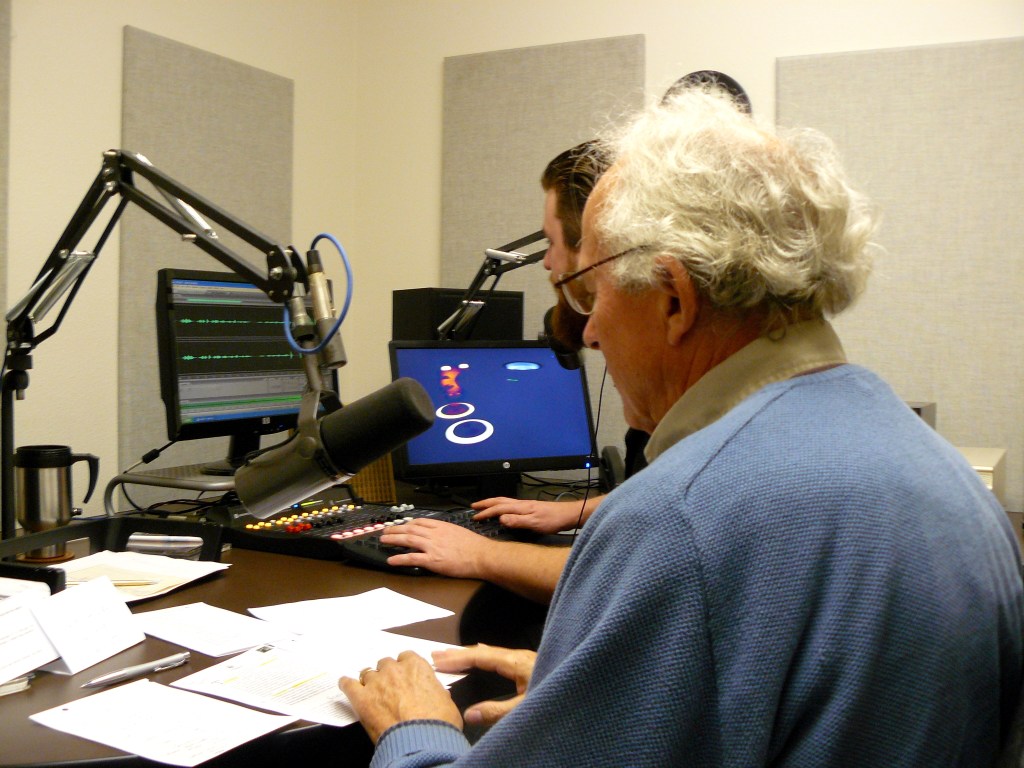
In exactly twenty-four hours from now, you will have the opportunity to listen to Kyle Dunlap of the radio station KAJO interviewing me about my book: Learning from Dogs.
The interview, that was pre-recorded on the 23rd November, is part of KAJO’s community broadcasts where they speak to local authors. As a newbie author, I was delighted and flattered to be asked to participate.
Anyway!
The broadcast is a little after 12:45 Pacific Standard Time on Tuesday, 8th December. If you are not in the USA, you can check the equivalent time easily at The World Clock website.
You will see the On Air button to click just to the right of the KAJO 1270am logo. Here is the “Click to Listen Live” button grabbed from the KAJO website at 3:20pm yesterday.
It will have Kyle Dunlap’s name on it when you “tune in” at 12:45 tomorrow.
If you do listen to the interview do leave a comment below – good or bad! 😉
What clues does your dog’s spit hold for human mental health?
This is not a spoof. Apparently the closeness of the relationship between dogs and humans holds real scientific value.
Just my way of introducing a most fascinating and interesting item that recently appeared on The Conversation blogsite. (And see my note at the end of today’s post.)
ooOOoo
What clues does your dog’s spit hold for human mental health?
December 2, 2015
Elixir Karlsson, Assistant Professor of Bioinformatics and Integrative Biology, University of Massachusetts Medical School
There goes some precious DNA…. Graeme Bird, CC BY-NC-ND
Dogs were the first animals people domesticated, long before the earliest human civilizations appeared. Today, tens of thousands of years later, dogs have an unusually close relationship with us. They share our homes and steal our hearts – and have even evolved to love us back. Sadly, they also suffer from many of the same difficult-to-treat psychiatric and neurological diseases we do.
I learned this firsthand about six years ago, when my sister Adria adopted Beskow, a beautiful,
Beskow, in fine spirits. Elinor Karlsson, CC BY-ND
boisterous, black and white mutt. Beskow became my constant companion on my morning runs along the Charles River. Her joy in running was obvious to everyone we passed, and she kept me going mile after mile.
When not running, though, Beskow suffered from constant anxiety that left her stressed and unhappy – on edge around other dogs and prone to aggressive behavior. Beskow had trouble even playing outdoors, since she was compelled to attend to every sound and movement. Working one-on-one with skilled behaviorists and trainers helped immensely, but poor Beskow still never seemed able to relax. Eventually, Adria combined the intensive training with medication, which finally seemed to give Beskow some relief.
Beskow’s personality – her intelligence, her focus and her anxiety – was shaped not only by her own life experiences, but by thousands of years of evolution. Have you ever known a dog who would retrieve the same ball over and over again, for hours on end? Or just wouldn’t stay out of the water? Or wasn’t interested in balls, or water, but just wanted to follow her nose? These dogs are the result of hundreds of generations of artificial selection by human beings. By favoring useful behaviors when breeding dogs, we made the genetic changes responsible more common in their gene pool.
When a particular genetic change rapidly rises in prevalence in a population, it leaves a “signature of selection” that we can detect by sequencing the DNA of many individuals from the population. Essentially, around a selected gene, we find a region of the genome where one particular pattern of DNA – the variant linked to the favored version of the gene – is far more common than any of the alternative patterns. The stronger the selection, the bigger this region, and the easier it is to detect this signature of selection.
In dogs, genes shaping behaviors purposely bred by humans are marked with large signatures of selection. It’s a bit like evolution is shining a spotlight on parts of the dog genome and saying, “Look here for interesting stuff!” To figure out exactly how a particular gene influences a dog’s behavior or health, though, we need lots more information.
To try to unravel these connections, my colleagues and I are launching a new citizen science research project we’re calling Darwin’s Dogs. Together with animal behavior experts, we’ve put together a series of short surveys about everything from diet (does your dog eat grass?) to behavior (is your dog a foot sitter?) to personality (is your dog aloof or friendly?).
Any dog can participate in Darwin’s Dogs, including purebred dogs, mixed breed dogs, and mutts of no particular breed – our study’s participants will be very genetically diverse. We’re combining new DNA sequencing technology, which can give us much more genetic information from each dog, with powerful new analysis methods that can control for diverse ancestry. By including all dogs, we hope to be able to do much larger studies, and home in quickly on the important genes and genetic variants.
A beagle considers making the saliva donation. Stephen Schaffner, CC BY-ND
Once an owner has filled out the survey, there’s a second, crucial step. We send an easy-to-use kit to collect a small dog saliva sample we can use for DNA analysis. There’s no cost, and we’ll share any information we find.
Our plan is to combine the genetic data from many dogs and look for changes in DNA that correlate with particular behaviors. It won’t be easy to match up DNA with an obsession with tennis balls, for instance. Behavior is a complex trait that relies on many genes. Simple Mendelian traits, like Beskow’s black and white coat, are controlled by a single gene which determines the observable characteristic. This kind of inherited trait is comparatively easy to map. Complex traits, on the other hand, may be shaped by tens or even hundreds of different genetic changes, each of which on its own only slightly alters the individual carrying it.
Adding to the complexity, environment often plays a big role. For example, Beskow may not have been as anxious if she’d lived with Adria from puppyhood, even though her genetics would be unchanged.
Darwin’s Dogs team member Jesse McClure extracts DNA from a sample. Elinor Karlsson, CC BY-ND
To succeed, we need a lot of dogs to sign up. Initially, we’re aiming to enroll 5,000 dogs. If successful, we’ll keep growing. With bigger sample sizes, we’ll be able to tackle even more complex biological puzzles.
Understanding the biology underlying a disease is the first step in developing more effective treatments – of both the canine and human variety. For example, genetic studies of narcolepsy in Doberman pinschers found the gene mutation causing the disease – but only in this one dog population. Researching the gene’s function, though, led to critical new insights into the molecular biology of sleep, and, eventually, to new treatment options for people suffering from this debilitating disease.
Darwin’s Dogs is investigating normal canine behaviors as well as diseases. We hypothesize that finding the small genetic changes that led to complex behaviors, like retrieving, or even personality characteristics, like playfulness, will help us figure out how brains work. We need this mechanistic understanding to design new, safe and more effective therapies for psychiatric diseases.
And Beskow? Six years later, she is as wonderful as ever. While still anxious some of the time, the
Beskow with one of her loving family members. Adria Karlsson, CC BY-ND
medication and training have paid off, and she enjoys her daily walks, training and playtime. She still gets very nervous around other dogs, but is a gentle, playful companion for my sister’s three young children.
We are now sequencing her genome. In the next few months, we should have our first glimpse into Beskow’s ancestry. We know she is a natural herder, so we’re curious to find out how much her genome matches up to herding breeds, and which genes are in that part of the genome.
This is an incredibly interest research project with far-reaching implications for us humans. I have written to Professor Karlsson to double-check that anyone who reads this can participate, even if living outside the USA, and will update this post as soon as I hear back from her.
Do share this as far and wide as you can for the benefits for us humans are clear and obvious.
Not a week goes by without me gaining more and deeper understanding of just how wonderful and fabulous our dogs are.
Your dog can cue to you open the door by ringing a bell, but how about taking it to the next level and teaching your dog to open the door by himself? In fact, there’s a handy trick built into this that we will introduce later on! This video walks you through all the steps to opening doors and drawers:
Hold an object
If your dog likes to play fetch or tug, it may be a great idea to teach him how to hold and carry an object. It’s a new way for a dog to think about holding a toy, since once the dog has a grip on it, he needs to wait for you to give the cue to release it. This trick is also included in a more complicated trick, which is next on our list. But first, here’s a video that shows you how to master this trick:
Fetch something from the fridge or cupboard
When you have the training down for touch, opening the door, knowing the names of objects, and holding an object, it’s just a matter of putting the steps together to teach your dog to fetch an item from somewhere in the house. A popular version of this trick is of course to fetch a beer from the fridge! But maybe start out with a less fizzy drink option, just in case.
Back up
An interesting trick to teach your senior dog is how to walk backwards. It’s a great one to help with getting him to think about using his body a little differently. Most dogs aren’t really aware of where their hind end is — it’s just the part that follows their front end. By teaching your dog to walk backward, you’re teaching him to be aware of where his back legs are going. It’s great for both mental and physical agility.
Find it
Keep life interesting for your dog by creating a game around using his nose to find a reward. This is a great trick especially for dogs whose hearing or sight has diminished with age. The trick teaches them to use their noses even more purposefully, using scent work to find the hidden treat or toy. Once you teach your dog how to find it, you can have the “it” be something different every time you play to keep your dog at the top of his game. This video shows an older Labrador learning the steps to the “find it” game and having fun playing:
Tuck himself in bed
It’s surprising how much fun you can have with a trick that only requires your dog to grab a blanket and roll over. This adorable trick is great for dogs of any age, and is an easy (and cozy) trick for your senior dog to learn. You simply teach your dog to lie down on a blanket, grab and hold the corner of it, and roll over so he tucks himself into bed. For senior dogs who like to snooze in extra warm blankets, this is a dream trick. Here’s how it works:
ooOOoo
So there you are. Plenty to keep you and your senior dogs engaged for a long time. Once again, if you missed part one then that was published yesterday.
The household here in Oregon has a number of seniors, both dogs and humans. And while I’m pretty sure that this senior human is practically past the point of learning new tricks, apparently it doesn’t apply to our old dogs.
So enjoy this recent article that appeared on Mother Nature News.
oooooh
Teaching an old dog new tricks is not only possible, but a lot of fun!
By: Jaymi Heimbuch, November 30, 2015
Old dogs can learn new tricks with ease! (Photo: Annette Shaff/Shutterstock)
The old saying goes that you can’t teach an old dog new tricks, but we know a lot of old sayings are wrong — this one included. Of course we can teach old dogs new tricks! In fact, it’s a great way to keep your dog mentally stimulated and having fun throughout his life.
One important thing to keep in mind about teaching senior dogs new tricks and behaviors is the dog’s level of physical ability. Many senior dogs are perfectly able, but if your dog is getting achy in the joints or has other limitations that come with age, keep these in mind. Older dogs may have joint pain or arthritis and have a harder time jumping or even sitting for long periods. They may also have dental issues which may limit the tricks they can do using their mouths. And they may also have hearing or vision problems which alter not only what kinds of tricks you want to teach them but also the way in which you teach them. So it’s important to know what your dog’s physical limitations are when you’re thinking up new tricks, and not push him to the point of possible injury.
While your dog may be past the days of learning to jump through hoops or leap over walls, there is a huge range of tricks that keep mobility issues in mind, and which senior dogs will have a lot of fun learning. Some of the tricks listed here build on each other and gain complexity, so you can keep things interesting for your dog for weeks at a time while training.
Touch
This is such a great trick to use as a foundation for other tricks, from flipping light switches on or off to coming back to your side. And it’s incredibly easy for your dog to learn and do. This is great for older dogs because you can make it really simple at first and build complexity into it after your dog has it down. To start out, you train your dog to do hand targeting. Here’s a video that shows not only how to train your dog to touch your hand, but many of the uses of the behavior:
Teaching your dog to yawn is all about “capturing behavior” with clicker training. It’s much like training your dog “touch” but this time, you have to wait for your dog to offer the behavior and capture it when it happens. Click — or say a key word like “Yes” — whenever you catch your dog yawning, and then reward him with treats or a game with a toy. After awhile, your dog begins to associate the yawn as being a trick that earns a reward. Here’s a video that demonstrates capturing different behaviors that you can turn into cute tricks, including yawning on command:
Even when you’re a grown-up, you have to pick up your toys when you’re done playing. Teaching your dog this tidy behavior will keep him or her a little more active in a low-key way, and thus help loosen up those stiff joints and muscles without putting a strain on their body. Plus, it’s a fun game that you can play over and over, not just on clean-up duty.
Stretch your dog’s mental abilities by teaching him the name of different objects or toys. This is a great way to teach your dog to fetch certain items from the toy box or even various objects from around house. You can start off with a few items from the toy box or simply get rolling with items you may want him to fetch for you, including hats, keys, shoes, blankets and so on.
Though it may take a while for your dog to truly grasp the name for each item at first, soon he will catch on to what the name game is all about and will likely grasp names faster when introduced to new objects.
Here’s a video that shows how to begin teaching a dog the name of an item, and how to add more items into the mix:
Your senior dog may be house-trained, but is he also trained to tell you precisely when he wants or needs to go out? You can give your older dog a great tool to tell you what he needs by teaching him to ring a bell as a cue to go outside. This video shows the progression of teaching a dog to touch the bell, and then eventually transition to learning that ringing the bell means their human opens the door for them.
For a few hours ago the WordPress theme I am using on Learning from Dogs was changed.
The change is necessary to allow a number of eCommerce features to be added to the blog in connection with me being able to sell my book, both in paperback and eBook formats, directly to you good people.
Plus there’s a real bonus.
This theme is mobile friendly.
In other words, everything on Learning from Dogs will be much, much easier to read on tablets and smartphones.
Finally, if anyone is within reach of Grants Pass then you have a warm welcome to come along on Saturday, December 12th. There will be some specials available to visitors only.






 Learning from Dogs