A wonderful story that mustn’t be allowed to fade away.
Togo
A week ago, I wrote a post called Sticks and Stones. Towards the end of that post, I mentioned Togo,
In 1925, a ravaging case of diphtheria broke out in the isolated Alaskan village of Nome. No plane or ship could get the serum there, so the decision was made for multiple sled dog teams to relay the medicine across the treacherous frozen land. The dog that often gets credit for eventually saving the town is Balto, but he just happened to run the last, 55-mile leg in the race. The sled dog who did the lion’s share of the work was Togo. His journey, fraught with white-out storms, was the longest by 200 miles and included a traverse across perilous Norton Sound — where he saved his team and driver in a courageous swim through ice floes.
and added that I would write more about Togo. Here it is.
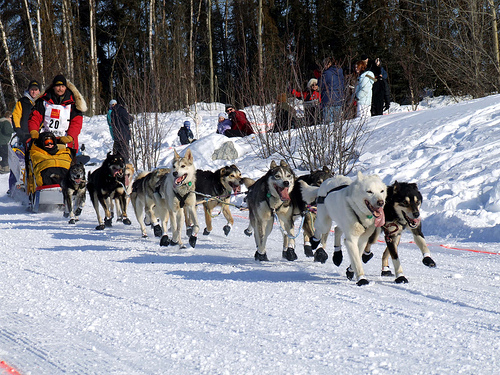
Togo (October 1913 – December 5, 1929) was the sled dog who led Leonhard Seppala and his dog sled team as they covered the longest distance in the 1925 relay of diphtheria antitoxin from Anchorage to Nome, Alaska, to combat an outbreak of the disease. The run is commemorated by the annual Iditarod dog sled race.
Annual Iditarod Trail Sled Dog Race
Togo was a Siberian Husky, his coat was black, brown, and gray, and he weighed about 48 pounds (22 kg). Seppala’s lead dog during the 1914 All-Alaska Sweepstakes, and was a precocious leader. At the time of the serum run Togo was twelve years old.
Within that entry, under the sub-heading of the Great Race of Mercy is this,
The first batch of 300,240 units of serum was delivered by train from Anchorage to Nenana, Alaska, where it was picked up by the first of twenty mushers and more than 100 dogs who relayed the serum a total of 674 miles (1,085 km) to Nome.
Togo and Seppala traveled 170 miles (274 km) from Nome in three days, and picked up the serum in Shaktoolik on January 31. The temperature was estimated at −30 °F (−34 °C), and the gale force winds causing a wind chill of −85 °F (−65 °C).
The return trip crossed the exposed open ice of the Norton Sound. The night and a ground blizzard prevented Seppala from being able to see the path but Togo navigated to the roadhouse at Isaac’s Point on the shore by 8 AM preventing certain death to his team. After traveling 84 miles (134 km) in one day, the team slept for six hours before continuing at 2 AM.
Before the night the temperature dropped to −40 °F (−40 °C), and the wind increased to 65 mi/h (105 km/h). The team ran across the ice, which was breaking up, while following the shoreline. They returned to shore to cross Little McKinley Mountain, climbing 5,000 feet (1,500 m). After descending to the next roadhouse in Golovin, Seppala passed the serum to Charlie Olsen, who in turn would pass it to Gunnar Kaasen and Balto.
A web search for ‘Togo’ including a mention on a website called Find A Grave that has this,
Birth: Oct., 1913
Death: Dec. 5, 1929, Poland Spring, Androscoggin County, Maine, USA
A sled dog for Leonhard Seppala. In 1925, When a diphtheria out brake happened in Nome Alaska. Seppala, Togo and a team of dogs ran to Nenana. He ran 10 times the distance of a average sled run. However another dog named Balto got nearly all of the fame. After the run, Seppala sold Togo to a friend in Poland Spring Maine were Togo was euthanized on December 5th 1929. He was stuffed and was put on display at Yale University. He was eventually moved to the Iditarod Trail Sled Dog Race Museum in Wasilla Alaska, where he is today.
Burial: Iditarod Trail Sled Dog Race Museum, Wasilla, Matanuska-Susitna Borough, Alaska, USA
I make no apologies for today’s post being more emotional and sentimental.
The phrase ‘sticks and stones may break my bones but names will never hurt me‘ is well known throughout the English-speaking world and surprisingly goes back some way. A quick web search found that in the The Christian Recorder of March 1862, there was this comment:
Remember the old adage, ‘Sticks and stones will break my bones, but words will never harm me’. True courage consists in doing what is right, despite the jeers and sneers of our companions.
So if in 1862 the saying was referred to as an ‘old adage’ then it clearly pre-dated 1862 by some degree.
A few days ago, Dusty M., here in Payson, AZ, sent me a short YouTube video called The Power of Words. I’m as vulnerable as the next guy to needing being reminded about what’s important in this funny old world. Then I started mulling over the tendency for all of us to be sucked into a well of doom and gloom. Take my posts on Learning from Dogs over the last couple of days, as an example.
There is no question that the world in which we all live is going through some extremely challenging times but anger and negativity is not going to be the answer. As that old reference spelt out so clearly, “True courage consists in doing what is right, despite the jeers and sneers of our companions.”
So first watch the video,
then let me close by reminding us all that courage is yet something else we can learn from dogs.
Togo the husky
In 1925, a ravaging case of diphtheria broke out in the isolated Alaskan village of Nome. No plane or ship could get the serum there, so the decision was made for multiple sled dog teams to relay the medicine across the treacherous frozen land. The dog that often gets credit for eventually saving the town is Balto, but he just happened to run the last, 55-mile leg in the race. The sled dog who did the lion’s share of the work was Togo. His journey, fraught with white-out storms, was the longest by 200 miles and included a traverse across perilous Norton Sound — where he saved his team and driver in a courageous swim through ice floes.
A new angle on the famous ‘hear no evil, see no evil, speak no evil’ saying!
What climate change??
That new angle being ‘hear no climate change, see no climate change, speak no climate change!‘
So what has prompted this outburst from me? It started with me seeing a truly scary graph that was on Peter Sinclair’s Climate Crock blogsite on the 20th September. That was the graph that was published yesterday on Learning from Dogs under the post title of It’s not rocket science! If you didn’t see that graph yesterday, don’t read further on until you have looked at it.
Thus while today’s post could easily be interpreted as yet another blogpost from yet another writer about climate change, that is not the case. What I am doing is taking a quick trip across a few recently published items that really do make it utterly clear what is happening to the Earth’s biosphere, all in support of a very simple question to two gentlemen who are currently in the news; stay with me for all to become clear!
However, this is what caught my eye, (an interview between Dr. Francis and Peter Sinclair).
What she told me in a recent interview was that the sea ice record is not something that we just pay attention to in September – there will, in fact, be reverberations that will make fall and winter “very interesting” around the globe.
An unusually strong storm formed off the coast of Alaska on August 5 and tracked into the center of the Arctic Ocean, where it slowly dissipated over the next several days. The center of the storm was located in the middle of the Arctic Ocean.
On Wednesday, the National Snow and Ice Data Center concluded Arctic sea ice is at its lowest late-August level since records began, and the area covered by ice has continued to shrink in September. Since 1979, the 1.54 million square miles of ice is the smallest coverage on record at the North Pole, the report states.
With so many questions surrounding these latest findings, perhaps one of the most immediate is whether this melting of sea ice will affect the upcoming winter across the United States and Northern Hemisphere. Is it possible that a lack of Arctic sea ice could change weather patterns across the globe?
Four meteorologists spoke about these possibilities, and while they didn’t say dramatic weather shifts are imminent in the short-term, they did give some thoughts on what could happen.
One of the meteorologists was Dr. Jeff Masters, Director of Meteorology, Weather Underground. He wrote,
In my December 2011 blog post, I discuss research by Dr. Jennifer Francis of Rutgers University, who found that Arctic sea ice loss may significantly affect the upper-level atmospheric circulation, slowing its winds and increasing its tendency to make contorted high-amplitude loops. High-amplitude loops in the upper level wind pattern (and associated jet stream) increases the probability of persistent weather patterns in the Northern Hemisphere, potentially leading to extreme weather due to longer-duration cold spells, snow events, heat waves, flooding events, and drought conditions.
Several studies published in 2012 have linked Arctic sea ice loss to an increase in probability of severe winter weather in Western Europe, Eastern North America and Eastern Asia.
Then if one goes to that December 2011 blog post, one reads this,
“The question is not whether sea ice loss is affecting the large-scale atmospheric circulation…it’s how can it not?” That was the take-home message from Dr. Jennifer Francis of Rutgers University, in her talk “Does Arctic Amplification Fuel Extreme Weather in Mid-Latitudes?“, presented at last week’s American Geophysical Union meeting in San Francisco. Dr. Francis presented new research in review for publication, which shows that Arctic sea ice loss may significantly affect the upper-level atmospheric circulation, slowing its winds and increasing its tendency to make contorted high-amplitude loops. High-amplitude loops in the upper level wind pattern (and associated jet stream) increases the probability of persistent weather patterns in the Northern Hemisphere, potentially leading to extreme weather due to longer-duration cold spells, snow events, heat waves, flooding events, and drought conditions.
Arctic sea ice loss can slow down jet stream winds
Dr. Francis looked at surface and upper level data from 1948 – 2010, and discovered that the extra heat in the Arctic in fall and winter over the past decade had caused the Arctic atmosphere between the surface and 500 mb (about 18,000 feet or 5,600 meters) to expand. As a result, the difference in temperature between the Arctic (60 – 80°N) and the mid-latitudes (30 – 50°N) fell significantly. It is this difference in temperature that drives the powerful jet stream winds that control much of our weather. The speed of fall and winter west-to-east upper-level winds at 500 mb circling the North Pole decreased by 20% over the past decade, compared to the period 1948 – 2000, in response to the extra warmth in the Arctic. This slow-down of the upper-level winds circling the pole has been linked to a Hot Arctic-Cold Continents pattern that brought cold, snowy winters to the Eastern U.S. and Western Europe during 2009 – 2010 and 2010 – 2011.
OK, nearly finished! Stay with me for one last item. Did you note in that blog post (the first section quoted) this, “Dr. Francis presented new research in review for publication …“? Here’s the Abstract from that publication, from which one reads,
Evidence linking Arctic amplification to extreme weather in mid-latitudes
Key Points
Enhanced Arctic warming reduces poleward temperature gradient
Weaker gradient affects waves in upper-level flow in two observable ways
Both effects slow weather patterns, favoring extreme weather
Jennifer A. Francis, Institute of Marine and Coastal Sciences, Rutgers University, New Brunswick, New Jersey, USA
Stephen J. Vavrus, Center for Climatic Research, University of Wisconsin-Madison, Madison, Wisconsin, USA
So to the point of both yesterday’s Post and the information above.
Will someone tell me why Messrs Barack Obama and Willard Mitt Romney so fervently adopt the stance of ‘hear no climate change, see no climate change, speak no climate change!‘
I am indebted to Peter Sinclair for his permission to reproduce the graph below. It was embedded in his post on Climate Crocks on the 20th September, a post he not unreasonably called The Planetary Emergency.
As Peter wrote,
As you can see from the graphic above, the actual observations of arctic sea ice melt are far outstripping the climate model predictions of just a few years ago, that the denial-sphere continues to call “alarmist”. Apparently, not alarming enough.
The point of publishing this on Learning from Dogs is simply as an introduction to a post coming out tomorrow called Hear no evil; or is that hear no climate change?, the purpose of which is to ask a very simple question of the two gentlemen wishing to reside in the White House as President of the USA for another four years. All revealed tomorrow!
A lifting of the importance of integrity is the key to our survival.
Let me start by reflecting on the difference between ‘truth’ and ‘integrity’.
Here’s one of the definitions of Truth: conformity with fact or reality; verity: the truth of a statement.
Here’s one of the definitions of Integrity: adherence to moral and ethical principles; soundness of moral character; honesty.
So while in yesterday’s article, I frequently referred to the word ‘truth‘, determining the ‘fact or reality‘ of a wide range of issues associated with anthropogenic climate change is not always straightforward. Many of us probably have a strong intuition of the ’cause and effect’ of man’s footprint on this planet but a strong intuition is not the same as truth.
Then let’s turn to the notion of integrity. This is a much bigger issue, to my mind, the appalling lack of integrity! Illustrated by one simple example. How many leading politicians from any number of countries have demonstrated soundness of moral character; honesty with regard to the changing climate, even offering something as simple as “I don’t know!”
There’s a saying that pilots use, “If there’s any doubt, there’s no doubt!” Come on, politicians and leaders, at the very least there is doubt!
OK, let me move on!
If integrity is partly defined as honesty, then while it’s easy to take a pot-shot at the world’s politicians maybe we need to look closer at home; ourselves. Are we as honest with our own self as we now need to be?
Here’s an example that supports that question.
A few days ago there was a report on the website The Daily Impact about the crash of US fisheries. Let me show you how that report opens,
Report: US Fisheries Crashing
We live in a country in which every household has two TV sets, most of them receiving hundreds of channels, and two cell phones, many of them “smart.” One of every two households has a computer connected to the Internet. This country is currently in the middle of a hotly contested presidential election. And yet among the things that have almost completely escaped public attention is this: last week the US government declared fisheries disasters on four coasts.
Reflect on that paragraph. Surely it’s a reflection about the lack of integrity, of honesty, about our society?
The report ends thus,
The disaster declaration covering all these dire situations makes them eligible for Congressional aid, along with drought-stricken farmers in the Midwest and Southwest, flooded-out homeowners in New Orleans and along the Gulf, the fire-ravaged states of the far West, and the derecho-pounded Northeast. Congress will no doubt be delighted by the opportunity to help.
We eat nearly five billion pounds of seafood every year — about 16 pounds for each of us — and 85 per cent of it is imported (according to NOAA). Yet in the wake of this grim assessment of a large proportion of the domestic industry, and the questions it raises about the future sources of seafood, there is no discussion of “fisheries independence” or “peak fish” in politics or the media. Only in such outposts as this website and Mother Jones will the dire warning from the Commerce Department be reported as what it is — a dire warning.
Then there was a recent article on the Australian Permaculture news website about the US food and dairy industry. Here’s how that opened,
Americans’ right to access fresh, healthy foods of their choice is under attack. Farmageddon tells the story of small, family farms that were providing safe, healthy foods to their communities and were forced to stop, sometimes through violent action, by agents of misguided government bureaucracies, and seeks to figure out why.
Filmmaker Kristin Canty’s quest to find healthy food for her four children turned into an educational journey to discover why access to these foods was being threatened. What she found were policies that favor agribusiness and factory farms over small family-operated farms selling fresh foods to their communities. Instead of focusing on the source of food safety problems — most often the industrial food chain — policymakers and regulators implement and enforce solutions that target and often drive out of business small farms that have proven themselves more than capable of producing safe, healthy food, but buckle under the crushing weight of government regulations and excessive enforcement actions.
I’m not going to insert that YouTube video into this post but you can link to both the full article and the film here. For anyone interested in the fate of the family farm in the USA, the film is a ‘must see’! Once again, the theme of integrity, of adherence to moral and ethical principles; honesty, comes to mind!
How I do want to close this rather personal reflection on present times (some may call it an indulgent reflection!) is by including a video from this seasons TED Talks. It was brought to my attention by Christine over at her excellent blog 350 or bust. The video is about resolving conflict,
William Ury, author of “Getting to Yes,” offers an elegant, simple (but not easy) way to create agreement in even the most difficult situations — from family conflict to, perhaps, the Middle East.
The reason why this seems like a very appropriate way to close this is because the way things are going at the moment, avoiding conflict could become rather important, rather soon!
This is not the first time that I have wandered through this subject. Indeed, Learning from Dogs would never have seen the light of day if, all those years ago, Jon Lavin hadn’t raised the fascinating idea that dogs are integrous animals. As the quote says in the sidelink Purpose of Learning from Dogs;
There is nothing to fear except the persistent refusal to find out the truth, the persistent refusal to analyse the causes of happenings. Dorothy Thompson.
So what is it that has rocked my boat again? A number of things, to be honest. So much so, please forgive me for running these musings over to tomorrow!
Regular readers may have noticed that both Tuesday’s post Modelling the future and yesterday’s A study of man’s behaviours explored determining truth; frequently a fickle beast to track down! Then last Monday, I read the latest post from Climate Denial Crock of the Week that was about Sea Ice Slowing to Minimum. It was yet another reminder that embracing the truth of what is happening to our planet is vital, I mean VITAL, for anyone who has a reasonable expectation to be alive in 20 years time.
Here’s how Peter opened that post (published with Peter’s kind permission):
Not there yet, but in an interview with Dr. Jennifer Francis of Rutgers last week, the message was clear – the ice has retreated so much that at this point, we will already be experiencing the impacts of a low or no-ice arctic minimum, including “very interesting” weather in the northern hemisphere this fall and winter. Wow. I can’t wait.
Peter then included an update in that post, a reference to a report published in the Australian newspaper The Sydney Morning Herald. I requested permission to republish the SMH article but that wasn’t granted, well to be factual it was offered at a fee of $420.75 – say no more. Here is how that report from on board the Greenpeace ice-breaker Arctic Sunrise opened,
We are a few hundred miles from the north pole. The air temperature is -3C, the sea freezing. All around us in these foggy Arctic waters at the top of the world are floes – large and small chunks of sea ice that melt and freeze again with the seasons.
Arne Sorensen, our Danish ice pilot, is 18 metres up in the crow’s nest of the Arctic Sunrise vessel. Visibility is just 200 metres and he inches the 1,000-tonne Greenpeace ice-breaker forward at two knots through narrow passages of clear water.
A few paragraphs later come this:
More than 600,000 sq km more ice has melted in 2012 than ever recorded by satellites. Now the minimum extent has nearly been reached and the sea is starting to refreeze.
‘‘This is the new minimum extent of the ice cap,’’ [Sorensen] says – the frontline of climate change. ‘‘It is sad. I am not doubting this is related to emitting fossil fuels to a large extent. It’s sad to observe that we are capable of changing the planet to such a degree.’’
British, Italian and American scientists on the Arctic Sunrise say they are shocked at the speed and extent of the ice loss.
Over at the Guardian newspaper, their reporter John Vidal, also aboard the Arctic Sunrise, reports:
One of the world’s leading ice experts has predicted the final collapse of Arctic sea ice in summer months within four years.
In what he calls a “global disaster” now unfolding in northern latitudes as the sea area that freezes and melts each year shrinks to its lowest extent ever recorded, Prof Peter Wadhams of Cambridge University calls for “urgent” consideration of new ideas to reduce global temperatures.
In an email to the Guardian he says: “Climate change is no longer something we can aim to do something about in a few decades’ time, and that we must not only urgently reduce CO2 emissions but must urgently examine other ways of slowing global warming, such as the various geoengineering ideas that have been put forward.”
Professor Peter Wadhams is head of the Cambridge University Polar Ocean Physics Group, from which one may learn,
Sea ice covers 7% of the surface of our planet. It is one of the most important and variable components of the planetary surface and is the key to understanding many basic questions about the energy balance of the Earth. The ice-covered seas represent the cold end of the enormous heat engine that enables the Earth to have temperatures suitable for human life over most of its surface.
Just go back and re-read, “.. the enormous heat engine that enables the Earth to have temperatures suitable for human life over most of its surface.”
So determining the truth of what is happening to our planet is not some elegant academic exercise, it is about determining the likelihood of human life surviving or not!
Doesn’t that put everything else we are doing into some form of perspective? Let me rant on tomorrow!
A reflection on why living in harmony with Planet Earth seems so challenging.
John Hurlburt is the ‘mover and shaker’ behind a series of talks and discussions under the overall title of Everything Fits Together, part of the adult education umbrella of St Paul’s Episcopal Church here in Payson, AZ. John generously asked if I would lead the discussion tonight (19th) along the theme of Nature and Faith. I plan to close the session with these words and the compelling video that was on Learning from Dogs last Friday A planet worth protecting.
oooOOOooo
Man – a study in behaviours.
The relationship between Planet Earth and man goes back a very long way. But what of today?
There is little doubt that many people, even with the minimum of awareness about the world in which we live, are deeply worried. On so many fronts there are forbidding and scary views. It feels as though all the certainty of past times has gone; as if all the trusted models of society are now broken. Whether we are talking politics, economics, employment or the environment, nothing seems to be working.
Why might this be?
It would be easy to condemn man’s drive for progress and an insatiable self-centredness as the obvious causes of our society failing in widespread ways. But in my view that’s too simple an explanation. It’s much more complex.
I propose that the challenges we all face today have their roots in the dawning of our evolution. Let’s remind ourselves how far back that goes.
The earliest documented members of the genus Homo are Homo habilis which evolved around 2.3 million years ago. Homo habilis was the first species for which we have positive evidence of the use of stone tools.
A theory known as Recent African Ancestry theory, postulates that modern humans evolved in Africa possibly from Homo heidelbergensis and migrated out of the continent some 50,000 to 100,000 years ago, replacing local populations of Homo erectus and Homo neanderthalensis.
Thus for tens of thousands of years, the behaviours of humans have served our species well, by definition. Ergo, mankind has evolved as the result of mankind’s behaviours. Behaviours that may have changed little over those countless years.
So one might speculate that these behaviours have been potentially damaging to the ultimate survival of our species, perhaps hugely damaging, for a very long time. But because man’s population footprint has been so small for 99% of eternity the consequences have not impinged on the planet until now. Let’s reflect on those population figures.
Until the development of agriculture, around the 11th millennium BC, the world population was stable at around one million persons, as man lived out a subsistence hunter-gatherer existence. By about 2000 years ago the global population of man had climbed to around 300 million. It took another 1,200 years for that global population to reach the first billion, as it did in 1804.
However, just 123 years later, in 1927, the two-billionth baby was born. The three-billionth baby was born in 1960, just 33 years later! Only a further 14 years slip by for the four-billionth baby to be born in 1974. Another blink of the geological eyelid and 13 years later, in 1987, along comes the five-billionth bundle of joy. Around October 1999, the sixth-billionth baby is born! It is likely that we are in a world where there are now seven billion people! Indeed, the world population clock estimates that on September 12th, a week ago, the world population was 7,039,725,283 persons.
About a billion every decade. The equivalent of a growth of 100 million each and every year, or around 270,000 every single day! Or if you prefer 11,250 an hour (Remember that’s the net growth, births minus deaths, of the population of humans on this planet!)
Combine man’s behaviours with this growth of population and we have the present situation. A totally unsustainable situation on a planet that is our only home.
The only viable solution is to amend our behaviours. To tap into the powers of integrity, self-awareness and mindfulness and change our game.
All of us, no exceptions, have to work with the fundamental, primary relationships we have with each other and with the planet upon which we all depend. We need the birth of a new level of consciousness; of our self, of each other and of the living, breathing planet. A new consciousness that will empower change. We need spiritual enlightenment. We need a spiritual bond with this beautiful planet.
Over eons of time, Planet Earth has favoured our evolution. Now, today, not tomorrow, it is time to favour our beautiful planet with our love and with our faith. It is the ultimate decision for our species.
oooOOOooo
If you need a reminder of how beautiful our planet is (and I’m sure the majority of LfD readers don’t require that reminder) then go back and watch David Attenborough’s video and voice-over to the song What a Wonderful World.
I will close by inserting into this post, the video that Martin Lack included in a recent comment to my post The wind doth blow!
Can we trust the predictive output of computer modelling?
I would be the first to admit that this is not an area where I have anything more than general knowledge. However, what prompted me to think about this topic was a chance conversation with someone here in Payson. We were chatting over the phone and this person admitted to being less than fully convinced of the ’cause and effect’ of man’s influence on the global biosphere.
When I queried that, what was raised was the idea that all modelling algorithms used in climate change predictions must incorporate mathematical constants. I continued to listen as it was explained that, by definition, all constants were, to some degree, approximations. Take, for example, the obvious one of the constant π, that Wikipedia describes as: a mathematical constant that is the ratio of a circle’s circumference to its diameter. Pi, of course, would have to be rounded if it was to be used in any equation. Even taking it to thirty decimal places, as in 3.14159 26535 89793 23846 26433 83279, would mean rounding it to 3.14159 26535 89793 23846 26433 83280 (50288 being the 30th to 35th decimal places).
OK, so I must admit that I was leaning to the viewpoint that this person had a valid perspective. I then asked Martin Lack, he of Lack of Environment and a scientifically trained person, for his thoughts. The rest of this post is based on the information that Martin promptly sent me.
One of the links that Martin sent was to this post on the Skeptical Science blogsite. That post sets out the common skeptics view, namely:
Models are unreliable
“[Models] are full of fudge factors that are fitted to the existing climate, so the models more or less agree with the observed data. But there is no reason to believe that the same fudge factors would give the right behaviour in a world with different chemistry, for example in a world with increased CO2 in the atmosphere.” (Freeman Dyson)
The author of the Skeptical Science posting responds,
Climate models are mathematical representations of the interactions between the atmosphere, oceans, land surface, ice – and the sun. This is clearly a very complex task, so models are built to estimate trends rather than events. For example, a climate model can tell you it will be cold in winter, but it can’t tell you what the temperature will be on a specific day – that’s weather forecasting. Climate trends are weather, averaged out over time – usually 30 years. Trends are important because they eliminate – or “smooth out” – single events that may be extreme, but quite rare.
Climate models have to be tested to find out if they work. We can’t wait for 30 years to see if a model is any good or not; models are tested against the past, against what we know happened. If a model can correctly predict trends from a starting point somewhere in the past, we could expect it to predict with reasonable certainty what might happen in the future.
So all models are first tested in a process called Hindcasting. The models used to predict future global warming can accurately map past climate changes. If they get the past right, there is no reason to think their predictions would be wrong. Testing models against the existing instrumental record suggested CO2 must cause global warming, because the models could not simulate what had already happened unless the extra CO2 was added to the model. All other known forcings are adequate in explaining temperature variations prior to the rise in temperature over the last thirty years, while none of them are capable of explaining the rise in the past thirty years. CO2 does explain that rise, and explains it completely without any need for additional, as yet unknown forcings.
I strongly recommend you read the full article here. But I will republish this graph that, for me at least, is a ‘slam dunk’ in favour for modelling accuracy.
Sea level change. Tide gauge data are indicated in red and satellite data in blue. The grey band shows the projections of the IPCC Third Assessment report (Copenhagen Diagnosis 2009).
Not only does this show that the data is within the range of projections of the modelled output, more seriously the data is right at the top end of the model’s predictions. The article closes with this statement:
Climate models have already predicted many of the phenomena for which we now have empirical evidence. Climate models form a reliable guide to potential climate change.
There is a more detailed version of the above article available here. Do read that if you want to dig further down into this important topic. All I will do is to republish this,
There are two major questions in climate modeling – can they accurately reproduce the past (hindcasting) and can they successfully predict the future? To answer the first question, here is a summary of the IPCC model results of surface temperature from the 1800’s – both with and without man-made forcings. All the models are unable to predict recent warming without taking rising CO2 levels into account. Noone has created a general circulation model that can explain climate’s behaviour over the past century without CO2 warming. [my emphasis, Ed.]
Finally, back to Lack of Environment. On the 6th February, 2012, Martin wrote an essay Climate science in a nut fragment. Here’s how that essay closed:
Footnote:
If I were to attempt to go even further and summarise, in one single paragraph, why everyone on Earth should be concerned about ongoing anthropogenic climate disruption, it would read something like this:
Concern over anthropogenic climate disruption (ACD) is not based on computer modelling; it is based on the study of palaeoclimatology. Computer modelling is based on physics we have understood for over 100 years and is used to predict what will happen to the atmosphere for a range of projections for CO2 reductions. As such, the range of predictions is due to uncertainty in those projections; and not uncertainties in climate science. Furthermore, when one goes back 20 years and chooses to look at the projection scenario that most-closely reflects what has since happened to emissions, one finds that the modelled prediction matches reality very closely indeed.
In his email, Martin included these bullet points.
Concern over anthropogenic climate disruption (ACD) is not based on computer modelling.
It is based on our understanding of atmospheric physics (and how the Earth regulates its temperature).
Computer modelling is based on this physics (which we have understood for over 100 years).
Models have been used to predict temperature and sea level rise for a range of projections for CO2 emissions.
The wide range of predictions was due to uncertainty in those emissions projections not uncertainties in climate science.
This can be demonstrated by looking at predictions made over 20 years ago in light of what actually happened to emissions.
The model predictions for both temperature and sea level rise are very accurate (if not slightly under-estimating what has happened).
Sort of makes the point in spades! The sooner all human beings understand the truth of what’s happening to our planet, the sooner we can amend our behaviours. I’m going to pick up the theme of behaviours in tomorrow’s post on Learning from Dogs.
Finally, take a look at this graph and reflect! This will be the topic that I write about on Thursday.
There have been a couple of hard-hitting posts this week, first about the implications of climate, with respect to the massive drought across the USA this year, and the efforts of Polly Higgins of the Eradicating Ecocide movement to make ecocide a crime against humanity.
This short but very compelling video shows why the planet is so worth protecting. Enjoy!
OK, that sub-heading must seem a tad bizarre! Let me explain. On Tuesday, Jean had an important visit to make down in Mesa, AZ on the outskirts of Phoenix. The first 65 miles, give or take, from Payson to Mesa are down along Highway 87.
At 11.20 we started on our return from Mesa planning on being early back home, say by 1pm at the latest. But 31 miles up the Northbound carriageway of Highway 87, we came to a halt. The road was closed due to an accident with a tanker. As our local newspaper, the Payson Roundup, put it,
The driver of the truck was taken by ambulance to a Scottsdale hospital with non life-threatening injuries. DPS has not ruled out speed as the cause of the crash. Photo by Andy Towle.
Due to a hazardous spill, Highway 87 was closed most of Tuesday, but reopened Wednesday morning after overnight clean up efforts, according to the Arizona Department of Public Safety.
Officials initially thought the roadway could be closed as many as two days due to the amount of oil spewed across both sides of the highway.
The highway closed down after a semi truck carrying oil used for paving rolled Tuesday afternoon near milepost 228, at the bottom of Slate Creek.
That resulted in us having to take a 170 mile detour and not arriving back until 4.30pm!
So what’s that got to do with the post for today? Simply that the implications of Tuesday spilled, like the tanker’s oil cargo, across into Wednesday and the long, thoughtful post I had in my mind to write got put on hold. Thus in its place is this republication of a recent release by Stanford School of Engineering at Stanford University. Apologies for another republished item but the article is relevant and interesting.
oooOOOooo
WIND COULD MEET WORLD’S TOTAL POWER DEMAND – AND THEN SOME – BY 2030
Wind turbines near Livermore, CA.
HIGH RESOLUTION MODELS
In their study, Jacobson and Archer adapted the three-dimensional, atmosphere-ocean-land computer model known as GATOR-GCMOM to calculate the theoretical maximum wind power potential on the planet taking into account wind reduction by turbines. Their model assumed wind turbines could be installed anywhere and everywhere, without regard to societal, environmental, climatic or economic considerations.
The new paper contradicts two earlier studies that said wind potential falls far short of the aggressive goal because each turbine steals too much wind energy from other turbines, and that turbines introduce harmful climate consequences that would negate some of the positive aspects of renewable wind energy.
The new model provides a more sophisticated look than previously possible by separating winds in the atmosphere into hypothetical boxes stacked atop and beside one another. Each box has its own wind speed and weather. In their model, Jacobson and Archer exposed individual turbines to winds from several boxes at once, a degree of resolution earlier global models did not match.
“Modeling the climate consequences of wind turbines is complex science,” said Jacobson. “This software allows that level of detail for the first time.”
With a single model, the researchers were able to calculate the exposure of each wind turbine in the model to winds that vary in space and time. Additionally, the model extracts the correct amount of energy from the wind that gets claimed by the turbines, reducing the wind speed accordingly while conserving energy. It then calculates the effect of these wind speed changes on global temperatures, moisture, clouds and climate.
POTENTIAL APLENTY
Among the most promising things the researchers learned is that there is a lot of potential in the wind—hundreds of terawatts. At some point, however, the return on building new turbines plateaus, reaching a level in which no additional energy can be extracted even with the installation of more turbines.
“Each turbine reduces the amount of energy available for others,” Archer said. The reduction, however, becomes significant only when large numbers of turbines are installed, many more than would ever be needed.
“And that’s the point that was very important for us to find,” Archer said.
The researchers have dubbed this point the saturation wind power potential. The saturation potential, they say, is more than 250 terawatts if we could place an army of 100-meter-tall wind turbines across the entire land and water of planet Earth. Alternatively, if we place them only on land (minus Antarctica) and along the coastal ocean there is still some 80 terawatts available—about seven times the total power demand of all civilization. Hypothetical turbines operating in the jet streams six miles up in the atmosphere could extract as much as an additional 380 terawatts.
“We’re not saying, ‘Put turbines everywhere,’ but we have shown that there is no fundamental barrier to obtaining half or even several times the world’s all-purpose power from wind by 2030. The potential is there, if we can build enough turbines,” said Jacobson.
Mark Z. Jacobson, professor of civil and environmental engineering. Photo: Linda Cicero / Stanford News Service
HOW MANY TURBINES?
Knowing that the potential exists, the researchers turned their attention to how many turbines would be needed to meet half the world’s power demand—about 5.75 terawatts—in a 2030 clean-energy economy. To get there, they explored various scenarios of what they call the fixed wind power potential—the maximum power that can be extracted using a specific number of wind turbines.
Archer and Jacobson showed that four million 5-megawatt turbines operating at a height of 100 meters could supply as much 7.5 terawatts of power—well more than half the world’s all-purpose power demand—without significant negative affect on the climate.
“We have a long way to go. Today, we have installed a little over one percent of the wind power needed,” said Jacobson.
In terms of surface area, Jacobson and Archer would site half the four million turbines over water. The remaining two million would require a little more than one-half of one percent of the Earth’s land surface—about half the area of the State of Alaska. However, virtually none of this area would be used solely for wind, but could serve dual purposes as open space, farmland, ranchland, or wildlife preserve.
Rather than put all the turbines in a single location, Archer and Jacobson say it is best and most efficient to spread out wind farms in high-wind sites across the globe—the Gobi Desert, the American plains and the Sahara for example.
“The careful siting of wind farms will minimize costs and the overall impacts of a global wind infrastructure on the environment,” said Jacobson. “Regardless, as these results suggest, the saturation of wind power availability will not limit a clean-energy economy.”
Funding sources include National Science Foundation, U.S. Environmental Protection Agency, and National Aeronautics and Space Administration high-end computing.
Andrew Myers is associate director of communications for the Stanford University School of Engineering.
Monday, September 10, 2012
oooOOOooo
Let me close by pointing you to Mark Jacobson’s website.