Category: Climate

What part of the word ‘no’ are you having trouble with?

So long overdue to saying ‘no’ to more drilling for oil and gas!

Just five days ago, I republished an essay from Tom Engelhardt of TomDispatch fame called The more it changes, the more it’s the same thing.  Despite Tom’s permission for me to republish any of the essays that appear on TomDispatch, I do try to be very selective and not republish too often.

However, what was published by Tom on the 18th, just three days ago, is so powerful that it requires the widest readership possible.  That’s why Tomgram: Ellen Cantarow, “Little Revolution,” Big Fracking Consequences is being republished on Learning from Dogs today and tomorrow.  The reason I have split the essay into two parts is because I want to add some other material. Tom’s publication is in one part so if you can’t wait for my sequel tomorrow, then click here.

Here’s something that I want to draw your attention to:

If you’re 27 or younger, you’ve never experienced a colder-than-average month

By Philip Bump
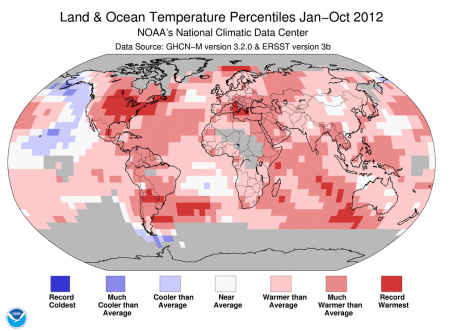
This image sums up 2012, temperature-wise.

Nowhere on the surface of the planet have we seen any record cold temperatures over the course of the year so far. Every land surface in the world saw warmer-than-average temperatures except Alaska and the eastern tip of Russia. The continental United States has been blanketed with record warmth — and the seas just off the East Coast have been much warmer than average, for which Sandy sends her thanks.

I saw this on the Grist website yesterday.  Here are the next couple of paragraphs from that Grist article:

The National Oceanic and Atmospheric Administration summarizes October 2012:

The average temperature across land and ocean surfaces during October was 14.63°C (58.23°F). This is 0.63°C (1.13°F) above the 20th century average and ties with 2008 as the fifth warmest October on record. The record warmest October occurred in 2003 and the record coldest October occurred in 1912. This is the 332nd consecutive month with an above-average temperature.

If you were born in or after April 1985, (i.e. now 27 years old or younger), you have never lived through a month that was colder than average. That’s beyond astonishing.

You might want to go to the NOAA State of the Climate report just issued to read more.  Indeed, go to read this: (my emboldening)

The average temperature across land and ocean surfaces during October was 14.63°C (58.23°F). This is 0.63°C (1.13°F) above the 20th century average and ties with 2008 as the fifth warmest October on record. The record warmest October occurred in 2003 and the record coldest October occurred in 1912. This is the 332nd consecutive month with an above-average temperature. The last below-average month was February 1985. The last October with a below-average temperature was 1976. The Northern Hemisphere ranked as the seventh warmest October on record, while the Southern Hemisphere ranked as second warmest, behind 1997.

So with all that in mind, here’s the first half of Ellen Cantarow‘s essay including the ‘must-read’ introduction from Nick Turse.

oooOOOooo

Tomgram: Ellen Cantarow, “Little Revolution,” Big Fracking Consequences

Posted by Ellen Cantarow at 5:59pm, November 18, 2012.
Follow TomDispatch on Twitter @TomDispatch.

[Note for TomDispatch Readers: Back in May 2005, this site posted “Against Discouragement,” a graduation speech by the late, great Howard Zinn.  Though it hardly needs be said, it was, of course, inspiring.  I also interviewed him for TomDispatch and hewrote for the site.  A last book of his has just been published, Howard Zinn Speaks: Collected Speeches (1963-2009).  How could I not recommend it?  After all, he still speaks to us all. 

Also a reminder for TD readers: we don’t encourage you to become Amazon customers, but if you already are, and you go to that site via a TomDispatch book link like the one in the previous paragraph (or any book cover image link on the site), we get a modest cut of anything you buy, book or otherwise.  It’s a way to support this site at absolutely no cost to you!  Tom]

To say the Central Intelligence Agency has had an uneven record over its 65 years would be kind.  It found early “success” in plotting to overthrow the legitimate governments of Iran and Guatemala (even if it did fail to foresee the Soviet Union going nuclear in 1949).  Then, it had a troubled adolescence.  The Bay of Pigs.  Vietnam.  Laos.  Spying on Americans.  As the Agency matured, it managed to miss all signs of the oncoming Iranian revolution — the natural endpoint of its glorious 1953 coup that brought the Shah to power — and the Soviet invasion of Afghanistan.  (It did, however, manage to arm America’s future enemies there, sowing the seeds of 9/11.)  Then there was the Reagan era Iran-Contra affair, the failure to notice the fall of the Berlin Wall until it was on CNN, the WMD “intelligence” of the Iraqi leaker codenamed “Curveball,” the Iraq debacle that followed, and…

Well, you get the picture.  Recently, however, things seemed to be looking up.  The most popular general in a generation or two, a soldier-scholar-superman who could do no wrong, became its director.  Just before that, the Agency helped take out America’s public enemy number one in a daring night raid about which Hollywood is soon to release a celebratory movie.

But just as things were looking up, the rock star general was caught with his pants down, resigning in disgrace after an extramarital affair became public.  That titillating development overshadowed another more serious one: a cry for help about a looming threat from the Agency and its brethren in the American intelligence community (IC).  In late October, the National Research Council was toissue a report commissioned by the CIA and the IC.  Superstorm Sandy intervened and so it was only recently released, aptly titled “Climate and Social Stress: Implications for Security Analysis.” And what a dire picture it painted: security analysts should, it explained “expect climate surprises in the coming decade… and for them to become progressively more serious and more frequent thereafter, most likely at an accelerating rate… It is prudent to expect that over the course of a decade some climate events… will produce consequences that exceed the capacity of the affected societies or global systems to manage and that have global security implications serious enough to compel international response.”

Think failed states, water wars, forced mass migrations, famine, drought, and epidemics that will spill across borders, overwhelm national and international mitigation efforts, and leave the United States scrambling to provide disaster response, humanitarian relief, or being drawn into new conflicts.  That’s bad news for everyone, including the intelligence community.  Even worse, the 206-page report calls for more study, more analysis, and more action — and yet none of that is likely to happen without the assent of Congress.

Keep in mind that Republican members of Congress opposed even the creation of a CIA climate change center and tried starve it of funding while, as Kate Sheppard of Mother Jones noted last year, “Republican lawmakers — including the chairman and ranking member of the House and Senate intelligence committees, respectively — have also expressed skepticism about the CIA’s climate work.”

In other words, add Republicans to the list of those who, like Cuban and Laotian communists of yore, have worked to thwart the Agency.  And cross the CIA off any list of potential environmental saviors.  In fact, when it comes to the health of this planet, saviors seem distinctly in short supply.  As TomDispatch regular Ellen Cantarow reports from the frontlines of a full-scale climate conflict, the only hope for the environment may come from unlikely groups of people in the unlikeliest of places fighting a shadow war more important than any ever waged by the CIA. Nick Turse

Frack Fight
A Secret War of Activists — With the World in the Balance
By Ellen Cantarow

There’s a war going on that you know nothing about between a coalition of great powers and a small insurgent movement.  It’s a secret war being waged in the shadows while you go about your everyday life.

In the end, this conflict may matter more than those in Iraq and Afghanistan ever did.  And yet it’s taking place far from newspaper front pages and with hardly a notice on the nightly news.  Nor is it being fought in Yemen or Pakistan or Somalia, but in small hamlets in upstate New York.  There, a loose network of activists is waging a guerrilla campaign not with improvised explosive devices or rocket-propelled grenades, but with zoning ordinances and petitions.

The weaponry may be humdrum, but the stakes couldn’t be higher. Ultimately, the fate of the planet may hang in the balance.

All summer long, the climate-change nightmares came on fast and furious. Once-fertile swathes of American heartland baked into an aridity reminiscent of sub-Saharan Africa. Hundreds of thousands of fish dead in overheated streams. Six million acres in the West consumed by wildfires.  In September, a report commissioned by 20 governments predicted that as many as 100 million people across the world could die by 2030 if fossil-fuel consumption isn’t reduced.  And all of this was before superstorm Sandy wreaked havoc on the New York metropolitan area and the Jersey shore.

Washington’s leadership, when it comes to climate change, is already mired in failure. President Obama permitted oil giant BP to resume drilling in the Gulf of Mexico, while Shell was allowed to begin drilling tests in the Chukchi Sea off Alaska.  At the moment, the best hope for placing restraints on climate change lies with grassroots movements.

In January, I chronicled upstate New York’s homegrown resistance to high-volume horizontal hydraulic fracturing, an extreme-energy technology that extracts methane (“natural gas”) from the Earth’s deepest regions.  Since then, local opposition has continued to face off against the energy industry and state government in a way that may set the tone for the rest of the country in the decades ahead.  In small hamlets and tiny towns you’ve never heard of, grassroots activists are making a stand in what could be the beginning of a final showdown for Earth’s future.

oooOOOooo

The second part of Ellen’s essay will be published tomorrow.

Ellen Cantarow first wrote from Israel and the West Bank in 1979. A TomDispatch regular, her writing has been published in The Village Voice, Grand Street, Mother Jones, Alternet, Counterpunch, and ZNet, and anthologized by the South End Press. She is also lead author and general editor of an oral-history trilogy, Moving the Mountain: Women Working for Social Change, published in 1981 by The Feminist Press/McGraw-Hill, widely anthologized, and still in print.

Follow TomDispatch on Twitter @TomDispatch and join us on Facebook.  Check out the newest Dispatch book, Nick Turse’s The Changing Face of Empire: Special Ops, Drones, Proxy Fighters, Secret Bases, and Cyberwarfare.

Copyright 2012 Ellen Cantarow

No signs of intelligent life!

Sometimes one just has to scratch one’s head and wonder about life!

I can’t recall when and where I first heard the muse as to why Planet Earth has not been visited by aliens, but I recall the answer: “Because alien passers-by have not found any signs of intelligent life!

The reason that this comes to mind is that the damage that we are doing to our planet, nay to life on our planet, if we don’t embrace the reality of climate change is truly ‘gob-smacking’!

The evidence for this statement is over-powering.  Just last Friday, I republished a recent essay from Tom Engelhardt under the title of ‘The more it changes, the more it’s the same thing.”  Tom’s essay focused on the lack of any change that came out of the recent Presidential election.  That essay closed, thus:

But stop waiting for change, “big” or otherwise, to come from Washington.  It won’t.  Don’t misunderstand me: as the residents of the Midwestern drought zone and the Jersey shore now know all too well, change is coming, like it or not.  If, however, you want this country to be something other than its instigator and its victim, if you want the U.S. to engage a world of danger (and also of opportunity), you’d better call yourself and your friends and neighbors to the colors.  Don’t wait for a Washington focused on its own well-being in 2014 or 2016.  Mobilize yourself.  It’s time to occupy this country before it’s blown away in a storm.

An inciteful comment from reader Jules was this:

“Don’t count on anyone doing the obvious: launching the sort of Apollo-style R&D program that once got us to the moon and might speed the U.S. and the planet toward an alternative energy economy, or investing real money in the sort of mitigation projects for the new weather paradigm that might prevent a coastal city like New York — or even Washington – from turning into an uninhabitable disaster zone in some not so distant future.”

A pity. Americans can do some things very well, the kind of stuff that merits some of the hyperbole of being the greatest nation, the ability to mobilise a nation and lead the world being one of them. We need heroes maybe it’s time for you lot to don that cape and be one.

Americans have such a potential for positive change – I just can’t imagine why this Nation isn’t leading the world to a more Earth-friendly environment.

This then came into my ‘in-box’ on Friday: Could NDAA be the Death of Biofuels in America?  The article opened thus:

The US military is one of the most important developers of new technologies leading them to a point where they can be released onto the market for public and private use. Currently the Department of Defense, led by the Navy, is attempting to reduce its dependence on oil by as much as 50% by 2020, by producing US-made biofuels.

and the author concluded:

Nicole Lederer, the co-founder of E2, despaired that, “the military often leads major economic transitions in our country. Yet right now in Washington, some shortsighted lawmakers are poised to block a potentially major transformation of our national energy supply – and also hold back the significant economic growth and job gains that would come with it.”

Russ Teal, founder of the biorefinery builder Biodico, warned that, “the military is the biggest driver of the biofuels industry right now. If Congress stops the military from doing what the military knows is best, Congress also could threaten the growth of the Made-in-America biofuels industry.”

By. Joao Peixe of Oilprice.com

Then more or less the same time as I read the piece above, in came the latest from 350.org, an essay by Naomi Klein.

Naomi Klein: Do The Math, The Fossil Fuel Industry Is Destroying Our Future

Naomi Klein was out in the shattered neighbourhood of Rockaway Park Queens last weekend, participating in the Occupy relief efforts there. In this interview she underscores the importance of both increasing local resilience as a response to our changing climate and addressing the fossil fuel industry’s business model directly. As 350.org’s Do The Math campaign makes clear, the fossil fuel industry’s business plan will destroy the planet. Bill McKibben reminded the “Do The Math”audience in Seattle this month that the global warming math is quite simple: we can burn 565 more gigatons of carbon dioxide and stay below 2 degrees of warming. Anything more than that risks catastrophe for life on earth. The only problem? Fossil fuel corporations now have 2,795 gigatons in their reserves, 5Xs the safe amount. And they are planning to burn it all, unless we rise up & stop them.

So is there any hope?  So easy to think not.  But in terms of hope the answer is “Yes, yes and yes!”  Because the decent peoples of the world are way ahead of their politicians.  Take the transition movement.  I used to live in the village of Harberton, just 3 miles from the town of Totnes, Devon, in the South-West of England.

Totnes High Street

Totnes was the site of the world’s first transition movement: Transition Town Totnes.  But as the Transition US website reveals, there are now:

126 official US initiatives
437 official initiatives worldwide
33 US states
34 countries
13 languages

One of the latest has just been formed in the city where Jean and I were living until just a few weeks ago, namely Payson, Arizona.  Here’s a reflection from John Hurlburt in Payson, one of a group of committed citizens who, like so many millions of others around the world, just can’t wait for governments to ‘lead’ and was one of the founding members of Transition Town Payson.

Keep it Simple

We share a living planet as a living species. Corporate finance fuels political hate and denial. The divisiveness of global and national politics reflects an unprecedented escalating global crisis. We live in a world of constant sorrow.

Our stubborn ignorance is the greatest threat to the objectives of peace and well-being. We have become so entrenched in the ‘ruts’ of our conditioned opinions that any semblance of balanced responsibility is immediately numbed by the deliberate stupidity of well-paid spin-doctors across a global electronic media.

The recovery process is truly simple. Surrender to the scientific facts of our inclusive reality, clean house, and have compassion for each other.  The good news is that a basic natural instinct of all life forms is to survive through adaptation.

John Hurlburt

So, on reflection, I was wrong to open with the degree of irony in my ‘voice’ that I had.  This is now a world of wonderful and amazing communication channels, many of them directly ‘person to person’.  The views of the world’s peoples are now so much louder than in previous times.  I am confident that right, rather than might, will prevail.

A plea from the Executive Director of Greenpeace UK

Attention all UK-based Learning from Dogs readers: I received this email today and felt compelled to publish it on my blog – and now here as well (thanks Paul).

For the benefit of new readers (thank you – and welcome – to you all), when you read the email appended below, please bear in mind that I am (or at least have been) a supporter of the Conservative Party.  However, I am very upset by the way in which the Coalition government’s position regarding the Climate Change Act (and our commitments to invest in renewable power generation technologies of all kinds) is being undermined by climate change sceptics who have been encouraging people like John Hayes (Energy Minister) and George Osborne (Chancellor) to question the sense of investing in the Green Economy.

It is also worth pointing out that I do not agree with Greenpeace’s attitude to GMOs or Nuclear Power but, that does not prevent me from supporting them in their attempts to publicise the failure of our politicians to take a strategic long-term decision (to lessen our dependence on fossil fuels) and stick to it.  I therefore hope you will consider adding your name to the online petition to the Prime Minister to get him to face-down the sceptics in his own party; and stick to his election manifesto pledge to lead “the greenest ever government”.

**************************************************

Hi Martin,

I don’t normally email you, but this campaign you’re part of is making headlines.

It’s been front page of the newspapers for two days now and over 35,000 of us have told David Cameron to weed out the climate saboteurs in his party.

But we need many more in our movement if we are to overcome this new anti-climate ‘Tea Party’ trend infecting UK politics.

Please forward the email below to one person you know who will join us. If we all do that, we’ll be 70,000 strong by tomorrow.

Right now we have the opportunity to define our future. If the government does the right thing, we could be getting our energy from renewable sources which would create new jobs, stabilise our bills and help protect the rapidly melting Arctic.

But all that is in danger now as highlighted by our undercover investigation.

If we want a green and a peaceful world the most important thing we can do is source our energy in a way that doesn’t harm the environment. Our only choice is clean energy – let’s demand it from the government.

Please forward the email below to at least one person who will join us.

We’re only getting started,

John Sauven
Executive Director
Greenpeace UK

**************************************************

Hi there,

Over 20,000 people have already told David Cameron to stop Osborne sabotaging progress on climate change.

If these Conservatives have their way, we’ll have more dirty, expensive gas power stations written into the Energy Bill. The bill is crucial in shaping the way our electricity is generated for the next 30 years.

Osborne wants to hand the Energy Bill – and our future – to the gas companies, allowing them to build dozens of new gas power stations. This dash for gas could lead to decades of unrestricted carbon emissions and increasingly volatile household bills, plunging more people into fuel poverty.

We need the opposite, so join the campaign for a future built on clean energy.

A clean Energy Bill would mean almost zero carbon emissions from electricity generation by 2030, a new wave of clean energy and a thriving green economy with tens of thousands of new jobs.

A majority of us – 64% of the British public – want renewable energy powering our lives.

Osborne knows he’s in the minority, and recent investigations shows he’s positioning climate sceptics and anti-wind MPs in key government roles – like pieces on a chessboard – to undermine the progress we’ve made.

But Osborne still answers to the prime minister.

It now falls to David Cameron to respond to the scandal we’ve uncovered and decide where his party – and our country – is going.

At the last election when looking for our votes, Cameron rebranded the Conservative party with the environment at its heart. Our undercover investigation shows he has a fundamental question to answer: will he side with the majority of the British public, or the dirty energy faction led by George Osborne?

Tell David Cameron to listen to the country on clean energy, and please watch the undercover report and share.

Thanks,

Pete and the Energy Team
Greenpeace

The power of consequences

That unwritten law of the power of unintended consequences strikes again.

Before moving on to today’s post, just wanted to say that our recent move to Merlin, Oregon continues to take up huge (and enjoyable) demands on our time so the opportunity to write lengthy posts on Learning from Dogs is still some way off.  Having said that with the quality of analysis that is available from others, some readers may prefer it as it currently is!

There is no better example of this than the post that follows.  It is from the blog site of Peter Sinclair ‘Climate Crocks‘.  As the ‘About‘ page says,

Peter Sinclair is a long time advocate of environmental awareness and energy alternatives. An award winning graphic artist, illustrator, and animator, Mr. Sinclair runs Greenman Studio from his home in Midland, MI.

Mr. Sinclair’s syndicated cartoons have appeared worldwide, and his work has been profiled in numerous publications, including the New York Times.  He is the producer of the YouTube series, “Climate Denial Crock of the Week”.

A couple of days ago, Peter published a post called, ““La La La I Can’t Hear You” Comes Home to Haunt GOP, in the Election, and on Climate”. I read it with interest and asked Peter if I might republish it.  In a matter of moments, I received a reply giving me such permission; here it is.

oooOOOooo

When Al Jazeera and The American Conservative are in agreement that you have a problem, you probably have a problem.

The American Conservative:

But the problem wasn’t just that conservative media gave Romney supporters bad information. The people in conservative media also seem to have been fully taken in by the idea that Romney would win and would do so in decisive fashion, and the campaign came to believe its own propaganda, too. As York notes, Romney didn’t have a prepared concession speech. It apparently never occurred to his campaign that he would lose. That’s not so remarkable by itself, but it is just one part of the overall pattern of the Romney campaign and the conservative movement’s reaction to Obama. Romney spent years running against a fantasy record and campaigning on a series of gross distortions and falsehoods, and so it shouldn’t be too surprising that his campaign and his conservative media boosters didn’t have the firmest grip on political reality.

Al Jazeera:

After the election, a number of different people tweeted about a rather obvious connection – how the same people who didn’t believe the polls don’t believe global warming, either. There’s a further correlation here: On the polling side, the supposedly most liberally-biased pollsters actually came closest to hitting the mark, both in the Fordham analysis of national polls and a more sophisticated analysis of state polls by Emory political scientist Drew Linzer at his Votamatic website.

On the global warming side, a new study comparing climate models finds that those predicting the largest climate impacts by 2100 are the most accurate in modelling climate change that’s already occurred – specifically, humidity levels related to cloud formation. In short, the reality being denied in both cases is even worse than it first appears, so attempts to “compromise” or give conservatives “the benefit of the doubt” actually lead us further astray (since I first wrote this, David Roberts of Grist has written an excellent comparison of the twin delusions).

But there is more than just a correlation here. There is a common causal factor involved: Conservatives, trusting their guts, have created their own separate reality, with their own authorities, and their reasoning dominated by ideology, where certain sorts of facts simply cannot intrude. Election day was one of those rare moments in which the bubble they live inside collapsed.

Dave Roberts in Grist:

In the face of model projections like Silver’s, Jonah Goldberg said that “the soul … is not so easily number-crunched.” David Brooks warnedthat “experts with fancy computer models are terrible at predicting human behavior.” Joe Scarborough said “anybody that thinks that this race is anything but a tossup right now is such an ideologue.” Peggy Noonan said that “the vibrations are right” for a Romney win. All sorts of conservative pundits were convinced the Romney campaign just felt like a winner.

Empiricism won. It didn’t win because it’s a truer faith or a superior ideology. It won because it works. It is the best way humans have figured out to set aside their perceptual limitations and cognitive shortcomings, to get a clear view of what’s happening and what’s to come.

As it happens, there’s another issue in American politics where empiricists are forecasting the future and being ignored. Here’s what the Nate Silvers of climate science are up to:

Looking back at 10 years of atmospheric humidity data from NASA satellites, [John Fasullo and Kevin Trenberth of the National Center for Atmospheric Research] examined two dozen of the world’s most sophisticated climate simulations. They found the simulations that most closely matched actual humidity measurements were also the ones that predicted the most extreme global warming.

In other words, by using real data, the scientists picked simulation winners and losers.

“The models at the higher end of temperature predictions uniformly did a better job,” Fasullo said. The simulations that fared worse — the ones predicting smaller temperature rises — “should be outright discounted,” he added.

The Washington Post spells out what that means:

That means the world could be in for a devastating increase of about eight degrees Fahrenheit by 2100, resulting in drastically higher seas, disappearing coastlines and more severe droughts, floods and other destructive weather.

Just reread that last paragraph a couple of times – and make a promise to yourself, and those loved ones around you, to make a positive difference starting now.  And subscribe to Peter’s blogsite!

Postscript to the result

Will we see the renewed President Obama take notice of what we are doing to the planet?

But don’t hold your breath! The BBC reported that President Obama in his victory speech had “pledged to work with Republican leaders in Congress to reduce the government’s budget deficit, fix the tax code and reform the immigration system.”  All well and dandy but, perhaps, missing the big one – climate change.

OK, on to the meat of this post.

“Frankenstorm”

I first came across this reflection on Hurricane Sandy in Christine’s great blog 350 or bust.  It’s an essay written by Colin Beavan, aka “No Impact Man“, who lives in New York City and wrote a response after experiencing Hurricane Sandy last week.  I then asked Colin if I could republish his essay on Learning from Dogs and promptly received his approval.

What to do if Hurricane Sandy scared you

Dear friends,

I don’t say this often but I am scared. Not scared to the point of paralysis. Not scared enough to run away. Not scared enough to stop trying to help. Not scared enough to think we’re doomed. Just scared enough to feel worried for myself, my family, my friends, my community, my country, and my world.

I was lucky when Hurricane Sandy hit. My daughter Bella and I put on our waterproofs in the early hours and ran around Brooklyn’s Fort Greene park in the wind and rain with Frankie–our dog–and our Occupy Wall Street activist friend/hero Monica Hunken.

That night, the lights flickered a couple of times. I lost my internet for three hours. Frankie the dog hid in the upstairs bathroom bathtub. That was the extent of it.

But when I woke up, lower Manhattan was flooded and without power. All the coastal parts of Brooklyn and Queens from Red Hook to Coney Island through the Rockaways and Hamilton Beach were hammered. The wind had driven a fire through Queens that destroyed so many houses. And the world’s most amazing subway system was brought to its knees. To say nothing of poor Staten Island and coastal New Jersey.

We in the Tri-State Area didn’t get Katrina. But we got a taste of her.

Yes, there are some good parts. New Yorkers have been showing up some of the emergency shelters in such numbers that they have been turned away. There are donation drives and volunteer efforts. And about a gazillion New Yorkers have taken to cycling.

But there is a lot of suffering. And a lot of fear not of what Sandy brought. But of what next year’s storm will bring. And the year after that. And after that. First Irene, now Sandy, for how many years in a row can New York City withstand a “once in a century” storm, people are asking?

I hung up the phone with a friend just a few minutes ago. She said, “In some ways, this is way more scarey than 9/11, because you get the feeling that it could happen again and again and again.”

In a coffee shop this afternoon, everyone at every table was talking about climate change. People are talking about where they will go next time. To an aunt’s in New Hampshire. A friend with three cottages in Maine. People are talking about their escape plan for when New York stops functioning.

Katrina, Irene, Sandy, droughts all summer, busted corn crops, water shortages in the southwest: it’s hard to believe we aren’t seeing what the climate scientists predicted. But sooner. Way sooner than they said.

It feels ironic and sad. That the war in Iraq sparked by 9/11 may have got us what we wanted–control over more oil. But that burning that self-same oil has brought us another mini-9/11. Except that this one we are kind of doing to ourselves.

Fracking–the drilling for natural gas by injecting poisonous chemicals into the same rock formations that our drinking comes from. Fighting in the Middle East. Drilling in the arctic. Mountaintop removal in Appalachia. Mining the Canadian tar sands. Building the pipelines. This is bonkers.

Especially when the sun shines everywhere. The wind blows everywhere. The rivers run everywhere. We can generate our power in better, cheaper, safer ways.

Of course, there are reasons for resistance. Our economy is based on fossil fuels. Changing it would be a gargantuan effort. There would be a cost to a transition. But the costs of not making the transition will be much higher. Ask the NY Mass Transit Authority, which is still pumping out the tunnels. Or ask the citizens of New Orleans.

But this isn’t a bitch fest. It’s an appeal.

Years ago, when I did the No Impact Man experiment, I went on the Good Morning America show and I said it wasn’t important that all Americans did as much as I did. “We must each just do something,” I said.

I was mistaken. We must each do a lot.

We all–including me–have a tendency to think that shaking our fist at the TV news or leaving an angry comment on a blog or “clictivism” is some sort of an expression. We need to do more. Not just more at home, but more in our civic engagement, more in the citizen guiding of how our society moves forward.

In fact, I’d argue that we–all of us–need to find a way to dedicate at least some part of our lives to solving our problems. Climate change we need to fix, yes. But also we need to accept that the economic system we live in is driving that climate change. Consumption, as the basis for economy, has become like a winter coat that needs to be shed. It no longer serves us.

Now, I’m not going to claim that I know what each of us should do, how each of us should help to bring about the Great Transformation. I don’t think anyone exactly knows. This, by the way, was the great criticism of Occupy Wall Street, back in the day. That they didn’t say exactly what we should do. They didn’t make their demands clear, the press kept saying.

That was Occupy’s strength in my view. The willingness to bring attention to problems we don’t quite know the solutions for. Occupy didn’t have concrete demands because none of us quite know what we should be demanding quite yet. Occupy was saying “stop ignoring problems just because we don’t know the solution!!!!!!”

You may disagree with me. You may say, we know the solution, it’s renewable energy. But where is the political will to bring that change about when the fossil fuel industry has spent $150 million in this election cycle?

You may say, the solution is getting corporate money out of politics. But how do we do that when the politicians we need to vote for such a thing are the beneficiaries of that self-same corporate money?

You may say, the solution lies in measuring Gross National Happiness instead of Gross Domestic Product. But how do we get that done?

We have lots of ideas about what would fix things, but we have no idea how to actually get those ideas instituted. That’s kind of where we are at a loss. How do we actually bring about the change?

It’s not to say we can’t bring it about. But it is to say that a lot more of us are going to have to join the search for the solutions and the effort to institute them.

In a way, what I am saying is the same as what Occupy said: “Stop pretending that you can’t help just because you don’t know exactly how to help!!!!!!”

We all have to start dedicating some of our lives to these problems. Not just voting for the right people. Not just leaving comments on blogs. Not just having intense conversations over coffee.

So what then?

Here’s a thought. Decide to dedicate five to ten hours a week to helping figure out what to do. Then use those five to ten hours to bring your personal gifts to the search for societal solutions and the means of implementing them.

If you are political then, whatever side of the aisle you are on, start going to your party’s meetings and insist that they address themselves to the major, new-world problems we are facing instead of grumbling over the same stuff they have for 50 years. Get them to try to be leaders instead of winners.

If you are an artist or musician or writer, use your talents to bring more and more attention to our problems and the quest for the solution. Be a constant reminder of the peril our society and world faces.

If you are a therapist or life coach, find a way to introduce to your clients the idea that the problems they face are the same problems all of us are facing. Financial insecurity, for example, is something we can fix together better than any one of us can fix alone.

If you are a banker, bring your personal values and your heart and soul to work with you. The expression “it’s only business” has to be jettisoned. This idea that the free market will fix things so we can ignore the dictates of our conscience needs to be fixed.

If you have a spare bedroom, find an activist who can’t drag themselves away from the work they are doing for all of us long enough to earn themselves some rent. Home and safety for those on the front line of social change is a wonderful service.

If you have two feet, march with my friends at 350.org whenever you have a chance.

All of us have our own ways to help.

One thing is clear, whatever our individual contribution, every one of us needs to be moving back into the political system and the democracy. We are all so disgusted by it that our instinct is to abandon it. In this case, our instinct is wrong. We totally need to Occupy our democracy. We need to flood it with people, with us.

Overall, though, my point here is that all of us have a role to play in our cultural healing. There is no leader who can tell us how to contribute. Each of us has to look around us and use our own minds and souls to see what needs doing and how we are best suited to do it. Each of us must contribute in our own way.

I began this piece by saying that I’m scared. Because I am. But my fear is just a sign that I need to do something. There is really only one thing I know how to do–to write. And so I’m doing it. I don’t know if if will help. But it is the one thing I know how to do.

What is the one thing you know how to do? What is the one thing you can dedicate a slice of your life to?

We can’t leave it to the politicians or the designers or the Occupiers or the activists. It’s up to each of us.

Because–and I’ve said and written this many times–the question is not whether each of us is the type of person who can make a difference. The question is whether we are the type of people who want to try to make a difference. And Sandy has told us we all need each other to try.

Love,
Colin

Nothing much to argue about that! Thanks Colin for letting me republish your essay.

Cities and forests; the outlook

Just a couple of items that came through my ‘in-box’ in recent times.

From the Payson Roundup newspaper of the 9th October, last.

Southwest forests are already in the early stages of a mega drought brought on by climate change.

Southwest forests are already in the early stages of a mega drought brought on by climate change that will result in massive tree die-offs and sweeping changes in Rim Country forests, according to an analysis published in the scientific journal Climate Change.

Severe drought will dominate much of this century, creating stresses on forests not seen for more than 1,000 years, according to the research that used tree ring samples from 13,000 trees, historical rainfall records and computer projections of future climate change.

The shifts will likely dramatically shrink the world’s largest ponderosa pine forest in northern Arizona, replacing pines with junipers at elevations like Payson and replacing junipers with chaparral and cactus at lower elevations.

The article concludes,

Unfortunately, the team’s climate prediction models suggest that within the next 40 years the region will fall deep into mega drought conditions. The models predict that even the wettest, coolest years in the late 21st century will exceed mega drought levels. In that case, the drought conditions of the past decade will prove the new normal rather than a bad stretch.

Williams noted that while winters in the past decade haven’t been exceptionally dry, summer temperatures have soared. As a result, the stress on the trees in the past 13 years has exceeded mega drought levels about 30 percent of the time — conditions not matched for the previous 1,000 years.

Now to a more positive message, this one from Climate Denial Crock of the Week for 10th October, 2012.

One of the clean little secrets about dealing with climate change, is that if we make our cities more efficient, and reduce their carbon footprint, we will also make them more resilient, quieter, more comfortable, more human scaled, more inviting,  and more fun.

For more on this story go to http://www.pbs.org/newshour/topic/climate-change/

As global temperatures rise, urban areas are facing challenges in keeping their infrastructure and their residents cool. Chicago is tackling that problem with a green design makeover. This report is part of our Coping with Climate Change series.

Regrowth

Yet another example of how positive change is so powerful.

I first saw this mentioned in a recent update from The Permaculture Research Institute of Australia.  It concerns the wonderful work being done by the town of Todmorden in the UK.  Here’s a recent piece on Daily Mail Online,

Carrots in the car park. Radishes on the roundabout. The deliciously eccentric story of the town growing ALL its own veg

Admittedly, it sounds like the most foolhardy of criminal capers, and one of the cheekiest, too.

Outside the police station in the small Victorian mill town of Todmorden, West Yorkshire, there are three large raised flower beds.

If you’d visited a few months ago, you’d have found them overflowing with curly kale, carrot plants, lettuces, spring onions — all manner of vegetables and salad leaves.

Today the beds are bare. Why? Because people have been wandering up to the police station forecourt in broad daylight and digging up the vegetables. And what are the cops doing about this brazen theft from right under their noses? Nothing.

Now watch this:

Todmorden have a website where all is explained, not unnaturally (sorry) called Incredible Edible Todmorden Unlimited! From there one learns that what they do is as follows:

What we do

We grow and campaign for local food.

Follow the links on the left to see in detail what we’re up to. Or you can get involved yourself. Our growing around town is organised by our community growers’ group: find out about that here.

From our beginnings with herb gardens, we’ve taken to planting and growing veggies and trees round town we’ve planted several orchards and there are more to come, and we’re working with public bodies round town to use their land – like the fire station and the railway station – or to work with them on their own Incredible ideas – like social landlord Pennine Housing.

Every school in the town is now involved in growing with us and we promotefood-based learning for the community as a whole.

We’re reaching back into local memories and knowledge with our History project.

Our campaigns aim to make different futures happen, through local campaigns like Every Egg Matters, and by spreading the word locally, regionally and nationally.

We hope to make a difference with major projects. We now have Lottery funding for our food hub at Tod High School and are just waiting for the final planning permission. That bid included the work of a food-inspirer a position now held by Sally.

We have also branched out to greenfield sites, working on donated land in Walsden to create a major resource for growing and learning, and on donated land in Gorpley to develop ideas about hill-top farming. More about them here

Growing herbs at the Station – of course!

What an absolutely fabulous example to the rest of the world!

Extreme weather events

Nature is really starting to speak to mankind!

I started writing this post back on the 25th September.  Why so far back?  Because that day something came into my in-box that deserved the widest circulation.  It’s an event being held just under a month from today, November 14th.  But it seemed worthwhile to give this amount of notice.  However, the reason why I wanted to start it back in September was because in the last 24 hours of that day, the 25th, the UK offered very good evidence of the significant increase in severe weather.

From the UK’s Met Office blog on the 25th September, 2012, (I have included the inches equivalent of the mm figures)

Rainfall figures: over a month’s worth of rain in two days

Rainfall totals for the past few days – from 1:00 am Sunday morning to 8:00 am this morning [Tuesday] – show some areas have already had more than twice their usual September rainfall. Ravensworth, in North Yorkshire, has seen the highest total, with 107.8 mm [4.24 in] falling, over 200 % of its average September rainfall.

The rainfall has been widespread, with many areas across the United Kingdom receiving large totals. Killylane, in Antrim Northern Ireland saw 98.2 mm [3.87 in], and high totals were also recorded in the south-west, with 72.4 mm [2.85 in] in Filton and 65.2 mm [2.57 in] at Dunkeswell Aerodrome.

Dunkeswell Aerodrome in Devon was where I used to fly our group-owned Piper Super Cub, still in military markings.

Piper Super Cub at Dunkeswell Aerodrome
A carriage made for two!

Anyway, back to the plot!

Also on that day (September 25th) the website Think Progress released this item,

Markey/Waxman Report: Carbon Pollution Creating A ‘Cocktail Of Heat And Extreme Weather’

By Climate Guest Blogger and Stephen Lacey on Sep 25, 2012 at 3:31 pm

by Katie Valentine and Stephen Lacey

Two House Democrats have released a report that aims to connect the dots on climate change and extreme weather events.

The staff report, issued by Henry Waxman (D-Calif.) and Edward Markey (D-Mass.), outlines the past year’s record-setting temperatures, storms, droughts, water levels and wildfires, and is being circulated in an attempt to rebuild congressional momentum to address climate change.

“The evidence is overwhelming — climate change is occurring and it is occurring now,” said Rep. Waxman, a Ranking Member of the Energy and Commerce Committee, in a statement.

The report outlines the stunning array of record-breaking extreme weather events throughout 2012 within five categories:

Extreme temperatures

  • July was the hottest month ever recorded in the continental U.S.  Some areas were 8 degrees warmer than average, with the average temperature in the lower 48 states at 77.6 degrees Fahrenheit, 3.3 degrees above the 20th century average.
  • Spring 2012 saw the warmest March, third-warmest April and second-warmest May in history, and was approximately 5.2 degrees Fahrenheit above average overall.
  • Through late June 2011, daily record highs were outnumbering daily record lows by 9-to-1.

Drought

  • As of September, 64 percent of the continental U.S. is experiencing drought, with August and September 2012 comparable to the worst months of the 1930s Dust Bowl.
  • By the beginning of August, more than half the counties in the U.S. had been designated disaster zones because of drought.
  • As of August, 51 percent of corn and 38 percent of soybeans grown in the U.S. were rated as poor or very poor by the U.S. Department of Agriculture. Some states’ corn fared worse – Indiana had 70 percent of its corn rated as poor or very poor, and Missouri had 84 percent.

Wildfires

  • This fire season 8.6 million acres – roughly the size of Connecticut and New Jersey combined – have burned in the U.S., with fires still burning in parts of the West.
  • Wildfires in Colorado have killed six people, destroyed 600 homes and caused about $500 million in property damage.
  • There has been nearly a four-fold increase in large wildfires in the West in recent decades, with fires burning longer and more intensely and wildfire seasons lasting longer.

Storms

  • Tropical Storm Debby caused Florida to have its wettest June on record. The storm killed at least seven people and also damaged more than 7,500 homes and businesses.
  • In July, the “derecho” storm system killed at least 23 people and left more than 3.7 million people without power.
  • In August, Hurricane Isaac caused storm surges of up to 15 feet in some places and contributed to Louisiana and Mississippi experiencing their second-wettest August on record and to Florida experiencing its wettest summer on record.

Extreme water levels and water temperatures

  • In July, water in the Great Lakes reached temperatures of 60 and 65 degrees Fahrenheit – more than 10 degrees warmer than the same time last year.
  • In August, water temperatures of up to 97 degrees and low water levels caused tens of thousands of fish to die in Midwestern lakes and rivers.
  • Low water levels in the Mississippi watershed have caused some barge companies to reduce their loads by 25 percent and have caused harbor closures in Tennessee, Missouri, Arkansas and Mississippi.

According to the report, 2012 natural disasters (not including wildfires or drought) have caused $22 billion in insured losses and more than 220 deaths as of August. The full cost of 2012’s extreme weather events isn’t yet known, but it’s expected to rival 2011’s record-breaking $55 billion.

The document outlines what scientists following the link between extreme weather and climate change have been saying for years: more carbon pollution adds extra energy in the atmosphere, thus warming the planet and making extreme weather events more likely.

Read the full report here.

So what came into my in-box?  An announcement from The Climate Reality Project: 24 HOURS OF REALITY: The Dirty Weather Report.

NOVEMBER 14-15, 2012

A lot can change in a day. This November 14, we hope you can help us make big change happen.

Join The Climate Reality Project for 24 Hours of Reality: The Dirty Weather Report. This will be our second annual, online event showing how global climate change is connected to the extreme weather we experience in our daily lives. The entire 24-hour event will be broadcast live over the Internet.

We’ll move between our home studio in New York City and into each region of the world, bringing voices, news and multimedia content across all 24 time zones. We’ll feature videos from around the globe, man-on-the-street reports, music, and most importantly, stories from communities moving forward with solutions.

Most of all, we’ll generate new energy and urgency around the fact that we must — and we can — work together to address the climate crisis.

GET INVOLVED

Sign up today to be a part of the global community taking part in 24 Hours of RealityRSVP on Facebook. Share this event with your friends. Submit your own video about the impacts of climate change where you live. And keep checking this page: We’ll post further details as the event draws closer.

Millions of people around the world know that the weather, their climate is changing.  But if you can take some more powerful evidence of just how it’s all changing then go and read a recent report on the Grist website, entitled ‘Deadly connection: New report on extreme weather and climate change’

So one more video to close.

Sands of time

Lives of great men all remind us, we can make our lives sublime, and, departing, leave behind us, footprints on the sands of time.” Longfellow.

Longfellow, the only American writer honored in the Poets’ Corner of Westminster Abbey.

Longfellow has been dead for 130 years, as of last March, but of his many wonderful words that have stayed with us over the last century and more, these must be some of the more familiar.  (Or am I showing my appalling lack of literary knowledge?)

Following on from yesterday’s post about the scary mathematics of climate change,  this really is the ONE thing that we have to learn from dogs; from nature.  If we don’t live in harmony with our planet pretty damn soon, then this particular civilisation is not far from extinction.  Let me remind you of a key paragraph from yesterday,

It’s simple math: we can burn 565 more gigatons of carbon and stay below 2°C of warming — anything more than that risks catastrophe for life on earth. The only problem? Fossil fuel corporations now have 2,795 gigatons in their reserves, five times the safe amount. And they’re planning to burn it all — unless we rise up to stop them.

Ergo, we do not have endless time available to us!

Otherwise the footprints left on those sands of time will be nothing more than the next civilisation pondering from time to time why those Atlantacists that sunk beneath the waves were unable to do anything to save their world!

If you think I’m being a tad excitable, then see what Rob Hopkins wrote recently over at Transition Culture.

New Economics Foundation’s ’100 Months’ campaign today reaches its midway point.  It was launched in August 2008 based on the understanding that the time that remains to us to avoid the likelihood of runaway climate change is limited, and based on the science at the time, there was a closing window of opportunity to do something meaningful about it.

Then adding,

“The question here is “what should we do differently?”  The answer is “pretty much just about everything”.  Nationally and internationally, while the scale and pace of climate change are accelerating, meaningful responses are dwindling.  Part of our collective paralysis comes from the fact that we struggle to imagine a world with less energy, less consumerism, less annual GDP growth.  What will it look like, sound like, feel like?  Does it inevitably mean that you should start seeking out your cave on Dartmoor [Devon in South-West England, PH] as we speak, and developing a taste for slugs?  Of course not.

Shortly before the 100 Months campaign began, I was part of initiating an experiment to see what a self-organised response to climate change might look like, one based on rebuilding community, on the belief that what is needed is people, everywhere, making their communities happier, healthier, lower-carbon, and more resilient, in a huge variety of ways.

Rob Hopkins was also asked to write a piece for the UK’s Guardian Newspaper in recognition that we are half-way through that 100-month campaign.  Here’s how Rob concluded that piece,

Transition Bath set up an energy company which has raised £250,000 in shares from local people. Transition town Totnes’ Transition Streets programme has enabled almost 700 local householders to reduce their carbon emissions while rediscovering a sense of community on their streets. Bristol soon sees the launch of the Bristol Pound, the UK’s first citywide transition complementary currency. Transition Brixton’s Brixton Energy is installing community-owned renewables supported by local people. Check out transitionnetwork.org to get a sense of the amazing projects under way.

At its core, this is about the belief that our best way forward is for communities to build local resilience in order to be able to better face the shocks of the present and the uncertainties of the future, from economic crisis to climate change, seeing increased community resilience as economic development. It’s a process of plugging the leaks in our local economies, seeing every leak as a potential new business, new livelihood, new apprenticeship opportunity.

Of course we need government responses, and international responses, but all of those will struggle without a vibrant bottom-up movement of ordinary people showing what’s possible and how thrilled they are by those possibilities. So although the answer is “pretty much just about everything”, I would argue that seeing this as a once-in-a-lifetime opportunity for entrepreneurship, vision and action is where our successful navigation of the next 50 months lies.

Think about it!  What are you doing today?

An image of the future?

Changing the mathematics of the climate!

An important plea to support a major road tour by the 350.org team.

Bill McKibben

There are a number of key players in the movement to arrest the affects of man on the world’s future climate and one of those is Bill McKibben.  His organisation, 350.org, has been at the forefront of raising the public’s awareness as to the terrible consequences of not changing our ways pretty damn soon.

As Wikipedia puts it,

William Ernest “Bill” McKibben (born 1960) is an American environmentalist, author, and journalist who has written extensively on the impact of global warming. He is the Schumann Distinguished Scholar at Middlebury College. In 2010, the Boston Globe called him “probably the nation’s leading environmentalist”  and Time magazine described him as “the world’s best green journalist.”

Anyway, something came in to my ‘in-box’ the other day that I wanted to share with all Learning from Dogs readers.  This is what was said,

Friends,

The reaction to our announcement of our national “Do the Math” road tour has been utterly pheneomenal.

Case in point: the event in Boston sold out in 24 hours. We’re trying to find another, larger venue to seat everyone, but the main point is this: this tour is going to be huge, and you need to be part of it.

Get your tickets here (math.350.org), and please do spread the word to everyone you know.

See you on the road,

Bill for the 350.org team

P.S. If you haven’t gotten a chance to read our first announcement, I’ve included it below.

 oooOOOooo

Dear Friends,

We’re getting ready for our most ambitious venture yet.

From November 7th to December 3rd, I’ll be on the road, visiting 20 cities in 20 nights (with a few days for travel in between) to help bring together the movement we need to make sure this planet has a future that we can all appreciate.

We’re calling it the Do the Math tour, but it’s not (thank heaven) just going to be me standing in front of a microphone.The goal is to jump-start the kind of movement that I discussed in the article I wrote for Rolling Stone about the scary new math of climate change. We will bring together musicians, artists and voices from across the movement to work together on directly confronting the financial and political might of the fossil fuel industry.

If you are near one of our stops, I want to make sure you’re there with us. You’re exactly the people we need to be there — folks who understand the climate math already, have experience in the movement, and are willing to step up to do more.


Click to check out the tour and RSVP

These events will need to be big, and reach beyond our normal circle of friends. That’s why we need to make sure that everyone knows that something big is underway. Can you take a moment to share the Do the Math tour site with your social networks?

       
Click to share on Facebook                 Click to share on Twitter

Also, just a heads up — we’re going to be putting together a live web event so that everyone who doesn’t happen to be near a tour stop can still get together and get a campaign started in their community. Our team is still hammering out the details for the exact date and time, but please keep an eye out — we absolutely need you in this fight.

I do a lot of talks to big groups, but this is a new kind of undertaking for me, and for 350.org. We’re trying to quickly build up some serious momentum, which is why we’ve gone to great lengths to make this a very different kind of event.

Not only will we have music and guests like Naomi Klein, Jim Hansen, Desmond Tutu, in person and via video, this event is also the kickoff to some serious organizing in your community. This tour will launch our next big mission — a campaign to directly confront the economic power of the fossil fuel industry. Our message will be crystal clear: it’s not OK to sacrifice our future for the sake of one industry’s bottom line. Divestment is one important tool that we’ll discuss, but we’re ready for many other tactics as well.

Over the past few months our planet gave stark warning signs that humans have never seen before. The Arctic melted, breaking every record. The Great Plains sweltered. The West burned. This roadshow is the next big step — but the price of admission, besides the ticket, is a willingness to really go to work to change the world in the year ahead. That’s why we need you this November.

The stakes have never been this high, and I’ve never been more serious.

Please join us: math.350.org

–Bill McKibben for 350.org

So go across to that Tour site, where you will read this,

On November 7th, we’re hitting the road to jumpstart the next phase of the climate movement.

It’s simple math: we can burn 565 more gigatons of carbon and stay below 2°C of warming — anything more than that risks catastrophe for life on earth. The only problem? Fossil fuel corporations now have 2,795 gigatons in their reserves, five times the safe amount. And they’re planning to burn it all — unless we rise up to stop them.

This November, Bill McKibben and 350.org are hitting the road to build the movement that will change the terrifying math of the climate crisis.

and see the link to the Tour locations and dates.

TOUR DATES & TICKETS

***Click a city to sign up and buy tickets.***

Don’t see your town on the map? You can still get involved by signing up here.

ABOUT THE TOUR

This won’t be your typical lecture.

Each event will be a unique and interactive experience, unlike any talk you’ve been to before. It will pick up where Bill McKibben’s landmark Rolling Stone article left off — and everyone who comes will be asked to join a growing movement that is strong enough to stand up to the fossil fuel industry. Together we’ll mount an unprecedented campaign to cut off the industry’s financial and political support by divesting our schools, churches and government from fossil fuels.

This won’t be easy: we’re up against the most profitable, powerful, and dangerous industry in history. But we have our own currency: creativity, courage and if needed, our bodies.

Never let it be said that we, as in all of us, don’t have the power to change the world.  Oh, and feel free to circulate today’s post.