As I wrote yesterday, “… out of curiosity I wondered what I had published a year ago, in early February 2012. To my amazement what was published was as fresh and relevant as if it had been published today.”
So here’s the second part of that trilogy of posts from February, 2012. (It reads in its original form with the links and references unchanged.)
Last Friday I started re-publishing the wonderful comments that had appeared on Climate Sight in response to a question that I had raised, namely,
“While in every way that I can think of, I support the premise of mankind affecting global climate, I would love to hear from someone who could reconcile the Post above with these recent items:” and then included the links to the WSJ and Daily Mail items.
If you are not familiar with those WSJ and Daily Mail items, then you will need to go back to Friday’s Post.
So moving on.
The third response was from chrisd3, here’s what he wrote,
Paul, here is the Met Office’s response, which begins, “[The Daily Mail] article includes numerous errors in the reporting of published peer reviewed science undertaken by the Met Office Hadley Centre and for Mr. Rose to suggest that the latest global temperatures available show no warming in the last 15 years is entirely misleading.”
Here is Deltoid taking David Rose apart on some earlier pieces:
And NASA never said anything about the Thames freezing over. Rose just made that bit up.
From this, it is pretty clear why Rose chooses 15 years as his starting point: 1997-1998 was the time of the largest El Nino ever recorded, resulting in a huge temperature spike. Using that as the starting point for a temperature comparison is absolutely classic cherry-picking.
And in any event, you can’t say anything about trends in noisy data by simply comparing two arbitrary points. That is not a valid way to analyze the data (especially if you pick an obvious outlier as your starting point!). It is like trying to say whether the tide is coming in or going out by looking at the height of two waves. It just doesn’t work that way. You have to look at the long-term trend to remove the noise.
Let me take you to that Met Office response (and I’m republishing it in full).
Met Office in the Media: 29 January 2012
Today the Mail on Sunday published a story written by David Rose entitled “Forget global warming – it’s Cycle 25 we need to worry about”.
This article includes numerous errors in the reporting of published peer reviewed science undertaken by the Met Office Hadley Centre and for Mr. Rose to suggest that the latest global temperatures available show no warming in the last 15 years is entirely misleading.
Despite the Met Office having spoken to David Rose ahead of the publication of the story, he has chosen to not fully include the answers we gave him to questions around decadal projections produced by the Met Office or his belief that we have seen no warming since 1997.
For clarity I have included our full response to David Rose below:A spokesman for the Met Office said: “The ten year projection remains groundbreaking science. The complete period for the original projection is not over yet and these projections are regularly updated to take account of the most recent data.
“The projections are probabilistic in nature, and no individual forecast should be taken in isolation. Instead, several decades of data will be needed to assess the robustness of the projections.
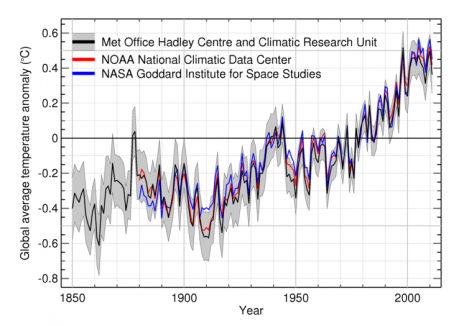
“However, what is absolutely clear is that we have continued to see a trend of warming, with the decade of 2000-2009 being clearly the warmest in the instrumental record going back to 1850. Depending on which temperature records you use, 2010 was the warmest year on record for NOAA NCDC and NASA GISS, and the second warmest on record in HadCRUT3.”
Global average temperatures from 1850 to 2011 from the three individual global temperature datasets (Met Office/UEA HadCRUT3, NASA GISS and NOAA NCDC)
Furthermore despite criticism of a paper published by the Met Office he chose not to ask us to respond to his misconceptions. The study in question, supported by many others, provides an insight into the sensitivity of our climate to changes in the output of the sun.
It confirmed that although solar output is likely to reduce over the next 90 years this will not substantially delay expected increases in global temperatures caused by greenhouse gases. The study found that the expected decrease in solar activity would only most likely cause a reduction in global temperatures of 0.08 °C. This compares to an expected warming of about 2.5 °C over the same period due to greenhouse gases (according to the IPCC’s B2 scenario for greenhouse gas emissions that does not involve efforts to mitigate emissions). In addition the study also showed that if solar output reduced below that seen in the Maunder Minimum – a period between 1645 and 1715 when solar activity was at its lowest observed level – the global temperature reduction would be 0.13C.
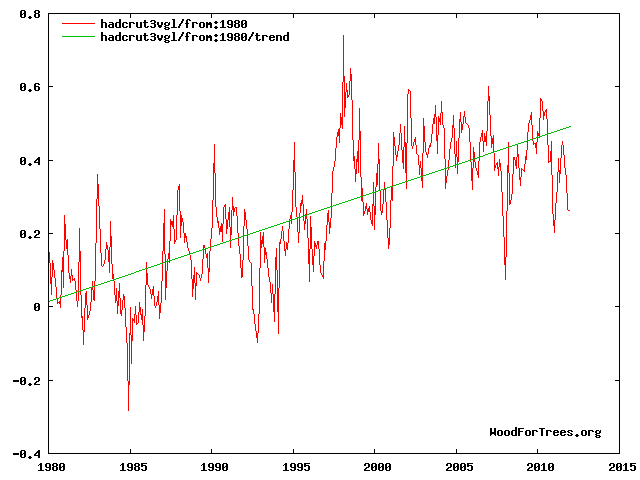
Back to that response from chrisd3. He offered this, “Finally, here is a chart of global temps from HadCRU.” Here is that chart, remember we are looking at Global temperatures.
Global temperature trend
OK, between this Post and my Post last Friday, you probably get the message! There were many other contributions and I could go on and on quoting the great responses I got, all of them uniformly saying there IS global warming unprecedented in recent years. The message is crystal clear and those who wish to deny the evidence … well, I can’t come up with a polite term, so will just leave it at that!
My final contribution is from Martin Lack, author of the Blog Lack of Environment, and a good friend of Learning from Dogs. Here is what he wrote in a recent email,
When I eventually saw your earlier comment, I was surprised and disappointed in equal measure because I almost feel that I have failed in some way. Let me explain: Unlike ClimateSight and SkepticalScience, which both do an excellent job of focusing on the science of climate change, my blog is deliberately focused on the politics underlying the denial of all environmental our problems; including 2 key aspects to my MA dissertation, namely the political misuse of scepticism; and the psychology of denial. See my How to be a Climate Change ‘Sceptic’ for more detail.
Therefore, although not specifically categorised as such, just about everything I have posted is traceable back to Paul and Anne Ehrlich’sBetrayal of Science and Reason (1996) and/or Naomi Oreskes and Erik Conway’s Merchants of Doubt (2010). For someone who does not currently go to any Church, I am remarkably fond of quoting Scripture so, if necessary, please forgive me but, as the Good Book says: “What has been will be again, what has been done will be done again; there is nothing new under the sun” (Ecclesiastes 1:9).
Therefore, I do not think you should be surprised by the amount of misinformation and misrepresentation contained in the original WSJ Sixteen’s article; and/or the fact that denialist arguments are repeated no matter how many times they have been shown to be false. Furthermore, I would warn against trying to summarise it all on Learning from Dogs. This is definitely Book territory and, in addition to the two mentioned above, the market is already saturated by the likes of Climate Change Cover-up by James Hoggan and Climate Change Denial by Haydn Washington and John Cook.
With very best wishes for a fog-free future,
What to say to close these two Posts off? Frankly, it’s difficult to know how to pitch it. The science seems clear beyond reasonable doubt. But if you are reading this and disagree, then PLEASE offer the science to refute the conclusions presented here. I promise you that I will present it on Learning from Dogs.
So let me end with a simple photograph.
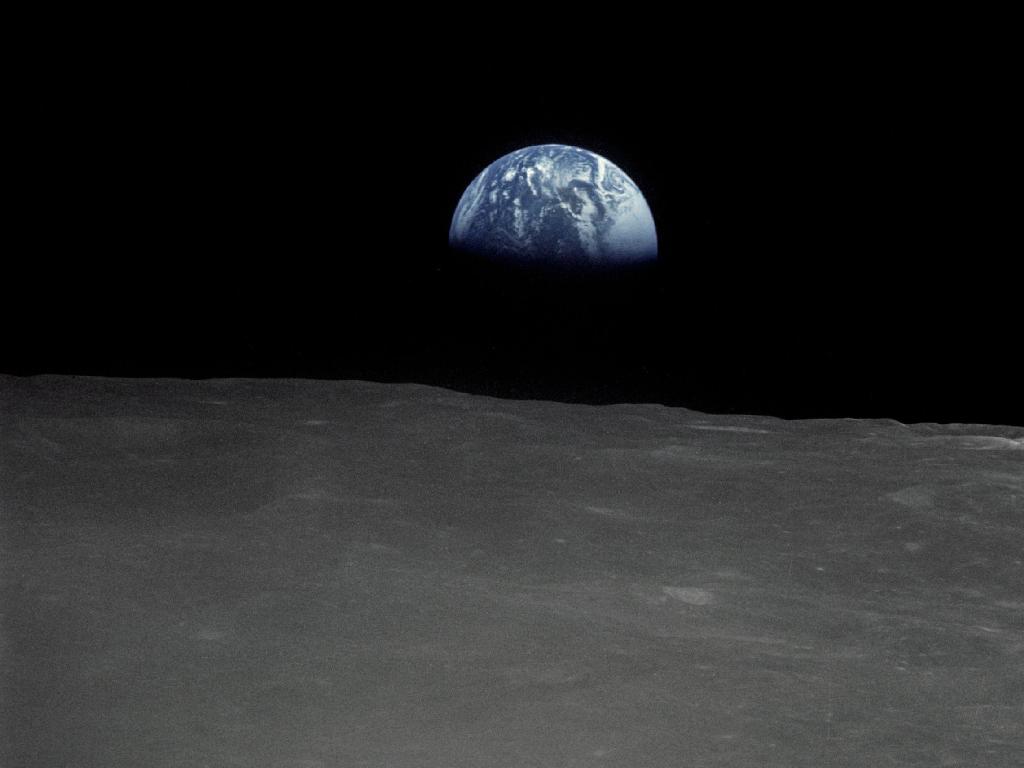
Earthrise
This is the photograph that wilderness photographer Galen Rowell called, “the most influential environmental photograph ever taken.”
The now world-famous photograph was taken by Astronaut William Anders from Apollo 8, the first manned mission to the Moon, a little over 43 years ago on December 24th, 1968.
As the Earth rose above the horizon of the moon, NASA astronaut Frank Borman uttered the words, “Oh my God! Look at that picture over there! Here’s the Earth coming up. Wow, is that pretty.” Bill Anders then took the ‘unscheduled’ photograph.
Now project forward 43 years to the year 2055 and play with the idea of what ‘pretty‘ planet Earth will be like for mankind and so many other species, including our longest companion, the dog, if we don’t get our act together pretty soon!
I’m at my PC thinking about tomorrow’s post. It’s past 4pm and my creative juices are elsewhere! So out of curiosity I wondered what I had published a year ago, in early February 2012. To my amazement what was published was as fresh and relevant as if it had been published today. So that’s what I am doing. Republishing it along with the sequels on Tuesday and Wednesday.
oooOOOooo
Climate, truth and integrity, part one.
It ought to be straightforward, but the reality is different!
Those of you, dear readers, that have been following these ramblings and musings over the last 30 months, now amounting to more than 1,200 Posts [now 1,582, Ed.] , will hopefully have sensed that Learning from Dogs is much more than a blogsite about dogs! It is, as I say here, about truth, integrity, honesty and trust using dogs as a powerful metaphor for these essential qualities of a civilised society.
But perhaps there is no topic more challenging for people to determine the truth than the topic of man’s impact on the earth’s climate. I’m sure that millions intuitively sense that we are over-consuming ourselves to oblivion. That is where I come from. I am not a scientist, just a humble writer, and rely on quality sources of information and instinct to form my conclusions in this area. I am also deeply suspicious of the largely out-of-sight relationships between large corporations, big money and politics!
I have no doubt that there are other millions of people who do believe that mankind is changing our planet’s climate.
So when I saw this article in the Wall Street Journal, I was dumbstruck. Here’s the headline and opening paragraph,
No Need to Panic About Global Warming
There’s no compelling scientific argument for drastic action to ‘decarbonize’ the world’s economy.
Editor’s Note: The following has been signed by the 16 scientists listed at the end of the article:
A candidate for public office in any contemporary democracy may have to consider what, if anything, to do about “global warming.” Candidates should understand that the oft-repeated claim that nearly all scientists demand that something dramatic be done to stop global warming is not true. In fact, a large and growing number of distinguished scientists and engineers do not agree that drastic actions on global warming are needed.
The long article closes with this paragraph just ahead of the ‘signatures’ of the scientists.
Every candidate should support rational measures to protect and improve our environment, but it makes no sense at all to back expensive programs that divert resources from real needs and are based on alarming but untenable claims of “incontrovertible” evidence.
The supposed ‘consensus’ on man-made global warming is facing an inconvenient challenge after the release of new temperature data showing the planet has not warmed for the past 15 years.
The figures suggest that we could even be heading for a mini ice age to rival the 70-year temperature drop that saw frost fairs held on the Thames in the 17th Century.
Based on readings from more than 30,000 measuring stations, the data was issued last week without fanfare by the Met Office and the University of East Anglia Climatic Research Unit. It confirms that the rising trend in world temperatures ended in 1997.
I subscribe both to Climate Sight and Lack of Environment, although wish I spent more time thoroughly reading these fabulous sources of information. However, I did spot an article on Climate Sight that came out on the 31st January with the heading of How much is most? It opened thus,
A growing body of research is showing that humans are likely causing more than 100% of global warming: without our influences on the climate, the planet would actually be cooling slightly.
In 2007, the Intergovernmental Panel on Climate Change published its fourth assessment report, internationally regarded as the most credible summary of climate science to date. It concluded that “most of the observed increase in global average temperatures since the mid-20th century is very likely due to the observed increase in anthropogenic greenhouse gas concentrations”.
A clear question remains: How much is “most”? 51%? 75%? 99%? At the time that the IPCC report was written, the answer was unclear. However, a new frontier of climate research has emerged since, and scientists are working hard to quantify the answer to this question.
The timing was impeccable, so far as I was concerned. I posted a comment, “While in every way that I can think of, I support the premise of mankind affecting global climate, I would love to hear from someone who could reconcile the Post above with these recent items:” and then included the links to the WSJ and Daily Mail items.
Little did I realise what a response I would get. Just wonderful! I will offer some of them to you in this piece, but please do read all the comments offered on that Climate Sight post.
First up was Dana Nuccitelli. Dana is an environmental scientist at a private environmental consulting firm in the Sacramento, California area. He has a Bachelor’s Degree in astrophysics from the University of California at Berkeley, and a Master’s Degree in physics from the University of California at Davis. (Taken from here.) This is what he wrote,
How to reconcile the two? The folks who wrote those two articles you linked are misinformed and/or misinformers. I covered the first here (and) SkS will shortly have a post on the second as well, but I covered the solar cycle issue recently here.
Dana’s article in Skeptical Science, that first link, included this:
Nearly half of the list (at least 7 of 16) have received fossil fuel industry funding, and the list also includes an economist, a physician, a chemist, an aerospace engineer, and an astronaut/politician. These are apparently the best and brightest the climate denialists can come up with these days?
Claude Allegre, former director of the Institute for the Study of the Earth, University of Paris
J. Scott Armstrong, cofounder of the Journal of Forecasting and the International Journal of Forecasting;
Jan Breslow, head of the Laboratory of Biochemical Genetics and Metabolism, Rockefeller University;
Roger Cohen, fellow, American Physical Society;
Edward David, member, National Academy of Engineering and National Academy of Sciences;
William Happer, professor of physics, Princeton;
Michael Kelly, professor of technology, University of Cambridge, U.K.;
William Kininmonth, former head of climate research at the Australian Bureau of Meteorology;
Richard Lindzen, professor of atmospheric sciences, MIT;
James McGrath, professor of chemistry, Virginia Technical University;
Rodney Nichols, former president and CEO of the New York Academy of Sciences;
Burt Rutan, aerospace engineer, designer of Voyager and SpaceShipOne;
Harrison H. Schmitt, Apollo 17 astronaut and former U.S. senator;
Nir Shaviv, professor of astrophysics, Hebrew University, Jerusalem;
Henk Tennekes, former director, Royal Dutch Meteorological Service;
Antonio Zichichi, president of the World Federation of Scientists, Geneva.
RED – No climate science publications, member of at least one climate denialist group – GWPF (advisory board), George C. Marshall Institute (board of directors or roundtable speakers), Australian Climate Science Coalition (advisory panel), Heartland Institute (board of directors), and/or ExxonMobil
BLUE – Published climate science research
Orange – both a member of a climate denialist group and has published climate science research
Black – no climate science publications or climate denialist group membership
A lot of folks have asked me to debunk the recent anti-truthful Wall Street Journal article with the counterfactual headline, “No Need to Panic About Global Warming.” I’ll combine my debunking with the rapidly growing list of debunkings from scientists and others. And I’ll update this as new debunkings come in.
But the most amazing and telling evidence of the bias of the Wall Street Journalin this field is the fact that 255 members of the United States National Academy of Sciences wrote a comparable (but scientifically accurate) essay on the realities of climate change and on the need for improved and serious public debate around the issue, offered it to the Wall Street Journal, and were turned down. The National Academy of Sciences is the nation’s pre-eminent independent scientific organizations. Its members are among the most respected in the world in their fields. Yet the Journal wouldn’t publish this letter, from more than 15 times as many top scientists. Instead they chose to publish an error-filled and misleading piece on climate because some so-called experts aligned with their bias signed it. This may be good politics for them, but it is bad science and it is bad for the nation.
A tad more surprising is that 16 admittedly non-leading scientists would choose to soil their reputations by stringing together a collection of long-debunked falsehoods. What is surprising is that these falsehoods are more easily debunked than the typical disinformer clap-trap because they are so out-of-date!
This is a long, detailed and powerful response to that WSJ article. Do try and read it in full.
But that doesn’t stop serial disinformer David Rose of the UK’s Daily Mail from misleading the public — even after being slammed by top scientists in 2010 for falsely asserting “no global warming since 1995″ — see “Error-riddled articles and false statements destroy Daily Mail’s credibility.“ Rose has another willfully misleading piece, “Forget global warming – it’s Cycle 25 we need to worry about (and if NASA scientists are right the Thames will be freezing over again): Met Office releases new figures which show no warming in 15 years.”
OK, I think this is going to end up too long for one Post.
So let’s pause there and I will continue on Monday. [Tomorrow, Ed.]
A necessary diversion from my usual style of post.
Today, I am asking you to watch a film. A full-length film that is on YouTube. It will open your eyes and almost certainly confirm suspicions that you may have harboured about the long-term consequences of holding a microwave transmitter close to the brain; namely a cell phone or mobile phone.
Tomorrow, I will explore what we can do to reduce the risks that so many of us are exposed to.
So settle down as soon as you can and watch.
Published on Nov 27, 2012
(Full Film) RESONANCE ➜ This James Russell film is a Sensational Eye Opening Documentary that examines 60 years of scientific research! ➜ Join the FACEBOOK page http://goo.gl/yf4Qs
This spectacular documentary uncovers for the very first time the actual mechanisms by which mobile phone technology can cause cancer. And how every single one of us is reacting to the biggest change to the environment this planet has ever seen.
Two billion years ago life first arrived on this planet; a planet which was filled with a natural frequency. As life slowly evolved, it did so surrounded by this frequency and inevitably began tuning in.
By the time mankind arrived on earth an incredible relationship had been struck, a relationship that science is just beginning to comprehend.
Research is showing that being exposed to this frequency is absolutely integral to us. It controls our mental and physical health, it synchronizes our circadian rhythms, and it aids our immune system and improves our sense of wellbeing.
Not only are we surrounded by natural frequencies, our bodies are filled with them too. Our cells communicate using electro-magnetic frequencies. Our brain emits a constant stream of frequencies and our DNA delivers instructions, using frequency waves. Without them we couldn’t exist for more than a second.
This delicate balance has taken billions of years to perfect. But over the last 25 years the harmony has been disturbed and disturbed dramatically.
Mankind has submerged itself in an ocean of artificial frequencies. They are all around us filling the air and drowning out the earth’s natural resonance.
To the naked eye the planet appears to be the same. But at a cellular level it is the biggest change that life on earth has endured; the effects of which we are just starting to see and feel.
I must share the feelings of millions of others across the world when I admit to going through periods of quiet despair about where ‘modern man’ has got himself. (I don’t intend to be gender specific!)
It goes way beyond the disbelief at some of the things happening today; way beyond the anger that is generated by so many examples of greed and corruption. It goes to a point where I just want to snuggle down with Jean, curl up with the dogs and kiss the rest of the world good-bye!
The expression that comes to mind is the one about the last person to leave the planet please switch the lights off!
(As if to demonstrate how sensitive dogs are to the feelings of us humans, Cleo just came into the room where I am writing this and laid her head across my left thigh. I stroked her head and then she wandered back to our bed next door – I then took the following photograph)
So what’s feeding my feelings?
Well, as many of you know yesterday and Sunday had posts about saving the Ecuadorian Jaguar and the African Lion. In the case of the former, it’s:
The president of Ecuador claims to stand for indigenous rights and the environment, but he has just come up with a new plan to bring oil speculators in to 4 million hectares of jungle. (That’s 9.9 million acres in old money!)
In the case of the African Lion, it’s:
In the past fifty years, the African lion population declined by as much as 90%. Many of the lion prides that do exist today are so genetically weak from being small and isolated by international borders that they can’t promise a future for African lions ….. two thirds of the African lions killed by trophy hunters end up in the U.S. That’s thousands of lions!
Last Friday I wrote about how community living for wolves and dogs had given those species “group survival and well-being“ that we humans couldn’t even dream about.
I attended a lecture at Essex University Colchester last Wednesday on the plight of indigenous indians in Canada, specifically those in Labrador. The Canadian government has embarked on a scheme to disenfranchise the indians of all their land, wipe out all their rights forever, and place them in perpetual bondage. Underlying this horror was what has happened to the indians themselves, a people tainted with mental illness, alcoholism and high suicide rates.
I asked the lecturer why it is that it appears all indigenous people across the globe share this common trait of high levels of abuse, mental illness, suicide and alcoholism. The answer given was that outsiders desired to force their alien world views upon these people destroying their sense of personal identity. For example many of these people see land as a shared resource, the capitalist ideas of land ownership is at odds with their world view. All Native American problem solving is through talking, and everyone has choice, whereas outsiders prefer to impose solutions and intellectualise with clever words.
Just read that last paragraph carefully again and note “outsiders desired to force their alien world views upon these people destroying their sense of personal identity.”
Back closer to home, the struggles of the North American Indians are well-known.
So no nice, neat solution to this place that I’m in just now other than to put down my pen and let the music from the following two videos wash over me.
If you read this far, thank you for suffering the ramblings of this silly old fart!
Please help save the Ecuadorian Jaguar and the Amazon jungle
Today’s article is a complete reposting of what appeared on Lack of Environment last Friday.
oooOOOooo
Please help save the Ecuadorian Jaguar and the Amazon jungle and stop Ecuador’s President from being a total hypocrite!
This courtesy of Avaaz:
———–
Dear friends,
There is one area of the Ecuadorian Amazon that is so pristine that the whole ecosystem has been preserved and even jaguars roam free! But the government is now threatening to go in and drill for oil.
The local indigenous people have been resisting, but they are afraid that oil companies will break up the community with bribes. When they heard that people across the world might stand with them and make a stink to save their land, they were thrilled. The president of Ecuador claims to stand for indigenous rights and the environment, but he has just come up with a new plan to bring oil speculators in to 4 million hectares of jungle. If we can say ‘wait a minute, you’re supposed to be the green president who says no one can buy Ecuador’, we could expose him for turning his back on his commitments just as he is fighting for re-election.
He doesn’t want a PR nightmare right now. If we get a million of us to help this one community defend their ancestral land and challenge the president openly to keep to his word, we could start a media storm that would make him reconsider the whole plan. Sign the petition now and tell everyone — let’s help save this beautiful forest:
After Texaco and other oil companies polluted Ecuadorian waters and irreversibly devastated precious ecosystems, Correa led his country to be the world’s first nation to recognize the rights of “Mother Earth” in its constitution. He announced Ecuador was not for sale, and in Yasuni National Park promoted an innovative initiative where other governments pay Ecuador to keep oil in the ground to protect the rainforest rather than destroy it. But now he’s on the verge of selling out.
Shockingly, the Sani Isla Kichwa land is partly in Yasuni National Park. But even more shocking is Correa’s bigger plan — in days government officials begin a world tour to offer foreign investors the right to drill across 4 million hectares of forest (an area larger than the Netherlands!) Ecuador, as any country, may argue it has the right to profit from its natural resources, but the constitution itself says it must respect indigenous rights and its amazing forests, which bring millions in tourist dollars every year.
Right now, Correa is in a tough fight to win a second term as president. It’s the perfect time to make him honour his environmental promises and make this green constitution come to life. Sign now to stand with the Kichwa people and save their forest:
Our community has fought year after year to protect the Amazon in Brazil and Bolivia, and won many victories standing in solidarity with indigenous communities. Now it’s Ecuador’s turn — let’s respond to this urgent call for action and save their forest.
With hope and determination,
Alex, Pedro, Alice, Laura, Marie, Ricken, Taylor, Morgan and all the Avaaz team
Dogs wouldn’t treat other members of their pack like this.
(I realise how the heading and the sub-heading don’t appear to have any correlation but stay with me please!)
It’s widely known, I’m sure, that the wolf, from which the wild dog and the domesticated dog evolved, lives in packs of around 50 animals. The size of the pack offers a cohesive, stable structure for the wolf, and other pack species, ensuring group survival and well-being. In a very real sense the way that wolves live is a fabulous example of the power of community.
My understanding of early hominids is pretty basic but if ‘Homo habilis‘ represents the evolution of modern man then our species goes back less than 3 million years.
The Dog linage began 37 million years ago in North America in predators that had distinctive pairs of shearing teeth and ran down prey. Early canids reached Europe seven million years ago.
Thirty-seven million years! Now that’s what I call an example of “group survival and well-being“. The power of community.
As stated elsewhere on this blog,
Dogs are part of the Canidae, a family including wolves, coyotes and foxes, thought to have evolved 60 million years ago. There is no hard evidence about when dogs and man came together but dogs were certainly around when man developed speech and set out from Africa, about 50,000 years ago. See an interesting article by Dr. George Johnson.
The ten dogs we have here at home are split into two groups of five. What we call the bedroom group: Pharaoh, Cleo, Sweeny, Hazel and Dhalia, and the kitchen group consisting of Lily, Casey, Ruby, Paloma and Loopy. Both groups are separated by wooden fences so are more than aware of each other.
Something that is clear is that whenever one of the dogs is hurt, all the other dogs take notice. Others in the same group will come up to their hurt ‘buddy’ and offer comfort in a variety of ways. Sadly, I can’t give you a better example than our poor Loopy who is suffering badly from the dog equivalent of dementia.
Here’s a picture taken of Loopy on Wednesday afternoon. You will notice the strange sleeping position that she frequently adopts. That’s an aspect of her dementia.
The other dogs in her group all give her special attention. Such as not grabbing her sleeping bed, not pushing or shoving near her, giving her a wide space in general. The other dogs sense there is something badly awry with Loopy and accommodate that.
So what on earth has this to do with yesterday’s post Who owns the World? Keep hanging in there!
A recent link in Naked Capitalism‘s daily news summary was to a story in the British Guardian newspaper. Written by the Guardian’s Kevin McKenna, it was about the likelihood of Scotland breaking away from the United Kingdom.
Scottish independence is fast becoming the only option
Even to a unionist like me, an Alex Salmond-led government is preferable to one that rewards greed and corruption
It’s an interesting article and I recommend you read it directly. But what jumped off the page at me were these paragraphs. Please focus deeply on the words and ponder on how foreign they are to the concept of community.
Yet we conveniently overlook the fact that London has already broken away from the United Kingdom and now exists as a world super-state governed by the greed of unhindered capitalism and recognisable as British only by its taxis and bad service. As the world’s most newly minted oligarchs continue to colonise the independent state of London, it becomes almost impossible for families on less than £250k to live decently there. Poor London families made homeless by the coalition benefit cuts are being evacuated as far north as Middlesbrough.
Last week, Goldman Sachs, one of the banks with its fingers in the till when global economic meltdown occurred, awarded an average bonus of £250,000 to each of its employees. The gap between the richest in our society and the poorest stretched a little more and we were reminded yet again that the UK government, despite its promises, allows greed, incompetence and corruption to be rewarded. (How many people do you think will go to jail for the Libor rate-fixing scandal?) Meanwhile, Westminster politicians are dividing the poor into categories marked “deserving” and “scum”.
Think a dog is just a cuddly animal that gives you a chance to do some dog-walking? Again, written elsewhere on Learning from Dogs.
value and cherish the ‘present’ in a way that humans can only dream of achieving
are, by eons of time, a more successful species than man.
Now compare that with the last sentence in Noam Chomsky’s essay from yesterday, “As long as the general population is passive, apathetic, diverted to consumerism or hatred of the vulnerable, then the powerful can do as they please, and those who survive will be left to contemplate the outcome.”
“Hatred of the vulnerable“; “those who survive will be left to contemplate the outcome” are not expressions that resonate with the values of loving communities. If we humans want “group survival and well-being” we had better learn from species lupus and canid. Pronto!
Powerful words from President Obama; now we the people must act.
I’m taking the liberty of reproducing in full the item that was published by Bill McKibben of 350.org yesterday. As I wrote on the 17th this year has to be the year that we make a difference, a call to every man, woman and child on the planet. This is a snippet from that post.
With these in mind, Doherty proposes a new grand strategic concept: “The United States must lead the global transition to sustainability.“
What a vision for the United States of America. That this Nation will be the most wonderful example of how man can learn, adapt and change.
Here’s what President Obama said about climate change during his address today:
With words like that, it’s easy to let ourselves dream that something major might be about to happen to fix the biggest problem the world has ever faced.
But we know that even if the President is sincere in every syllable, he’s going to need lots of backup to help him get his point across in a city dominated by fossil fuel interests. And, given the record of the last four years, we know that too often rhetoric has yielded little in the way of results.
That’s why we need you — very badly — to take a trip to our nation’s capital on Feb. 17th. We’ll gather on the National Mall, in what is shaping up to be be the largest environmental rally in many years.
Together we’ll send the message loud and clear: ‘If you’re serious about protecting future generations from climate change, stop the Keystone XL tar sands pipeline. If you can do that, Mr. President, we can all work together to help build a climate legacy that will be a credit to your critical eight years in office.’
Look — numbers count. If 20,000 of us show up on February 17th, it will be noticed. We need you in that number. The President may have given us an opening, but it’s up to us to go through it, and we need to do it together.
Thanks for all you’ve done to bring us this far, friends. Let’s keep it up — this is our chance.
Bill
oooOOOooo
Even if you are unable to be there in person on the 17th., do what you can to circulate this just as far and wide as possible.
Icebergs calved from Jakobshavn Glacier float to sea near Illulissat. This glacier dumps more ice into the global ocean than any other glacier in the Northern Hemisphere, and is thus Greenland’s single biggest contributor to the global sea level rise of one-eight inch per year. Photograph: James Balog/Extreme Ice Survey
When researching material for that article, I came across the official trailer for the film Chasing Ice. The fact that this film is being shown in cinemas and movie theaters across the world is highly relevant.
Because it demonstrates that there is a public appetite for such a film otherwise it would never had made it as a film project.
But not only that, read some of the reviews mentioned on the Chasing Ice website.
Jeff Orlowski’s documentary begins as a straightforward biographical profile, before shifting up into something more urgent, impassioned and compelling. Its subject, James Balog, is a photographer who goes to extremes to prove the existence of global warming: his latest expedition involves descending Arctic cliff faces to fit time-lapse cameras with which to monitor glacial erosion.
The review concludes, thus:
If any film can convert the climate-change sceptics, Chasing Ice would be it: here, seeing really is believing.
Jeff Orlowski’s first-rate documentary begins with complacently smug anti-global-warming clips from Fox News and from the owner of America’s weather channel. It then introduces the persuasive environmentalist James Balog, a celebrated photographer working for National Geographic, who became fascinated with what glaciers can teach us about our changing planet.
In 2007 he set up the Extreme Ice Survey (EIS), a well-funded project to monitor glaciers in Greenland, Iceland, Montana, the Alps, Canada and Bolivia, and the results – photographed using state-of-the-art time-lapse cameras – are sensational in their beauty, terror and the irrefutable evidence they provide of the rapidity with which age-old ice packs are melting away. It’s like watching our world disappear.
“Chasing Ice” aims to accomplish, with pictures, what all the hot air that has been generated on the subject of global warming hasn’t been able to do: make a difference.
The documentary by Jeff Orlowski follows nature photographer James Balog as he documents melting glaciers, beginning in 2007, in Alaska, Iceland, Greenland and Montana. Called the Extreme Ice Survey, the project works like this: Balog sets up still cameras that have been programmed to take a picture, once every hour, for three years, of the same glacier from a fixed spot.
Concluding:
“Chasing Ice” will make an impact, that’s for sure. Whether it can be said to have been effective remains to be seen. This portrait of a man on a mission moves us, not by showing us what we’ve already lost, but what’s still at stake.
My final dip into the review pot is from America Magazine – The National Catholic Review.
Anyone with a desire to preserve our planet has no choice but to see Chasing Ice, the gorgeous, inventive documentary released last month. As of this writing it has been shown to selected audiences but has yet to reach the popularity of a film like “An Inconvenient Truth.” Give it time, however, and hopefully further promotion, because it is truly revelatory. Produced by Paula DuPré Pesmen and Jerry Aronson and directed by Jeff Orlowski, the film is a unique pictorial about global warming, which left me impressed, thoughtful and sad.
Wil Lepkowski closes with these words,
Take the time to see “Chasing Ice,” even if it is not the type of film you would typically see. These are not typical times. We must begin to act. In the wake of a devastating hurricane on the East Coast of the United States, the United States may finally be taking steps to address climate change. Ordinary citizens must take on a greater role too. We cannot dwell on our sadness, but work to provide hope for our children, who will suffer the most if we continue to ignore the disaster on the horizon.
So you get the message!
Here’s that film trailer. And make a note to go to the website of the Extreme Ice Survey and ponder on what you can do to make a difference. That’s the broad ‘you’ by the way. The one that includes you and me and all those on this planet that want to make a difference.
Back on the 10th we had a few days of cold, overcast weather that brought temperatures down below freezing and some snow.
Here’s a scene looking towards the North-East corner of the property, taken just before 11 am.
Then a few days later, on the 14th, the sun was out while the temperatures remained below freezing. Shown clearly as the sunlight catches the frost on the tree.
A few minutes later I swung the camera to take a picture of Dancer munching away in the morning sunshine, just a day after we collected her and Grace.
The horses settled in quickly, adapting to the dogs who were very curious.
Grace and Cleo being nonchalant with each other.
Jean unable to get her fill of her new companions.
And in a very different vein, a sneak photograph taken of yours truly who had collapsed in front of the fire early evening last Friday, quickly becoming a cushion for Hazel.
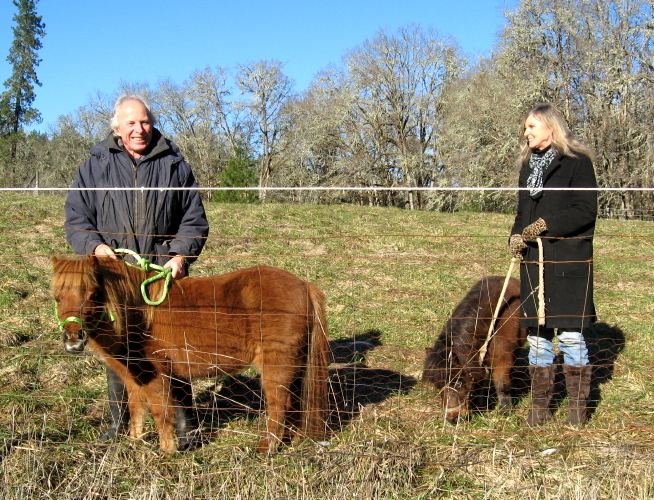
Today’s title came from a recent chat ‘across the garden fence’ with our neighbours, Dordie and Bill. At their request we had walked our two horses over to the fence-line between our two properties so Dordie and Bill could meet and fondle them. The warm afternoon sunshine was beautiful and while the horses munched the newly-found grass, we grown-ups talked about this and that and generally tried to put the world to rights!
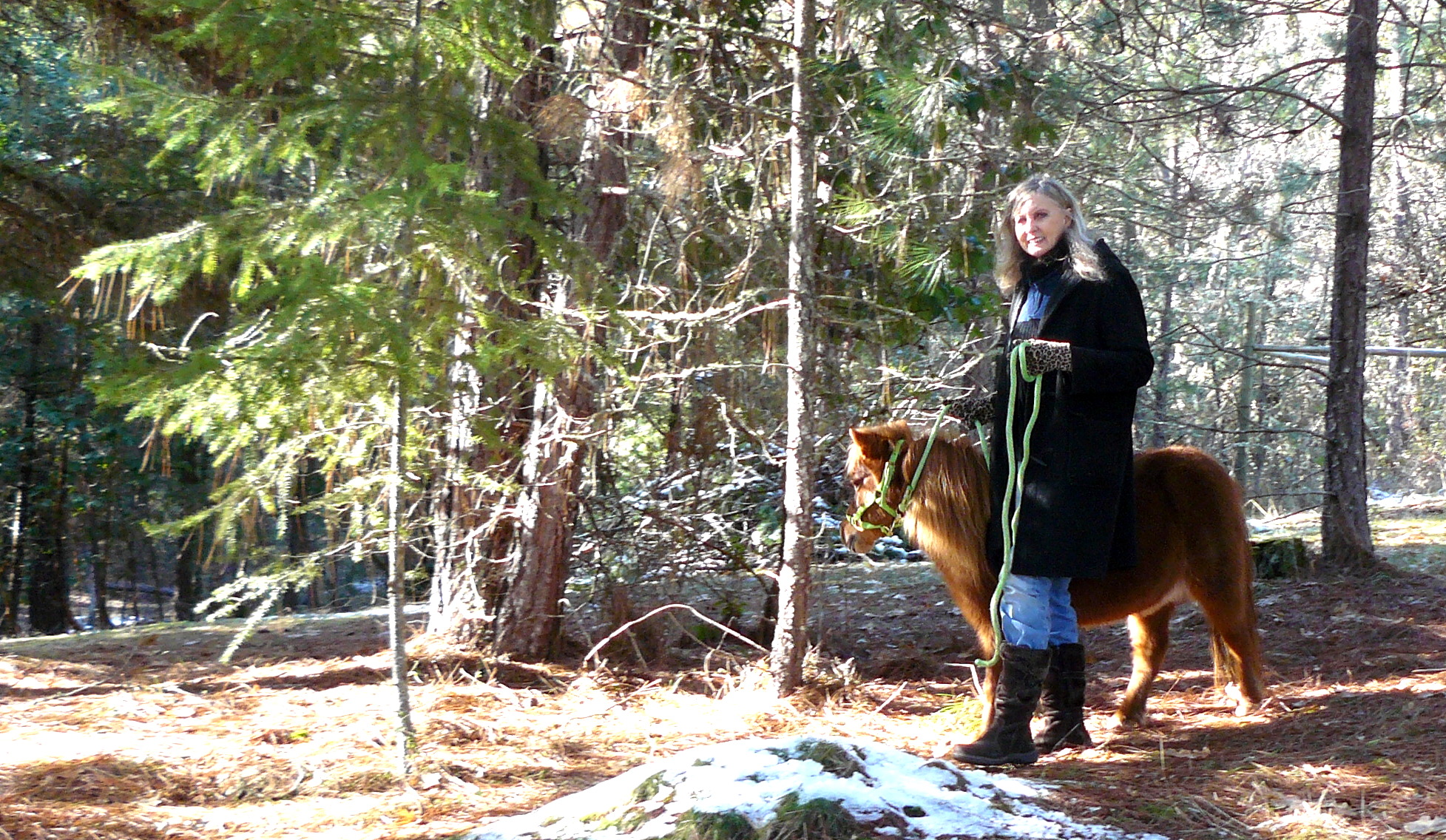
Paul with Dancer; Jean with Grace.
We talked about the strangeness of present times. Not just in the USA but across the world. Bill thought 2013 would be the year of separation. I queried what he meant by that.
Bill replied, “I sense that by the end of the year, the vast majority of people will have decided if climate change is or is not a significant issue.” There would be few who remained neither unconcerned nor undecided.
That resonated with me and neatly put the framework to today’s post. Stay with me while I journey to the destination that this year will be the year of hope.
I am one of many who subscribe to the online magazine Grist. They describe themselves, thus:
Laugh now — or the planet gets it.
You know how some people make lemonade out of lemons? At Grist, we’re making lemonade out of looming climate apocalypse.
It’s more fun than it sounds, trust us!
Grist has been dishing out environmental news and commentary with a wry twist since 1999 — which, to be frank, was way before most people cared about such things. Now that green is in every headline and on every store shelf (bamboo hair gel, anyone?), Grist is the one site you can count on to help you make sense of it all.
The weekly Grist digest that arrived in my in-box that same day as when we were chatting with Dordie and Bill included a number of key stories.
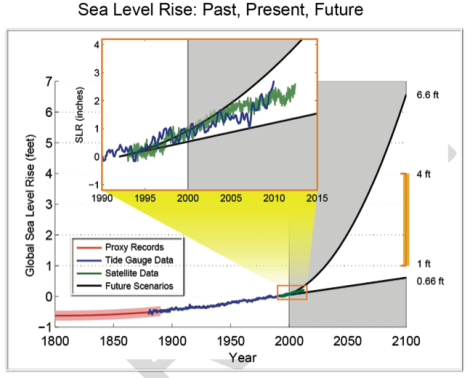
Now I’m not going to republish all 32 charts but will include just these two, because the message is clear.
It’s possible that sea levels could only rise eight inches. It is also possible that they could rise over six-and-a-half feet.
—-
Sea-level rise will affect different areas to different degrees — but note the map at lower right. On the Georgia coast, “hundred year” floods could happen annually.
OK, that first chart takes a while to absorb the full implications. The second one doesn’t!
The full range of charts is chilling. While they refer to the USA, the messages apply to the whole world.
Then in that same Grist weekly summary was this story.
If you aren’t alarmed about climate, you aren’t paying attention
There was recently another one of those (numbingly familiar) internet tizzies wherein someone trolls environmentalists for being “alarmist” and environmentalists get mad and the troll says “why are you being so defensive?” and everybody clicks, clicks, clicks.
I have no desire to dance that dismal do-si-do again. But it is worth noting that I find the notion of “alarmism” in regard to climate change almost surreal. I barely know what to make of it. So in the name of getting our bearings, let’s review a few things we know.
We know we’ve raised global average temperatures around 0.8 degrees C so far. We know that 2 degrees C is where most scientists predict catastrophic and irreversible impacts. And we know that we are currently on a trajectory that will push temperatures up 4 degrees or more by the end of the century.
David then works his way through those ‘things we know’ in a powerful manner. Do read the full article, please! This is his conclusion:
All this will add up to “large-scale displacement of populations and have adverse consequences for human security and economic and trade systems.” Given the uncertainties and long-tail risks involved, “there is no certainty that adaptation to a 4°C world is possible.” There’s a small but non-trivial chance of advanced civilization breaking down entirely.
Now ponder the fact that some scenarios show us going up to 6degrees by the end of the century, a level of devastation we have not studied and barely know how to conceive. Ponder the fact that somewhere along the line, though we don’t know exactly where, enough self-reinforcing feedback loops will be running to make climate change unstoppable and irreversible for centuries to come. That would mean handing our grandchildren and their grandchildren not only a burned, chaotic, denuded world, but a world that is inexorably more inhospitable with every passing decade.
Take all that in, sit with it for a while, and then tell me what it could mean to be an “alarmist” in this context. What level of alarm is adequate?
So am I stark staring mad for having hope in my mind? Stay with me for just a little longer. Then form your own judgment.
Recall the post that I published on Tuesday hitting out at the British newspaper The Daily Mail. Towards the end of that post, in discussing the recently released American National Climate Assessment, I wrote this:
That’s why this report is to be encouraged, nay embraced. Of all the nations in the world, the one that should be setting the lead is the United States of America. As the banner on that globalchange.gov website proclaims: Thirteen Agencies, One Vision: Empower the Nation with Global Change Science
So go and read the report. For your sake and all our sakes.
Because the more informed you and I are, the better the chances of real political leadership taking place in this fine nation.
Let’s just accept it: America’s current political and economic systems are incapable of responding adequately to climate change. As things stand, reducing carbon emissions — or more broadly, shifting to sustainability — is a kind of add-on, a second-tier consideration, bolted onto systems and institutions that were built for other purposes.
A little later, David writes:
So what would a new U.S. grand strategy built around sustainability look like? That’s the question tackled by “A New U.S. Grand Strategy,” a piece in Foreign Policy by Patrick Doherty, director of the Smart Strategy Initiative at the New America Foundation.
It’s a hugely ambitious and wide-ranging piece, far too much to even summarize adequately here. Bookmark it. Instapaper it. Pinterest it to your iCloud, or whatever kids do these days. But let’s take a quick look.
Doherty identifies four central challenges facing the U.S.:
Economic inclusion: People are swarming out of poverty around the world (especially in China). Over the next 20 years, the global middle class will welcome around 3 billion new members. That’s going to put intense stress on natural, economic, and political systems that are already showing signs of strain.
Ecosystem depletion: Pretty sure Grist readers are familiar with this one.
Contained depression: Rather than a recession, the U.S. faces a “constrained depression,” with the full effects of low aggregate demand and high debt being masked by policy. No amount of fiscal or economic stimulus will revive a system that has exhausted itself.
Resilience deficit: Our industrial supply lines and value chains are efficient, but lack redundancy; they are brittle. Our infrastructure is old and crumbling, $2.2 trillion in the hole, and that’s just for the aging Cold War stuff, never mind building water, power, and transportation systems suited to an era of climate disruption.
“These four challenges,” Doherty says, “are the four horsemen of the coming decades.” And they are inter-dependent. They must be solved together. It’s a rough situation.
With these in mind, Doherty proposes a new grand strategic concept: “The United States must lead the global transition to sustainability.“
What a vision for the United States of America. That this Nation will be the most wonderful example of how man can learn, adapt and change. David Roberts concludes:
Here are Doherty’s main suggestions for how to realign the U.S. economic engine:
Walkable communities: More and more Americans want to live in dense, walkable areas; get rid of regulations that hamper them and start building them.
Regenerative agriculture: Farmers can produce “up to three times the profits per acre and 30 percent higher yields during drought” with agricultural techniques that also clean water and restore soils. America must “adopt modern methods that will bring more land into cultivation, keep families on the land, and build regional food systems that keep more money circulating in local economies.”
Resource productivity: “Energy and resource intensity per person will have to drop dramatically.” That imperative can drive “innovation in material sciences, engineering, advanced manufacturing, and energy production, distribution, and consumption.”
Excess liquidity: Channel all the corporate cash that’s sitting around in funds into long-term investments in America by taxing waste and creating regional growth strategies.
Stranded hydrocarbon assets: Figure out how to devalue the immense amount of carbon that’s still sitting underneath the ground without unduly traumatizing the economy.
Obviously the devil is in the details on this stuff, but at a broad level, this is about as eloquent and forward-thinking as it gets. I love the idea of using sustainability in a muscular way, to revive regional economies and nurture the middle class. I recommend reading the whole thing.
I, too, recommend reading “A New U.S. Grand Strategy – Why walkable communities, sustainable economics, and multilateral diplomacy are the future of American power.” (NB: You will have to register with Foreign Policy before access to the report is possible, but it’s free.)
So, the wall-to-wall stream of information that is shouting out how quickly the planet is changing is the fuel that is going to feed the fires of hope.
Let me leave you with the most beautiful words of an ancient philosopher – Aristotle.





 Learning from Dogs