A very Happy New Year to you and all your loved ones!
Yesterday (I’m tempted to write last year!), I posted a little tale about the donkey in the well; essentially a message about being happy.
My original plan for today was to post a series of photographs of some animals next door that our neighbours, Larry and Janell, have recently adopted.
But then Jean and I watched a documentary two evenings ago that had us both spellbound. The documentary, Awakening the Dreamer, consisted of two 45-minute films. The first highlighting the precarious nature of our present times. The second showing the accelerating pace of people all across the world actively changing things for the better. Hence the title of the post The Pain and the Hope.
So here’s Part One. I do so hope you can find the time to watch it.
Some seven days ago, there was an item on Permaculture News about Steve Marsh’s fight with Monsanto. Here is that article in full. I strongly recommend watching the longer video at the end of the post. It’s an incredibly important issue for all lovers of healthy food.
You might not have heard of Steve Marsh yet but this man could lose everything to protect your right to eat GM-free food.
Who is Steve Marsh?
Steve Marsh is an Australian farmer who lost his organic certification when Monsanto’s genetically modified (GM) canola blew onto his farm from a neighbouring property in 2010. Since then, Steve lost most of his income and has been struggling to get his organic certification back.
Monsanto has a no liability agreement with GM farmers that prevent them from being sued. The only avenue Steve had to protect his livelihood was to take his neighbour to court. It is due to start on the 10th February 2014 in the Western Australian Supreme Court and is scheduled to run for three weeks.
This is the world’s first case of an organic farmer using the courts to recover loss and damages from a GM farmer. This case has been described as a landmark case to determine who should take responsibility in case of GM contamination. If Steve wins it will set a precedent to guide the application of common law to GM contamination and will be of interest to lawmakers worldwide.
We don’t want to be part of the global GM experiment underway with barely tested, unlabeled and uncontrolled GM foods infiltrating our food supplies. When people like Steve stand up for their rights in spite of what he may lose, it gives us a chance to stand alongside him.
Take action!
Steve’s neighbour is well supported and well funded by a pro-GM organization and we are helping to raise funds and awareness for Steve’s case.
Have a look at the short video above explaining his story and share it with friends, family and work colleagues. Please make a donation to support this landmark case and protect the future of GM-free food.
Confidence in what you and I can achieve is our salvation.
Yesterday, I wrote about just a few of the things going on in our world that have the power to destroy us. Destroy us in the sense of making us feel powerless, irrelevant and insignificant. Trust me, there were plenty more examples that I could have mentioned.
But so what!
The vast majority of the humans on this planet have control over what they think. Untold numbers of those self-same people have control over what they do with their lives.
Take Dr Peter Pratje. I suspect that you, as with me, hadn’t heard of Dr Pratje before. But he is a Project leader with the Frankfurt Zoological Society and he holds an MSc in Biology and a PhD in Conservation biology. This may be learned not from the website of that Frankfurt Society but from the website of the Orangutan project. Bet you hadn’t heard of that project either. The Orangutan Project (TOP) is described:
The Orangutan Project (TOP) is the world’s foremost not-for-profit organisation, supporting orangutan conservation, rainforest protection, local community partnerships and the rehabilitation and reintroduction of displaced orangutans back to the wild, in order to save the two orangutan species from extinction.
Back to the good Doctor. This is what he says, “What we do for orangutans, we do for ourselves.”
Now settle down for a tad less than twelve minutes and see the power of self, see what we can do for ourselves.
Published on Dec 4, 2013
Peter Pratje, of the Frankfurt Zoological Society, introduces us to our orangutan family and reveals how we, as individuals, can help prevent their imminent extinction.
The eleven minutes long video accompanies Peter Pratje and his team working with young orangutans at the jungle school. The apes have been confiscated after illegally being held as pets. In daily training sessions they now learn the survival skills they need for a life of freedom – how to climb trees, build nests, find food and generally behave like wild orangutans. The project aim is to re-introduce the great apes into the Bukit Tigapuluh national park in central Sumatra.
Taking matters into their own hands, the young orangutans were most supportive – snatching the small and robust cameras and filming themselves climbing up and down trees.
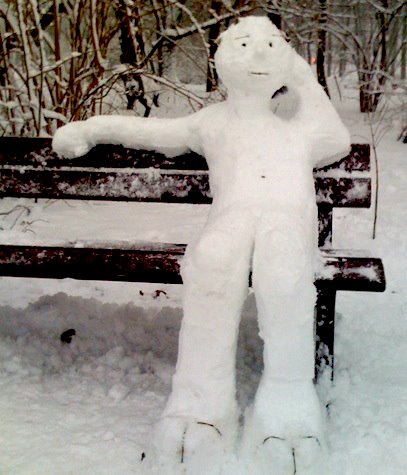
Last Sunday I published a set of pictures from Dan Gomez showing a wonderful collection of clever things you can do with snow. The post closed with a weather warning that Oregon was set to experience some wintery weather before the week was out.
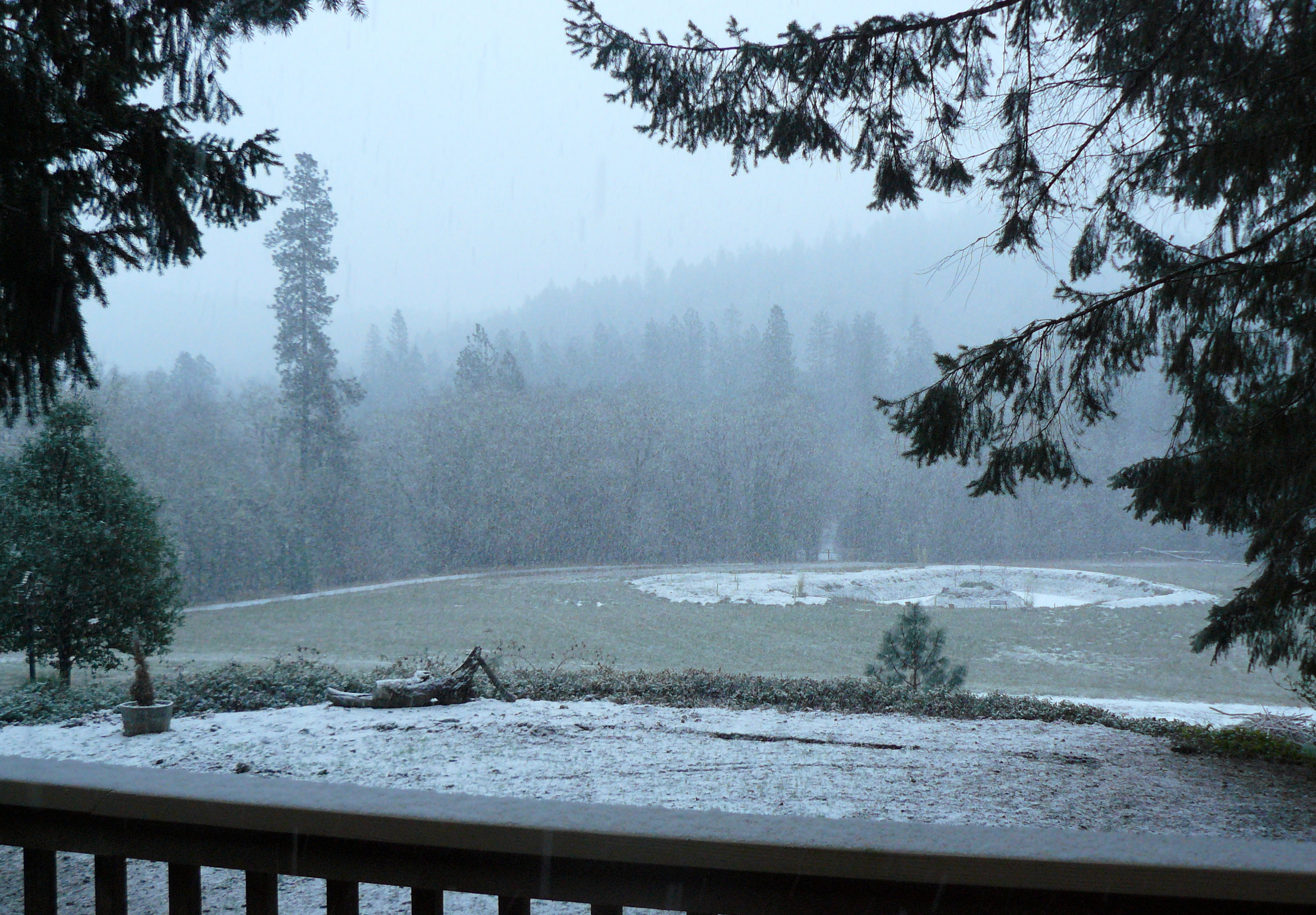
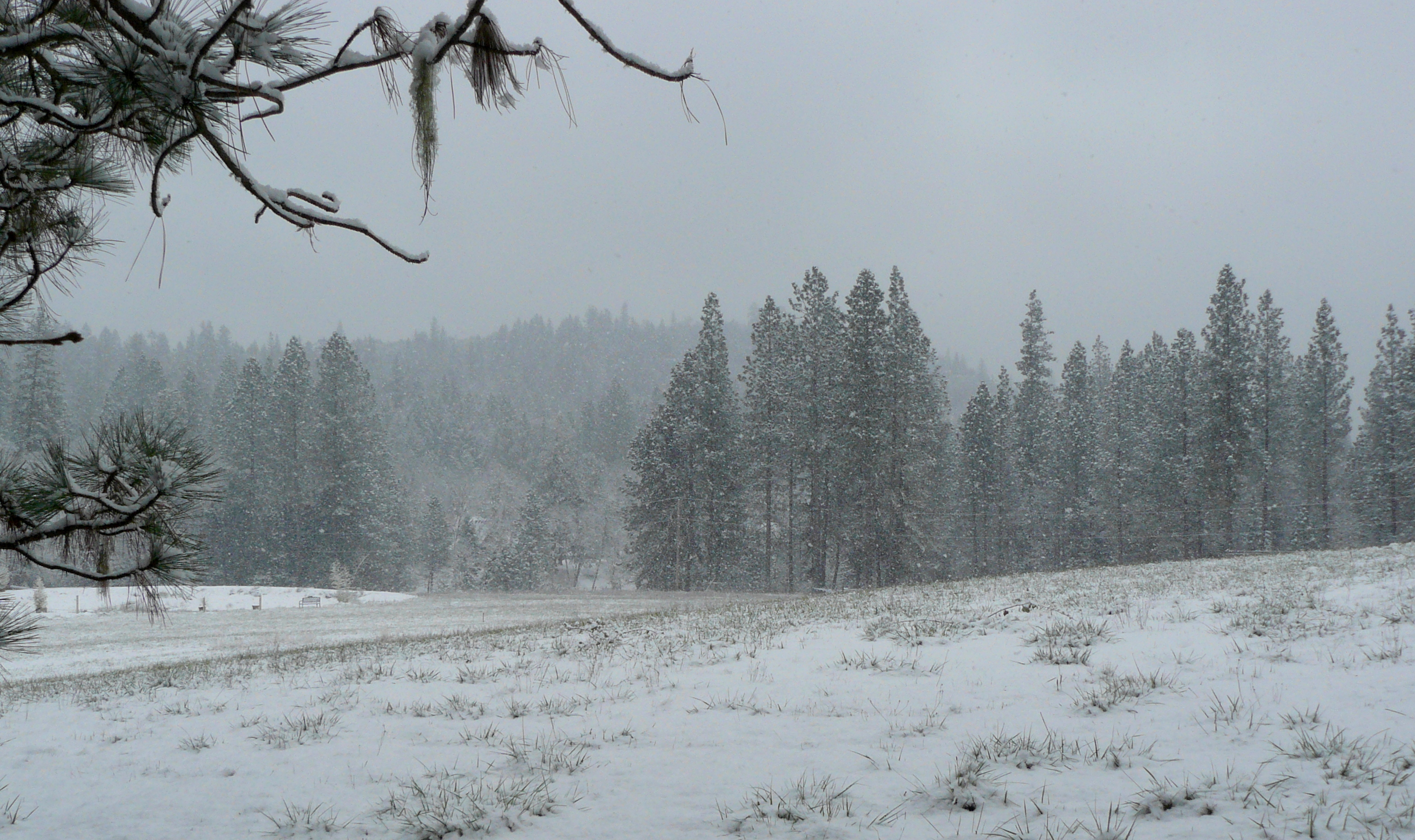
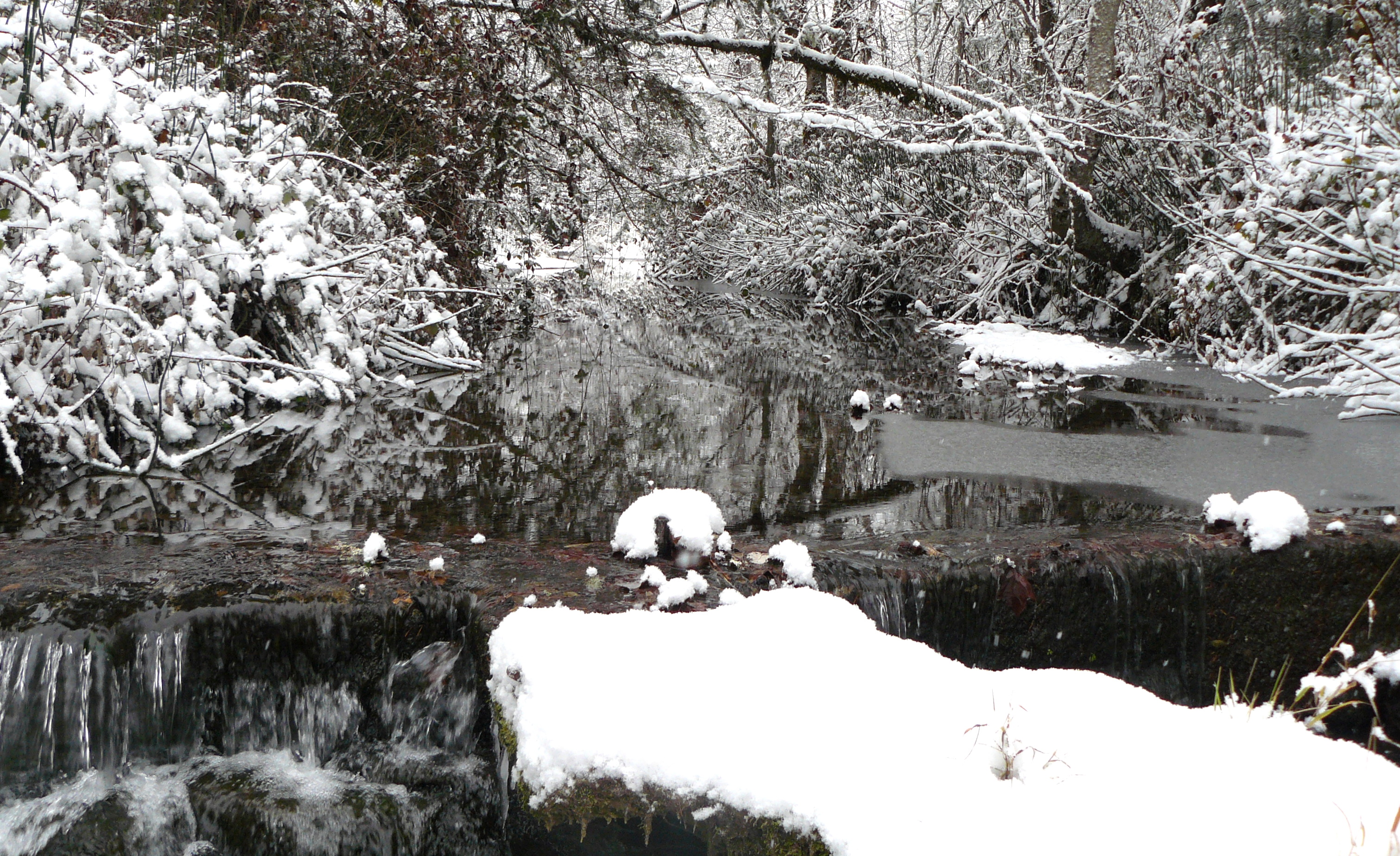
Thus a small collection of photographs taken on our property last Friday afternoon offering proof that the snows did arrive.
Snow just starting. Last Friday around 7am
oooo
Again, taken at 7am.
oooo
Looking down the driveway at 3pm last Friday.
oooo
Looking across to the South-East.
oooo
Nature’s colours.
oooo
Bummer Creek, looking downstream.
oooo
Bummer Creek, looking upstream from just above the flood irrigation dam.
oooo
Water flowing over the edge of the dam.
oooo
Merry Christmas from the BLM.
Finally, the picture above represents a delightful way to find your Christmas Tree, or Noble Fir in tree speak! We discovered that if one goes to the local office of the Bureau of Land Management (BLM) you can purchase a $5 permit allowing one to go into the forests and cut your own Christmas Tree. The red permit can be seen in the above photograph attached near the top of the tree. So last Thursday we took our Jeep filled to the brim with blankets, spades and tow chains and other paraphernalia to allow us to safely drive some miles into the forest and 2 hours later had our tree.
oooo
Wherever you are in the world, you stay warm and dry this Winter.
Just fancied a change from two days of Democratic Deficit. So today’s post is a brief overview of the US State that Jean and I live in, together with our animals, the State of Oregon.
Now it’s easy to look up a Wikipedia reference to Oregon but what really caught my eye was as a result of a recent visit to the local Grants Pass office of the Bureau of Land Management. We had gone there to purchase a $5 permit that allows us to go on to BLM land and harvest our own Christmas Tree!
In the Grants Pass office were a number of brochures of scenic attractions in Oregon and we picked up one describing the Rogue-Umpqua National Scenic Byway. Just a quick browse reminded us of Oregon’s stunning and dramatic scenery. Just wanted to share some images.
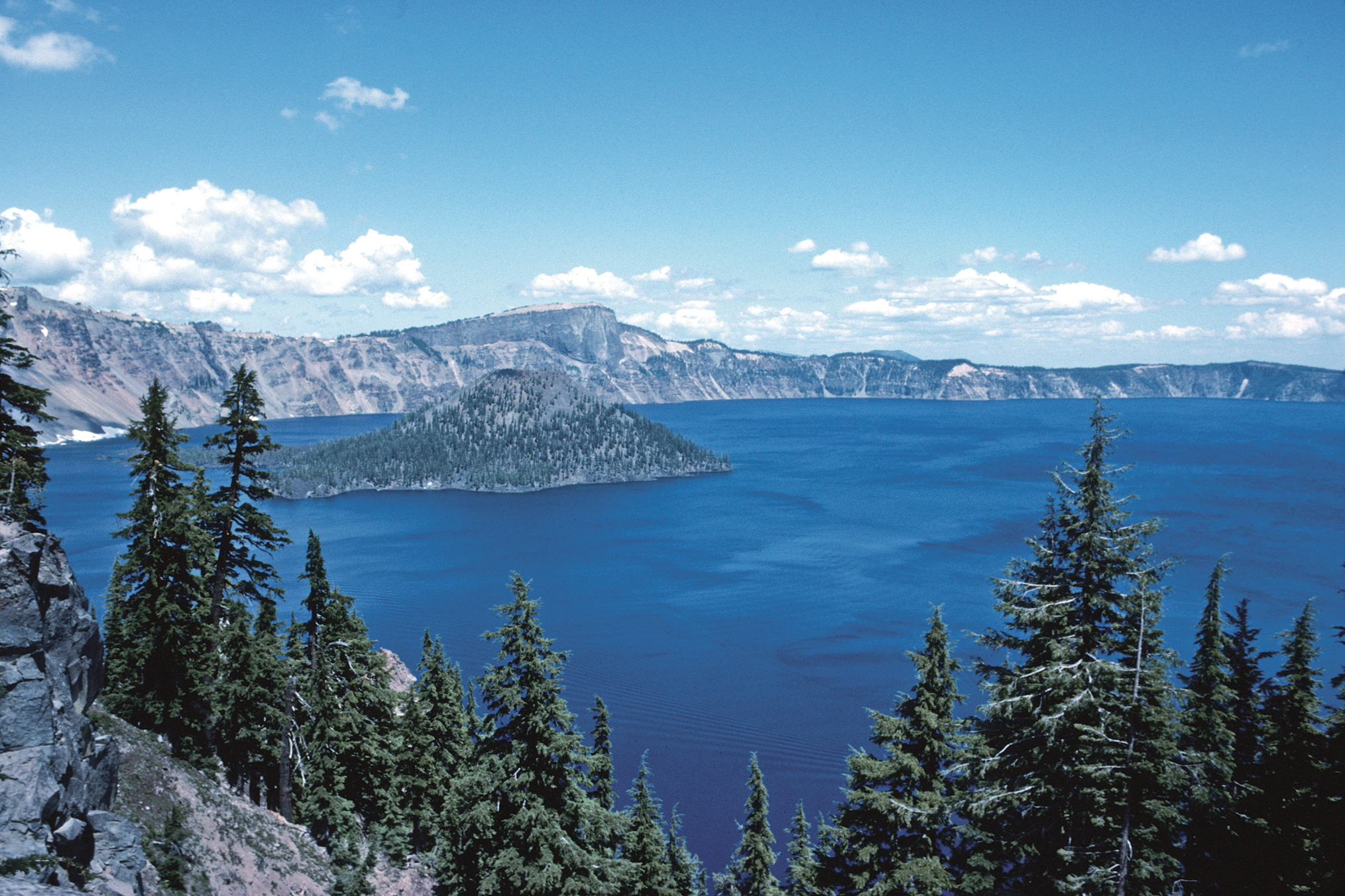
At a depth of 1,932 feet Crater Lake is the deepest lake in the United States. It was formed more than 7,500 years ago when the Mount Mazama volcano erupted and then collapsed back in on itself.
The lake partly fills a nearly 2,148-foot (655 m)-deep caldera[1] that was formed around 7,700 (± 150) years ago[2] by the collapse of the volcano Mount Mazama. Human interaction is traceable back to the indigenousNative Americans witnessing the eruption of Mount Mazama. There are no rivers flowing into or out of the lake; the evaporation is compensated for by rain and snowfall at a rate such that the total amount of water is replaced every 250 years. At 1,943 feet (592 m), the lake is the deepest in the United States, and the seventh[3] or ninth deepest in the world, depending on whether average or maximum depth is measured.[4]
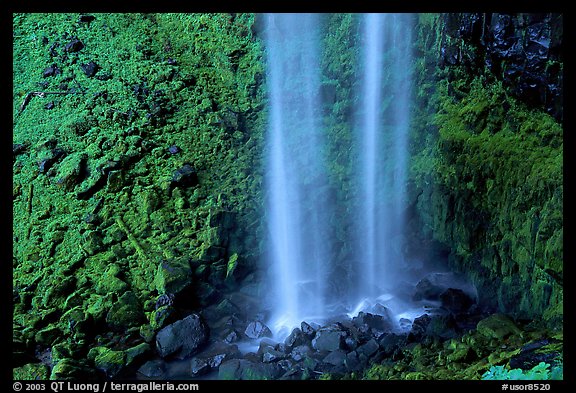
Watson Falls is the third highest waterfall in Oregon at 272 feet. It is the most beautiful waterfall along the North Umpqua River Valley. You will cross a wooden bridge below the falls that will put you right into the lower rapids with an amazing view of the falls as they roar over the basalt lava cliffs ahead.
Someone who goes under the handle of HikingTheWest posted this video on YouTube about 6 weeks ago.
Oregon Caves
These caves are an Oregon National Monument with full details on the US National Park Service’s website. That website explains:
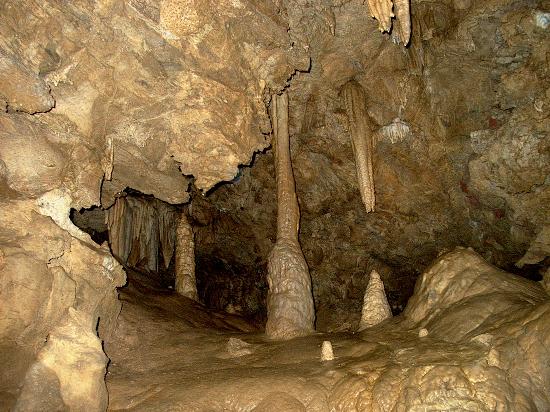
Nestled deep inside the Siskiyou Mountains, the caves formed as rainwater from the ancient forest above dissolved the surrounding marble and created one of the world’s few marble caves. The highly complex geology found on the Monument contributes to the unusual and rare plants and animals found nowhere else but here.
A view of the inside of the caves.
There are many good videos of the Oregon Caves on YouTube so do have a browse if you want to. This one caught my eye, especially as it was filmed in January, 2013..
Rogue River
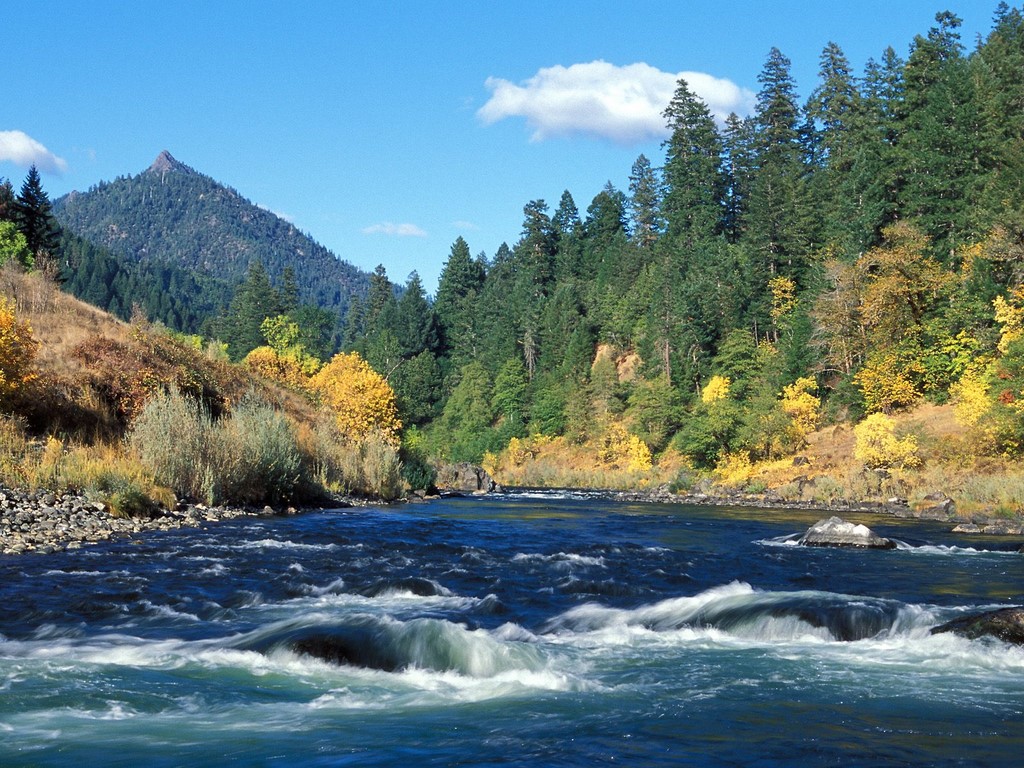
The Rogue River
Final sight for today, the Rogue River runs close by Grants Pass, our nearest town to where we live. Again there is a Wikipedia entry from which one learns that, “Although the Rogue Valley near Medford is partly urban, the average population density of the Rogue watershed is only about five people per square mile (12 per km2).”
Just reflecting on that last paragraph, a simple calculation reveals that the State of Oregon has a population of around 3.9 million people with an land area of 98,300 square miles. Thus the population density of Oregon is 39.6 persons per square mile. To put that into perspective, our neighbouring Californians to the South enjoy a population density of 238 persons per square mile!
Jean and I are very lucky to be living in such a beautiful part of Southern Oregon.
Coincidentally, rather timely with what is most definitely not a delightful weather warning for next week. As in the latest Special Weather Statement from the National Weather Service (NWS). Note we are living in Josephine County, just a few miles from Grants Pass:
Special Weather Statement
SPECIAL WEATHER STATEMENT…CORRECTED
NATIONAL WEATHER SERVICE MEDFORD OR
404 PM PST SAT NOV 30 2013
ORZ023>026-020015-
CENTRAL DOUGLAS COUNTY-EASTERN CURRY COUNTY AND JOSEPHINE COUNTY-
EASTERN DOUGLAS COUNTY FOOTHILLS-JACKSON COUNTY-
INCLUDING THE CITIES OF…DRAIN…ELKTON…ROSEBURG…SUTHERLIN…
GREEN…MYRTLE CREEK…CANYONVILLE…GLENDALE…GRANTS PASS…
CAVE JUNCTION…STEAMBOAT…TOKETEE FALLS…MEDFORD…ASHLAND
404 PM PST SAT NOV 30 2013
…VERY COLD WEATHER THIS WEEK WITH LIGHT SNOW POSSIBLE IN THE VALLEYS…
A STRONG COLD FRONT WILL MOVE THROUGH THE REGION ON MONDAY.
PRECIPITATION IS EXPECTED TO BE RAIN IN THE VALLEYS THROUGH MONDAY
AFTERNOON, HOWEVER BY MONDAY NIGHT AND TUESDAY IT WILL BE COLD
ENOUGH THAT SNOW MAY FALL ALL THE WAY TO THE VALLEY FLOORS.
THE AIRMASS WILL THEN DRY OUT AND BECOME VERY COLD TUESDAY NIGHT
THROUGH THE REST OF THE WEEK. LOW TEMPERATURES WILL BE WELL DOWN
INTO THE 20S OVER SOUTHWEST OREGON VALLEYS WITH HIGHS IN THE LOW
TO MID 30S. THURSDAY MORNING IS EXPECTED TO THE BE THE COLDEST
TIME WHEN LOWS IN THE MID TO UPPER TEENS ARE POSSIBLE.
IT IS CERTAIN THAT VERY COLD WEATHER IS COMING TO SOUTHWEST
OREGON THIS WEEK. CONFIDENCE IN SNOWFALL IS LOWER, BUT RESIDENTS
AND TRAVELERS SHOULD ALSO BE PREPARED FOR THE POSSIBILITY OF
LIGHT SNOW EARLY TUESDAY WHICH COULD IMPACT TRAVEL.
STAY TUNED TO THE NATIONAL WEATHER SERVICE FOR UPDATED FORECASTS
AS THIS STORM SYSTEM APPROACHES.
$$
Our local Grants Pass Weather website is predicting a low around 20 for Wednesday Night. (-5 deg C.) B’rrrr!
Yesterday’s post here on Learning from Dogs looked at the utter insanity, the greed, the short-sightedness of extracting oil in greater and more varied ways; as if the future for all of life on this planet just didn’t matter. I guess the truth is that for those who stand to benefit from this wealth, the future of the planet just doesn’t matter.
Revealing the obvious!
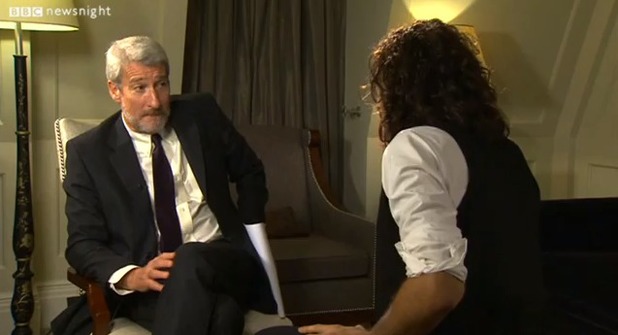
The recent interview on BBC Newsnight by Jeremy Paxman of British comedian Russell Brand has gone viral. At the time of writing this post, YouTube report 7,661,280 viewings! It’s not surprising because what Russell Brand is saying is obvious to millions of people all around the world. What Brand is expressing is as clear as a lone, lighted beacon at midnight on the darkest Winter night one could imagine.
During his Wednesday night interview with Jeremy Paxman on BBC Newsnight, comedian and actor Russell Brand said what no politician or pundit would ever dare say: that without dramatic, fundamental change, the prevailing political and economic system is broken, and hell-bent on planetary-level destruction:
With Dr Ahmed, the author of that Guardian article, concluding:
And in doing so, we might begin to realise that it is precisely the lack of a single, top-down manifesto that is our greatest strength – because, unlike the old, dying, fossil fuel dependent paradigm of endless growth for its own sake for the corporate few, the new, emerging post-carbon paradigm will be co-created by people themselves from the ground up.
That is why Brand’s answer for the way forward is so compelling:
“We shouldn’t destroy the planet. We shouldn’t create massive economic disparity. We shouldn’t ignore the needs of the people.”
If we want our children to inherit a habitable planet, rather than bashing Brand for not having a more coherent solution, we need to start being part of it.
You know what! The incredible response to that Paxman-Brand interview shows the millions of us who are already “part of it.” Yes, it really does feel that the time is now. That time that so very many of us, in a myriad of different ways, are fighting for our beautiful planet from the ground up.
Finally, if you want to read that interview between Paxman and Brand in detail, then over on Corrente there is a full transcript of the exchange between them.
Long may this run!
Passion for speaking the truth about our present times!
It’s really terribly easy – we just have to leave the oil in the ground!
The current issue of The Economist has an article on page 43, under The Americas section, headed Cheap at the price.
It’s a review of the biggest oil auction this year.
A single bid for a vast field shows the weakness of Brazil’s state-led approach to developing its oil reserves
SIX years after discovering giant offshore“pré-sal” oil deposits, so called because they lie beneath a thick layer of salt under the ocean bed, Brazil has finally auctioned the rights to develop some of its deeply buried wealth. On October 21st the Libra field, off Rio de Janeiro’s coast (see map), was sold to a consortium led by Petrobras, Brazil’s state-controlled oil firm, and including France’s Total, Anglo-Dutch Shell and China’s state-owned CNOOC and CNPC. Libra’s estimated 8 billion-12 billion barrels of recoverable oil make it the biggest oil prospect in the world to be auctioned this year. Once it reaches peak production, sometime in the next decade, it should increase Brazil’s output from 2.1m to about 3.5m barrels per day.
The article was critical of the way Brazil managed the auction resulting in just one consortium bidding, against the expectation there would be strong competition for the oil from possibly 40 companies despite the huge costs in extracting it from over 6,000 metres (nearly 20,000 feet) below sea-level. The article didn’t even hint at the madness of even thinking it should be extracted but I guess that’s The Economist for you.
So with that in mind, let me turn to a recent essay from TomDispatch by world-renown climate-change activist Bill McKibben. As regular readers will be aware Tom Engelhardt of the TomDispatch blog has given blanket permission for TD essays to be republished here on Learning from Dogs.
oooOOOooo
Tomgram: Bill McKibben, Can Obama Ever Stand Up to the Oil Industry?
Recently, “good” news about energy has been gushing out of North America, where a cheering crowd of pundits, energy experts, and government officials has been plugging the U.S. as the “Saudi Arabia” of the twenty-first century. You know, all that fracking and those luscious deposits of oil shale and gas shale just waiting to be pounded into shape to fill global gas tanks for an energy-rich future. And then, of course, just to the north there are those fabulous Canadian tar sands deposits whose extraction is reportedly turning parts of Alberta into an environmental desert. And that isn’t all.
From the melting Arctic, where the Russians and others are staking out energy claims, to the southernmost tip of South America, the dream of new energy wealth is being pursued with a fervor and avidity that is hard to take in. In distant Patagonia, an Argentinean government not previously known for its friendliness to foreign investment has just buddied up with Chevron to drill “around the clock in pursuit of a vast shale oil reservoir that might be the world’s next great oil field.” Huzzah and olé!
And can you even blame the Argentinean president for her choice? After all, who wants to be the country left out of the global rush for new energy wealth? Who wants to consider the common good of the planet, when your country’s finances may be at stake? (As with the Keystone XL pipeline protest movement here, so in Argentina, there actually are environmentalists and others who are thinking of the common good, but they’re up against the state, the police, and Chevron — no small thing.) All of this would, of course, be a wondrous story — a planet filled with energy reserves beyond anyone’s wildest dreams — were it not for the fact that such fossil fuel wealth, such good news, is also the nightmarish bad news of our lives, of perhaps the lifetime of humanity.
There is an obvious disconnect between what is widely known about climate change and the recent rush to extract “tough energy” from difficult environments; between the fires — and potential “mega-fire” — burning wildly across parts of overheated Australia and its newly elected government run by a conservative prime minister, essentially a climate denier, intent on getting rid of that country’s carbon tax. There is a disconnect between hailing the U.S. as the new Saudi Arabia and the recent report of the prestigious Intergovernmental Panel on Climate Change warning that fossil fuel reserves must be kept in the ground — or else. There is a disconnect between what our president says about climate change and the basic energy policies of his administration. There is a disconnect between what the burning of fossil fuels will do to our environment and the urge of just about every country on this planet to exploit whatever energy reserves are potentially available to it, no matter how “dirty,” no matter how environmentally destructive to extract.
Somewhere in that disconnect, the remarkable Bill McKibben, whose new book, Oil and Honey: The Education of an Unlikely Activist, is at the top of my personal reading list, has burrowed in and helped to create a global climate change movement. In this country, it’s significantly focused on the Keystone XL pipeline slated, if built, to bring tar sands oil from Canada to the Gulf Coast. For the last several years at TomDispatch, McKibben has kept us abreast of the most recent developments in that movement. Here is his latest report from the tar sands front. Tom
X-Ray of a Flagging Presidency Will Obama Block the Keystone Pipeline or Just Keep Bending?
By Bill McKibben
As the battle over the Keystone XL pipeline has worn on — and it’s now well over two years old — it’s illuminated the Obama presidency like no other issue. It offers the president not just a choice of policies, but a choice of friends, worldviews, styles. It’s become an X-ray for a flagging presidency. The stakes are sky-high, and not just for Obama. I’m writing these words from Pittsburgh, amid 7,000 enthusiastic and committed young people gathering to fight global warming, and my guess is that his choice will do much to determine how they see politics in this country.
Let us stipulate at the start that whether or not to build the pipeline is a decision with profound physical consequences. If he approves its construction, far more of the dirtiest oil on Earth will flow out of the tar sands of Alberta, Canada, and reach the U.S. Gulf Coast. Not just right away or for a brief period, but far into the future, since the Keystone XL guarantees a steady flow of profits to oil barons who have their hearts set on tripling production in the far north.
The history of oil spills and accidents offers a virtual guarantee that some of that oil will surely make its way into the fields and aquifers of the Great Plains as those tar sands flow south. The greater and more daunting assurance is this, however: everything that reaches the refineries on the Gulf Coast will, sooner or later, spill into the atmosphere in the form of carbon, driving climate change to new heights.
In June, President Obama said that the building of the full pipeline — on which he alone has the ultimate thumbs up or thumbs down — would be approved only if “it doesn’t significantly exacerbate the problem of carbon pollution.” By that standard, it’s as close to a no-brainer as you can get.
These days, however, as no one will be surprised to hear, brainless things happen in Washington more often than not, and there’s the usual parade of the usual suspects demanding that Keystone get built. In mid-October, a coalition that included Exxon, Chevron, ConocoPhillips, and Royal Dutch Shell, not to mention the U.S. Chamber of Commerce, the National Association of Manufacturers, and the Business Roundtable, sent Obama a letter demanding that he approve Keystone in order to “maintain investor confidence,” a phrase almost guaranteed to accompany bad ideas. A report last week showed that the Koch brothers stood to earn as much as $100 billion in profits if the pipeline gets built (which would come in handy in helping fund their endless assault on unions, poor people, and democracy).
But don’t think it’s just Republican bigwigs and oil execs rushing to lend the pipeline a hand. Transcanada, the pipeline’s prospective builder, is at work as well, and Obama’s former communications director Anita Dunn is now on the Transcanada dime, producing TV ads in support of the pipeline. It’s a classic example of the kind of influence peddling that knows no partisan bounds. As the activists at Credo put it: “It’s a betrayal of the commitments that so many of us worked so hard for, and that Dunn herself played a huge role in shaping as top strategist on the 2008 campaign and communications director in the White House.”
Credo’s Elijah Zarlin, who worked with Dunn back in 2008, wrote that attack on her. He was the guy who wrote all those emails that got so many of us coughing up money and volunteering time during Obama’s first run for the presidency, and he perfectly exemplifies those of us on the other side of this divide — the ones who actually believed Dunn in 2008, the ones who thought Obama was going to try to be a different kind of president.
On energy there’s been precious little sign of that. Yes, the Environmental Protection Agency has put in place some new power plant regulations, and cars are getting better mileage. But the president has also boasted again and again about his “all of the above” energy policy for “increasing domestic oil production and reducing our dependence on foreign oil.” It has, in fact, worked so well that the United States will overtake Russia this year as the biggest combined oil and natural gas producer on the planet and is expected to pass Saudi Arabia as the number one oil producer by 2017.
His administration has okayed oil drilling in the dangerous waters of the Arctic and has emerged as the biggest backer of fracking. Even though he boasts about marginal U.S. cuts in carbon emissions, his green light to fracking means that he’s probably given more of a boost to releases of methane— another dangerous greenhouse gas — than any man in history. And it’s not just the environment. At this point, given what we know about everything from drone warfare to NSA surveillance, the dream of a progressive Obama has, like so many dreams, faded away.
The president has a handy excuse, of course: a truly terrible Congress. And too often — with the noble exception of those who have been fighting for gay rights and immigration reform — he’s had little challenge from progressives. But in the case of Keystone, neither of those caveats apply: he gets to make the decision all by himself with no need to ask John Boehner for a thing, and people across the country have made a sustained din about it. Americans have sent record numbers of emails to senators and a record number of comments to the State Department officials who oversee a “review” of the pipeline’s environmental feasibility; more have gone to jail over this issue than any in decades. Yet month after month, there’s no presidential decision.
There are days, in fact, when it’s hard to muster much fire for the fight (though whenever I find my enthusiasm flagging, I think of the indigenous communities that have to live amid the Mordor that is now northern Alberta). The president, after all, has already allowed the construction of the southern half of the Keystone pipeline, letting Transcanada take land across Texas and Oklahoma for its project, and setting up the beleaguered communities of Port Arthur, Texas, for yet more fumes from refineries.
Stopping the northern half of that pipeline from being built certainly won’t halt global warming by itself. It will, however, slow the expansion of the extraction of tar sands, though the Koch brothers et al. are busy trying to find other pipeline routes and rail lines that would get the dirtiest of dirty energy out of Canada and into the U.S. via destinations from Michigan to Maine. These pipelines and rail corridors will need to be fought as well — indeed the fights are underway, though sometimes obscured by the focus on Keystone. And there are equally crucial battles over coal and gas from the Appalachians to the Pacific coast. You can argue that the president’s people have successfully diverted attention from their other environmental sins by keeping this argument alive long past the moment at which it should have been settled and a decision should have been made.
At this point, in fact, only the thought of those 900,000 extra barrels a day of especially nasty oil coming out of the ground and, via that pipeline, into refineries still makes the fight worthwhile. Oh, and the possibility that, in deciding to block Keystone, the president would finally signal a shift in policy that matters, finally acknowledge that we have to keep most of the carbon that’s still in the ground in that ground if we want our children and grandchildren to live on a planet worth inhabiting.
If the president were to become the first world leader to block a big energy project on the grounds of its effects on climate, it might help dramatically reset the international negotiations that he allowed to go aground at Copenhagen in 2009 — the biggest foreign policy failure of his first term.
But that cascade of “ifs” depends on Obama showing that he can actually stand up to the oil industry. To an increasingly disillusioned environmental movement, Keystone looks like a last chance.
President Obama turned 52-years-old on August 4th this year. Michelle, his wife, will be 50-years-old next January, 17th. Their children, Malia and Sasha, are aged 15 and 12 respectively.
Thus this family of four are all sufficiently young to be alive when the consequences of burning all this oil will be very painfully obvious, when all the power and money in the world will come to naught.
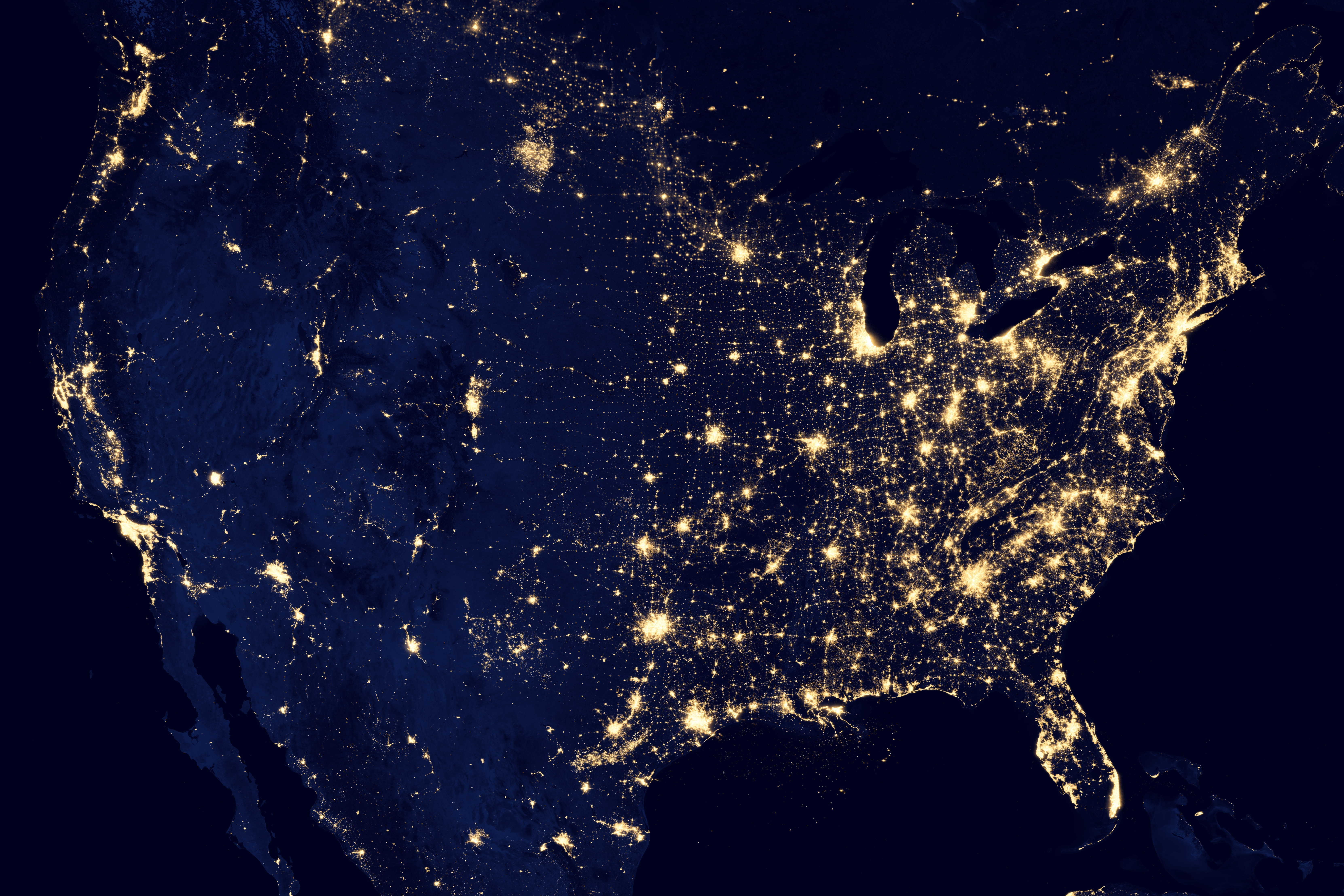
So it strikes me that young Malia and Sasha should be shown where Planet Earth’s master circuit-breaker is located. Would be such a shame to leave the lights on when there’s no-one at home.
North America burning bright – an image from NASA.
The sub-heading is the first line of the poem To Autumn by John Keats. The full poem closes today’s post.
Old habits from England die hard. My way of explaining my reticence to adopt a whole panoply of American words including Fall. Of course, it’s the perfect word to describe this time of the year but, nonetheless, Autumn feels like its ‘hard-wired’ into my personal vocabulary.
With the Summer heat behind us, the task-list for jobs to be done outside can no longer be fudged by “it’s too hot to work outside just now” excuse!
Frankly, the weather at the moment is so beautiful that it’s a privelege to be out in the open; to be enveloped by Nature.
Autumn colours on the trees along our Northern boundary. Mt. Sexton in the distance.
One job that we have been engaged in is installing a couple of raised vegetable beds on the flat area that used to be a tennis court. We had the asphalt base torn up a few months back. Yesterday, saw the first of the two beds filled ready for a crop of Winter vegetables to be planted in the coming weeks.
Anticipating eating our own vegetables for next year.
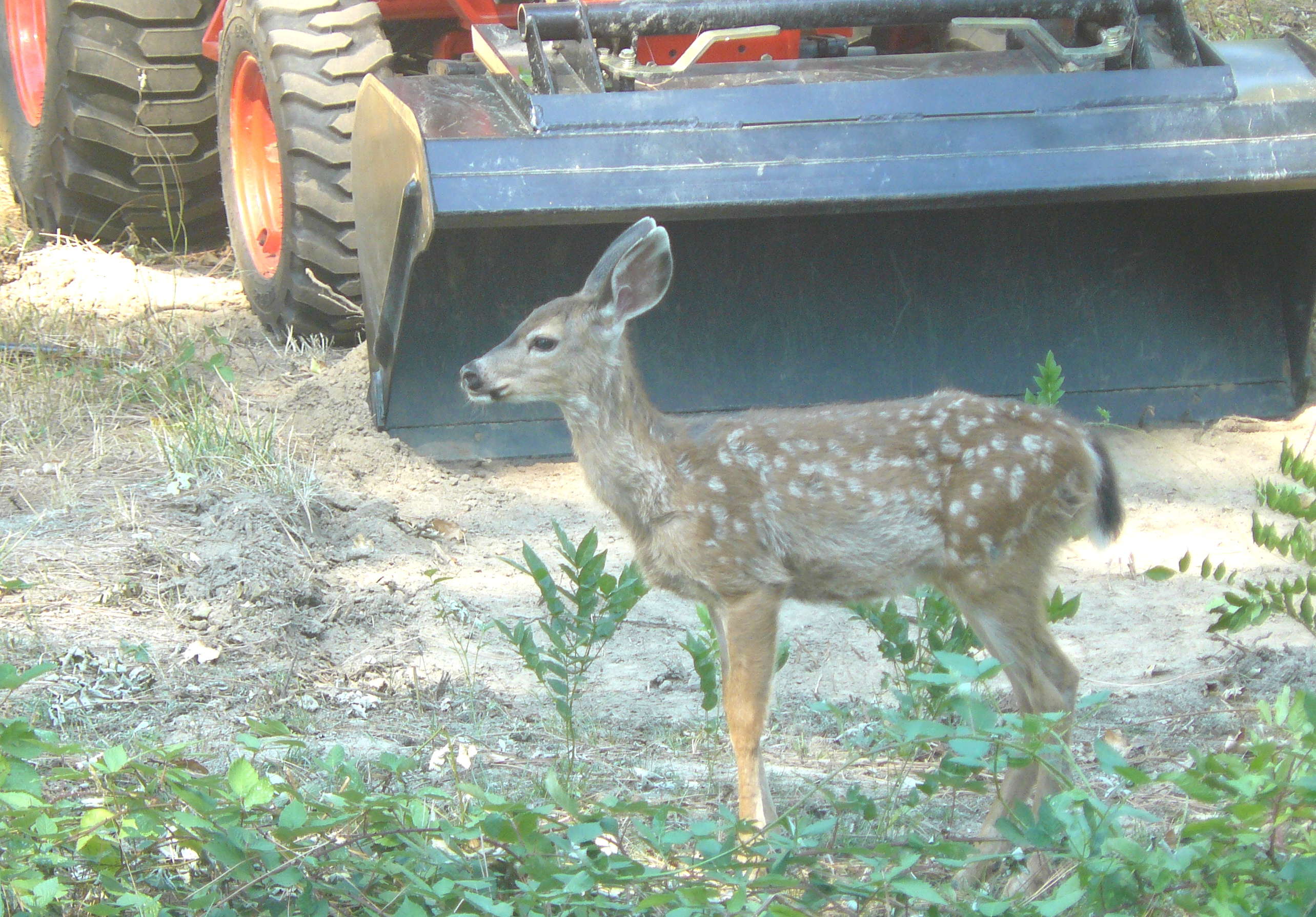
So many wild creatures, large and small, are storing up their body reserves for the long Winter months. Our neighbours, Dordie and Bill, regularly feed the wild deer and we have joined in as well. It’s fascinating to see how quickly they work out that we are not going to harm them. The picture below shows a young deer that allowed me to jump off the tractor, go indoors to find my camera, and return to snap the gorgeous, pretty creature.
Trusting little soul.
There’s been a couple of posts that I want to refer to because they underline the fact that humans are so prone to forgetting that we are of the wild, from the wild and connected to the wild. That’s for tomorrow.
Thus will close today with a recent Autumnal picture of the early-morning mists across our open grass area.
Misty Autumnal mornings
So to that John Keats poem:
To Autumn
John Keats (1820)
Season of mists and mellow fruitfulness,
Close bosom-friend of the maturing sun;
Conspiring with him how to load and bless
With fruit the vines that round the thatch-eves run;
To bend with apples the moss’d cottage-trees,
And fill all fruit with ripeness to the core;
To swell the gourd, and plump the hazel shells
With a sweet kernel; to set budding more,
And still more, later flowers for the bees,
Until they think warm days will never cease,
For Summer has o’er-brimm’d their clammy cells.
Who hath not seen thee oft amid thy store?
Sometimes whoever seeks abroad may find
Thee sitting careless on a granary floor,
Thy hair soft-lifted by the winnowing wind;
Or on a half-reap’d furrow sound asleep,
Drows’d with the fume of poppies, while thy hook
Spares the next swath and all its twined flowers:
And sometimes like a gleaner thou dost keep
Steady thy laden head across a brook;
Or by a cyder-press, with patient look,
Thou watchest the last oozings hours by hours.
Where are the songs of Spring? Ay, where are they?
Think not of them, thou hast thy music too,—
While barred clouds bloom the soft-dying day,
And touch the stubble-plains with rosy hue;
Then in a wailful choir the small gnats mourn
Among the river sallows, borne aloft
Or sinking as the light wind lives or dies;
And full-grown lambs loud bleat from hilly bourn;
Hedge-crickets sing; and now with treble soft
The red-breast whistles from a garden-croft;
And gathering swallows twitter in the skies.





















 Learning from Dogs