Here’s what HSUS are doing for the poor dogs out in Puerto Rico.
From time to time we do donate a few cents to The Humane Society of the United States (HSUS) because their size and huge support from so many people does allow them to step up to the really big needs.
And Hurricane Maria certainly left a big need in its wake for dogs.
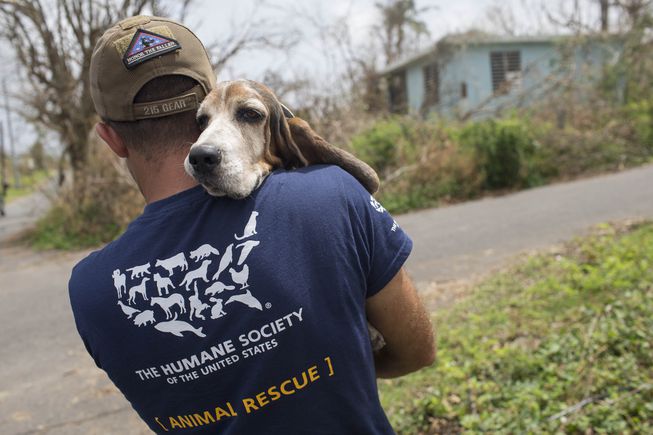
The HSUS Animal Rescue Team (ART) assists with animal rescue and response following Hurricane Maria on the island of Vieques, Puerto Rico. (Photo: Dennis M. Rivera Pichardo/AP Images for The HSUS)
In the wake of Hurricane Maria, hundreds of dogs, as well as cats, horses and even a few pigs, are getting off the island.
Several rescue groups, including the Humane Society of the United States, have waded into the breach to rescue some of the island’s most defenseless residents: its burgeoning population of stray dogs, as well as those currently in shelters.
HSUS has a history with the territory, helping with law enforcement training and horse care, and working closely with animal shelters across the island.
“Since the storm hit, we’ve been doing our best to stay in contact, given the communication challenges, with all of our shelter partners and other partners on the island,” Inga Fricke, director of pet retention programs for HSUS, tells MNN.
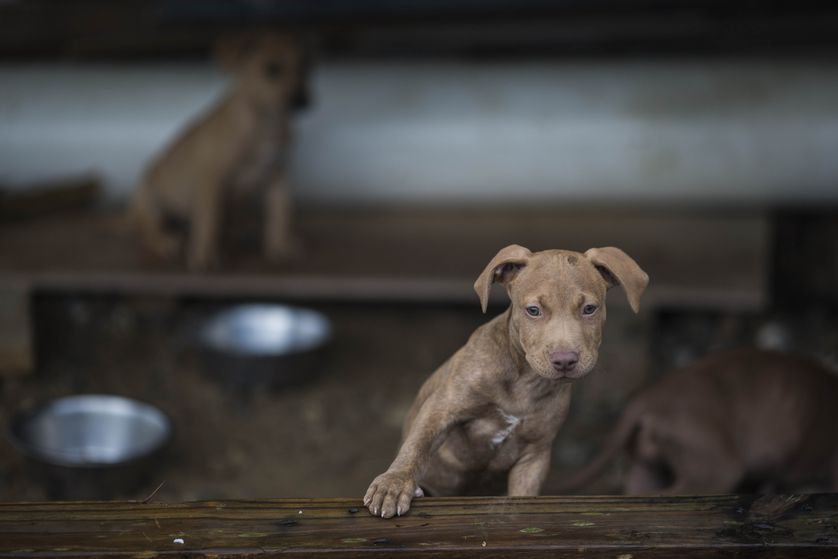
Puppies under a house in Vieques, Puerto Rico. (Photo: Dennis M. Rivera Pichardo/AP Images for The HSUS)
This week, the organization — with help from partners like Wings of Rescue and St. Hubert’s Animal Welfare Center — began airlifting dogs from stressed island shelters to a processing center in New Jersey.
“They get vetted there, get the care they need and then get parceled out to other partners around the country,” Fricke says.
Not every animal survived Maria’s onslaught. Notably, a southeast corner of the island once teeming with strays — nicknamed “Dead Dog Beach” — was found to be desolate when rescuers arrived.
“We’re hearing from our rescuers who have a feeding area where they go every day and we are hearing that most of those dogs have perished,” Twig Mowatt, co-founder of All Sato Rescue, tells MNN.
While the organization is based in San Juan, Puerto Rico, Mowatt is just outside of Boston, coordinating with the Humane Society of Puerto Rico to get vulnerable dogs airlifted to the mainland.
“I’m kind of like an air traffic controller these days,” she says. “My group is largely rescue and transport but we partner with the humane society for those really badly affected.”
“We were able to get dogs out on Friday and then yesterday,” Mowatt adds.
John Peaveler, an inspector with HSUS, does a field inspection in Vieques. (Photo: Dennis M. Rivera Pichardo/AP Images for The HSUS)
Described as “apocalyptic,” the hurricane left much of the island in the dark, without electricity or communications. And while the humanitarian relief effort is ongoing — much of the island was still without power in early October — the search for animals in distress may be even more complicated.
With an estimated 150,000 dogs in Puerto Rico and not enough animal shelters, there’s no space for dogs found roaming at large. As a result, many of them are put down immediately.
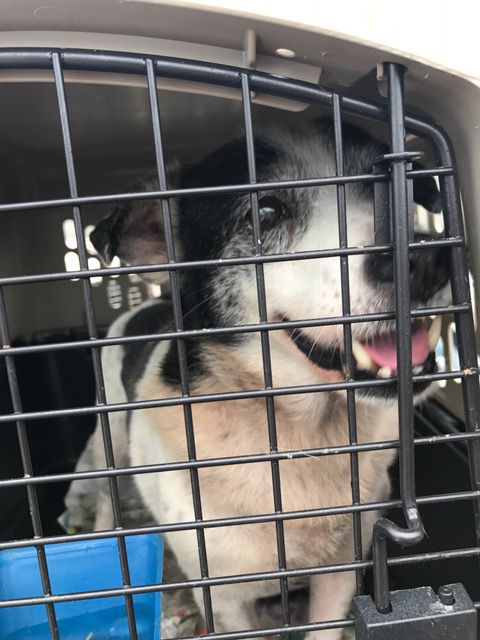
A crated dog is prepared for transport to New Jersey. (Photo: Dennis M. Rivera Pichardo/AP Images for The HSUS)
“We have even done several transports, even just this year, to try and alleviate some of the overcrowding and the pressures on the shelters across the island,” Fricke explains.
“But certainly our focus now, after the hurricane, is to try and remove as many of the sheltered animals as possible so we can allow them to make room for animals that unfortunately have been affected by the storm and can’t be kept by their families any more for any reason.”
With the recent earthquakes in Mexico being a glorious example of that!
Nobody would have missed out on the news of the terrible catastrophe of the recent earthquakes in Mexico.
As seen on the NBC news site.
Mexico Earthquake Death Toll Climbs as Dozens Sleep on Streets
byThe Associated Press
JUCHITAN, Mexico — The death toll from one of the most powerful earthquakes ever recorded in Mexico rose to at least 61 early Saturday as workers scrambled to respond to the destruction just as Hurricane Katia struck its coastline.
The 8.1 quake off the southern Pacific coast just before midnight Thursday toppled hundreds of buildings in several states. Hardest-hit was Juchitan, Oaxaca, where 36 people died and a third of the city’s homes collapsed or were otherwise rendered uninhabitable, President Enrique Pena Nieto said late Friday in an interview with the Televisa news network.
It’s impossible to truly appreciate the terror of such an event unless one has had the misfortune of already living through such an earthquake. Likewise, almost as difficult to appreciate the terror of being trapped.
But thank goodness for dogs that are trained to sniff out those trapped persons. Such as Frida who saved so many lives down in Mexico. Here’s the account of Frida’s special deeds as carried on the Care2 site.
ooOOoo
Frida, the Heroic Rescue Dog, Saves Lives After Mexico’s Earthquake
Photos and videos of a rescue dog named Frida have gone viral — complete with her cute-yet-necessary work uniform: doggie goggles, vest and four protective, Velco-strapped booties. She has become a four-legged symbol of hope during these dark times in Mexico.
Although, contrary to some early news reports, Frida didn’t really rescue 52 people after the devastating 7.1 earthquake struck Mexico Sept. 19, the 7-year-old yellow Labrador retriever has nonetheless become a media sensation.
What’s true is that prior to the earthquake, Frida (she’s named after the artist Frida Kahlo) had helped rescue 12 people and recover the bodies of 40 people during her career as a disaster rescue dog with the Mexican Navy’s (SEMAR) Canine Unit.
Working with 14 other dogs in the unit, she has located 12 victims of the Sept. 19 quake so far.
Frida’s first mission after the earthquake struck was to find survivors at the Enrique Rebsamen School in Mexico City. Eleven children were found alive by other emergency workers. Tragically, 19 children and six adults did not survive.
Frida suffered from exhaustion after searching the school Sept. 20, her handler, Israel Arauz Salinas, told the Los Angeles Times. After napping and drinking plenty of water with electrolytes, she was in better spirits the following day and ready to go back to work.
Frida has two colleagues in the Canine Unit, Evil and Echo, who are both one-year-old Belgian Malinois dogs. Because Frida is getting on in years, Evil and Echo enter collapsed buildings before she does. If they find someone, Frida enters and spends no longer than 20 minutes inside the building.
The disaster rescue dogs can reach areas that are inaccessible to human responders, including spaces that are less than 20 inches high. When they find a victim who’s alive, the dogs bark. Otherwise they stop and slowly approach the body. “They act afraid,” Salinas told the L.A. Times. “That indicates to us that there is a cadaver.”
Like the other dogs in the Canine Unit, Frida began training when she was just two months old. The skills the dogs show in training determine whether they will go on to detect people, narcotics or explosives.
To train dogs to find people, they are first taught to fetch toys and balls. Once they learn how to do that, their trainers run with the toy or ball in their hands. The dogs learn to associate the smell of the person with the reward of the ball, Salinas told the L.A. Times. Before they’re ready to be dispatched to disaster areas, the dogs train for about three hours a day for a year.
Just two weeks before the Sept. 19 earthquake, Frida helped locate the body of a policeman after a massive 8.1 quake struck Juchitan. She also worked in Ecuador after an earthquake there in April last year.
Before Frida won the hearts of the rest of the world, even the president of Mexico, Enrique Pena Nieto, was a fan of hers (or at least the person in charge of his official Twitter account was).
“She is @Frida, belongs to the #SEMAR_mx and has helped save 52 lives in various natural disasters at the national and international levels,” says a @PresidenciaMX tweet on Sept. 13.
ooOOoo
I’m going to finish off today’s post with a recent video aired by Quebec News. (Actually, a series of still photographs.)
Quebec NEWSPublished on Sep 21, 2017
Thousands of emergency services, military, and civilians are currently searching through rubble across the country for survivors. Among them are Frida, a rescue dog who has saved 52 people throughout her career, according to the office of Mexico’s President. Frida’s adorable outfit has a purpose. The goggles are to protect her eyes from smoke and debris, while the boots protect her feet from rough terrain. A massive 7.1 earthquake rocked Mexico earlier this week,It was the second major earthquake to hit Mexico in two weeks
Our English guests, Mark and Debbie, who stayed with us after traveling to Warm Springs, South-East of Portland, Oregon, to view the eclipse took the following three photographs.
See the crescents in the dappled shade of a near by bush. 10 minutes before totality.
oooo
Totality – August 21st, 2017.
oooo
Our English guests.
oooo
Then you will love the next one. Sent in by Neil Kelly from Devon, England.
Madison wears sunglasses to view the eclipse along the Cumberland River, Nashville, USA
oooo
And another beauty courtesy of Neil K.
Last but not least ….
oooo
Back to the stars!
The rising moon a little after 5am on the 19th August.
oooo
And there hanging above that rising moon was Venus!
oooo
Finally, back to Tanja Brandt whose most beautiful photographs will be gracing these Picture Parades in the future.
We all know that so many things in life have two sides to them. As in a positive and negative side. Which ‘side’ we look at has more to do with ourselves, again as you all know.
So when I republished an essay from Patrice Ayme a little over a year ago about the loss of the ice in Antarctica I was in harmony with Patrice’s gloomy stance:
I have written for years that a runaway Antarctica was certain, with half the icy continent melting rather spectacularly on an horizon of two centuries at most, and probably much less than that. This rested on the fact that half of Antarctica rests on nothing but bedrock at the bottom of the sea. At the bottom of what should naturally be the sea, in the present circumstances of significant greenhouse gas concentrations.
But Lady Luck comes into view and we have this: (Courtesy of Mother Nature Network.)
ooOOoo
Global warming is making Antarctica green again, and it’s stunning
At current rates, it’s not crazy to think that the Antarctic peninsula could eventually become forested again.
From white to green: plant life is booming in Antarctica as the climate warms. (Photo: Matt Amesbury, University of Exeter/Flickr)
When you think of Antarctica, you probably imagine a frigid, windswept, icy, inhospitable domain; the whitest, most barren canvas on Earth. That’s pretty much the way the Southern continent has been for at least the last 3 million years, since the last time atmospheric carbon dioxide levels approached their current levels. But times, they are a-changing.
The effects of global warming are beginning to radically alter the Antarctic landscape in some surprising ways. Scientists say it’s like looking back in time, to an epoch when this bleached terrain was actually green. Mossy mats are rapidly spreading across the thawed, exposed soils at unprecedented rates, transforming the land from a place of desolation, to a place of viridescence.
At the very least, we’re getting a peek at Antarctica’s future, which like its past was green and filled with plant-life, reports the Washington Post.
“This is another indicator that Antarctica is moving backward in geologic time — which makes sense, considering atmospheric CO2 levels have already risen to levels that the planet hasn’t seen since the Pliocene, 3 million years ago, when the Antarctic ice sheet was smaller, and sea-levels were higher,” said Rob DeConto, a glaciologist at the University of Massachusetts, Amherst.
“If greenhouse gas emissions continue unchecked, Antarctica will head even further back in geologic time… perhaps the peninsula will even become forested again someday, like it was during the greenhouse climates of the Cretaceous and Eocene, when the continent was ice free.”
So far, the greening of Antarctica is mostly limited to the peninsula, where two different species of mosses are fanning out at a startling clip, at four to five times the rate seen just a few decades ago. They gain a footing in the summers, when the frozen ground thaws, then freeze back over in the winter. But these layers-upon-layers are thickening, generating an increasingly detailed record of Antarctica’s warming climate.
It’s perhaps only a matter of time before grasses, bushes, perhaps even trees begin to sprout. As beautiful as a forested Antarctica might be to imagine, it’s important to remember that this isn’t necessarily a good thing. Climate change is an ambiguous beast; Antarctica might be getting greener, but deserts elsewhere in the world are expanding, sea levels are rising, and weather is becoming more severe.
“These changes, combined with increased ice-free land areas from glacier retreat, will drive large-scale alteration to the biological functioning, appearance, and landscape of the [Antarctic peninsula] over the rest of the 21st century and beyond,” wrote the authors of the study, which was published in the journal Current Biology.
Lead author Matthew Amesbury added: “Even these relatively remote ecosystems, that people might think are relatively untouched by human kind, are showing the effects of human induced climate change.”
ooOOoo
Sorry to drag out this old saw of mine, but it is so perfect: “I can predict anything except those things that involve the future”!
Because I am still staying with the Lady Luck theme but this time going from the vastness of the Southern polar regions to something a little closer to home. (Again, seen on Mother Nature Network.)
ooOOoo
Pit bull on ‘death row’ at shelter gets new life as police dog
Leonard recently became Ohio’s first ever pit bull K-9. Jenn Savedge May 19, 2017
Leonard found his forever home with Ohio’s Clay Township police force. (Photo: Union County Humane Society/Facebook)
When Leonard, a stout young pit bull, arrived on the doorstep of the Union County Humane Society in Ohio a few months ago, the staff had little hope for his prospects of being adopted. Leonard was deemed “aggressive,” and that meant he was more likely to be euthanized than sent home with a new family. But Jim Alloway, the center director, saw something different in the dog. And thanks to his observation, Leonard has a future that includes work, play and lots of belly rubs.
As luck would have it, Alloway has an extensive background of working with police dogs. He realized Leonard’s aggression was really a very strong desire to play. Whenever someone was holding something, Leonard wanted it and would try to grab it. As a pet in the average family, this may not be a desirable trait. But this strong “prey drive” made him a great candidate for training as a police dog.
So Alloway called Storm Dog K-9 training. After an initial round of testing, Mike Pennington, the owner of the training facility, agreed to take Leonard on and train him to sniff out narcotics. (Leonard wasn’t a good candidate for tracking and catching suspects because he loves people way too much.)
Before his training with Pennington, Leonard didn’t even know basic commands. But after a few weeks of hard work — which his trainers said he absolutely loved — Leonard was fully certified as a police dog, becoming Ohio’s first pit bull K-9 officer.
Leonard was paired with Terry Mitchell, Clay Township’s Chief of Police. Mitchell told the local ABC affiliate that he was unsure at first about the idea of using a pit bull as a K-9. But the pair bonded immediately.
“I scheduled a time to come down and see him, and after about 10 minutes, I knew this was the dog for us,” Mitchell said.
Leonard officially started work with the force this week. When he has his police vest on, Mitchell says the pup is all business and ready to tackle his narcotics-sniffing job. Off-duty though, Leonard is just a sweet, playful pup, hopping on Mitchell’s lap for evening naps. Oh, and according to Mitchell, he snores horribly.
Leonard — and Mitchell — couldn’t be happier.
ooOOoo
Wonder how long it will be before we have happy ex-rescue dogs frolicking through the forests of Antarctica!!
The creators of “SKYGLOW,” a crowd-funded project showing the impact of urban light pollution through time-lapse videos, photos and a book, have another stunning video to share. In “Kaibab Elegy,” filmmakers Gavin Heffernan and Harun Mehmedinović visit Grand Canyon National Park and capture a rare weather event.
In the mesmerizing video, clouds build inside the canyon almost like bubbling water filling a jacuzzi as the sun rises and sets in the background, creating the pinkest sky you’ve ever seen. Those clouds roll like waves in the ocean and crash against the cliffs. This phenomenon is called full cloud inversion, and it happens when cold air is trapped in the canyon and topped by a layer of warm air, which combines with moisture and condensation.
“We were extremely lucky to be there to capture it, and it’s a collection of unique footage not found anywhere else,” Mehmedinović says.
He and Heffernan, who journeyed 150,000 miles around the globe for their new book and video series, work with the International Dark-Sky Association, a nonprofit fighting to preserve the dark skies around the world.
Why can’t we leave nature to do what’s best for our world!
Now, I would be the first to ‘tut-tut’ a little over my sub-heading. For here I am sitting in front of a computer in a room in a reasonably-sized home that undoubtedly has denuded the natural world formerly underneath the present foundations.
Thirteen acres orientated West-East.
Plus, as the property boundary shown on the above picture confirms, about 50% of our acreage is no longer wilderness.
Ergo, it is impossible for humans to live on this planet without there being consequences that conflict with the natural order of the wild.
But homes to live in are one thing. A planned madness for the Lake District in Northern England is another thing altogether.
The attempt to turn the Lake District into a World Heritage site would be a disaster
By George Monbiot, published in the Guardian 9th May 2017
If this bid for power succeeds, the consequences for Britain will be irreversible. It will privilege special interests over the public good, shut out the voices of opposition and damage the fabric of the nation, perhaps indefinitely. No, I’m not writing about the election.
In the next few weeks Unesco, the UN’s cultural organisation, will decide whether or not to grant World Heritage status to the Lake District. Once the decision is made, it is effectively irreversible.
Shouldn’t we be proud that this grand scenery, that plays such a prominent role in our perceptions of nationhood, will achieve official global recognition? On the contrary, we should raise our voices against it. World Heritage status would lock the Lake District into its current, shocking state, ensuring that recovery becomes almost impossible.
Stand back from the fells and valleys and try to judge this vista as you would a landscape in any other part of the world. What you will see is the great damage farming has inflicted: wet deserts grazed down to turf and rock; erosion gullies from which piles of stones spill; woods in which no new trees have grown for 80 years, as every seedling has been nibbled out by sheep; dredged and canalised rivers, empty of wildlife and dangerous to the people living downstream; tracts of bare mountainside on which every spring is a silent one. Anyone with ecological knowledge should recoil from this scene.
This photo was used as the frontispiece of the “State of Conservation” section of the bid documents. It is meant to show how beautiful the fells are. If we saw it anywhere else, we would recognise it as an environmental disaster.
The documents supporting the bid for world heritage status are lavishly illustrated with photos, that inadvertently reveal what has happened to the national park. But this slow-burning disaster goes almost unmentioned in the text. On the contrary, the bid repeatedly claims that the park is in “good physical condition”, and that the relationship between grazing and wildlife is “harmonious”. Only on page 535, buried in a table, is the reality acknowledged: 75% of the sites that are meant to be protected for nature are in “unfavourable condition”.
This is another photo from the bid document, showing St John’s Beck in Thirlmere. The beck is notorious for its flashy response to rainfall – rising dangerously fast. It’s not hard to see why. As the photo shows, it has been dredged and canalised on behalf of the farmers in the valley, and now contains almost no natural features that can slow the flow.
This great national property has degenerated into a sheepwrecked wasteland. And the national park partnership, that submitted the bid, wants to keep it this way: this is the explicit purpose of its attempt to achieve world heritage status. It wants to preserve the Lake District as a “cultural landscape”. But whose culture? Whose landscape? There are only 1080 remaining farms in the district. Should the entire national park be managed for their benefit? If so, why? The question isn’t raised, let alone answered.
I can see the value and beauty of the traditional shepherding culture in the Lake District. I can also see that the farming there, reliant on subsidies, quad bikes and steel barns, now bears little relationship to traditional practice. As the size of landholdings has increased, it looks ever more like ranching and ever less like the old system the bid describes. The bid’s claim that farming there is “wholly authentic in terms of … its traditions, techniques and management systems” is neither intelligible nor true. Remnants of the old shepherding culture tend to be represented ceremonially, as its customs are mostly disconnected from the farm economy.
Shepherding is not the only cultural legacy in play. The other is that the Lake District is the birthplace of the modern conservation movement. Inspired by the Picturesque and Romantic movements, much of our environmental ethic and the groups representing it, such as the National Trust, originated here. Attempts to preserve natural beauty in the district began in the mid-18th century, with complaints against the felling of trees around Derwent Water. Today, the national park cares so little for this legacy that, as the bid admits, “there are no data available” on the condition of the Lake District’s woodlands.
The small group favoured by this bid sees environmental protection as anathema. Farmers’ organisations in the Lake District have fought tooth and nail against conservation measures. They revile the National Trust and the RSPB, whose mild efforts to protect the land from overgrazing are, with the help of a lazy and compliant media, treated like bubonic plague. As one of these farming groups exults, world heritage status “gives us a powerful weapon” that they can wield against those who seek to limit their impacts. If the plan is approved, this world heritage site would be a 230,000-hectare monument to overgrazing and ecological destruction.
30 years ago, this was a bare sheep pasture (with a couple of seeding birch trees). This is a photo I took (with my failing phone) on a hill elsewhere in Britain. It gives an idea of what parts of the Lake District fells could look like if they were allowed to recover.
This is not the only sense in which the bid is unsustainable. Nowhere in its 700 pages is Brexit mentioned. It was obviously written before the referendum, and has not been updated. Yet the entire vision relies, as the bid admits, on the economic viability of the farming system, which depends in turn on subsidies from the European Union.
Without these payments, there would be no sheep farming in the Lake District: it operates at a major loss. European subsidies counteract this loss, delivering an average net farm income of £9,600. Unsurprisingly, people are leaving the industry in droves: the number of farms in the national park is declining by 2% a year. And this is before the payments cease.
What is the national park partnership, that prepared this bid, going to do – march people onto the fells at gunpoint and demand they continue farming? Or does it hope that the government, amid the massacre of public investment that will follow Brexit, will not only match but exceed the £3bn of public money currently being passed to UK farmers by the European Union? Your guess is as good as mine. This omission alone should disqualify the bid.
The failure to mention this fatal issue looks to me like one of many attempts to pull the Herdwick wool over Unesco’s eyes. The entire bid is based on a fairy tale, a pretence that the rural economy of the Lake District hasn’t changed for 200 years. If Unesco grants world heritage status on these grounds, it will inflict irreparable harm on both our natural heritage and its own good standing.
The hills, whose clothes so many profess to admire, are naked. The narrative we are being asked to support is false. The attempt to ensure that the ecological disaster zone we call the Lake District National Park can never recover from its sheepwrecking is one long exercise in woolly thinking.
When one reads this one is left with a feeling of great sadness. A sadness that our ‘movers and shakers’ can’t resist the urge to meddle. Can’t understand the beauty that is found in nature in the raw.
Earlier on I illustrated how our own property has ‘interfered’ with the wilderness of this most beautiful Oregonian countryside. But as I hope to show you with the following photographs taken on our property back in 2014 that wild beauty can be hung on to in some measure.
Looking upstream along Bummer Creek from the driveway bridge.
I have sent a message to Unesco asking if the views of the public are being taken into account and, if so, how those views are to be communicated to Unesco. If you wish to contact them then the details are on this page: http://whc.unesco.org/en/world-heritage-centre/
Any replies from Unesco will be posted here.
UPDATE 0815 PDT May 22nd.
My email yesterday to Unesco was ‘bounced back’ as an invalid email address (despite me using the email address on the Unesco website!!).
But following George Monbiot’s reply to me, giving me the name of James Bridge (jbridge@unesco.org.uk) at Unesco, I have now sent Mr. Bridge the following email:
Dear Mr. Bridge,
I write as a British citizen, born a Londoner in 1944, to protest in the strongest possible terms to the proposal to turn the English Lake District into a World Heritage Site. This is your Tentative List reference http://whc.unesco.org/en/tentativelists/5673/.
Would you please provide me with the details of where or whom within Unesco I can write setting out in detail my objections to this proposal?
Your soonest reply would be very much appreciated.
Sincerely,
Paul Handover
I won’t hold my breath over getting a quick reply.
There are plenty more of those wonderful pictures and cartoons to come to come from Janet Goodbrod.
But a few days ago there were so many beautiful flowers blooming in the Spring sunshine that I couldn’t resist taking photographs of them and sharing them with you. All from home! (Apart from the young tree and the cows on our neighbour’s property for while not being flowery , nonetheless, they seemed to speak to me about springtime.)
oooo
oooo
oooo
oooo
oooo
oooo
Don’t ask me what the names of the various flowers are!
We all know how good are the noses of our dogs. Yet, I suspect, many do not know how truly good is that nose. The Science ABC site has a detailed account of Why Do Dogs Have Such A Great Sense of Smell?
Here’s part of that article:
Dog Nose vs. Human Nose
When we try to smell something, we inhale air with our nose and we use the same passage in our nose to exhale that air. Therefore, all the smell that we get when we are inhaling is lost when we exhale that air. However, a dog has two different air passages, one for breathing and another for smelling. This means that dogs are able to store the smell in their nose even while breathing out the air!
When dogs exhale, they send air out through the slits of their nose, but the manner in which this air is exhaled through their nose helps the dogs to draw in new odor molecules. This also helps dogs capture more smells when sniffing.
You must have noticed that dogs’ noses are always wet, but have you ever wondered why? The mucus on the dog’s nose helps it smell by capturing scent particles. A dog also has the ability to smell independently from each nostril, this helps the dog to understand from which direction the smell is coming.
The passage through which dogs smell the air contains highly specialized olfactory receptor cells, which are responsible for receiving smells. A dog contains about 225-300 million smell receptors, as compared to just 5 million of these receptors being present in a human nose.
Dog Brain vs. Human Brain
By now, we clearly know that dogs have a nose that can smell about 1,000-10,000 times better than a human, but how are dogs able to remember all the different smells that they have sensed throughout their life?
The answer lies in the difference between the brains of dogs and humans. A human brain has a larger visual cortex than dogs, whereas a dog’s brain has a much larger olfactory cortex than humans. The visual cortex is responsible for processing visual information, whereas the olfactory cortex is responsible for processing the sense of smell. A dog’s olfactory cortex is about 40 times larger than that of a human.
Working dogs are an amazing asset not only for people, but for wildlife, endangered species and even threatened habitats. Expanding on the skills dogs have for tracking down scents and guarding something important, we humans have enlisted their help in many ways for conservation.
Here are five ways dogs are contributing to environmental protection efforts.
Smell for scat
It’s amazing the amount of information that can be sussed out of an animal’s poop. We can determine diet, health, genetics — even whether or not an animal is pregnant. Scat is really important to biologists studying elusive, sensitive or endangered species. Putting dogs on the track is an ideal solution.
Take cheetahs, for example. Scientists in Africa are using dogs and their unparalleled sniffing power to find cheetah poop, all in an effort to get an accurate count on the endangered big cats. (Only 7,000 cheetahs are left in the African wild, according to estimates.) And it’s working. Two trained dogs found 27 scats in an area of 2,400 square kilometers in western Zambia, according to a study published in the Journal of Zoology. Humans, looking for cheetah tracks over the same area, found none.
Groups like Conservation Canines (a handler and dog from the program pictured above), Working Dogs for Conservation and Green Dogs Conservation specialize in this area. Conservation Canines rescues highly energetic, “last chance” dogs from shelters and trains them to track down the scat of dozens of species, from wolves to moose to owl. Even things that are nearly impossible for humans to find — the minuscule scat of endangered pocket mice or orca scat floating on the ocean surface — dogs can track down. They are able to make huge contributions to scientific studies, all without ever bothering the wildlife being studied.
Sniff out problems for wildlife
Whether it’s sniffing out invasive species like giant snails in the Galapagos or detecting disease in beehives, dogs’ noses can be put to work in searching out what shouldn’t be there so that humans can act.
Dogs are able to sniff out particular plant species, pointing ecologists to tiny patches of invasive mustard so that the plants can be removed before they take over an area.
Conversely, dogs can sniff out rare or endangered native plants so that the species can be protected. Rogue is one such dog. The Nature Conservancy writes, “The 4-year-old Belgian sheepdog is part of a Nature Conservancy collaborative project to test the efficacy of using dogs to sniff out the threatened Kincaid’s lupine. The plant is host to the endangered Fender’s blue butterfly, found only in Oregon’s Willamette Valley.”
Surveying for the plant species is difficult work for people. It can only be done when the plant is in bloom so people can visually identify it. However, dogs like Rogue can sniff out the plant even when not in bloom, which can potentially double the length of the field season.
“More refined regional mapping of Kincaid’s lupine could promote the butterfly’s recovery and delisting — and contribute to larger habitat goals and wildlife impacts.”
Track down poachers
The trade in rare or endangered wildlife is a lot tougher for traffickers thanks to wildlife detector dogs. Trained to smell anything from tiger parts to ivory to South American rosewood, dogs are used in shipping ports, airports, border crossings and other locations to sniff out smuggled products.
It doesn’t stop there. Trained dogs can lead rangers to armed poachers in the wild, tracking down the culprits over long hours through heat and rain. They can catch poachers in the act, rather than just the products.
“Canine sleuths aren’t limited to the plains of East Africa, either,” reports National Geographic. “In the Democratic Republic of the Congo, bloodhounds are assisting in the fight against poaching in forested Virunga National Park, where the world’s last remaining mountain gorillas live. In South Africa, Weimaraner and Malinois dogs are helping to find wounded animals and track poachers on foot through the reserves around Kruger National Park.”
Guard endangered species
Dogs are also useful in putting their protective nature to use for endangered species.
Livestock protection dogs are trained to keep predators like cheetahs, lions and leopards safe, which then reduces conflict between ranchers and big cats and minimizes the instances of snaring or retaliatory killing of big cats. Cheetah Conservation Fund has a successful livestock protection dog program, which places Anatolian shepherd and Kangal dogs with ranchers. That not only has significantly reduced the number of livestock killed by predators but is also improving the attitude of local people toward cheetahs.
Sometimes the dogs are put to work guarding the endangered species themselves. One such successful program uses Maremma shepherd dogs to protect colonies of little penguins from foxes.
Keep bears wild
Karelian bear dogs are trained to keep bears from becoming too comfortable around people. A program by Wind River Bear Institute named Partners-in-Life uses a technique called bear shepherding. This specialized breed of hunting dog is used to scare bears away, and are an important part of the “adverse conditioning” work that keeps bears from becoming habituated. The ultimate goal is to protect bears from becoming habituated, a problem that leads to their being relocated or euthanized.
“Our Wind River Bear Institute mission, with the effective training and use of Karelian Bear Dogs, is to reduce human-caused bear mortality and conflicts worldwide to ensure the continued survival of all species of bears for future generations,” states the program.
This list is only a handful of ways that dogs help us with environmental conservation every day. More and more, we are figuring out new ways to put their skills to work, and more and more the dogs are proving they’re ready for the task!
Editor’s note: This story was originally published in July 2016 and has been updated with more recent information.
ooOOoo
Closing words from that Science ABC piece:
A dog does not care how you look or dress, but if he gets good vibes from your smell, then a dog will love you. The world is truly a better place because of these wonderful creatures that we are lucky enough to welcome into our lives.
Why not make the world smell a bit more beautiful for them?
Belay that!
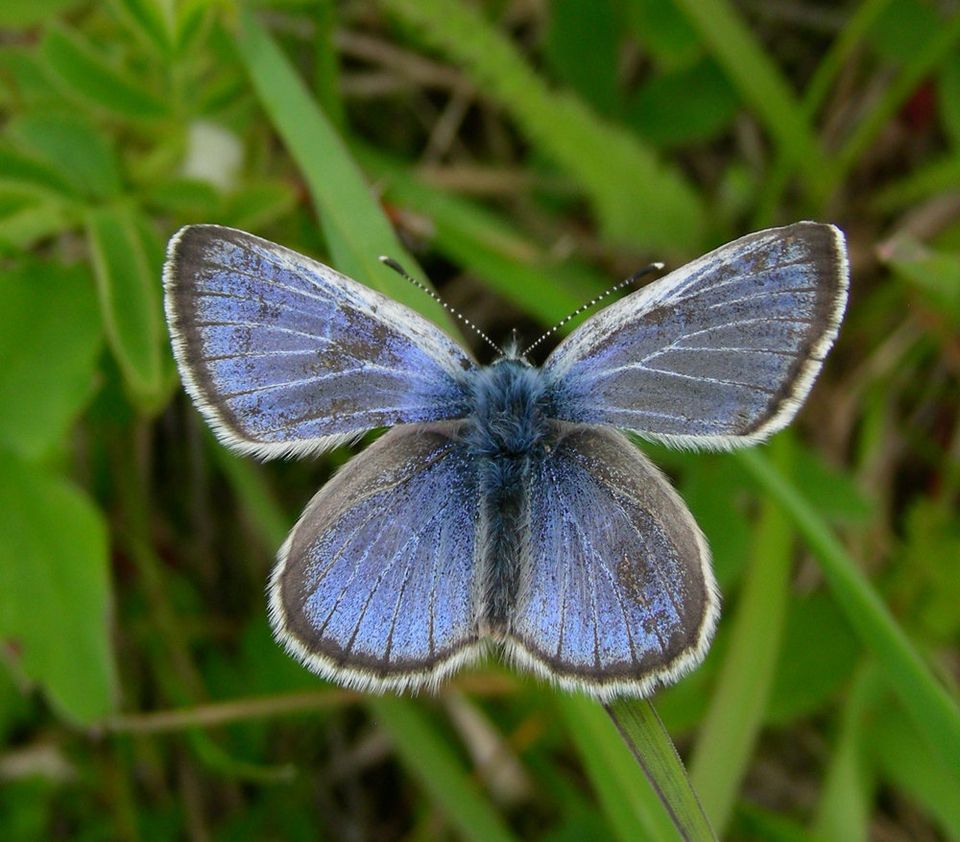
Closing picture taken from the OregonLive website. A stunning picture of the “Fender’s blue butterfly, found only in Oregon’s Willamette Valley.”
It is very hard to avoid hyperbole when one speaks of global warming.
I am indebted to The Nation magazine, May 8/15 Issue, in which is included a feature article authored by Bill McKibben. My sub-heading is much of what Bill wrote in his first line.
It is hard to avoid hyperbole when you talk about global warming. It is, after all, the biggest thing humans have ever done, and by a very large margin.
A few sentences later, Bill offers this:
In the drought-stricken territories around the Sahara, we’ve helped kick off what The New York Times called “one of the biggest humanitarian disasters since World War II.” We’ve melted ice at the poles at a record pace, because our emissions trap extra heat from the sun that’s equivalent to 400,000 Hiroshima-size explosions a day.
Yet what scares me, scares me beyond comprehension, is the almost universal disregard being shown by Governments and those with power and influence right across the world to what in anyone’s language is the most pressing catastrophe heading down the tracks. Not next year; not tomorrow, but now!
Or in Mr. McKibben’s words, once more from that Nation article:
But as scientists have finally begun to realize, there’s nothing rational about the world we currently inhabit. We’re not having an argument about climate change, to be swayed by more studies and journal articles and symposia. That argument is long since won, but the fight is mostly lost—the fight about the money and power that’s kept us from taking action and that is now being used to shut down large parts of the scientific enterprise. As Trump budget chief Mick Mulvaney said in March, “We’re not spending money on that anymore. We consider that to be a waste of your money to go out and do that.” In a case this extreme, scientists have little choice but to be citizens as well. And given their credibility, it will matter: 76 percent of Americans trust scientists to act in the public interest, compared with 27 percent who think the same thing about elected officials.
Whatever your response is to what I have already presented, the one thing that I do know is that you have been aware of humanity’s effect on our atmosphere for many, many years. Indeed, Bill McKibben wrote his first book twenty-eight years ago!
His 1989 book The End of Nature is regarded as the first book for a general audience about climate change, and has appeared in 24 languages; he’s gone on to write a dozen more books.
But I would be the first to acknowledge that back in 1989 while I did become aware of Bill McKibben and did purchase and read that book of his, I didn’t see the effects he prophesied. In addition, I didn’t understand the mechanisms that would bring those effects into place.
Now, today, it’s very difficult to deny that global weather systems are behaving in ways that most do not understand albeit we do understand how those weather changes are affecting our lives.
One person who did, and still does even more, understand the physics involved in our changing weather, is Patrice Ayme. For some nineteen years after Bill McKibben’s first book, Patrice published a post on his blog. I have been following Patrice’s blog for some years and while I would be the first to stick my hand in the air and declare that some of his posts are a little beyond me, there’s no question of the integrity of his writings and his bravery in spelling out the truth of these present times. (OK, the truth a la Monsieur Aymes but I would place a decent bet of PA being closer to the core truth of many issues than Joe Public.)
I am indebted to Patrice for granting me permission to republish that post. Please read it. Don’t be put off by terms that may not be familiar to you. Read it to the end – the message is very clear.
ooOOoo
Applying Equipartition Of Energy To Climate Change PREDICTS WILD WEATHER.
By Patrice Ayme, March 8th, 2008.
Lately, the world weather has been especially perplexing, influenced by the cold ocean temperatures of a La Niña current in the equatorial Pacific. For Earth’s land areas, 2007 was the warmest year on record.
This year, record cold is more the norm. Global land-surface temperatures so far are below the 20th-century mean for the first time since 1982, according to the National Climatic Data Center. Last month in China, snowstorms stranded millions of people, while in Mumbai, officials reported the coldest day in 46 years.
Yet, England basked in its fourth-warmest January since 1914, the British Met Office reported. The crocus and narcissus at the U.K.’s Royal Botanical Gardens at Kew flowered a week earlier than last year — 11 days ahead of their average for the decade and weeks ahead of their pattern in the 1980s. In Prague, New Year’s Day was the warmest since 1775.
“It is difficult to judge the significance of what we are seeing this year,” said Kew researcher Sandra Bell. “Is it a glitch or is it the beginning of something more sinister and alarming?”” (Robert Lee Hotz, Wall Street Journal, March 8, 2008).
Many scientists have pondered this question, as if they did not know the answer, but it is a straightforward application of thermodynamics.
A basic theorem of equilibrium thermodynamics, the EQUIPARTITION OF ENERGY theorem, says that the same amount of energy should be present in all degrees of freedom into which energy can spill.
(How does one demonstrate this theorem? Basically, heat is agitation, kinetic energy at the scale of atoms and molecules. This agitation can spill in a more organized manner, in great ensembles, such as vast low and high pressure systems, or large scale dynamics. See the note on entropy and negative temperatures.)
In the case of meteorology, this implies, oversimplifying a bit, that only one-third of the energy should go into heat (and everybody focuses on the augmentation of temperature). Now, of course, since the energy enters the system as heat, non equilibrium thermodynamics imposes more than one-third of the energy will be heat.
As time goes by, though, the other two degrees of freedom, potential energy (represented as the geometry of gradients of pressures, high and low pressure systems, hurricanes) and dynamics (wind speed and vast movements of air masses of varying temperatures and/or pressure; and the same for sea currents) will also store energy.
Thus the new heat created in the lower atmosphere by the increased CO2 greenhouse will be transformed in all sorts of weather weirdness: heat, cold, high and low pressures, wind, and big moves of big things. Big things such as vast re-arrangements of low and high pressure systems, as observed in the Northern Hemisphere, or the re-arrangement of sea currents as apparently also observed, and certainly as it is expected. Since it happened in the past (flash ice age of the Younger Dryas over Europe, 18,000 years ago).
As cold and warm air masses get thrown about, the variability of temperatures will augment all over.
In other words, record snow and cold in the Alps and record warmth simultaneously in England is a manifestation of the equipartition of energy theorem applied to the greenhouse warming we are experiencing. It is not mysterious at all, and brutal variations such as these, including sudden cold episodes, are to be expected, as more and more energy gets stuffed in the planetary climate, and yanks it away from its previous equilibrium.
Wind speed augmentations have already had a spectacular effect: by shaking the waters of the Austral ocean with increasingly violent waves, carbon dioxyde is being removed as if out of a shaken carbonated drink. Thus the Austral ocean is now a net emitter of CO2 (other oceans absorb CO2, and transform it into carbonic acid).
Hence the observed variations are the beginning of something more sinister and alarming. Climate change is changing speed. Up, up, and away.
Note on entropy: Some may object that transforming heat into collective behavior of vast masses of air or sea violates the Second Law Of Thermodynamics, namely that entropy augments always, in any natural process. Well, first of all, the genius of the genus Homo, not to say of all of life itself, rests on local violations of the Second Law. Secondly, the most recent physics recognizes that fundamental considerations allow systems where increased energy lead to increased order (such a system is said to be in a negative temperature state).
Even more revealingly, a massive greenhouse on planet Earth would lead, as happened in the past, to a much more uniform heat, all around the planet, that is, a more ordered state. Meanwhile, the transition to the present order of a temperate climate to the completely different order of an over-heated Earth will bring complete disorder, as observed.
ooOOoo
Going to leave you with a picture taken from weather.com
An emaciated polar bear is seen on a small sheet of ice in this image taken in August in Svalbard, north of mainland Norway. (Kerstin Langenberger)
Please, please, please: make a difference! Environmentally, domestically and politically, please make a difference.
Will optimistic stories get people to care about nature?
By Diogo Veríssimo David H. Smith Conservation Research Fellow, Georgia State University
May 7, 2017
Nature doesn’t make the news often these days. When it does, the story usually revolves around wildlife on the brink, record-setting climate extremes or ruined landscapes. However, that is not the whole story. There is also good news, but it often receives little attention.
It is easy to see how bleak accounts of the state of the planet can overwhelm people and make them feel hopeless. What is the point of even trying if the world is going down the drain anyway?
To muster public and political support on a scale that matches our environmental challenges, research shows that negative messaging is not the most effective way forward. As a conservation scientist and social marketer, I believe that to make the environment a mainstream concern, conservation discussions should focus less on difficulties. Instead we should highlight the growing list of examples where conservation efforts have benefited species, ecosystems and people living alongside them.
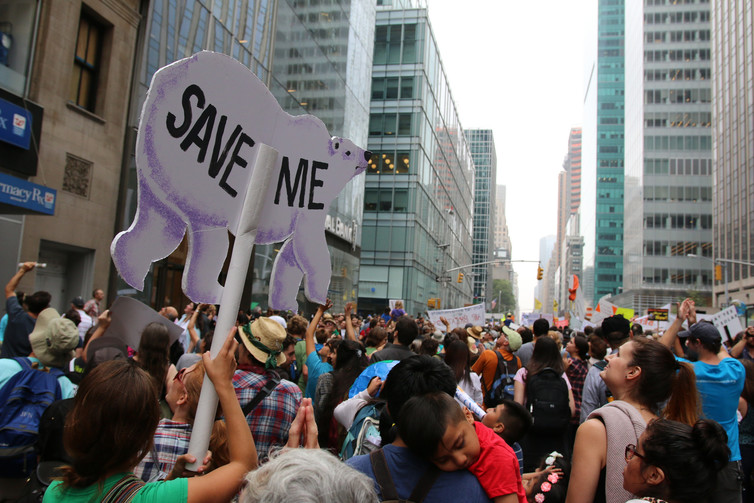
People’s Climate March, New York, New York, Sept. 21, 2014. CIFOR/Flickr, CC BY-NC-ND
The power of positive messages
This question is not new. Professionals in many fields have to consider how to frame their messages to maximize their impact. For example, public health agencies can make positive recommendations that emphasize benefits of being disease-free, or use negative messages that focus on the consequences of disease. A 2008 meta-analysis of 60 health communication studies concluded that messages focused on loss were less likely to be effective than positive messages.
Another study examined ads designed to persuade income support recipients to report their incomes. It concluded that messages focused on fear, shame or guilt could generate emotional backlash, in which people rationalized decisions to protect themselves from feeling ashamed of their behavior. This approach also caused emotional saturation that led people to “switch off” from the message because of its negativity.
Environmental advocates also confront this challenge. Much discussion has centered on the issue of climate change, where a number of scholars and advocates assert that doom-and-gloom messaging has not been effective. Yet until recently, we have not asked the same question about how we frame nature conservation.
Lost and found species
Today a growing number of scholars and activists are working to create a positive vision for protecting wildlife and wild places. One key effort started in 2014 with the launch of a marine conservation movement called Ocean Optimism, which works to “create a new narrative of hope for our oceans,” and by doing so, to help move towards “a sustainable future for our seas.”
In April 2017 the Earth Optimism Summit, organized by the Smithsonian Institution, brought together environmentalists, scientists, industry and the media to shift the global conservation movements focus away from problems and toward solutions. What started as a single event in Washington, D.C. soon turned into a truly global movement, with about 30 sister events in countries including Colombia, New Zealand and Hong Kong.
Lost & Found – Author provided
This effort has kick-started a range of initiatives that are all about communicating conservation bright spots to as many people as possible. One, which I co-founded, is the Lost & Found project, sponsored by the Society for Conservation Biology and the British Ecological Society. This online storytelling initiative focuses on a particularly inspiring kind of good news: rediscovering species that once were thought to be long extinct. After all, what can be more rousing than recovering something unique that you thought was lost forever?
Every year numerous species thought to have disappeared are rediscovered. Over the past century more than 300 species have been rediscovered, mostly in the tropics. On average, these species were missing for about 60 years before being rediscovered. Most rediscovered species have restricted ranges and small populations, which means they are usually highly threatened.
Lost & Found – Author provided
Our goal is not only to tell good stories, but also to showcase the dedication and determination of adventurers who lead these improbable quests and rewrite the history of species they care deeply about. While not every reader may be interested in a red-crested tree rat or a golden-fronted bower bird, all humans are curious about other people.
Lost & Found is making content available in various formats, including text, comics and soon, video animations. This helps make the stories more accessible to people who are not instinctively inclined to read about nature. Currently we have 13 stories freely available online that feature diverse species, from squirrels and toads to bats and birds. They cover a wide geographic range, from Latin America and Oceania to North America and Southeast Asia.
The response has been tremendously positive. More than 1,000 people from over 50 countries visited the website in its first 10 days. Some of our more popular stories, such as the Bulmer’s Fruit Bat and the Cave Splayfoot Salamander, are animals that would commonly not be considered particularly charismatic.
Getting these inspirational rediscoveries into the hands of as many people as possible is a first step toward creating a more positive vision for Earth’s future. The timeless principles of storytelling seem like the right place to start. After all, who doesn’t love a happy ending?
ooOOoo
Did you note the name of that website!!
Lost & Found. Go visit it and enjoy these wonderful happy endings!











 Learning from Dogs