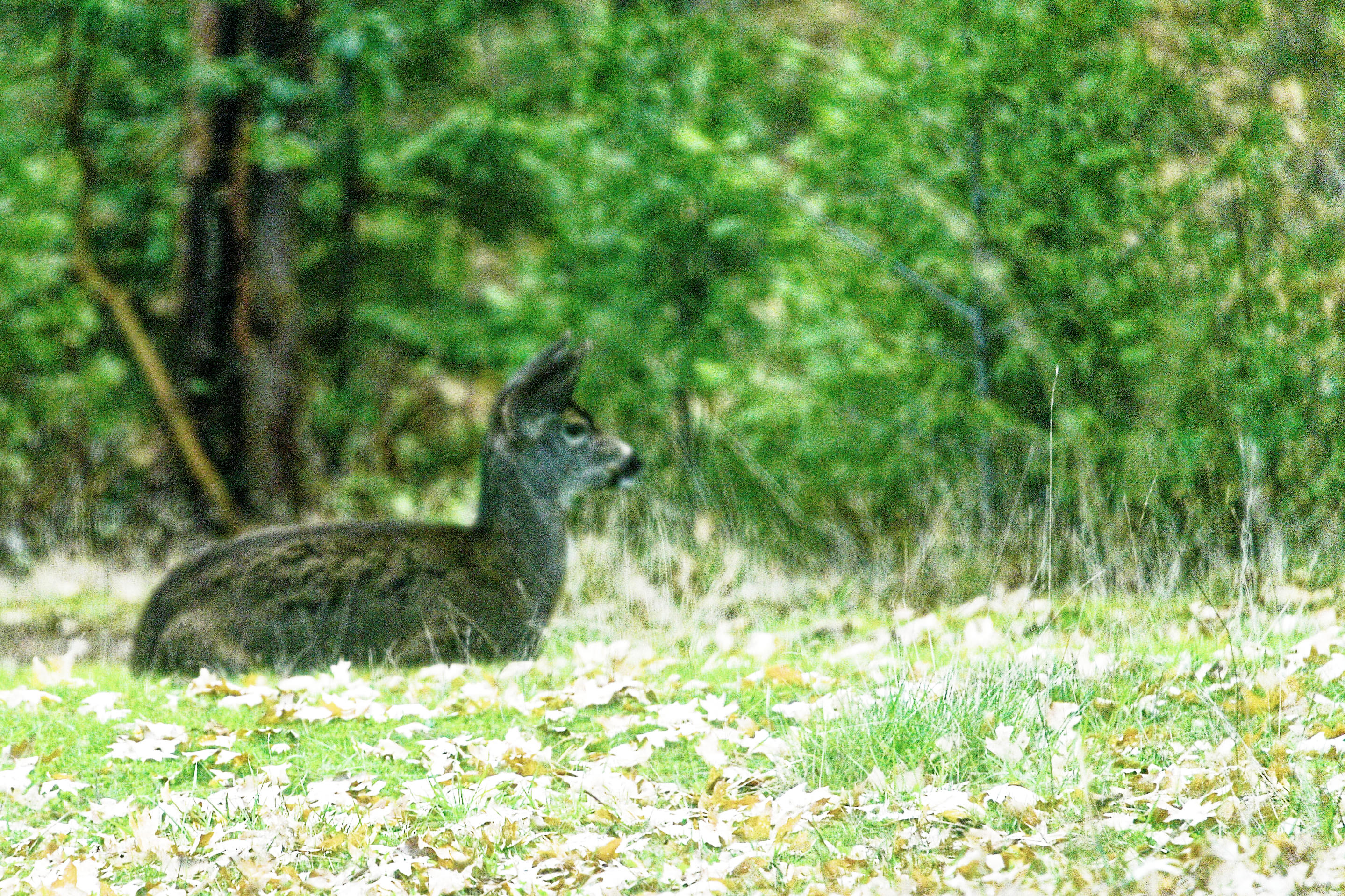
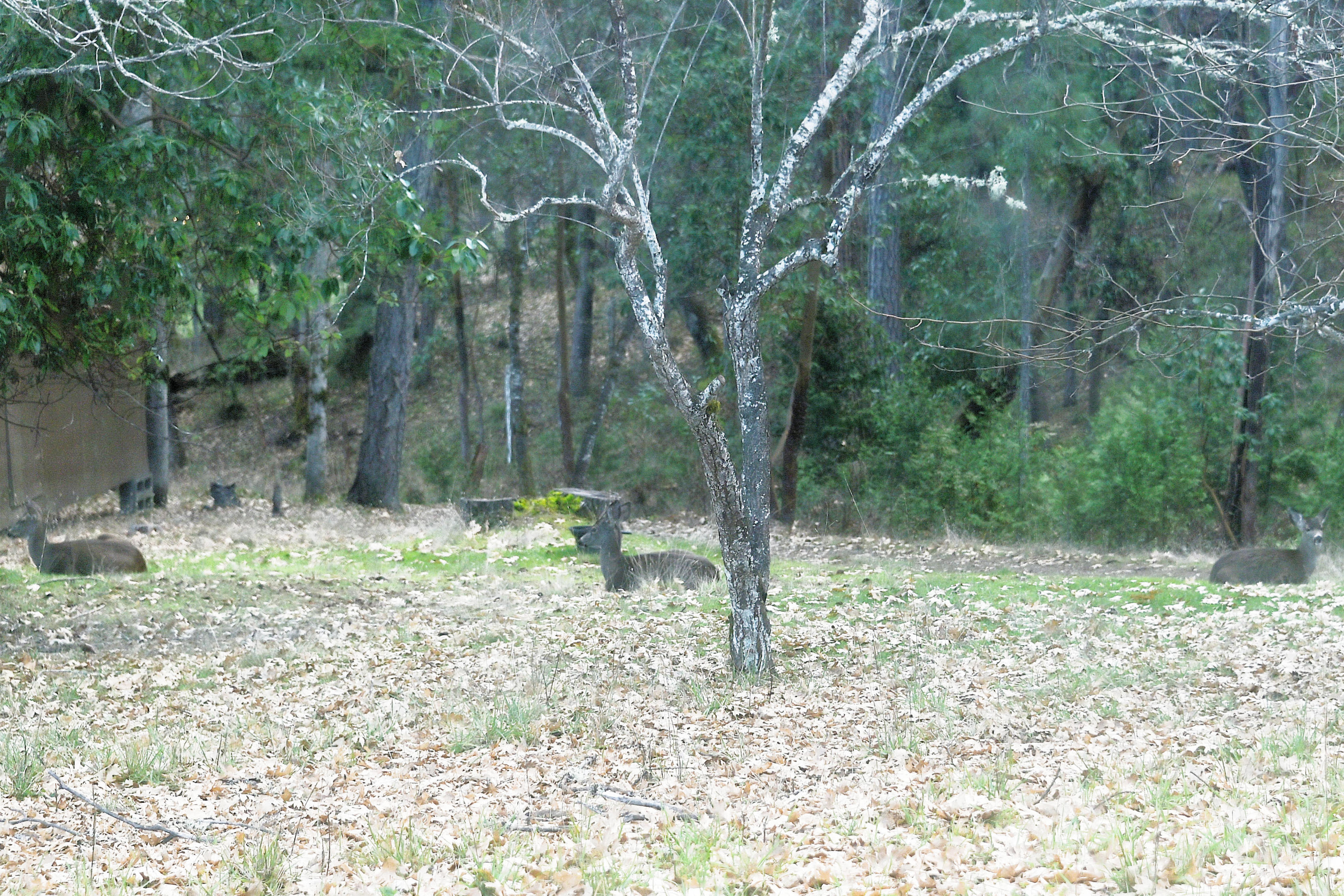
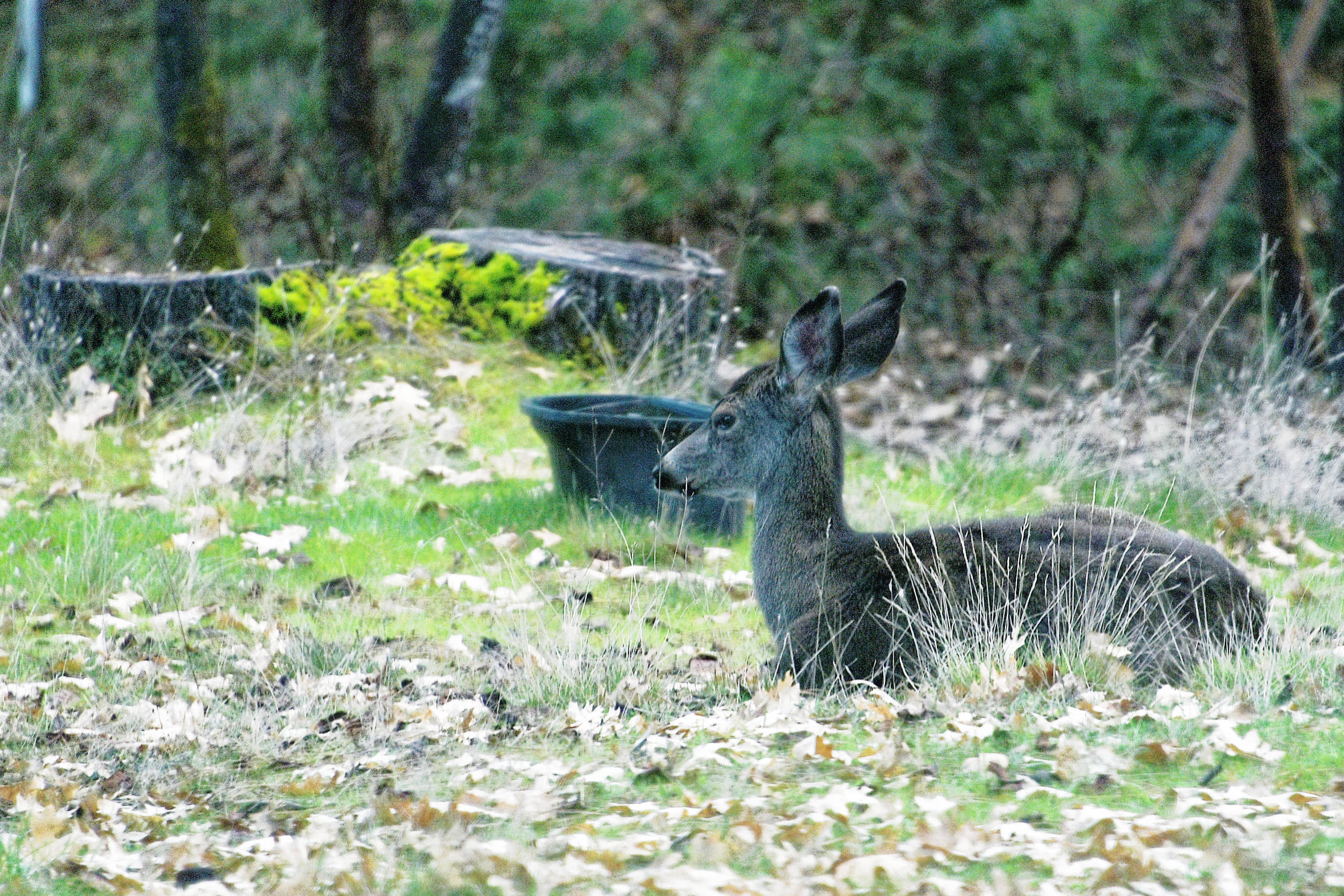
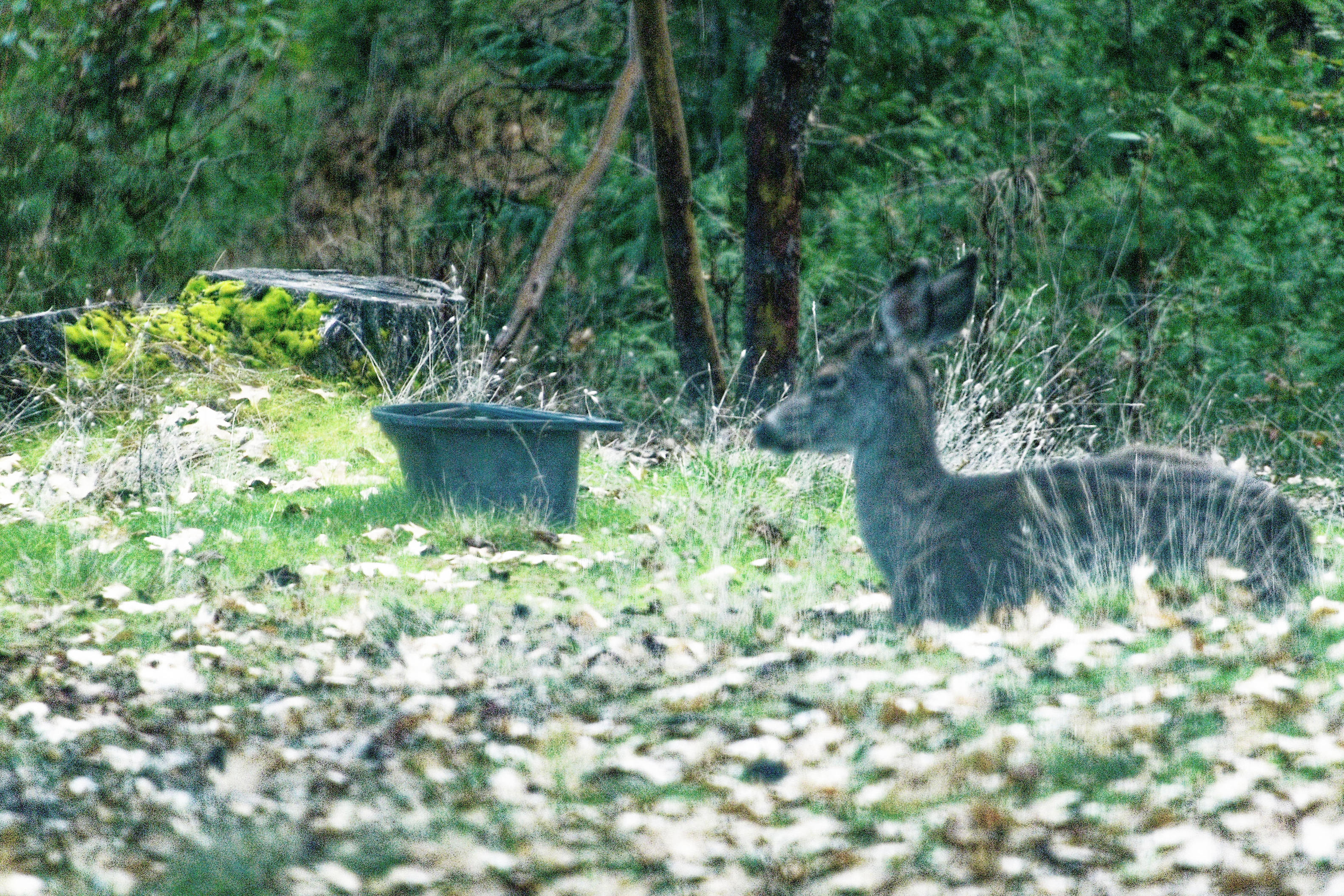
These are the deer in our garden. I feed them every morning and they have become good friends. However, taking the photos was tricky as I had to use a zoom lens and I did not have a tripod with me.
For many years I lived in South Devon, England. I never thought twice about hedgerows because they were so common.
Then today I read an article in The Economist about Brexit and the one thing that was favourable was this “Brexit delivers a win for British wildlife.“
Here’s a small extract from the magazine:
No other country matches the rich heritage of hedgerows that weave across the damp (ideal for hedges) British Isles. Since the Bronze Age, Britons have reared sheep and cattle and have used hedges to mark the boundaries of fields and keep livestock in place. Some of these ancient bushes still stand. In West Penwith, one such prehistoric hedge, a gurgoe, might be over 4,000 years old. Most, though, were planted in the 18th century, when landowners enclosed the commons, an event that turned the country into a chequerboard of small, irregular fields. America, by contrast, passed a law prohibiting private landowners from enclosing public land in 1885, protecting its open ranges.
Here in Oregon hedges are not so common. But I did some research as to the cause and came upon this article by Oregon State University.
I trust it may be shared with you.
ooOOoo
A Guide to Hedgerows: Plantings That Enhance Biodiversity, Sustainability and Functionality
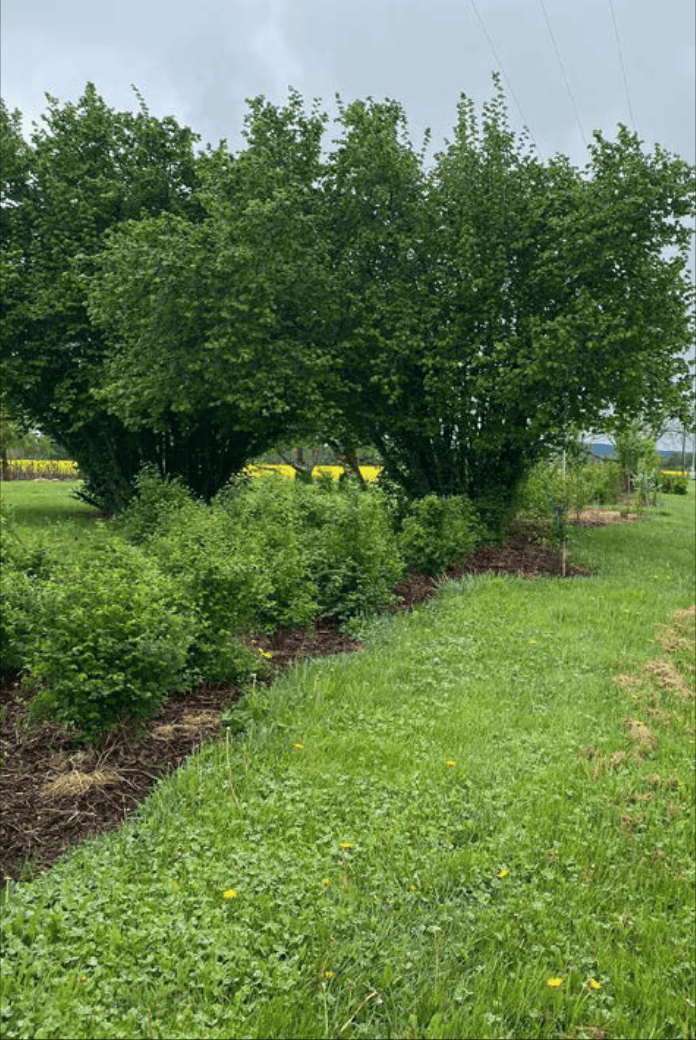
We see them at the edges of farm fields or along roads: long rows of trees, shrubs, flowers and grasses known as hedgerows. They are living fences with the ability to grow food, shelter wildlife, save water, manage weeds and look beautiful all year round.
Hedgerows are sometimes called shelter belts, windbreaks or conservation buffers. These layers of plant life enhance the beauty, productivity and biodiversity of a landscape.
Hedgerows originated in medieval Europe and are enjoying a modern resurgence. People in England planted hawthorn cuttings and allowed them to grow about 6 feet. They were bent and trained to fill gaps in the trees, yielding a living fence. They called these fences “hagas” or hedges, form the word “hawthorn.” As the birds settled in the hawthorns and dropped seeds. more plants sprung up. Today, many farms in England are surrounded by ancient hedgerows that shelter beneficial organisms and conserve soil and water.
Hedgerow plantings were uncommon in the early United States. In the 1930s, the U.S. Department of Agriculture’s Shelterbelt Program briefly supported planting trees for windbreaks to prevent soil erosion in the Midwest. Today, as interest surges in sustainable farming methods, more people are turning to this age-old practice.
Hedgerows can serve several ecological functions. Among their many benefits, hedgerows:
Enhance ecological biodiversity.
Offer food for livestock, humans and wildlife.
Provide habitat for beneficial insects and pollinators.
Facilitate water conservation.
Provide windbreaks.
Help manage invasive weeds.
Provide erosion control and improve soil health.
Support the health of aquatic habitats.
Enhance carbon sequestration.
Create borders and privacy screens.
Reduce noise, dust, chemical drift and other types of pollution.
Diversify farm income.
Generate year-round beauty.
Let’s look at these benefits in detail.
Benefits of hedgerows
Enhance ecological biodiversity
Biodiversity describes the variety of life forms within a specific ecosystem and the relationship of these organisms to one another and the broader environment. Hedgerows can be designed to attract a wide variety of mammals, birds, reptiles, amphibians, insects and plants, many of which offer beneficial relationships to each other. They also create more edges, or “ecotones,” between different habitats, which increases species diversity. Trees and shrubs provide shelter for larger mammals, and nesting sites and perches for raptors, which are important predators of rodents. Dense or thorny shrub thickets can offer songbirds a refuge to escape predators as well as a place to nest. The diverse composition and structure of a hedgerow creates a functional habitat where species experience vital interconnections with one another and the environment.
Offer food for livestock, humans and wildlife
Hedgerows provide undisturbed refuge for species of all kinds, creating wildlife corridors, travel lanes or habitat islands. Hedgerows help protect wildlife from predators and provide sheltered access to riparian zones or other water sources. These corridors are especially important in fragmented landscapes, such as fields where only a single crop is grown. Hedgerows provide shade to reduce heat stress and help to block wind currents. These measures support a healthier wildlife population. Berry-producing plants encourage insectivores, such as birds, that also prey upon common crop pests. The hedgerow habitat creates cover for wildlife so they can feed, nest and care for their young.
Provide habitat for beneficial insects and pollinators
Planting a variety of flowering trees, shrubs, forbs and perennial plants provides insect habitat, and nectar and pollen sources throughout the year for beneficial insects and pollinators. Plants in the family Umbelliferae attract parasitic wasps; predator flies such as hover flies, lacewings and ladybeetles; and true bugs, like ambush or minute pirate bugs. Flowering plants in this family include coriander, dill, fennel, parsnip, parsley and carrots. These plants are useful in the kitchen and are also very attractive to pollinators. Over 75% of successful production of food requires pollination. Increasing plant habitat for pollinator species improves fruit set, size and quality, as well as general biodiversity. Pollinator habitat also attracts beneficial insects, which prey on many crop pests. Increasing the numbers of beneficial insects can help farmers manage crop pests and cut down on insecticide use.
Facilitate water conservation
Hedgerows retain water and reduce evaporation by reducing wind speed and providing cover over the ground surface. Plants also catch and store water in their root systems, leaves and branches, slowing the rate of excess rainwater entering waterways and reducing the risk of flooding. Decaying matter from the roots, stems and branches of hedgerow plants increase the organic matter in the soil over time. This increases the soil’s ability to absorb and retain water. Planting hedgerows on hillsides helps conserve water and soil by reducing erosion. If planting near adjacent cropland, periodic root pruning can reduce competition for nutrients and water.
Provide windbreaks
Properly designed hedgerows can reduce wind speed by as much as 75% and improve crop performance. This is especially effective when plantings reach a density of 40%–50% and are planted perpendicular to the prevailing wind. Wind-resistant trees usually have flexible, wide-spreading, strong branches and low centers of gravity. Wind-tolerant shrubs often have small, thick or waxy leaves or very narrow leaves or needles, to help control moisture loss. Wind can disturb pollination and damage fruit and flowers when plant parts thrash against each other. During times when soil is exposed, a windbreak can protect topsoil from erosion. Crops under wind stress also put energy into growing stronger roots and stems, resulting in smaller yields and delayed maturity. Strong winds also cause lodging of grain and grass crops, bending the stems and making harvest more difficult. Winds dry out crops on the field edges, increasing pests such as two-spotted spider mites.
Help manage invasive weeds
Hedgerows planted along roads or between crop fields may prevent weed seeds from blowing into the field. The weed seed pods collect on hedgerow plants, where a farmer could remove and burn them. Hedges can prevent millions of weed seeds from entering the crop field. As hedgerows mature, these plantings displace invasive weeds. If well maintained, this weed management lasts the lifetime of the hedgerow.
Provide erosion control and improve soil health
Rain, irrigation, clean cultivation and vacant field borders can all increase erosion potential in an agricultural system.
Hedgerow plantings can significantly reduce the amount of soil erosion on a landscape. They can also provide a barrier to filter out pollutants, such as pesticides, and slow down sediments and organic material that can flow from farm fields into waterways. This is accomplished by increasing the surface water infiltration rate and improving soil structure around the root zone. This, in turn, decreases fertilizer runoff from farm fields. The biomass that plants shed acts as a soil conditioner and can enhance plant growth. In urban or suburban environments, hedges similarly reduce pollutants from neighboring sites.
Support aquatic habitat
Hedgerows can provide shade to riparian areas. Shade reduces water temperatures, prevents water evaporation and improves watershed quality. Though many factors influence watershed temperatures, studies have proven that lowland streams bordered by trees and tall shrubs exhibit cooler temperatures. The hedgerow’s latitude, stream aspect, leaf density and the height of its vegetation from the water surface all affect water temperature.
Enhance carbon sequestration
During photosynthesis, trees, shrubs and grasses absorb carbon dioxide from the atmosphere, allowing the carbon to become part of the plant’s tissue. As plants die or shed tissue — either through natural processes or pruning — the carbon that was stored in the plant breaks down and enters the soil. Plants store relatively large amounts of carbon in their biomass, helping to offset some of the effects of climate change. A tree can absorb as much as 48 pounds of carbon dioxide per year and can sequester, or store, 1 ton of carbon dioxide by the time it reaches 40 years old.
Create borders and privacy screens along roads and between properties
Hedgerows are attractive borders and can block undesirable views. Evergreens offer year-round screening. When selecting plants, consider the height at maturity for optimum screening. Evergreens can be pruned to control height and density. Plant a diverse mix of species to help protect against damage from a single pest or disease.
Reduce noise, dust, chemical drift and other types of pollution
As hedgerows mature and become dense, they can create barriers to reduce noise, dust, chemical drift and other pollutants. Open canopy trees are effective barriers to dust and pesticides; air and particles slowly filter through them instead of depositing clouds of pollutants on the other side of the hedge.
Plant hedges as close as possible to any areas where pollutants are a concern. This can help alleviate neighborhood conflicts where agriculture intersects with urban areas.
Hedgerows can act to contain contaminants from urban or suburban environments and keep them from entering agricultural areas.
Diversify farm income
Trees, shrubs and herbaceous plants in a hedgerow can also serve as sources of income. Potential products include nuts, fruits, berries, leaves, flowers, seeds, bark and medicinal herbs. You can grow plants to be propagated as seeds, rootstock, cuttings and transplants. Other potential crops are nursery stock and floral materials, including ferns, broadleaf evergreens, flowers and willows grown for craft material and furniture. You can grow fruits, berries and nuts for food. Hedgerows can shelter bees and encourage a higher pollination rate. Consider planting trees for secondary wood products such as lumber, veneer, firewood, chips for bedding and mulch. Game birds such as quail, pheasant and sage grouse are attracted to hedgerows. Managed hunting can provide a potential source of food and off-season revenue for landowners.
Generate year-round beauty
Hedgerows in the landscape add continuous beauty. You can design a hedge for year-round interest, considering the color and texture of leaves and bark, bloom color and timing, and the general growth habit or form of plants.
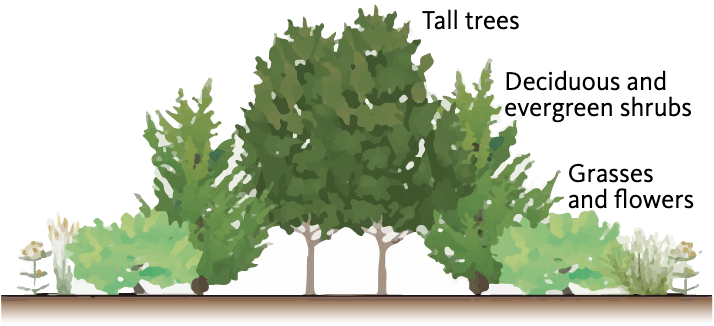
Hedgerow design Graphic: Kerry Wixted with graphics from Tracey Saxby, IAN Image Library, courtesy of the Integration and Application Network, University of Maryland Center for Environmental Science
Whether in rural or urban settings, the principles of planning a hedgerow are the same: Evaluate the site, determine what you would like to accomplish with the plantings, match the right plant with the right place, and properly prepare the site.
Design
There are many essential components to consider when designing a multifunctional hedgerow. The first step is to observe the site where the hedge is to be planted and take into consideration the ecological and environmental conditions listed below. These elements influence the design, plant selection, location and the size of the area to be planted. Although a single line of trees will provide some benefits, four or more rows of plants are optimal for windbreaks, water and soil conservation, wildlife habitat and general biodiversity. When it works for the situation, place plants tallest at maturity in the center row, with shorter ones inter-planted between and along the edges. A diverse selection of plant sizes and characteristics is most beneficial. When possible, orient rows perpendicular to prevailing winds.
Hedgerows following land contours create meandering lines on the landscape, producing a natural appearance and larger buffer for wildlife habitat. If the goal is to attract pollinator species, reserve approximately one half-acre for every 40 acres planted in crops.
Plant selection
Plant a wide variety of multi-tiered plants for maximum habitat. Avoid varieties that are susceptible to common pests and diseases and choose plants that are non-invasive. Some perennial species such as blackberry can provide excellent wildlife habitat and food crops but are highly invasive and require frequent maintenance. See the plant lists on page 7 for plantings suited to the Pacific Northwest.
When selecting plants, consider the conditions plants need to survive in specific habitats:
Range: place of origin (indigenous, native/non-native).
Hardiness zones: frost dates.
Light requirements: sun or shade.
Size of plants at maturity, growth.
Soil type (pH, fertility, erosion concerns).
Drainage.
Water movement and moisture needs.
Planting time.
Bloom time: seasonal interest.
Day length.
Productivity.
Tolerance to heat, cold, salt, drought, pollution, wind and wild or domestic animals.
Evergreen or deciduous.
Plant structure: form or shape, texture, leaf and bark type.
Edible or poisonous: what parts.
Insect and disease resistance.
Plant size, costs and availability.
Maintenance needed.
Allellopathy: a chemical inhibitor of one plant to another which can impact germination or plant growth.
Ultimately, place plants together that have similar soil, water, sun and drainage needs.
General planting recommendations:
Plant trees and shrubs about 6 to 8 feet apart in rows 8 to 10 feet apart.
Plant one or two rows of tall trees flanked by a row or two of shrubs. A 20-foot wide hedgerow can have two rows of shrubs flanking a row of trees.
Hedgerows work best for wildlife when they are wider than 20 feet.
Depending on the site’s prevailing winds, a winter windbreak could have at least two rows of evergreen trees and a row of deciduous trees or shrubs. A summer windbreak could have at least one row of tall deciduous trees and a row of deciduous shrubs.
Make sure the planting holes are deep and wide enough to accept and cover the roots of each plant. Be sure to water in each new planting.
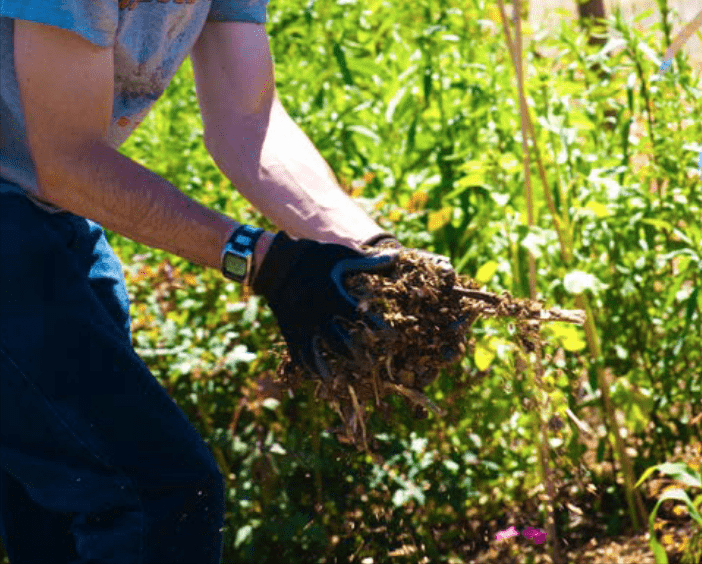
In a small area, place a 3-inch layer of straw mulch or cardboard around each tree and shrub after planting to discourage weeds and encourage plant survival.
Soil preparation
Soil preparation is one of the keys to plant survival. On a smaller site, an easy way to establish planting areas in existing grass or pasture is to apply a thin layer of compost or manure, followed by several layers of cardboard, and mulch such as straw or leaves. Worms are attracted to the manure and will work over the winter to decompose grasses and fertilize the soil. However, this method may not be practical on a large scale. In this instance, prepare the area for planting by tilling the ground in spring and planting an early cover crop such as crimson clover, followed by buckwheat. In late summer, till or disc in the cover crop and replant an overwintering cover crop such as crimson clover, field peas or vetch. Cover crops improve soil fertility, reduce weeds, stabilize the soil and attract beneficial insects. Till again the following spring and install the first set of plantings for the hedgerow.
Another option for sites with high weed pressure is solarization. Closely mow the ground and put down UV-stabilized anti-condensation greenhouse plastic in midsummer for several weeks to kill the weeds. After solarization, remove the plastic and follow with a fall planting.
Planting time
In more temperate environments, fall planting allows roots to become established before foliage emerges and gives plants the benefit of winter rains. In extreme cold climates, early spring may be the ideal time for planting. At the time of planting, apply amendments such as compost or manure as a top dressing.
Irrigation
To increase the success rate of your hedgerow planting, provide supplemental water for the first two or three years. Irrigate once a week during the heat of the summer during the first year. For the second year, water every two weeks. In the third year, irrigate once a month. Irrigation needs depend on the location and the plants selected. Be sure to water deeply to encourage deep root growth. Most hedgerow plantings may not survive if they do not get supplemental water in the first few years. Water can be supplied by swales, furrows, flood, drip irrigation or hand watering. If the hedgerow is next to cropland, overhead irrigation from the crop can be extended to water the hedge.
Keeping out weedy plants and destructive wildlife
One of the biggest challenges in establishing a hedgerow is keeping unwanted plants from taking over the new plantings. There are a variety of techniques to inhibit these weedy plants. The simplest method is to leave alleys between plant rows for mowing, cultivation or mulching until plants are well established. Ideally, an area 6 to 8 feet wide around the hedgerow should be mowed, flailed or tilled for weed management, fire protection and rodent control. It is also important to mulch heavily with a minimum of 3 inches of leaves, straw, sawdust or cardboard around each plant. As plants mature, they will eventually shade out most annual weeds. This is the ideal time to infill with low-growing, shade-tolerant plants.
If needed, protect plants from beaver and nutria with hardware cloth, and use partially buried plastic-coated cardboard or tubing around tree trunks to protect from voles and mice. If applying pesticides, follow the label in order to protect riparian zones along rivers, creeks and ponds from contamination.
Managing a hedgerow in the first few years is similar to managing a crop. Good weed management during establishment results in less labor to control weeds in seasons to come.
Cost of establishment
Planting hedgerows does not have to be expensive. Seedling plants are available at low cost, and you can propagate new plants from existing plantings. The larger the plant, the sooner it will reach maturity, which is especially important in creating a fast-growing privacy screen. This can be achieved by purchasing dormant bareroot plants and 1-gallon potted plants or larger. Remember, these larger plants will most likely require summer irrigation. Government programs are available to assist landowners with hedgerow development. Many counties have tax exemption programs for riparian lands, along with wildlife habitat conservation and management programs. See “Incentive programs to help with hedgerow establishment” and Estimated Costs To Establish Pollinator Hedgerows, in “Resources,” pages 9–10.
Conclusion
A hedgerow is a long-term commitment. With proper planning and care, it will take approximately four to eight years to establish a hedgerow and 30 or more years for it to reach maturity. To encourage success, draft a plan with planting installments for each year, depending on your goals and budget.
Hedgerows in rural agricultural or urban settings provide many benefits that increase over time, including the opportunity for supplemental income. With benefits for wildlife, humans and the planet, hedgerows are a practice that has stood the test of time.
Hedgerow plants
Hedgerows can contain native and non-native plants, although plants should not be invasive. The following trees, shrubs, groundcovers and perennial plants are appropriate for hedgerows in the Pacific Northwest. Remember to consider proper site selection and plant requirements. Plants that tolerate wet soil are indicated by an asterisk (*).
Sun-tolerant plants under 25 feet
Arbutus unedo Strawberry tree
Aronia Chokeberry Schubert
Baccharis pilularis consanguinea Coyote brush
Ceanothus velutinus Tobacco brush
Cornus stolonifera Red twig dogwood
Diospyros kaki Japanese persimmon
Diospyros virginiana American persimmon
Elaeagnus multiflora Goumi
Elaeagnus umbellata Autumn olive
Ficus carica Fig
Fuchsia magellanica Hardy fuschia
Lonicera caerulea Blue honeyberry
Lonicera involucrata Twinberry
Malus fusca West Coast crabapple
Malus sp. Apple
Morus Mulberry
Myrica pensylvanica Bayberry
Oemleria cerasiformis Osoberry
Philadelphus lewisii Mock orange
Prunus avium Cherry
Prunus domestica Plum
Pyrus pyrifolia Asian pear
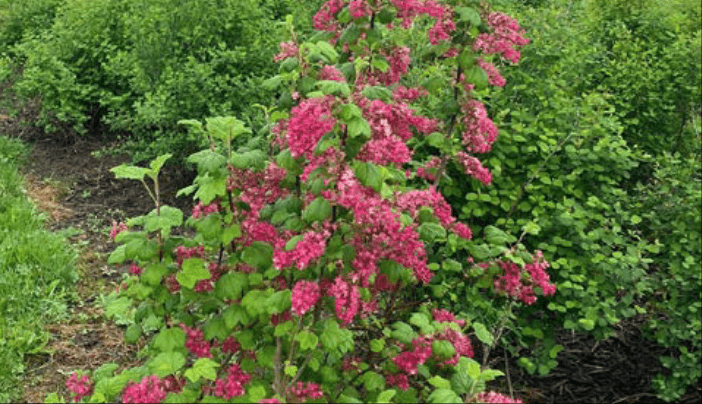
Ribes sanguineum Red-flowering currant
Ribes divaricatum Black gooseberry*
Ribes nigrum Black currant*
Rosa nutkana Nootka rose
Salix fluviatilis Columbia River willow*
Salix hookeriana Hooker’s willow*
Sambucus cerulea Blue elderberry*
Spiraea douglasii Western spiraea*
Vaccinium corymbosum Blueberry*
Vaccinium ovatum Evergreen huckleberry
Viburnum opulus Highbush cranberry
Sun-tolerant plants 25+ feet tall
Abies grandis Grand fir
Acer macrophyllum Bigleaf maple
Alnus rubra Red alder*
Arbutus menziesii Madrone
Asimina Pawpaw
Calocedrus decurrens Incense-cedar
Castanea Chestnut
Chrysolepis chrysophylla Golden chinkapin
Diospyros virginiana Persimmon
Fraxinus latifolia Oregon ash*
Juglans regia English walnut
Picea species Spruce
Pinus ponderosa Ponderosa pine
Populus trichocarpa Black cottonwood
Prunus subcordata Klamath plum*
Pseudotsuga menziesii Douglas-fir
Quercus garryana Oregon white oak
Robinia pseudoacacia Black locust
Thuja plicata Western redcedar
Groundcovers
Fragaria chiloensis Strawberry
Gaultheria shallon Salal
Mahonia nervosa Oregon grape
Polystichum munitum Sword fern
Vaccinium vitis idaea Lingonberry
Vines
Lonicera Honeysuckle
Akebia Five-fingered akebia*
Plants for pond edges
Typha latifolia Cattail*
Ledum glandulosum Labrador tea
Plants that tolerate shade
Chrysolepis chrysophylla Golden chinkapin
Cornus nuttallii Western flowering dogwood*
Corylus cornuta Hazel*
Physocarpus capitatus Ninebark
Polystichum munitum Sword fern
Sambucus racemosa Red elderberry*
Prunus virginiana Chokecherry
Plants for partial shade to shade
Acer circinatum Vine maple *
Amelanchier alnifolia Serviceberry
Berberis aquifolium Oregon grape
Gaultheria shallon Salal
Cornus stolonifera Red-osier dogwood
Holodiscus discolor Oceanspray
Lonicera involucrata Twinberry
Oemleria cerasiformis Indian plum
Philadelphus lewisii Mock orange
Rhamnus purshiana Cascara sagrada
Taxus brevifolia Western yew*
Vaccinium ovatum Evergreen huckleberry
Edge plantings
Achillea millefolium Yarrow
Arctostaphylos uva-ursi Kinnikinnick
Berberis nervosa Cascade Oregon grape
Calendula officinalis Calendula
Cichorium intybus Chicory
Foeniculum vulgare Fennel
Fragaria chiloensis Wild strawberry
Gaultheria shallon Salal
Lavandula angustifolia English lavender
Medicago sativa Alfalfa
Nuts
Carya illinoinensis Northern pecans
Carya ovata Shagbark hickory
Castanea Chestnuts
Ginkgo biloba Gingko
Juglans ailantifolia Heartnut
Juglans regia English Walnut
Xanthoceras sorbifolium Yellowhorn
Plants for arid environments
Plantings around vineyards
Some flowering plants attract specific kinds of beneficials, for example, carnivorous flies (Oregon sunshine), predatory bugs (stinging nettle) and Anagrus wasps (sagebrush). Research shows trends of reduced pest abundance and increased beneficial insect diversity and abundance in vineyards with a diversity of native flowering plants compared to vineyards lacking native plants.
Incentive programs to help with hedgerow establishment
Conservation Reserve Enhancement Program
In exchange for removing environmentally sensitive land from production and establishing permanent resource-conserving plant species, farmers and ranchers are paid an annual rental rate along with other federal and state incentives. This program is administered through the USDA Farm Service Agency and local Soil and Water Conservation districts.
Environmental Quality Incentives Program
This program provides financial and technical assistance to agricultural producers in order to address natural resource concerns and deliver environmental benefits such as improved water and air quality, conserved ground and surface water, reduced soil erosion and sedimentation or improved or created wildlife habitat. The program is administered through the USDA Natural Resources Conservation Service via local field offices.
Guard, J.B. Wetland Plants of Oregon and Washington. 2010. Lone Pine Publishing.
Imhoff, D. and R. Carra. Farming With The Wild: Enhancing Biodiversity on Farms and Ranches. 2011. Sierra Club Books.
Kruckenberg, A. Gardening With Natives of the Pacific Northwest. 1982. University of Washington Press.
Lee-Mäder, E., J. Hopwood, M. Vaughan, S. Hoffman Black and L. Morandin. Farming with Native Beneficial Insects: Ecological Pest Control Solutions. 2014. Storey Publishing.
Link, R. Landscaping for Wildlife in the Pacific Northwest. 1999. University of Washington Press,
Mader, E., M. Shepherd, M. Vaughan, S. Black, G. LeBuhn, Attracting Native Pollinators. 2011. The Xerces Society for Invertebrate Conservation.
Martin, A., H.S. Zim, A.L. Nelson. American Wildlife and Plants: A Guide To Wildlife Food Habits. 1951. Dover Publications.
Pendergrass, K., M. Vaughan and J. Williams. Plants for Pollinators in Oregon.2007. USDA Natural Resources Conservation Service and The Xerces Society for Invertebrate Conservation,
An incredible fact, as in the truth, that almost nobody will accept.
Until the 22nd November, 2025, that is last Saturday, I believed this lie. A lie that spoke of the dangers, the hazards, the imminent end of the world as I believed it; as in Climate Change!
Very few of you will change your minds, of that I’m sure.
Nonetheless, I am going to republish a long article that was sent to me by my buddy, Dan Gomez.
ooOOoo
Latest Science Further Exposes Lies About Rising Seas
By Vijay Jayaraj
It’s all too predictable: A jet-setting celebrity or politician wades ceremoniously into hip-deep surf for a carefully choreographed photo op, while proclaiming that human-driven sea-level rise will soon swallow an island nation. Of course, the water is deeper than the video’s pseudoscience, which is as shallow as the theatrics.
The scientific truth is simple: Sea levels are rising, but the rate of rise has not accelerated. A new peer-reviewed study confirms what many other studies have already shown – that the steady rise of oceans is a centuries-long process, not a runaway crisis triggered by modern emissions of carbon dioxide (CO2).
For the past 12,000 years, during our current warm epoch known as the Holocene, sea levels have risen and fallen dramatically. For instance, during the 600-year Little Ice Age, which ended in the mid-19th century, sea levels dropped quite significantly.
The natural warming that began in the late 1600s got to a point around 1800 where loss of glacial ice in the summer began to exceed winter accumulation and glaciers began to shrink and seas to rise. By 1850, full-on glacial retreat was underway.
Thus, the current period of gradual sea-level increase began between 1800-1860, preceding any significant anthropogenic CO2 emissions by many decades. The U.S. Department of Energy’s 2025 critical review on carbon dioxide and climate change confirms this historical perspective.
“There is no good, sufficient or convincing evidence that global sea level rise is accelerating –there is only hypothesis and speculation. Computation is not evidence and unless the results can be practically viewed and measured in the physical world, such results must not be presented as such,” notes Kip Hansen, researcher and former U.S. Coast Guard captain.
New Study Confirms No Crisis
While activists speak of “global sea-level rise,” the ocean’s surface does not behave like water in a bathtub. Regional currents, land movements, and local hydrology all influence relative sea level. This is why local tide gauge data is important. As Hansen warns, “Only actually measured, validated raw data can be trusted. … You have to understand exactly what’s been measured and how.”
In addition, local tide-gauge data cannot be extrapolated to represent global sea level. This is because the geographic coverage of suitable locations for gauges is often poor, with the majority concentrated in the Northern Hemisphere. Latin America and Africa are severely under-represented in the global dataset. Hansen says, “The global tide gauge record is quantitatively problematic, but individual records can be shown as qualitative evidence for a lack of sea-level rise acceleration.”
A new 2025 study provides confirmation. Published in the Journal of Marine Science and Engineering, the study systematically dismantles the narrative of accelerating sea-level rise. It analyzed empirically derived long-term rates from datasets of sufficient length – at least 60 years – and incorporated long-term tide signals from suitable locations.
The startling conclusion: Approximately 95% of monitoring locations show no statistically significant acceleration of sea-level rise. It was found that the steady rate of sea-level rise – averaging around 1 to 2 millimeters per year globally – mirrors patterns observed over the past 150 years.
The study suggests that projections by the Intergovernmental Panel on Climate Change (IPCC), which often predicts rates as high as 3 to 4 millimeters per year by 2100, overestimate the annual rise by approximately 2 millimeters.
This discrepancy is not trivial. It translates into billions of dollars in misguided infrastructure investments and adaptation policies, which assume a far worse scenario than what the data support. Because we now know that local, non-climatic phenomena are a plausible cause of the accelerated sea level rise measured locally.
Rather than pursuing economically destructive initiatives to reduce greenhouse gas emissions on the basis of questionable projections and erroneous climate science, money and time should be invested in supporting coastal communities with accurate data for practical planning to adapt to local sea level rise.
Successful adaptation strategies have existed for centuries in regions prone to flooding and sea-level variations. The Netherlands is an excellent example of how engineering solutions can protect coastal populations even living below sea level.
Rising seas are real but not a crisis. What we have is a manageable, predictable phenomenon to which societies have adapted for centuries. To inflate it into an existential threat is to mislead, misallocate, and ultimately harm the communities that policymakers claim to protect.
This commentary was first published by PJ Media on September 10, 2025.
Vijay Jayaraj is a Science and Research Associate at the CO₂ Coalition, Fairfax, Virginia. He holds an M.S. in environmental sciences from the University of East Anglia and a postgraduate degree in energy management from Robert Gordon University, both in the U.K., and a bachelor’s in engineering from Anna University, India.
ooOOoo
I shall be returning to this important topic soon. Probably by republishing that 2025 Study referred to in the above article.
Anyone proposing to offer a master class on changing the world for the better, without becoming negative, cynical, angry or narrow-minded in the process, could model their advice on the life and work of pioneering animal behavior scholar Jane Goodall.
Goodall’s life journey stretches from marveling at the somewhat unremarkable creatures – though she would never call them that – in her English backyard as a wide-eyed little girl in the 1930s to challenging the very definition of what it means to be human through her research on chimpanzees in Tanzania. From there, she went on to become a global icon and a United Nations Messenger of Peace.
Until her death on Oct. 1, 2025 at age 91, Goodall retained a charm, open-mindedness, optimism and wide-eyed wonder that are more typical of children. I know this because I have been fortunate to spend time with her and to share insights from my own scientific career. To the public, she was a world-renowned scientist and icon. To me, she was Jane – my inspiring mentor and friend.
Despite the massive changes Goodall wrought in the world of science, upending the study of animal behavior, she was always cheerful, encouraging and inspiring. I think of her as a gentle disrupter. One of her greatest gifts was her ability to make everyone, at any age, feel that they have the power to change the world. https://www.youtube.com/embed/rcL4jnGTL1U?wmode=transparent&start=0 Jane Goodall documented that chimpanzees not only used tools but make them – an insight that altered thinking about animals and humans.
Discovering tool use in animals
In her pioneering studies in the lush rainforest of Tanzania’s Gombe Stream Game Reserve, now a national park, Goodall noted that the most successful chimp leaders were gentle, caring and familial. Males that tried to rule by asserting their dominance through violence, tyranny and threat did not last.
I also am a primatologist, and Goodall’s groundbreaking observations of chimpanzees at Gombe were part of my preliminary studies. She famously recorded chimps taking long pieces of grass and inserting them into termite nests to “fish” for the insects to eat, something no one else had previously observed.
It was the first time an animal had been seen using a tool, a discovery that altered how scientists differentiated between humanity and the rest of the animal kingdom.
Renowned anthropologist Louis Leakey chose Goodall to do this work precisely because she was not formally trained. When she turned up in Leakey’s office in Tanzania in 1957, at age 23, Leakey initially hired her as his secretary, but he soon spotted her potential and encouraged her to study chimpanzees. Leakey wanted someone with a completely open mind, something he believed most scientists lost over the course of their formal training.
Because chimps are humans’ closest living relatives, Leakey hoped that understanding the animals would provide insights into early humans. In a predominantly male field, he also thought a woman would be more patient and insightful than a male observer. He wasn’t wrong.
Six months in, when Goodall wrote up her observations of chimps using tools, Leakey wrote, “Now we must redefine tool, redefine Man, or accept chimpanzees as human.”
Goodall spoke of animals as having emotions and cultures, and in the case of chimps, communities that were almost tribal. She also named the chimps she observed, an unheard-of practice at the time, garnering ridicule from scientists who had traditionally numbered their research subjects.
One of her most remarkable observations became known as the Gombe Chimp War. It was a four-year-long conflict in which eight adult males from one community killed all six males of another community, taking over their territory, only to lose it to another, bigger community with even more males.
Confidence in her path
Goodall was persuasive, powerful and determined, and she often advised me not to succumb to people’s criticisms. Her path to groundbreaking discoveries did not involve stepping on people or elbowing competitors aside.
Rather, her journey to Africa was motivated by her wonder, her love of animals and a powerful imagination. As a little girl, she was entranced by Edgar Rice Burroughs’ 1912 story “Tarzan of the Apes,” and she loved to joke that Tarzan married the wrong Jane.
When I was a 23-year-old former NFL cheerleader, with no scientific background at that time, and looked at Goodall’s work, I imagined that I, too, could be like her. In large part because of her, I became a primatologist, co-discovered a new species of lemur in Madagascar and have had an amazing life and career, in science and on TV, as a National Geographic explorer. When it came time to write my own story, I asked Goodall to contribute the introduction. She wrote:
“Mireya Mayor reminds me a little of myself. Like me she loved being with animals when she was a child. And like me she followed her dream until it became a reality.”
In a 2023 interview, Jane Goodall answers TV host Jimmy Kimmel’s questions about chimpanzee behavior.
Storyteller and teacher
Goodall was an incredible storyteller and saw it as the most successful way to help people understand the true nature of animals. With compelling imagery, she shared extraordinary stories about the intelligence of animals, from apes and dolphins to rats and birds, and, of course, the octopus. She inspired me to become a wildlife correspondent for National Geographic so that I could share the stories and plights of endangered animals around the world.
Goodall inspired and advised world leaders, celebrities, scientists and conservationists. She also touched the lives of millions of children.
Jane Goodall and primatologist Mireya Mayor with Mayor’s book ‘Just Wild Enough,’ a memoir aimed at young readers. Mireya Mayor, CC BY-ND
Through the Jane Goodall Institute, which works to engage people around the world in conservation, she launched Roots & Shoots, a global youth program that operates in more than 60 countries. The program teaches children about connections between people, animals and the environment, and ways to engage locally to help all three.
Along with Goodall’s warmth, friendship and wonderful stories, I treasure this comment from her: “The greatest danger to our future is our apathy. Each one of us must take responsibility for our own lives, and above all, show respect and love for living things around us, especially each other.”
It’s a radical notion from a one-of-a-kind scientist.
This article has been updated to add the date of Goodall’s death.
That comment by Jane that was treasured by Mireya is so important. “The greatest danger to our future is our apathy. Each one of us must take responsibility for our own lives, and above all, show respect and love for living things around us, especially each other.”
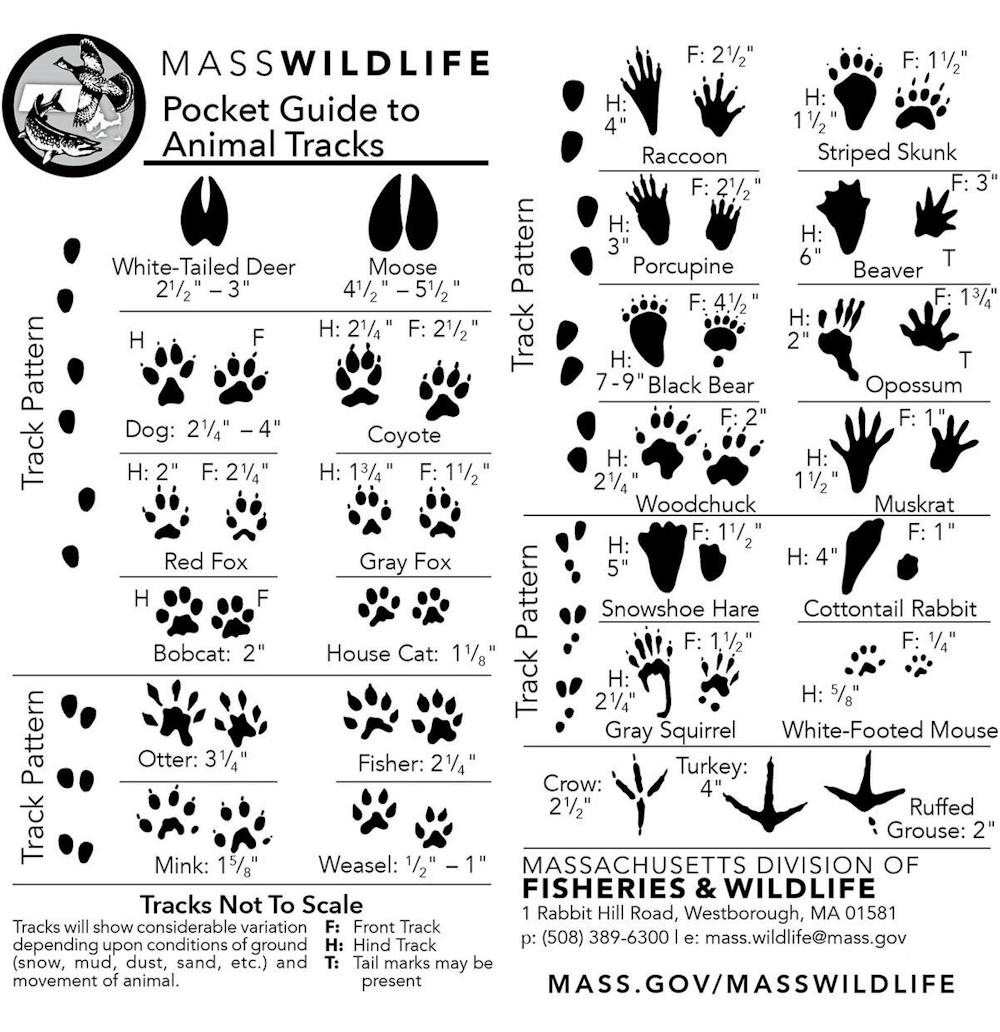
Every morning I go outside to feed the wild deer, as I have said before. However this morning, the 1st October, the rain had softened the ground and I saw animal footprints close to where I put out the COB for the deer.
Here’s a photograph albeit it is almost impossible to distinguish.
Anyway, to the post.
ooOOoo
How to identify animal tracks, burrows and other signs of wildlife in your neighborhood
Your neighborhood is home to all sorts of amazing animals, from racoons, squirrels and skunks to birds, bugs and snails. Even if you don’t see them, most of these creatures are leaving evidence of their activities all around you.
Paw prints in different shapes and sizes are clues to the visitors who pass through. The shapes of tunnels and mounds in your yard carry the mark of their builders.
Even the stuff animals leave behind, whether poop or skeletons, tells you something about the wilder side of the neighborhood.
Tree squirrels can excavate small holes all over a yard to hide seeds and nuts or when searching for them. Ground squirrels also create burrows. Snowmanradio/Wikimedia Commons, CC BY
I’m a zoologist and director of the Hefner Museum of Natural History at Miami University of Ohio, where we work with all kinds of wildlife specimens. With a little practice, you’ll soon notice a lot more evidence of your neighborhood friends when you step outside.
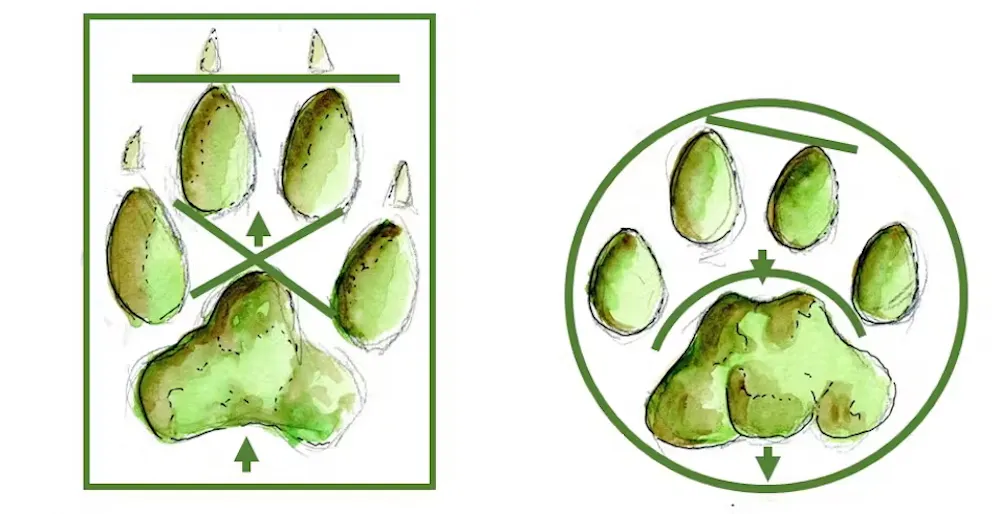
The dog family, including coyotes and foxes, can be differentiated from the cat family by the shape of their palm pads — triangular for dogs, two lobes at the peak for cats.
Canid tracks, left, are roughly rectangular, with the tips of the middle two toes aligned. They often, but don’t always, show claw marks. The pad has an indentation on the back and a projection on the front, with the space between the pad and the toes forming an X. Felid tracks, right, are roughly circular, with the tip of one toe extending slightly farther than all other toes. They seldom show claw marks. The pad has three lobes on the back and an indentation on the front, with the space between the pad and toes forming a curve. Steven Sullivan, CC BY-NC-ND
Both opossums and raccoons leave prints that look like those of a tiny human, but the opossum thumb is held at nearly right angles to the rest of the fingers.
Opossum, left, and raccoon tracks. Like humans, opossums have opposable thumbs. Steven Sullivan
Not all prints are so clear, however.
Invasive rats and native squirrels have prints that often look pretty similar to each other. Water erosion of a skunk print left in mud might connect the toe tips to the palm, making it look more like a raccoon. And prints left in winter slush by the smallest dog in the neighborhood can grow through freezing and thawing to proportions that make people wonder whether wolves have returned to their former haunts.
Often, it’s easiest to figure out which animal left a paw print by correlating its tracks with other evidence.
If what look like squirrel prints lead to a hole in the ground, then it wasn’t a tree squirrel. Stuff a handful of leaves or newspaper in the hole. If it gets pushed out during the day, the hole is probably inhabited by a ground squirrel, such as a chipmunk. But if the plug is pushed out at night, you probably have a rat.
I once noticed a faint trail in the soil near my porch. Using the hole-stuffing method, I determined that something spent most days under the wooden stairs that people constantly, and often loudly, traversed. When I was pretty sure my newly discovered neighbor was home, I used a mirror and flashlight to investigate the opening without exposing myself to a protective resident. Sure enough, there was a cute little skunk staring back at me. https://www.youtube.com/embed/6fCFy29aHbY?wmode=transparent&start=0 Animals that excavate in search of food or to create shelter leave different types of holes. Gardening Latest.
Skunks, and many other local animals, often leave obvious excavations in lawns.
Lawns are biological deserts where few species can live, but those that can survive there often reach high numbers. Lawn grubs – the milk-white, C-shaped caterpillars of a few beetle species – particularly love the lack of competition found in a carpet of grass. Polka dots of dead thatch are one sign of these grubs, but if you have a biodiverse neighborhood, many animals will consume this high-calorie treat before you ever notice them.
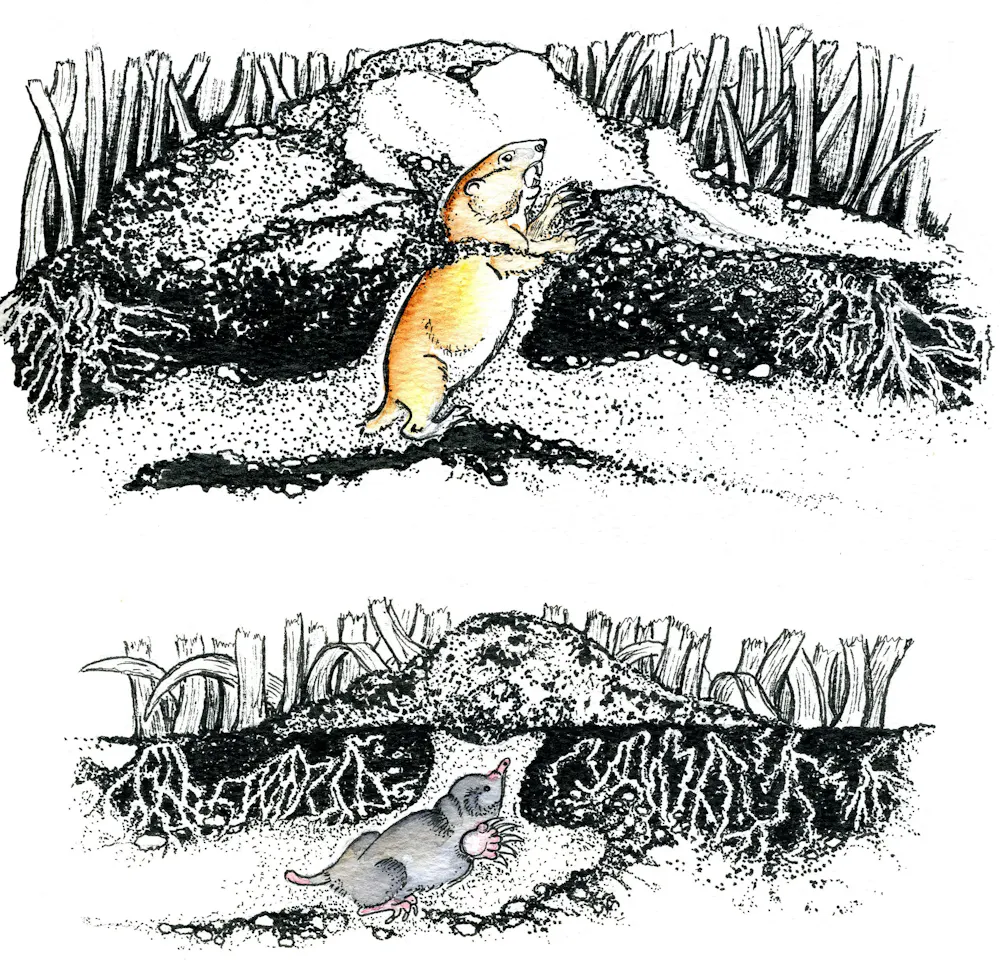
Skunks and raccoons will dig up each grub individually, leaving a small hole that healthy grass can refill quickly. Moles – fist-size insectivores more closely related to bats than rodents – live underground where they virtually swim through soil, leaving slightly raised trails visible in mowed lawns. In spring and fall, moles make volcano-shaped mounds with no visible opening.
Left to right, mole, vole and gopher skulls show clear differences: Moles are insectivores with lots of pointy teeth; voles are rodents the size of mice, and gophers are also rodents but bigger. Steven Sullivan
Gophers, on the other hand, are herbivorous rodents – they eat plants rather than grubs. They also leave tunnels and mounds, but the tunnels are usually very visible and their mounds are crescent-shaped, often with a visible opening.
Voles, not to be confused with moles, are also herbivorous rodents. They’re mouse-size, with tiny, furry ears and short tails. They may dig small holes, but more obviously they leave thatch-lined runways on the surface.
Gophers, top – long-toothed, long-nailed rodents – tunnel and gnaw their way through soil and roots, creating C-shaped mounds that open on the inside of the C. The opening may be big enough for a golf ball or plugged with soil. Moles, bottom – insectivorous, smooth-furred, nearly eyeless and earless – swim through the soil with paddle-shaped forelimbs, occasionally making a volcano-shaped mound with no obvious opening. Steven Sullivan
Even the cicadas singing loudly in the trees in my yard this summer left pinky-size holes in the ground as they emerged 17 years after hatching. The boom-bust cycle of cicadas has brought more moles, squirrels and birds to my neighborhood this year to munch on the nutrient-rich insects.
Think about a dog marking its territory. Sometimes it seems they can’t go for more than a few feet before reading the pee-mail left on every prominent post. Urine, feces and gland oil act like social media posts, conveying each individual’s identity, health, height and reproductive status, the availability and quality of prey, and the extent of their territory. https://www.youtube.com/embed/-3JU_y-uI5E?wmode=transparent&start=0 Different types of animal feces from around the world.
Though most of the smell communication is lost on humans, the contents of the feces can tell a lot about the inhabitants of a neighborhood.
Domestic dog poop is usually just a big, homogeneous lump because they eat processed food, but wild canid feces is often full of bones and fur. Coyote feces is usually lumpy and larger than fox feces, which has pointy ends. Once it has weathered a bit, it’s easy to break open to find identifiable remains such as vole, rat and rabbit. Use care when inspecting feces, since it may transmit parasites.
Depending on time of year, the contents and shape of feces can vary considerably. Raccoon feces lacks the pointy ends and is often filled with seeds, but wild canids may eat lots of seeds, too. Deer feces is usually small, fibrous pellets, but those pellets may form clumps.
If you are lucky, you might find a pellet of bone and fur regurgitated by an owl near the base of a tree. Carefully break it apart and there’s a good chance you’ll find the skull of a vole or rat.
The items inside an owl pellet can tell you something about the smaller animals in the neighborhood, as well as the owls. Andy Reago & Chrissy McClarren, CC BY
Look closely at living and dead trees to find evidence of even smaller neighbors. A fine, uniform, granular sawdust pushed from tiny holes in bark can indicate beetle larvae feces, or “frass.” A large mass of frass at the base of a tree likely indicates carpenter ants.
In contrast to dusty frass, aphids slurp sap so rich in sugar that their feces coats surrounding surfaces in, essentially, maple syrup.
All of these insects attract many species of birds. Woodpeckers are hard to miss as they loudly hammer holes into trees. But don’t blame them for tree decline – they eat the things that are killing the tree.
Look for dead trees
Dead trees are a key feature of wildlife habitat, like a bus stop, and host different occupants throughout the day and over the year.
Dead and dying trees are useful for many animals, from woodpeckers that excavate holes to eagles, crows and other birds that build nests in them. This acorn woodpecker creates holes to store acorns. Eric Phelps via Wikimedia Commons, CC BY
For example, a tree buzzing with cicadas in my yard this summer is quite healthy but has one big, dead branch that has been an important way station for wildlife over the past 20 years.
A decayed cavity at the base of the branch is polished smooth with the activity of generations of squirrels, while the tip is a favorite perch of all the neighborhood birds. By night, it is visited by a great horned owl, who, I somewhat sadly note, may be scanning for my porch skunk.
Decomposers: The neighborhood cleaning crew
This brings us to the decomposers. Animal carcasses are evidence of the neighborhood’s wild population, too, but they typically don’t last long. Insects make quick work of dead animals, often consuming the soft parts of a carcass before it is even noticed by humans.
Long after most activity around the carcass has ceased, exoskeletons left behind by the decomposers will remain in the soil. Dermestids, including the carpet beetles often found in our homes, leave fuzzy larval exoskeletons. Fly pupae look like brown pills. And sometimes adult carrion beetles keep a home underneath partially buried bones for years.
Earthworms, feasting on nutrient-soaked soil, may leave a squirt of mud like a string of hot glue, while ants will leave piles of uniformly sorted sand. Snails will visit carcasses periodically to eat the bones, leaving trails that sparkle like thin, impossibly long ribbons in the morning sun.
From snails to skunks, squirrels to cicadas, most of our neighbors are quiet and seldom interact with us, but they play important roles in the world.
As we get to know them better, through their digging, eating and decomposing, and sometimes by watching them in action, we can better understand the animals that make our own lives possible and, maybe, understand ourselves a little better, too.
Steven Sullivan in that last paragraph poses an interesting question “….. and sometimes by watching them in action, we can better understand the animals that make our own lives possible and, maybe, understand ourselves a little better, too.“
To my mind, nothing beats the sights of the World’s oceans.
In the past, I spent four years living on a yacht, a Tradewind 33, out in Cyprus. During that time I cruised to Turkey, to Greece, to Algiers, and loved it.
Here’s an extract from World Oceans day website.
Why Earth’s oceans are so important
Earth’s oceans are critical to human survival. Indeed, more than half the oxygen in our atmosphere is generated via photosynthesis by phytoplankton and seaweed in oceans. In addition, millions of people depend on fish and other marine animals for food. Research on some marine organisms has led to the development of new medications. Moreover, ocean currents, known as global conveyor belts, help regulate Earth’s climate.
Sir David Attenborough has produced a film Ocean and the trailer follows:
There is so much more to view on the World Oceans Day website. Please go to it.




















 Learning from Dogs
.jpg)


.jpg)