Tag: Miami University

The unacceptable side of technology

The right to repair one’s own technology products is under attack.

I hadn’t really thought of this before now. I am speaking of an article last Friday that was published by The Conversation.

A large part of me is very open to the ways that technology is helping me. I presume that I am far from being alone.

Here is that article that questions the way things are.

ooOOoo

Today’s bans on DIY repairs of everything from cell phones to tractors grew out of Hollywood’s fear of videotaping
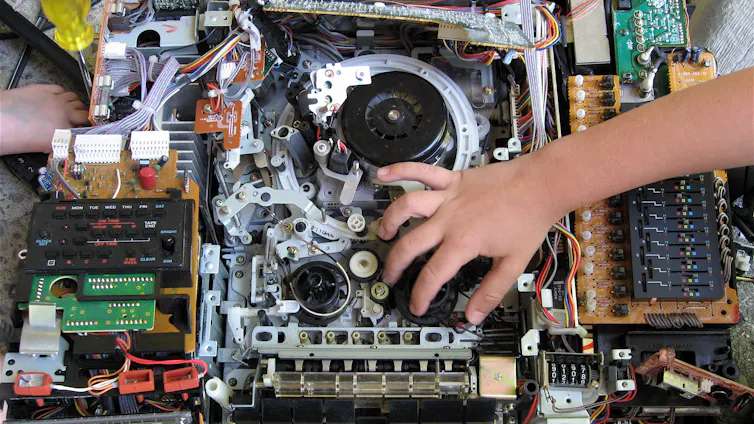
Betamax video recorders like this one helped set off a chain of events leading to bans on repairing your own devices. Steve Jurvetson/Wikimedia Commons, CC BY

Oana Godeanu-Kenworthy, Miami University

If you have ever tried to repair something, realized that it was beyond your financial or technical means, and ended up buying a new one, you are not alone. Repairing electronics and household appliances has not been a real option in the United States for decades now, particularly for items that have proprietary software in them.

Absurd situations have proliferated. It can cost about the same to buy a new printer as it does to replace the ink cartridge. The U.S. Department of Defense cannot repair the weapons systems it purchases because the intellectual property rights remain with the manufacturer. John Deere, the farming equipment company, doesn’t allow farmers to access the software needed to repair their own combines and tractors because, while the purchase covers the physical machinery, it does not cover the software.

One consequence, in addition to cost and frustration for consumers, is environmental harm. The U.S. is the world’s second producer of electronic waste after China, to the tune of about 43 lbs (19.5 kg) of electronic waste annually per person. Only 25% of this e-waste is recycled.

The right-to-repair movement emerged in response, calling for people to be able to repair what they purchase, or have third parties do the repair work, without unnecessary financial, legal or technical barriers. Right to repair seems to be a rare area of bipartisanship in Congress. The Warrior Right to Repair Act – introduced in 2025 by a Democrat – and the Repair Act – introduced by a Republican – are two ongoing legislative initiatives to create a federal legal framework that would make it easy and cheap for American users to repair their devices. Both bills are fiercely opposed by industry groups.

As a scholar of American culture, I found through my research that the origins of the legal and technical obstacles to product repairs lie in debates in the 1980s over new media and copyright guardrails.

Hollywood and VCRs

The rapid rise and popularity of video cassette recorders, or VCRs, in the late 1970s transformed films and TV shows from transient experiences into tangible consumer goods. As I show in my book, “Videotape,” despite the potential for extra revenue, Hollywood was alarmed by the fact that users were now able to copy films on videotape, and tried to stop the technology. Today’s repair bans are part of that story.

The first U.S. copyright provisions were embedded in the 1790 Constitution. Over time, the law was amended to include new technologies, but at the core of future legal arrangements remained the initial intent: to protect the financial rights of creators while giving enough access to information for society as a whole to progress.

Until the second half of the 20th century, the American doctrine of fair use, which allows the unlicensed use of protected works under specific conditions, allowed judges to prevent copyright law from negatively affecting public interest. Organizations such as public libraries, book clubs, universities and news organizations benefited from this legal approach. The concept was codified into American law in the Copyright Act of 1976.

When the film studios took Sony to court to stop the production and sale of video recorders in 1976, they argued that Sony’s product encouraged copyright infringement. But the U.S. Supreme Court ruled in 1984 that taping TV content for personal use did not violate copyright law, expanding the understanding of fair use.

The industry then focused on finding a technological solution to the piracy problem and on securing stricter legal protections for its products.

They identified the digital versatile disc, or DVD, as a safer alternative to the VHS tape. Initially, the DVD was a read-only format. It took a few more years of engineering before affordable recording was possible. Even then, the process was far more complicated for users than videotape recording. In 1997, barely one year after the video disc was launched, all of the Motion Picture Association of America member studios joined the DVD Forum, collectively adopted the new format and started to phase out films released on videotape. https://www.youtube.com/embed/46RDkiy5h3U?wmode=transparent&start=0 Manufacturers use several tactics to block consumers and third-party repair shops from fixing their products.

Copyright and virtual locks

Then came digital rights management. Collectively, the term refers to the battery of technological tools that the industry developed in order to control user access to content. These include encryption software and various forms of authentication or enforcement software that limit which types of digital activities users can perform. For instance, some mechanisms block the option to download or share a digital file.

The Digital Millennium Copyright Act, or DMCA, signed into law by President Bill Clinton in 1998, provided the broad legal framework that allowed these technological locks to expand far beyond entertainment, including to software. The Digital Millennium Copyright Act reflected a new alignment in interests between the entertainment and software industries. It increased existing penalties for copyright infringement online and criminalized any technology used to bypass technological locks. The law was adopted although at the time – and since then – critics warned that it could stifle innovation and increase costs for consumers.

Since 1998, more and more consumer products, from toys to dishwashers, use microchips and proprietary software protected by copyright. Because of the Digital Millennium Copyright Act, third party repairers cannot alter or bypass the proprietary software. If they did so, they would be liable for infringing the manufacturer’s intellectual property rights, as is the case for John Deere farm equipment. Some electronics are even designed to make tampering with the product impossible.

Manufacturers maintain that only they or authorized personnel can and should repair their products. These repairs are often quite costly. When getting a product repaired becomes almost as expensive as buying a new one, many consumers will choose to buy and throw repairable items away.

Rising resentment over repair bans

Technology tends to outpace existing legal arrangements. With over 80% of Americans supporting the right to repair, it remains to be seen when or if American law will catch up with the unexpected consequences of a law meant to protect the intellectual rights of the creative industries, but which is now hurting consumers’ pocket books.

Oana Godeanu-Kenworthy, Teaching Professor of American Studies, Miami University

This article is republished from The Conversation under a Creative Commons license. Read the original article.

ooOOoo

The end of that article points out that more than 80% of Americans support the right to repair and, I guess, that support extends far beyond the USA.

Indeed, a quick online search found that in the UK an organisation, Restart, had a website on the subject. Here is a little of what they said;

The last few years have been really exciting for the Right to Repair in many countries outside the UK. Around the world we’ve seen people get access to more repairable and longer lasting products, cheaper repair options and better information about product repairability. As a result, repair is helping tackle climate change, reduce waste, lower living costs, support communities and create green skilled jobs in more places than ever.

Then another search found out that the Eurpoean Commission had a Right to repair law in place. It was introduced in 2024. Here’s how it starts:

“The new rules reinforce the right to repair, aim to reduce waste and bolster the repair sector by making it easier and more cost-effective to repair goods.

So, hopefully, Oana, the teaching professor at Miami University, can establish a new law that will give American consumers the right to replair their technology belongings.
Identifying tracks.

Living in a rural area has a bonus!

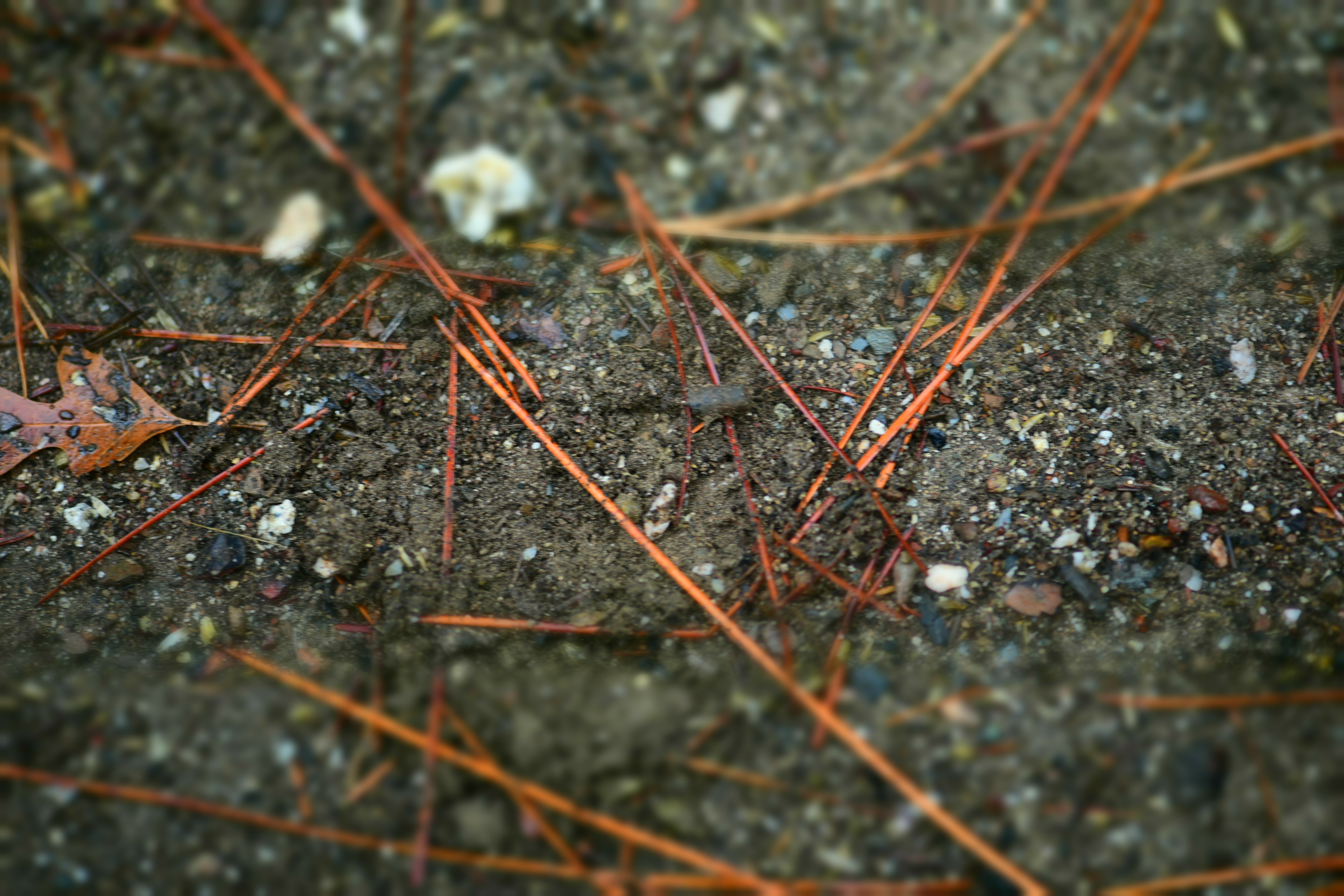
Every morning I go outside to feed the wild deer, as I have said before. However this morning, the 1st October, the rain had softened the ground and I saw animal footprints close to where I put out the COB for the deer.

Here’s a photograph albeit it is almost impossible to distinguish.

Anyway, to the post.

ooOOoo

How to identify animal tracks, burrows and other signs of wildlife in your neighborhood

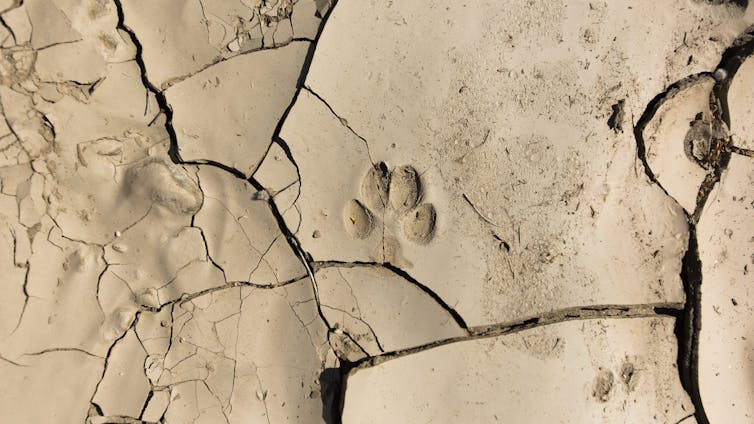
A paw print in baked mud at Joshua Tree National Park, likely from a coyote. Brad Sutton/National Park Service

Steven Sullivan, Miami University

Your neighborhood is home to all sorts of amazing animals, from racoons, squirrels and skunks to birds, bugs and snails. Even if you don’t see them, most of these creatures are leaving evidence of their activities all around you.

Paw prints in different shapes and sizes are clues to the visitors who pass through. The shapes of tunnels and mounds in your yard carry the mark of their builders.

Even the stuff animals leave behind, whether poop or skeletons, tells you something about the wilder side of the neighborhood.

A gray squirrel (Sciurus carolinenensis), nose down in a small hole that it's excavating in the dirt.
Tree squirrels can excavate small holes all over a yard to hide seeds and nuts or when searching for them. Ground squirrels also create burrows. Snowmanradio/Wikimedia Commons, CC BY

I’m a zoologist and director of the Hefner Museum of Natural History at Miami University of Ohio, where we work with all kinds of wildlife specimens. With a little practice, you’ll soon notice a lot more evidence of your neighborhood friends when you step outside.

What makes those animal tracks?

You can learn a lot from a nice, crisp paw print.

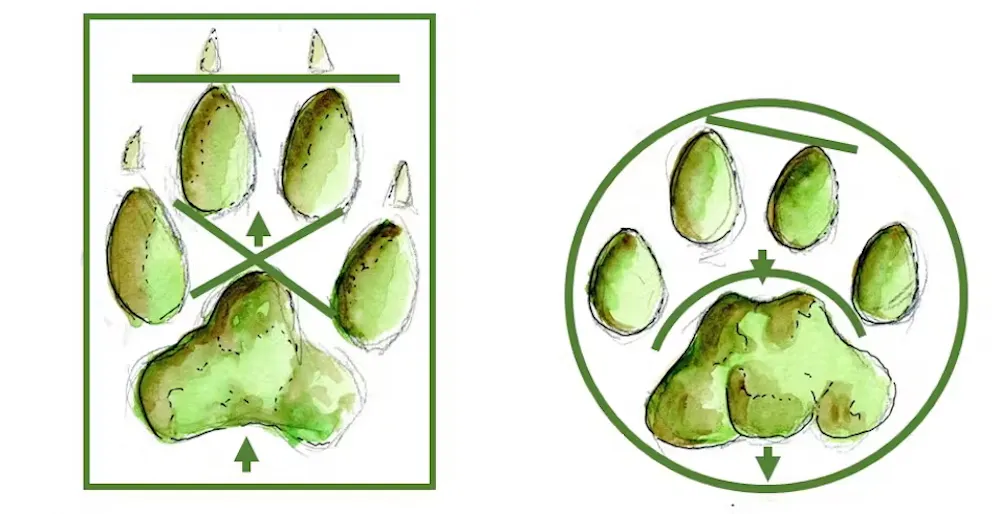
The dog family, including coyotes and foxes, can be differentiated from the cat family by the shape of their palm pads — triangular for dogs, two lobes at the peak for cats.

Images of footprints of canid and felid.
Canid tracks, left, are roughly rectangular, with the tips of the middle two toes aligned. They often, but don’t always, show claw marks. The pad has an indentation on the back and a projection on the front, with the space between the pad and the toes forming an X. Felid tracks, right, are roughly circular, with the tip of one toe extending slightly farther than all other toes. They seldom show claw marks. The pad has three lobes on the back and an indentation on the front, with the space between the pad and toes forming a curve. Steven Sullivan, CC BY-NC-ND

Both opossums and raccoons leave prints that look like those of a tiny human, but the opossum thumb is held at nearly right angles to the rest of the fingers.

Illustrations of two tracks. The opposable thumb is evident with the oppossum track.
Opossum, left, and raccoon tracks. Like humans, opossums have opposable thumbs. Steven Sullivan

Not all prints are so clear, however.

Invasive rats and native squirrels have prints that often look pretty similar to each other. Water erosion of a skunk print left in mud might connect the toe tips to the palm, making it look more like a raccoon. And prints left in winter slush by the smallest dog in the neighborhood can grow through freezing and thawing to proportions that make people wonder whether wolves have returned to their former haunts.

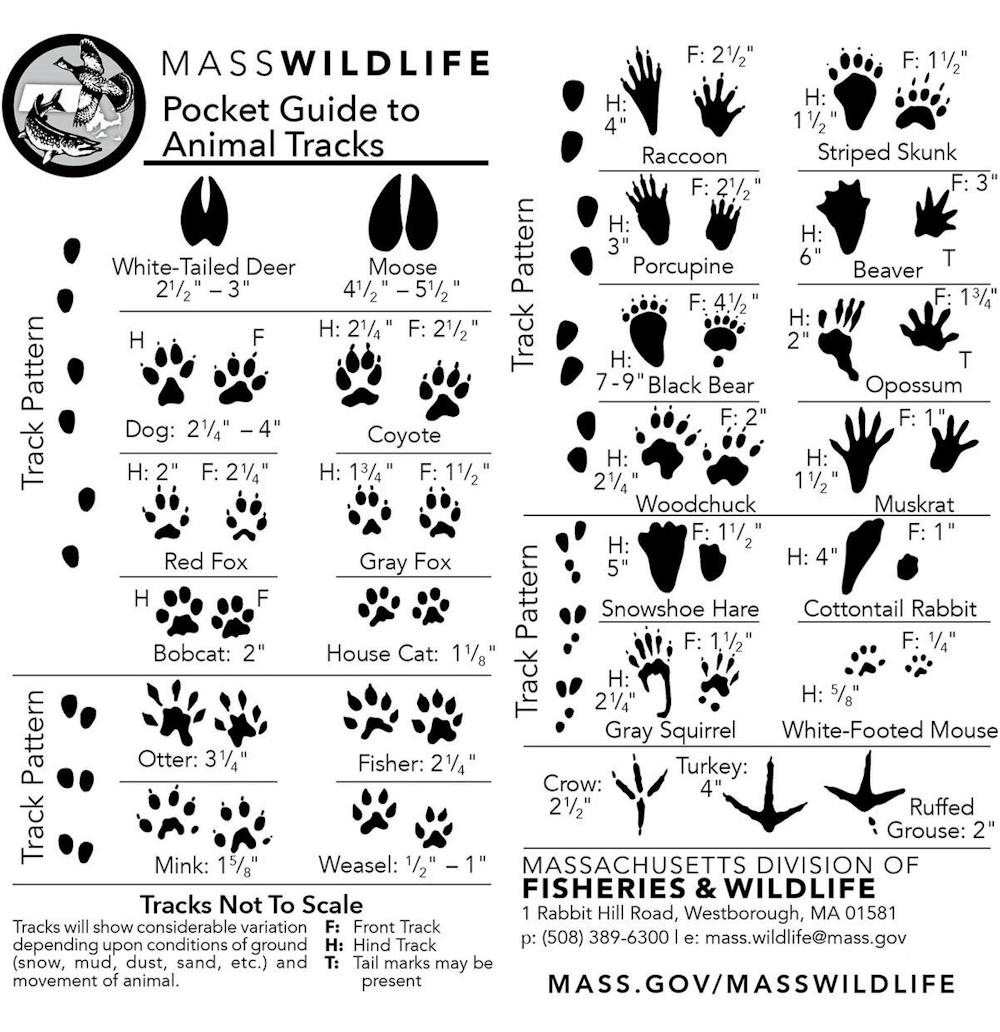
There are good reference books where you can learn more about track analysis, and it can be fun to go down the rabbit hole of collecting and studying prints.

Illustrations of animal tracks by typical size, pairs and track pattern.
Examples of many types of animal tracks found in the Northeast and other parts of North America. Massachusetts Division of Fisheries and Wildlife

Clues from holes and other animal excavations

Often, it’s easiest to figure out which animal left a paw print by correlating its tracks with other evidence.

If what look like squirrel prints lead to a hole in the ground, then it wasn’t a tree squirrel. Stuff a handful of leaves or newspaper in the hole. If it gets pushed out during the day, the hole is probably inhabited by a ground squirrel, such as a chipmunk. But if the plug is pushed out at night, you probably have a rat.

I once noticed a faint trail in the soil near my porch. Using the hole-stuffing method, I determined that something spent most days under the wooden stairs that people constantly, and often loudly, traversed. When I was pretty sure my newly discovered neighbor was home, I used a mirror and flashlight to investigate the opening without exposing myself to a protective resident. Sure enough, there was a cute little skunk staring back at me. https://www.youtube.com/embed/6fCFy29aHbY?wmode=transparent&start=0 Animals that excavate in search of food or to create shelter leave different types of holes. Gardening Latest.

Skunks, and many other local animals, often leave obvious excavations in lawns.

Lawns are biological deserts where few species can live, but those that can survive there often reach high numbers. Lawn grubs – the milk-white, C-shaped caterpillars of a few beetle species – particularly love the lack of competition found in a carpet of grass. Polka dots of dead thatch are one sign of these grubs, but if you have a biodiverse neighborhood, many animals will consume this high-calorie treat before you ever notice them.

Skunks and raccoons will dig up each grub individually, leaving a small hole that healthy grass can refill quickly. Moles – fist-size insectivores more closely related to bats than rodents – live underground where they virtually swim through soil, leaving slightly raised trails visible in mowed lawns. In spring and fall, moles make volcano-shaped mounds with no visible opening.

Three small skulls
Left to right, mole, vole and gopher skulls show clear differences: Moles are insectivores with lots of pointy teeth; voles are rodents the size of mice, and gophers are also rodents but bigger. Steven Sullivan

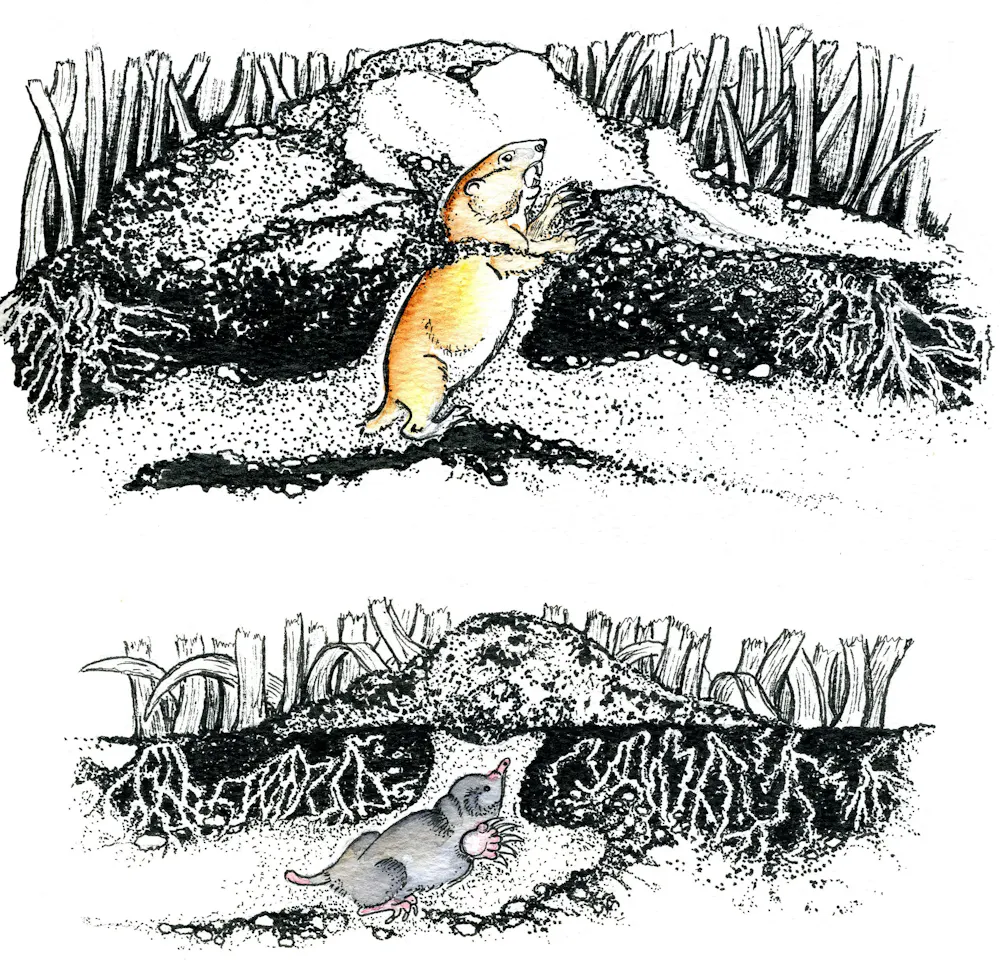
Gophers, on the other hand, are herbivorous rodents – they eat plants rather than grubs. They also leave tunnels and mounds, but the tunnels are usually very visible and their mounds are crescent-shaped, often with a visible opening.

Voles, not to be confused with moles, are also herbivorous rodents. They’re mouse-size, with tiny, furry ears and short tails. They may dig small holes, but more obviously they leave thatch-lined runways on the surface.

Illustration of a mole and a gopher under ground
Gophers, top – long-toothed, long-nailed rodents – tunnel and gnaw their way through soil and roots, creating C-shaped mounds that open on the inside of the C. The opening may be big enough for a golf ball or plugged with soil. Moles, bottom – insectivorous, smooth-furred, nearly eyeless and earless – swim through the soil with paddle-shaped forelimbs, occasionally making a volcano-shaped mound with no obvious opening. Steven Sullivan

Even the cicadas singing loudly in the trees in my yard this summer left pinky-size holes in the ground as they emerged 17 years after hatching. The boom-bust cycle of cicadas has brought more moles, squirrels and birds to my neighborhood this year to munch on the nutrient-rich insects.

The evidence left behind, including poop

Where there is food, there is poop. Though the subject of feces is taboo among polite human society, it’s a fundamental, though understudied, communication method for many mammals.

Think about a dog marking its territory. Sometimes it seems they can’t go for more than a few feet before reading the pee-mail left on every prominent post. Urine, feces and gland oil act like social media posts, conveying each individual’s identity, health, height and reproductive status, the availability and quality of prey, and the extent of their territory. https://www.youtube.com/embed/-3JU_y-uI5E?wmode=transparent&start=0 Different types of animal feces from around the world.

Though most of the smell communication is lost on humans, the contents of the feces can tell a lot about the inhabitants of a neighborhood.

Domestic dog poop is usually just a big, homogeneous lump because they eat processed food, but wild canid feces is often full of bones and fur. Coyote feces is usually lumpy and larger than fox feces, which has pointy ends. Once it has weathered a bit, it’s easy to break open to find identifiable remains such as vole, rat and rabbit. Use care when inspecting feces, since it may transmit parasites.

Depending on time of year, the contents and shape of feces can vary considerably. Raccoon feces lacks the pointy ends and is often filled with seeds, but wild canids may eat lots of seeds, too. Deer feces is usually small, fibrous pellets, but those pellets may form clumps.

If you are lucky, you might find a pellet of bone and fur regurgitated by an owl near the base of a tree. Carefully break it apart and there’s a good chance you’ll find the skull of a vole or rat.

A tiny skull and fur found in an owl pellet
The items inside an owl pellet can tell you something about the smaller animals in the neighborhood, as well as the owls. Andy Reago & Chrissy McClarren, CC BY

Look closely at living and dead trees to find evidence of even smaller neighbors. A fine, uniform, granular sawdust pushed from tiny holes in bark can indicate beetle larvae feces, or “frass.” A large mass of frass at the base of a tree likely indicates carpenter ants.

In contrast to dusty frass, aphids slurp sap so rich in sugar that their feces coats surrounding surfaces in, essentially, maple syrup.

All of these insects attract many species of birds. Woodpeckers are hard to miss as they loudly hammer holes into trees. But don’t blame them for tree decline – they eat the things that are killing the tree.

Look for dead trees

Dead trees are a key feature of wildlife habitat, like a bus stop, and host different occupants throughout the day and over the year.

A woodpecker with a read head on the side of a tree with dozens of holes that have acorns stuffed into them.
Dead and dying trees are useful for many animals, from woodpeckers that excavate holes to eagles, crows and other birds that build nests in them. This acorn woodpecker creates holes to store acorns. Eric Phelps via Wikimedia Commons, CC BY

For example, a tree buzzing with cicadas in my yard this summer is quite healthy but has one big, dead branch that has been an important way station for wildlife over the past 20 years.

A decayed cavity at the base of the branch is polished smooth with the activity of generations of squirrels, while the tip is a favorite perch of all the neighborhood birds. By night, it is visited by a great horned owl, who, I somewhat sadly note, may be scanning for my porch skunk.

Decomposers: The neighborhood cleaning crew

This brings us to the decomposers. Animal carcasses are evidence of the neighborhood’s wild population, too, but they typically don’t last long. Insects make quick work of dead animals, often consuming the soft parts of a carcass before it is even noticed by humans.

Long after most activity around the carcass has ceased, exoskeletons left behind by the decomposers will remain in the soil. Dermestids, including the carpet beetles often found in our homes, leave fuzzy larval exoskeletons. Fly pupae look like brown pills. And sometimes adult carrion beetles keep a home underneath partially buried bones for years.

A box with different types of beetles on display
A collection of beetles found around Austin, Texas. Beetles are common decomposers. VPaleontologist/Wikimedia Commons, CC BY-SA
Two beetles and several flies feeding.
Carrion beetles and flies feeding. Benoit Brummer/Wikimedia Commons, CC BY

Earthworms, feasting on nutrient-soaked soil, may leave a squirt of mud like a string of hot glue, while ants will leave piles of uniformly sorted sand. Snails will visit carcasses periodically to eat the bones, leaving trails that sparkle like thin, impossibly long ribbons in the morning sun.

From snails to skunks, squirrels to cicadas, most of our neighbors are quiet and seldom interact with us, but they play important roles in the world.

As we get to know them better, through their digging, eating and decomposing, and sometimes by watching them in action, we can better understand the animals that make our own lives possible and, maybe, understand ourselves a little better, too.

Steven Sullivan, Director of the Hefner Museum of Natural History, Miami University

This article is republished from The Conversation under a Creative Commons license. Read the original article.

ooOOoo

Another super article from The Conversation.

Steven Sullivan in that last paragraph poses an interesting question “….. and sometimes by watching them in action, we can better understand the animals that make our own lives possible and, maybe, understand ourselves a little better, too.

I wish, I wish, I wish!