Category: Capitalism

Caring does make a difference.

“All that evil needs to succeed is for good people to do nothing.”

You will recall that on the 8th March I published a post called Anger Alert. It was about raising awareness for “Stella has spent the last two years locked in a 3-by-9 foot cage in a kennel in Devon, England. She has never been let out to exercise or play.”

I included a link to a Care2 Petition that as of now has been signed by nearly 38,000 persons including many who read this blog. Thank you. Keep Stella in your thoughts.

Regretably, Stella’s imprisonment has not yet come to an end but here is a good news story that underlines why we must always keep fighting for the things we believe need to be changed.

ooOOoo

Over 61,000 Care2 Activists Want To Save These Dogs From Euthanasia

3170931.large

When Kirstyn Smith heard that 31 pit bulls had been rescued from a dog-fighting ring in her native Ontario, Canada, she was thrilled, but then she learned there was a catch: Officials had plans to euthanize the dogs, rather than free them. That’s when she jumped into action and decided to create a Care2 petition.

That petition now has over 61,000 signatures, as people around the world react to the horrifying and deeply unfair death sentence.

Here’s what Smith wrote in her petition:

“My name is Kirstyn Smith and I have been following a very heart-breaking story since October 2015. The town of Chatham-Kent, ON fell victim to a horrible and cruel act where 31 pitbull-type dogs were seized from an alleged dog fighting-ring.

 These animals need our help.

Please sign and share this petition to demand that these dogs are treated humanely, medically taken care of and rehabilitated in order to live out their lives away from torture and neglect.”

Close To Victory

On March 10, she issued this update to her petition:

“We are so close! The accused have agreed to hand over ownership to Dog Tales Sanctuary in King City, ON. This is incredible news, but we still need the Ministry of Community Safety & Correctional Services to give proper designation which will allow the dogs to legally reside in Ontario. Thank you to each and every one of you for your support on this long journey!!”

Smith is referring to the fact that pit bulls are banned in the province of Ontario, and only a pound can take in pit bull-type dogs. However, Dog Tales is not a pound, so the sanctuary must make a special application in an effort to get the designation that will allow them to take in the pit bulls.

This of course is not unique to Ontario. Pit bulls are banned or restricted in most Canadian provinces; in the U.S., over 700 cities have enacted breed-specific legislation which is any ordinance, or dog law, that relates to specific dog breeds but does not affect any others.

The next court date will be March 18, and there will likely be another one after that, but things are moving forward in a positive way, thanks largely to Smith’s persistence and the awesome support of those 61,000 Care2 activists.

An Awesome Sanctuary

If justice prevails, these dogs will move to their new home, which CTV News London describes as an “opulent sanctuary in King City, Ontario, which is owned by one of Canada’s richest families.”

“The issues present are nothing that we haven’t seen before, and nothing that we feel cannot be changed with time, patience, and the proper technique,” says Clare Forndran, a spokesperson at Dog Tales Rescue and Sanctuary.

“At Dog Tales we are fortunate enough to have the facilities and the resources to provide for our dogs in ways that many other shelters cannot,” owner Danielle Eden said in an email.

While this story has come a long way and is very close to a happy ending, it’s not quite there yet.

You can help rescue these dogs from a death sentence by signing Smith’s petition, asking the authorities to treat these animals humanely, and take care of them so that they can live out their lives away from torture and neglect. 

And if you have a cause that you care deeply about, and want to make a difference in the world, you can create your own petition, just as Kirstyn Smith did. You’ll soon find the Care2 community of activists ready to join you in your cause. And if you’d like to read more about petitions, you can check out this handy guide.

ooOOoo

So, please, if you are not one of those 61,000 who have already signed this petition then, without delay, go here and add your support to this wonderful cause.

Interconnections Three

Is there a case for optimism? You bet there is!

To be honest, at a personal level I just don’t know the answer to that question. It seems to depend on the mood that Jean and I are in at any particular time. All I can fall back on is that well-used saying from me: “Never underestimate the power of unintended consequences”.

In other words, we shouldn’t underestimate the strength of millions of good people when their demands start reaching out to those in power. (And whatever your reaction to this post, please don’t miss watching the inspirational Al Gore speech towards the end of this post.)

Recently over on the Grist site there was an article about the critical changes that each and every one of us should be making. I want to share it with you in full.

ooOOoo

Want to fight climate change? Here are the 7 critical life changes you should make

None so blind …

…. as those who choose not to see!

Note: This is a long and pretty depressing post yet one that contains a critically vital message. Just wanted to flag that up.

This is not the first time I have used this expression as a header to a blogpost. The first time was back in August 2013 when I introduced the TomDispatch essay: Rebecca Solnit, The Age of Inhuman Scale.

I am using it again to introduce another TomDispatch essay. Like the Solnit essay a further reflection on the incredible madness of these present global times.

But before getting to that essay let me refer to a recent Patrice Ayme post. It is called: New Climate Lie: Magical CO2 Stop Possible.

Patrice included this graph:

To Stay Below 2C, CO2 Emissions Have To Stop Now. We Are On The Red Trajectory: Total Disaster

Adding:

Tempo depended upon the CO2 concentration, pitch upon the Earth global temperature, distortion upon the energy balance on land in watts per square meter. The numbers used were past and anticipated. After 2015, the graphs became two: one was red, the bad case scenario, the other was blue, and represented the good scenario.

As I looked at the blue graphs, the optimistic graphs, I got displeased: the blue CO2 emissions, the blue temperature, and the blue power imbalance, had a very sharp angle, just in 2016. First a sharp angle is mathematically impossible: as it is now, the curves of CO2, and temperature are smooth curves going up (on the appropriate time scale). It would require infinite acceleration, infinite force. Even if one stopped magically any human generated greenhouse gases emissions next week, the CO2 concentration would still be above 400 ppm (it is 404 ppm now). And it would stay this way for centuries. So temperature would still rise.

The composer, who was on stage, had been advised by a senior climate scientist, a respectable gentleman with white hair, surrounded by a court, who got really shocked when I came boldly to him, and told him his blue graph was mathematically impossible.

I told him that one cannot fit a rising, smooth exponential with a sharp angle bending down and a line. Just fitting the curves in the most natural, smooth and optimistic way gives a minimum temperature rise of four degrees Celsius. (There is a standard mathematical way to do this, dating back to Newton.)

Read Patrice’s essay in full here.

However, I find the malaise gripping us in these times to be infinitely more difficult to understand than what is or is not mathematically possible. I just can’t get my mind around the possibility that we are in an era where greed, inequality and the pursuit of power and money will take the whole of humanity over the edge.

Why, for goodness sake, is the U.S., my adopted home country, pursuing gas exports? As I read here: United States On Path to Becoming Major Exporter of Natural Gas Despite Climate Impacts
Here’s a taste of this report from Julie Dermansky of Desmogblog:

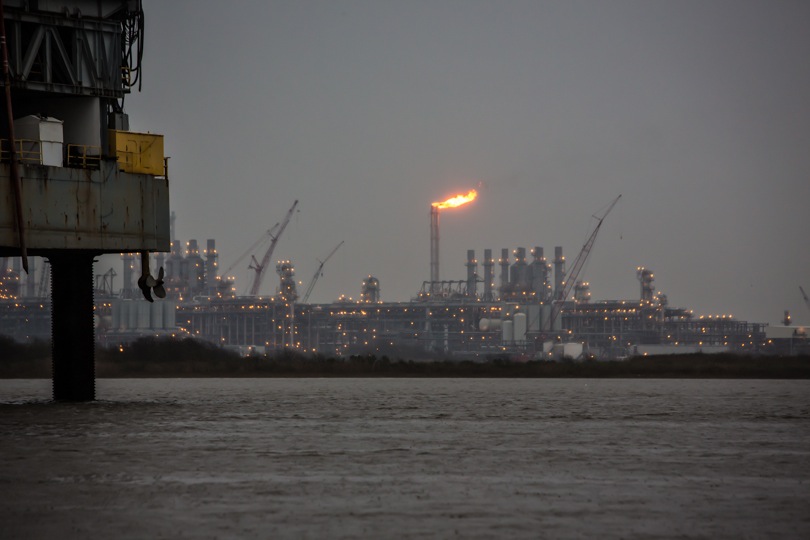
A flare at Cheniere Energy Sabine Pass LNG facility. ©2016 Julie Dermansky

But rather than acknowledging the climate risk posed by further expansion of LNG export infrastructure, the U.S. Congress and the Obama administration are moving in the opposite direction.

The natural gas export industry may grow even more rapidly if the first new bipartisan energy legislation drafted since 2007 passes. The Energy Policy Modernization Act of 2015, known as S. 2012, would expedite permitting for LNG export terminals.

The bill’s passage was considered imminent until it derailed with the introduction of an amendment that would provide emergency aid towards solving the lead-contaminated water crisis in Flint, Michigan. Now the passage of the bill hinges on whether the Senate will come to terms on aid to Flint.

Lobbying for the bill has been heavy. As DeSmog’s Steve Horn reported: “The list of lobbyists for S.2012 is a who’s who of major fossil fuel corporations and their trade associations: BP, ExxonMobil, America’s Natural Gas Alliance, American Petroleum Institute, Peabody Energy, Arch Coal, Southern Company, Duke Energy and many other prominent LNG export companies.”

I highlighted the name ExxonMobil in that extract because that company is the subject of Tom Engelhardt’s essay from Bill McKibben. Republished here with Tom’s kind permission.

ooOOoo

Tomgram: Bill McKibben, It’s Not Just What Exxon Did, It’s What It’s Doing

Shining a light on these times.

There’s many a slip ‘twixt the cup and the lip.

That sub-heading is a very old proverb supporting the idea  “that even when the outcome of an event seems certain, things can still go wrong.”

That proverb came to me when I was reading a TomDispatch essay that was published last Tuesday. I couldn’t make up my mind about whether or not to continue with yesterday’s mood of “Living in interesting times” but in the end decided to so do. Because Peter Van Buren’s essay, published as a Tomgram, needs to be widely read so that as many as possible appreciate the need to reach out to those that should be supported.

I am very grateful to Tom Engelhardt for his continuing permission for me to republish his TomDispatch essays.

ooOOoo

Tomgram: Peter Van Buren, Minimum Wage, Minimum Chance

We live in interesting times!

The impending ‘banquet of consequences’.

The Welcome page of this blog includes this:

Dogs ‘teaching’ man to be so successful a hunter enabled evolution, some 20,000 years later, to farming,  thence the long journey to modern man.  But in the last, say 100 years, that farming spirit has become corrupted to the point where we see the planet’s plant and mineral resources as infinite.  Mankind is close to the edge of extinction, literally and spiritually.

I continue that theme in Part Two of my book (Chapter 7: This Twenty-First Century)

Bad news sells! Bad news also causes stress and worry. In my previous explanation, I explained that the last thing you want is a catalogue of all the things that have that power to cause you stress and worry. However, I do see three fundamental aspects of this new century that have their roots in that loss of principles that I referred to in the previous chapter. They are

1. the global financial system,
2. the potential for social disorder, and
3. the process of government.

Because they are at the heart of how the coming years will pan out.

The first aspect, our global financial system, was selected because it underpins all our lives in so many ways. When I was living in southwest England I was a client of Kauders Portfolio Services[1]. The founder of the company, David Kauders, published[2] a book, The Greatest Crash, in 2011. It was an obvious read for me at that time and I still have the book on my shelves here in Oregon.
David explained that whether we like it or not, our lives are inextricably caught up in the twin dependencies of the global financial system: credit and debt. As he wrote in his opening chapter:

Households can barely afford their existing debts, let alone take on more. Since households now prefer not to borrow, indeed some even choose to pay back debt, it follows that those who have already borrowed, as a group, can no longer contribute to economic expansion.
People can be divided into borrowers and savers. With existing borrowers unable to afford or unwilling to take on extra debt, can new borrowers be found instead? Those who do not need to borrow are unlikely to volunteer. Except for the young wishing to buy houses, facing the reality that house prices are beyond their pockets, where are the new borrowers?
Businesses are also under pressure. There has been an inadequate recovery from recession, business prospects are poor as households cut back their spending. Lack of bank lending is a symptom rather than a cause, for if existing businesses were to be given more credit, they would probably be unlikely to find profitable growth opportunities in a world of austerity.

Later on in the book David describes this as “the financial system limit”. In other words, the period of growth and expansion, especially of financial and economic expansion, has come to an end in a structural sense. This was his perspective from 2011.

Recently, I chose to reread The Greatest Crash. What struck me forcibly, reading the book again some four years later on, was how visible this “system limit” appeared in the world today. Everywhere there are signs that the era of growth has come to an end. Many countries are now indebted to a point that reinforces the proposition of there being a financial system limit. The United States is greatly in debt[3] but the only thing mitigating that situation, for the time being anyway, is that the American dollar is the quasi dominant global currency.
The changing nature of the global population is also reinforcing the fact that this is the end of a long period of growth. Even without embracing the question of how much longer we can increase the number of people living on a finite planet, the demographics spell out a greater-than-even chance of a decline in consumption and economic activity. Simply because in all regions of the planet, except for India where there is still a growing youth element in the country, people are ageing. To state the obvious, ageing persons do not consume as much as middle-aged and younger persons.
Thus, the world’s economy that is just around the corner is certainly going to be very different to what it has been in the past. It is not being widely discussed. Worse than that, there is a widespread assumption adopted by many governments that a return to the “normal” economic growth of previous times is a given. Many do not share that assumption.

The second aspect that isn’t being spoken about is the potential for massive, widespread social disorder. All summed up in just three words: greed, inequality, and poverty. Just three words that metaphorically appear to me like a round, wooden lid hiding a very deep, dark well. That lifting this particular lid, the metaphorical one, exposes an almost endless drop into the depths of where our society appears to have fallen.
Even the slightest raising of awareness of where this modern global world is heading is scary. I have in mind the author Thomas Piketty who warned[4] that, “the inequality gap is toxic, dangerous.” Then there was the news in 2015[5] that, “Billionaires control the vast majority of the world’s wealth, 67 billionaires already own half the world’s assets; by 2100 we’ll have 11 trillionaires, while American worker income has stagnated for a generation.”

The third and final aspect that isn’t being widely discussed is the process of government. Not from the viewpoint of “left” or “right”, Labour or Conservative, Democratic or Republican (insert the labels appropriate to your own country), that is being discussed ad nauseum, but from the viewpoint of good government. It might be a terrible generalisation but it is still a fair criticism to say that many peoples of many countries have lost faith in their governments.
There appears to be a chronic absence of open debate about the need for good government, what that good government would look like, and how do societies bring it about.

If we were a dog pack, then our leader, our female mentor dog, would have moved us all to a new, pristine territory!


[1] My relationship was terminated when I became a resident of the United Staes in 2011.
[2] 2011, Sparkling Books.
[3] http://www.usgovernmentdebt.us offers on the 14th November, 2014 that the Federal Debt of the United States was about $18,006,100,032,000.
[4] In his book Capital in the Twenty-First Century (Belknap Press, 2014).
[5] http://www.marketwatch.com/story/capitalism-is-killing-americas-morals-our-future-2015-05-22.

Yes, these are indeed very interesting times!

So, dear reader, you can understand why a recent article over on Naked Capitalism spoke to me. It was penned by Satyajit Das, a former banker and the author of a number of books. Both Satyajit and Yves, of Naked Capitalism, were delighted to offer me permission to republish the full post.

ooOOoo

Satyajit Das: Age of Stagnation or Something Worse?

Yves here. If you’ve read Das regularly, one of the characteristics of his writing is wry detachment. The shift to a sense of foreboding is a big departure.

By Satyajit Das, a former banker and author whose latest book, The Age of Stagnation, is now available. The following is an edited excerpt from Age of Stagnation (published with the permission of Prometheus Books)

If you look for truth, you may find comfort in the end; if you look for comfort you will not get either comfort or truth, only . . . wishful thinking to begin, and in the end, despair. C.S. Lewis

The world is entering a period of stagnation, the new mediocre. The end of growth and fragile, volatile economic conditions are now the sometimes silent background to all social and political debates. For individuals, this is about the destruction of human hopes and dreams.

One Offs

For most of human history, as Thomas Hobbes recognised, life has been ‘solitary, poor, nasty, brutish, and short’. The fortunate coincidence of factors that drove the unprecedented improvement in living standards following the Industrial Revolution, and especially in the period after World War II, may have been unique, an historical aberration. Now, different influences threaten to halt further increases, and even reverse the gains.

Since the early 1980s, economic activity and growth have been increasingly driven by financialisation – the replacement of industrial activity with financial trading and increased levels of borrowing to finance consumption and investment. By 2007, US$5 of new debt was necessary to create an additional US$1 of American economic activity, a fivefold increase from the 1950s. Debt levels had risen beyond the repayment capacity of borrowers, triggering the 2008 crisis and the Great Recession that followed. But the world shows little sign of shaking off its addiction to borrowing. Ever-increasing amounts of debt now act as a brake on growth.

Growth in international trade and capital flows is slowing. Emerging markets that have benefited from and, in recent times, supported growth are slowing.

Rising inequality and economic exclusion also impacts negatively upon activity.

Financial problems are compounded by lower population growth and ageing populations; slower increases in productivity and innovation; looming shortages of critical resources, such as water, food and energy; and manmade climate change and extreme weather conditions.

The world requires an additional 64 billion cubic metres of water a year, equivalent to the annual water flow through Germany’s Rhine River. Agronomists estimate that production will need to increase by 60–100 percent by 2050 to feed the population of the world. While the world’s supply of energy will not be exhausted any time soon, the human race is on track to exhaust the energy content of hundreds of millions years’ worth of sunlight stored in the form of coal, oil and natural gas in a few hundred years. 10 tons of pre-historic buried plant and organic matter converted by pressure and heat over millennia was needed to create a single gallon (4.5 litres) of gasoline.

Europe is currently struggling to deal with a few million refugees fleeing conflicts in the Middle East. How will the world deal with hundreds of millions of people at risk of displacement as a resulting of rising sea levels?

Extend and Pretend

The official response to the 2008 crisis was a policy of ‘extend and pretend’, whereby authorities chose to ignore the underlying problem, cover it up, or devise deferral strategies to ‘kick the can down the road’. The assumption was that government spending, lower interest rates, and the supply of liquidity or cash to money markets would create growth. It would also increase inflation to help reduce the level of debt, by decreasing its value.

It was the grifter’s long con, a confidence trick with a potentially large payoff but difficult to pull off. Houses prices and stock markets have risen, but growth, employment, income and investment have barely recovered to pre-crisis levels in most advanced economies. Inflation for the most part remains stubbornly low.

In countries that have ‘recovered’, financial markets are, in many cases, at or above pre-crisis prices. But conditions in the real economy have not returned to normal. Must-have latest electronic gadgets cannot obscure the fact that living standards for most people are stagnant. Job insecurity has risen. Wages are static, where they are not falling. Accepted perquisites of life in developed countries, such as education, houses, health services, aged care, savings and retirement, are increasingly unattainable.

In more severely affected countries, conditions are worse. Despite talk of a return to growth, the Greek economy has shrunk by a quarter. Spending by Greeks has fallen by 40 percent, reflecting reduced wages and pensions. Reported unemployment is 26 percent of the labour force. Youth unemployment is over 50 percent. One commentator observed that the government could save money on education, as it was unnecessary to prepare people for jobs that did not exist.

Future generations may have fewer opportunities and lower living standards than their parents. A 2013 Pew Research Centre survey conducted in thirty-nine countries asked whether people believed that their children would enjoy better living standards: 33 percent of Americans believed so, as did 28 percent of Germans, 17 percent of British and 14 percent of Italians. Just 9 percent of French people thought their children would be better off than previous generations.

The Deadly Cure

Authorities have been increasingly forced to resort to untested policies including QE forever and negative interest rates. It was an attempt to buy time, to let economies achieve a self-sustaining recovery, as they had done before. Unfortunately the policies have not succeeded. The expensively purchased time has been wasted. The necessary changes have not been made.

There are toxic side effects. Global debt has increased, not decreased, in response to low rates and government spending. Banks, considered dangerously large after the events of 2008, have increased in size and market power since then. In the US the six largest banks now control nearly 70 percent of all the assets in the US financial system, having increased their share by around 40 percent.

Individual countries have sought to export their troubles, abandoning international cooperation for beggar-thy-neighbour strategies. Destructive retaliation, in the form of tit-for-tat interest rate cuts, currency wars, and restrictions on trade, limits the ability of any nation to gain a decisive advantage.

The policies have also set the stage for a new financial crisis. Easy money has artificially boosted prices of financial assets beyond their real value. A significant amount of this capital has flowed into and destabilised emerging markets. Addicted to government and central bank support, the world economy may not be able to survive without low rates and excessive liquidity.

Authorities increasingly find themselves trapped, with little room for manoeuvre and unable to discontinue support for the economy. Central bankers know, even if they are unwilling to publicly acknowledge it, that their tools are inadequate or exhausted, now possessing the potency of shamanic rain dances. More than two decades of trying similar measures in Japan highlight their ineffectiveness in avoiding stagnation.

Heart of the Matter

Conscious that the social compact requires growth and prosperity, politicians, irrespective of ideology, are unwilling to openly discuss the real issues. They claim crisis fatigue, arguing that the problems are too far into the future to require immediate action. Fearing electoral oblivion, they have succumbed to populist demands for faux certainty and placebo policies. But in so doing they are merely piling up the problems.

Policymakers interrogate their models and torture data, failing to grasp that ‘many of the things you can count don’t count [while] many of the things you can’t count really count’. The possibility of a historical shift does not inform current thinking.

It is not in the interest of bankers and financial advisers to tell their clients about the real outlook. Bad news is bad for business. The media and commentariat, for the most part, accentuate the positive. Facts, they argue, are too depressing. The priority is to maintain the appearance of normality, to engender confidence.

Ordinary people refuse to acknowledge that maybe you cannot have it all. But there is increasingly a visceral unease about the present and a fear of the future. Everyone senses that the ultimate cost of the inevitable adjustments will be large. It is not simply the threat of economic hardship; it is fear of a loss of dignity and pride. It is a pervasive sense of powerlessness.

For the moment, the world hopes for the best of times but is afraid of the worst. People everywhere resemble Dory, the Royal Blue Tang fish in the animated film Finding Nemo. Suffering from short-term memory loss, she just tells herself to keep on swimming. Her direction is entirely random and without purpose.

Reckoning Postponed

The world has postponed, indefinitely, dealing decisively with the challenges, choosing instead to risk stagnation or collapse. But reality cannot be deferred forever. Kicking the can down the road only shifts the responsibility for dealing with it onto others, especially future generations.

A slow, controlled correction of the financial, economic, resource and environmental excesses now would be serious but manageable. If changes are not made, then the forced correction will be dramatic and violent, with unknown consequences.

During the last half-century each successive economic crisis has increased in severity, requiring progressively larger measures to ameliorate its effects. Over time, the policies have distorted the economy. The effectiveness of instruments has diminished. With public finances weakened and interest rates at historic lows, there is now little room for manoeuvre. Geo-political risks have risen. Trust and faith in institutions and policy makers has weakened.

Economic problems are feeding social and political discontent, opening the way for extremism. In the Great Depression the fear and disaffection of ordinary people who had lost their jobs and savings gave rise to fascism. Writing of the period, historian A.J.P. Taylor noted: ‘[the] middle class, everywhere the pillar of stability and respectability . . . was now utterly destroyed . . . they became resentful . . . violent and irresponsible . . . ready to follow the first demagogic saviour . . .’

The new crisis that is now approaching or may already be with us will be like a virulent infection attacking a body whose immune system is already compromised.

As Robert Louis Stevenson knew, sooner or later we all have to sit down to a banquet of consequences.

ooOOoo

henrifredericamiel148210Very interesting times indeed!

In defence of sovereignty and democracy.

The challenges facing the European Union ripple out across the whole of the free world.

I note that this is the second Friday where there is an abrupt change from the run of posts during the previous few days. For last Friday I republished a George Monbiot article on Rigging the Market and today there is another Monbiot article that I want to share with you; shared with you with the kind permission of Mr. Monbiot.

Unlike last Friday’s Monbiot article that clearly had global implications, at first sight this article about the European Union has no relevance to those of us not living with EU boundaries. But that would be wrong. For the importance of protecting a country’s sovereignty and the democratic processes within that country is supreme across all democratically elected governments.

ooOOoo

The Lesser Evil

Oil, corruption and public money.

Nothing at all to do with dogs, or with integrity if it comes to that!

Regular followers of this place know that I am a tremendous fan of George Monbiot, the Englishman who so regularly exposes stuff that needs to be aired and discussed. As his About page explains:

Here are some of the things I love: my family and friends, salt marshes, arguments, chalk streams, Russian literature, kayaking among dolphins, diversity of all kinds, rockpools, heritage apples, woods, fishing, swimming in the sea, gazpacho, ponds and ditches, growing vegetables, insects, pruning, forgotten corners, fossils, goldfinches, etymology, Bill Hicks, ruins, Shakespeare, landscape history, palaeoecology, Gavin and Stacey and Father Ted.

Here are some of the things I try to fight: undemocratic power, corruption, deception of the public, environmental destruction, injustice, inequality and the misallocation of resources, waste, denial, the libertarianism which grants freedom to the powerful at the expense of the powerless, undisclosed interests, complacency.

Here is what I fear: other people’s cowardice.

I still see my life as a slightly unhinged adventure whose perpetuation is something of a mystery. I have no idea where it will take me, and no ambitions other than to keep doing what I do. So far it’s been gripping.

Way back in the early days of Learning from Dogs, the blog that is, not the book, George was very gracious in giving me blanket permission to republish his posts, and many of them have appeared in this place.

So now read George Monbiot’s latest Rigging the Market. It is yet another example of what is going wrong in these times.

ooOOoo

Rigging the Market

More sharing the thoughts of others.

Unexplored waters ahead!

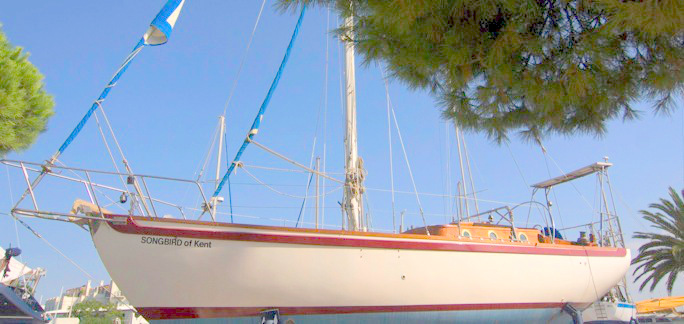
My sub-title comes from personal knowledge of what it feels like to set out on an ocean voyage into waters that one has not sailed before. In my case, leaving Gibraltar bound for The Azores on my yacht Songbird of Kent in the Autumn of 1969.

Tradewind 33 - Songbird of Kent.
My home for five years – Tradewind 33: Songbird of Kent.

Despite me being very familiar with my boat, and with sailing in general, there was nonetheless a sense of trepidation as I headed out into a vast unfamiliar ocean.

Coming to matters closer to hand, there is a sense of trepidation felt by me and countless others as to what world we are heading into if we don’t take seriously the risks that are ‘tapping on our door’.

So hold that in your mind as you read a recent essay published by Patrice Ayme’; an essay that highlights very uncertain times ahead if we, as a global society, don’t get our act together pretty damn quick. Republished here on Learning from Dogs with Patrice’s kind permission.

ooOOoo

Record Heat 2015, Obama Cool

2014 was the warmest year ever recorded. 2015 was even warmer, and by far, by .16 degrees centigrade. The UK (Great Britain) meteorological office announced that the temperature rise is now a full degree C above the pre-industrial average. At this annual rate of increase, we will get to two degrees within six years (as I have predicted was a strong possibility).

What’s going on? Exponentiation. Just as wealth grows faster, the greater the wealth, mechanisms causing more heat are released, the greater the heat. Yes, it could go all the way to tsunamis caused by methane hydrates explosions. This happened in the North Atlantic during the Neolithic, leaving debris of enormous tsunamis all over Scotland.

heat-2015
2015: Not Only Record Heat, But Record Acceleration Of Heat

The Neolithic settlements over what is now the bottom of the North Sea and the Franco-English Channel (then a kind of garden of Eden), probably perished the hard way, under giant waves.

Explosions of methane hydrates have started on the land, in Siberia. No tsunami, so far. But it can, and will happen, any time. The recent North Easter on the East Coast of the USA was an example of the sort of events we will see ever more of: a huge warm, moist Atlantic born air mass, lifted up by a cold front.

Notice that, at the COP 21 in Paris all parties, 195 nations, agreed to try their best to limit warming to 1.5 degree Centigrade. At the present instantaneous rate, that’s less than 4 years away. Even with maximum switching out of fossil fuels, we are, at the minimum, on a three degrees centigrade target, pretty soon.

By the way, if all nations agree, how come the “climate deniers” are still heard of so loudly? Well, plutocrats control Main Stream Media. It’s not just that they want to burn more fossil fuels (as it brings them profit, they are the most established wealth). It’s also that they want to create debates about nothing significant, thus avoiding debates about significant things, such as how much the world is controlled by Dark Pools of money.

Meanwhile, dear Paul Krugman insists in “Bernie, Hillary, Barack, and Change“, that it would be pure evil to see him as a “corrupt crook“, because he believes everything Obama says about change and all that. Says Krugman: “President Obama, in his interview with Glenn Thrush of Politico, essentially supports the Hillary Clinton theory of change over the Bernie Sanders theory:

[Says Obama]: ‘I think that what Hillary presents is a recognition that translating values into governance and delivering the goods is ultimately the job of politics, making a real-life difference to people in their day-to-day lives.’”

This is all hogwash. We are not just in a civilization crisis. We are in a biosphere crisis, unequalled in 65 million years. “Real-life differences“, under Obama, have been going down in roughly all ways. His much vaunted “Obamacare” is a big nothing. All people in the know appraise that next year, it will turn to a much worse disaster than it already is (in spite of a few improvements, “co-pays” and other enormous “deductibles” make the ironically named, Affordable Care Act, ACA, unaffordable).

The climate crisis show that there is no more day-to-day routine. At Paris, the only administration which caused problem, at the last-minute, was Obama’s. How is that, for “change”? The USA is not just “leading from behind”, but pulling in the wrong direction. Really, sit down, and think about it: under France’s admirable guidance (!), 194 countries had agreed on a legally enforceable document. Saudi Arabia agreed. The Emirates agreed. Venezuela agreed. Nigeria agreed. Russia agreed. Byelorussia agreed. China, having just made a treaty with France about climate change, actually helped France pass the treaty. Brazil agreed. Zimbabwe agreed. Mongolia agreed. And so on. But, lo and behold, on the last day, Obama did not.

I know Obama’s excuses well; they are just that, excuses. Bill Clinton used exactly the exact same excuses, 20 years ago. Obama is all for Clinton, because, thanks to Clinton, he can just repeat like a parrot what Clinton said, twenty years ago. Who need thinkers, when we have parrots, and they screech?

I sent this (and, admirably, Krugman published it!):

“No doubt Obama wants to follow the Clintons in making a great fortune, 12 months from now. What is there, not to like?

Obama’s rather insignificant activities will just be viewed, in the future, as G. W. Bush third and fourth terms. A janitor cleaning the master’s mess. Complete with colored (“bronze”) apartheid health plan.

What Sanders’ supporters are asking is to break that spiral into ever greater plutocracy (as plutocrat Bloomberg just recognized).”

Several readers approved my sobering message, yet some troll made a comment, accusing me of “racist “slander”. Racist? Yes the “bronze” plan phraseology is racist. I did not make it up. And it is also racist to make a healthcare system which is explicitly dependent upon how much one can afford. Krugman is all for it, but he is not on a “bronze” plan. Introducing apartheid in healthcare? Obama’s signature achievement. So why should we consider Obama as the greatest authority on “progressive change”? Because we are gullible? Because we cannot learn, and we cannot see? Is not that similar to accepting that Hitler was a socialist, simply because he claimed to be one, it had got to be true, and that was proven because a few million deluded characters voted for him?

We are in extreme circumstances, unheard of in 65 million years, they require extreme solutions. They do not require, nor could they stand, Bill Clinton’s Third Term (or would that be G. W. Bush’s fifth term? The mind reels through the possibilities).

“Change we can believe in”: the new boss, same as the old boss, the same exponentiation towards inequality, global warming and catastrophe, the same warm rhetoric of feel-good lies.

As it is, there is a vicious circle of disinformation between the Main Stream Media, and no change in the trajectory towards Armageddon. Yes, Obama was no change. Yes, Obama was the mountain of rhetoric, who gave birth to a mouse. Yes, we need real change, and it requires to start somewhere. And that means, not by revisiting the past.

Patrice Ayme’

ooOOoo

Yes, we do need real change, and every day that we think that this change is the responsibility of someone else then that is another day lost forever. Or in the more proasic words of Mahatma Gandi, “You must be the change you wish to see in the world.”

This interconnected world.

There is no question that we are living in interesting times!

Back in the old country there was a popular saying: “There are liars, damn liars, and politicians.” I am insufficiently aware of politics in both my new home country, the US of A, and my new home state, Oregon, to know if that saying is equally pertinent to life in America as it was in Great Britain – I suspect that it is.

So what’s getting ‘my knickers in a twist’ today? Namely the state of the world economy.

There seems to be so much spin and counter-spin that getting to the truth of what is going on, economically speaking, is not straightforward.

Which is why a recent article posted by over on The Automatic Earth jumped out at me. To my eyes, it really did cover the truth of what’s going on. And to double-check my analysis I shared it with Dan Gomez, no stranger to global finances, and he found it useful. Indeed, this was Dan’s reply: “That’s pretty much it. This should be the top of the world news every week until governments become accountable. All the other big issues of the day pale compare to the backlash from this sclerotic thinking. Good luck to all of us.”

Raúl has very kindly given me his permission to republish this. It’s not an easy read but that doesn’t detract from the value of the essay.

ooOOoo

 Why This Slump Has Legs

 January 18, 2016  Posted by Raúl Ilargi Meijer
Berenice Abbott Columbus Circle, Manhattan 1936

We’ve only really been in two weeks of trading in the new year, things are looking pretty bad to say the least, so predictably the press are asking -and often answering- questions about when the slump will be over. Rebound, recovery, the usual terminology. When will we get back to growth?

For me personally, but that’s just me, that last question sounds a bit more stupid every single time I hear and read it. Just a bit, but there’s been a lot of those bits, more than I care to remember. Luckily, the answer is easy. The slump will not be over for a very long time, there will be no rebound or recovery, and please stop talking about a return to growth unless you can explain what you want to grow into.

I’m sorry, I know that’s not what you want to hear, but life’s a bitch and so’s the economy. You’ve lived on pink fumes for a long time, most of you for their whole lives, but reality dictates that real ‘growth’ stopped decades ago, and you never figured that out because, and I quote here (see below), you and the world you’re part of became “addicted to borrowing money, spending it, and passing this off as ‘growth’”.

That you believed this was actual growth, however, is on you. You fell for a scam and you’re going to have to pay the price. If there’s one single thing people are good at, it’s lying. It’s as old as human history, and it happens every day, so you’re no exception to any rule. You’re perhaps just not particularly clever.

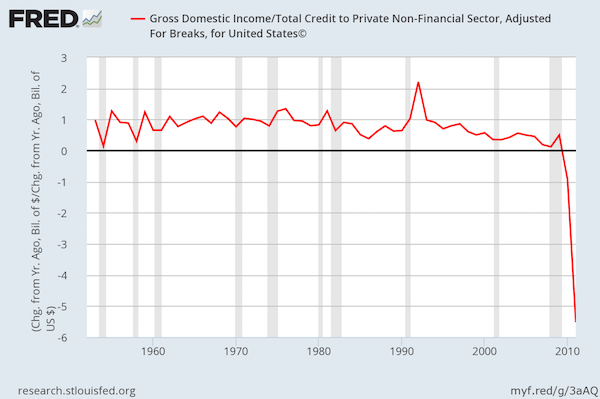
How do we know a ‘recovery’ is so far off it’s really no use to even talk about it? As I said, it’s easy. Let me lead this in with a graph I saw just today, which deals with a topic the Automatic Earth has covered a lot: marginal debt, or more precisely, the productivity/growth gained from each additional dollar of debt.

Please note, this particular graph deals with private non-financial debt only, we’ll get to other kinds of added debt, but that restriction is actually quite illuminating.

MarginalDebtNow of course, you have to wonder about the parameters the St. Louis Fed uses for its data and graphs, and whether ‘growth’ was all that solid in the run up to 2008. There’s plenty of very valid arguments that would say growth in the 1960’s was a whole lot more solid than that in the naughties, after the Glass-Steagall repeal, and after the dot.com blubber.

However, that’s not what I want to take away from this, I use this to show what has happened since 2008, more than before, when it comes to “passing debt off as ‘growth’”.

But it’s another thing that has happened since 2008, or rather not happened, that points out to us why this slump will have legs. That is, in 2008 a behemoth bubble started bursting, and it was by no means just US housing market. That bubble should have been allowed to fully deflate, because that is the only way to allow an economy to do a viable restart.

Instead, all that has been done since 2008, QE, ZIRP, the works, has been aimed at keeping a facade ‘alive’, and aimed at protecting the interests of the bankers and other rich parties. That facade, expressed most of all in rising stock markets, has allowed for societies to be gutted while people were busy watching the S&P rise to 2,100 and the Kardashians bare 2,100 body parts.

It was all paid for, apart from western QE, with $28 trillion and change of newfangled Chinese debt. The problem with this is that if you find yourself in a bubble and you don’t go through the inevitable deleveraging process that follows said bubble in a proper fashion, you’re not only going to kill economies, you’ll destroy entire societies.

And that is not just morally repugnant, it also works as much against the rich as it does against the poor. It’s just that that is a step too far for most people to understand. That even the rich need a functioning society, and that inequality as we see it today is a real threat to everyone.

Recognizing this simple fact, and the consequences that follow from it, is nothing new. It’s why in days of old, there were debt jubilees. It’s also why we still quote the following from Marriner Eccles, chairman of the Federal Reserve under FDR and Truman from 1934-1948, in his testimony to the Senate Committee on the Investigation of Economic Problems in 1933, which prompted FDR to make him chairman in the first place.

It is utterly impossible, as this country has demonstrated again and again, for the rich to save as much as they have been trying to save, and save anything that is worth saving. They can save idle factories and useless railroad coaches; they can save empty office buildings and closed banks; they can save paper evidences of foreign loans; but as a class they cannot save anything that is worth saving, above and beyond the amount that is made profitable by the increase of consumer buying.

It is for the interests of the well to do – to protect them from the results of their own folly – that we should take from them a sufficient amount of their surplus to enable consumers to consume and business to operate at a profit. This is not “soaking the rich”; it is saving the rich. Incidentally, it is the only way to assure them the serenity and security which they do not have at the present moment.

Everything would all be so much simpler if only more people understood this, that you need a – fleeting, ever-changing equilibrium- to prosper.

Instead, we’re falling into that same trap again. Or, more precisely, we already have. We have been fighting debt with more debt and built the facade put up by the Fed, the BoJ and the ECB, central banks that all face the same problems and all take the same approach: save the rich at the cost of the poor. Something Eccles said way back when could not possibly work.

Anyway, so here are the graphs that prove to us why the slump has legs. There’s been no deleveraging, the no. 1 requirement after a bubble bursts. There’s only been more leveraging, more debt has been issued, and while households have perhaps deleveraged a little bit, though that is likely strongly influenced by losses on homes etc. plus the fact that people were simply maxed out.

First, global debt and the opposite of deleveraging:

LeverageGlobalAnd global debt from a longer, 65 year, more historical perspective:

LeverageGlobal2-500It’s a global debt graph, but it’s perhaps striking to note that big ‘growth’ spurts happened in the days when Reagan, Clinton and Obama were the respective US presidents. Not so much in the Bush era.

Next, China. What we’re looking at is what allowed the post 2008 global economic facade to have -fake- credibility, an insane rise in debt, largely spent on non-productive overinvestment, overcapacity highways to nowhere and many millions of empty apartments, in what could have been a cool story had not Beijing gone all-out on performance enhancing financial narcotics.

LeverageChina500Today, the China Ponzi is on its last legs, and so is the global one, because China was the last ‘not-yet-conquered’ market large enough to provide the facade with -fleeting- credibility. Unless Elon Musk gets us to Mars very soon, there are no more such markets.

So US debt will have to come down too, belatedly, with China, and it will have to do that now. because there are no continents to conquer and hide the debt behind. We’re all going to regret engaging in the debt game, and not letting the bubble deflate in an orderly fashion when we still could, but all those thoughts are too late now.

LeverageUS500What the facade has wrought is not just the idea that deleveraging was not needed (though it always is, after every single bubble), but that net US household worth rose by 55% in the 6-7 years since the bottom of the crisis, an artificial bottom fabricated with…more debt, with QE, and ZIRP.

USTaxesHoneyPot2Meanwhile, in today’s world, as stock markets go down at a rapid clip, China, having lost control of a market system it never had the control over that Politburos are ever willing to acknowledge they don’t have, plays a game of Ponzi whack-a-mole, with erratic ‘policies’ such as circuit breakers and CIA-style renditions of fund managers and the like.

And all the west can do is watch them fumble the ball, and another one, and another. And this whole thing is nowhere near the end.

China bad loans have now become a theme, but the theme doesn’t mean a thing without including the shadow banking system, which in China has been given the opportunity to grow like a tumor, on which Beijing’s grip is limited, and which has huge claims on local party officials forced by the Politburo to show overblown growth numbers. If you want to address bad loans, that’s where they are.

Chinese credit/debt graphs paint only a part of the picture if and when they don’t include shadow banks, but keeping their role hidden is one of Xi’s main goals, lest the people find out how bad things really are and start revolting. But they will anyway. That makes China a very unpredictable entity. And unpredictable means volatile, and that means even more money flowing out of, and being lost in, markets.

The ‘least worst’ place to be for what money will be left is US dollars, US treasuries and perhaps metals. But there’ll be a whole lot less left than just about anyone thinks. That’s the price of deleveraging.

The price of not deleveraging, on the other hand, is what we see in the markets today. And there is no cure. It must be done. The price for keeping up the facade rises sharply with each passing day, and the effort will in the end be futile. All bubbles have limited lifespans.

I’ll close this with a few recent words from Tim Morgan, who puts it so well I don’t feel the need to try and do it better.

The Ponzi Economy, Part 1

In order to set the Ponzi economy into some context, let’s put some figures on it. In the United States, total “real economy” debt (which excludes inter-bank borrowing) increased by $19.4 trillion – in real, inflation-adjusted terms – between 2000 and 2014, whilst real GDP expanded by only $3.7 trillion. Britain, meanwhile, added £1.9 trillion of new debt for less than £400bn on “growth” over the same period. I spent part of the holiday period unearthing quite how much debt countries added for each dollar of “growth” over a period starting at the end of 2000 and ending in mid-2015.

Unsurprisingly, the league is topped by Portugal ($5.65 for each $1 of growth), Ireland ($5.42) and Greece ($5.39). Britain’s ratio ($3.46) is somewhat flattering, in that the UK has used asset sales as well as borrowing to sustain its consumption. The average for the Eurozone ($3.54) covers ratios as diverse as Germany (just $1.87) and France ($4.22).

China’s $2.56 looks unexceptional until you note that the more recent (post-2007) number is much worse. Economies which seem to have been growing without too much borrowing (such as Brazil and Russia) are now experiencing dramatic worsening in their ratios, generally in the wake of tumbling commodity prices.

In the proverbial nutshell, then, the world has become addicted to borrowing money, spending it, and passing this off as “growth”. This is a copybook example of a pyramid scheme, which in turn means that the world’s most influential economic mentor is neither Keynes nor Hayek, but Charles Ponzi.

[..] How, in the absence of growth, can inflated capital values be sustained? The answer, of course, is that they can’t. Like all Ponzi schemes, this ends with a bang, not a whimper. This is why I find forecasts of a ‘big fall’ or ‘sharp correction’ in markets hard to swallow. Ponzi schemes don’t end gradually, any more than someone can fall off a cliff gradually, or be “slightly pregnant”.

The Ponzi economy simply continues for as long as irrationality prevails, and then implodes. Capital markets, though, are the symptom, not the cause. The fundamental problem is an inability to escape from an addictive practice of manufacturing supposed “growth” on the basis of borrowed money.

There may be shallow lulls in the asset markets, nothing ever only falls down in a straight line in the real world, but that debt I’ve described here will and must come down and be deleveraged.

The process will in all likelihood lead to warfare, and to refugee movements the likes of which the world has never seen just because of the sheer numbers of people added in the past 50 years.

When your children reach your age, they will not live in a world that you ever thought was possible. But they will still have to live in it, and deal with it. They will no longer have the facade you’ve been staring at for so long now, to lull them into a complacent sleep. And the Kardashians will no longer be looking so attractive either.

ooOOoo

If you found your mind wandering somewhat as you tried to stay focussed on the essay, just go back and read the closing two paragraphs.

The process will in all likelihood lead to warfare, and to refugee movements the likes of which the world has never seen just because of the sheer numbers of people added in the past 50 years.

When your children reach your age, they will not live in a world that you ever thought was possible. But they will still have to live in it, and deal with it. They will no longer have the facade you’ve been staring at for so long now, to lull them into a complacent sleep. And the Kardashians will no longer be looking so attractive either.

As I said at the start: we are living in interesting times!

Trying to make sense of these times?

A departure from recent themes.

Tom Engelhardt
Tom Engelhardt

Some time ago, I republished, with Tom’s permission, essays that were being published on the TomDispatch blogsite. While those essays had nothing at all to do with dogs, they had much to do with integrity; the underlying theme of Learning from Dogs. Then Tom Engelhardt very generously gave me blanket permission to republish further TomDispatch essays whenever I felt so inclined. Thus back in 2011, I republished The Great American Carbon Bomb because it seemed so important to readers of this place. Subsequently, from time to time, other essays have been republished again because they seemed worthy of a broader distribution.

Which brings me to today’s post; another republication of a TomDispatch essay. Why? Because what is presently going on in the world, about the price of oil, about the chaos in the Middle-East, about the prospects of global deflation and the frightening consequences that could flow from that, are of concern to 99.9% of the ordinary folk living on this planet, including the vast majority of owners of dogs.

Thus without any further ado, here is the latest ‘Tomgram’: Michael Klare, The Look of a Badly Oiled Planet.

ooOOoo

Tomgram: Michael Klare, The Look of a Badly Oiled Planet