Category: Capitalism

This interconnected world.

There is no question that we are living in interesting times!

Back in the old country there was a popular saying: “There are liars, damn liars, and politicians.” I am insufficiently aware of politics in both my new home country, the US of A, and my new home state, Oregon, to know if that saying is equally pertinent to life in America as it was in Great Britain – I suspect that it is.

So what’s getting ‘my knickers in a twist’ today? Namely the state of the world economy.

There seems to be so much spin and counter-spin that getting to the truth of what is going on, economically speaking, is not straightforward.

Which is why a recent article posted by over on The Automatic Earth jumped out at me. To my eyes, it really did cover the truth of what’s going on. And to double-check my analysis I shared it with Dan Gomez, no stranger to global finances, and he found it useful. Indeed, this was Dan’s reply: “That’s pretty much it. This should be the top of the world news every week until governments become accountable. All the other big issues of the day pale compare to the backlash from this sclerotic thinking. Good luck to all of us.”

Raúl has very kindly given me his permission to republish this. It’s not an easy read but that doesn’t detract from the value of the essay.

ooOOoo

 Why This Slump Has Legs

 January 18, 2016  Posted by Raúl Ilargi Meijer
Berenice Abbott Columbus Circle, Manhattan 1936

We’ve only really been in two weeks of trading in the new year, things are looking pretty bad to say the least, so predictably the press are asking -and often answering- questions about when the slump will be over. Rebound, recovery, the usual terminology. When will we get back to growth?

For me personally, but that’s just me, that last question sounds a bit more stupid every single time I hear and read it. Just a bit, but there’s been a lot of those bits, more than I care to remember. Luckily, the answer is easy. The slump will not be over for a very long time, there will be no rebound or recovery, and please stop talking about a return to growth unless you can explain what you want to grow into.

I’m sorry, I know that’s not what you want to hear, but life’s a bitch and so’s the economy. You’ve lived on pink fumes for a long time, most of you for their whole lives, but reality dictates that real ‘growth’ stopped decades ago, and you never figured that out because, and I quote here (see below), you and the world you’re part of became “addicted to borrowing money, spending it, and passing this off as ‘growth’”.

That you believed this was actual growth, however, is on you. You fell for a scam and you’re going to have to pay the price. If there’s one single thing people are good at, it’s lying. It’s as old as human history, and it happens every day, so you’re no exception to any rule. You’re perhaps just not particularly clever.

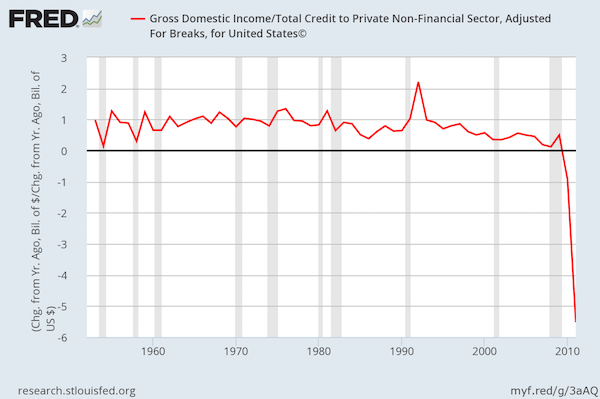
How do we know a ‘recovery’ is so far off it’s really no use to even talk about it? As I said, it’s easy. Let me lead this in with a graph I saw just today, which deals with a topic the Automatic Earth has covered a lot: marginal debt, or more precisely, the productivity/growth gained from each additional dollar of debt.

Please note, this particular graph deals with private non-financial debt only, we’ll get to other kinds of added debt, but that restriction is actually quite illuminating.

MarginalDebtNow of course, you have to wonder about the parameters the St. Louis Fed uses for its data and graphs, and whether ‘growth’ was all that solid in the run up to 2008. There’s plenty of very valid arguments that would say growth in the 1960’s was a whole lot more solid than that in the naughties, after the Glass-Steagall repeal, and after the dot.com blubber.

However, that’s not what I want to take away from this, I use this to show what has happened since 2008, more than before, when it comes to “passing debt off as ‘growth’”.

But it’s another thing that has happened since 2008, or rather not happened, that points out to us why this slump will have legs. That is, in 2008 a behemoth bubble started bursting, and it was by no means just US housing market. That bubble should have been allowed to fully deflate, because that is the only way to allow an economy to do a viable restart.

Instead, all that has been done since 2008, QE, ZIRP, the works, has been aimed at keeping a facade ‘alive’, and aimed at protecting the interests of the bankers and other rich parties. That facade, expressed most of all in rising stock markets, has allowed for societies to be gutted while people were busy watching the S&P rise to 2,100 and the Kardashians bare 2,100 body parts.

It was all paid for, apart from western QE, with $28 trillion and change of newfangled Chinese debt. The problem with this is that if you find yourself in a bubble and you don’t go through the inevitable deleveraging process that follows said bubble in a proper fashion, you’re not only going to kill economies, you’ll destroy entire societies.

And that is not just morally repugnant, it also works as much against the rich as it does against the poor. It’s just that that is a step too far for most people to understand. That even the rich need a functioning society, and that inequality as we see it today is a real threat to everyone.

Recognizing this simple fact, and the consequences that follow from it, is nothing new. It’s why in days of old, there were debt jubilees. It’s also why we still quote the following from Marriner Eccles, chairman of the Federal Reserve under FDR and Truman from 1934-1948, in his testimony to the Senate Committee on the Investigation of Economic Problems in 1933, which prompted FDR to make him chairman in the first place.

It is utterly impossible, as this country has demonstrated again and again, for the rich to save as much as they have been trying to save, and save anything that is worth saving. They can save idle factories and useless railroad coaches; they can save empty office buildings and closed banks; they can save paper evidences of foreign loans; but as a class they cannot save anything that is worth saving, above and beyond the amount that is made profitable by the increase of consumer buying.

It is for the interests of the well to do – to protect them from the results of their own folly – that we should take from them a sufficient amount of their surplus to enable consumers to consume and business to operate at a profit. This is not “soaking the rich”; it is saving the rich. Incidentally, it is the only way to assure them the serenity and security which they do not have at the present moment.

Everything would all be so much simpler if only more people understood this, that you need a – fleeting, ever-changing equilibrium- to prosper.

Instead, we’re falling into that same trap again. Or, more precisely, we already have. We have been fighting debt with more debt and built the facade put up by the Fed, the BoJ and the ECB, central banks that all face the same problems and all take the same approach: save the rich at the cost of the poor. Something Eccles said way back when could not possibly work.

Anyway, so here are the graphs that prove to us why the slump has legs. There’s been no deleveraging, the no. 1 requirement after a bubble bursts. There’s only been more leveraging, more debt has been issued, and while households have perhaps deleveraged a little bit, though that is likely strongly influenced by losses on homes etc. plus the fact that people were simply maxed out.

First, global debt and the opposite of deleveraging:

LeverageGlobalAnd global debt from a longer, 65 year, more historical perspective:

LeverageGlobal2-500It’s a global debt graph, but it’s perhaps striking to note that big ‘growth’ spurts happened in the days when Reagan, Clinton and Obama were the respective US presidents. Not so much in the Bush era.

Next, China. What we’re looking at is what allowed the post 2008 global economic facade to have -fake- credibility, an insane rise in debt, largely spent on non-productive overinvestment, overcapacity highways to nowhere and many millions of empty apartments, in what could have been a cool story had not Beijing gone all-out on performance enhancing financial narcotics.

LeverageChina500Today, the China Ponzi is on its last legs, and so is the global one, because China was the last ‘not-yet-conquered’ market large enough to provide the facade with -fleeting- credibility. Unless Elon Musk gets us to Mars very soon, there are no more such markets.

So US debt will have to come down too, belatedly, with China, and it will have to do that now. because there are no continents to conquer and hide the debt behind. We’re all going to regret engaging in the debt game, and not letting the bubble deflate in an orderly fashion when we still could, but all those thoughts are too late now.

LeverageUS500What the facade has wrought is not just the idea that deleveraging was not needed (though it always is, after every single bubble), but that net US household worth rose by 55% in the 6-7 years since the bottom of the crisis, an artificial bottom fabricated with…more debt, with QE, and ZIRP.

USTaxesHoneyPot2Meanwhile, in today’s world, as stock markets go down at a rapid clip, China, having lost control of a market system it never had the control over that Politburos are ever willing to acknowledge they don’t have, plays a game of Ponzi whack-a-mole, with erratic ‘policies’ such as circuit breakers and CIA-style renditions of fund managers and the like.

And all the west can do is watch them fumble the ball, and another one, and another. And this whole thing is nowhere near the end.

China bad loans have now become a theme, but the theme doesn’t mean a thing without including the shadow banking system, which in China has been given the opportunity to grow like a tumor, on which Beijing’s grip is limited, and which has huge claims on local party officials forced by the Politburo to show overblown growth numbers. If you want to address bad loans, that’s where they are.

Chinese credit/debt graphs paint only a part of the picture if and when they don’t include shadow banks, but keeping their role hidden is one of Xi’s main goals, lest the people find out how bad things really are and start revolting. But they will anyway. That makes China a very unpredictable entity. And unpredictable means volatile, and that means even more money flowing out of, and being lost in, markets.

The ‘least worst’ place to be for what money will be left is US dollars, US treasuries and perhaps metals. But there’ll be a whole lot less left than just about anyone thinks. That’s the price of deleveraging.

The price of not deleveraging, on the other hand, is what we see in the markets today. And there is no cure. It must be done. The price for keeping up the facade rises sharply with each passing day, and the effort will in the end be futile. All bubbles have limited lifespans.

I’ll close this with a few recent words from Tim Morgan, who puts it so well I don’t feel the need to try and do it better.

The Ponzi Economy, Part 1

In order to set the Ponzi economy into some context, let’s put some figures on it. In the United States, total “real economy” debt (which excludes inter-bank borrowing) increased by $19.4 trillion – in real, inflation-adjusted terms – between 2000 and 2014, whilst real GDP expanded by only $3.7 trillion. Britain, meanwhile, added £1.9 trillion of new debt for less than £400bn on “growth” over the same period. I spent part of the holiday period unearthing quite how much debt countries added for each dollar of “growth” over a period starting at the end of 2000 and ending in mid-2015.

Unsurprisingly, the league is topped by Portugal ($5.65 for each $1 of growth), Ireland ($5.42) and Greece ($5.39). Britain’s ratio ($3.46) is somewhat flattering, in that the UK has used asset sales as well as borrowing to sustain its consumption. The average for the Eurozone ($3.54) covers ratios as diverse as Germany (just $1.87) and France ($4.22).

China’s $2.56 looks unexceptional until you note that the more recent (post-2007) number is much worse. Economies which seem to have been growing without too much borrowing (such as Brazil and Russia) are now experiencing dramatic worsening in their ratios, generally in the wake of tumbling commodity prices.

In the proverbial nutshell, then, the world has become addicted to borrowing money, spending it, and passing this off as “growth”. This is a copybook example of a pyramid scheme, which in turn means that the world’s most influential economic mentor is neither Keynes nor Hayek, but Charles Ponzi.

[..] How, in the absence of growth, can inflated capital values be sustained? The answer, of course, is that they can’t. Like all Ponzi schemes, this ends with a bang, not a whimper. This is why I find forecasts of a ‘big fall’ or ‘sharp correction’ in markets hard to swallow. Ponzi schemes don’t end gradually, any more than someone can fall off a cliff gradually, or be “slightly pregnant”.

The Ponzi economy simply continues for as long as irrationality prevails, and then implodes. Capital markets, though, are the symptom, not the cause. The fundamental problem is an inability to escape from an addictive practice of manufacturing supposed “growth” on the basis of borrowed money.

There may be shallow lulls in the asset markets, nothing ever only falls down in a straight line in the real world, but that debt I’ve described here will and must come down and be deleveraged.

The process will in all likelihood lead to warfare, and to refugee movements the likes of which the world has never seen just because of the sheer numbers of people added in the past 50 years.

When your children reach your age, they will not live in a world that you ever thought was possible. But they will still have to live in it, and deal with it. They will no longer have the facade you’ve been staring at for so long now, to lull them into a complacent sleep. And the Kardashians will no longer be looking so attractive either.

ooOOoo

If you found your mind wandering somewhat as you tried to stay focussed on the essay, just go back and read the closing two paragraphs.

The process will in all likelihood lead to warfare, and to refugee movements the likes of which the world has never seen just because of the sheer numbers of people added in the past 50 years.

When your children reach your age, they will not live in a world that you ever thought was possible. But they will still have to live in it, and deal with it. They will no longer have the facade you’ve been staring at for so long now, to lull them into a complacent sleep. And the Kardashians will no longer be looking so attractive either.

As I said at the start: we are living in interesting times!

Trying to make sense of these times?

A departure from recent themes.

Tom Engelhardt
Tom Engelhardt

Some time ago, I republished, with Tom’s permission, essays that were being published on the TomDispatch blogsite. While those essays had nothing at all to do with dogs, they had much to do with integrity; the underlying theme of Learning from Dogs. Then Tom Engelhardt very generously gave me blanket permission to republish further TomDispatch essays whenever I felt so inclined. Thus back in 2011, I republished The Great American Carbon Bomb because it seemed so important to readers of this place. Subsequently, from time to time, other essays have been republished again because they seemed worthy of a broader distribution.

Which brings me to today’s post; another republication of a TomDispatch essay. Why? Because what is presently going on in the world, about the price of oil, about the chaos in the Middle-East, about the prospects of global deflation and the frightening consequences that could flow from that, are of concern to 99.9% of the ordinary folk living on this planet, including the vast majority of owners of dogs.

Thus without any further ado, here is the latest ‘Tomgram’: Michael Klare, The Look of a Badly Oiled Planet.

ooOOoo

Tomgram: Michael Klare, The Look of a Badly Oiled Planet

A tiny bite of this could kill your dog!

Please read, digest and share as widely as you can!

Fellow author, Deborah Taylor-French, recently posted a stark warning for all dog owners. Deborah wrote on her blog, Dog Leader Mysteries, the following:

1 thing more toxic than chocolate for dogs

More toxic than chocolate?

Yes, and it’s everywhere.

Please visit my guest blog post on 4Knines blog “One common thing that is more toxic than chocolate for dogs”  Then please comment! Of course, after you comment, I’d love it if you would share far and wide for the love and lives of dogs. After working on this post for about a month I shared it as a guest post so that it may reach a larger audience of dog lovers, beyond my WordPress blog.

(I also can’t resist including the following photograph of Deborah and Syd that was in that post!)

Syd the kid!
Syd the kid!

So the balance of my post today is a full republication of Deborah’s guest post as it appeared over on 4knines blog.

ooOOoo

One Common Thing That is More Toxic Than Chocolate for Dogs!

Moments in history

You can blame John Zande for today’s post!

John left an intriguing question as a comment to yesterday’s post.

Oh to have a time machine!

Tell me, Paul, if you did have one, a time machine, what three moments in history would you visit?

It really grabbed Jean and me and we spent quite a few minutes during the day kicking around ideas. At first, it was easy just to do a web search on epic moments in history and see if any of them related to me. But that seemed too easy. So I have picked three that do connect with my life.

  1. May 8th, 1945

I was born on November 8th, 1944. I was born in North London (Acton). It was the period of the Second World War when the V2 rockets were landing all around. Take, for example, the incident just eleven days after my birth, when on the 19th November, 1944 a V2 landed in Wandsworth causing much damage and many fatalities around Hazlehurst Road and Garratt Lane. Spend a moment reviewing who died, and their ages, in that bombing.

img7

So I was precisely six months old when the armistice was announced on May 8th, 1945. As Wikipedia describes it:

Victory in Europe Day, generally known as V-E Day, VE Day or simply V Day was the public holiday celebrated on 8 May 1945 (7 May in Commonwealth realms) to mark the formal acceptance by the Allies of World War II of Nazi Germany’s unconditional surrender of its armed forces.[1] It thus marked the end of World War II in Europe.

On 30 April, Adolf Hitler, the Nazi leader, committed suicide during the Battle of Berlin. Germany’s surrender, therefore, was authorised by his successor, Reichspräsident Karl Dönitz. The administration headed by Dönitz was known as the Flensburg Government. The act of military surrender was signed on 7 May in Reims, France and on 8 May in Berlin, Germany.

I would have loved to witness, by being in the crowd that day, the King and Queen acknowledging the end of the war in Europe.

tdih-may08-HD_still_624x352
May 8, 1945: King George VI and Queen Elizabeth, with Princess Elizabeth and Princess Margaret, are joined by Prime Minister Winston Churchill.

Nevertheless, that day in May, 1945 has been memorable for me for all of my life. Because my mother, who is still alive today, aged 96, (still living in London but spending Christmas with my sister in Cape Town, by the way), held me in her arms and said aloud: “My dear Paul, you are going to live!” I grew up with those loving words deeply rooted within me.

2. Stonehenge – too many moons ago!

For reasons that I am not entirely clear about, I have always been fascinated by the stars. From the point of view of using the stars to help me navigate strange parts of the world, both on land and at sea. I grew up regarding Polaris, the North Star, almost as a companion. Later in my life when sailing solo from Gibraltar to The Azores, a distance of just under 1,150 nautical miles, on a Tradewind 33 yacht, despite having an early GPS unit it was backup to me using a sextant to maintain (some) awareness of my position.

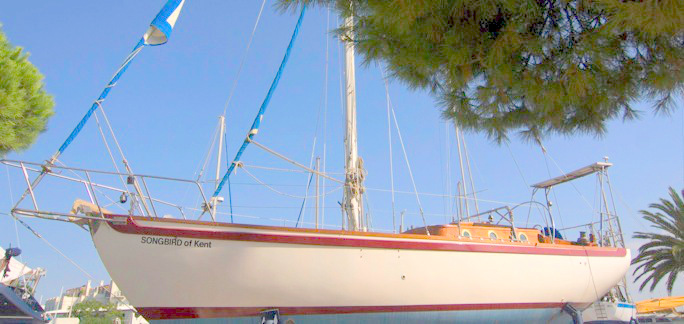
Tradewind 33 - Songbird of Kent. My home for five years.
Tradewind 33 – Songbird of Kent. My home for five years.

(Reminds me of a anecdote when I was crewing on a privately-owned East Coast Essex fishing smack. I was asking Bill, the owner, why he always laid his thumb on the position on the chart in response to the question, “Where are we?” Bill’s reply: “That’s as accurate as anyone can be!”)

In 1969, when I was driving across the desert plains of Australia, often with inhabited places more than a 150-mile radius away (the Simpson Desert especially coming to mind) the Southern Cross seemed to keep me grounded and remind me that I was making progress.

Back when I was living just outside Totnes in South Devon, my frequent drives up to London along the A303 took me past Stonehenge in Wiltshire.

The December solstice happens at the same instant for all of us, everywhere on Earth. This year the solstice occurs on Tuesday December 22nd at 04:49 GMT (Universal time) with the sun rising over Stonehenge in Wiltshire at 08:04.

THE EARLIEST MONUMENT

It is possible that features such as the Heel Stone and the low mound known as the North Barrow were early components of Stonehenge,[3] but the earliest known major event was the construction of a circular ditch with an inner and outer bank, built about 3000 BC. This enclosed an area about 100 metres in diameter, and had two entrances. It was an early form of henge monument.[4]

Within the bank and ditch were possibly some timber structures and set just inside the bank were 56 pits, known as the Aubrey Holes. There has been much debate about what stood in these holes: the consensus for many years has been that they held upright timber posts, but recently the idea has re-emerged that some of them may have held stones.[5]

Within and around the Aubrey Holes, and also in the ditch, people buried cremations. About 64 cremations have been found, and perhaps as many as 150 individuals were originally buried at Stonehenge, making it the largest late Neolithic cemetery in the British Isles.[6]

Taken from here.

I would have loved being present at Stonehenge when the builders finally were able to stand back and see the Sun “speak” to them at the first Solstice after that point in its construction.

It seems to me to be a most magical place yet Stonehenge offers a mathematical and rhythmic foundation to that magic.

3. First man into space – 12th April, 1961

It was, of course, Yuri Gagarin, who made the first complete orbit of Planet Earth in space.

Yuri Alekseyevich Gagarin

I would have given anything to be in his seat (and suit). For to look out and see our planet as a small object in an enormous outer space would have to change one’s perception of almost everything; for evermore.

exo-planet-earth-from-space

My wish for the New Year is that we recognise our place both in history and on our Planet Earth, and care for it as the sole, beautiful home that we have.

Now that global recognition would be a moment in history that I would want to experience before I die!

(Thanks John for inspiring me to jot down these thoughts!)


Britain before humans.

A remarkable look at the extraordinary history of the British Isles.

Now on first sight, any reasonable follower of my scribblings who lived outside Britain might wonder why this post was so focussed on one particular country, the country of my birth: Great Britain.

My justification, however, for including this George Monbiot essay is that many residents of many other countries, not just North Americans, have roots and family ties in GB. Plus, so typical of a Monbiot essay, the subject will be of interest to anyone, wherever they live in the world, who wonders about time before we shaped our environment. (I have converted some of the figures used in the essay within square brackets [ …] )

Could I also mention that from Thursday through to the end of the year, my posts in this place are going to be a mix of trivial, humorous and repeat posts. I need a bit of a break as much as you good people need a break from Learning from Dogs! 😉

Monbiot’s essay is republished here with the kind permission of George Monbiot.

ooOOoo

Walk on the Wild Side

17th December 2015

Rewilding, hillwalking and the extraordinary history of these islands.

George Monbiot, interviewed by Dan Bailey for UKHillwalking.com, 11th December 2015

What would a natural upland habitat have looked like in Britain before humans started having the dominant influence?

This is a particularly interesting question, because we have two completely different baselines in Britain. The more recent one is the situation that prevailed after the ice retreated, and a temperate climate returned. I’m talking about parts of the Boreal and Atlantic stages, roughly between 9000 and 5000 years ago. It seems that during this period, Britain was more or less covered by closed canopy rainforest from top to toe. I’m using the term rainforest precisely: to denote forests that are wet enough to support epiphytes, plants that grow on other plants. Wherever you see polypody, the many-footed fern, growing along the branches of a tree, it’s a reminder that you are looking at rainforest fragment.

Hardly any land in this country would have been treeless at this time. With the exception of the summits of the Cairngorms, Ben Nevis and one or two other mountains, there is nowhere here that is too high for them to grow. Our bare and rocky hills are an artefact of deforestation, heavy grazing and the subsequent loss of soil.

But even that state arguably reflected the dominant influence of humans. To see what the land would have been like without them, you would have to go back to the previous interglacial period, the Eemian. At this time, the climate was almost identical to ours, but for some reason the people driven out by the previous ice age appear not to have returned to this country. At this stage, there was plenty of forest, but it seems that it was not continuous. The closed canopy rainforest was punctuated by more open forest, as well as wood pasture and savannah. Why? Because humans had not wiped out the dominant species. During the Eemian, Britain had a fairly similar collection of wildlife to the one we know today. You know: foxes, badgers, hedgehogs, deer, robins, jackdaws, elephants, rhinos, hippos, scimitar cats, hyenas and lions.

Ah yes, not the same in all respects. Like everywhere else on earth, we had a megafauna, and this shaped the ecosystem. The large herbivores were driven out of Britain by the ice, then driven to extinction in southern Europe about 30,000 years ago when modern humans arrived. (The hyenas and lions, incidentally, persisted throughout the ice age, hunting reindeer across the frozen tundra, and it seems that they survived here until about 10,000 years ago, when Mesolithic hunters turned up).

What does a typical British upland habitat look like now, and how does it differ from uplands in Mainland Europe?

In almost all other European countries (Ireland is an exception), the pattern of tree cover is what you would expect to see. The lowlands, where the land is worth farming, are largely treeless. The uplands, where the land is infertile and the climate is harsh, largely forested. This is why Europe has an average forest cover of 37%. In Britain, the lowlands are largely treeless, as you might expect, but the uplands are even barer. This peculiarity explains the fact that Britain has only 13% tree cover. Instead of a rich ecosystem in the hills, a mosaic of trees, scrub and glades (which is what would occur now, on our depleted soils, if the land were allowed to recover), the uplands are almost entirely treeless, and therefore remarkably poor in birds, insects and all the other lifeforms you might expect to find there. The parts of the country which would otherwise function as our great wildlife reserves – those places, in other words, where hardly anyone lives and there is almost no economic activity – have even less wildlife than the places that are intensely habited and farmed.

What are the people and processes responsible for keeping our hills bare in England and Wales? Who’s more to blame in Scotland?

In England and Wales, the cause is simply stated. Sheep, which originated in Mesopotamia, are wildly, disproportionately destructive. In many of our hills, they are kept at densities of no more than one per hectare or even less. But because they selectively browse out tree seedlings, they ensure that no recovery can take place. Even where remaining woods exist, they are often dying on their feet, because there are no young trees with which to replace the old ones. In terms of food production, upland sheep farming makes a minuscule contribution. It is hard to think of any industry where there is a higher ratio of destruction to production.

The denuding of our hills by sheep is supplemented by the burning of grouse moors, a fantastically destructive activity carried out for the benefit of a very small number of exceedingly rich people. These two activities ensure that in England and Wales there are scarcely any trees above around 200 m. [Ed: 656 feet]

Both are also important factors in Scotland, but in the Highlands the dominant cause of destruction is the deer stalking estates. By keeping the numbers of red deer very high, so that a banker waddling up the hillside in tweed pantaloons is almost guaranteed to make a kill, these estates have a similar effect to sheep farms. Like sheep, deer seek out the seedlings, and when their numbers rise above five or ten per square kilometre, they ensure that no forest can grow.

So why the difference between Britain and the rest of Europe? The answer seems to be the size of land holdings. Because, unlike most other European countries, Britain never had a successful revolution, we have, on one estimate, the second highest concentration of landholding in the world, after Brazil. This grants landowners inordinate power. It also leads to the situation I’ll describe in the next answer.

Where does subsidy farming come in?

People farming the uplands claimed to make their money by raising sheep. But in economic terms, sheep are ornamental. Sheep farming throughout our hills is a loss-making activity, and persists only as a result of public money, that takes the form of farm subsidies. We pay £3.6 billion [Ed: 5.33 billion US dollars] a year in this country to have our watersheds destroyed and our wildlife wiped out. The reason why the hills are kept bare here but not in the rest of Europe is that the landholdings in Britain are big enough to make subsidy harvesting a worthwhile activity: you are paid by the hectare. The more land you own, the more public money you receive. Some people take millions of pounds in these benefit payments every year. It’s extraordinary, when such restrictions are placed upon the ordinary recipients of social security, that this situation has not yet become politically explosive.

And culturally – how does our idealised view of the upland landscape feed into land management?

Our idealised, romanticised view of sheep farming, that bears almost no relationship to reality, but that is constantly drilled into our minds by programmes like Countryfile, makes it hard for us to see what is really going on. It’s because of this view that we fail to grasp a vast and obvious fact. That by denuding our hills, this economically-tiny industry has done more damage to our ecosystems and wildlife than all the building that has taken place in Britain.

Can you explain, in a nutshell, what you mean by re-wilding, and why you’d like to see it in the British hills?

Rewilding is the mass restoration of ecosystems and the re-establishment of missing species. I’m not arguing for the blanket rewilding of our hills by any means. But I believe that Britain would be greatly enriched, in terms of both wildlife and human experience, if significant areas were allowed to recover; if trees were allowed to grow in some of our denuded places, and some of the wonderful species we have lost were permitted to return. In particular, I’m thinking of beavers, boar, lynx, wolves and species that we retain in small numbers but that were once widespread, such as wildcat, pine martens, capercaillie, eagles and goshawks.

The other great benefit of allowing trees to return to the hills is the restoration of watersheds. In one study in Wales, the soil beneath woodland was found to absorb water at 67 times the rate of the soil beneath sheep pasture. The rain flashes off sheep pasture as if it were concrete, instantly causing floods downstream. Trees hold back the water and release it gradually, smoothing out the cycle of flood and drought.

Could you talk us through the stages of a habitat restoration process that could take a bare hillside and return it to woodland?

Many of our hillsides have been so thoroughly sheepwrecked that there are now no remaining seed sources. In these circumstances, we would need to plant islands of trees, using seed taken from the nearest surviving pockets of woodland in order to sustain local genetic diversity. Short of greatly reducing stocking levels or temporarily keeping herbivores off altogether, there is not a lot more that needs to be done. In some places, all that is required is temporary exclusion of grazing animals.

What is a trophic cascade, and how is this idea relevant in the British context?

A trophic cascade is an ecological process that tumbles from the top of the foodchain to the bottom. It turns out that in many places, large carnivores regulate the entire ecosystem; ecosystems that retain them behave in radically different ways to ecosystems from which they have been lost. This presents a powerful challenge to British models of conservation, as we have lost all our large carnivores here, with the result that ecological processes, and their dynamic and ever-shifting successional patterns, have been curtailed.

Critics sometimes suggest that proponents of re-wilding are advocating turning the clock back to an arbitrary point in history and then keeping things permanently fixed in this state. Is that fair?

It is precisely the opposite. Our current model of conservation fixes ecosystems at an arbitrary point and then keeps them in a state of arrested development through extreme management of the kind that everywhere else on earth we recognise as destruction, not protection: namely cutting, burning and grazing. There is no intelligible reason behind the choices that have been made by conservationists of the ecosystems and species they choose to maintain by these means. Rewilding, by contrast, has no fixed outcomes. It seeks to restore ecological processes by bringing back some of the key elements of ecosystems and the key drivers: species that trigger trophic cascades. To the greatest extent possible, it then seeks to stand back and allow natural processes to take their course.

What would a healthy population of deer look like? How about sheep – do you have a figure for environmentally supportable grazing densities?

In the infertile uplands, it is roughly 5 per square kilometre (in other words per 100 ha). [Ed: 247 acres] Beyond that point, there is almost no regeneration of trees.

The debate often seems to be framed in absolute terms – either we re-wild everywhere, and get rid of all the farmers and deer, or not at all. How big would be big enough to please you? Are you talking about re-foresting every hill, moor and mountain, from valley to summit?

The aim of the group Rewilding Britain, that I helped to found but do not run, is to allow natural ecological processes and key species to return to at least one million hectares (4.5%) of Britain’s land and 30% of our territorial waters over the next 100 years. It would like to see at least one large rewilded area to connect both land and sea – descending from the mountaintops to our coastal waters.

In somewhere as crowded as Britain are vast re-created wildernesses a viable prospect, or would it be more realistic to go for smaller scale projects in which re-wilding is just part of a mixed land use picture – projects such as Wild Ennerdale perhaps, where habitat restoration is being managed in conjunction with forestry, leisure, water extraction and livestock?

The British population is highly concentrated. Some parts of the country are exceedingly crowded; others remarkably empty. Most British uplands have a far lower population density than many parts of Europe in which wolves, lynx, bear and other species are found. Wolves have even been appearing in countries such as Belgium, the Netherlands and Denmark, where there is very little land that is unsuitable for intensive farming, and the rural population density tends to be much higher. Their arrival has been greeted by most sectors of society with delight.

Many hill-goers will recognise your picture of the degraded upland environment, but some may simply be making a different aesthetic judgement to you, valuing the barren wide open spaces for the experience they provide. If they just happen to prefer grass and heather landscape on some romantic level, and don’t much care about botany and wildlife, how might you seek to convert them?

I believe we should have both. At the moment those who value a wild, self-willed landscape have nowhere to turn in Britain. We have to travel abroad to find it and to experience magnificent encounters with wildlife. I believe this deprives us of the wonder and delight that can enhance our lives and of choice and freedom. We have nowhere in which to escape the order and control that governs all other aspects of our lives.

Hillwalkers and climbers have fought long and hard against vested landowning interests for our right to roam. There is a worry that conservation could be used to curtail these freedoms, and some evidence to support that concern. What place does public access on open upland have in a re-wilded landscape, and which would take precedence – amenity or conservation?

I was heavily involved in campaigns for the right to roam, through another group I helped to found, The Land Is Ours, and I would be dismayed by any scheme which sought to keep people out of the hills. I believe that rewilding and access are entirely compatible. While it may be necessary in some places temporarily to fence out grazing animals, the fencing required is no different from that which is already found across the uplands, and exactly the same arrangements can be made to cross it as are used today. My hope is that in some places, as a result of rewilding, in some places there will one day be no fencing at all: in other words it will mean better access than there is today.

On a related note, could public support for re-wilding have unintended consequences? Might it, for instance, be a gift to landowners and conservation bodies with priorities quite other than public access?

I would be surprised if there were no unintended consequences. But if problems arise, the policies should be modified. No good policy emerges from the egg mature and complete. It must be constantly assessed and adjusted to head off any problems that emerge.

What sort of reception have your ideas met from folk in rural communities such as hill farmers and shooting estate workers?

I think it’s fair to say that they have been mixed. There has been a fair bit of hostility from some farming and shooting groups, but also support from surprising quarters, including landowners’ representatives and a large number of individual farmers and estate owners. In the wider countryside, there is often strong support. We would do well to remember that farmers are a very small minority even of the rural population, though this often gets forgotten because of their powerful influence on policy.

Can you offer a fully thought-through transition from sheep farming and shooting to an alternative model for the rural economy, one in which rural residents still have a secure place in a re-wilded countryside? Can you understand people’s aversion to risking this?

I certainly can understand people’s concerns. But there is going to be a major transition in the countryside before long, with or without rewilding, when farm subsidies are either scrapped or greatly reduced, as they inevitably will be. When essential public services are being cut, giving €55 billion [Ed: 61 billion USD] a year from the public purse across the EU to landowners, while helping to destroy both human communities and ecological resilience is surely as unsustainable politically as it is environmentally. So what are farmers whose livelihood is sustained only as a result of farm subsidies going to do?

I have two proposals. The first is that we start campaigning for the retention of some subsidies, whose purpose would be changed to that of ecological restoration and the support of communities. Landowners and tenants would be paid to restore watersheds, woodlands, rivers and wildlife. It’s hard to see how else continued subsidies could remain publicly acceptable. Rewilding could be a way out for struggling rural communities.

The second proposal is to start investigating means by which rural people can enhance their livelihoods by enhancing the ecosystem. There are plenty of examples from around the world of eco-tourism and associated activities reviving communities by generating income and employment. Given that the traditional industries have manifestly failed to sustain jobs and incomes, in some cases it will not be hard to show the alternatives might work better. But more research is needed, and we have to remember that the same approach is not going to work everywhere. Different local circumstances demand different strategies.

“We have an incredibly narrow and restrictive vision of cultural heritage and cultural landscapes” – your words. What would a broader vision look like?

I would love to see rural culture becoming more inclusive. It’s often highly hierarchical, with the landowners and farmers sitting at the top of the pyramid, dictating policy. In some respects, democracy is a stranger to the countryside; the old, landed powers still wield disproportionate influence over the lives of others. But I don’t want to invent a new culture. I believe that democratisation and pluralism creates its own cultures, that will evolve and develop independently in different places. I’m calling on people to challenge cultural hegemony in the countryside – perhaps we could call it agricultural hegemony – and for a much wider range of voices to be heard.

Farming and shooting are supported by the current dominant countryside culture. But wouldn’t a shift to re-wilding simply be replacing this set of special interests with another, a sort of cultural colonisation of the countryside by urbanites?

That’s certainly not how I see it. And this has nothing whatever to do with the presumed urban-rural divide. Many of rewilding’s most ardent proponents live in the countryside, perhaps unsurprisingly. We are repeatedly told that the countryside is at war with the towns and vice versa. But I see no evidence of this. What I see is certain dominant interests in the countryside in conflict with other rural interests. And those dominant interests often have either one or both feet in the cities.

A few years ago there was an article in the Telegraph that sought to characterise authentic rural people. These people apparently don’t care about “newts, trees and bats”: such matters are of interest only in London. It described David Cameron as “at heart, a rural Tory”, who “still grumbles to his wife about what, for him, are ‘banned activities’ – notably shooting”. Authentic rural people, in other words, spend their adult lives in Notting Hill and drive out to their second homes for a shooting party at the weekend. People who live in the countryside and care about wildlife, on the other hand, are, “at heart”, Londoners. The rural-urban divide, as characterised in such papers, has nothing to do with location. It’s really about class.

What chance is there of significant progress being made in the current funding climate? You’ve recently written about the ‘toothless’ Environment Agency in this regard. Given the squeeze on public bodies would it be more effective to promote the out-sourcing of re-wilding to non-governmental organisations, private philanthropists and large corporate landowners such as water companies?

There is a real problem here. Government agencies are being gutted and re-centralised. Cameron’s devolution agenda is a con: he is even more of a micromanager than Tony Blair was. The current environment secretary, Liz Truss, has put her department’s head on the block, volunteering for early execution. Statutory bodies like the Environment Agency are now, in terms of what they can do, almost dead. But the crazy situation that prevails today might not – should not – last forever. It is true to say however, that we cannot rely on government alone to deliver these changes, whatever form a government might take.

Are our National Park Authorities a help or a hindrance?

At the moment, they are a real drag on progress. This is partly because of policy, such as the Lake District National Park’s application for World Heritage status, which, as currently framed, will ensure that destructive practices are locked in (and continue to contribute to flooding). And it’s partly because of the way they frame the issues. They go to great lengths to persuade us that current land management is not only compatible with the protection of nature, but actually essential to it! All their brochures and display boards and websites create the impression that these ecological disaster zones are rich and thriving ecosystems, so people are constantly misled and misdirected. They are led to believe that all is well in our national parks, that these wastelands, which are in most cases little more than sheep ranches, are magnificent wildernesses. Our national parks are a disgrace, a shame upon the nation, and park authorities with an ounce of intellectual honesty would recognise this and seek to address it.

Re-wilding seems to be moving up the agenda of the large conservation organisations, and gaining a space in the public discourse. Do you see grounds for optimism?

It certainly is. Before Feral was published, I visited all the principal conservation groups, and received responses that varied from mild interest to outright rejection. The change over the past three years has been astonishing. Rewilding appears to have moved from the fringe of the mainstream, and I’m delighted to see how these groups have begun to pick it up and engage with it. There’s still a long way to go, and plenty of daft practices still in play, but change among the conservation groups is certainly happening, albeit slowly. We will see rewilding in this country. The question is how far and how fast it will go.

ooOOoo

Much of my adopted country, the United States, is still wild and the Bureau of Land Management state that they manage “over 245 million surface acres ..”. However, to put that into perspective the area of the USA is 2.436 billion acres so the BLM managed area is just a fraction over 10%.

Finally, Monbiot refers to his book Feral. I have read it and can recommend it.

Feral-665x1024

More details of his book may be found here.

This is much more than an issue for just Great Britain.

Another dog food alert.

Please share this widely, as always.

Dear Fellow Dog Lover,

Dave’s Pet Food of Agawam, Massachusetts, has confirmed it is voluntarily recalling one production lot of its Dave’s Simply the Best dry dog food due to the presence of an “off odor”.

To learn which products are affected, please visit the following link:

Dave’s Dog Food Recall of December 2015

Please be sure to share the news of this alert with other pet owners.

Mike Sagman, Editor
The Dog Food Advisor

You couldn’t make it up!

However hard one tried to!

LfDFrontCoverebook
In Chapter Eight, Behaviours and Relationships, I speak of how the development of humans has been, unsurprisingly, the result of our human behaviours. Adding that it is likely that our behaviours have been damaging, in varying degrees, to the survival of our species and countless others for a very long time. Continuing:

But 2,000 years ago, the global population of man was only 300 million persons[1]. It took 1,200 years for that global population to become 1 billion persons; in 1800. Now track the intervals as we come forward in time.

In 1927, just 127 years later, the two-billionth baby was born. In 1960, only 33 years on, came the birth of the three-billionth baby. Just 16 years later, in 1974, the four-billionth baby was born. In 1987, now only 13 years later, we have a population of five billion persons. Around October 1999, the sixth-billionth baby was born.
The growth rate of global population is slowing[2] but nevertheless it is trending to a billion additional persons every decade. In other words, a 100-million population growth every year, or about 270,000 more persons every single day.

Combine man’s behaviours rooted in times way back with this growth in population and we have the present situation. A totally unsustainable situation for one basic and fundamental reason. We all live on a finite planet.

[1] http://en.wikipedia.org/wiki/Population_growth
[2] According to UN’s 2010 revision to its population projections, world population will peak at 10.1bn in 2100 compared to 7bn in 2011. A 2014 paper by demographers from several universities and the United Nations Population Division forecast that the world’s population will reach about 10.9 billion in 2100 and continue growing thereafter. However, some experts dispute the UN’s forecast and have argued that birthrates will fall below replacement rate in the 2020s. According to these forecasters, population growth will be only sustained till the 2040s by rising longevity but will peak below 9bn by 2050.

A growth of about 270,000 more persons every single day!

I am sure that I am not alone in seeing this growth in our population as something that is both unsustainable and a critical component of long-term damage to our planet.

But George Monbiot in a recent essay, in true Monbiot style, highlights an aspect of our human population and the damage resulting that would have never previously occurred to me.

Read it and see if you don’t agree likewise. (Again, there are just too many links in George’s essay to reconstruct in this republishing and, as the other day, I have highlighted those phrases that are a link to other material in red. Go here if you wish to further investigate those links.)

ooOOoo

Pregnant Silence

19th November 2015

It’s about time we discussed the real population crisis.

By George Monbiot, published in the Guardian 18th November 2015

This column is about the population crisis. About the breeding that’s laying waste to the world’s living systems. But it’s probably not the population crisis you’re thinking of. This is about another one, that we seem to find almost impossible to discuss.

You’ll hear a lot about population in the next three weeks, as the Paris climate summit approaches. Across the airwaves and on the comment threads it will invariably be described as “the elephant in the room”. When people are not using their own words, it means they are not thinking their own thoughts. Ten thousand voices each ask why no one is talking about it. The growth in human numbers, they say, is our foremost environmental threat.

At their best, population campaigners seek to extend women’s reproductive choices. Some 225 million women have an unmet need for contraception. If this need were answered, the impact on population growth would be significant, though not decisive: the annual growth rate of 83 million would be reduced to 62m (1). But contraception is rarely limited only by the physical availability of contraceptives. In most cases, it’s about power: women are denied control of their wombs. The social transformations they need are wider and deeper than donations from the other side of the world are likely to achieve.

At their worst, they seek to shift the blame from their own environmental impacts. Perhaps it’s no coincidence that so many post-reproductive white men are obsessed with human population growth, as it’s about the only environmental problem of which they can wash their hands. Nor, I believe, is it a coincidence that of all such topics this is the least tractable. When there is almost nothing to be done, there is no requirement to act.

Such is the momentum behind population growth, an analysis in the Proceedings of the National Academy of Sciences discovered, that were every government to adopt the one-child policy China has just abandoned, there would still be as many people on Earth at the end of this century as there are today. If two billion people were wiped out by a catastrophe in mid-century, the planet would still hold a billion more by 2100 than it does now.

If we want to reduce our impacts this century, the paper concludes, it’s consumption we must address. Population growth is outpaced by the growth in our consumption of almost all resources. There is enough to meet everyone’s need, even in a world of 10 billion people. There is not enough to meet everyone’s greed, even in a world of 2 billion people.

So let’s turn to a population crisis over which we do have some influence. I’m talking about the growth in livestock numbers. Human numbers are rising at roughly 1.2% a year. Livestock numbers are rising at around 2.4% a year. By 2050, the world’s living systems will have to support about 120m tonnes of extra human, and 400m tonnes of extra farm animals(2).

Raising them already uses three quarters of the world’s agricultural land. One third of our cereal crops are used to feed them. This may rise to roughly half by 2050. More people will starve as a result, because the poor rely mainly on grain for their subsistence, and diverting it to livestock raises the price. Now the grain that farm animals eat is being supplemented by oil crops, particularly soya, for which the forests and savannahs of South America are being cleared at shocking rates.

This might seem counter-intuitive, but were we to eat soya, rather than meat, the clearance of natural vegetation required to supply us with the same amount of protein would decline by 94%. Producing protein from chickens requires three times as much land as protein from soybeans. Pork needs nine times, beef 32 times.

A recent paper in the journal Science of the Total Environment suggests that our consumption of meat is likely to be “the leading cause of modern species extinctions”. Not only is livestock farming the major reason for habitat destruction and the killing of predators, but its waste products are overwhelming the world’s capacity to absorb them. Factory farms in the US generate 13 times as much sewage as the human population. The dairy farms in Tulare county, California produce five times as much as New York City.

Freshwater life is being wiped out across the world by farm manure. In England, as I reported last week, the system designed to protect us from the tide of crap has comprehensively broken down. Dead zones now extend from many coasts, as farm sewage erases ocean life across thousands of square kilometres.

Livestock farming causes around 14% of the world’s greenhouse gas emissions: slightly more than the output of the world’s cars, lorries, buses, trains, ships and planes. If you eat soya, your emissions per unit of protein are 20 times lower than eating pork or chicken, and 150 times lower than eating beef.

So why is hardly anyone talking about the cow, pig, sheep and chicken in the room? Why are there no government campaigns to reduce the consumption of animal products, just as they sometimes discourage our excessive use of electricity? A survey by the Royal Institute of International Affairs found that people are not unwilling to change their diets, once they become aware of the problem, but that many have no idea that livestock farming damages the living world.

It’s not as if eating less meat and dairy will harm us. If we did as our doctors advise, our environmental impacts would decline in step with heart disease, strokes, diabetes and cancer. British people eat, on average, slightly more than their bodyweight in meat every year, while Americans consume another 50%: wildly more, in both cases, than is good for us or the rest of life on Earth.

But while plenty in the rich world are happy to discuss the dangers of brown people reproducing, the other population crisis scarcely crosses the threshold of perception. Livestock numbers present a direct moral challenge, as in this case we have agency. Hence the pregnant silence.

www.monbiot.com

Footnotes:

  1. While the number of unintended pregnancies would fall by 52m (or 70%), this does not mean that the number of babies would fall by the same amount. The Guttmacher/UNFPA report breaks down the outcome thus: “21 million fewer unplanned births; 24 million fewer abortions; six million fewer miscarriages; and 0.6 million fewer stillbirths.”
  2. Additional global meat consumption by this date is estimated to be roughly 200 million tonnes. Boned meat comprises roughly half the weight of a living animal. So total additional livestock biomass will be in the order of 400 million tonnes, or 400 billion kg. The average human weight is 52 kg and the anticipated rise in population by 2050 is 2.3 billion (the median estimate is 9.7 billion by that date). So the additional human weight is likely to be somewhere around 120 billion kg.

ooOOoo

Powerful reasons to turn vegetarian or vegan. And well done if you are already there. Well done, indeed!

Our changing climate – what is the truth?

A video on YouTube raises some fundamental questions about our changing climate.

Let me say straight away that my belief in Anthropogenic Global Warming (AGW) is based on instinct, and not on me understanding the science, simply because I am not a scientist; far from it! As I share on this blog:

Paul Handover is a child of the post-war era in Great Britain having been born in London a few months before the end of WWII. After a rather shaky attempt at being educated, including 2 years studying for a Diploma in Electrical Engineering, Paul’s first job was as a commercial apprentice at the British Aircraft Corporation. He then joined the sales desk of British Visqueen, a polythene film and products manufacturer located in Stevenage, Hertfordshire, and part of ICI Plastics Division. In 1968, he travelled out to Sydney, Australia and became part of the sales team at ICIANZ’s Inorganic Chemicals Division.

I am a fundamentally a retired salesman/entrepreneur with a very out-of-date knowledge of electrical engineering and radio communications (G3PUK), and now struggling to be an author. 😉

Plus, my generally sceptical view of how countries are governed, my awareness of a terrible lack of integrity in politicians, plays to those instincts of mine that humanity is, indeed, responsible primarily for our changing climate. And there is no shortage of supporting evidence!

A very quick web search found this NASA site that included the following graph and text (in part):

This graph, based on the comparison of atmospheric samples contained in ice cores and more recent direct measurements, provides evidence that atmospheric CO2 has increased since the Industrial Revolution. (Credit: Vostok ice core data/J.R. Petit et al.; NOAA Mauna Loa CO2 record.)

The Earth’s climate has changed throughout history. Just in the last 650,000 years there have been seven cycles of glacial advance and retreat, with the abrupt end of the last ice age about 7,000 years ago marking the beginning of the modern climate era — and of human civilization. Most of these climate changes are attributed to very small variations in Earth’s orbit that change the amount of solar energy our planet receives.

Scientific Consensus
Ninety-seven percent of climate scientists agree that climate-warming trends over the past century are very likely due to human activities, and most of the leading scientific organizations worldwide have issued public statements endorsing this position.

Click here for a partial list of these public statements and related resources.

However, a dear and close friend of nearly 40 years, Dan Gomez, is sceptical and simply says to me: “Paul, follow the money!” Dan is a very widely-read person and a great thinker.

Plus, among our wonderful neighbours there is a couple, Dordie and Bill, that we get on with extremely well. Bill is a sceptic of AGW and recently sent me the link to the following video.

Please watch it. If you have evidence that all or many of the facts on this video are incorrect then I would love to hear from you.

For this is way too important for the truth not to be widely promoted.

Don’t let your dog swim in these waters!

Sometimes, one just has to hold one’s head in shame ….

… at the madness that we humans are capable of.

I included this sub-heading in the draft of this post last Thursday intending to make it Friday’s post then changed my mind. Hence the reason behind me writing in Friday’s post:

I was looking at a recent George Monbiot essay and getting myself all wound up about it, thinking that it should be today’s post. Then I thought, “Come on, Paul, end the week on a gentle tone.”

In the light of events in Paris last Friday, I had no idea how pertinent my sub-heading was!

What wound me up, so to speak, was a recent essay from George Monbiot about the damage being done to a Devon river; the River Culm. This river was known to me in the days that I lived in South Devon and had my Piper Super Cub based at Dunkeswell Airfield that was not far from the Culm.

Dunkeswell Airfield
Dunkeswell Airfield

So with no further ado, here is George Monbiot’s essay republished with Mr. Monbiot’s kind permission.

ooOOoo

Strategic Incompetence

12th November 2015

The agencies supposed to protect the living world have been neutered, and polluters and wildlife destroyers now have a free hand.

By George Monbiot, published on the Guardian’s website 12th November 2015

It could scarcely have been a starker case. The river I came across in Devon six weeks ago, and described in the Guardian, was so polluted that I could smell it from 50 metres away. Farm slurry pouring into the water, from a pipe that I traced back to a dairy farm, had wiped out almost all the life in the stretch of River Culm I explored.

All that now grew on the riverbed were long, feathery growths of sewage fungus. An expert on freshwater pollution I consulted told me that the extent of these growths showed the poisoning of the river was “chronic and severe”.

Here, as a reminder of what I saw, are some of the pictures I took:

Sewage fungus covering the river bed.

Slurry pouring from a pipe cut into the riverbank:

Slurry outfall just above the river.

And mingling with the clear water of the river:

The slurry entering the river.

I reported the pollution to the Environment Agency’s hotline. It told me it was taking the matter seriously. So when I received its report on the outcome of its investigation, I nearly fell off my chair.

It had decided to take no action against the farmer, as “the long term ecological impacts on the environment were fortunately low”. How did it know? Because there was “no evidence of a fish kill”.

Why in the name of all that’s holy should there be evidence of a fish kill? This is a chronic pollution case, not an acute one. Fish kills are what you see when a sudden poisoning occurs, as pollutants are flushed into a healthy living system. Chronic pollution deprives fish of their habitats and prey, but no investigator in their right mind would expect to see them floating belly up in the river as a result. They are simply absent from places where you would otherwise have found them.

And if a riverbed covered in nothing but sewage fungus suggests a “low” ecological impact, I dread to think what a high one looks like.

The same inability to distinguish between an acute event and a chronic one was revealed by another of the agency’s statements: the pollution “had a short term impact”. The slurry had plainly been pouring out of the pipe for months, as the luxuriant growths of sewage fungus show. It would doubtless have continued, had I not reported it.

The Environment Agency also told me that it had inspected the farm, and found no problems with the infrastructure, as there was plenty of space for slurry storage under the floor of the barn where the cows were kept. But, the problem, as I had explained to them, had nothing to do with slurry storage in the barn. It was caused by leakage from the outdoor slurry lagoons, where I found cow manure pouring down the hill.

They could scarcely have made a bigger mess of their investigation if they had tried. The mistakes the agency made are so fundamental and so obvious that it makes me wonder whether they are mistakes at all. What does a farmer have to do to get prosecuted these days, detonate an atom bomb?

If this were an isolated case, you could put it down to ineptitude, albeit ineptitude raised to the status of an Olympic sport. But responses like this are now the norm at the Environment Agency. It has been so brutally disciplined by cuts and by ministers’ demands that it leave farms and other businesses alone that it is now almost incapable of enforcement.

Even when the fish kills it appears to see as the only real proof of pollution do occur, in the great majority of cases it doesn’t even bother to assess them, let alone investigate and prosecute. Freedom of information requests by the environmental group Fish Legal reveal that the agency sent its investigators to visit just 16% of reported fish kills.

There was massive regional variation. While in the Anglian Central region, covering parts of Norfolk, Cambridgeshire and surrounding counties, the agency inspected 61% of these events, in Devon they investigated only 3%. (I suspect that it was only because I’m a journalist for a national newspaper that they came out at all in the case I reported). In the fishery areas on either side of it – Cornwall and Wessex – the inspection rate was, er, 0%. If you want to pollute rivers in these regions, there’s nothing stopping you.

The Environment Agency no longer prosecutes even some of the most extreme pollution events. In 2013, a farmer in Somerset released what the agency called a “tsunami of slurry” into the Wellow Brook. One inspector said it was the worst pollution she had seen in 17 years. But the agency dithered for a year before striking a private agreement with the farmer, allowing him to avoid prosecution, a criminal record, a massive fine and court costs, by giving £5000 to a local charity.

New rules imposed by the government means that such under-the-counter deals, which now have a name of their own – enforcement undertakings – are likely to become more common. They are a parody of justice: arbitrary, opaque and wide open to influence-peddling, special pleading and corruption.

I see the agency’s farcical investigation of the pollution incident I reported as strategic incompetence, designed to avoid conflict with powerful landowners. Were it to follow any other strategy, it would run into trouble with the government.

These problems are likely to become even more severe, when the new cuts the environment department (Defra) has just agreed with the Treasury take effect. An analysis by the RSPB and the Wildlife Trusts reveals that, once the new reductions bite, the government’s spending on wildlife conservation, air quality and water pollution will have declined by nearly 80% in real terms since 2009/10.

It’s all up for grabs now: if you want to wreck the living world, the government is not going to stop you. Those who have power, agency, money or land can – metaphorically and literally – dump their crap on the rest of us.

Never mind that the government is now breaking European law left right and centre, spectacularly failing, for example, to ensure that all aquatic ecosystems are in good health by the end of this year, as it is supposed to do under the water framework directive. It no longer seems to care. It would rather use your tax money to pay fines to the European Commission than enforce the law against polluters.

I’ve heard the same description of Liz Truss, the secretary of state for environment, who oversees the work of the Environment Agency, from several people over the past few months. “Worse than Owen Paterson”. At first, I refused to take it seriously. It’s the kind of statement that is usually employed as hyperbole, such as “somewhere to the right of Genghis Khan”, or “more deluded than Tony Blair”. But in this case, they aren’t joking. Preposterous as the notion of any environment secretary being worse than Mr Paterson might seem, they mean it.

Nowhere, as far as I can discover, in Liz Truss’s speeches or writing before she was appointed, is there any sign of prior interest in the natural world or its protection. What we see instead is perhaps the most extreme manifestation of market fundamentalism on this side of the Atlantic. She founded the Conservative Free Enterprise Group, and was co-author of the book Britannia Unchained, that laid out a terrifying vision of a nation run by raw economic power, without effective social or environmental protection. Now she has a chance to put that vision into practice.

Those who have tried to engage with her describe her as indissolubly wedded to a set of theories about how the world should be, that are impervious to argument, facts or experience. She was among the first ministers to put her own department on the block in the latest spending review, volunteering massive cuts. She seems determined to dismantle the protections that secure our quality of life: the rules and agencies defending the places and wildlife we love.

Bureaucracy and regulation are concepts we have been taught to hate, through relentless propaganda in the media. But they are essential pillars of civilisation. They make the difference between a decent society and a barbarous one.

www.monbiot.com

ooOOoo

While this essay from Monbiot clearly concerns a river in the South-West of England and may therefore not relate to readers in other parts of the UK or the world, those closing sentences [my emphasis] do relate to all of us wherever we are on this planet.

Bureaucracy and regulation are concepts we have been taught to hate, through relentless propaganda in the media. But they are essential pillars of civilisation. They make the difference between a decent society and a barbarous one.

Tomorrow, I will return to Piper Cubs flying out of Dunkeswell!

Having fun with history.

Nothing to do with dogs but, nonetheless, a neat way to finish the week.

I was looking at a recent George Monbiot essay and getting myself all wound up about it, thinking that it should be today’s post. Then I thought, “Come on, Paul, end the week on a gentle tone.”

So with that in mind, let me offer you an item on British history that Su sent me a week ago. I can’t authenticate the details but my instinct is that everything mentioned is correct.

ooOOoo

There is an old Pub in Marble Arch, London, which used to have a gallows adjacent to it. Prisoners were taken to the gallows (after a “fair” trial of course) to be hanged. The horse-drawn dray, carting the prisoner, was accompanied by an armed guard, who would stop the dray outside the pub and ask the prisoner if he would like ”ONE LAST DRINK.” If he said YES, it was referred to as ONE FOR THE ROAD. If he declined, that prisoner was ON THE WAGON.

So there you go … On with some more history.

They used to use urine to tan animal skins, so families used to all pee in a pot and then once a day the pot was taken and sold to the tannery. If you had to do this to survive you were “piss poor”, but worse than that were the really poor folk, who couldn’t even afford to buy a pot, they “didn’t have a pot to piss in” and were the lowest of the low. The next time you are washing your hands and complain because the water temperature isn’t just how you like it, think about how things used to be.

Here are some more facts about the 1500s:

Most people got married in June, because they took their yearly bath in May and they still smelled pretty good by June. However, since they were starting to smell, brides carried a bouquet of flowers to hide the body odor. Hence the custom today of carrying a bridal bouquet when getting married.

Baths consisted of a big tub filled with hot water. The man of the house had the privilege of the nice clean water, then all the other sons and men, then the women and finally the children. Last of all came the babies. By then the water was so dirty you could actually lose someone in it. Hence the saying, “Don’t throw the baby out with the bath water!”

Houses had thatched roofs, thick straw piled high on the rafters, with no wood underneath. It was the only place for animals to get warm, so all the cats and other small animals (mice, bugs) lived in the roof. When it rained it became slippery and sometimes the animals would slip and fall off the roof. Hence the saying “It’s raining cats and dogs.” There was nothing to stop things from falling into the house.

This posed a real problem in the bedroom, where bugs and other droppings could mess up your nice clean bed. Hence, a bed with four big posts and a sheet hung over the top afforded some protection. That’s how canopy beds came into existence.

The floor was dirt. Only the wealthy had something other than a dirt floor. Hence the saying, “dirt poor.” The wealthy had slate floors that would get slippery in winter when wet, so they spread thresh (straw) on floor to help keep their footing. As the winter wore on they added more thresh until, when you opened the door, it would all start slipping outside. A piece of wood was placed in the entrance. Hence: a threshold.

In those old days, they cooked in the kitchen with a big kettle that always hung over the fire. Every day they lit the fire and added things to the pot. They ate mostly vegetables and did not get much meat. They would eat the stew for dinner, leaving leftovers in the pot to get cold overnight, then start over the next day. Sometimes stew had food in it that had been there for quite a while. Hence the rhyme: ”Peas porridge hot, peas porridge cold, peas porridge in the pot, nine days old.” Sometimes they could get pork, which made them feel quite special. When visitors came over they would hang up their bacon, to show off.

It was a sign of wealth that a man could, “Bring home the bacon.” They would cut off a little to share with their guests and would all sit around talking and ”chew the fat.”

Those with money had plates made of pewter. Food with high acid content caused some of the lead to leach onto the food, causing lead poisoning and death. This happened most often with tomatoes, so for the next 400 years or so, tomatoes were considered poisonous.

Bread was divided according to status. Workers got the burnt bottom of the loaf, the family got the middle, and guests got the top, or ”The Upper Crust.”

Lead cups were used to drink ale or whisky. The combination would sometimes knock the imbibers out for a couple of days. Someone walking along the road would take them for dead and prepare them for burial. They were laid out on the kitchen table for a couple of days and the family would gather around and eat and drink and wait and see if they would wake up. Hence the custom of ”Holding a Wake.”

England is old and small and the local folks started running out of places to bury people, so they would dig up coffins and would take the bones to a bone-house and reuse the grave site. When reopening these coffins, 1 out of 25 coffins were found to have scratch marks on the inside and they realised they had been burying people alive. So they would tie a string on the wrist of the corpse, thread it out through the coffin and up through the ground and tie it to a bell. Someone would have to sit out in the graveyard all night (the graveyard shift) to listen for the a bell; thus someone could be, ”Saved by the Bell ”or was considered a ”Dead Ringer.” And that’s the truth.

Now, whoever said history was boring ! ! !
So ….. get out there and educate someone!

ooOOoo

Just out of curiosity, I did a web search on that Pub in Marble Arch. Quickly came across this, from which I quote, in part:

The site of the Tyburn Tree is said to be at what is now Marble Arch, at the north-east corner of Hyde Park. Some historians give a more precise location as slightly to the north-west at Connaught Square. In fact, many bodies were found there when the square was being built in the 1820s, so it’s possible that some Tyburn victims were buried right where they died.

Mass executions took place on Mondays, when prisoners were transported from Newgate Prison to Tyburn in an open wagon, often in their finest clothes. The procession, which was watched by a large and enthusiastic crowd, wound down Snow Hill, across Holborn Bridge into Holborn, down Broad St Giles into Oxford Street and on to Tyburn.

And it was but a moment to find a photograph of the place.

Tyburn

 You all have a wonderful, relaxing week-end and don’t lose your head over anything!