Category: Business

His first working dog.

I have permission from Jason to republish his post.

When I receive notice that there has been a new follower of Learning from Dogs I go across to their blog site and leave a ‘thank you’ note..

So it was with Jason who, I assume, is a relatively new member of the WordPress club. He has published a blog Life Journeys and Passions. The first post is How I met my first working dog.

As soon as I read it I contacted Jason and asked his permission to share it with you all.

Here it is!

ooOOoo

How I met my first working dog.

April 6th, 2023

Hello, my name is Jason. For as long as I can remember, I have loved dogs. Dogs have been a big part of my life while growing up. They have also been a big part of having a family with kids. 

I am super lucky, because over the last couple of years, I have had the job of my dreams. I get to work with a dog every day. This dog has become my best friend, she has become my work partner, and she has become a very important part of my family.

I am excited to share my stories about this big, floppy eared, wrinkly faced, hard working Bloodhound. Would it surprise any of you that the job that Sophie and I do every day is to help find people that have gone missing?

Her nose, second to none in the dog world, has helped the community where we work to find people in many aspects. We have found criminals that have ran away from law enforcement, we have found missing children that ran away from home, and we have helped look for people that for any number of circumstances were in danger if they weren’t found in a timely manner.
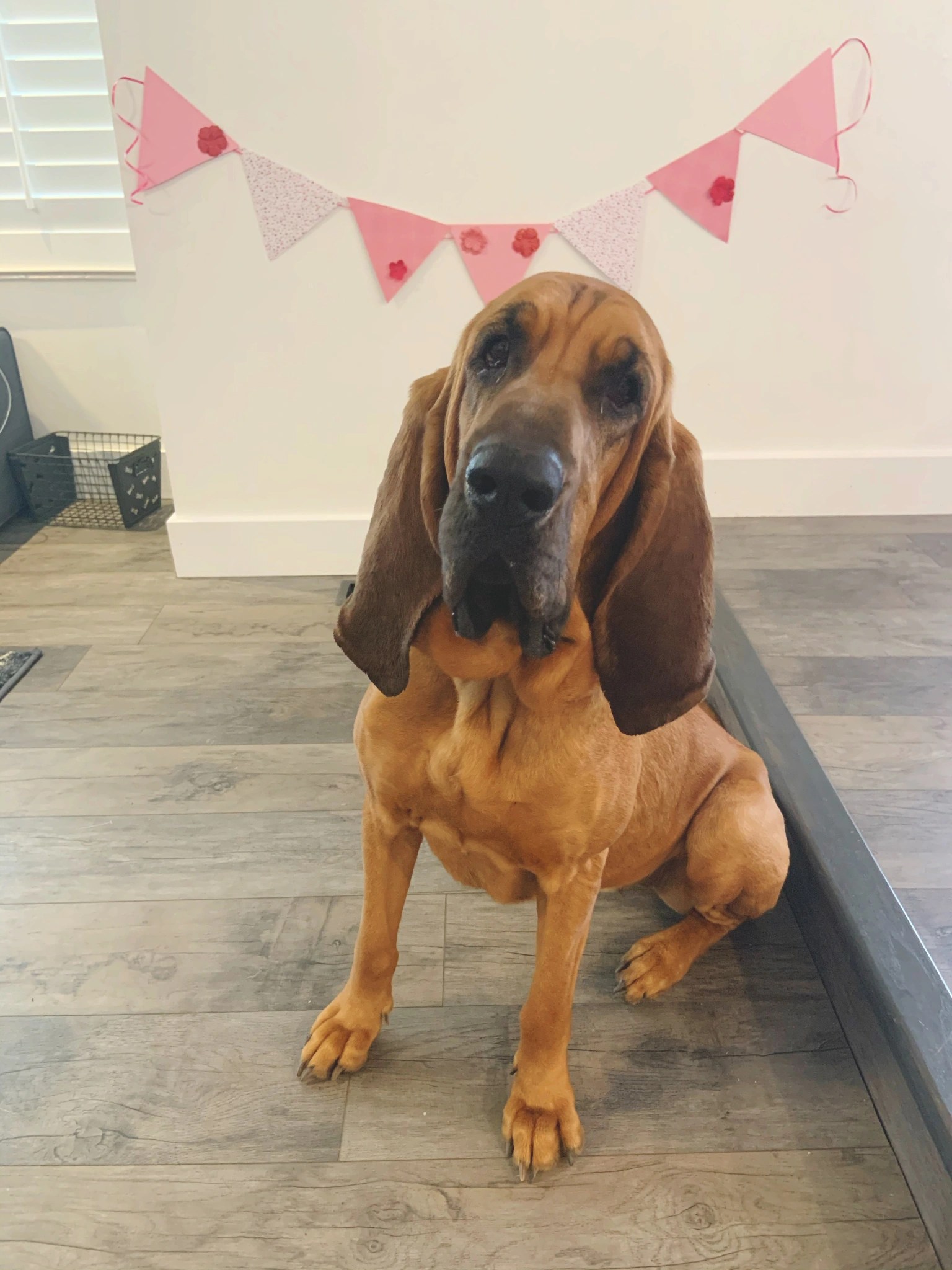
This is Sophie!

I hope to be able to entertain you with stories of this wonderful dog. She’s got a stubborn streak both while working and while at home. She has made life interesting to be sure, and more entertaining and loving than I deserve in a friend and partner. I want to share my story of how I met her. 

Unfortunately, her story wasn’t one without a few struggles of her own. She had to deal with some struggles before I was able to be lucky enough to have her stumble head first into my life. Maybe in some ways though, her and I were better off having to work through some of the repercussions of moving away from multiple families. Maybe because of what she went through, it opened my eyes to the opportunity to train with her in more than just search and rescue type work. 

It’s been a long road from the time that I got her. Trying to help her get through her anxiety and stress that led to her sometimes biting people, dog aggression, and sometimes just not wanting to listen to me at all.

The dog that I live with now is still a working machine. She loves the hunt more than anything else. So much so that if we go too many days without it, she starts destroying my house. Instead of the biting and hating other dogs, she now gets to live with my family of a wife and two children. She has grown to love and co-exist with a stubborn Rottweiler that constantly gives her a run for her money.

I still wonder how I had the opportunity to have a dog that was born and raised in Massachusetts. At least for the first two years of her life.

Her story started with a hound handler that had many years, and many hounds during his time of working with dogs. Sophie was still really young when her handler had an unfortunate thing happen to him. He injured his back to where he was no longer able to run with a hound the same way he had in the past.

With her age, abilities, and ultimately what she was bred for, her first owner decided that he still wanted the world to have the opportunity to have Sophie provide her assistance to a community somewhere.

Across the United States in the state of Utah was a small police department that had been in contact with the organization that Sophie’s handler was part of. The police chief with this department had attended a seminar where this organization presented the abilities and benefits of a hound working for a local police department.

This police chief made quick friends with the people of this organization. He was also invited to Massachusetts where he spent some time watching the hounds work. Learning first hand what these amazing dogs can do to help find missing people.

When this organization realized that Sophie needed a new home, they contacted this chief from Utah and told them of a rare opportunity they wanted to offer him. They told him that they had a hound that needed to be re-homed. That she was a couple of years old, and was fully trained in her abilities. All she needed was a handler and a department willing to use her. The chief of police sent his lieutenant to Massachusetts where he spent about a week learning the basics of how Sophie worked. The lieutenant then drove back to Utah to start a bloodhound unit program with this police department.

A couple of years in of getting this program off of the ground, another incident happened. Sophie’s new handler got injured. For month’s it was thought that the lieutenant would be back to work. He was adamant that he wanted to stay with the department until Sophie retired so he could take her with him. He came to the realization though, that he was going to have to leave before Sophie could retire.

It was rumored around the police department that Sophie was just going to retire with the lieutenant even though she had years left available to keep working and providing for the community. One day, the lieutenant announced that he wanted officers to put in letters of interest to be the new hound handler for the department. He told those interested that there was going to be a panel of three officers, all hound handlers from Utah, that would decide who the best candidate would be for Sophie.

I was about two years into my career as a law enforcement officer at this same police department where Sophie worked. When I first started in law enforcement, my goal and biggest dreams were to work with a dog in some capacity. When I heard that they were looking for people that wanted the position, I didn’t think much of it. I was newer, other more experienced officers were putting in for the position, and I didn’t know if I wanted to run a tracking/trailing dog. I had always dreamed of having a dog that helped find drugs or had a more known job as a police officer.

I was called by my lieutenant shortly after the position to be Sophie’s handler opened up. He was aware that I have always wanted to be a K9 handler. He knew that I spent a lot of time working with another officer with the department that has a dog used to find drugs. He told me that he wanted me to put in for the position.

I wrote my letter of interest, then started the process of getting ready to interview. I had a small amount of experience with training a dog that I had previously that had behavior issues. My experience was no more than working with a company that helped with behavioral modification for my dog that had health and anxiety issues.

During the interview, among many questions, I was asked what experience I had working with dogs. I shared the small bit of experience that I had. Among all the other questions that stood out to me was asking if my family was prepared for the time and energy it took to be a police K9 handler. I was able to explain to them that my wife was very aware that having a dog in a working capacity has been a dream of mine even before meeting her. That I probably have no idea how big of a commitment this really was, but if given the opportunity, I would give it my all and put forth all the effort I could to succeed.

Hours after the interview, my lieutenant called me and one other officer that made it to the final interview process. The call was to announce to the two of us who had gotten the position. I expected this other officer, almost a 20 year veteran officer, to get the position. Well, I was pleasantly surprised and shocked that my name was the one called to be Sophie’s next handler!

ooOOoo

I hope you read it completely through because you would agree with me that this is most interesting. Hopefully, Jason will be publishing more posts.

Moore’s Law

In memory of Gordon Moore.

From Wikipedia:

Gordon Earle Moore (January 3, 1929 – March 24, 2023) was an American businessman, engineer, and the co-founder and emeritus chairman of Intel Corporation.

It was in 1965 that Gordon Moore suggested that every year there would be a doubling of the number of components per integrated circuit. In 1975 he revised his forecast to a doubling every two years; that prediction has become a reliable outcome and became known as Moore’s Law.

Just look at the left-hand scale of that graph above and ponder on the figures. From less than 10,000 in 1971 to more than 10 billion in 2021!

Incredible!

Gordon Earle Moore in 1978. He died on March 24th, 2023 aged 94 years.

What an amazing man!

Keeping dogs from fighting each other.

A video courtesy of Zak George’s Dog Training Revolution.

I was in a bit of a hurry yesterday and looked through my folder of blog posts and came across this video.

ooOOoo

The words that accompanied the video are also presented:

Discover the secrets to successful dog training in a multi-dog household! We delve into the challenges and rewards of training multiple dogs, offering practical tips and expert advice to help you create a harmonious home. From establishing routines and managing individual training sessions to addressing common behavioral issues, we’ve got you covered in this informative and insightful video. I’ll guide you through essential techniques for managing multiple dogs, including establishing boundaries, promoting positive reinforcement, and tailoring training approaches to each dog’s unique personality and needs. Whether you’re a seasoned dog owner or new to multi-dog households, these expert tips will help you transform potential chaos into a well-coordinated, stress-free environment. Don’t miss out on this valuable resource for training multiple dogs effectively and efficiently. Be sure to like, share, and subscribe to our channel for more dog training tips and tricks. We’d love to hear about your own experiences with multi-dog households and training, so leave a comment below to join the conversation!

Sponsored by PupBox! Get your first PupBox for ONLY $5!!! Use code: ZAK5 at https://pupbox.com

ooOOoo

Needless to say I have no affiliation with PupBox.

Keeping our dogs free from poisons

Just a single image!

The vet practice we use is Lincoln Road Veterinary Clinic, and we have used them for quite a few years. They recently sent out a mailer that contained the following:

Now the ‘CALL US’ has to be the vet in your own location; that’s obvious!

But nonetheless I thought it was worth sharing with you.

Our pets are very special!

The end maybe in sight!

A rather gloomy analysis about the next few years!

One makes decisions all one’s life. But too few of us are making decisions that will prevent our planet from over-heating.

Patrice Ayme wrote a comment in a recent post that said (in part): “However we are tracking to a much higher temperature: + 7 (seven) Celsius in some now temperate parts… imminently. That is going to be catastrophic.”

There is a terrible change going on right now. From the deforestation in the Amazon rainforest to the unseasonable heat in Europe, as reported in the Guardian newspaper: “The result of this advection has been anomalously warm temperatures across large parts of Europe – in particular across France and Spain, where temperatures soared to over 10C above normal. Maximum temperatures widely exceeded 30C in parts of Spain on Thursday, with 35.2C measured at Morón de la Frontera, south-east of Seville.

One would think that our governments would be pulling together in order to have a co-ordinated global plan. But there’s no sight of that yet. What we do have is a sort of craziness of Governments that causes me to lament over our, as in a global ‘our’, distractions. We are running out of time!

To this end I am republishing in full the latest George Monbiot essay. I hasten to add with Mr Monbiot’s permission.

ooOOoo

The Oligarch’s Oligarch

Published 30th October 2022.

Just as we need to get the money out of politics, we have been gifted a Prime Minister who represents the ultra-rich.

By George Monbiot, published in the Guardian 26th October 2022

Before we decide what needs to change, let’s take stock of what we have lost. I want to begin with what happened last week. I don’t mean the resignation of the prime minister. This is more important.

Almost all the media reported a scripted comment by the newly reinstated home secretary, Suella Braverman, about the “Guardian-reading, tofu-eating wokerati”. Astonishingly, scarcely any of them reported what she was doing at the time. She was pushing through the House of Commons the most repressive legislation of the modern era.

Under the public order bill, anyone who has protested in the previous five years, or has encouraged other people to protest, can be forced to “submit to … being fitted with, or the installation of, any necessary apparatus” to monitor their movements. In other words, if you attend or support any protest in which “serious disruption to two or more individuals or to an organisation” occurs, you can be forced to wear an electronic tag. “Serious disruption” was redefined by the 2022 Police Act to include noise.

This is just one of a series of astounding measures in the bill, which has been hardly remarked upon in public life as it passes through Britain’s legislature. What we see here is two losses in one moment: the final erasure of the right to protest, and political journalism’s mutation from reporting substance to reporting spectacle. These are just the latest of our losses.

So extreme has inequality become, and so dangerous is the combination of frozen wages, lagging benefits, rising rents and mortgage repayments, soaring bills and food inflation, that millions of people are being pushed towards destitution. Unless something changes, many will soon lose their homes. In the midst of this crisis, we have been gifted a prime minister who owns four luxury “homes”. One of them is an empty flat in Kensington that he reserves for visiting relatives.

While Rishi Sunak was chancellor, the government repeatedly delayed its manifesto promise to ban no-fault evictions. Landlords are ruthlessly exploiting this power to throw their tenants on to the street or use the threat to force them to accept outrageous rent rises and dismal conditions. Had Sunak’s “help to buy” mortgage scheme succeeded (it was a dismal flop), it would have raised house prices, increasing rents and making ownership less accessible: the opposite of its stated aim. But this, as with all such schemes, was surely its true purpose: to inflate the assets of existing owners, the Conservative party’s base.

Public services are collapsing at breathtaking speed. Headteachers warn that 90% of schools in England could run out of money next year. NHS dentistry is on the verge of extinction. Untold numbers are now living in constant pain and, in some cases, extracting their own teeth. The suspicion that the NHS is being deliberately dismembered, its core services allowed to fail so that we cease to defend it against privatisation, rises ever higher in the mind.

But Sunak appears determined only to hack ever further. Sitting on a family fortune of £730m, he seems unmoved by the plight of people so far removed from him in wealth that they must seem to exist on another planet. He is the oligarch’s oligarch, ever responsive to the demands of big capitaland the three offshore plutocrats who own the country’s biggest newspapers, oblivious of the needs of the 67 million people who live here.

After 12 years of Conservative austerity and chaos, the very rich have taken almost everything. They have even captured virtue. They now appropriate the outward signs of an ethical life while continuing – despite or because of their organic cotton jackets and second homes, their electric cars and pasture-fed meat, their carbon offsets and ayahuasca retreats, philanthropy and holidays in quiet resorts whose palm-thatched cabins mimic the vernacular of the people evicted to make way for them – to grasp the lion’s share of everything.

Corruption is embedded in public life. Fraud is scarcely prosecuted. Organised crime has been so widely facilitated, through the destruction of the state’s capacity to regulate everything from money laundering to waste dumping, that you could almost believe it was deliberate. Our rivers have been reduced to sewers, our soil is washing off the land, the planning system is being dismantled, and hundreds of environmental laws are now under threat. We hurtle towards Earth systems oblivion, while frenetically talking about anything but.

In other words, it’s not just a general election we need, it’s a complete rethink of who we are and where we stand. It’s not just proportional representation we need, but radical devolution to the lowest possible levels at which decisions can be made, accompanied by deliberative, participatory democracy. It’s not just new lobbying laws we require, but a comprehensive programme to get the money out of politics, ending all private political donations, breaking up the billionaire press and demanding full financial transparency for everyone in public life. We should seek not only the repeal of repressive legislation, but – as civil disobedience is the bedrock of democracy – positive rights to protest.

All this now feels far away. Jeremy Corbyn offered some (though by no means all) of these reforms. Keir Starmer offers none. Though Labour MPs voted against the public order bill, his only public comment so far has been to endorse its headline policy: longer sentences for people who glue themselves to roads. But if the Labour party or its future coalition partners can persuade him to agree to just one aspect of this programme, proportional representation, we can start work on the rest, building the political alliances that could transform the life of this nation. Without PR, we’re stuck with a dysfunctional duopoly, in hock to the billionaire press and the millionaires it appoints to govern us. We cannot carry on like this.

http://www.monbiot.com

ooOOoo

So much is really telling but I just want to draw your attention to this sentence: In other words, it’s not just a general election we need, it’s a complete rethink of who we are and where we stand.

It is not just in England and Wales but also in the USA. Indeed, most of the countries in the world.

Here is an excerpt from the latest email from The Economist. It presages the COP27 to be held in Egypt next week.

By burning fossil fuels, humans have altered Earth’s atmosphere, which has consequences for almost everything on the planet. It is reshaping weather systems and coastlines, transforming where crops can be grown, which diseases thrive, and how armies fight . Rising temperatures affect geopolitics, migration, ecosystems and the economy. Over the next century and beyond, climate change—and the responses to it—will remake societies and the world.

And a paragraph later:

This week I wrote about the seven texts I recommend as an introduction to the climate crisis—and explained why each is worth turning to—as a part of our “Economist reads” series. They range from Bill Gates’s assessment of technological solutions to a discussion of international justice by the former UN High Commissioner on Human Rights. One book I find myself recommending over and over again is “What We Know About Climate Change” by Kerry Emanuel, an atmospheric scientist at MIT. At 88 pages, it is a blessedly short, readable primer on the science, history and economics of climate change. The climate crisis touches everything. Understanding it, even a little, is essential for anyone who is engaged with the world and its future. This is a good place to start

Please follow this advice because it is an excellent place to start.

I wish with all my heart that I am wrong and maybe, just maybe, I am having a ‘down in the dumps’ day. Whatever, my judgement is that we have a few more years at most to find out.

One of the puzzles of this age.

Why society doesn’t worry a whole lot more about the changing climate.

There was an article recently on Treehugger that I read in full.

It was predictable, in a way, and very disturbing. Have a read yourself.

ooOOoo

Why Don’t People Care About Climate Change?

They have other things on their mind, like being hit by a car.

By Lloyd Alter,

Published October 21, 2022

People fear this more than climate change. Halfpoint/ Getty Images

Treehugger was founded by Graham Hill as “a green lifestyle website dedicated to driving sustainability mainstream.” Sustainability is often defined as “meeting our own needs without compromising the ability of future generations to meet their own needs,” and doesn’t seem to be much more mainstream now than it was then. Here we are, 18 years later, and key sustainability issues like climate change are not top of mind for most people, and Treehugger is not the world’s biggest website.

One reason might be because of people’s perception of risk. The Lloyd’s Register Foundation is a charity that “helps to protect life and property at sea, on land, and in the air.” It hired Gallup to do a World Risk Poll in 2020, using 2019 data, and just published its latest 2022 poll with 2021 data, after polling 125,911 people in 121 countries, mostly by telephone. One poll was pre-pandemic, and the other during it.1Chief executive Dr. Ruth Boumphrey compares the two:

“Looking at this first report of the 2021 World Risk Poll, what strikes me most about the findings is what hasn’t changed, as much as what has. People globally still worry about perennial threats such as road crashes, crime, and violence more than any other risks, including Covid-19, and this has important implications for how policymakers work with communities to manage emerging public health challenges in the context of their everyday lives.”

Perhaps the most surprising statistic is that North Americans believe that their greatest daily source of risk is from road-related accidents and injuries at 29%, followed by crime and violence at 11%. Australia and New Zealand put road risk at 33%, weirdly followed by cooking and household accidents at 11%.1

At first, I thought this is terrible; we have been writing about road safety for years, and nothing gets fixed, and yet it is North Americans’ biggest worry! And what’s wrong with Australian kitchens? But when you look at the numbers, you realize that this is a result of rich countries not suffering as much from many of the things other countries worry about, such as Latin America with crime and violence at 43%, Africa worrying about not having money, and North Africa worried about disease.1

Covid-19 was considered a major risk in some parts of the world, but “its impact was moderate overall, and day-to-day risks such as road-related injuries, crime and violence, and economic concerns remained top-of-mind for most people.”

This has been the perennial sustainability story; day-to-day issues and worries have higher priority. Climate change gets its own special section of the risk report and it comes to much the same conclusion. The authors start by noting that “the global risk posed by climate change is widely recognised, and warnings about its effects are increasingly dire. A recent joint statement by more than 200 medical journals called the rapidly warming climate the ‘greatest threat to global public health.'”

But then they dig into the data and find that, while 67% of respondents consider climate change a threat, only 41% deem it serious.1 It varies by education:

“The likelihood of people viewing climate change as a very serious threat to their country was much lower among those with primary education or less (32%) than among those with secondary (47%) or post-secondary (50%) education. More than a quarter of people in the lowest education group (28%) said they ‘don’t know,’ compared to 13% among those with secondary education and 7% with at least some post-secondary education.”

Logically, people who had experienced severe weather events were more likely to consider climate change to be a serious threat, although even then, there is a correlation with education. So university grads in Fort Myers are probably pretty convinced that climate change is a problem right now. The conclusion:

“As in 2019, the 2021 World Risk Poll findings demonstrate the powerful influence of education on global perceptions of climate change. The data highlight the challenge of reaching people who may be vulnerable to risk from extreme weather but have low average education levels, such as agricultural communities in low- and middle-income countries and territories… Spreading awareness of how climate change may directly impact people’s lives may be crucial in broadening local efforts to reduce carbon emissions and build resilience to the effects of rising temperatures.”

Education has always been a problem because, as climate journalist Amy Westervelt noted after the latest IPCC report, there are powerful forces interested in downplaying the importance of climate change. She wrote, “The report made one thing abundantly clear: the technologies and policies necessary to adequately address climate change exist, and the only real obstacles are politics and fossil fuel interests.” Education would have a lot to do with how susceptible people are to their stories.

In many ways, we have seen this movie before, in the Great Recession of 2008. When people are worrying about whether they can heat or they can eat, or apparently whether they will survive crossing the street, then climate change is something they can worry about later.

  1. 2021 Report: A Changed World? Perceptions and Experiences of Risk in the Covid Age.” Lloyd’s Register Foundation, 2022.

ooOOoo

This is the reason why we need leaders, as in country leaders, because only these people are sufficiently committed to plan and to legislate for the most important tasks facing that country. In the case of climate change it requires even more co-ordination across all the countries in the world; we do have a way to go before that is achieved.

We are getting close to it being too late!

As in we humans living on this planet.

Next Saturday I am giving a talk to our local Freethinkers and Humanists group on climate change. As a result of this I was doing some research on the subject and I thought that I would share what I found with you.

But first may I say that the new King of the United Kingdom, King Charles III, may not have ages and ages on the throne but he is a committed environmentalist. In a recent VoA article the Prince of Wales, as he was then, reported that when Charles opened the COP26 climate summit, held in Scotland last year, and gave the opening speech, urging world leaders seated in front of him to redouble their efforts to confront global warming, he warned: “Time has quite literally run out.”

It is us!

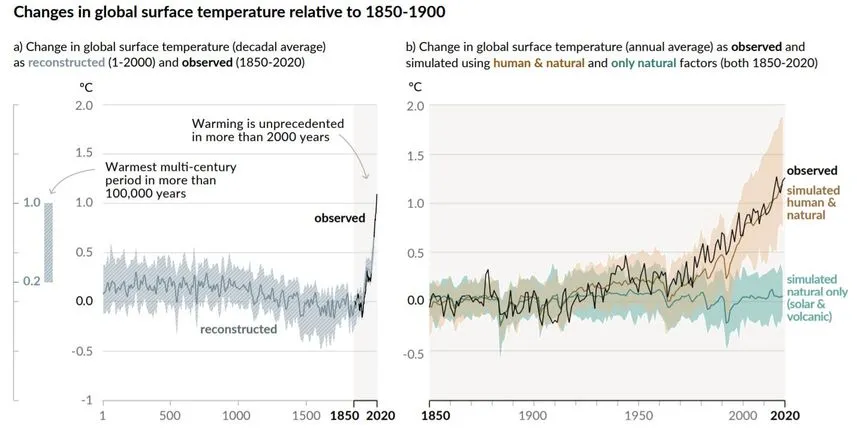
The UN’s Intergovernmental Panel on Climate Change (IPCC) kicked off its 2021 report with the following statement: “It is unequivocal that human influence has warmed the atmosphere, ocean and land.

A little later the article says: It took a while, but climate modelling is now refined enough to predict how things would go without human influence, within a margin of error. What we are observing today, however, is beyond that margin of error, therefore proving that we have driven the change.

It is getting hot

The last decade was the hottest in 125,000 years. There are a number of graphs to support this. Here is one:

The oceans

One of the facts of having a water world, 71% of the Earth’s surface is water-covered, and the oceans hold about 96.5% of all Earth’s water, is that a 2019 study found that oceans had sucked up 90% of the heat gained by the planet between 1971 and 2010. Another found that it absorbed 20 sextillion joules of heat in 2020  – equivalent to two Hiroshima bombs per second.

Carbon-dioxide

In fact CO2 levels are now the highest that they have been in 2 million years. Today, they stand at close to 420 parts per million (ppm). To put that into context pre-industrial levels, before 1750, had CO2 levels around 280 parts per million.

We are losing ice big time

I can do no better than to quote from Earth.org: Since the mid-1990s, we’ve lost around 28 trillion tons of ice, with today’s melt rate standing at 1.2 trillion tons a year. To help put that into perspective, the combined weight of all human-made things is 1.1 trillion tons. That’s about the same weight as all living things on earth.

I repeat: Every single year we are losing 1,200,000,000,000 tons of ice!

Extreme weather

We can now attribute natural disasters to human-driven climate change with certainty. We can now say with precision how much likelier we made things like the North American summer 2021 heatwave, which the World Weather Attribution says was “virtually impossible” without climate change as well as the Indian heatwave, which experts believe it was made 30 times more likely because of climate change.

Climate change mitigation

There is a long and comprehensive article on the above subject on WikiPedia. I will quote from the paragraph Needed emissions cuts.

If emissions remain on the current level of 42 GtCO2, the carbon budget for 1.5 °C could be exhausted in 2028. (That’s 42 gigatones, as in 1 gigaton is a unit of explosive force equal to one billion (109) tons of trinitrotoluene (TNT).

In 2022, the Intergovernmental Panel on Climate Change (IPCC) released its Sixth Assessment Report on climate change, warning that greenhouse gas emissions must peak before 2025 at the latest and decline 43% by 2030, in order to likely limit global warming to 1.5°C (2.7°F). Secretary-general of the United Nations, António Guterres, clarified that for this “Main emitters must drastically cut emissions starting this year”.

Then just before that paragraph WikiPedia reports that: The UNFCCC aims to stabilize greenhouse gas (GHG) concentrations in the atmosphere at a level where ecosystems can adapt naturally to climate change, food production is not threatened, and economic development can proceed in a sustainable fashion. Currently human activities are adding CO2 to the atmosphere faster than natural processes can remove it.

We need to act now, otherwise…

… it will be too late for billions of us.

This may be the most catastrophic of our climate change facts. As of now, only 0.8% of the planet’s land surface has mean annual temperatures above 29°C, mostly in the Sahara desert and Saudi Arabia (solid black in the map below).

study by Xu et al. (2020) called “Future of the Human Niche” found that by 2070, under a high emissions scenario, these unbearable temperatures could expand to affect up to 3 billion people (dark brown areas).

Doing nothing is much worse than doing something

On the current path, climate change could end up costing us 11 to 14% of the global GDP by mid-century. Regression into a high emissions scenario would mean an 18% loss, while staying below 2°C would reduce the damage to only 4%. 

It has been proposed that ending climate change would take between $300 billion and $50 trillion over the next two decades. Even if $50 trillion is the price tag, that comes down to $2.5 trillion a year, or just over 3% of the global GDP. 

Climate change is an incredibly complex phenomenon, and there are many other things happening that were not covered above.

These are the facts. There is no disputing them. Jean and I are relatively immune from the effects, because of our ages, but not entirely so. The last few weeks with the imminent risk of our property being damaged by wildfires is one example. The last three winters being below average rainfall is another. But it is the youngsters I fear most for. On a personal note, my daughter and husband have a son and he is now 12. What sort of world is he growing up in?

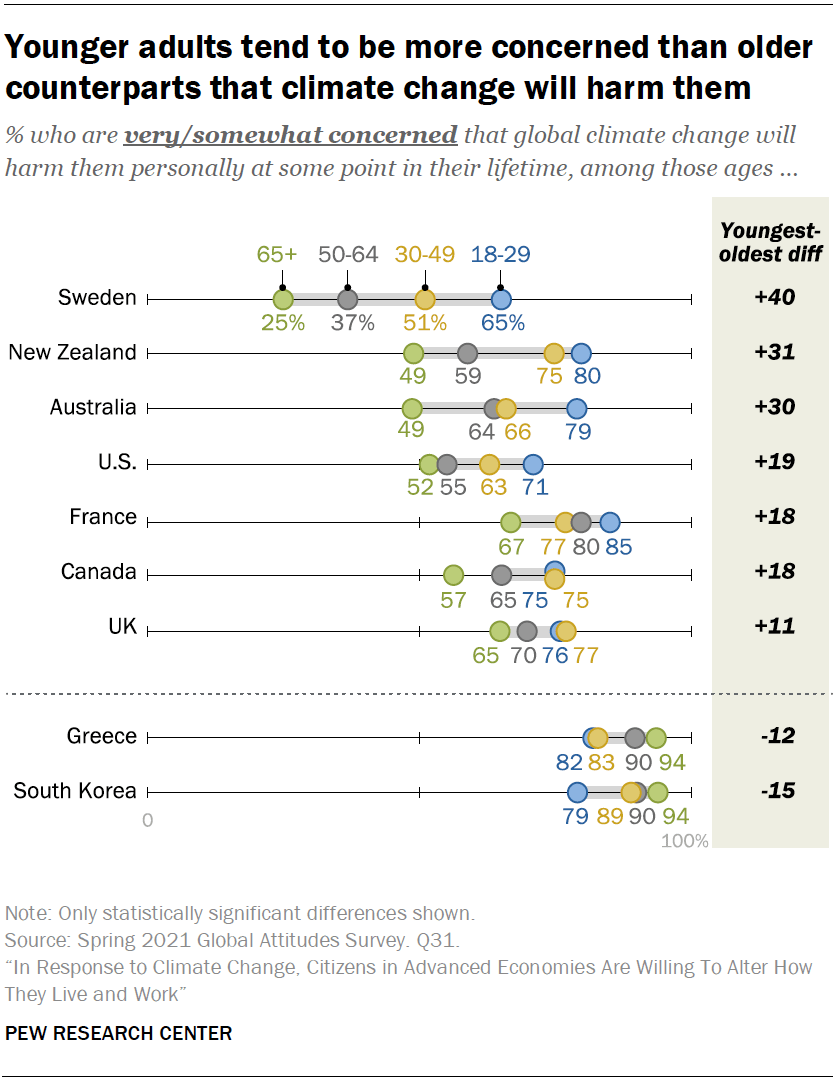
So here is a view of the global population of young people.

Just before I close let me show you my final chart. It goes to show our attitudes.

I am not a political animal. However I recognise that it is our leaders, globally, but especially in the top 10 countries in the world, who have to be leaders! Here are the top 10 countries.

So, please, dear leader, make this the number one priority for your country and for the world (areas of their country in square kilometres): Russia. 17,098,242, Canada. 9,984,670, United States. 9,826,675, China. 9,596,961, Brazil. 8,514,877, Australia. 7,741,220, India. 3,287,263 and Argentina. 2,780,400.

Sir David Attenborough.

There are not many who achieve so much, but Sir David most definately has!

This is our planet. It is the only one we have (stating the obvious!).

This beautiful photograph taken from the Apollo 11 mission says it all. That Commander Neil Armstrong and lunar module pilot Buzz Aldrin landed the Apollo Lunar Module Eagle on July 20, 1969 changed everything.

But one thing that was not on anyone’s mind then; the state of the planet!

This view of Earth rising over the Moon’s horizon was taken from the Apollo 11 spacecraft. The lunar terrain pictured is in the area of Smyth’s Sea on the nearside. Coordinates of the center of the terrain are 85 degrees east longitude and 3 degrees north latitude.
While astronaut Neil A. Armstrong, commander; and Edwin E. Aldrin Jr., lunar module pilot, descended in the Lunar Module (LM) “Eagle” to explore the Sea of Tranquility region of the moon, astronaut Michael Collins remained with the Command and Service Modules (CSM) “Columbia” in lunar orbit.
Image Credit: NASA

How that has changed since 1969.

David Attenborough is a giant of a man, and I say this out of humility and respect for what he has done in his long life, he was born in May, 1926, and he is still fighting hard to get us humans to wake up to the crisis that is upon us.

Wikipedia has an entry that lists all the television shows, and more, that David Attenborough has made. As is quoted: “Attenborough’s name has become synonymous with the natural history programmes produced by the BBC Natural History Unit.”

Please take 45 minutes and watch this film. It is so important.

But before you do please read this extract taken from this site about the film:

For decades David Attenborough delighted millions of people with tales of life on Earth, exploring wild places and documenting the living world in all its variety and wonder. Now, for the first time he reflects upon both the defining moments of his lifetime as a naturalist and the devastating changes he has seen.

Honest, revealing and urgent, the film serves as a witness statement for the natural world – a first-hand account of humanity’s impact on nature, from Australia’s Great Barrier Reef to the jungles of central Africa, the North Pole and Antarctica. It also aims to provide a message of hope for future generations.

“I’ve had a most extraordinary life. It’s only now I appreciate how extraordinary,” Sir David says in the film’s trailer, in which he also promises to tell audiences how we can “work with nature rather than against it”.

The film retraces Sir David’s career, his life stages and natural history films, within the context of human population growth and the loss of wilderness areas. “I don’t think that the theoretical basis for the reason why biodiversity is important is a widely understood one,” he told the Guardian in September.

This autumn, a series of publications warned that “humanity is at a crossroads” in its relationship with nature, culminating in a UN report that the world has failed to meet a single target to stop the destruction of nature in the past decade.

Sir David has been vocal about the threat of climate change in recent years, calling on politicians to take their “last chance” to act rather than continue to “neglect long-term problems”.

We need to learn how to work with nature, rather than against it”, according to Sir David. In the film, he is going to tell us how.

Now watch the film. Please!

As you can see, in the film Sir David states that the only way out of this mess is a massive focus on rewilding.

Coincidentally, Patrice Ayme last Sunday wrote about rewilding: California Grizzly: Rewilding Is A Moral Duty. In the latter half of that essay, he wrote: “One should strive to reintroduce American megafauna, starting with the more innocuous species (and that includes the grizzly). By the way, I have run and hiked in grizzly country (Alaska), with a huge bear pepper spray cannister at the ready. I nearly used the cannister on a charging moose (with her calf which was as big as a horse). The calf slipped off, and I eluded the mom through a thicket of very closely spaced tough trees. But I had my finger on the trigger, safety off. Moose attack more humans than grizzlies and wolves combined (although a bear attack is more dangerous). In any case, in the US, stinging insects kill around 100, deer around 200 (mostly through car collisions), and lightning around three dozen people, per year.

As it is, I run and hike a lot in California wilderness, out of rescue range. I generally try to stay aware of where and when I could come across bears, lions and rattlers. My last close call with a large rattlesnake, up a mountain slope, was partly due to hubris and not realizing I was moving in dangerous terrain. Fortunately I heard the slithering just in time. Dangerous animals make us aware of nature in its full glory, and the real nature of the human condition. They keep us more honest with what is real, what humanity is all about.

And that should be the primordial sense.

I will close by offering you this photograph. May it inspire you to rewild, in small ways and also, if you can, in bigger ways. All of us must be involved. Otherwise…

Photo by Cosmic Timetraveler on Unsplash

…otherwise… (sentence left unfinished).

How to balance your working life with your dog.

Yet another great guest post from Penny Martin.

Penny writes about starting your own business but in my experience any person who is devoted to their job, be it self-employed or not, should read what Penny has to say.

(Apologies for forgetting a post last Tuesday)

ooOOoo

Five Recommendations for Balancing Time With a New Pet While Starting a Business

Whether your new pet purrs, barks, neighs, squawks or something in between, welcoming a new animal into your home brings a little more love into your life. However, extra chores come hand-in-hand with a new pet. Add in the fact that you are starting a business and all the to-do lists can feel daunting. To ensure you have time to grow your company and bond with your pet, follow these five tips.

1. Stock Up on Supplies

Time is extremely valuable when getting a company off the ground; the last thing you want chipping away at your precious time is numerous trips to the stores for your animal. To prevent this, set aside time each week to make a list of the food, toys, treats, bedding, and any other items your pet requires.

Note which stores you need to visit for all the supplies. Take a few hours to go to each shop to make sure your pet has everything he or she needs for the week. 

2. Revamp Your Space

Starting a company comes with lots of stress; turning your home into a fresh and vibrant space helps relieve this tension. A clean home makes it easier to be effective at work and relax during off-hours. Plus, revamping your rooms gives you the opportunity to create a special space for your animal to feel safe and cozy.

Create a productive and positive atmosphere by cleaning and decluttering your house. Open windows to let in fresh air and sunlight. According to one study, nearly every participant felt less anxiety and depression and had better focus when exposed to sunlight. So scrub those windows and let in some light!

3. Remove Distractions

During your room makeovers, remove as many distractions from your office space as possible. TVs, video games, social media, and music can all be distracting when trying to work and waste valuable time that could be spent bonding with your new pet.

Do not put a TV or game console in the office. If you like background noise but find it tends to interrupt your workflow, put on a calming playlist, such as instrumental songs or sounds of nature.

While you probably need your phone during office hours, do your best to resist games and social media during this time. Update your phone’s layout so the tempting apps are not visible, or download an app, such as Forest, that encourages you to focus during work hours. 

4. Save Time With Invoicing Software

Invoicing software can be a lifesaver for busy small business owners. Rather than spending hours creating invoices by hand, by choosing invoicing software, you can simply enter your customers’ information into the software and let it do the rest. The software will generate professional-looking invoices that you can send to your customers electronically. Not only does this save you time, but it also allows you to get paid faster. In addition, most invoicing software comes with built-in accounting features that make it easy to track your expenses and keep tabs on your profitability. If you’re not using invoicing software, you’re needlessly wasting valuable time that could be better spent growing your business and spending more time with your new pet.

5. Schedule Time for Important Tasks

Having important tasks scheduled in your planner makes certain you have time to get them done. Perhaps your fuzzy, furry, or fluffy friend needs weekly grooming. Instead of doing it “when you have time,” schedule a specific period during the week to wash and clean your pet.

When it comes to your company and your pet, you do not have to choose one over the other. Make time for both by grabbing all the supplies you need, refreshing your home, removing distractions, utilizing invoicing software, and making time for crucial tasks. 

Image via Pexels

ooOOoo

This is good advice from Penny and I would applaud her.

If I was to pick out one piece of advice above all others it has to be the one about scheduling, or planning as I prefer to call it. When you are really busy the only way to stay on top of everything, and that includes time with your dog, is to plan.

Finally, I asked Penny to tell me a little more about herself. This is what she said:“Penny Martin is an advocate for rescue dogs. Her goal is to inform people of what to expect and how to react to their dog so that the relationship always retains love. She created fureverfriend.info to help new owners prepare themselves for new furry friends

Splendid!

Starting your own pet business.

Another guest post from Penny Martin.

Well I am preparing this post on Saturday, the 14th. The operation for the hernia on the 10th went smoothly enough but I did not reckon on the discomfort that would follow. Indeed, I was talking to a good friend on Thursday and he said that the pain would more or less last for two weeks. My son gave me the good advice to take regular doses of an over-the-shelf painkiller rather than the stronger tablets the hospital gave me because those prohibited driving! I returned to a small amount of driving last Friday.

Now on with the show!

Penny Martin first wrote a guest post for me in February, Fostering or adopting a dog, and I am delighted to present her second post. Over to her!

ooOOoo

Why Now Is a Great Time for a Pet Business and How to Start Your Own

By Penny Martin.

If you are an animal lover who wants to spend your days scrolling through cute dog pictures and surrounded by furry clients, now is a great time to consider starting your own pet business. Here, you can learn more about which relevant business areas experiencing growth and tips to get started on the right foot. 

Reasons Why It’s a Great Time for Pet Businesses

A growing number of families include animals. According to the American Veterinary Medical Association data, more than half of American households have a pet. That number appears to be growing, too, representing an increased need for care services. 

Pets are not just more abundant; they are also becoming full-fledged family members. As a result, spending on them is also increasing. Despite rapid growth in many care service areas, there are not enough providers to meet this increased demand. 

Animal-Related Businesses That Are Thriving

If you are curious about what type of business to start, look no further than pet care providers. There are several types of jobs you can get involved in:

  • Training and behavioral services: Training isn’t just for puppies. Dogs of all ages can benefit from learning household rules and appropriate behaviors when they are out and about. 
  • Dog walking and pet sitting: This is usually based out of the client’s home, where you pick them up for a walk or provide companionship for short periods.
  • Boarding: This is an excellent option for individuals who would rather welcome dogs and cats to their own home or care facility. Many boarding companies also provide daycare services. 
  • Grooming: You will need to learn how to groom different types of pets to master the skills for a successful grooming career. However, if you enjoy helping dogs look their best, this is an excellent high-demand field. 

Business Strategies to Help You Succeed

Economic conditions are excellent for small pet-focused companies to thrive. However, as an entrepreneur, you need to follow some basic business principles to succeed.

Start by choosing an appropriate legal structure. Research the most popular setup for businesses like yours to find one that fits your needs. Then, file with the appropriate offices to make it official. Next, take time to develop a comprehensive business plan. This document will do more than get you up and running; it will also serve as a reference as you continue to grow. Be sure to conduct market research to identify your target customers.  

Implement a structured invoicing process to set clear payment terms for clients and ensure you get paid on time, especially if you send invoices immediately after performing a service. Accepting several forms of payment is also helpful for clients. Use an invoice maker, free online usually, to streamline the process. Simply add your logo and business information, and you are ready to go. 

Use bookkeeping software to track your income and expenses and gain insight into your cash flow. This is a great way to organize and store receipts, ensuring compliance with regulatory agencies. It also makes tax filing easier at the end of the year and helps you find the most deductions.

A growing number of households with pets and increased spending make now a great time to start an animal-related business. Care and service providers are excellent fields to consider, with high demand for groomers, trainers, and dog walkers. However, no matter what type of company you start, sound business strategies can keep it running smoothly.

Image via Pixels

oOOoo

Excellent!

As an ex-entrepreneur, who fundamentally was a salesman, I can also add the following to that post.

It starts and ends with the customer. A business plan is vital and so too is market research. But unless you have a clear vision of how you are to sell your services and what’s the difference that makes the difference you must not proceed. Selling is all about: Need; Feature; Benefit.

  • Open-ended questions to establish the need. (Those are questions that cannot be answered with a yes or a no.)
  • Keep on asking, and establishing a relationship, until you and the potential customer are clear that there is a need.
  • Then speak about the features of what you are selling that matches the need/s. Do not progress until the prospective customer understands and agrees.
  • For every agreed feature be clear what the benefit is for the customer; of that particular feature.
  • Try closing the deal. If there is hesitation then understand why. Resolve it. Try closing the deal again.

The very best of luck to those that want to run with this.