Category: Business

Dog Food Recall Alert

Yet another one!

Note: If readers find these food recall alerts a waste of time, then do let me know – I’m aware that for many there are already too many emails in the ‘in-box’.

Dear Fellow Dog Lover,

On September 30, 2015, Salix Animal Health of Deerfield, Florida announced the recall of one lot of its Good ‘n’ Fun Beefhide Chicken Sticks because the product has the potential to be contaminated with Salmonella.

Salmonella is a bacteria that can affect the health of both pets and humans.

To learn which products are affected, please visit the following link: Good ‘n’ Fun Beefhide Chicken Sticks Dog Chews Recall

Please be sure to share the news of this alert with other pet owners.

Mike Sagman, Editor
The Dog Food Advisor

If you click on that link above, you will see pictures of the packets and also read this:

What’s Being Recalled?

The recalled product is packaged in a 2.8 ounce bag stamped on the back side with:

Lot # AO15010
Expiration date of 03/2018
UPC code 0 91093 82247 1

No other product is affected at this time.

Where Was It Sold?

The recalled “Good ‘n’ Fun Beefhide Chicken Sticks” was distributed nationwide by Salix Animal Health at the following retail stores:

Dollar General Stores
Dollar Tree Stores

The power of hope!

It really is about good people refusing to let evil dominate our world.

The response to yesterday’s post was incredible and very gratifying.

For I was conscious that many would simply reject the proposition that I saw in John Zande’s book, namely that, “there was an evil origin to the universe and, more directly, that the deep, and growing, suffering of the pinnacle of evolution, us humans, can be traced back to that evil origin.”

The emotional challenge, of which I am acutely aware, is recognising that core proposition, that as we humans evolve so too does the capacity for human suffering, yet not wanting to give up on my personal core belief that better times ahead are possible, given sufficient people sharing that power of hope. Echoing what Sue wrote as a response to yesterday’s post that motivated me to reply, in part, thus:

If there was one sentence of yours that struck me as spot on, it was your declaration that what we think is what we create. Or as I often reflect, we are what we think.

Jean and I last night watched the latest BBC Panorama report about the migrant/refugee crisis in Europe. It was profoundly upsetting for reasons that many will understand.

George Monbiot’s essay that follows shortly is also profoundly upsetting.

But if hope is to be translated into a determination to make a difference, then it demands that we don’t ignore the pain but use our anger to fuel our passion to behave appropriately: We are what we think! Or in the much more eloquent words of Albert Einstein:

Learn from yesterday, live for today, hope for tomorrow. The important thing is not to stop questioning.

George Monbiot is to be saluted for his commitment to questioning and I am privileged to have his permission to republish the following.

ooOOoo

Inhospitable Planet

29th September 2015

There may be water on Mars. But is there intelligent life on Earth?

By George Monbiot, published in the Guardian 30th September 2015

Evidence for flowing water on Mars – this opens up the possibility of life; of wonders we cannot begin to imagine. Its discovery is an astonishing achievement. Meanwhile, Martian scientists continue their search for intelligent life on Earth.

We might be captivated by the thought of organisms on another planet, but we seem to have lost interest in our own. The Oxford Junior Dictionary has been excising the waymarks of the living world. Adders, blackberries, bluebells, conkers, holly, magpies, minnows, otters, primroses, thrushes, weasels and wrens are now surplus to requirements.

In the past four decades, the world has lost 50% of its vertebrate wildlife. But across the latter half of this period, there has been a steep decline in coverage. In 2014, according to a study at Cardiff University, there were as many news stories broadcast by the BBC and ITV about Madeline McCann (who went missing in 2007) as there were about the entire range of environmental issues.

Think of what would change if we valued terrestrial water as much as we value the possibility of water on Mars. Only three percent of the water on this planet is fresh, and of that two-thirds is frozen. Yet we lay waste to the accessible portion. Sixty percent of the water used in farming is needlessly piddled away by careless irrigation. Rivers, lakes and aquifers are sucked dry, while what remains is often so contaminated that it threatens the lives of those who drink it. In the UK, domestic demand is such that the upper reaches of many rivers disappear during the summer. Yet still we install clunky old toilets and showers that gush like waterfalls.

As for salty water of the kind that enthralls us when apparently detected on Mars, on Earth we express our appreciation with a frenzy of destruction. A new report suggests that fish numbers have halved since 1970. Pacific bluefin tuna, that once roamed the seas in untold millions, have been reduced to an estimated 40,000, yet still they are pursued. Coral reefs are under such pressure that most could be gone by 2050. And in our own deep space, our desire for exotic fish rips through a world scarcely better known to us than the red planet’s surface. Trawlers are now working at depths of 2000 metres. We can only guess at what they might be destroying.

A few hours before the Martian discovery was announced, Shell terminated its Arctic oil prospecting in the Chukchi Sea. For the company’s shareholders, it’s a minor disaster: the loss of $4 billion. For those who love the planet and the life it sustains, it is a stroke of great fortune: it happened only because the company failed to find sufficient reserves. Had Shell succeeded, it would have exposed one of the most vulnerable places on Earth to spills that are almost inevitable, where containment is almost impossible. Are we to leave such matters to chance?

At the beginning of September, two weeks after he granted Shell permission to drill in the Chukchi Sea, Barack Obama travelled to Alaska to warn Americans about the devastating effects that climate change, caused by the burning of fossil fuels, might catalyse in the Arctic. “It’s not enough just to talk the talk”, he told them. “We’ve got to walk the walk.” We should “embrace the human ingenuity that can do something about it.” Human ingenuity is on abundant display at Nasa, which released those astounding images. But when it comes to policy, the search for intelligent life goes on.

Let the market decide: this is the way in which governments seek to resolve planetary destruction. Leave it to the conscience of consumers, while that conscience is muted and confused by advertising and corporate lies. In a near-vacuum of information, we are each left to decide what we should take from other species and other people; what we should allocate to ourselves or leave to succeeding generations. Surely there are some resources and some places – such as the Arctic and the deep sea – whose exploitation should simply stop?

All this drilling and digging and trawling and dumping and poisoning – what is it for anyway? Does it enrich human experience, or stifle it? A couple of weeks ago, I launched the hashtag #extremecivilisation, and invited suggestions. They have flooded in. Here are just a few of the products my correspondents have found. All of them, as far as I can tell, are real.

An egg tray for your fridge, that syncs with your phone to let you know how many eggs are left. A gadget for scrambling them – inside the shell. Wigs for babies, to allow “baby girls with little or no hair at all the opportunity to have a beautifully realistic hair style”. The iPotty, that permits toddlers to keep playing on their iPads while toilet training. A £2000 spider-proof shed. A snow sauna, on sale in the United Arab Emirates, in which you can create a winter wonderland with the flick of a switch. A refrigerated watermelon case on wheels: indispensable for picnics. Or perhaps not, as it weighs more than the melon. Anal bleaching cream, for … to be honest, I don’t want to know. An “automatic watch rotator” that saves you the bother of winding your luxury wrist candy. A smart phone for dogs, with which they can take pictures of themselves. Pre-peeled bananas, in polystyrene trays covered in clingfilm. Just peel back the packaging …

Every year, clever new ways of wasting stuff are devised, and every year we become more inured to the pointless consumption of the world’s precious resources. With each subtle intensification, the baseline of normality shifts. It should not be surprising to discover that the richer a country becomes, the less its people care about their impacts on the living planet.

Our alienation from the world of wonders with which we evolved has only intensified since David Bowie described a girl stumbling through a “sunken dream”, on her way to be “hooked to the silver screen”, where a long series of distractions diverts her from life’s great questions. The song, of course, was Life on Mars.

www.monbiot.com

ooOOoo

David Bowie’s track Life on Mars from the album Hunky Dory was released in 1971. Courtesy of YouTube, here it is again:

Dog Food Recall Alert

Reminds me of London buses: You wait for hours and then two arrive almost one behind the other!

(Previous alert was just two days ago.)

Dear Fellow Dog Lover,

Because you signed up on our website and asked to be notified, I’m sending you this special recall alert.

On September 23, 2015, The U.S. Food and Drug Administration announced the recall of certain lots of Dingo brand dog chews because the product has the potential to contain amantadine.

Amantadine is a human antiviral drug not approved for use in animal food.

To learn which products are affected, please visit the following link: Dingo Chip Twists Dog Chew Treats Recall of September 2015

Please be sure to share the news of this alert with other pet owners.

Mike Sagman, Editor
The Dog Food Advisor

P.S. Not already on our dog food recall notification list yet? Sign up to get critical dog food recall alerts sent to you by email. There’s no cost for this service.

No way to run a world!

Why we have to learn integrity from our dogs, and soon!

After yesterday’s post about the ice dagger poised to fall on the heads of humanity, I was hoping to offer something more cheerful for today. Indeed, I had a guest post ready for publication but then ran into a small technical hitch that stopped it being scheduled for today.

So I turned to this recent article that appeared on The Conversation blogsite that is, unfortunately, another reminder of these mad times. It is republished within the terms of articles that appear on The Conversation.

ooOOoo

How could VW be so dumb? Blame the unethical culture endemic in business.

Author: Edward L Queen, Director of Ethics and Servant Leadership Program, Emory University.

How much can corporate culture explain VW’s deception? Jim Young/Reuters

That far too much of the world’s corporate leadership is driven by moral midgets who have been educated far beyond their capacities for good judgment should be obvious after observing the events of the past week.

The financial industry-led economic collapse of 2008 should have taught us this lesson, but the specificity and clarity of it was brought home by news of price-gouging in the pharmaceutical industry and, even more blatantly, by the announcement that Volkswagen intentionally programmed thousands of its diesel automobiles to cheat emissions testing.

We should be outraged by such behavior and demand appropriate punishments and sanctions as well as restitution and correction. But we should not be shocked. As an ethicist who has looked at the behavior of individuals in business and corporations, I can point to a number of troubling trends that help explain these transgressions.

Impaired moral imaginations

For the past five to six decades, epigones of Milton Friedman have been emphasizing that the only duty of a corporation is return on investment (regularly ignoring his caveat of doing so within the law and social norms).

This lesson, drilled into generations of business school graduates, now drives tsunamis of corporate malfeasance. Data regularly demonstrate that business school students are more likely to cheat on examinations and assignments than their peers, although – and this is of interest for the Volkswagen case – they are closely followed by engineering students.

Are business school teaching the right values? mleiboff/flickr, CC BY-NC-ND

Additionally, some evidence suggests that not only are business students more impaired in their moral judgments in a broader sense than are those in other majors and professional schools, but that business schools themselves may be responsible.

More disturbing, observational and anecdotal evidence suggests that business students are not only impaired in their moral judgments but that significant percentages of them have severely impaired moral imaginations. By this I mean not only do they make bad ethical decisions, but they actually are incapable of identifying an ethical situation when they are presented with one.

Numerous interviews with business ethics faculty I have had over the past decade suggest that when business students are presented with an ethics case, that is a case where they have been told that there is an ethical problem, 20% to 30% of the students cannot find or identify the ethical issue. This has been borne out by my personal experience when teaching business students.

Unmistakable malfeasance

With regards to the Volkswagen scandal, let us be clear about the nature of the company’s activities. This was not a mistake, an error, an ethical lapse or poor judgment. This was an intentionally designed and executed violation of the law in both its letter and its spirit. It also was an ethical violation of the highest level.

Volkswagen intentionally deceived those to whom it owed a duty of honesty. It fraudulently misrepresented its automobiles to be other than what they were. Most significantly, it intentionally chose to do so and went out of its way to commit the wrong.

This last fact may make it far more difficult for VW to recover from the reputational hit than it perhaps has been for GM or Toyota. Even though the latter’s product defects cost people their lives, they did not intentionally produce such parts.

The sheer brazenness and conniving that went into Volkswagen’s actions are probably what shocked people the most. This was a highly technical and sophisticated operation that basically taught the emissions system how to distinguish between road travel, typical idling and idling while undergoing an emissions test.

No spin can mitigate that fact. There is and can be no claims of confusion or misunderstanding, no failures to communicate. This will erode people’s trust in Volkswagen as a company to a degree that the failures of other companies may not have experienced. In the Volkswagen scandal, just like the story about price gouging in pharmaceuticals that broke the same week, consumers are confronted with the stark reality of corporate malfeasance.

In both instances, the wrongdoing was exacerbated by the responses of the companies’ CEOs. The now former CEO of Volkswagen, Martin Winterkorn, basically acknowledged his incompetence and failure of leadership by claiming that he was unaware of the actions taken by his employees. Martin Shkreli, the CEO of Turing Pharmaceuticals, in a series of tweets responding to criticisms of its pricing of the drug Daraprim demonstrated a level of knowledge of moral and social norms that can only be described as clueless.

Redefining success

These events – and others – make clear that there is a need to look at the broader cultural realities that drive unethical decisions in business, particularly the perception that the only way of determining value and worth is money.

This situation is not new – as early as 1906 William James wrote in a letter to H G Wells, “The moral flabbiness born of the exclusive worship of the bitch-goddess SUCCESS. That – with the squalid cash interpretation put on the word success — is our national disease.”

When a person’s worth is determined only by money, only by success as it is and can be monetized, when one has no sense of being without the BMW, the Rolex, the Armani suits, the yacht, etc, the moral flabbiness emerges. Indeed, it engulfs entire organizations and perhaps even entire societies.

ooOOoo

Those last two sentences of that essay need repeating over and over again. This may just be a blog about learning from our beloved dog companions but as my home page spells out, this is not some silly romantic notion:

As man’s companion, protector and helper, history suggests that dogs were critically important in man achieving success as a hunter-gatherer. Dogs ‘teaching’ man to be so successful a hunter enabled evolution, some 20,000 years later, to farming, thence the long journey to modern man. But in the last, say 100 years, that farming spirit has become corrupted to the point where we see the planet’s plant and mineral resources as infinite. Mankind is close to the edge of extinction, literally and spiritually.

Dogs know better, much better! Time again for man to learn from dogs!

So there!

Dog Food Recall Alert

Republished for the wider promotion of this alert.

Dear Fellow Dog Lover,

Because you signed up on our website and asked to be notified, I’m sending you this special recall alert.

On September 25, OC Raw Dog of Rancho Santa Margarita, CA, announced it is recalling its OC Raw Chicken, Fish and Produce Raw Frozen Canine Formulation because it has the potential to be contaminated with Salmonella.

To learn which products are affected, please visit the following link:

OC Raw Dog Food Recall of September 2015

Please be sure to share the news of this alert with other pet owners.

Mike Sagman, Editor
The Dog Food Advisor

P.S. Not already on our dog food recall notification list yet? Sign up to get critical dog food recall alerts sent to you by email. There’s no cost for this service.

Never stop fighting for a better world.

Protecting our right to breathe good, clean air.

robertgreeningersoll118442

Fundamentally, today’s post is not about dogs. But it is about the qualities that we can see in our dogs: trust, honesty, openness, and the core quality that inspires my writings about dogs: integrity.

I’m speaking of the disgusting news that has been headlined in the world’s media in recent days, no better summarised than by this extract from a current (1pm PDT yesterday)) BBC news report:

Volkswagen chief executive Martin Winterkorn has resigned following the revelation that the firm manipulated US diesel car emissions tests.

Mr Winterkorn said he was “shocked” by recent events and that the firm needed a “fresh start”.

He added that he was “not aware of any wrongdoing on my part” but was acting in the interest of the company.

VW has already said that it is setting aside €6.5bn (£4.7bn) to cover the costs of the scandal.

The world’s biggest carmaker admitted last week that it deceived US regulators in exhaust emissions tests by installing a device to give more positive results.

The company said later that it affected 11 million vehicles worldwide.

As ever, the voice of George Monbiot speaks a little clearer than most, and I am referring to his recent essay published both on his blog and in The Guardian newspaper.  I am very pleased to have Monbiot’s permission to republish his essay here on Learning from Dogs.

ooOOoo

Smoke and Mirrors

22nd September 2015

Pollution, as scandals on both sides of the Atlantic show, is a physical manifestation of corruption.
By George Monbiot, published in the Guardian 23 September 2015

In London, the latest figures suggest, it now kills more people than smoking. Worldwide, a new study estimates, it causes more deaths than malaria and HIV-Aids together. I’m talking about the neglected health crisis of this age, that we seldom discuss or even acknowledge. Air pollution.

Heart attacks, strokes, asthma, lung and bladder cancers, low birth weight, low verbal IQ, poor memory and attention among children, faster cognitive decline in older people and – recent studies suggest – a link with the earlier onset of dementia: all these are among the impacts of a problem that, many still believe, we solved decades ago. The smokestacks may have moved to China, but other sources, whose fumes are less visible, have taken their place. Among the worst are diesel engines, sold, even today, as the eco-friendly option, on the grounds that their greenhouse gas emissions tend to be lower than those of petrol engines. You begin to wonder whether any such claims can still be trusted.

Volkswagen’s rigging of its pollution tests is an assault on our lungs, our hearts, our brains. It is a classic example of externalisation: the dumping of costs that businesses should carry onto other people. The air that should have been filtered by its engines is filtered by our lungs instead. We have become the scrubbing devices it failed to install.

Who knows how many people have paid for this crime already, with their health or with their lives? In the USA, 200,000 deaths a year are attributed to air pollution. For how many of those might Volkswagen be responsible? Where else was the fraud perpetrated? Of what proportion of our health budgets has this company robbed us?

The fraud involves the detection of nitrogen oxides (NOx), of which diesel engines are the major source in many places. This month, for the first time in our history, the UK government estimated the impact of NOx emissions on public health, and discovered that they are likely almost to double the number of deaths from air pollution, adding 23,000 to the 29,000 attributed to particulates (tiny particles of soot).

The government released this discovery, alongside its useless proposals for dealing with the problem, on Saturday 12 September, a few minutes before Jeremy Corbyn’s election as Labour leader was announced. How many government press releases are published on a Saturday? How many are published on a Saturday during an event on which everyone is focused? In other words, as a Labour press officer once notoriously advised, this was “a good day to bury bad news”. Not only was the number of deaths buried by this means, but so was the government’s consultation on its feeble plans for reducing this pollution: a consultation to which it evidently wanted as few respondents as possible. Liz Truss, the environment secretary, has some explaining to do.

She has her reasons for keeping us in the dark. In April, the Supreme Court ruled that the UK is in breach of the European air quality directive, and insisted that the government draw up a plan for compliance by the end of this year. Instead, Truss produced a plan to shed responsibility. Local authorities, her consultation suggests, should create clean air zones in at least eight cities, in which diesel engines are restricted or banned. But she has given them neither new money nor new powers. Nor has she offered an explanation of how this non-plan is going to address the issue in the rest of the country, as the ruling demands.

Already, the UK has missed the European deadline by six years. Under Truss’s proposals, some places are likely still to be in breach by 2025: 16 years after the original deadline. I urge you to respond to the consultation she wanted you to miss, which closes on November 6.

The only concrete plan the government has produced so far is to intensify the problem, through a new programme of airport expansion. This means more nitrous oxides, more particulates, more greenhouse gas emissions.

Paradoxically, the Volkswagen scandal may succeed where all else has failed, by obliging the government to take the only action that will make a difference: legislating for a great reduction in the use of diesel engines. By the time this article is published, we might know whether the company’s scam has been perpetrated in Europe as well as North America: new revelations are dripping by the hour. But whether or not this particular deception was deployed here, plenty of others have been.

Last week the Guardian reported that nine out of ten new diesel cars break European limits on nitrous oxides – not by a little but by an average of sevenfold. Every manufacturer whose emissions were tested had cars in breach of the legal limit. They used a number of tricks to hotwire the tests: “stripping components from the car to reduce weight, using special lubricants, over-inflating tyres and using super-smooth test tracks.” In other words, the emissions scandal is not confined to Volkswagen, not confined to a single algorithm and not confined to North America: it looks, in all its clever variants, like a compound global swindle.

There are echoes here of the ploys used by the tobacco industry: grand deceptions smuggled past the public with the help of sophisticated marketing. Volkswagen sites advertising the virtues of “clean diesel” have been dropping offline all day. In 2009, the year in which its scam began, the TDI engine at the centre of the scandal won the Volkswagen Jetta 2.0 the green car of the year award. In 2010, it did the same for the Audi A3.

There’s plenty that’s wrong with corporate regulation in the United States, but at least the fines, when they occur, are big enough to make a corporation pause, and there’s a possibility of guilty executives ending up in prison. Here, where corruption, like pollution, is both omnipresent and invisible, major corporations can commit almost any white-collar crime and get away with it. Schemes of the kind that have scandalised America are, in this country, both commonplace and unremarked. How can such governments be trusted to defend our health?

www.monbiot.com

ooOOoo

I found myself having two emotional reactions to Monbiot’s essay. The first was that for many years, when I was living and working in England, I drove diesel-powered cars on the (now false) belief that they were better for the environment.

My second reaction was to Monbiot listing the likely impacts from air pollution,”Heart attacks, strokes, asthma, lung and bladder cancers, low birth weight, low verbal IQ, poor memory and attention among children, faster cognitive decline in older people and – recent studies suggest – a link with the earlier onset of dementia. . . “, for the reason that at the age of 70, I am already noticing the creeping onset of reduced verbal IQ, cognitive decline, and worry about the onset of dementia. To think that my earlier decisions about what cars to drive might be a factor in this is disturbing.

I am going to close this post by highlighting how fighting for what we want is important, critically so. By republishing an item that was posted on AmericaBlog just over a year ago, that fortuitously is a reward for living in the State of Oregon.

ooOOoo

Climate win: Appeals court in Oregon rules state court must decide if atmosphere is a “public trust”

6/16/14 10:00am by Gaius Publius

Two teenagers from Eugene, Ore. filed suit against Governor Kitzhaber and the State of Oregon for failing to protect the “atmosphere, state waters, and coast lines, as required under the public trust doctrine.”

They lost the first round, where the state court said that climate relief was not a judicial matter. But they won on appeal. The case goes back to the original court, which now has orders to decide the case on its merits and not defer to the executive or legislature.

The gist of the appeals court decision:

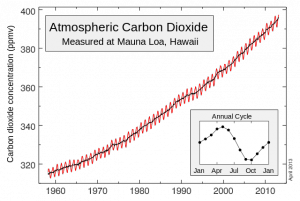
Their lawsuit asked the State to take action in restoring the atmosphere to 350 ppm of CO2 by the end of the century. The Oregon Court of Appeals rejected the defenses raised by the State, finding that the youth could obtain meaningful judicial relief in this case.

That’s quite a nice victory. Here’s the full story, from the Western Environmental Law Center (my emphasis throughout):
Keeling-curve_CO2_ppm_Mauna_Loa_Carbon_Dioxide_Apr2013.svg_-300x201

In a nationally significant decision in the case Chernaik v. Kitzhaber, the Oregon Court of Appeals ruled a trial court must decide whether the atmosphere is a public trust resource that the state of Oregon, as a trustee, has a duty to protect. Two youth plaintiffs were initially told they could not bring the case by the Lane County Circuit Court. The trial court had ruled that climate change should be left only to the legislative and executive branches. Today, the Oregon Court of Appeals overturned that decision.

Two teenagers from Eugene, Kelsey Juliana and Olivia Chernaik, filed the climate change lawsuit against Governor Kitzhaber and the State of Oregon for failing to protect essential natural resources, including the atmosphere, state waters, and coast lines, as required under the public trust doctrine. Their lawsuit asked the State to take action in restoring the atmosphere to 350 ppm of CO2 by the end of the century. The Oregon Court of Appeals rejected the defenses raised by the State, finding that the youth could obtain meaningful judicial relief in this case. …

In reversing the Lane County trial court, the Oregon Court of Appeals remanded the case ordering the trial court to make the judicial declaration it previously refused to make as to whether the State, as trustee, has a fiduciary obligation to protect the youth from the impacts of climate change, and if so, what the State must do to protect the atmosphere and other public trust resources.

The implications of this are broad, and similar cases are pending in other states, as the article describes.

Make no mistake; decisions like this matter. It places the court squarely in the mix as a power player in the climate war, the fight for “intergenerational justice” as James Hansen puts it — or the war against intergenerational betrayal, as I put it.

This is a cornerstone decision from the Oregon Court of Appeals in climate change jurisprudence. The court definitively ruled that the question of whether government has an obligation to protect the atmosphere from degradation leading to climate change is a question for the judiciary, and not for the legislative or executive branches. The Court did not opine as to how that question should be answered, only that it should be answered by the judiciary.

We can win this; it’s not over. If we reach 450 ppm and we’re still not stopping with the CO2, then it’s over and I become a novelist full-time. But we’re not there yet, and please don’t surrender as if we were.

The courts are now a powerful tool, as is divestment. James Hansen has a way to restore the atmosphere to 350 ppm CO2 in time to stop slow feedbacks from kicking in. It’s a doable plan, but we’ll need to use force. Using the courts, as with using divestment campaigns, counts as force. Stay tuned.

(Want to use force at the national level? Find a way to challenge Obama publicly to stop leasing federal land to coal companies. He’s a hypocrite until he stops federal coal from being mined and sold abroad. A simple and obvious challenge for him. You too can be the activist.)

GP

Twitter: @Gaius_Publius
Facebook: Gaius Publi

(Facebook note: To get the most from a Facebook recommendation, be sure to Share what you also Like. Thanks.)

ooOOoo

 Never forget that you, me and every other good-minded person on this planet can make a positive difference. Need inspiration? Gain it from our dogs! Let’s use the liberty we enjoy to make a difference.


Please adopt your next dog.

Continuing the message of that special bond between us humans and our dogs.

Yesterday’s post regarding the dog saved from the Texas floods came to mind when earlier today (Tuesday) I was reading the Fall issue of The Bark magazine.

Cover of the Fall 2015 issue.

Reading the magazine took me across to The Bark website and from there I ended up reading about dogs being mentioned in people’s obituaries. Here’s a snippet of that article:

Dogs in Obituaries

Included as cherished family members
Karen B. London, PhD | September 18, 2015

dogorbits

It’s been a long time since the majority of people with dogs considered them property, but the inclusion of them in the celebrations and events of life associated with family continues to grow. Birthday parties and gifts for dogs have become increasingly common in recent years, and the number of dogs included in family photos or in signatures on greeting cards is bigger than ever. It’s really old news to say that many people consider dogs to be family members, but interesting studies of the ways in which that’s true continue to be published.

Earlier this year, a study called Companion Animals in Obituaries: An Exploratory Study was published in the journal Anthrozoös. The study illuminated the importance of companion animals, including dogs, based on the frequency and manner in which they were mentioned in obituaries.

Another article in that same issue of The Bark was by photographer Traer Scott. Scott is the author of the book Shelter Dogs and has just launched a new book called Finding Home: shelter dogs & their stories. (Her blogsite is here.) As is detailed on her website:

Traer Scott is an award winning fine art and commercial photographer and author of six books including “Nocturne: Creatures of the Night” (Princeton Architectural Press, 2014) and her newest release “Finding Home; Shelter Dogs and Their Stories” (Princeton Architectural Press, Fall 2015). Her work has been exhibited in several countries and featured in National Geographic, Life, Vogue, People, O, on the NY Times Lens Blog, “Behold” and dozens of other national and international print and online publications. Her first solo museum show Natural History opens at the University of Maine Museum of Art in October 2015. Traer was the recipient of the Rhode Island State Council for the Arts 2010 Photography Fellowship Grant and the 2008 Helen Woodward Humane Award for animal welfare activism. She lives in Providence, Rhode Island with her husband, daughter and adopted dogs: a pit bull and a baby basset hound.

A quick mouse-click took me to Amazon and to Scott’s latest book. Where one reads:

scottbook

Bold, retiring, serious, sparkling, quirky, or lovable—the dogs in Traer Scott’s remarkable photographs regard us with humor, dignity, and an abundance of feeling. Scott began photographing these dogs in 2005 as a volunteer at animal shelters. Her first book, Shelter Dogs, was a runaway success, and in this follow-up, Scott introduces a new collection of canine subjects, each with indomitable character and spirit: Morrissey, a pit bull, who suffered from anxiety related behaviors brought on by shelter life until adopted by a family with four children; Chloe, a young chocolate Lab mix, surrendered to a shelter by a family with allergies; Gabriel and Cody, retired racing greyhounds; and Bingley, a dog who lost his hearing during a drug bust but was brought home by a loving family that has risen to the challenge of living with a deaf dog. Through extended features we become better acquainted with the personalities and life stories of selected dogs and watch as they experience the sometimes rocky and always emotional transition to new homes. The portraits in Finding Home form an eloquent plea for the urgent need for more adoptive families, as well as a tribute to dogs everywhere.

Further down that Amazon page there was a review by The Bark magazine and what they wrote is the perfect way of heading to the close of today’s post. [My emphasis]

“Photographer Traer Scott follows up her groundbreaking book Shelter Dogs with a new work of equal grace and sensitivity. The portraits in Finding Home not only showcase a collection of canines with indomitable character and spirit, they are also an eloquent plea for more adoptive families, and a tribute to all dogs everywhere.” – The Bark

Please, howsoever you can, share the benefits of adopting a dog from your nearest animal care centre.

No avoiding those eyes (and I'm not referring to Jean!).
Proof positive of the love that flows between Jean and our Oliver.

This man is a hero!

The best of humans.

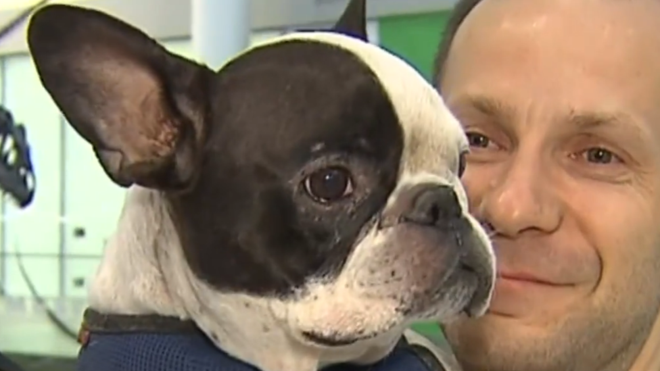
In contrast to yesterday’s post highlighting the disgusting way humans kill wildlife, today is all about humans saving life. Specifically, the life of a seven-year-old French bulldog.

I came across a news item reported by Citynews in Canada on the BBC News website. This is how the news story opened:

Air Canada flight diverted to save dog from freezing

16 September 2015

Picture copyright CityNews, Toronto.

An Air Canada flight was diverted after the pilot realised that a cargo hold heating unit failed, threatening the life of a pet dog.

Simba, a seven-year-old French bulldog, was riding in the cargo hold where – without heating – temperatures can become very cold at high altitude.

The Sunday flight from Tel Aviv, Israel, to Toronto, Canada, and was diverted to Frankfurt, Germany.

It was then a simple process to go to that CityNews website in Canada and read the original story. It contained these delightful messages:

With the dog’s well-being in peril the pilot decided to land the plane in Frankfurt, Germany.

Simba was placed on another flight and the plane continued on to Toronto.

The dog’s owner was more than grateful.

“It’s my dog, it’s like my child. It’s everything to me,” he said after they were reunited at Pearson Airport.

Aviation expert Phyl Durby said the pilot made the right call, despite tacking on about $10,000 in fuel costs and delaying the flight by 75 minutes.

“If you look at the outside temperature, if it’s minus 50 or 60, there is some insulation but it will probably still get down to below freezing (in the cargo area),” Durby said.

“The captain is responsible for all lives on board, whether it’s human or K-9.”

The owner of the dog, German Kontorovich, was thankful for the pilot’s rapid actions, “It’s my dog, it’s like my child. It’s everything to me,” Mr Kontorovich told the Canadian news website CityNews.

To close today’s good news story, watch the following:

Well done, everybody!

For safer, cheaper pest control, just add ants!

A very interesting report that recently appeared on Mother Nature Network (MNN).

We live in Josephine County here in Southern Oregon. Our next door neighbours to the East are Jackson County. Josephine and Jackson Counties share one very noble attribute: each is only one of just nine GMO-free counties in the entire United States of America.  Plus, as evidenced at our local Grants Pass Farmers’ Market every Saturday, the growing of organic fruit and vegetables is widespread in our county.  We feel very happy to have ended up in this part of America.

All of which makes a logical introduction to a report that appeared on MNN on September, 1st.  It is republished below.

ooOOoo

For safer, cheaper pest control, just add ants

Ants offer a surprisingly effective alternative to synthetic pesticides on crops ranging from cashews to sugar cane, according to a new review of more than 70 scientific studies.

By: Russell McLendon, September 1, 2015, 9:30 a.m.

Weaver ants can not only protect tree crops from pests, but may also benefit the quality of produce. (Photo: Rushen/Flickr)

Sometimes ants are pests, marching through our kitchens on an industrious quest for crumbs. But when faced with more serious pests — namely those that destroy crops on which people’s livelihoods depend — we can also use ants to our advantage.

Published in the Journal of Applied Ecology, a new research review suggests ants can control agricultural pests as efficiently as synthetic pesticides, with the bonus of being more cost-effective and generally safer. And since many pesticides pose a danger to helpful wildlife like birds, bees and spiders — not to mention humans — ants might be a key ally in feeding the planet’s booming human population.

The review covers more than 70 scientific studies on dozens of pest species that plague nine crop varieties in Africa, Southeast Asia and Australia. Because ants are organized as “superorganisms” — meaning the colony itself is like an organism, with individual ants acting as “cells” that can move around independently — they are uniquely capable of hunting down pests and then overwhelming them.

“Ants are great hunters and they work cooperatively,” says author Joachim Offenberg, a biologist at Aarhus University in Denmark, in a press release about the research. “When an ant finds its prey, it uses pheromones to summon help from other ants in the nest. By working together, they can subdue even large pests.”

Most studies in the review focused on weaver ants, a tropical genus of tree-dwelling ants that weave ball-shaped nests using leaves and larval silk. Since they live in the canopy of their host trees, near the fruit and flowers that need protection, weaver ants have a natural tendency to control pest populations in orchards.

A colony of weaver ants in India works on converting leaves into a nest. (Photo: Raghu Mohan/Flickr)

In one three-year study, Australian cashew growers recorded yields 49 percent higher in trees guarded by weaver ants versus trees treated with synthetic chemicals. But higher yields were only part of the prize: The farmers also got higher-quality cashews from the trees with ants, resulting in a 71 percent higher net income.

Similar results were reported in mango orchards. While mango trees with ants had roughly the same yields as those with synthetic chemicals, the ants were cheaper — and the trees they inhabited grew higher-quality fruit. That led to a 73 percent higher net income compared with pesticide-treated trees. Not all crops had such dramatic results, but studies on more than 50 pests showed that ants can protect crops including cocoa, citrus and palm oil at least as effectively as pesticides.

“Although these are rare cases where the ants were superior to chemicals, many studies show that ants are just as efficient as chemical controls,” Offenberg says. “And of course ant technology is much cheaper than chemical pest control.”

To recruit weaver ants in their orchards, farmers just collect nests from the wild, hang them in plastic bags from tree branches and feed them a sugar solution while they build new nests. Once the ants establish their colony, farmers can help them expand by connecting target trees with aerial walkways made from string or vines.

The ants are mostly self-sufficient from there, needing only some water during the dry season — provided via plastic bottles in the trees — and pruning of non-target trees that host different ant colonies to prevent fights. Farmers can also help their ants by avoiding broad-spectrum insecticide sprays, researchers say.

Ants protect mango trees about as effectively as pesticides, but at less cost, research suggests. (Photo: Shutterstock)

It’s worth noting that ants can also be detrimental to some plants, such as when they herd sap-feeding insects like aphids and leafhoppers. But if they still fend off fruit-ruining flies and beetles, their net impact may be positive nonetheless. Not only do weaver ants kill pest insects on their trees, but their presence alone is reportedly enough to scare away marauders as large as snakes and fruit bats. And research suggests their urine even contains important plant nutrients.

The use of ants for pest control isn’t new. As early as 300 B.C., Chinese farmers could buy weaver ants in markets to release in their citrus groves, a practice that has faded over time, especially after the advent of chemical pesticides. But it may be coming back, both because ants are cheaper than pesticides and because certified organic produce can fetch higher prices, due to concerns that broad-spectrum pesticides harm more than just pests. Aarhus University is studying the use of weaver ants as pest control in Benin and Tanzania, for example, where the insects could lead to increased export revenue of $120 million and $65 million, respectively.

“To kill the flies with pesticides, you have to make the mango so poisonous that it can kill the maggot,” Aarhus University biologist Mogens Gissel Nielsen told China’s Xinhua news agency in 2010. “But when it is too poisoned for the maggot to eat, it might not be good for us to eat either.”

While the research in Offenberg’s review focused largely on weaver ants, he points out they “share beneficial traits with almost 13,000 other ant species, and are unlikely to be unique in their properties as control agents.” Lots of ants nest in the ground, and while it may be a challenge to relocate them, they too have shown promise in protecting a variety of commercially important crops.

“Weaver ants need a canopy for their nests, so they are limited to plantations and forestry in the tropics,” Offenberg says. “But ground-living ants can be used in crops such as maize and sugar cane. European wood ants are renowned for controlling pests in forestry, and new projects are trying to use wood ants to control winter moths in apple orchards. Ants could even be used to fight plant pathogens because they produce antibiotics to combat diseases in their dense societies.”

ooOOoo

As with many of the other fine articles that appear on Mother Nature Network, this report by Russell McLendon has many links to other information sources, too many for me to set up. So if this report ‘speaks’ to you and you want to look up the background information then please go here and read it over on MNN.


Down under dogs!

A guest post all the way from Australia.

A few days ago I received a friendly email from Alex in Sydney, Australia.

My name is Alex and I work for Spoilt Rotten Dogs, a boutique dog care centre in Sydney.

In an effort to improve community awareness and knowledge about dog care, we are looking at contributing to high profile blogs like Learning From Dogs by sharing tips and information provided by professional carers, vets, and groomers. I’ve learned from your site that you are looking for guest contributors.

I’ve recently written a post that I think fits pretty well with your site especially that you are based in Australia. It’s about the best places in Sydney to walk your dog. I’m sure your readers will find it really helpful.

I politely replied to Alex pointing out that Learning from Dogs was based in Southern Oregon and not Australia and thus a guest essay on walking one’s dog in Sydney was unlikely to have huge reader appeal! 😉

Unperturbed, Alex then replied with a guest essay that seemed much more pertinent to dog lovers right across the world. It now follows but not before I declare that there is no connection between this blog and Alex’s dog care centre. The following image is taken from the home page of the website for Spoilt Rotten Dogs.

ooOOoo

welcome-to-spoiltrottendogs

5 Tips to Dog Proof Your Backyard

Regardless of the fact that you really love your dogs, you cannot keep your eyes on them and supervise their activities all the time. However, this doesn’t set you free from the responsibilities that you have towards your pets either.

In order to ensure that they are living in a safe, secure, and hygienic environment, it is necessary to observe some basic safety precautions. These safety measures will not only ensure that your pets are far away from all types of risks and dangers but will also put an end to the complaints that you have been receiving for their ill behaviour when they start barking when someone passes by or stands near the backyard fence.

For your assistance, here we present you 5 useful tips to dog proof your backyard.

Fencing the Yard

Creating a boundary around your backyard is the first and foremost step to ensuring your pets’ safety. It keeps your dog inside your property and safe from other animals roaming around the neighbourhood. It is suggested that you choose the material of the fence, depending on the temperament of your dog. If your dog gets excited or furious when it sees someone around the yard, use opaque fences. You can opt for reed fencing that is neat, cheap, and also helps in maintaining privacy. On the other hand, if your dog has a calm nature, you can use regular wooden fences to surround your yard.

Sheltering for All Weathers

It has been observed that dogs are very sensitive to climatic changes. Whether it’s the scorching heat of the summers or chilly winds of the winter, your dogs need an appropriate home to maintain their body temperature. Instead of considering the entire open yard as their home, you should place a small yet spacious doghouse for them to live in.

Internal Dangers

It’s not just external dangers or outsiders that can cause harm to your dog, as there are several things inside your backyard that can put your pet into trouble. Wondering about those? Sharp and pointed tools, pest traps and pest treating chemicals, as well as pools, toxic plants, and so on; can all cause harm to your beloved dogs. Therefore, keep all such items and areas, out of your dogs’ reach.

Additional Airlocks

Airlocks are not very common around homes but you must have seen them in dog parks. These are additional fences that are set in front of the gates to ensure that even if the main gates are not closed properly, dogs cannot leave the premises and are thus, kept inside.

Maximum Supervision

Last but certainly the most essential tip is to supervise your dog as much as possible. You cannot expect them to maintain discipline and follow your set of rules. Instead, you can spend more time with them and train them to keep themselves safe from such troubles.

So, check on your pets timely to ensure they are away from all types of dangers and take the measures necessary to safeguard their well being.

ooOOoo

Seems like sound advice.