Category: Animal rescue

Footnotes.

Where we are today?

On New Year’s Day I published the first part of a film called Awakening the Dreamer: Changing the Dream.  Then yesterday came the second part.  I found it a remarkable film.  Because, while the first part reminded the viewer of the list, the long list, of things that are wrong with these present times, the second part highlighted the many currents of positive changes that are taking place here and now.
Without hope there is nothing.

The film is available to watch on Top Documentary Films and here is the introduction offered in that place.

Of all the innumerable beliefs and hypotheses that make up our contemporary industrial perspective on life there is one that is dominant and very frequent. That’s the assumption that we are disconnected, from everyone and everything. This belief configures basically all our ideas and actions. There’s a crucial fallacy that we are separate. But, if there is only one, then whatever I do to you I’m actually doing it to myself, my family, and my children.

Spiritual attitude has long instructed that partition is actually an illusion. However, in the past, the narrative that’s been exchanged in the modern world, whether consciously or unconsciously, has been that the world functions like a huge machine made of separate parts like a big clock. For the past four centuries, the scientific established practice has been trying to take the clock apart, and figure out how it functions, so we can use it for our own ambitions.

This rigid aspect meant that instead of realizing the relation between things, we were analyzing and taking apart those very same things. So, what developed was kind of disintegrated view of the natural world. And we became entranced with the ability that came out of this technology, and we lost our relations to each other; we lost our connection to the enigma of the cosmos.

Although the modern worldview is superior on Earth, it’s valuable to identify that it’s not the only worldview. Traditional, native cultures are not so concentrated on “advancement”, rather they’re focused on their health and persistence of the community, and they see the interdependence of all things. They try to recognize that we’re related to everything… to the animals, fish, plants, trees, birds, and even to the microorganisms. Indigenous people of the world have a particularly important role to play at this moment in history. We need them to come forward and explain how they see things.

The film was produced by the Pachama Alliance, an organisation I hadn’t come across before.  Their website is here and on the About page one learns:

Purpose

The Pachamama Alliance, empowered by our partnership with indigenous people, is dedicated to bringing forth an environmentally sustainable, spiritually fulfilling, socially just human presence on this planet.   Our unique contribution is to generate, and engage people everywhere in, transformational conversations and experiences consistent with this purpose. We weave together indigenous and modern worldviews such that human beings are in touch with their dignity and are ennobled by the magnificence, mystery and opportunity of what is possible for humanity at this time.   We are here to inspire and galvanize the human family to generate a critical mass of conscious commitment to a thriving, just and sustainable way of life on Earth. This is a commitment to transforming human systems and structures that separate us, and to transforming our relationships with ourselves, with one another, and with the natural world.

If you have read this post so far, then you will enjoy this video. More than enjoy it; you will find it inspiring and liberating.

Another organisation mentioned in the film was Bioneers, also not previously known to me.  Their website is here. The organisation describes itself, in part:

Collective Heritage Institute – Bioneers is a non-profit New Mexico corporation founded in 1990 by Kenny Ausubel and Nina Simons. The overarching mission of Bioneers is the advancement of holistic education pertaining to global social, cultural and environmental issues. Bioneers identifies progressive yet nature-honoring solutions to rising challenges of instability, inequality, and unsustainable growth and disseminates this knowledge via independent media, events, and community action networks.

There is much on these two websites to offer hope.

Approaching the New Year!

Part One of reflections on where we are today.

Depending on just where in the world you are, the New Year of 2014 is anything from a few to twenty-four hours away.  How that year turns out will, to a very great extent, depend on millions and millions of behaviours.  In other words, the behavioural choices each of us makes. Because, as millions of us already understand, our world on this, our only, Planet is facing changes potentially beyond our imagination.  Caring for our Planet and all of life upon it is meaningless without those behavioural choices being the right ones for our Planet.

A couple of days ago, I read the following on Facebook.  It seemed an appropriate tale for the start of 2014.

ooOOoo

Now what?
Now what?

One day a farmer’s donkey fell down into a well. The animal cried piteously for hours as the farmer tried to figure out what to do. Finally, he decided the animal was old and the well needed to be covered up anyway; it just wasn’t worth it to retrieve the donkey.

He invited all his neighbors to come over and help him. They all grabbed a shovel and began to shovel dirt into the well. At first, the donkey realized what was happening and cried horribly. Then, to everyone’s amazement he quieted down.

A few shovel loads later, the farmer finally looked down the well. He was astonished at what he saw. With each shovel of dirt that hit his back, the donkey was doing something amazing. He would shake it off and take a step up.

As the farmer’s neighbors continued to shovel dirt on top of the animal, he would shake it off and take a step up. Pretty soon, everyone was amazed as the donkey stepped up over the edge of the well and happily trotted off!

MORAL :

Life is going to shovel dirt on you, all kinds of dirt. The trick to getting out of the well is to shake it off and take a step up. Each of our troubles is a steppingstone. We can get out of the deepest wells just by not stopping, never giving up! Shake it off and take a step up.

Remember the five simple rules to be happy:

  1. Free your heart from hatred – Forgive.
  2. Free your mind from worries – Most never happens.
  3. Live simply and appreciate what you have.
  4. Give more.
  5. Expect less from people but more from yourself.

You have two choices … smile and close this page, or pass this along to someone else to share the lesson.

ooOOoo

Part Two of these reflections is tomorrow.

A very Happy New Year to you.

Animal rights.

This cougar was looking for love.

I forget how I came across this editorial in the Chicago Tribune but it was published a month ago, to the day.  What is more to the point is that the editorial was inspiring and I vowed to republish it.  With the absence of any formal permission to republish the editorial I thought it best to leave it for a few weeks.  When you read it you will realise just why it needed to be shared with you.

ooOOoo

Editorial: The cougar killed in Illinois was looking for love

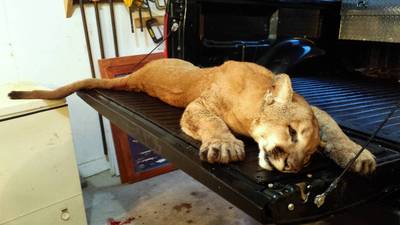
ILLINOIS DEPARTMENT OF NATURAL RESOURCESThis cougar was shot last week by a state conservation officer in Whiteside County. The animal needn’t really have been killed.
ILLINOIS DEPARTMENT OF NATURAL RESOURCES.
This cougar was shot last week by a state conservation officer in Whiteside County. The animal needn’t really have been killed.

He was lean, athletic and had traveled hundreds of miles, most likely from the Black Hills of southwestern South Dakota. He had attacked no one as he passed hundreds of towns and many more farms, each of them a lethal threat to his mission. Yet for lack of a better wildlife management plan in Illinois, the young cougar couldn’t get past a conservation officer armed with a state-issued rifle.

The necropsy says the cougar killed last week as he hid near Morrison, 130 miles west of Chicago, died of gunfire. In truth he died of official neglect: Even though more cougars and possibly wolves likely will be visiting Illinois, state lawmakers and the Department of Natural Resources haven’t forged policies that could allow the tranquilization, capture and survival of animals whose ancestors blissfully roamed the Midwest long before humans intruded on their turf.

Given his hunting skills, the young male could have homesteaded anywhere in the Upper Midwest and dined on the bountiful deer population for the rest of his life. Instead, his four huge paws carried out the imperative that drove him: With larger, older males driving him away from the females on their home ranges, this cougar came looking for love.

A farmer called authorities to report a large cat running from a cornfield toward his farmstead and, sure enough, a responding conservation officer found the cat under a corncrib, probably hiding until darkness would allow it to flee.

We won’t second-guess the officer, who consulted with law enforcement and wildlife personnel before killing the cougar. That said, this was an outcome that didn’t have to be. A magnificent creature might well be headed back to South Dakota if Illinois had learned lessons after Chicago police shot and killed a cornered cougar in the Roscoe Village neighborhood five years ago.

What all of us, legislators included, have to understand is that the return of feline or canine predators to their traditional realms doesn’t mean the animals want to hurt anyone. Even as this episode unfolded, millions of National Geographic readers were receiving the magazine’s December issue, with an 18-page spread: “Ghost Cats … Cougars are quietly reclaiming lost ground.” The relevant passage: “Cougars have attacked humans on about 145 occasions in the U.S. and Canada since 1890. Just over 20 of those assaults — an average of one every six years — proved fatal.”

Yet in this case, with an animal that had threatened no one while bypassing thousands of Midwesterners, a DNR spokesman rationalized that, “Public safety is what we’ll make the decision on every time.” The rest of DNR’s explanation is similarly lame: The department otherwise would have had to find someone to capture and move the animal. This officer thought the situation too unsafe to call a veterinarian to tranquilize the cat. Conservation officers don’t carry tranquilizer guns. That thinking led the DNR to the specious excuse that if the officer had shot the cougar with the wrong dosage of tranquilizer, the animal could have been harmed or killed accidentally. That excuse evokes the February 1968 explanation from a U.S. major to an Associated Press correspondent about the Vietnamese provincial city of Ben Tre: “It became necessary to destroy the town to save it.”

We were struck by sensible comments last week from Bruce Patterson, curator of mammals at Chicago’s Field Museum, who wonders why this animal had to be shot when it evidently was hiding during daylight and hadn’t threatened anyone: “It’s possible to manage wildlife while still keeping it around.”

When we editorialize about humans slaying wild predators, some readers say our concern should be — as it constantly is — directed instead to the needless killings of young people, and not toward one lost, probably frightened animal.

Fair enough, although it’s possible to think about both. Just as we know there will be more homicides, we know that more big predators likely are coming to Illinois. So we’ll look back to what we expressed after the 2008 killing of the cougar in Roscoe Village: We hope Illinois comes away from last week’s episode with more than one dead cougar and a communal sadness. Illinois should develop a reliable protocol that errs on the side of trying to preserve the life of the lost animal — not of making the ad hoc decision to kill it and then resolving the ambiguities in favor of that decision.

That’s what happened here. A logical first step now: Give cougars protection under the Illinois Wildlife Code; they lack that protection now only because there is no known breeding population in this state. But with trail cameras capturing photos of one or more cougars in Jo Daviess, Morgan, Pike and Calhoun counties last fall, the animals evidently are re-establishing themselves in a state where they haven’t been known to live since 1870. In recent years, wolves have dipped into Jo Daviess, the state’s northwest corner. A black bear even visited there, evidently for a few days.

Lawmakers, DNR officials, you can do better. So can the rest of us, first by using sites such as cougarnet.org to offset our visceral fear with scientific knowledge.

Wild animals roam this state. Always have and, we hope, always will. As we urged here in 2008: The same Illinois that was unprepared for the last cougar had better get ready for the next. He’s probably en route.

ooOOoo

As you contemplate your New Year resolutions for 2014 please resolve to protect our animals.

Words fail me!

But there is a very good ending!

There was an item in a recent set of links from Naked Capitalism that caught my eye.

It was a link to a story on Huffington Post that I am taking the liberty of republishing.

ooOOoo

Left To Die In A Trash Heap, Abandoned Dog Gets Remarkable Second Chance

The Huffington Post  |  By  Posted: 12/13/2013 5:19 pm EST

A moving video of the extraordinary recovery — and resilience — of an abandoned dog who was left to die in a trash heap is reminding us this week of the healing power of love, friendship and second chances.

On Nov. 15, when Eldad Hagar first laid eyes on Miley, an abandoned dog living among piles of trash on the outskirts of Los Angeles, his heart broke.

“When I got there, I almost couldn’t believe what I was seeing,” Hagar, the co-founder of animal rescue organization Hope For Paws, told The Huffington Post of his first encounter with the pup. “It’s almost as if this place was struck by a tsunami.”

Miley, covered in mange and infections, was so lifeless and defeated that Hagar, who recorded the dog’s rescue on camera, says she “didn’t even have the energy” to run away from him as he approached her.

Mileytrash1

Hagar says he rushed to Miley’s side after he heard about the pooch’s plight from a local resident. The tipster told him that Miley had been living in the trash heap for at least a few months. It is believed that she was abandoned by her owners.

Though he knew that Miley wouldn’t be in good shape, Hagar says he was still shocked when he finally made contact with her. Her physical deterioration was “definitely one of the worst cases” he’d ever seen, he said.

He knew he had to get Miley to a hospital right away.

Gaining the pup’s trust was no easy feat, however. Hagar says he offered her food and sat with her in the pile of trash for an hour before she was finally ready to leave with him. Then he got her into his car to be brought to the vet.

“She was very lucky we rescued her when we did, because her condition would have continued to deteriorate until she would have died a miserable and painful death,” Hagar said.

After examining Miley, veterinarian Dr. Lisa Youn discovered that the pooch wasn’t just suffering from mange and bacterial infections, but parasites and malnutrition, as well.

“She was in so much pain,” Hagar said.

Mileytrash2

Over the next two weeks, Miley got intensive medical care and was treated with antibiotics, medicine for parasites and frequent medicated baths. Slowly but surely, her spirits began to lift.

It wasn’t, however, until Miley found a best friend that her recovery took a dramatic turn for the better.

Miley met Frankie the chihuahua after he was rescued from a sewer tunnel by Hagar and a friend. The tiny dog had almost drowned, Hagar said, because of a spell of heavy rain.

“He was so scared of everything,” Hagar wrote of Frankie in the video. “Miley took Frankie under her wing and they quickly became really good friends.”

Mileytrash3

Miley and Frankie, who are wonderfully affectionate with each other, are said to be doing well.

The “worst part is behind [them],” Hagar told the HuffPost, adding that Miley should be “100 percent” in a few months.

Watch the adorable duo playing with each other in the video above. To find out more about the work that Hope For Paws does, visit the organization’s website andFacebook page.

ooOOoo

That first YouTube video also had the following comment:

Published on Dec 12, 2013

Please make a small donation to Hope For Paws and help us start 2014 strong with many more rescues. A $5 donation from many people would make all the difference to so many animals: HopeForPaws.org
Hope For Paws took care of Miley’s vet care, but she is now fostered by our friends from The Fuzzy Pet Foundation. Please visit their website to fill an application to adopt her: fuzzyrescue.org
Little guest star – Frankie was also rescued by Hope For Paws (with help from Lisa Chiarelli), and is now being fostered by our friends from The Forgotten Dog Foundation. If you would like to adopt him, please fill an application here: theforgottendog.org
Thanks 🙂
Eldad

The Hope For Paws website is here.  Please, please make a small Christmas donation.  It makes such a difference.  Chapter Twenty-Three of The Book comes out in thirty minutes and, I hope, goes a long way to demonstrate the value of our relationship with dogs over thousands upon thousands of years.

Scum worse than a dog!

G’rrr!

I am indebted to Per Kurowski who yesterday sent me an email about the atrocious recent act in North Korea.  Per writes the blog A view from the Radical Middle and has been a good friend of Learning from Dogs.

Per’s email read:

Lowly opinions on dogs

Paul

With respect to the execution of Jang Song Thaek the North Korea government issued a statement calling him “Despicable human scum who was worse than a dog”… and I just felt you could have a real serious issue with that.

Merry Christmas

Per

My reply to Per included, “I did hear about the statement and your thought also crossed my mind, then something came along and I forgot to do anything about it. Will be corrected in a post coming out tomorrow.”

Per’s email included a link to a Financial Times article that is not visible unless one registers with the FT.  However the relevant section reads thus:

Jang Song Thaek

Jang’s summary execution – reported by state media on Friday – marked a spectacular demise for a man seen until recently as the most powerful adviser to Kim Jong Un. It also raised questions about the potential for further instability in the court of the world’s youngest national leader.

Describing him as “despicable human scum”, state media said Jang had been put to death immediately after his conviction for treason by a military tribunal, where he confessed to having plotted a coup against Mr Kim.

If one then goes to the full text of that state media report, then one reads (my emboldening):

It is an elementary obligation of a human being to repay trust with sense of obligation and benevolence with loyalty.

However, despicable human scum Jang, who was worse than a dog, perpetrated thrice-cursed acts of treachery in betrayal of such profound trust and warmest paternal love shown by the party and the leader for him.

Frankly, if one cogitates about just a few of the qualities of dogs: integrity, loyalty, unconditional love, trust, openness, forgiveness, affection – then this world would be one hell of a better place to live for all humans if only we learnt to live like dogs.

G’rrrr!

Thanks Per!

The power of self.

Confidence in what you and I can achieve is our salvation.

Yesterday, I wrote about just a few of the things going on in our world that have the power to destroy us.  Destroy us in the sense of making us feel powerless, irrelevant and insignificant.  Trust me, there were plenty more examples that I could have mentioned.

But so what!

The vast majority of the humans on this planet have control over what they think.  Untold numbers of those self-same people have control over what they do with their lives.

Take Dr Peter Pratje.  I suspect that you, as with me, hadn’t heard of Dr Pratje before.  But he is a Project leader with the Frankfurt Zoological Society and he holds an MSc in Biology and a PhD in Conservation biology.  This may be learned not from the website of that Frankfurt Society but from the website of the Orangutan project.  Bet you hadn’t heard of that project either.  The Orangutan Project (TOP) is described:

The Orangutan Project (TOP) is the world’s foremost not-for-profit organisation, supporting orangutan conservation, rainforest protection, local community partnerships and the rehabilitation and reintroduction of displaced orangutans back to the wild, in order to save the two orangutan species from extinction.

Back to the good Doctor. This is what he says, “What we do for orangutans, we do for ourselves.”

Now settle down for a tad less than twelve minutes and see the power of self, see what we can do for ourselves.

Published on Dec 4, 2013

Peter Pratje, of the Frankfurt Zoological Society, introduces us to our orangutan family and reveals how we, as individuals, can help prevent their imminent extinction.

The eleven minutes long video accompanies Peter Pratje and his team working with young orangutans at the jungle school. The apes have been confiscated after illegally being held as pets. In daily training sessions they now learn the survival skills they need for a life of freedom – how to climb trees, build nests, find food and generally behave like wild orangutans. The project aim is to re-introduce the great apes into the Bukit Tigapuluh national park in central Sumatra.

Taking matters into their own hands, the young orangutans were most supportive – snatching the small and robust cameras and filming themselves climbing up and down trees.

Music Courtesy of ExtremeMusic, http://extrememusic.com

Special Thanks: Frankfurt Zoological Society (http://www.zgf.de)

Daisy offers a lesson for all.

A heart-rending, true story of a puppy. (Has a very happy ending!)

Those of you who have read today’s Chapter Eighteen of ‘the book’ will not have escaped the central role played by Philip’s German Shepherd: Pharaoh.

Well a few days ago the following video was sent to me by a good friend, Ginger, from our Payson days.  Won’t say anymore until you have watched it.

Tried hard to find the Facebook page but failed.  However, I did find this article on the Psychology Today website that not only refers to Daisy but offers more on the subject of animal emotions.

Animal Emotions

Do animals think and feel?
by Marc Bekoff – Professor Emeritus of Ecology and Evolutionary Biology at the University of Colorado, Boulder.

Daisy: The Injured Dog Who Believed She’d Walk Again and Did

Anthrozoology, also called human-animal studies (HAS), is a rapidly growing and expanding interdisciplinary field. A recent and comprehensive review of this wide-ranging discipline can be found in Paul Waldau’s book titled Animal Studies: An IntroductionMany of the essays I write for Psychology Today have something to do with anthrozoology in that they focus on the wide variety of relationships that humans establish with nonhuman animals (animals). Some essays also discuss what we can learn from other animals, including traits such as trust, friendship, forgiveness, love, and hope.

Often, a simple video captures the essence of the deep nature of the incredibly close and enduring bonds we form with other animals and they with us. As a case in point, my recent essay called “A Dog and His Man” showed a dog exuberantly expressing his deep feelings for a human companion he hadn’t seen for six months. Another essay titled “My Dog Always Eats First: Homeless People and Their Animals” dealt with the relationship between homeless people and the animals with whom they share their lives.

Daisy: An unforgettable and inspirational symbol of dedication and hope

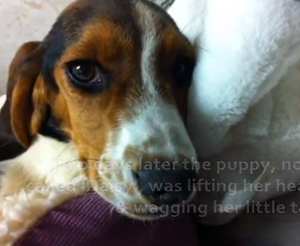
I just saw another video called “Daisy – the Little Pup Who Believed” that is well-worth sharing widely with others of all ages. There is no way I can summarize the depth of five-month old Daisy’s resolve to walk again after she was injured or of the devotion of the woman, Jolene, who found her on the side of a road – scared, malnourished, unable to walk or wag her tail, the people who contributed money to help her along, or the wonderful veterinarians and staff at Barrie Veterinary Hospital in Ontario, Canada, who took care of her. You can also read about Daisy’s remarkable and inspirational journey here.

Please take five minutes out of your day to watch this video, read the text, listen to the song that accompanies it, and share it widely. I am sure you will get teary as you watch Daisy go from an injured little ball of fur living in a ditch on the side of a road with a broken spine to learning to walk in water to romping around wildly as if life had been that proverbial pail of cherries from the start.

I’ve watched Daisy’s journey many times and every single time my eyes get watery. Among the many lessons in this wonderful video is “stay strong and never give up”. Clearly dogs and many other animals can truly teach us about traits such as trust, friendshipforgiveness, love, and hope.

OOOO

Daisy - a lesson for all!
Daisy – a lesson for all!

Two closing thoughts.

When you next want a dog please, please think of those dogs who are in shelters.  They must be our first priority.

If there is ever a time when we humans need to learn from dogs the qualities of trust, friendship, forgiveness, love and hope, it is now!

Picture parade eighteen.

Winter on its way.

We have had a run of cold days here in Southern Oregon going down to the mid-twenties Fahrenheit at night (-4 deg C.)

So this first picture sent in by John H. seemed appropriate for today.

wear a cat

oooo

Then continuing with the series that started last Sunday.

Hurl6

oooo

Hurl7

Wise words indeed.

oooo

Hurl8

oooo

Hurl9

oooo

Finally, to a short but inspiring video sent to me by Dan Gomez.

A man, a dog, a cat and a rat…

This is a video of a homeless man in Santa Barbara and his pets.
They work State Street every week for donations.
The animals are pretty well fed and are mellow.
They are a family.
The man who owns them rigged a harness up for his cat so she wouldn’t have to walk so much (like the dog and the man himself).
At some juncture the rat came along, and as no one wanted to eat anyone else, the rat started riding with the cat, frequently on the cat.
For a few chin scratches the dog will stand all day and, let you talk to him and admire him.

So the Mayor of Santa Barbara decided to film this clip and send it out as a holiday card.

Happy Thanksgiving in so many ways!

Sights and sounds.

Just a collection of items that I hope you will enjoy.

So enough of the book this week for you dear readers.

It’s the week-end and time to offer you some odds and ends that have come my way in recent days.

First up is some really glorious singing.

Rebecca Bains

Some years ago, I was working with a colleague and subsequently got to know that his wife was a brilliant singer/songwriter enjoying a good singing career.  Her name is Rebecca Bains and there is a website here although still under construction according to the home page.

So to Rebecca’s singing.

Now for something completely different.

It’s an advertisement for Volvo Trucks.  Sent to me by friend, Neil, from my Devon days. The short video has been seen over 45 million times! If you haven’t seen it, prepared to be wowed!

Now back to Rebecca’s singing.  But with this introduction from me.  Many know that here in Oregon we have nine dogs.  Four of those are dogs that were rescued by Jean from earlier days in Mexico and two from the shelter in Payson, Arizona where we were living before coming to Oregon.  There are many, many  others who adopt rescue dogs or care for homeless dogs in countless ways.

willloveforfood

So as we approach Christmas, the Season of Good Will, please do everything you can to help man’s best friend and companion for, literally, thousands upon thousands of years. If you are thinking of adopting a dog, or a cat, please visit your local shelter or the Pet Finder website.

OK, now to a short video with the singing from Rebecca Bains.

Trust me, this will rightly grab your heartstrings.

Well done, Rebecca.

A Saturday smile fishy story!

But on this Saturday in November it really is a fish story, or so I thought.

Earlier in the month, I received an e-mail from Dan Gomez. It told of this tale from Grand Lake St. Marys:

A guy who lives at Lake Saint Mary’s (60 miles north of Dayton, OH ) saw a ball bouncing around kind of strange in the lake and went to investigate.

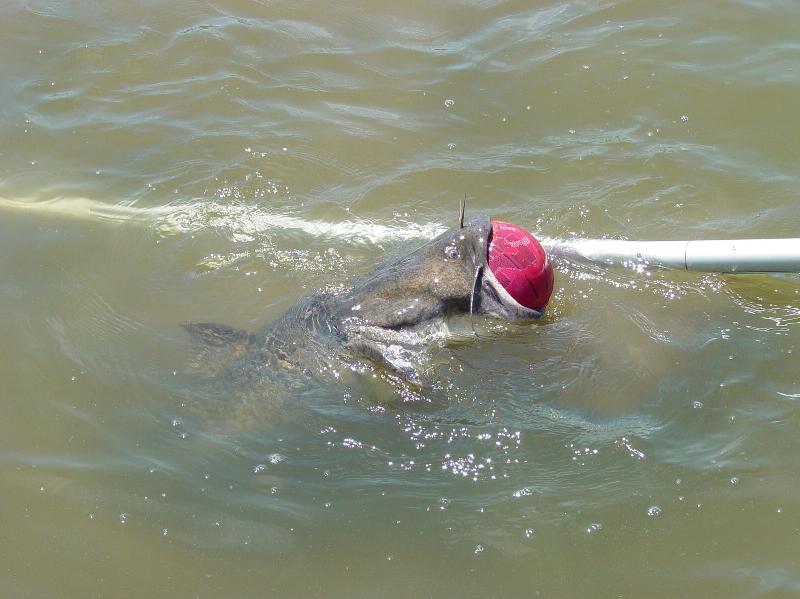
It turned out to be a flathead catfish that had apparently tried to swallow a basketball which became stuck in its mouth!!

The fish was totally exhausted from trying to dive, but unable to, because the ball would always bring him back up to the surface.

The guy tried numerous times to get the ball out, but was unsuccessful. He finally had his wife cut the ball in order to deflate it and release the hungry catfish.

You probably wouldn’t have believed this, if you hadn’t seen the following pictures:

Fish1

oooo

Fish2

oooo

Fish3

oooo

Fish4

oooo

Fish5

oooo

Be kinder than necessary because everyone bites off more than they can chew sometime in life…

oooOOOooo

I loved the story but then wanted to know: was it true?

Sadly, the story is true but the location is false.  Snopes.com researched this back in 2005. Hoax-Slayer.com wrote about it in 2007 after it “went viral”.

The true story originated in the Whichita (Kansas) Eagle on May 30, 2004. The man in the photo turns out to be Bill Driver, a fisherman at Sandalwood Lake who discovered the catfish with a taste for hardwood glory.

Two wonderful lessons to be learned from both the story and the story behind the story!

Don’t believe everything you read on the Internet and there’s always something fishy about a fisherman’s tale.

Have a great week-end.