This lovely cartoon is very close to the truth of the sleeping arrangements that Jean and I ‘enjoy’! For, at night, we share our bedroom with five beautiful dogs, four of which when so inclined enjoy our bed.
But it is a National Holiday for the USA, Martin Luther King Jr. Day, and these images taken two days ago seemed an appropriate ‘holiday’ post.
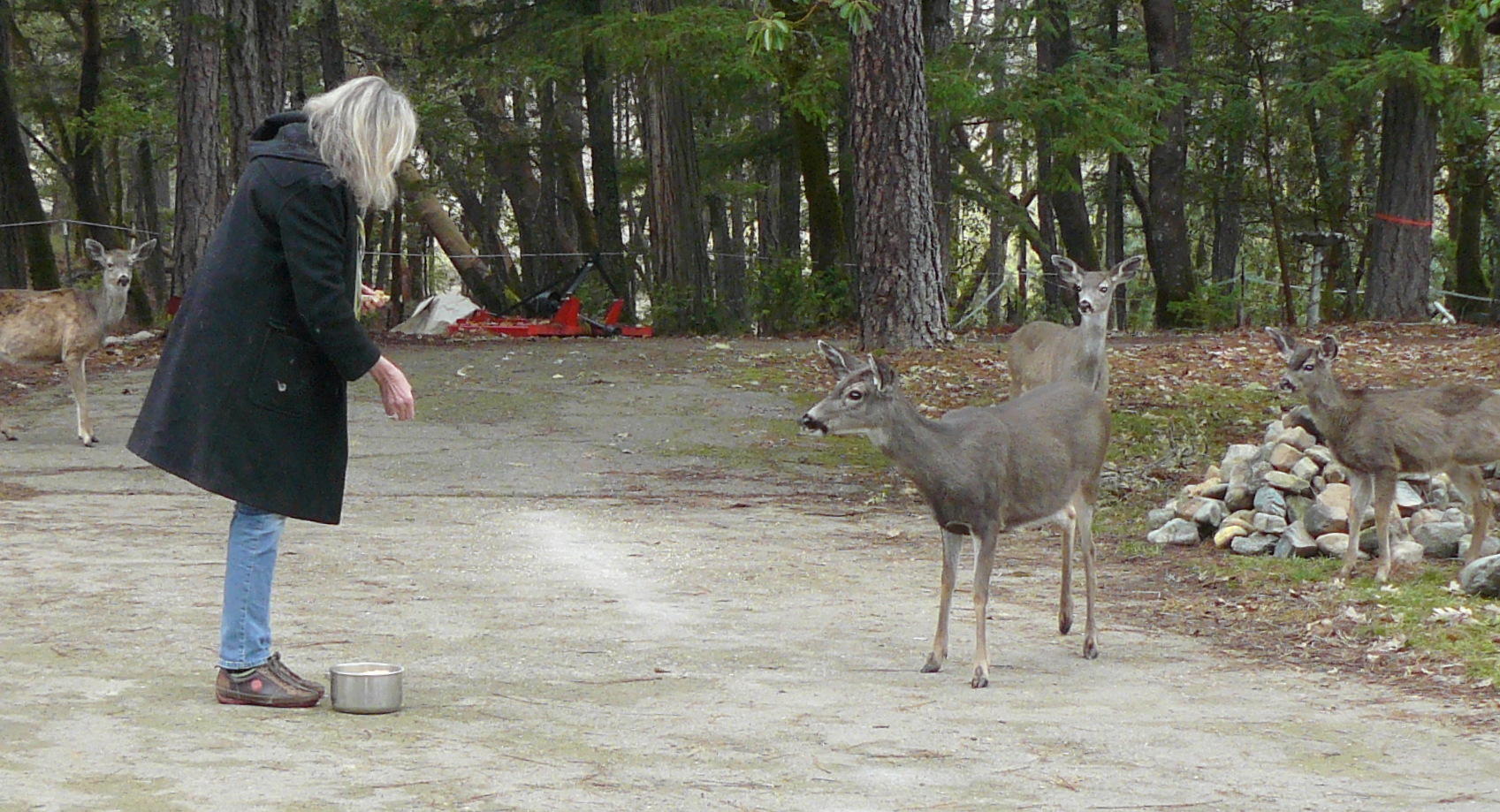
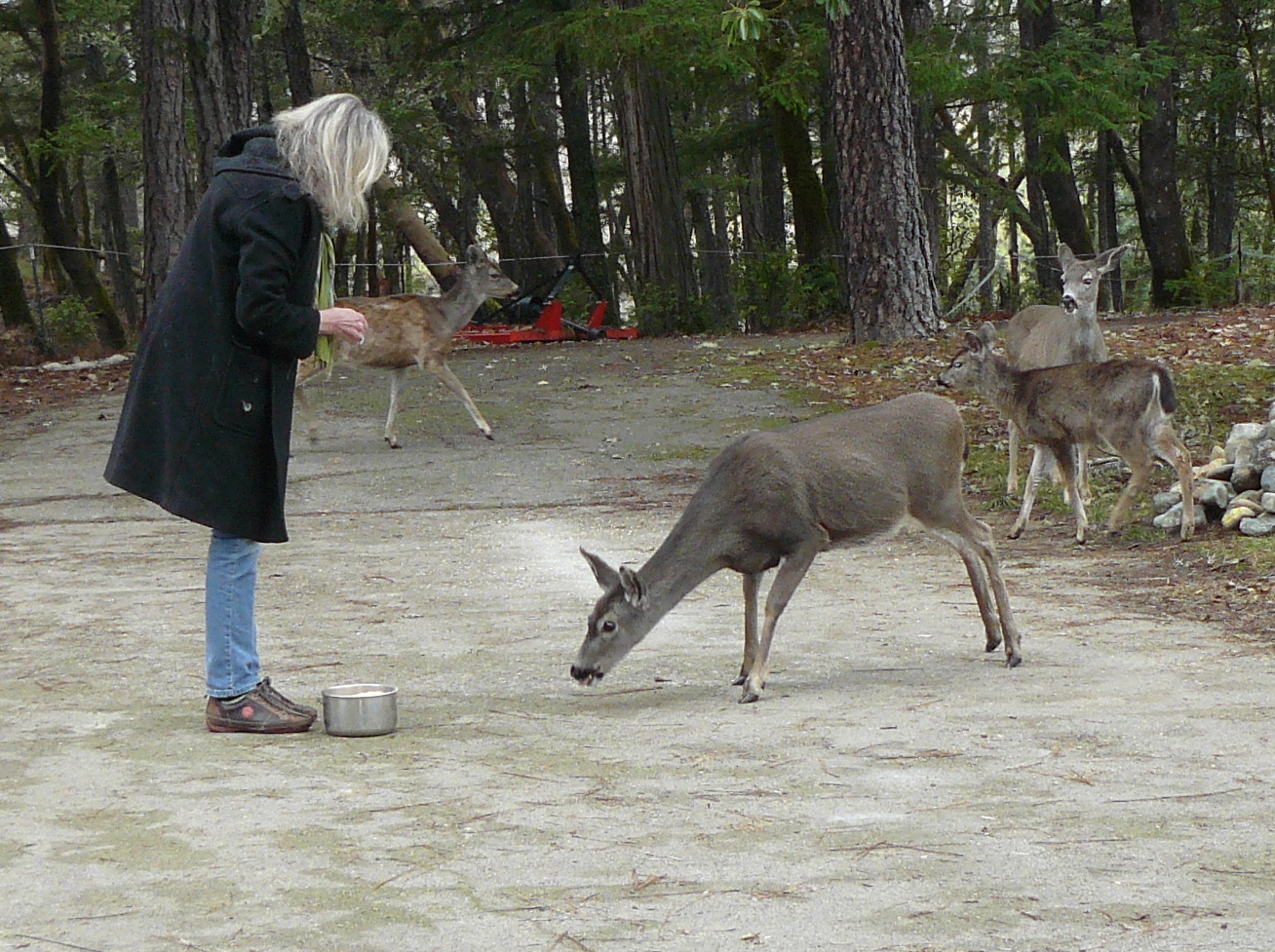
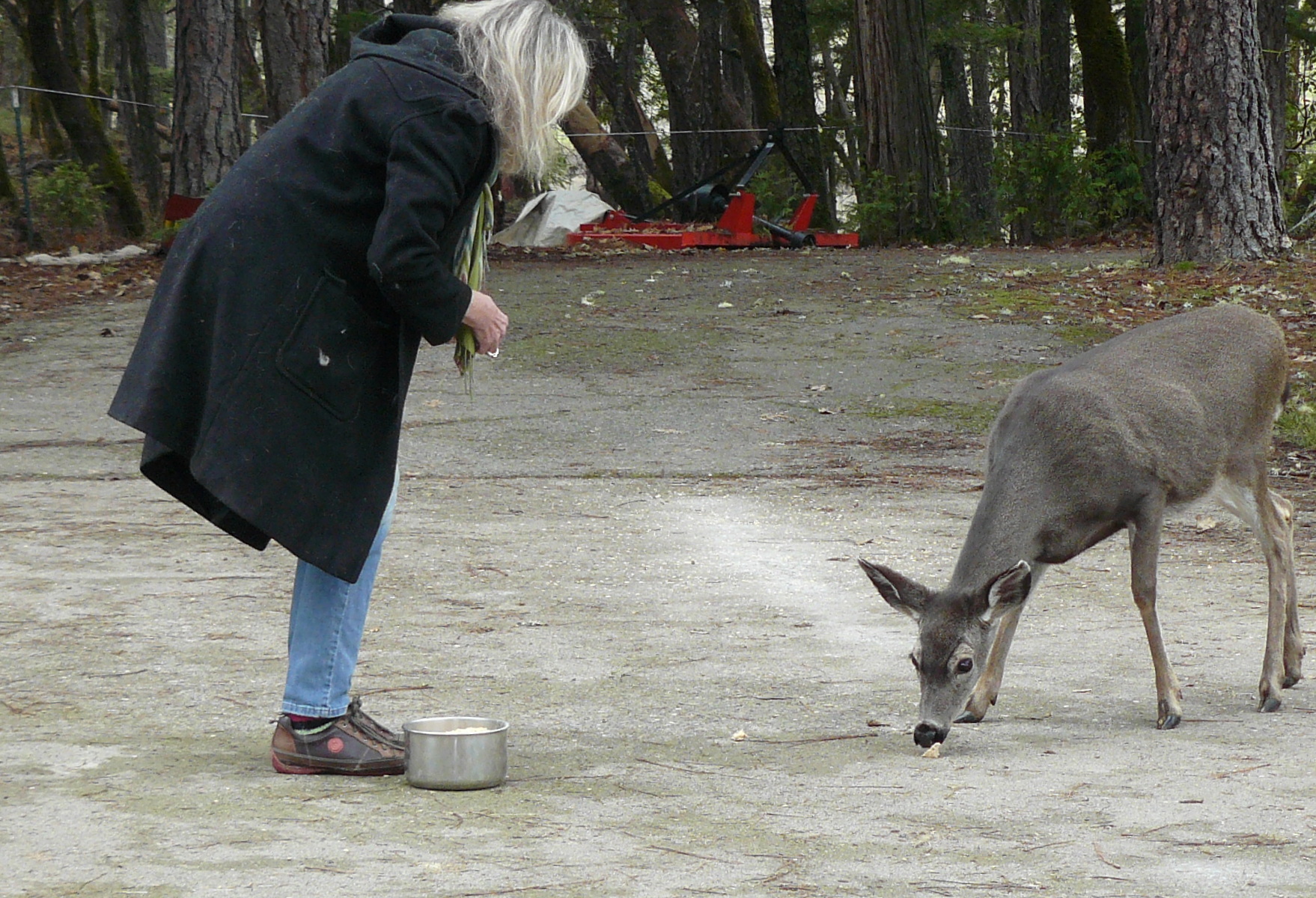
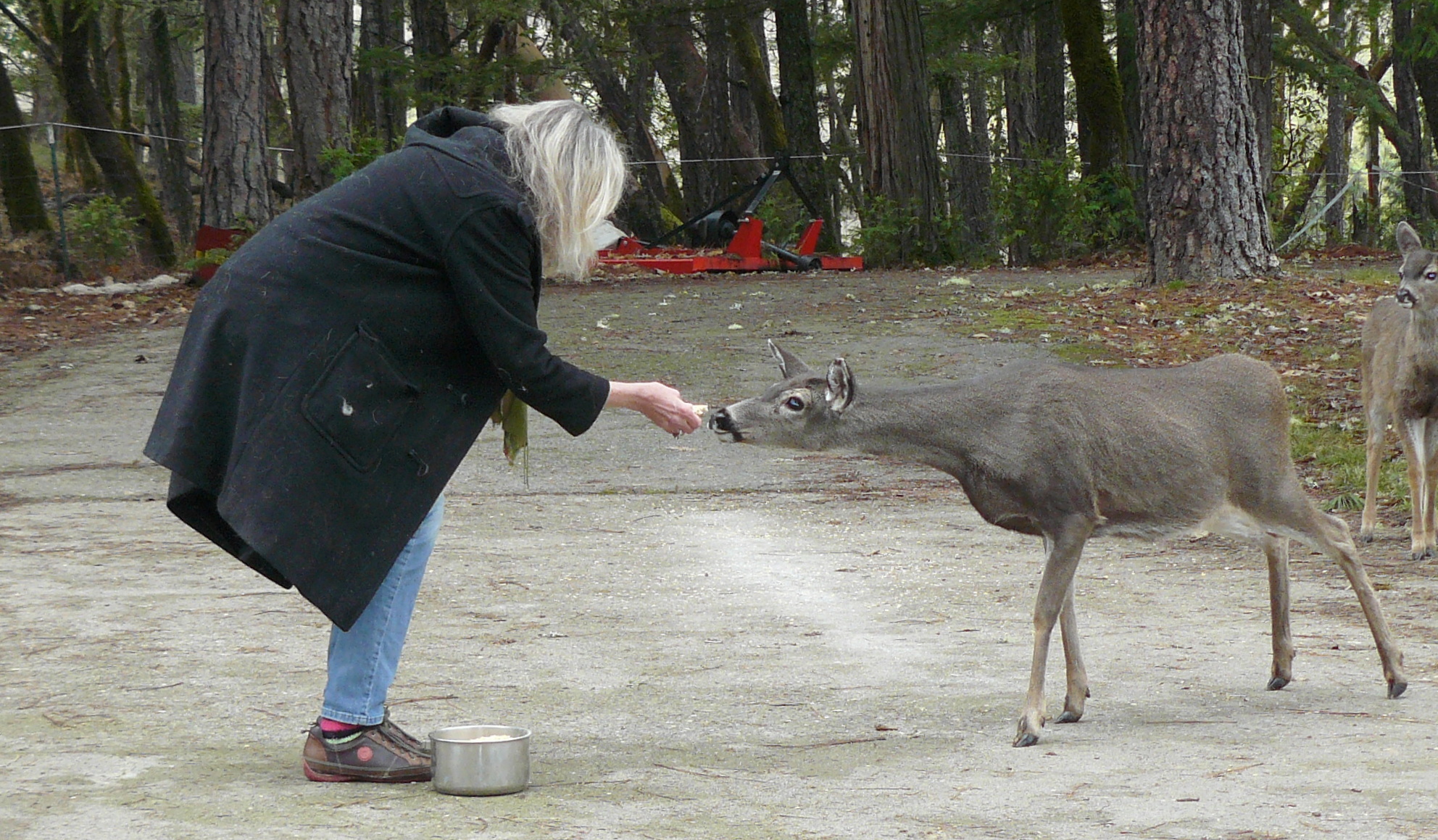
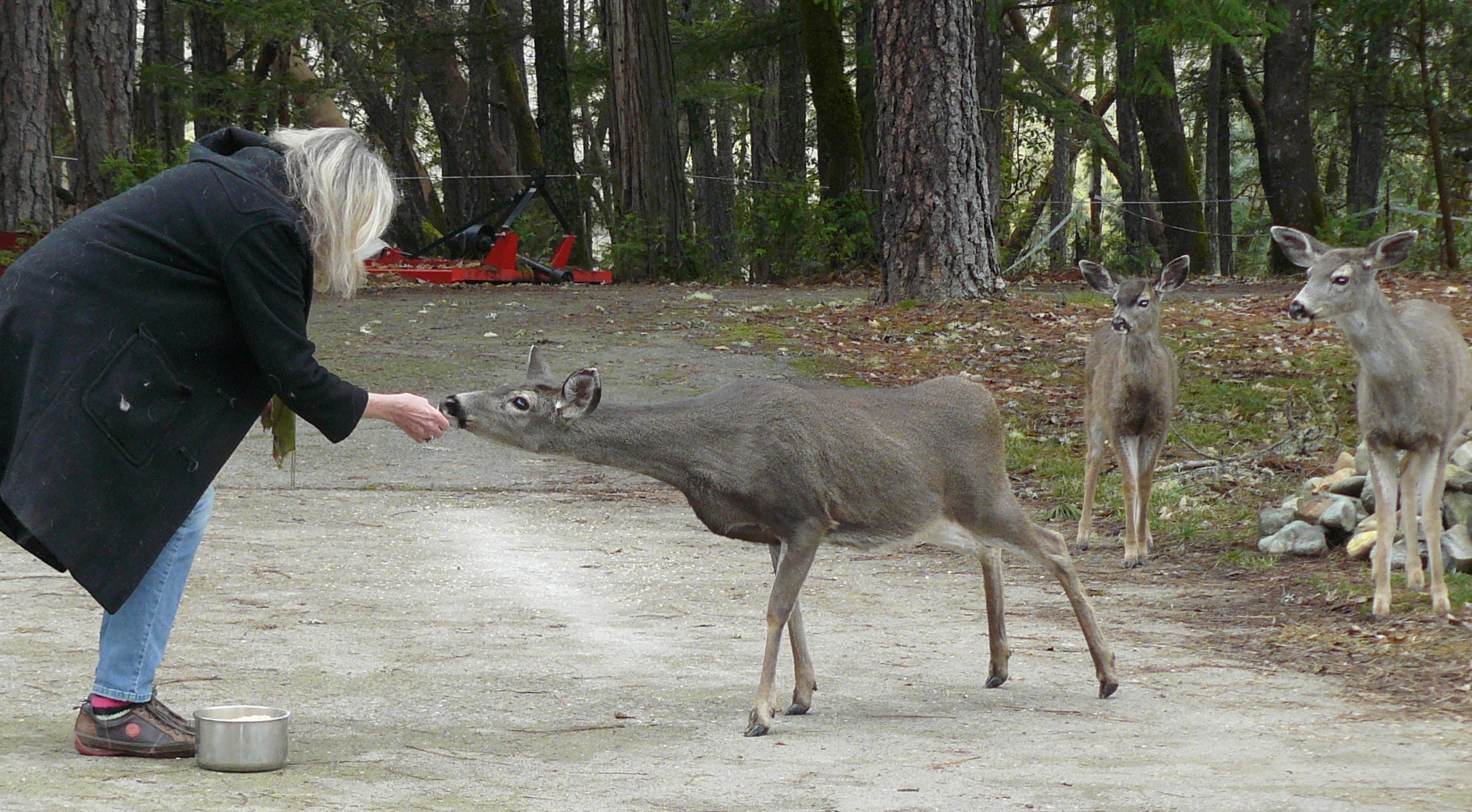
Follows of Learning from Dogs will remember that back on the 15th December I devoted a Sunday post, Picture parade twenty-one, to pictures of deer cautiously coming to feed when Jean was in their presence.
Now, some five weeks later, one of those deer has overcome fear to the point of taking a piece of bread from Jean’s hand. Here is the sequence of photographs taken last Saturday afternoon. N.B. We do not feed the deer bread as a routine; it’s not good for them.
I have a policy of not allowing Learning from Dogs to promote commercial interests. I need those who visit this place to trust the integrity of what they find here.
Then back on the 19th December last, in came the following email.
Dear LearningfromDogs (I think Paul!),
Greetings from Florence, Tuscany!
We are sending you a piece that we hope will be considered for publication on your blog: we begin by talking about making pet food at home (and then go on to list some of the risks – essentially the message here is don’t do it!), we then talk about buying products off the shelf, and explain about food labeling and what different types of labeling will mean in terms of the meat content. I’ve also included some pictures that we purchased from DepositPhotos to help support with its publication. You can verify the usage terms on Deposit photos, but I can tell you that for your website they will be considered appropriate use.
Our shop first opened it doors in 1962 and we’ve just started an English website where we (wait for it!) are making dog beds, and collars to order. We’ve got the most amazing fabrics from a town in Tuscany that has been producing fabrics from the 13th Century. The quality is (as I hope you will take a look) of the highest standard.
Please take a read through the article and if you would like to publish it we would be thrilled.
Best regards from Tuscany,
Glyn
The email offered me a potential conflict. Glyn was clearly promoting his company and yet the information struck me as valuable to pet owners. On balance, it seemed worthwhile to publish the article.
ooOOoo
We only want what’s best for our dogs.
There have been substantial changes in the market of pet foods over the last decade, and so this article sets out to demystify pet food labelling in layman’s terms. We also consider whether or not preparing the food your pet eats in your own home is really a viable option, if you want to have a healthy pet.
Preparing food at home
If you have decided to undertake the mission of preparing your pet’s food at home, it’s important that you take some time to look up what exactly is needed in your pet’s diet. You have to ensure that your pet gets all the nutrients it needs, and that you don’t provide it with too much of one food group or another as this could cause it serious health problems (Hypervitaminosis A, Hypervitaminosis D).
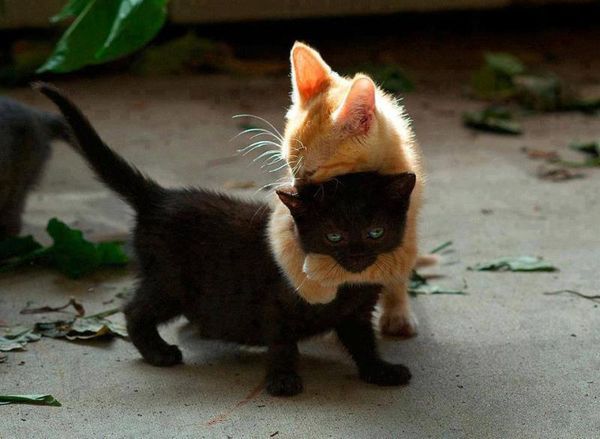
A short thought for the cat!
Cats require a varied diet, consisting mainly of meat. One of the most important amino acids for cats is Taurine which is only found in meat – a lack of this in a cat’s diet could cause cardiac dysfunction, blindness, etc. Other essential nutrients for our feline friend include: arginine (also important for dogs too), arachidonic acid, niacin, vitamin A, vitamin D, vitamin E. You should not forget to provide the right amount of calcium, phosphorus, and magnesium. Reading this you probably get the sense that taking on the task of being your pet’s personal cook is not as simple as it sounds. Our pets have very specific dietary needs, just like us, and you wouldn’t want to risk endangering them with the wrong food. The plate of scraps after a large meal is clearly not enough.
Purchasing food off the shelf
As the vast majority of consumers opt for buying their food from either the supermarket or their local pet store, it’s important to highlight that the range of dietary foods being produced today means that, if you don’t read the label carefully, you can really do harm to your pet feeding them food that is not matched to their actual dietary needs. We’ve seen dogs that look emaciated and thin simply because they have not been given the correct advice when feeding their dog (we then saw the same dog a few weeks later looking great!).
For example, ‘ash’ is often included in the ingredient list of pet foods. This refers to the inorganic component of the food, and it shouldn’t make up more than 6.5%-7% of dry foods and 1%-2% of wet foods. The lower the concentration of ash, the higher the quality of the food.
Labelling in pet food and what it means
Specifically regarding meat in packaged pet foods, there are a few things to keep an eye open for while studying the labels. The amount of meat included in pet food changes from brand to brand, but as a general rule the following serves as a guide:
– products that have the word ‘flavour’ or ‘aroma’ in their name contain under 4% of meat;
– when the product name declares ‘with meat’ it should contain over 4% of meat;
– when the name contains ‘rich in meat’ or ‘extra meat’ the percentage of meat is between 14% and 25%. Anything above 14% and 25% and the product takes on the name of the meat it’s made up of.
In dry foods, sometimes meat flour or fish flour are included. These sometimes contain offal and discarded meat so a better option is dehydrated meat.
Author Bi line
We hope that this article has provided you the reader with greater detail on some of the nuances involved in planning your pet’s diets. At ZEIPET in Florence, Tuscany, we have been serving customers in our little pet shop since 1962. We are most known for our luxury dog beds which are made to order and from some of the finest fabrics in Italy. So, after you pet has eaten and it’s time to stretch out, they are guaranteed to do so on a bed of doggie paradise.
Now what!
ooOOoo
Hope this has been helpful. If you have any questions, leave them as comments and I’ll ask Glyn to reply.
On Monday and Tuesday of the week I posted Legitimate Anger and Legitimate Hope. (And please see the footnote to today’s post)
Patrice Ayme left the following comment to the Legitimate Hope post:
It’s hard to live with elephants, especially in poor, crowded conditions. I remember bathing in Africa as a child with a bull elephant 200 meters away, on the other side of a stream, and being extremely worried, with all in attendance.
Europe used to have elephants, and North America, two species. Time to reintroduce them, and live according to our discourse.
Rewilding Euramerica can be done, and should be done, for the deepest philosophical and emotional reasons, and will create new, very productive jobs.
PA
Then on Friday came an email from reader and blogger Martin Lack:
It was but a moment to go across to The Conversation website (rather liked what I saw, by the way) and find the article that Martin linked to. It is republished here within the terms of The Conversation site.
ooOOoo
Restore large carnivores to save struggling ecosystems
By William Ripple, Oregon State University
We are losing our large carnivores. In ecosystems around the world, the decline of large predators such as lions, bears, dingoes, wolves, and otters is changing landscapes, from the tropics to the Arctic. Habitat loss, persecution by humans and loss of prey have combined to inflict great losses on these populations.
In fact more than 75% of the 31 largest carnivore species are declining, and 17 species now occupy less than half their former ranges. Southeast Asia, southern and East Africa, and the Amazon are among areas in which multiple large carnivore species are declining. And with only a few exceptions, large carnivores have already been exterminated from much of the developed world, including areas of Western Europe, and the eastern United States.
Top dogs keep ecosystems in order
Many of these large carnivore species are endangered and some are at risk of extinction, either in specific regions or entirely. Ironically, they are vanishing just as we are learning about their important ecological effects, which is what led us to write a new paper in the journal Science to document their role.
From a review of published reports, we singled out seven species that have been studied for their important ecological role and widespread effects, known as trophic cascades. These are the African lion, leopard, Eurasian lynx, cougar, gray wolf, sea otter and dingo.
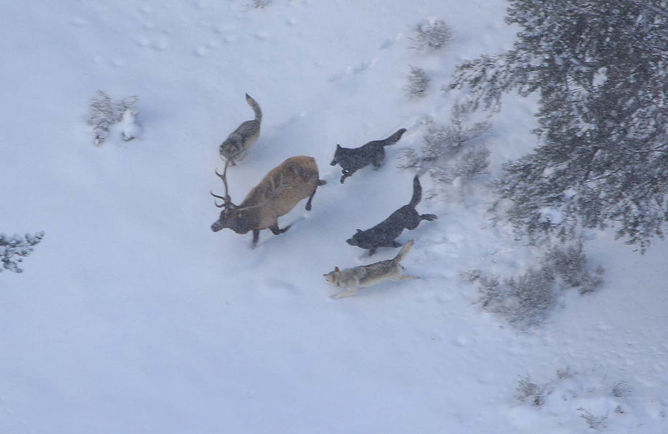
Based on field research, my Oregon State University co-author Robert Beschta and I documented the impact of cougars and wolves on the regeneration of forest tree stands and riverside vegetation in Yellowstone and other national parks in western North America. Fewer predators, we found, lead to an increase in browsing animals such as deer and elk. More browsing disrupts vegetation, reduces birds and some mammals and changes other parts of the ecosystem. From the actions of the top predator, widespread impacts cascade down the food chain.
Similar effects were found in studies of Eurasian lynx, dingoes, lions and sea otters. For example in Europe, absence of lynx has been closely tied to the abundance of roe deer, red fox and hare. In Australia, the construction of a 3,400-mile dingo-proof fence has enabled scientists to study ecosystems with and without dingoes which are closely related to gray wolves. They found that dingoes control populations of herbivores and exotic red foxes. The suppression of these species by dingoes reduces predation pressure, benefiting plants and smaller native prey.
In some parts of Africa, the decrease of lions and leopards has coincided with a dramatic increase in olive baboons, which threaten crops and livestock. In the waters off southeast Alaska, a decline in sea otters through killer whale predation has led to a rise in sea urchins and loss of kelp beds.
Predators are integral, not expendable
We are now obtaining a deeper appreciation of the impact of large carnivores on ecosystems, a view that can be traced back to the work of landmark ecologist Aldo Leopold. The perception that predators are harmful and deplete fish and wildlife is outdated. Many scientists and wildlife managers now recognise the growing evidence of carnivores’ complex role in ecosystems, and their social and economic benefits. Leopold recognised these relationships, but his observations were ignored for decades after his death in 1948.
Top carnivores, at work keeping things in check. Doug Smith
Human tolerance of these species is the major issue. Most would agree these animals have an intrinsic right to exist, but additionally they provide economic and ecological services that people value. Among the services documented in other studies are carbon sequestration, restoration of riverside ecosystems, biodiversity and disease control. For example, wolves may limit large herbivore populations, thus decreasing browsing on young trees that sequester carbon when they escape browsing and grow taller. Where large carnivore populations have been restored – such as wolves in Yellowstone or Eurasian lynx in Finland – ecosystems appear to be bouncing back.
I am impressed with how resilient the Yellowstone ecosystem is, and while ecosystem restoration isn’t happening quickly everywhere in this park, it has started. In some cases where vegetation loss has led to soil erosion, for example, full restoration may not be possible in the near term. What is certain is that ecosystems and the elements of them are highly interconnected. The work at Yellowstone and other places shows how species affect each another through different pathways. It’s humbling as a scientist to witness this interconnectedness of nature.
My co-authors and I have called for an international initiative to conserve large carnivores in co-existence with people. This effort could be modelled after a couple of other successful efforts including the Large Carnivore Initiative for Europe, a non-profit scientific group affiliated with the International Union for the Conservation of Nature, and the Global Tiger Initiative which involves all 13 of the tiger-range countries. With more tolerance by humans, we might be able to avoid extinctions. The world would be a scary place without these predators.
William Ripple does not work for, consult to, own shares in or receive funding from any company or organisation that would benefit from this article, and has no relevant affiliations.
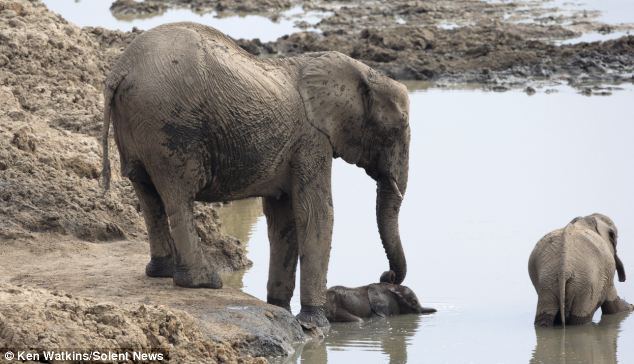
In 2011, more African elephants were killed than any other year in history. The figures for 2012 and 2013 are not yet known, but are likely to be even higher. At current rates, in twelve years, there will be none left.
It is a familiar cause, but it has never been more urgent. Poaching has turned industrial. Armed militia fly in helicopters over jungle clearings, machine gunning down entire herds. Their tusks are then sold to fund war and terrorism throughout the continent and the wider world. Ivory is still illegal, but as China booms, it is more popular than ever.
This campaign will raise money to support rangers on the ground to protect Kenya’s elephants from armed poachers, together with Space for Giants’ longer term work to create new wildlife sanctuaries where elephants will be safe, forever. More can be found about the charity at Space for Giants
The article above includes two videos. A shorter one that can be viewed on the paper’s campaign website. Then there is a longer, five-minute, video also on YouTube and included below.
Jean and I wanted to make a donation but found that without a UK bank account/UK Visa card it wasn’t possible. We contacted Space for Giants and received the following email from Amy.
Hi Paul
Sorry for the difficulties and thank you for your perseverance!
You can donate in USD through our CrowdRise page at www.crowdrise.com/spaceforgiants1. These funds are sent to TUSK USA who will then allocate them to us.
Alternatively, you can make out a cheque to ‘TUSK USA’ and send to TUSK USA, 40 East 94th Street, Apt 3A, New York, NY 10128 – please attach a covering note confirming that you would like your donation to be used to support the work of Space for Giants.
Many thanks,
Amy.
So if there’s anyone else out there not in the UK who would like to donate, here’s another option.
Please, for all our sakes, help these beautiful creatures.
Many will have read yesterday’s post about the slaughter of elephants by ivory poachers and felt, as I did, a feeling of despair in the pit of one’s soul. We seem to be living in such challenging times with so much madness about us. It’s incredibly easy to feel as if this is some sort of ‘end of times’ period.
Today’s post tells us that there is always hope.
Let’s remind ourselves that elephants are very intelligent animals. As I wrote last November in a post with the title of Smart Animals:
There was a fascinating article on the BBC news website a few weeks ago that went on to explain:
10 October 2013
Elephants ‘understand human gesture’
By Victoria GillScience reporter, BBC News
African elephants have demonstrated what appears to be an instinctive understanding of human gestures, according to UK scientists. In a series of tests, researcher Ann Smet, of the University of St Andrews, offered the animals a choice between two identical buckets, then pointed at the one containing a hidden treat.
From the first trial, the elephants chose the correct bucket.
In 2011, more African elephants were killed than any other year in history. The figures for 2012 and 2013 are not yet known, but are likely to be even higher. At current rates, in twelve years, there will be none left.
It is a familiar cause, but it has never been more urgent. Poaching has turned industrial. Armed militia fly in helicopters over jungle clearings, machine gunning down entire herds. Their tusks are then sold to fund war and terrorism throughout the continent and the wider world. Ivory is still illegal, but as China booms, it is more popular than ever.
This campaign will raise money to support rangers on the ground to protect Kenya’s elephants from armed poachers, together with Space for Giants’ longer term work to create new wildlife sanctuaries where elephants will be safe, forever. More can be found about the charity at Space for Giants
The article above includes two videos. A shorter one that can be viewed on the paper’s campaign website. Then there is a longer, five-minute, video also on YouTube and included below.
Then there is the David Sheldrick Wildlife Trust helping animals in Africa. And, finally, the campaign over at Bloody Ivory where one can sign a petition and donate towards stopping elephant poaching.
Thus, like so many aspects of life, never give up trying to help those less fortunate.
What a greedy, selfish race of people we can be at times!
I’m writing about the subject of elephants. Or, to put it more precisely and distastefully, the murder of elephants. For the ivory in their tusks.
The post was prompted by a recent item over on Chris Snuggs’ blog Nemo Insula Est. Chris and I have known each other for quite a few years now; since the time that he was Head of Studies at the French college, ISUGA, in Quimper, France and where I attended as a visiting teacher running a class on Sales & Marketing.
Chris has allowed me to republish the piece in full. Please read today’s post and then come back tomorrow to see in what ways we can all help.
ooOOoo
The Human Shame in Northern Kenya
03JAN
One of my NYRs was to stop reading bad news, but that lasted about 6 hours ….. there is of course so much of it, and so much that is utterly depressing. One of the first of 2014 was an article in “The Independent”:
Elephant Appeal: Few are willing to say just how bad the poaching crisis is – the elephant population may easily fall into terminal decline
Tragic, to the extreme!
You can get all the details from the article – which is pretty harrowing, with surviving elephants described as being “stricken with grief” as they cluster round their slaughtered brethren – but basically, elephants in the Tsavo East National Park in Northern Kenya are under threat of extinction from poachers from Somalia. This provoked a number of reactions on my part:
DEMAND
The price of ivory depends on the demand and supply. The former is very strong and apparently rising, especially in China. For extraordinarily moronic and selfish reasons, ivory is considered artistic and – for example – tiger and rhinoceros parts medicinal and/or possessing aphrodysiac properties.
Can China really do NOTHING to stop this cultural abomination? People in the west for the most part stopped acquiring ivory years ago.
If China – and other Asia nations – cannot or will not do anything, should the west not apply more pressure? Same applies of course to China’s support of North Korea. YES, sanctions are painful, but nothing NON-painful is likely to work.
THE POACHERS
They are execrable, of course …… and yet, many may be extremely poor, and indeed ignorant. There is no excuse in the strictest sense, but it may to some extent be understandable if they see a chance to make several years’ normal income in a single day. This is no different from City bankers, or indeed the Enron directors and many others: greed is sadly rampant on our planet.
There are insufficient funds to patrol the parks properly. Kenya is just one more corrupt African state where politicians earn a fortune while basic needs and services are severely underfunded.
MORALITY
So, there is a lack of funds to prevent the poacher-killers. Yet a few hundred miles away, vast sums of money are squandered on obscene luxuries.
I always wonder what if anything goes through the minds of those who spend these obscene sums on frippery and personal self-glorification. Do they ever think that their money could do immense good elsewhere? Would WE be just the same in their shoes?
Is there any solution to this greed?
ooOOoo
Chris wrote his post motivated by the article in The Independent UK newspaper. But that newspaper was not alone in promulgating the despicable killings of these smart and magnificent creatures. Here’s a story that was in the UK Daily Telegraph newspaper a year ago.
Horror as entire family of elephants slaughtered for ivory
Armed wildlife rangers on Tuesday night fanned out across eastern Kenya in pursuit of ivory poachers who killed an entire family of 12 elephants in the country’s worst single such slaughter since the 1980s.
Eleven adults and one infant calf died in a “targeted and efficient” attack highlighting the growing professionalism of poachers bankrolled by international criminals supplying soaring demand for ivory in the Far East.
Six of the animals lay in one heap, their tusks hacked out with machetes.
None of the family group managed to flee further than 300 yards before they were gunned down and their ivory removed.
The calf, less than a year old, is believed to have been crushed by its dying mother as she fell to the ground.
“It is unimaginable, a heinous, heinous crime,” said Paul Udoto, spokesman for the KenyaWildlife Service (KWS).
“We have not seen such an incident in recent memory, it’s the worst single loss that we have on record, and our records go back almost 30 years.
“These were professional killers. The attack was targeted and efficient.”
The poachers, armed with automatic rifles, had already fled but there were hopes last night that a massive search involving foot patrols, a dozen vehicles and three aircraft could still find them.
“Every possible resource is being deployed to track down these criminals,” Mr Udoto said. “They will feel the full force of the law.”
But the area where the elephants were killed, in the north of Kenya’s largest wildlife reserve, Tsavo East National Park, is sparsely populated, has few roads, and lies close to Kenya’s border with Somalia.
Privately, conservationists said they feared the poachers and their haul of 22 tusks, worth an estimated GBP175,000 on the Asian market, would already have escaped.
The attack was the latest in a surge of elephant deaths that has seen the number of the animals killed for their ivory in Kenya increase sevenfold in five years, from fewer than 50 in 2007 to 360 in 2012, according to KWS figures.
The increase has led many wildlife experts to declare the current situation a crisis worse even than the mass slaughter of Africa’s elephants in the 1970s and 1980s, which led to a global ivory trade ban in 1989.
I don’t have permission to republish the article so please go here and read the full piece and view a couple of harrowing photographs.
Then come back tomorrow and explore how you and I can do something to help. Please.
The first of the New Year and dedicated to Sue of Sue Dreamwalker.
A week ago, Sue left a nice comment about our ‘backyard’ here in Oregon. Specifically with regard to the two photographs of deer feeding in front of the house. I replied by saying that today I would offer a selection of views of our property.
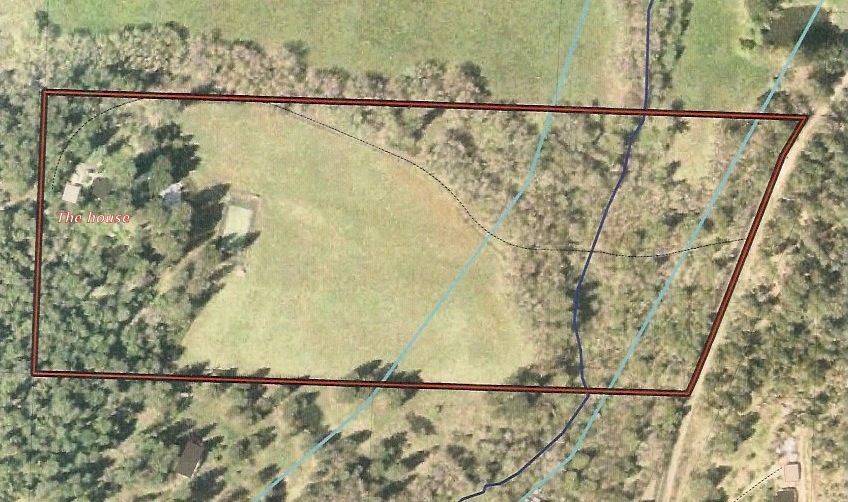
First off, an aerial view with the property boundary line overlaid, taken from the sale particulars. The right-hand, Eastern boundary follows the edge of Hugo Road. We are some four miles from Merlin in Southern Oregon.
Thirteen acres orientated West-East.
The solid blue line is the course of Bummer Creek that flows from top to bottom of the image. The thin, dotted blue line is the driveway that runs from Hugo Road up to the house, a distance of a 1/4 mile. The house is close to the Western boundary almost hidden from sight in this picture by the trees. There is a faint label ‘The House’ just below the building.
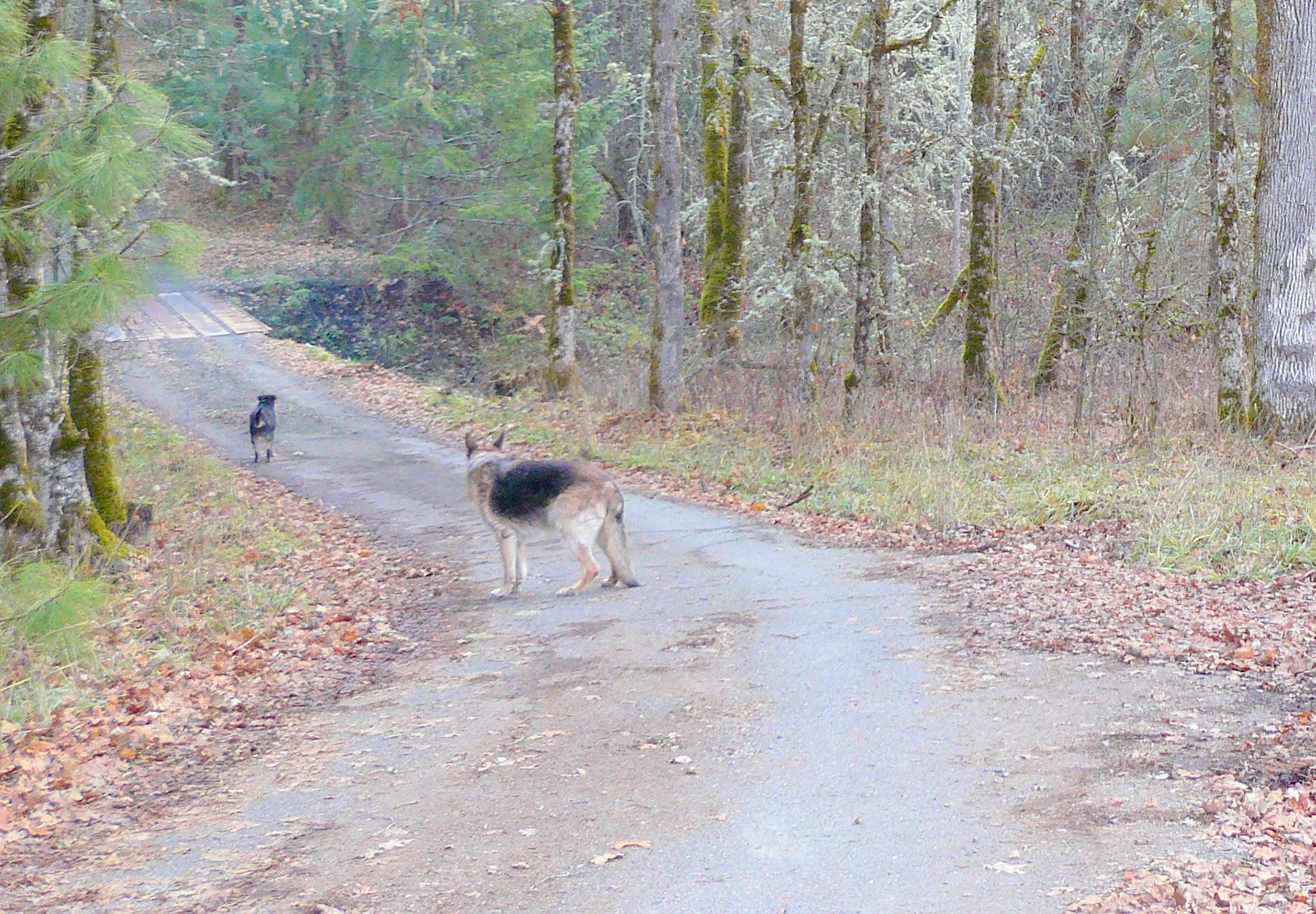
From left to right: Pharaoh, Sweeny, Cleo and Hazel.
The above photograph was taken from a point about half-way along the driveway, the house being behind the camera. Ahead, the driveway dips down to cross the bridge over the Creek, as the following picture reveals. Luckily the boundary fence is dog-proof!
oooo
Dogs and water!
Pharaoh in Bummer Creek just downstream of the bridge.
Looking further downstream from the bridge.
oooo
Looking upstream from the bridge.
The barrier across the Creek seen in the upper half of the photograph is a flood irrigation dam installed many years ago, presumably for agricultural purposes before the plot was sold for house building prior to 1977. One installs an iron pole on a centre bolt embedded in the dam and then places a stout plank across the flow on top of the dam. The plank can just be seen to the right of the dam, resting on the bank. Never tried the dam but going to some day!
Looking to the West up towards the house.
The above picture was taken close to where the previous one was shot. Simply by swinging around to the left and looking back up. The house is barely visible in the background behind the metal gate and wooden fence posts in the middle of the photograph.
Corinne’s field visible through the trees and undergrowth.
Again, the picture above is taken not far removed from where the previous two were taken. If one looks at the aerial view of the property in the first picture, in the top-right corner there is a small area of grassland; what would have been an offshoot of our neighbour’s grassland in previous times. After my sister, Corinne, died in the Summer of 2013 we named that area of grassland Corinne’s field.
A general view down over the main area of grass.
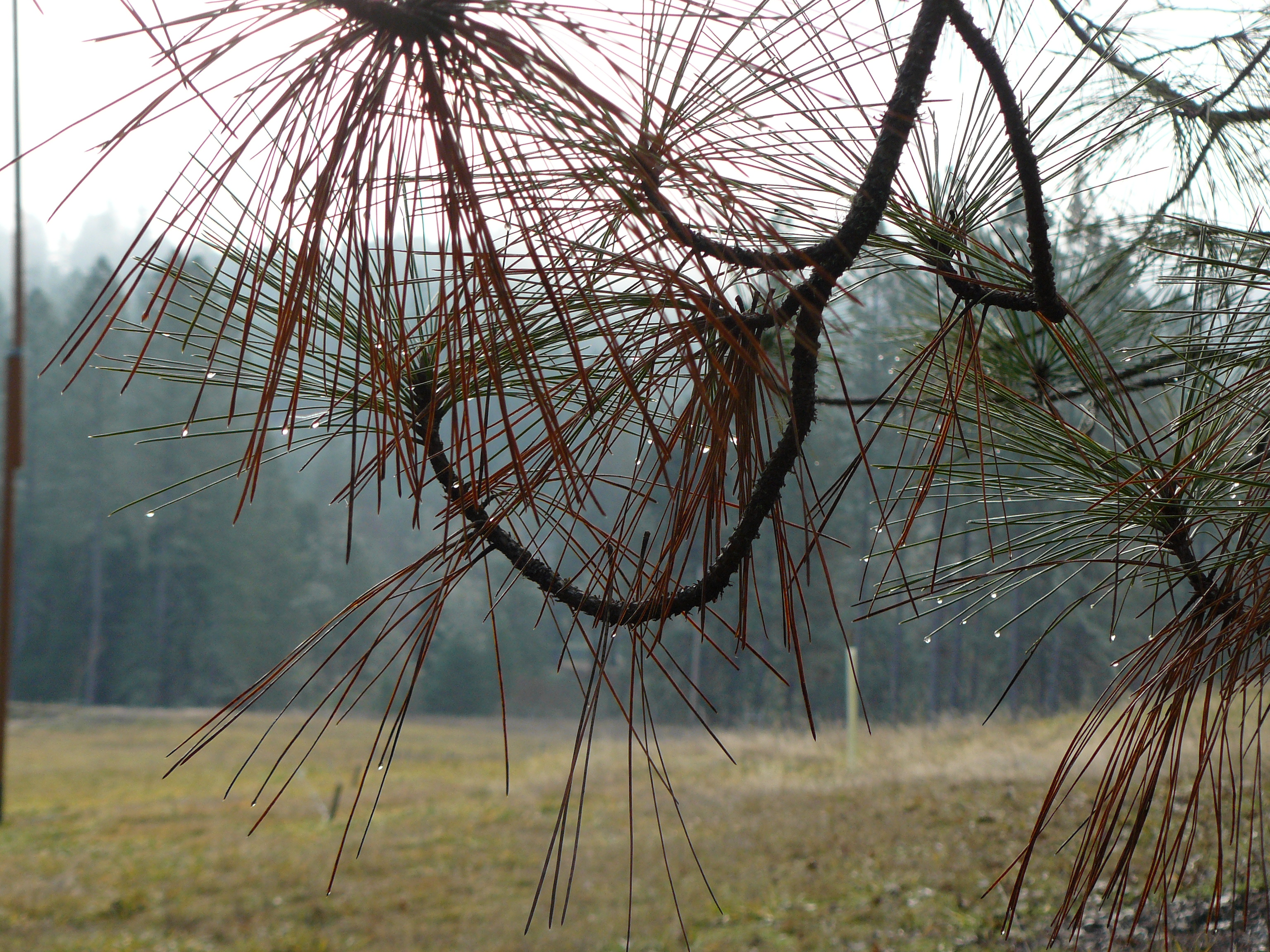
So now we are back standing just outside the Eastern side of the house looking South-East out over the main area where the dogs are walked twice a day. The picture was taken a little before noon and shows the low mist that has been with us for about two weeks.
Nature’s beauty.
Above, another photograph picking up on the mist that has been with us for some days. Until yesterday!
This is what I call a Winter day!
Yesterday dawned cold, clear and frosty. As this picture of one of our tall pine trees so vividly demonstrates. (The tree edges our driveway, about half-way to the house.)
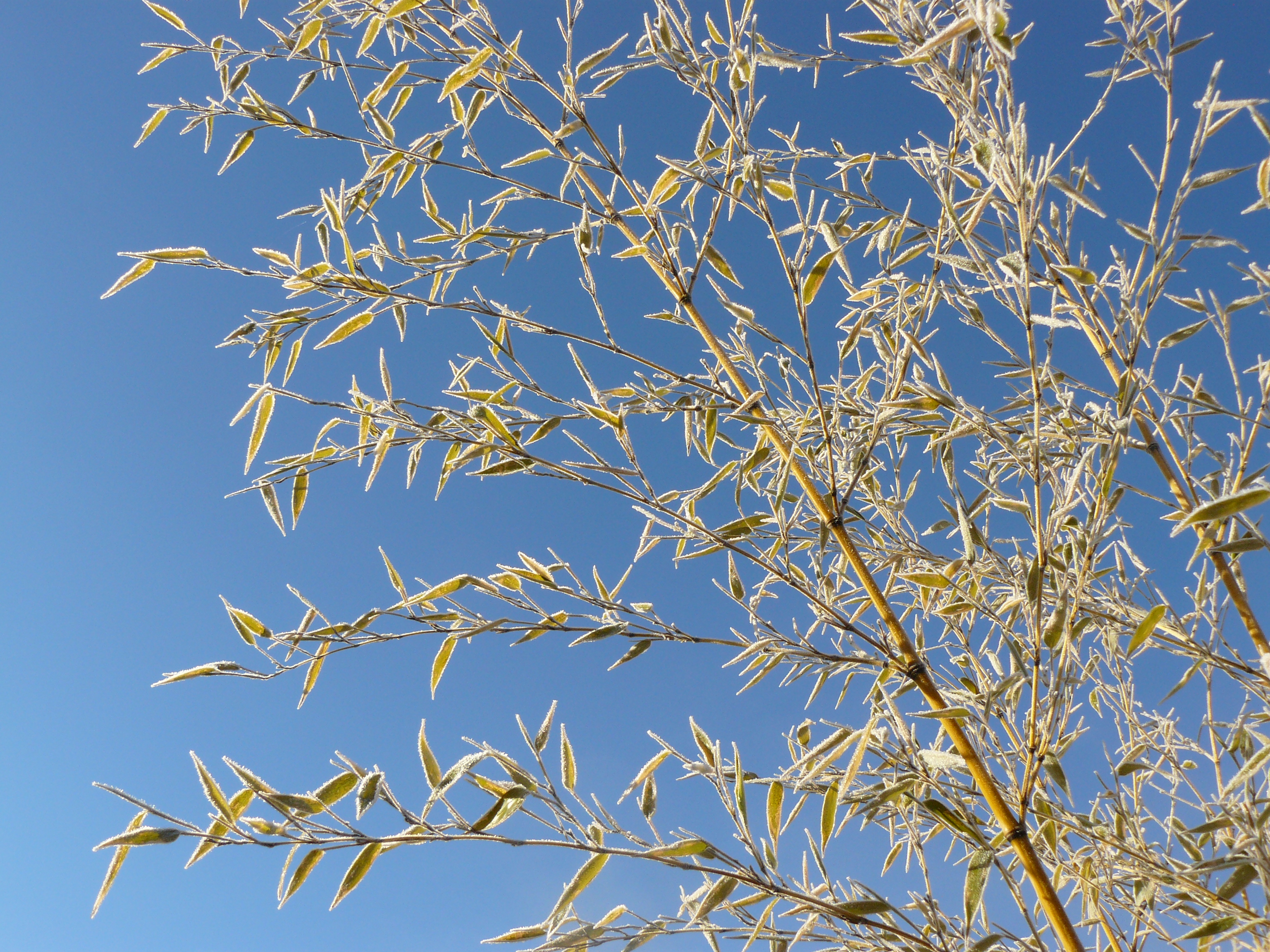
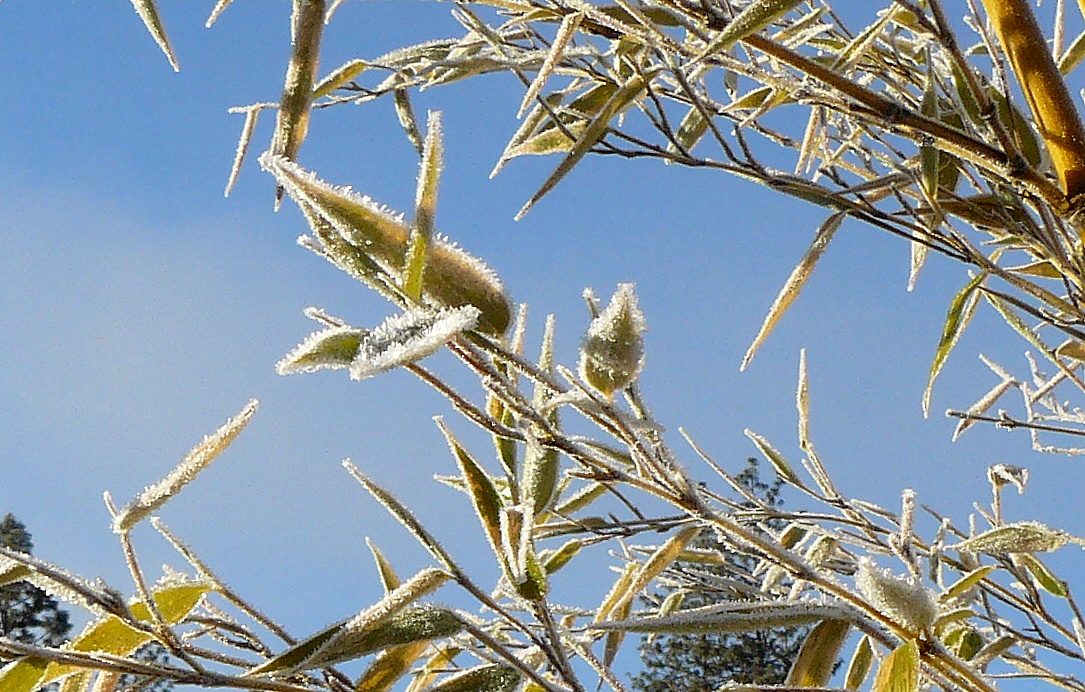
So will close today’s post with three more pictures of a frosty Saturday morning in Merlin, Oregon, USA.
A frosty yet sunny morning.
oooo
Frost on a bamboo tree.
oooo
It really is a beautiful world at times.
oooo
So there you are, Sue!
Needless to say, Jean and I are reminded almost daily how lucky we and all our animals are at finding such a beautiful place to live. I can’t ever imagine taking it for granted.
















 Learning from Dogs