Author: Jon Lavin

Dealing with the fear of the Known!

Can we ever conquer fear?

In a recent article I discussed the fear of the unknown, linked to the down-turn, redundancies, etc.

Per Kurowski, a great supporter of this Blog, posed the following question.

Great advice… but how do we remove the fear of what is known?

A simple, and slightly flipant answer would be,

“Develop a different relationship with it.”

What I’m saying is that when we are facing the known, and I’m assuming that it’s something unpleasant, our choices are limited. It’s going to happen, so the only thing we can do is change the way we view it.

This brings us back full circle to developing a different relationship with it.

Let’s take the word, ‘fear’.

All fear is an illusion, walk right through“. I heard Dr David Hawkins say on a CD. Granted, a great trick if you can do it!

Here’s another description of fear: Fear= False Evidence Appearing Real

Fear is generally future-based. We tend to use the past as a learning reference to inform us of what to be afraid of in the future. So human beings live their lives trying to predict and prepare for the future, limited by their past experiences.

Unfortunately, the only way to work with fear of the known is to live in the present! [Just like dogs! Ed.]

Our whole society is geared up to look into the future. We are forever worrying about or planning something for the future.

To begin focussing on the present, try this.

Simply, to start off, become aware of the breath and sensations in the body. This will slowly start to remind us to be present, or embodied, in our own body.

Fear

Problems, fear and spiral thinking, often at 3 or 4 in the morning, are generated in the mind.

Thoughts occur randomly, although we call them, “Our thoughts”, and refer to, “Our mind”.

By dropping out of the thought processes into awareness of the breath and body, the noise stops, even if only for a moment.

So very few people in the world will have even the slightest inkling what these words mean.

If more of us got used to coming out of the mind before making an important decision, and simply sat with the question for a while, the answer would probably present itself.

This will probably raise more questions than it answers but that’s not a bad thing.

By Jon Lavin

[If you have been affected by this Post and would like to contact Jon, he would be delighted to hear from you. Ed.]
A Way Forward?

Removing the fear of the unknown

I’ve been working with most of my clients recently through painful transformations brought about by the economic downturn.

An interesting metaphor really because since the first wave of uncertainty triggered panic, first noticed in the UK banking system, I have been picking up on that uncertainty that feels like it’s stalking the globe at the moment.

Interestingly, I, too, have been aware of an underlying fear that was difficult either to name or source.

It has been rather like a deep river in that whilst the surface feels slow moving, currents are moving things powerfully below.

So this ‘fear’ has caused a few household changes.

We now are the proud owners of 9 chickens. Our youngest son, Sami, and I have dug up the back lawn and planted vegetables and built a poly-tunnel.

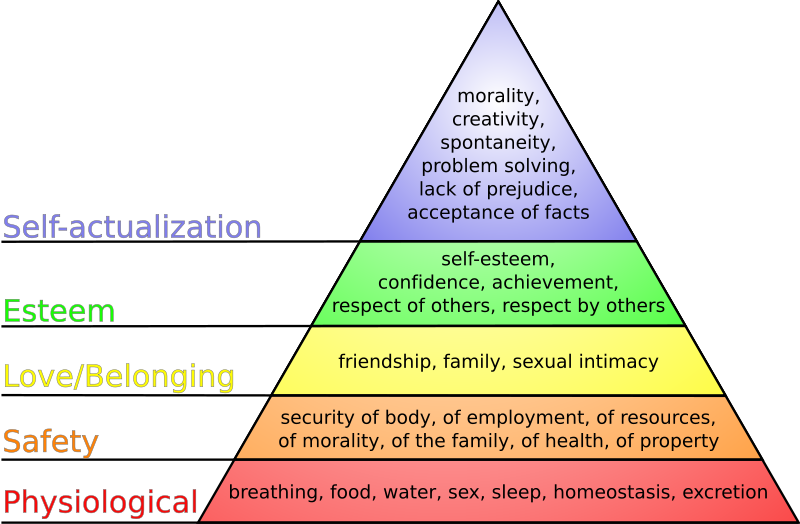
We have also installed a wood burning cooker. Right back down to the base of Maslow’s triangle really!

Maslow’s triangle of needs

These feelings have brought about such change everywhere and I wonder seriously whether we will ever return to what was; indeed would we want to?

I might not have mentioned it in previous blogs but as well as an engineering background, in latter years, I have focused on how interpersonal success in business is linked directly to relationships, integrity and vitally, self-awareness.

To inform this, some 7 years ago, I embarked on an MA in Core Process Psychotherapy, primarily to work on myself so that I could be the best I could be in my relationships, in and out of work.

The point I’m trying to make is that the same panic I notice in many of the companies I work in, and in me, is based on fear of the unknown and on a lack of trust in all its forms.  I’ve deliberately underlined that last phrase because it is so incredibly important.

The truth is that we get more of what we focus on.

So we can choose to focus on the constant news of more difficulties, hardship and redundancies, or we can focus on what is working.

In the workplace this positive focus has been pulling people together across functions and sites and pooling resources and ideas.

A farm evening

When we realise we’re not doing this alone it’s amazing how much lighter a load can feel and how much more inspired we feel.

I also notice how humour begins to flow and what a powerful antidote for doom and gloom that is.

Transformation is never easy but the rewards far exceed the effort put in ten fold.

So what is it going to be? Are we all going to bow down to the god of Doom & Gloom, fear and anxiety, heaping more and more gifts around it, or are we going to start noticing and focusing on the other neglected god – that of relationship, joy, trust, abundance and lightness?

Whatever the future holds for us all a belief in our inherent ability to adapt and change and focus on the greater good rather than fear, anxiety, greed and selfishness is the only sustainable way forward.

By Jon Lavin

[If you have been affected by this Post and would like to contact Jon, he would be delighted to hear from you. Ed.]

Giving Up!

[With this Post, Jon introduces a series of forthcoming articles looking at the inner person and exploring ways in which each of us can enhance our feelings of contentment and happiness. Ed.]

Stop the world, I want to get off!

Starting again requires giving up

Whichever way we look, there appear to be huge problems. Not insurmountable but, metaphorically speaking, sheer vertical cliffs without any easy way up.

One might ponder if the last 50 years, that post-war period of growth and prosperity, have, in reality given society real, sustainable, core improvements or whether all the ‘gains’ have come at such a cost that the net benefit is questionable?

This could be seen as pessimism gone mad. Undoubtedly, there have been some huge gains from a scientific point of view and we now enjoy lives that are greatly enhanced and longer. But not to ask such a fundamental question is to assume the alternative, that everything in the garden is rosy.

Now this may seem a strange introduction to a topic that is going to be deeply personal and private.

But both the private, individual world of the ‘self’ and the great, interconnected world of the planet are indivisible. Every aspect of our lives, our livelihoods, our environment and the future of our children depends on how well, and how sustainably, we manage our personal, local, national and international interests.

For example, if Prof. Lovelock’s theory on the planet being a self-regulating organism is correct, his Gaia theory,  then possibly in the lifetimes of our children, and certainly in the lifetimes of our grandchildren, worrying about a job or repaying the mortgage will be irrelevant. Our descendants will be worrying about their very survival!

I called this piece Giving Up. Why?

Because the only way forward is to give up on the present. I will expand on this theme in future Posts.

The future depends on each of us being happy and contented with ourselves and avoiding looking out there for the magic cure to all our troubles. Being, as far as we are able, at peace with our circumstances and able to do the best, individually, as well as the best for our families, our friends and the larger world in which we work and play.

I have heard people ask the question before, “How can I best help the world?” The only truthful answer is to develop ourselves as individuals. In doing this, the field of consciousness that we are all connected to is also lifted or elevated to a higher level.

At this stage of history, either…the general population will take control of its own destiny and will

Noam Chomsky

concern itself with community interests guided by values of solidarity and sympathy and concern for others or alternately there will be no destiny for anyone to control.

-Noam Chomsky

By Jon Lavin

[Anyone who has been affected by this article and wishes to contact Jon may find his contact details here. Ed.]

Attraction

The difference that makes the difference!

Nature's 'law' of attraction

As a follow-up to my last Post on Learning from Dogs “Managing in a mad world“, I got to thinking about the so called “Law of Attraction“.

I say that because I beginning to believe that this ‘Law’ is more about what we think about and focus our attention on than anything that has a tangible force of attraction.  But it is well known that the brain (to protect our sanity!) filters out on a huge scale so this ‘attraction’ may be our minds remaining receptive or, as it were, allowing us to ‘resonate’ with others sharing our ideas and emotions.

Again, I notice this common ground between my psychotherapy clients and my business clients. Successful people tend to focus on the positive and usually have a strong belief in themselves and their abilities, and unsuccessful people who have suffered any sort of difficulty for an extended time, tend to be preoccupied with focussing on the negative and tend to have a negative self-view.

Naturally, we become orientated around our belief systems. This, I believe is where good, consistent parenting comes in because many of our beliefs are taken on from our parents. Even if the parenting style has been ‘tough’ as long as there’s consistency, balance is maintained and there is a solid reference point for the youngster to come away from.

Management styles resemble parenting styles, and why shouldn’t they, as the higher qualities of facilitating structured learning in a safe environment is exactly what good management is all about. Delegating is about empowering and confidence building. Parenting styles that are loose or have little or no structure or that are overbearing and dictatorial tend to be damaging.

Of course, there are no hard and fast rules here, just tendencies but it’s interesting how these are played out everywhere, in every situation where we are in relationship with others. Even more interesting in a recession where companies are really struggling!

How fascinating to clock the number of companies struggling badly who have an autocratic management style, where staff are told what to do and there is little empowerment, and then compare them to ones where the opposite is true and people are free to interact, communicate, feel they’re reasonably empowered and work together in an environment of mutual trust.

The correlation in this part of the South West UK where I mainly work is significant. It’s as if  when we feel empowered and we’re working together with a group of like-minded people, all problems and challenges are solvable, because our self-belief is high and we visualise success. Also, adversity is seen as a challenge and one that can be mastered.

We certainly are living in interesting times!

By Jon Lavin

Managing in a mad world.

Even in the midst of great pain, we must think through our choices

The last week has been really mad.  I have been working in different companies and organisations and having to be part of redundancies, power struggles and people rebuilding their lives.

For example, I was in a company that had just let its second lot of people go in as many months. It’s gone past losing ‘dead wood’ and now people with valuable skills needed for recovery are going. I’ve noticed previously that good, employable people with key skills start to get concerned and will often take voluntary redundancy rather than hanging around to see how things pan out.

End of job!

It’s the shocking way that it’s done as well that’s unbelievable. No warning, just a phone call to attend a meeting, no hint as to what the meeting is about, then an envelope slid across the table and then a rapid escort off site. All done and dusted in 5 minutes.

Having been through this myself some years ago, it’s not something you forget in a hurry. Lots of feelings of rejection and feeling unvalued and unwanted are what I remember. Perhaps its part of being bought up in a job-for-life culture and then having that illusion shattered.

Working with people in this situation is literally quite shocking and traumatic because it clearly affects them and their lives and the lives of their families, and it affects me because the work we started comes to an abrupt end usually with little or no warning, and so does a source of income to be brutally honest. I don’t even have chance to say good-bye in many cases.

Every Thursday I become a trainee psychotherapist and work with people who mostly struggle to hold down any sort of job. The reasons for this are generally because of upbringings that are awful beyond description. The shock and trauma that is in the air when working with these people is amazing, and so scary for them that the idea of being present in the room with me and is virtually impossible.

So that brings us to managing in a world where lots of mad and non-integrous things happen. I believe that mindfulness can provide a key to these situations; being present for another does more than any instruction manual!

Being present means we make ourselves available at many levels to someone who is suffering. By avoiding the subtle invitation to join someone in their shock and trauma but by being there for them, to the best of our ability and listening to them at depth, we can provide an environment where real reflection can take place. Then options may be chosen which are not born of panic and reaction but come from reflection and response.

I believe that this approach gets us out of the ‘noise machine in our heads‘ (that is forever churning and worrying, in my case) that we have no control over, and creates space for more subtle things to come through the quiet and calm.

Most people I’ve met in my engineering work like to assume that they think their way out of tight situations but I’m not convinced that this process is actually effective. I have heard and practised many times the activity of ‘sleeping on something’ and then being able to decide on a course of action the following morning with relative ease. My psychotherapy clients can’t think their way out the awfulness because thinking about things has got them into a spiral

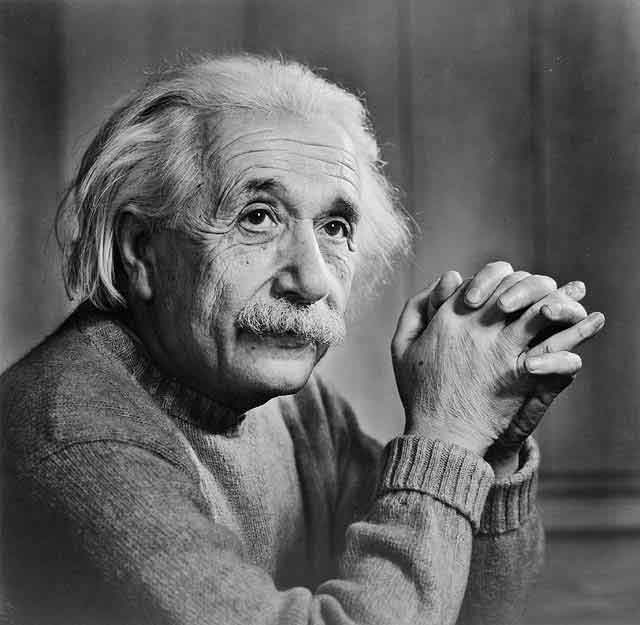
Albert Einstein

process which is highly addictive, predictable and virtually impossible to break without the intervention of a higher level of awareness. I think it was Einstein who said something like, “you can’t use the same intelligence that created a problem to solve it“!  In other words, a different approach or level must be used.

I believe that this different approach or level can be used to solve most problems we have. By bringing a different level of awareness to a challenge, whether it is redundancy or some other sort of deeper problem always gives different results and provides more options. It’s just that initially it needs to be facilitated, until we can do it under our own steam. I am heartened that even in the depths of a recession that there are still companies out there that support this approach and the work I do.

By Jon Lavin [This article from the BBC is worth reading in conjunction with Jon’s excellent Post. Jon may be contacted via learningfromdogs (at) gmail (dot) com]

Don’t lean the wrong way!

“…Skiing is the best way in the world to waste time.” ~ Glen Plake

Against my better judgement, my wife talked me into going skiing in the French Alps just before Christmas. It was a good opportunity to take our 3 teenage sons on holiday because they wouldn’t have come otherwise! They put some of their money in as well so it felt like a good call.

My wife and I have done a lot of cross-country skiing in Finland where I used to live, so we planned to do the same in France, while our boys went off down-hill skiing.

Unfortunately, the resort we picked didn’t cater for cross-country skiing so we ended up learning down-hill skiing. After a lot of falling over, laughter and tips from our sons, we started to get the hang of it and decided to sign-up for a half-day skiing lesson the next day.

After some initial runs on the nursery slopes, we agreed to have a go on a Green run. Although we part fell down the

"Feel the fear"

steep bits and included me nearly falling off of the ski lift as we left the station, it was an amazing experience.

What struck me was that it was a mixture of fear and exhilaration. I realised that the secret was leaning in the opposite direction to your natural instinct and trusting that that would work.

The skiing instructor was a student at a local business school and we got talking about trusting and having faith in things turning out well. Also, that in order to progress, it is usually necessary to take a risk or two and feel uncomfortable.

I realise that I have a tendency to play it safe and pull back from the new or unpredictable. In order to progress, it is necessary to do things that push back our comfort zones and put ourselves into situations which are not always pleasant. “Do something every-day that scares you.”

By Jon Lavin

Forwards to bygone times!

Sign of the times?

Woodstove

We have been looking for ways of cutting down our energy requirements and coupled with trying to grow as many of our own veggies as possible, 2 small flocks of chickens for eggs, we have now acquired a reconditioned, wood-burning cooker.

It arrived last Wednesday and weighs in at just under a third of a ton. It was manoeuvred into place by 2 men, some planks of wood and a few rollers made from off-cut, scaffolding poles.

Our youngest son and I fitted the flue and fired it up on Thursday evening. What a transformation!

The quality of heat and ambience it creates in the kitchen/dining room is amazing. It is like being transported back to a bygone era where everything seemed less stressed and slower. Whoever gets up in the morning lights it first and it seems to be able to rise from cold to a useful temperature in 20 minutes. It uses a very small amount of wood to keep it in all day and we have switched off all the heating in the adjoining rooms. We cooked a roast dinner in it on Sunday and a load of mince pies plus bread over the weekend.

It’s not instant and it has its own foibles but we love it – a bit like most of us, I expect!

By Jon Lavin

An interconnected world.

Bringing out the best in us.

As I visit some of my clients, I am becoming aware of an unusual phenomenon – I think some people are actually becoming less selfish. We are used to hearing stories of institutions reaching heights of greed and selfishness during this recession but not many that are about the other way round.

I don’t go to supermarkets very often because I’m usually out working when my wife goes but by a fluke, I kept her company recently. We have been trying to support the local farmer’s markets in the area but this is proving difficult as it’s much quicker to do a one-stop visit to a supermarket than lots of small visits since we both run our own businesses.

It is of course cheaper at the supermarket as they have systematically forced food prices down to a level that prohibits most small food producers from supplying them.

Anyway, I digress. In our local supermarket works an ex colleague and friend of mine. He was made redundant just over a year ago for the second time and decided that he would go for the stress-free, safe option. He used to organise procurement for a large, global communications company so he has his head screwed on around organising things. I guess the supermarket job means that he can just switch off away from work, something he could never do before.

I saw him with a large trolley, checking shelves and we stopped for a chat. He was fine and generally enjoying his work. He asked about mine and I mentioned that things were a bit tight at the moment. We got talking about how training is carried out at his work and how they work with developing employee’s interpersonal and communications skills. He mentioned that there was a new HR manager at the branch, or is it “in branch?”, and would I like an introduction as they were always recruiting new people and they needed training?

I was flabbergasted as we weren’t necessarily that good friends and he didn’t need to say or do anything but went out of his way to be helpful.

I have also noticed this phenomena in other companies from time to time, in the form of clients arranging meetings and spending time, something previously they really didn’t have time for. Maybe we get more of what we notice and by focusing on the positive, we attract more of the positive into our lives?

Is it because when the going gets really tough, for example, in times of national crisis or great hardship, that we remember that we are all interconnected?

By Jon Lavin

Are you there, but not present?

Communicating effectively means being totally mentally connected.

I have been working with a client recently through a very tough performance improvement plan.

As part of the plan, my client had to be videoed working with people in his workplace. I had to observe the video and then give feedback on it.

He seemed very efficient and made notes whilst he worked with each person. Occasionally though, something didn’t seem to be quite right. When I watched more closely I realised what was wrong. He wasn’t present. He wasn’t really connecting with the people he was working with.

It made me reflect on how much more effective he would have been if he had been able to connect with these people? I wondered if he was even able to understood about being present and what that meant?

By Jon Lavin

Mind over Matter: does it matter?

An example of how we really do own our lives.

We were invited to our friend’s 25th Wedding Anniversary on Saturday, 21st November.

English pub

It was in a local pub and they had invited many friends, some of whom we had not seen for many years.

One friend had started his own architect business, built it up over the last 10 years and, although he had lost a large amount of work because of the recession, things seemed to be picking up.

I mentioned that my work had dropped off dramatically since the summer. He said:

Well, Jon. You can make your own mind up what you do. You can either decide you’re going to go bankrupt or you can decide that you’re going to succeed –  in spite of everything.

For some reason, that short conversation had a huge impact on me and I realised that it really is mind over matter and once we make our mind up about something, good or bad, it tends to happen.

By Jon Lavin