Author: Paul Handover

Giving dogs the run of their lives.

How to build the perfect backyard for your dogs.

(I’m conscious that many recent posts have been more of me republishing stuff than being creative on my own account. Blame it on ‘the book’: my first edit is now complete and the next stage is sending the manuscript out to those who have volunteered to proof-read the book.)

I saw this article on Mother Nature Network and it struck me immediately as being full of common-sense and well worth sharing with you.

ooOOoo

How to build the perfect backyard for dogs

Learn which plants are hardy, which are poisonous, and how to create a beautiful but functional layout.

By: Jaymi Heimbuch
July 14, 2015

Designing your garden with your dog in mind will prevent an infinite number of headaches down the road. (Photo: upixa/Shutterstock)

A dog and a healthy, beautiful backyard don’t often go hand in hand. The amount of wear and tear a dog throws at a garden can leave it in tatters. But it doesn’t have to be this way! With a bit of planning and a careful selection of plants able to hold up to whatever dogs spray at them, your backyard can be both a haven for humans and a paradise for your pups.

Here are helpful strategies for planning out a yard and a list of plants to use or to avoid.

7 tips for dog-friendly garden design

Build raised beds for the more sensitive plants or for any fruits and vegetables you may want to grow. Add in some fencing or netting around the boxes to protect them if your dog is still tempted to hop up and snoop around in them.

Build a dog-friendly path around the yard. This will guide your dog through the garden and minimize the detours into the flowerbeds. You may want to start by watching where your dog goes on his own, and creating the path along that route. That way you aren’t trying to train your dog to go somewhere he doesn’t normally want to go, and you aren’t frustrated when your dog goes where he wants to anyway.

Providing pathways for your dogs will show them where they're allowed to run and will help keep them out of more sensitive areas of the garden. (Photo: Julius Elias/Shutterstock)
Providing pathways for your dogs will show them where they’re allowed to run and will help keep them out of more sensitive areas of the garden. (Photo: Julius Elias/Shutterstock)

Discourage digging through design. If your dog sometimes digs holes, you can help keep your garden beds safe by making them raised beds. However, if your dog is a relentless digger and no part of the yard is safe, then consider building an area where your dog can do anything he’d like within that space, including dig. This could be a fenced area that has a sand box, where the outlet of digging is welcomed.

Create a designated area for bathroom breaks. This will of course require training your dog to use it, but the time and effort spent in training will counter any time and money spent in replacing dead plants.

Provide places to sun. Many dogs love to sunbathe and might pick the sunniest spot in the middle of your favorite bed of flowers. Avoid a dog selecting his own area by providing one for him instead. A small deck, or a few paving stones in a pretty design, or even an area with bark chips will be a welcoming place for your dog to lie down, out of the way of the plants.

Create shaded areas to keep your pet comfortable. Yards are the perfect place to hang out in the sun, but on hot days it can feel pretty miserable without relief with a little shade. Plant trees or tall shrubs where your dog can enjoy a cool break from playing in the sun.

If you have a water feature, make sure the water is drinkable and free of chemicals.

Safe and hardy plants for dogs

After figuring out a few design elements to make your yard a place where both dogs and humans can feel comfortable, it’s time to review your plant selection. There are a fair number of plants that are resistant to dog urine. By placing these plants in the areas your dog frequents, you can reduce how much replanting you need to do as well as keep your yard looking fresh and healthy.

Many herbs are not only safe but also healthy for dogs. But you'll still want to protect them from your dog by growing them in a raised bed or pots. (Photo: Jamie Hooper/Shutterstock)
Many herbs are not only safe but also healthy for dogs. But you’ll still want to protect them from your dog by growing them in a raised bed or pots. (Photo: Jamie Hooper/Shutterstock)

Luckily, the herbs you likely want to have in your kitchen garden are also healthy for dogs. If you like cooking with these savory staples, you’ll be happy to know they’re more than welcome in your dog-friendly garden! The five best options include:

  • Basil — antioxidant, antiviral and antimicrobial properties
  • Oregano — helps digestive problems including diarrhea and gas
  • Parsley — a source of flavonoids, antioxidants and vitamins
  • Peppermint — soothes upset stomachs, reduces gas and nausea, and helps with travel sickness
  • Rosemary — high in iron, calcium and Vitamin B6

Groundcovers are a great alternative to a grassy lawn. Many varieties can withstand abuse from dogs better than any grasses. Great options include:

  • 
Carpet bugle
  • Elfin thyme
  • Kinnikinick
  • 
Miniature stonecrop
  • Silver carpet
  • Snow in summer
  • Winter creeper

Another staple for a dog-friendly yard are urine-resistant plants. Here are a few suggestions:

  • Bears breech
  • Burkwood osmanthus
  • Doublefile viburnum
  • Feather reed grass
  • Holly fern
  • Japanese spindle tree
  • Mexican sage
  • New Zealand flax
  • Redtwig dogwood
  • Snowball viburnum
  • Spider plants
  • Sword fern

Plants poisonous to dogs

Even if they look pretty, there are quite a few plants you should avoid having in your yard because ingesting them can mean illness or death for your pet. It doesn’t mean you can’t have these plants around; it just means you’ll want to plant them in areas your dog can’t access, such as fenced-off portions of the yard or in hanging baskets out of reach. University of California, Davis put together a list of the 12 plants that cause the most visits to their vet hospital. They include:

  • Aloe vera
  • All species of amaryllis
  • Anemone
  • Asparagus fern
  • Chrysanthemums
  • Cycads (including Sago palm and cardboard palm)
  • Cyclamen
  • Daffodil
  • Jade plants
  • Lilies
  • Lily of the valley
  • Philodendrons

The ASPCA provides a full list of plants toxic to dogs. Reviewing this list before planting will help prevent trips to the vet in the future.


Be sure to double check if the plants you're adding to your garden are toxic to dogs. While some dogs stay out of the plants, others may munch on anything they feel like, which could lead to a trip to the vet's office. (Photo: Dora Zett/Shutterstock)
Be sure to double check if the plants you’re adding to your garden are toxic to dogs. While some dogs stay out of the plants, others may munch on anything they feel like, which could lead to a trip to the vet’s office. (Photo: Dora Zett/Shutterstock)

Other things your dog could, but shouldn’t eat

Which mulch you select could be important to your dog’s health. Cocoa mulch, made of cocoa bean shells, is a by-product of chocolate production and can be toxic. Most dogs aren’t going to eat mulch and if they do, they probably wouldn’t eat enough to cause a problem. However, if you have a dog that seems to dine on anything and everything, you may want to consider using something like shredded pine instead.

Much like eating mulch, ingesting large amounts of fertilizer can be unhealthy or even life-threatening for your pet. Be sure to use all-natural fertilizers, follow the directions and make sure that your pet isn’t allowed into the fertilized area within the suggested waiting period after application.

Compost piles are a great addition to any garden but depending on what you’re tossing in them, they can also pose problems for pets. Coffee grinds, moldy food and certain types of fruit and vegetables are toxic to dogs. In addition, fungal toxins can grow within the compost piles that can cause problems for your pet’s health and overall immunity if consumed. It’s a good idea to keep your compost in a bin that is off limits to your dog.

It is also a smart idea to ditch the chemical herbicides and pesticides. Not only are they terrible for the environment but they can also have disastrous effects on pets, including causing cancer.

ooOOoo

This is so brimful of good advice that it deserves to be shared as widely as possible.

Another love story.

This is what happens when an animal trainer finds a bear cub.

(Today’s post has a number of very beautiful photographs. However, it is much better presented to you, dear reader, as a standalone post rather than under the umbrella of a Picture Parade.)

Thanks to Suzann for sending this on to me.

ooOOoo

A Man Found Two Bear Cubs Beside Their Dead Mother.

A naturalist named Casey Anderson stumbled across two grizzly bear cubs nestled beside their dead mother in the wild mountains of Alaska . Casey couldn’t just leave these little guys to die in the wilderness, so he made the brave decision to take them with him. He trains animals for a living, so he knew he would be able to give these cubs a real shot. That simple decision, borne out of grief, turned into one of the most unique and adorable rehabilitation stories we have ever laid eyes on.

bears1

This is Casey and the little cubs. Unfortunately, only one survived and Casey decided to adopt him.

He named him Brutus.

bears2

Brutus grew up as part of the family, albeit a very fuzzy part.

bears3

It was Casey’s job to train animals, so raising and training Brutus was normal for him.

bears4oooo

bears5

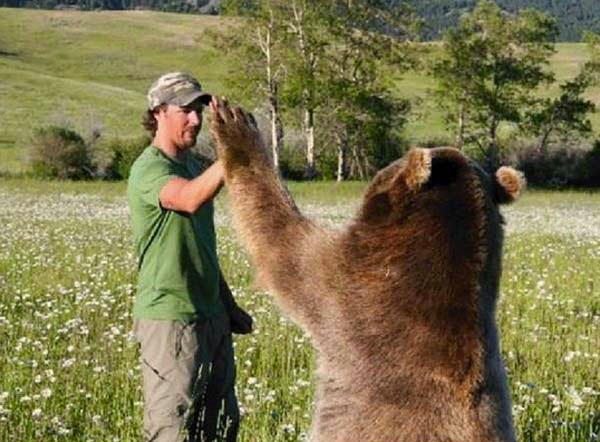
Over the years, they became close friends and brothers.

bears6

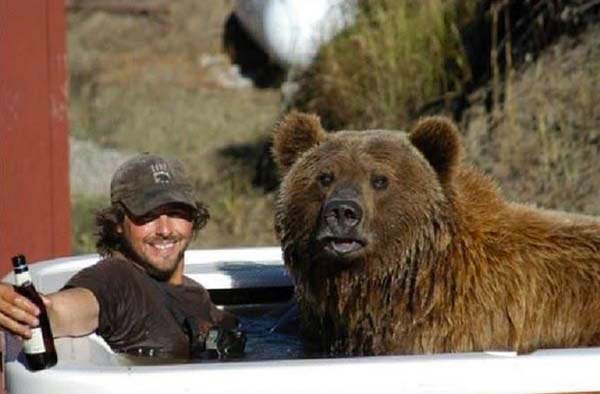
And Brutus got the run of the pool.

bears7

oooo

bears8

oooo

bears9

oooo

bears10

Brutus grew to be so close to Casey, he was even his best man (bear) at the wedding.

bears11

It may have made the bride a little nervous.

bears12

But she was probably glad Brutus wasn’t capable of taking him out to dinner (no thumbs).

bears13

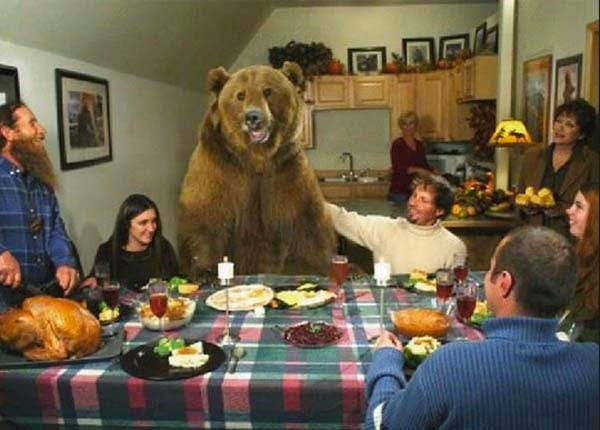
Brutus also gets a place of honor at the Thanksgiving table.

bears14

Life is good for this not-so-average bear.

bears15

oooo

bears16

oooo

bears17

oooo

bears18

oooo

bears19

oooo

bears20

You’ll be hard pressed to find a situation cooler than being best friends with a killer grizzly bear. If Casey and Brutus made you smile, then you should probably spread the joy and share this.

This is a lovely story. Shame all humans aren’t this kind and understanding. Though many are and this is a lovely example of such a person.

The bond between us and our dogs.

Here’s a wonderful tale of Igor the bulldog and his family.

As seen on Mother Nature Network:

Igor the bulldog had never spent a day without his family. From day one, he has been loved, doted on, and the center of the family’s attention. So when the family planned a vacation to a place where Igor couldn’t go, there was a lot of guilt and worry over how he would do on his own.

That’s when Igor’s dad came up with an amazing plan. While Igor would have to go into a kennel, it wasn’t going to be just any kennel. The plan was kept as a surprise for both Igor and the rest of the family, until it was time to leave. And what a surprise it was!

Friends, treats, bones and a home away from home is everything a dog could want! It also probably helped the family feel a bit better about leaving him behind. It’s not often people go to such amazing lengths to make sure their dog is comfortable!

Igor’s family came back from vacation and brought him back to the real version of home, but we’re pretty sure Igor won’t mind the next time they decide to head off without him!

Now enjoy the video:

A return to the topic of rewilding.

Lessons from the wild

At the end of 2013, I published a post under the title of We must rewild. The core of that post was an essay from Patrice Aymes called Rewilding Us. Here’s a small extract from that essay:

In Africa, there are about 500,000 elephants. 25,000 to 30,000 are killed, a year, to send the ivory to east Asia (China, Vietnam). So African elephants may disappear. This is beyond tragic, it’s irreplaceable. Elephants understand people’s gestures, without any learning (they apparently learn to use trunk gestures among themselves). One is talking about extremely intelligent animals here. (In contrast, chimpanzees have great difficulties understanding human gestures.)

My post also included this photograph of young Cleo, just five months old, showing that her innate skills of being in the wild were alive and well, despite thousands of years of dogs being domesticated animals. Ergo, humans could manage just as well.

Photograph taken 25th April, 2012.

Last Friday, George Monbiot published an essay in The Guardian newspaper that stays with the theme of loving the wild.  It is republished here with Mr. Monbiot’s very kind permission.

ooOOoo

Falling in Love Again

17th July 2015

Rebuilding our relationship with the natural world can re-animate our own lives, as well as the ecosystem.

When the robin was voted the UK’s national bird last month, we chose to celebrate half of a broken relationship. The robin is to the wild boar what the oxpecker is to the Cape buffalo: it has evolved to catch the worms and insects exposed by their grubbing. But boar are mostly absent from the UK, so its survival often depends on finding the next best thing: human gardeners. This is why the robin is so tame in this country. As far as the bird is concerned, you and I are just fake pigs.

We are surrounded by such broken relationships, truncated natural processes, cauterised ecologies. In Britain we lack almost all large keystone species: ecological engineers that drive the fascinating dynamics which allow other lifeforms to flourish. Boar, beavers, lynx, wolves, whales, large sharks, pelicans, sturgeon: all used to be abundant here, all, but for a few small populations or rare visitors, are missing.

The living systems that conservationists seek to protect in some parts of this country are a parody of the natural world, kept, through intensive management, in suspended animation, like a collection in a museum. An ecosystem is not just a place. It is also a process.

I believe their diminished state also restricts the scope of human life. We head for the hills to escape the order and control that sometimes seem to crush the breath out of us. When we get there, we discover that the same forces prevail. Even our national parks are little better than wet deserts.

Our seas were once among the richest on earth. A few centuries ago, you could have watched fin whales and sperm whales hammering the herring within sight of the shore. Shoals of bluefin tuna thundered up the North Sea. Reefs of oysters and other sessile animals covered the seabed, over which giant cod, skate and halibut cruised. But today, industrial fishing rips up the living fabric of all but 0.01% of our territorial waters. To walk or dive in rich environments we must go abroad.

Though not, I hope, for long. On Wednesday, a new organisation, Rewilding Britain, was launched. (It was inspired by my book Feral and I helped to found it, but I don’t have a position there). Its aim is to try to catalyse the mass restoration of the living world, bring trees back to bare hills, allow reefs to form once more on the seabed and to return to these shores the magnificent, entrancing animals of which we have so long been deprived. Above all it seeks to enhance and enrich the lives of the people of this nation. I hope that it might help to change the face of Britain.

Already, local projects hint at what could be achieved. In the southern uplands of Scotland, the Borders Forest Trust has bought 3000 hectares of bare mountainside and planted hundreds of thousands of native trees. The community of Arran seabed trust in the Firth of Clyde managed, after 13 years of campaigning, to persuade the government to exclude trawlers and scallop dredgers from one square mile of seabed. The result, in this tiny reserve, is an explosion of lobsters, crabs, scallops and fish. It’s now trying to extend the project to a larger area.

In Sussex, the Knepp Castle estate gave up its unprofitable wheat farming, released a few cattle and pigs and let natural processes take over. Now it hosts some of Britain’s highest populations of nightingales, purple emperor butterflies and turtle doves. Partly through ecotourism and accommodation and selling high-grade meat, it has become profitable. In south London, the Wandle Trust has turned a mangled and polluted urban river back into a beautiful chalkstream, supporting kingfishers and wild trout. Wonderful as these projects are, until now they have lacked a national voice. Britain remains in a state of extreme depletion.

Some people argue that we should not seek to re-establish missing species until we’ve protected existing wildlife. But nothing better protects our ecosystems than keystone species. Beaver dams provide habitats for fish, invertebrates, amphibians and waterbirds. In Ireland, resurgent pine martens appear to have pushed back the grey squirrel, allowing red squirrels to recolonise. One study suggests that our woodland ecology cannot recover unless half the country’s deer are culled every year. Lynx could do it for nothing. Functional ecosystems, in which dynamic living processes prevail once more, are likely to be more resistant to climate change than stagnant collections in virtual glass cases.

Over the past two years, there has been a surge of enthusiasm for change. A poll in Scotland found that 60% support the reintroduction of beavers, with only 5% opposed. 91% of respondents to a survey by the Lynx UK Trust supported a trial reintroduction. Researchers at the University of Cumbria digitally altered photographs of Borrowdale in the Lake District, adding or subtracting trees. 69% of the people who saw them favoured the images with extra trees. A video extracted from my TED talk, about the relationship between wolves and other wildlife, has been watched 18 million times.

But the interests of local people must never be overruled. Rewilding must take place only with active consent. Already, landowners are coming forward, proposing to rewild their own property. Community groups, such as Cambrian Wildwood in mid-Wales, are seeking to buy and restore surrounding land. What rewilding offers is a new set of options in places where traditional industries can no longer keep communities alive, where schools and shops and chapels and pubs are closing and young people are leaving the land to find work elsewhere.

In the hills of southern Norway, the return of trees has been accompanied by a diversification and enrichment of the local economy. There, the small income from farming is supplemented with eco-tourism, forest products, rough hunting, fishing, outdoor education, skiing and hiking. The governments of Britain now claim to be willing to pay for the protection of soils and watersheds. These are likely to be more resilient sources of income than the current farm subsidy system upon which all hill farming in this country depends, whose gross injustice – transferring vast sums from the poor to the rich simply for owning land – is as unsustainable politically as it is ecologically.

Perhaps most importantly, rewilding offers hope. It offers the hope of recovery, of the enhancement of wonder and enchantment and delight in a world that often seems crushingly bleak. My involvement with rewilding, to my own amazement, has made me much happier and more optimistic than I was before. I feel an almost evangelical sense of excitement about the prospects for change. I want other people to be able to experience it too.

In 2009, the rewilding pioneers Trees for Life released some wild boar into an enclosure at Dundreggan, in the Scottish Highlands. Within twenty minutes, robins came down from the trees and started following them. Their ecological memory was intact. When I’ve accompanied children from deprived London boroughs to the woods and rockpools for the first time in their lives, I have seen something similar: an immediate, instinctive re-engagement, the restoration of a broken ecological relationship. Once we have richer wild places to explore, we won’t need much prompting to discover their enchantments.

www.monbiot.com

ooOOoo

In the copy of George Monbiot’s essay that was published on his blogsite there were 25 links to other materials. I feel very bad that I just didn’t have the time to copy across all those links so my strong recommendation is that if you enjoyed reading this here then you go across to the essay on his blogsite and check out all the additional material available to you. My only exception was to insert the link to the organisation Rewilding Britain that was referred to in the sixth paragraph.

Understanding animals and pain.

Do animals feel pain in the way that we humans do?

Last week, shortly after Paloma had been let out for a ‘call of nature’, she emitted the most terrible of screams. No other dog had gone near her and there was no immediate explanation for the heart-rending cry.

While this was not the first time that Paloma had suddenly cried out for no apparent reason this was by far the worst cry that Paloma had made so Jean and I thought that an immediate visit to our local vet practice was sensible, that being Lincoln Road Veterinary Clinic. We were seen by Dr. Goodbrod and he came to the conclusion that she had a spinal disc problem: Paloma is thirteen years old.

Paloma, December 29th 2011

All of which serves as a relevant introduction to a recent essay over on The Conversation blogsite. The essay was written by Professor Andrea Nolan, who became Principal and Vice-Chancellor of Edinburgh Napier University in July 2013. (Andrea graduated as a veterinary surgeon from Trinity College Dublin, Ireland.)  Her essay is called Do animals feel pain like we do? and is republished here within the terms of The Conversation blogsite.

ooOOoo

Do animals feel pain like we do?

July 7, 2015 6.35am EDT

Not hard to read. Eddy Van 3000, CC BY-SA

Pain is a complex experience involving sensory and emotional components: it is not just about how it feels, but also how it makes you feel. And it is these unpleasant feelings that cause the suffering we humans associate with pain.

The science of suffering is well documented in the book of the same name by Patrick Wall. We know that animals certainly feel physical pain, but what is less clear is whether this emotional suffering that we feel can be said to be true of animals. And if it is, how we go about measuring it.

As a subjective emotion, pain can be experienced even in the absence of physical tissue damage, and the level of feeling can be modified by other emotions including fear, memory and stress. Pain also has different dimensions – it is often described in terms of intensity but it also has “character”, for example the pain of a pin-prick is very different from that of a toothache, a slipped disc or labour pain. Nearly all of us have experienced pain in our lives, but for each person, the experience is uniquely individual.

To understand or appreciate others’ pain we mostly rely on what they report. But there are many who either cannot communicate their pain verbally, babies for example, or effectively, like those with dementia or learning disabilities. In these situations, others must use a range of factors to judge the presence of pain and its impact on the individual.

Pain is not all bad – it serves a protective function, to keep us away from further danger, to help us heal, for example by stopping us from putting weight on a sprained ankle. But if it isn’t managed effectively it can have a major negative impact on our lives inducing fear, anger, anxiety or depression – all emotions which may in turn exacerbate it. And chronic pain is a major concern to millions of individuals and to our societies around the world.

Pain in animals

The nature of pain is perhaps even more complex in animals. How pain is sensed and the physical processes behind this are remarkably similar and well conserved across mammals and humans. There are also many similarities in pain behaviours across the species, for example they may stop socialising with people and/or other animals, they may eat less, they may vocalise more and their heart rate may rise. The capacity of animals to suffer as sentient creatures is well established and enshrined in law in many countries, however we don’t understand well how they actually experience pain.

Some aspects of the experience and expression of pain are not likely to be the same as in humans. First, animals cannot verbally communicate their pain. Dogs may yelp and you may notice behaviour change but what about your pet rabbit, cat, tortoise or horse? Animals rely on human observers to recognise pain and to evaluate its severity and impact. Without the ability to understand soothing words that explain that following surgery to repair a bone fracture, their pain will be managed (hopefully) and will subside, animals may also suffer more when in pain than we do.

Loud and clear.  William Heron, CC BY-SA
Loud and clear. William Heron, CC BY-SA

The debate around animals’ capacity to experience pain and suffer raged in the 20th century, but as we developed a greater understanding of pain, and studied its impact on the aspects of animal life that we could measure, we veterinary surgeons, along with many behavioural and animal scientists, recognised the significant impact of untreated pain, and we now believe this experience causes them to suffer.

For example, we know that animals and indeed birds with clinical signs of pain (limping) will choose to eat food containing pain-killing drugs (analgesics) over untreated food, and by measures of behaviour, they will improve.

Similarly many studies in a range of domestic animals have indicated that animals who have had surgery but not had adequate pain relief demonstrate behaviours reflective of pain which are alleviated when they are treated with analgesics such as morphine.

We also know that it is not just our dogs and cats that can suffer pain – there is an equally strong evidence base for the presence and negative impact of pain in sheep, cattle, pigs and horses among other species. But recognising pain in these different species is part of the complexity associated with animal pain. Managing it in animals that we rear for food and those that we keep as companions is equally challenging.

Behavioural disturbances have long been recognised as potential indicators of the presence of pain in animals. However it is important to recognise that each species manifests its own sometimes unique pain-related behaviours or behavioural disturbances in different ways, often rooted in the evolutionary process, so prey species, for example, are less likely to “advertise” an increased vulnerability to predators. Dogs may become aggressive, or quiet, or may stop socialising with “their” humans and other dogs. Sheep, on the other hand, may appear largely the same when casually observed.

Some expressions of pain however may be conserved. A recent paper suggested commonality in some features of facial expression during acute pain experiences in several animal species and humans.

These findings and much other work are being incorporated into tools to evaluate animal pain, because in the words of Lord Kelvin, the great Glaswegian scientist behind the Kelvin temperature scale, said: “When you cannot measure it, when you cannot express it in number … you have scarcely, in your thoughts, advanced to the stage of science, whatever the matter may be”.

So in order to treat and manage pain effectively we must measure it.

And there is a huge demand for these tools. The Glasgow Composite Pain Scale, a simple tool to measure acute pain in dogs and first published in 2007, has been translated into six languages. It is used in veterinary practices to measure pain to treat it effectively. It has also been used to evaluate the effectiveness of new analgesic drugs that are being developed by animal health companies. Tools to measure the impact of chronic pain, such as osteoarthritis, on the quality of life of dogs are now available and are a significant advance in managing chronic conditions.

There is now a global effort to raise awareness of pain in animals. Recently the World Small Animal Veterinary Association launched the Global Pain Council and published a treatise for vets and animal keepers worldwide to promote pain recognition, measurement and treatment. Dogs may be man’s best friend, but for all those who work with, care for and enjoy the company of animals, understanding how their pain feels is essential to improving the quality of their lives.

ooOOoo

Back to Paloma. Dr. Goodbrod prescribed muscle relaxers and a mild pain killer.

Dear, sweet Paloma. Found by Jean on a Mexican street in Guaymas in 2005 with her eight puppies. Jean found homes for all the eight puppies in the USA and adopted Paloma because she was very wild.

Paloma, Oregon, January 26th, 2014.

Picture parade one hundred and five

Delightful collection of pictures.

As found on the Cute Dogs website.

cute1

oooo

cute2

oooo

cute3

oooo

cute4

oooo

cute5

oooo

cute6

oooo

cute7

oooo

cute8

oooo

You all have a great week ahead.


A chance in life

The second of two beautiful videos

As I explained yesterday, Jean and I are taking part in a local garage sale that isn’t leaving much time for the usual things each day.

I’m very embarrassed in not recalling if someone sent me the link to the following video or whether I saw it on one of the general blogs that I subscribe to.

A chance in love.

Our neighbourhood watch garage sale has Jean and me fully occupied for these next two days.

Plus much of yesterday afternoon was spent getting our ‘site’ all set up ready for today.

I have taken the opportunity of showing you two videos, one today and one tomorrow.

This was sent to me by Suzann and will melt your heart in a very big way.

►If watching the flowering of love could inspire love, then “The Story Of The Weeping Camel” would forever alter the world…

►The Story of the Weeping Camel.
Mongolian: Ингэн нулимс, Ingen nulims, “Tears of the Camel” is a 2003 German docudrama released internationally in 2004.

►During Spring, a family of nomadic shepherds in the Gobi Desert, South Mongolia, assists the births of their camel herd. The last camel to calve this season has a protracted labor that persists for two days. With the assistance and intervention of the family, a rare white bactrian camel (Camelus bactrianus) calf is born.
This is the mother camel’s first calving. Despite the efforts of the shepherds, the mother rejects the newborn, refusing it her milk and failing to establish a care-bond with it. The family resolve to secure the services of an indigenous ‘violinist’ to play the music for a Mongolian ‘Hoos’ ritual.

When repeatedly intoned the calming sounds and beautiful melody of the violin, the mother camel starts to weep, tears visibly streaming from her eyes. Immediately after the rite the mother and calf are reconciled and the calf draws milk from her teat.

►Added music: Sad Romance – Thao Nguyen Xanh

The core subject of integrity.

Integrity really is at the heart of all that we are – or it should be.

The fundamental premise behind this blog is my discovery back in 2007, when I was living in South Devon, England with Pharaoh, that dogs are creatures of integrity. As is written elsewhere in this place:

Dogs are part of the Canidae, a family including wolves, coyotes and foxes, thought to have evolved 60 million years ago.  There is no hard evidence about when dogs and man came together but dogs were certainly around when man developed speech and set out from Africa, about 50,000 years ago.  See an interesting article by Dr. George Johnson.

Because of this closeness between dogs and man, we (as in man!) have the ability to observe the way they live.  Now I’m sure that scientists would cringe with the idea that the way that a dog lives his life sets an example for us humans, well cringe in the scientific sense.  But man seems to be at one of those defining stages in mankind’s evolution where the forces bearing down on the species homo sapiens have the potential to cause very great harm.  If the example of dogs can provide a beacon of hope, an incentive to change at a deep cultural level, then the quicker we ‘get the message’, the better it will be.

Dogs:

  • are integrous ( a score of 210) according to Dr David Hawkins
  • don’t cheat or lie
  • don’t have hidden agendas
  • are loyal and faithful
  • forgive
  • love unconditionally
  • value and cherish the ‘present’ in a way that humans can only dream of achieving
  • are, by eons of time, a more successful species than man.

And have poetry written for them:

Inner Peace

If you can start the day without caffeine,

If you can always be cheerful, ignoring aches and pains,

If you can resist complaining and boring people with your troubles,

If you can eat the same food every day and be grateful for it,

If you can understand when your loved ones are too busy to give you any time,

If you can take criticism and blame without resentment,

If you can conquer tension without medical help,

If you can relax without liquor,

If you can sleep without the aid of drugs,

You are probably the family dog!

So an essay that I came across in undertaking research for ‘the book’ really struck a chord. An essay written by Stephanie Staples (see footnote), and you can learn more about her at this place.  Her essay was entitled Reflections On The Value of Integrity and is republished here with Stephanie’s very kind permission.

ooOOoo

Your Life, Unlimited

Stephanie Staples

Reflections on The Value of Integrity?

Integrity comes into play in everything we do.
In fact, it’s more than everything we do,
it’s everything we are.

Having a high level of integrity is one of the most important characteristics we can possess. It is a core value, a choice, and something we can nurture. Integrity is modeled all around us, yet its value in our society seems to be underrated.

Coming from a place of integrity means being truthful and honest. It means being reliable. It means trying to build rather than break, help rather than hurt, connect rather than crumble. Coming from a place of integrity means being authentic—the same you, whether people are watching or not.

We will not always be right or do right, but when we have integrity, we step up; we accept responsibility for our actions, we feel remorse, we have an understanding of what went wrong and why it happened so that we can put a plan in place to ensure it won’t happen again.

You know how a bad reputation follows you around? Well, the fabulous thing about living life brimming with integrity is that it actually precedes you. If you tell the truth even when you don’t have to, do the right thing even when nobody is around to notice, honestly do your best, keep your promises, etc., then that is what people will assume of you. Your actions define your character. This comes in handy so when you do make a mistake, people tend to give you the benefit of the doubt, and perhaps forgive more easily. You see how the reputation comes first? Can you see how it could work in reverse as well? If you lack integrity, people will not trust, value or respect you.

Think about how integrity plays a role in your life, in the life of your family, and in your career. Think about what sort of values you are modeling, how you are modeling them, and how you can live a life of integrity.

This could mean being honest and saying your son is 12, even if he looks 11, and 12 years olds have to pay. This may mean answering a call light of a patient who is not ‘yours.’ It might mean accommodating a request even if you don’t want to. Perhaps it is giving credit where credit is due? What might it mean to you?

If you are not getting what you want out of your life, then look inside and see exactly what’s going on in your life. I know if you focus on being a person of integrity, your character will be strengthened, your relationships at home and at work will be strengthened, and your life will be strengthened. Start by being honest and true to yourself, and the rest will follow.

One final point—it is not just the big things that count, it is the hundreds of little things we do every day that mould our character, that develop our integrity, and that help us live our lives, unlimited!


ooOOoo

Of all the qualities that we have to learn from dogs, the one of integrity is the most important, by a mile. Stephanie’s essay gets to the heart of what integrity really means in a way that I have not previously come across. I am very grateful to have been given her permission to republish it.

Footnote

Stephanie Staples New Picture

Stephanie Staples is a member of Rockford Kingsley’s Advisory Board

and is a proud Canadian coach and speaker who helps audiences

around North America shift their perspective and kick up the quality of their life!

A posh night out!

Mustn’t let life get too serious!

Sent in to me by Cynthia Gomez, and it’s just gorgeous.

Marieles Dinner – Funny dog eats elegant at table

Published on Nov 22, 2013

Mariele, the German Shorthaired Pointer is the top model. She likes to eat in high-class places.

This little show took place in summer 2013. Mariele is sitting at the table and is looking forward to getting served. It took just a few training lessons for Mariele to get used to the situation because there is nothing further to do for her as to sit quite comfortable on a cushion and wait patiently for the food to come. Mariele is 12 years old and in younger years she worked as a rescue dog. She loves to make new experiences and she is very gentle. The temptation to wolf down sausages and meat would have been too strong to her. So we decided to serve carrots and potatoes which she likes too — but not too much…

We got inspired by TWO DOGS DINING — thank you very much.