One of the classic lessons we can learn from our dearest dogs.
In yesterday’s post, towards the end of the essay by Russell McLendon was the following paragraph:
All this may seem like an esoteric quest for neuroscientists, but it’s about more than just academic curiosity. By knowing which parts of the human brain generate our sensation of happiness, we might develop more accurate ways to test methods of becoming happier, like travel, exercise or meditation.
I have written before on the subject of stillness and how important it is for us humans. That was a post back in August where I shared an interesting talk by Pico Iyer The Art of Stillness.
Anyway, back to yesterday’s post and the essay that was linked to from the word “meditation”. An essay that I am going to republish in full, within the terms of Mother Nature Network.
ooOOoo
Russell Simmons says meditation is the key to greater happiness
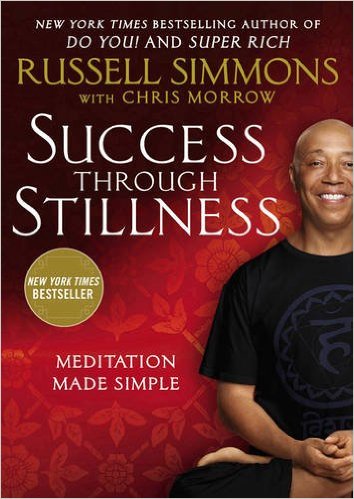
Business magnate shares the benefits and practice of daily meditation in his new book ‘Success Through Stillness.’
For those wondering if the daily practice of meditation really works, Russell Simmons has both a succinct response and a more in-depth answer totaling more than 220 pages.
“Today my new book ‘Success Through Stillness: Meditation Made Simple’ comes out,” he recently wrote in a blog post. “As the title suggests, it is a very straight-forward, easy-to-digest guide on how to get past whatever misconceptions or apprehensions you might have about meditation and learn how to use this simple yet incredibly effective tool.
“As I move around talking about the book, one question I seem to get asked over and over again is, ‘Does meditaion really work?’ And my answer is always an unequivocal ‘YES!'”
The 56-year-old vegan and healthy living guru, who has built a net worth estimated at more than $340 million, says he was skeptical at first that 40 minutes of daily meditation could do anything to stem the anxiety he was feeling.
“The idea of being still and operating from a calm place is one that I never would’ve thought would’ve suited my lifestyle or my goals or the way that I pursue life, ’cause I pursue everything with a vigor,” he told Yahoo! News.
Simmons explains that he practices mantra-based meditation, in which one repeats a word or sound for a period of 20 minutes. Simmons repeats the word “Rum” over and over, a process he says has led him to greater happiness.
“I come out of meditation, and sometimes I just start giggling, I feel so happy, right in the mornings,” he shares.
According to a study released earlier this year, while feelings of happiness may not necessarily occur for all practitioners of meditation, reductions in anxiety, depression and possibly pain are possible.
“Meditation helps young people and adults to get control of the noise,” says Simmons. “The noise is the cause of almost all sickness and sadness. If we can calm the noise, our relationship with the world benefits tremendously.”
ooOOoo
If you would like to buy a copy of Simmons’ book, in Kindle, Hardback or Paperback formats, then do click on the link below.
Chapter 8 of my book is entitled: Behaviours and Relationships. It opens thus:
“It is all to do with relationships.”
I heard this many years before the idea of writing this book came to me. Heard it from J, who was referred to in the previous chapter. J was speaking of what makes for happy people in all walks of life. It’s one of those remarks that initially comes over as such an obvious statement, akin to water being wet or the night being dark, that it is easy to miss the incredible depth of meaning behind those seven words.
Humans are fascinating. Every aspect of who we are can be seen in our relationships. How we relate to people around us, whether it be a thirty-second exchange with a stranger or a long natter with friends whom we have known for decades, including our partners and family relations. The core relationship, of course, the relationship that drives so many of our behaviours is the relationship that we have with ourself. That being rooted in our relationship experiences with the adults around us when we were young people.
When one looks at the performance of successful companies one often sees, nay one always sees, people being valued. The directors and managers of those companies understand that if people are valued then a myriad of benefits flow from that approach to relationships. Moving out of the workplace, the relationships that people have are always stronger and happier if those individual persons know they are valued. Moving beyond people, our dogs, and many other animals, are always stronger and happier if they feel valued. It’s the difference between empathy and sympathy.
Recently over on Mother Nature Network there was an essay presented by Russell McLendon who is science editor for MNN. It is about happiness.
ooOOoo
Happiness is all in your head
Scientists say they’ve found where happiness happens in the brain. What does that mean?
By: Russell McLendon, November 24, 2015
Understanding how our brains generate happiness could help make it less elusive, researchers say. (Photo: Andrew Vargas/Flickr)
Everyone wants to be happy. Yet despite all our efforts in pursuit of this prized emotion, it can be a surprisingly nebulous goal. What is “happiness,” exactly?
That question has puzzled philosophers for thousands of years, and it’s still tricky for anyone to tackle. But recent advances in neuroscience have finally begun to shed light on it, and now a new study claims to have found an answer. Being told happiness is “all in your head” may seem both obvious and dismissive, but in this case the specifics are also empowering. The more we know about how (and where) happiness happens, the less helpless we’ll be to summon it when we need it.
By comparing magnetic resonance imaging (MRI) with questionnaires about emotional states, researchers from Kyoto University in Japan say they’ve traced the experience of happiness to a specific part of the human brain. Overall happiness, they conclude, occurs when positive emotions combine with a sense of life satisfaction in the precuneus, a region of the medial parietal lobe that’s linked to important brain tasks like episodic memory, self-reflection and consciousness.
Psychologists already distinguish between broad life satisfaction and “subjective well-being,” since happiness often seems to fade during bad moods without necessarily plunging us into deeper existential despair. But by revealing the neural mechanics of how these feelings combine to create overall happiness, the authors of the new study hope to make it easier to objectively quantify this mysterious and elusive emotion.
“Over history, many eminent scholars like Aristotle have contemplated what happiness is,” lead author Wataru Sato says in a press release. “I’m very happy that we now know more about what it means to be happy.”
Scientists used MRI brain scans to identify happiness in a brain region known as the precuneus. (Photo: Kyoto University)
To pinpoint the location of happiness, Sato and his colleagues first used MRI to scan the brains of their study subjects. Those participants then took a survey, which asked about their general sense of happiness, the intensity of their emotions and the degree of their overall life satisfaction.
After analyzing the data, the researchers discovered that those who scored higher on the happiness survey also had more gray matter mass in the precuneus. That means this brain region is larger in people who feel happiness more intensely, feel sadness less intensely and who are better able to find meaning in life.
“To our knowledge, our study is the first to show that the precuneus is associated with subjective happiness,” the researchers write in the journal Scientific Reports.
Complex phenomena like happiness rarely boil down to a single brain region, but other recent research also points to an outsized role for the precuneus. A study published this month links impaired connectivity in the precuneus to depression, for example, and a 2014 study suggests the region is a “distinct hub” in the brain’s default-mode network, which is active during self-reflection and daydreaming.
All this may seem like an esoteric quest for neuroscientists, but it’s about more than just academic curiosity. By knowing which parts of the human brain generate our sensation of happiness, we might develop more accurate ways to test methods of becoming happier, like travel, exercise or meditation.
“Several studies have shown that meditation increases grey matter mass in the precuneus,” Sato says. “This new insight on where happiness happens in the brain will be useful for developing happiness programs based on scientific research.”
ooOOoo
It’s an unscientific opinion from me but I truly believe that humans have a bias towards happiness. And if there’s one animal that we can learn happiness from, it’s the dog!
An insight into the eating behaviours of cats and dogs.
As it happens, Jean and I are vegetarians; Jean going way back in years to when she first turned away from meat. Thus the only meat that we purchase is from Cartwrights’, a local butcher in Grants Pass, where we buy hearts and liver for the dogs. The cats are fed on dried cat biscuits and canned cat food.
All owners of cats and dogs know that they have very different eating habits, and behaviours.
So to put some flesh on the bone, so to speak, about the eating behaviours of cats and dogs I am going to republish a recent essay that appeared over on The Conversation. As always, it is republished within the terms of The Conversation.
ooOOoo
Why cats are fussy eaters but dogs will consume almost anything
by Hannah Rowland, Lecturer in Ecology and Evolution & Research Fellow at Zoological Society of London, University of Cambridge
November 13, 2015
Anyone who’s watched a cat throwing up after munching on grass knows that our feline friends aren’t natural plant eaters. So you might be surprised to discover that these carnivorous animals share some important genes that are more typically associated with herbivores. And this might help explain why cats aren’t always easy to please when it comes to food.
New research suggests that cats possess the genes that protect vegetarian animals from ingesting poisonous plants by giving them the ability to taste bitter. Animals use their sense of taste to detect whether a potential food is nutritious or harmful. A sweet taste signals the presence of sugars, an important source of energy. A bitter taste, on the other hand, evolved as a defence mechanism against harmful toxins commonly found in plants and unripe fruits.
Evolution has repeatedly tweaked animals’ taste buds to suit various dietary needs. Changes in an animal’s diet can eliminate the need to sense certain chemicals in food, and so receptor genes mutate, destroying their ability to make a working protein.
I can haz chlorophyll. Lisa Sympson/Wikimedia Commons, CC BY-SA
One example of this comes from strictly meat-eating cats, who can no longer taste sweetness. But if bitter detection evolved to warn of plant toxins, then it stands to reason that cats, which (usually) eschew plants, shouldn’t be able to taste bitter either. Humans and other vegetable-munching animals can taste bitter because we possess bitter taste receptor genes. If cats have lost the ability to taste bitterness, we should find that their receptor genes are riddled with mutations.
Geneticists at the Monell Chemical Senses Center in Philadelphia scoured the genome of cats and other carnivorous mammals like dogs, ferrets, and polar bears to see if our carnivorous cousins have bitter genes. They were surprised to find that cats have 12 different genes for bitter taste. Dogs, ferrets, and polar bears are equally well endowed. So, if meat eating animals are unlikely to encounter any bitter morsels, why do they boast genes for tasting bitterness?
Taste test
To find out, Peihua Jiang, a molecular biologist at Monell, put cat taste buds to the test. He inserted the cat taste receptor gene into human tissue cells in the lab. When combined, the cell and the gene act as a taste receptor that responds to chemicals dropped onto it.
Jiang discovered that the cat’s taste receptors responded to bitter chemicals found in toxic plants and to compounds that also activate human bitter receptors. The cat bitter taste receptor, known as Tas2r2, responded to the chemical denatonium benzoate, a bitter substance commonly smeared on the fingernails of nail-biting children.
So why have cats retained the ability to detect bitter tastes? Domestic cats owners know how unpredictable cats’ dietary choices can be. Some of the “presents” cats bring to their owners include frogs, toads, and other animals that can contain bitter and toxic compounds in their skin and bodies. Jiang’s results show that bitter receptors empower cats to detect these potential toxins, giving them the ability to reject noxious foods and avoid poisoning.
Hair of the dog. Michal Hrabovec/Flickr, CC BY-NC-SA
But how often do meat-loving cats actually get exposed to bitter and toxic compounds in their diet, compared with the plethora of plant toxins that their vegetarian counterparts have to contend with? Jiang suggests this is not enough to explain why cats have retained such an arsenal of receptors.
Instead, cat taste receptors may have evolved for reasons other than taste. In humans, bitter taste receptors are found not only in the mouth, but also in the heart and in the lungs, where they are thought to detect infections. It remains to be seen if feline bitter receptor genes also double-up as disease detectors.
The discovery of feline bitter receptors might explain why cats have got a reputation as picky eaters. But their unfussy canine counterparts have a similar number of bitter taste receptors – so why are cats so finicky? One answer might lie in how the cat receptors detect bitter-tasting compounds. Research published earlier this year by another team of researchers showed that some of the cat taste receptors are especially sensitive to bitter compounds, and even more sensitive to denatonium than the same receptor in humans.
Perhaps cats are also more sensitive to bitter chemicals than dogs, or they may detect a greater number of bitter compounds in their everyday diet. Food that tastes bland to us or to a dog could be an unpleasant gastronomic experience for cats. So rather than branding cats as picky, perhaps we should think of them as discerning feline foodies.
ooOOoo
Once again, I find it wonderful and incredible that there is so much knowledge and experience “out there” and how quickly a few clicks of a computer mouse can make it available to all of you wonderful readers!
And with that, it’s time to go off and feed the dogs. (Only showing off – Jean is the one who feeds both our dogs and our cats!)
According to a notice posted at PetSmart retail stores, Hill’s Science Diet is in the process of conducting a voluntary market withdrawal of some of its canned dog food products for unspecified reasons.
To learn which products are affected, please visit the following link:
Published on Nov 6, 2015
Another try at a slow motion video of Abbey shaking the water off after a bath
Published on Apr 24, 2014
Stunning, Perfection, Breathtaking – just a few words that describe this 3 minute surfing clip that shows Ian Walsh catching huge waves and making it look effortless.
Well over two million viewings.
Music: Versailles
Warner // Chappell Production Music
Published on Oct 22, 2014
This is a clip from our movie “THE SECRET LIFE OF TREES”.
More on www.homan.pl
Finally, back to slow animal shakes! (And I must acknowledge Mother Nature News for the idea for today’s picture parade.)
Published on Mar 21, 2013
Why do wet furry mammals shake? Si and Sam give some of their favourite animals a shower to uncover the science behind the ‘wet dog shake’. Sam caught up with Andrew Dickerson from Georgia Institute of Technology to find out more about the science… we’ll have the full interview for you soon.
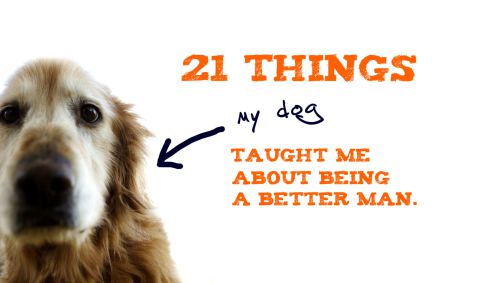
Twenty-one things my dog taught me about being a better man.
June 7, 2010 by Olivier Blanchard
We had to put our golden retriever to sleep this weekend, our friend of fifteen years, our family’s faithful guardian and companion, and one of the kindest, most loyal and giving souls I have ever met. True to her breed, Sasha was courageous, tender and selfless until the end.
I was trying to figure out how to give her a worthy send-off here on The BrandBuilder blog, and settled on some of the things she taught me over the years. Or rather, the things I didn’t realize she had taught me until this past week, much of which I spent caring for her, as she could no longer take care of herself. She and I had some long chats, in our own way, and the old girl was much wiser than I gave her credit for.
Are there business lessons in this list? Yes. There are. But all are deeply human lessons at the core. If being human can make a business better, if it can fuel its soul (or even simply give it one), then yes, let these be business lessons. But don’t ever forget that what makes a business truly great isn’t technology or design or a fancy logo. Those are expressions of something deeper. Something more visceral and powerful and true. What makes a business great, what makes it special, worthy of a connection, worthy of trust and loyalty, admiration and respect, even love, always starts with a beating heart, not a beeping cash register. (One is the cause, and the other one of many effects. Don’t lose sight of that distinction. Horse before cart: Soul drives love. Love drives business.)
It’s so easy to lose sight of what’s important in our lives. And this isn’t me being overly sentimental because I just lost my dog. I mean, yes, sure, okay… But there’s also something to this: That sentimentality, that emotion, these things that make us connect with other souls is at the heart of EVERYTHING this blog has been about these last few years: Business, design, marketing, social media, communications, corporate responsibility, best practices… No company can ever be great unless it can tap into the very essence of what makes us want to connect with each other, and no executive or business manager or cashier can ever truly be great at their jobs unless they also tap into the very thing that makes genuine human connections possible. If ever there was a secret to successfully building a brand, a lovebrand, the kind that people will fight for and whose mark they will tattoo on their bodies, it is this. The rest is merely execution.
If you only walk away with one bit of wisdom from this post, let it be this: You cannot build a better business unless you first become a better human being. Everything that strips you of your humanity, of your empathy, of your ability to connect with others is bad for business. It’s bad practice. It is doomed to fail in the end.
As my good friend John Warner noted yesterday, “If more people were as loyal and loving as dogs the world would be a better place.” (source) And he’s right. How do you become a better human being then? Well, that’s up to you, but if you had asked Sasha, she might have given you a few pointers of her own. Granted, she was never a Fortune 500 C.M.O. She didn’t design the iPad. She didn’t invent the internet or write a book. She never presented at a conference. All she did was hang out with me and Chico. We went on car rides. She watched me work. She lived the simple life of a dog, uncluttered by Twitter followers and Hubspot rankings and the drive to publish and present case studies. She was a dog, and so her perspective is a little different from what you may be used to. At any rate, here are twenty-one she and I discussed at length last week. I hope they will be as valuable to you as they now are to me.
Twenty-one things my dog taught me about being a better man:
1. Be true to your own nature. There’s no point in faking it. A golden retriever isn’t a chihuahua or a pug or a greyhound, and for good reason. Being comfortable in your own skin is 90% of the trick to rocking out your life. Not everyone is meant to be Rintintin or a seeing-eye dog or an Iditarod racer. It’s okay. Find yourself and embrace your nature. That’s always a great place to start.
2. Be true to the ones you love. Your friends, your family, your tribe, your pack. A life lived for others is a life well-lived. Selfish pursuits aside, ambition often grows hollow when turned inwardly instead of outwardly. It’s one thing to want to be pack leader, but there is just as much value and honor in serving than in leading. When in doubt, see item number one.
3. Never say no to a chance to go on a car ride. When the days grow short, I guarantee you’ll wish you’d have gone on more car rides.
4. Leashes are the enemy. Avoid them at all cost.
5. People are strange. So much potential, yet here they are, doing everything they can to complicate rather than simplify their lives. It’s puzzling.
6. Belly scratches.
7. The end isn’t pretty, but if you can face it with dignity and grace, none of your body’s weaknesses will matter. Your heart, your courage, your spirit is what people will see and remember. This isn’t only applicable in your last days and weeks. It’s applicable every day of your life. Adversity happens. It’s how you deal with it that matters.
8. Forgiveness is easier for dogs than for humans, but humans have opposable thumbs and the ability to speak, so it all balances out in the end.
9. Your bark is your own. No one has one quite like yours. Own it. Love it. Project it.
10. Trust your instincts. They rarely steer you wrong. The feeling in your gut though, that’s probably just something you ate.
11. Just because you’re meant to live on land doesn’t mean you can’t feel at home in water. Play outside the safety zone. Swim in the deep end. Dive in. We’re all designed to do more than the obvious.
12. Play more. The game is irrelevant. Just play. Tip: Exploring is play. Having adventures is play. Finding out what’s behind the next hill is play.
13. Your body growing old doesn’t mean you can’t be a puppy at heart. Actually, the first should have no impact on the latter. If you find that it does, take a step back, regroup, and restart. Always be a puppy at heart.
14. Humans aren’t all bad. But they aren’t all good either. Choose yours wisely.
15. Always keep that 20% wolf in you. If you ever give it up, you’re done. A dog without a little wildness in the blood isn’t a dog. It’s a furry robot. The beauty of a great dog doesn’t lie in its obedience but in its loyalty. Loyalty is a choice. Dogs choose to be dogs and not wolves. That’s what makes them so special.
16. Running full bore across a field in the rain.
17. There are no mysteries. Take cats, for example: Half rat, half badger. Crap in a box. Eat rodents. Where’s the mystery in that? If you look hard enough, you can figure most things out for yourself. The world isn’t as complicated as it sometimes seems.
18. Sometimes, you have to back up your growl with a bite. Go with it. Some people like to test your bark-to-bite ratio. With those “inquisitive” types, a little education goes a long way. As much as it sucks to have to go there, it is sometimes necessary. (It’s what the fangs are for.) Your territory, your space, your safety… They’re worth defending. Make a show of it once, and chances are you’ll never have to teach anyone a lesson again.
19. Being alone is no way to go through life. We’re pack animals. Humans, dogs, same thing. We need others to make all of this worthwhile. As an aside, if we live through others, why not also live for others, even if only a little bit? It isn’t that much of a stretch.
20. When you chase the ball, CHASE the fucking ball. Two reasons: a) It’s a chase. You don’t half-ass a chase. You go all out. It’s what you do. It’s the point. b) You don’t want some other mutt to get to the ball before you and slobber it all up, do you?
21. In the end, you will revisit your adventures, your battles, your chases, your voyages and all the excitement of your life with bemused pride, but it’s the quiet moments with loved ones that your mind will settle on. The comfort of those days when all you did was spend lazy hours with them, your head on their lap, their’s on yours, taking in the afternoon sun and the hundreds of fleeting stories carried like whispers on the breeze, those are the memories that will stay with you to the end and beyond.
Never give up on your thirst for life, on the beauty subtle moments, and on chasing that ball as hard and fast as your legs and heart will carry you.
Godspeed, Sasha.
Sasha (1995 – 2010) R.I.P.
ooOOoo
Shortly after completing today’s post, I read the following. It seemed appropriate to include it today.
When you talk, you are only repeating what you know,
Locavore or vegetarian? What’s the best way to reduce climate impact of food?
With Thanksgiving Day just behind us and Christmas just around the corner, this is the season of feasting.
Just last Monday I published an essay written by George Monbiot, Pregnant Silence, that highlighted the impact on our climate of modern food production. Here are a couple of paragraphs from that essay:
Freshwater life is being wiped out across the world by farm manure. In England, as I reported last week, the system designed to protect us from the tide of crap has comprehensively broken down. Dead zones now extend from many coasts, as farm sewage erases ocean life across thousands of square kilometres.
Livestock farming causes around 14% of the world’s greenhouse gas emissions: slightly more than the output of the world’s cars, lorries, buses, trains, ships and planes. If you eat soya, your emissions per unit of protein are 20 times lower than eating pork or chicken, and 150 times lower than eating beef.
Thus it seemed both timely and appropriate to republish a further essay on the topic. This one published in The Conversation by Elliott Campbell, who is Associate Professor, Environmental Engineering, at the University of California. It is republished here under the terms of essays published in The Conversation.
ooOOoo
Locavore or vegetarian? What’s the best way to reduce climate impact of food?
This year’s Thanksgiving feast falls only a few days before the start of the global climate summit in Paris. Although the connections are not always obvious, the topic of food – and what you choose to eat – has a lot to do with climate change.
Our global agriculture system puts food on the table but it also puts greenhouse gases (GHG) in the air, which represent a huge portion of global emissions. GHG emissions come directly from farms such as methane from cows and nitrous oxide from fertilized fields, while other emissions come from the industries that support agriculture, such as fertilizer factories that consume fossil fuels.
Still other emissions come from natural lands, which have massive stocks of natural carbon stored in plants and soils. When natural lands are cleared to make room for more food production, the carbon in those natural pools is emitted to the atmosphere as carbon dioxide.
Adding all these emissions together makes agriculture responsible for between roughly one fifth and one third of all global anthropogenic, or man-made, greenhouse gas emissions.
Undoubtedly, broad emissions reductions must come from political action and industry commitments. Nevertheless, an enlightened consumer can also help achieve meaningful reductions in GHG emissions, particularly for the case of food. The trick is to understanding what food means for your personal carbon footprint and how to effectively shrink this footprint.
On par with electricity
Zooming in from the global picture on emissions to a single home reveals how important our personal food choices are for climate change. You can use carbon footprint calculators, such as the University of California CoolClimate Tool, to get an idea of how important food is in relation to choices we make about commuting, air travel, home energy use, and consumption of other goods and services.
For the average U.S. household, food consumption will be responsible for about the same GHG emissions as home electricity consumption for the average US household.
Measuring the greenhouse gas impact of different foods is complex but in general, it’s commonly agreed that plant-based diets have a lower carbon footprint. davidwoliver/flickr, CC BY-NC
That’s a significant portion of an individual’s GHG footprint but it could be seen as a blessing in disguise. While you may be stuck with your home or your vehicle for some time and their associated GHG emissions, food is something we purchase with great frequency. And every trip to the grocery store or farmer’s market is another opportunity for an action that has a significant and lasting impact on our climate.
Making concrete decisions, though, is not always straight-forward. Many consumers are faced with a perplexing array of options from organic to conventional foods, supermarkets to farmers markets, and genetically modified organisms to more traditional varieties.
And in truth, the carbon footprint of many food options is disputed in the scientific literature. Despite the need for more research, there appears to be a very clear advantage for individuals to chose a more plant-based diet. A meat-intensive diet has more than twice the emissions of a vegan diet. Reducing the quantity of meat (particularly red meat) and dairy on the table can go a long way to reducing the carbon footprint of your food.
Food miles and water recycling
Local food systems are popularly thought to reduce GHG emissions through decreased food transport or food miles. But in many cases food miles turn out to be a meaningful but small piece of the overall GHG emissions from food.
For example, a broad analysis of the US food supply suggests that food miles may be responsible for less than 10% of the GHG emissions associated with food. This general trend suggests that where you get your food from is much less important than first-order issues, such as shifting to a more plant-based diet.
A little-appreciated way of reducing the carbon footprint of food is to recycle nearby water rather than pump it long distances. The Pajaro Valley Water Management Agency (PVWMA) Water Resources Center in California sanitizes wastewater for direct use or blending with ground (well) water. US Department of Agriculture, CC BY
Where, then, does this leave a rapidly emerging local food movement?
For starters, there are some cases where food miles have greater importance. For example, food miles can play a big part in the carbon footprint of foods when airplanes or refrigeration are required during transport.
There is, however, untapped potential for locally produced food to deliver carbon savings around water and fertilizers.
When water is pumped long distances, it can add to food’s carbon footprint. Re-use of purified urban wastewater for irrigating crops represents one strategy for addressing this challenge but is only economically and environmentally feasible when food production is in close proximity to cities.
Using fossil fuels to produce fertilizers, such as ammonia, can also be a big piece of the carbon footprint of food. Nutrients in reclaimed wastewater and urban compost may provide a low-carbon alternative to fossil fuel-based fertilizers. But similar to water re-use, reusing nutrients is most easily done when there is a short distance between food production and consumption.
To be sure, buying local food doesn’t imply that food or nutrient recycling has happened. But developing local food systems could certainly be a first step towards exploring how to close the water and nutrient loop.
ooOOoo
I am sure many, as with me, tend not to follow through on all the links in an online essay. But there was one that really caught my eye. It was the CoolClimate Calculator on the Berkeley Edu website. It allows one to fill in a number of figures in terms of living, travel, food and more, and determine one’s total tons CO2/year emitted and how that compares with other people in your neighbourhood. Unfortunately, it only calculates CO2/year for US locations. Does anyone know of similar calculators online in, say, the United Kingdom? Would love to know.
I know I did say about taking a day off but this was so easy to share.
ooOOoo
Dear Fellow Dog Lover,
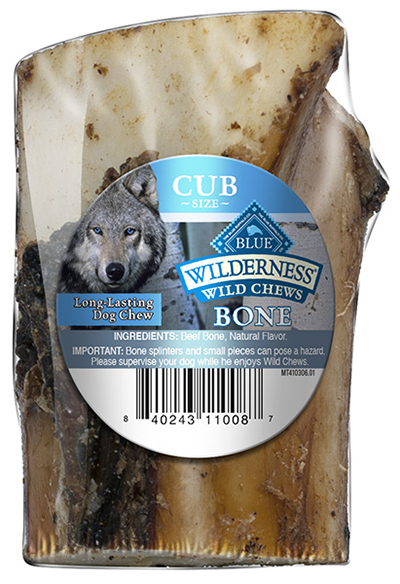
On November 25, 2015, Blue Buffalo announced the recall of one lot of its Cub Size Wilderness Wild dog chews because the product has the potential to be contaminated with Salmonella.
Salmonella is a bacteria that can affect the health of both pets and humans.
Please be sure to share the news of this alert with other pet owners.
Mike Sagman, Editor
The Dog Food Advisor
ooOOoo
That link offers the following:
Blue Buffalo Dog Chews Recall of November 2015
November 25, 2015 — Blue Buffalo Company is voluntarily recalling one lot of its Cub Size Wilderness Wild Chews Bones because it has the potential to be contaminated with Salmonella.
What’s Recalled?
The recalled product comes individually shrink-wrapped in plastic with the UPC number 840243110087 printed on a sticker affixed to the product.
It has an expiration date of November 4, 2017 — printed as “exp 110417” on the shrink-wrap.
Consumers should look at the UPC Code and expiration date on the product package to determine if it is subject to the voluntary recall.
The voluntary recall is limited to the following product and production lot:
Cub Size Wilderness Wild Chews Bone
UPC Code: 840243110087
Expiration Date: November 4, 2017
Where Was It Distributed?
The product was distributed starting November 19, 2015 in PetSmart stores located in the following 9 states:
California
Kansas
Michigan
Minnesota
Montana
Nevada
Oregon
Utah
Washington
What Caused the Recall?
Routine testing at the manufacturing site revealed the presence of Salmonella in the product.
No illnesses have been reported to date and no other Blue Buffalo products are affected.
About Salmonella
Salmonella can affect animals eating the product and there is risk to humans from handling contaminated pet products, especially if they have not thoroughly washed their hands after having contact with the products or any surfaces exposed to these products.
Healthy people infected with Salmonella should monitor themselves for some or all of the following symptoms: nausea, vomiting, diarrhea or bloody diarrhea, abdominal cramping and fever.
Rarely, Salmonella can result in more serious ailments including arterial infections, endocarditis, arthritis, muscle pain, eye irritation and urinary tract symptoms.
Consumers exhibiting these signs after having contact with this product should contact their healthcare provider.
Pets with Salmonella infections may have decreased appetite, fever and abdominal pain. Other clinical signs may include lethargy, diarrhea or bloody diarrhea, and vomiting.
Infected but otherwise healthy pets can be carriers and infect other animals or humans.
If your pet has consumed the recalled product and has these symptoms, please contact your veterinarian.
What to Do?
Consumers who have purchased the product subject to this recall are urged to dispose of the product or return it to the place of purchase for full refund.
Consumers with questions may contact Blue Buffalo at: 888-641-9736 from 8 AM to 5 PM ET Monday through Friday and the weekend of November 28, 2015.
Or by email at Bluebuffalo4260@stericycle.com for more information.
U.S. citizens can report complaints about FDA-regulated pet food products by calling the consumer complaint coordinator in your area.
In view of all that’s been happening these last few weeks, this is perfect!
We are exactly one month away from Christmas Day! Not sure if that’s scary or satisfying. For years, I have always embraced mid-Winter’s Day on December 21st as the bottom of the slope; so to speak. Thus on that basis Christmas Day is satisfying.
Anyway, tomorrow is Thanksgiving Day in this fine, new country of ours and I was wondering what to write to recognise both the importance, current and historical, for Americans and, at a more parochial level, for yours truly. Because, for sure, at the start of this year I wouldn’t have imagined in my wildest dreams that by Thanksgiving Day I would have a book available on Amazon!
Then along comes the perfect answer to my pondering as to what to write. A gorgeous post written by Kate Johnston of 4am Writer‘s fame. Even better, Kate giving me permission to republish it in this place. So to all my readers and followers: Happy Thanksgiving.
ooOOoo
The Writers’ Tree
Kate Johnston
There once was a tree where writers could go and put down stories in the thin bark. Over time, the stories began to bleed into each other until the day came when the tree could take no more stories.
image courtesy of wordsareart.wordpress.com
The writers didn’t have any other place to go.
They tried to write in the sand dunes, but the wind just blew the words around into gibberish.
They tried to write in the sky, but the rains came and washed everything away.
They tried to write on the animals and birds but got bitten and clawed for their trouble.
One little girl missed writing too much. Her stories were piling up inside her like rotten apples on the ground, and she needed a place to write them. She went searching. Over the hills and behind some mist that beckoned with gauzy fingers.
She found a secret place where trees grew by the dozens, trees with papery bark that wanted to give stories. She told no one of her discovery, wanting to keep all the trees to herself. She spent day after day writing story after story upon tree after tree.
When she had scribed all her stories, she abandoned the secret place and never returned. She didn’t tell a single soul about the trees that gave stories, for fear that someone wouldn’t like what she wrote, would laugh at her, wouldn’t understand.
But while she was gone, attending to other things like school, friends, growing up and starting a family, her stories began to fade away. With no one to savor them, the tales began to disappear from the trees.
Stories cannot exist without readers. And writers cannot exist without stories.
The girl, now an old woman, returned to the secret place with her grandson, thinking he would appreciate the magic of the stories on the trees. Imagine her devastation when she saw that her words were destroyed, scabbed over by new bark and punctured by holes from insects and birds.
It was plain to the girl, now an old woman, the trees could no longer give to a writer who had stopped writing. She fell to her knees and wept. She couldn’t even start over. It’d been too long since she’d come to the secret place and had forgotten how to write at all.
image courtesy of socialmeems.com
Her grandson scraped away the new growth, traced his finger over the faintest of marks, trying to find the long-lost stories. It was no use, not by himself. He was young and couldn’t yet read.
They went back to the world where they found a baker, a postman, a teacher, an electrician, and a dancer, all of whom could read and longed to write stories. The old woman and her grandson brought their new friends to the secret place to find the lost stories, but still, it was no use.
The stories were gone forever.
It had been too long since the girl, now an old woman, had written them that she couldn’t even remember how they went, or what they were about, or why she wrote them at all.
All she knew was that when she wrote, she’d felt indescribable joy. She’d fooled herself into thinking that was enough. The girl not knowing then as the old woman knows now that you must tend to joy if you want joy to stay.
Together, the friends wrote anew, wrote stories into the bark like paper. They shared their ideas and questions and hopes. They took the time to feel and find meaning in all of the stories. They laughed and cried and debated over worlds they created. They left comments with hearts to show how much each story moved them. They talked about how they couldn’t wait to bring a husband or a mother or a friend to the writers’ trees to show them the stories that grew there.
The girl, now an old woman, watched her friends’ stories blossom and grow with each reader that visited the writers’ trees. She saw the joy on her friends’ faces, saw how the joy stayed because they kept doing the one thing they loved: writing.
She wondered if she dared try again, to bring a story to life here, even though she’d failed so miserably in the past.
Image courtesy of Paul W. Koester Photography
Her friends walked the old woman to a new tree. If you love it so, they said, if writing brings you joy, they said, then write you must and never give up, they said.
The old woman took to the tree and wrote.
Her stories live on.
Happy Writersgiving!
ooOOoo
Perfect!
Dear readers: I am going to take a break for one day, so my next post will be on Friday. You all have a wonderful time wherever you are in the world.
Yesterday, I wrote a post under the title of You couldn’t make it up! It featured a recent essay Pregnant Silence from George Monbiot about the consequences and implications of the widespread consumption of meat and dairy products.
Now look at this example of what nature does make up.
A Sunset with Searchlights
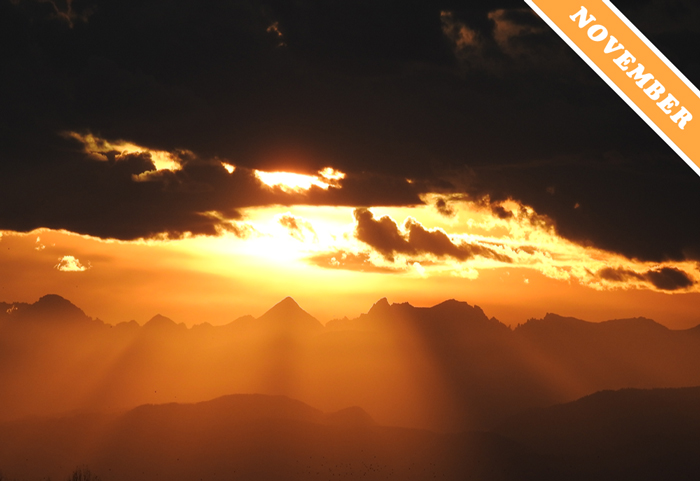
You know those glorious fingers of sunlight that sometimes burst out from behind clouds? They’re called ‘crepuscular rays’, they form when light and shadow are rendered visible by haze in the atmosphere and these photographed by Alli Bush over Fort Collins, Colorado, US, are the Cloud of the Month for November.
The haze giving rise to crepuscular rays can be due to the air being filled with fine particles such as sand, dust or pollen. Or it can result from a delicate mist of water droplets – plentiful enough to scatter the sunlight but too scarce to show up as a cloud. The scattering is the important bit. Since we only see light that shines directly into our eyes, rays of sunlight shining in other directions are not visible unless they encounter something that scatters light towards us. Think of shining a torch beam on a clear night. The light only appears where it strikes a surface such as the ground. But on a foggy night, the full torch beam shows up because some light is also scattered towards us by the droplets of fog in the air it passes through. This is why a hazy sky renders rays of sunlight visible.
The other requisite for crepuscular rays besides haze is something to cast the shadows. Most commonly it is a cloud blocking the sunlight that creates the regions of light and shadow we see in the sky. But the crepuscular rays in Alli’s photograph are cast not by clouds but by the peaks of the Rocky Mountains. The rays fan outwards because they are coming towards the camera. In fact, the Sun’s rays are actually pretty much parallel by the time they reach Earth. They only appear to spread out like this because of the effect of perspective. It is just like looking down the length of train tracks. Even though they are parallel, they appear to spread outwards the nearer they are. Only when the sun is high in the sky so that its rays are pointing more directly downwards do crespuscular rays look parallel.
The photograph comes from the website of The Cloud Appreciation Society of which I am a lowly member. Thus it was that in my in-box yesterday was their latest newsletter. In that newsletter there was the following stunning film, described thus:
This month, we were sent an amazing film of storms over Arizona, US. It was made by Davo Laninga, Cloud Appreciation Society Member No 1,095. You can learn a lot about how storms develop by watching time-lapse videos. Well done, Davo, for this stunning example, showing the monumental power that drives our atmosphere.
Do drop in to Dave’s website and admire his incredible photographs and videos.