Published on Nov 6, 2015
Another try at a slow motion video of Abbey shaking the water off after a bath
Published on Apr 24, 2014
Stunning, Perfection, Breathtaking – just a few words that describe this 3 minute surfing clip that shows Ian Walsh catching huge waves and making it look effortless.
Well over two million viewings.
Music: Versailles
Warner // Chappell Production Music
Published on Oct 22, 2014
This is a clip from our movie “THE SECRET LIFE OF TREES”.
More on www.homan.pl
Finally, back to slow animal shakes! (And I must acknowledge Mother Nature News for the idea for today’s picture parade.)
Published on Mar 21, 2013
Why do wet furry mammals shake? Si and Sam give some of their favourite animals a shower to uncover the science behind the ‘wet dog shake’. Sam caught up with Andrew Dickerson from Georgia Institute of Technology to find out more about the science… we’ll have the full interview for you soon.
Twenty-one things my dog taught me about being a better man.
June 7, 2010 by Olivier Blanchard
We had to put our golden retriever to sleep this weekend, our friend of fifteen years, our family’s faithful guardian and companion, and one of the kindest, most loyal and giving souls I have ever met. True to her breed, Sasha was courageous, tender and selfless until the end.
I was trying to figure out how to give her a worthy send-off here on The BrandBuilder blog, and settled on some of the things she taught me over the years. Or rather, the things I didn’t realize she had taught me until this past week, much of which I spent caring for her, as she could no longer take care of herself. She and I had some long chats, in our own way, and the old girl was much wiser than I gave her credit for.
Are there business lessons in this list? Yes. There are. But all are deeply human lessons at the core. If being human can make a business better, if it can fuel its soul (or even simply give it one), then yes, let these be business lessons. But don’t ever forget that what makes a business truly great isn’t technology or design or a fancy logo. Those are expressions of something deeper. Something more visceral and powerful and true. What makes a business great, what makes it special, worthy of a connection, worthy of trust and loyalty, admiration and respect, even love, always starts with a beating heart, not a beeping cash register. (One is the cause, and the other one of many effects. Don’t lose sight of that distinction. Horse before cart: Soul drives love. Love drives business.)
It’s so easy to lose sight of what’s important in our lives. And this isn’t me being overly sentimental because I just lost my dog. I mean, yes, sure, okay… But there’s also something to this: That sentimentality, that emotion, these things that make us connect with other souls is at the heart of EVERYTHING this blog has been about these last few years: Business, design, marketing, social media, communications, corporate responsibility, best practices… No company can ever be great unless it can tap into the very essence of what makes us want to connect with each other, and no executive or business manager or cashier can ever truly be great at their jobs unless they also tap into the very thing that makes genuine human connections possible. If ever there was a secret to successfully building a brand, a lovebrand, the kind that people will fight for and whose mark they will tattoo on their bodies, it is this. The rest is merely execution.
If you only walk away with one bit of wisdom from this post, let it be this: You cannot build a better business unless you first become a better human being. Everything that strips you of your humanity, of your empathy, of your ability to connect with others is bad for business. It’s bad practice. It is doomed to fail in the end.
As my good friend John Warner noted yesterday, “If more people were as loyal and loving as dogs the world would be a better place.” (source) And he’s right. How do you become a better human being then? Well, that’s up to you, but if you had asked Sasha, she might have given you a few pointers of her own. Granted, she was never a Fortune 500 C.M.O. She didn’t design the iPad. She didn’t invent the internet or write a book. She never presented at a conference. All she did was hang out with me and Chico. We went on car rides. She watched me work. She lived the simple life of a dog, uncluttered by Twitter followers and Hubspot rankings and the drive to publish and present case studies. She was a dog, and so her perspective is a little different from what you may be used to. At any rate, here are twenty-one she and I discussed at length last week. I hope they will be as valuable to you as they now are to me.
Twenty-one things my dog taught me about being a better man:
1. Be true to your own nature. There’s no point in faking it. A golden retriever isn’t a chihuahua or a pug or a greyhound, and for good reason. Being comfortable in your own skin is 90% of the trick to rocking out your life. Not everyone is meant to be Rintintin or a seeing-eye dog or an Iditarod racer. It’s okay. Find yourself and embrace your nature. That’s always a great place to start.
2. Be true to the ones you love. Your friends, your family, your tribe, your pack. A life lived for others is a life well-lived. Selfish pursuits aside, ambition often grows hollow when turned inwardly instead of outwardly. It’s one thing to want to be pack leader, but there is just as much value and honor in serving than in leading. When in doubt, see item number one.
3. Never say no to a chance to go on a car ride. When the days grow short, I guarantee you’ll wish you’d have gone on more car rides.
4. Leashes are the enemy. Avoid them at all cost.
5. People are strange. So much potential, yet here they are, doing everything they can to complicate rather than simplify their lives. It’s puzzling.
6. Belly scratches.
7. The end isn’t pretty, but if you can face it with dignity and grace, none of your body’s weaknesses will matter. Your heart, your courage, your spirit is what people will see and remember. This isn’t only applicable in your last days and weeks. It’s applicable every day of your life. Adversity happens. It’s how you deal with it that matters.
8. Forgiveness is easier for dogs than for humans, but humans have opposable thumbs and the ability to speak, so it all balances out in the end.
9. Your bark is your own. No one has one quite like yours. Own it. Love it. Project it.
10. Trust your instincts. They rarely steer you wrong. The feeling in your gut though, that’s probably just something you ate.
11. Just because you’re meant to live on land doesn’t mean you can’t feel at home in water. Play outside the safety zone. Swim in the deep end. Dive in. We’re all designed to do more than the obvious.
12. Play more. The game is irrelevant. Just play. Tip: Exploring is play. Having adventures is play. Finding out what’s behind the next hill is play.
13. Your body growing old doesn’t mean you can’t be a puppy at heart. Actually, the first should have no impact on the latter. If you find that it does, take a step back, regroup, and restart. Always be a puppy at heart.
14. Humans aren’t all bad. But they aren’t all good either. Choose yours wisely.
15. Always keep that 20% wolf in you. If you ever give it up, you’re done. A dog without a little wildness in the blood isn’t a dog. It’s a furry robot. The beauty of a great dog doesn’t lie in its obedience but in its loyalty. Loyalty is a choice. Dogs choose to be dogs and not wolves. That’s what makes them so special.
16. Running full bore across a field in the rain.
17. There are no mysteries. Take cats, for example: Half rat, half badger. Crap in a box. Eat rodents. Where’s the mystery in that? If you look hard enough, you can figure most things out for yourself. The world isn’t as complicated as it sometimes seems.
18. Sometimes, you have to back up your growl with a bite. Go with it. Some people like to test your bark-to-bite ratio. With those “inquisitive” types, a little education goes a long way. As much as it sucks to have to go there, it is sometimes necessary. (It’s what the fangs are for.) Your territory, your space, your safety… They’re worth defending. Make a show of it once, and chances are you’ll never have to teach anyone a lesson again.
19. Being alone is no way to go through life. We’re pack animals. Humans, dogs, same thing. We need others to make all of this worthwhile. As an aside, if we live through others, why not also live for others, even if only a little bit? It isn’t that much of a stretch.
20. When you chase the ball, CHASE the fucking ball. Two reasons: a) It’s a chase. You don’t half-ass a chase. You go all out. It’s what you do. It’s the point. b) You don’t want some other mutt to get to the ball before you and slobber it all up, do you?
21. In the end, you will revisit your adventures, your battles, your chases, your voyages and all the excitement of your life with bemused pride, but it’s the quiet moments with loved ones that your mind will settle on. The comfort of those days when all you did was spend lazy hours with them, your head on their lap, their’s on yours, taking in the afternoon sun and the hundreds of fleeting stories carried like whispers on the breeze, those are the memories that will stay with you to the end and beyond.
Never give up on your thirst for life, on the beauty subtle moments, and on chasing that ball as hard and fast as your legs and heart will carry you.
Godspeed, Sasha.
Sasha (1995 – 2010) R.I.P.
ooOOoo
Shortly after completing today’s post, I read the following. It seemed appropriate to include it today.
When you talk, you are only repeating what you know,
Locavore or vegetarian? What’s the best way to reduce climate impact of food?
With Thanksgiving Day just behind us and Christmas just around the corner, this is the season of feasting.
Just last Monday I published an essay written by George Monbiot, Pregnant Silence, that highlighted the impact on our climate of modern food production. Here are a couple of paragraphs from that essay:
Freshwater life is being wiped out across the world by farm manure. In England, as I reported last week, the system designed to protect us from the tide of crap has comprehensively broken down. Dead zones now extend from many coasts, as farm sewage erases ocean life across thousands of square kilometres.
Livestock farming causes around 14% of the world’s greenhouse gas emissions: slightly more than the output of the world’s cars, lorries, buses, trains, ships and planes. If you eat soya, your emissions per unit of protein are 20 times lower than eating pork or chicken, and 150 times lower than eating beef.
Thus it seemed both timely and appropriate to republish a further essay on the topic. This one published in The Conversation by Elliott Campbell, who is Associate Professor, Environmental Engineering, at the University of California. It is republished here under the terms of essays published in The Conversation.
ooOOoo
Locavore or vegetarian? What’s the best way to reduce climate impact of food?
This year’s Thanksgiving feast falls only a few days before the start of the global climate summit in Paris. Although the connections are not always obvious, the topic of food – and what you choose to eat – has a lot to do with climate change.
Our global agriculture system puts food on the table but it also puts greenhouse gases (GHG) in the air, which represent a huge portion of global emissions. GHG emissions come directly from farms such as methane from cows and nitrous oxide from fertilized fields, while other emissions come from the industries that support agriculture, such as fertilizer factories that consume fossil fuels.
Still other emissions come from natural lands, which have massive stocks of natural carbon stored in plants and soils. When natural lands are cleared to make room for more food production, the carbon in those natural pools is emitted to the atmosphere as carbon dioxide.
Adding all these emissions together makes agriculture responsible for between roughly one fifth and one third of all global anthropogenic, or man-made, greenhouse gas emissions.
Undoubtedly, broad emissions reductions must come from political action and industry commitments. Nevertheless, an enlightened consumer can also help achieve meaningful reductions in GHG emissions, particularly for the case of food. The trick is to understanding what food means for your personal carbon footprint and how to effectively shrink this footprint.
On par with electricity
Zooming in from the global picture on emissions to a single home reveals how important our personal food choices are for climate change. You can use carbon footprint calculators, such as the University of California CoolClimate Tool, to get an idea of how important food is in relation to choices we make about commuting, air travel, home energy use, and consumption of other goods and services.
For the average U.S. household, food consumption will be responsible for about the same GHG emissions as home electricity consumption for the average US household.
Measuring the greenhouse gas impact of different foods is complex but in general, it’s commonly agreed that plant-based diets have a lower carbon footprint. davidwoliver/flickr, CC BY-NC
That’s a significant portion of an individual’s GHG footprint but it could be seen as a blessing in disguise. While you may be stuck with your home or your vehicle for some time and their associated GHG emissions, food is something we purchase with great frequency. And every trip to the grocery store or farmer’s market is another opportunity for an action that has a significant and lasting impact on our climate.
Making concrete decisions, though, is not always straight-forward. Many consumers are faced with a perplexing array of options from organic to conventional foods, supermarkets to farmers markets, and genetically modified organisms to more traditional varieties.
And in truth, the carbon footprint of many food options is disputed in the scientific literature. Despite the need for more research, there appears to be a very clear advantage for individuals to chose a more plant-based diet. A meat-intensive diet has more than twice the emissions of a vegan diet. Reducing the quantity of meat (particularly red meat) and dairy on the table can go a long way to reducing the carbon footprint of your food.
Food miles and water recycling
Local food systems are popularly thought to reduce GHG emissions through decreased food transport or food miles. But in many cases food miles turn out to be a meaningful but small piece of the overall GHG emissions from food.
For example, a broad analysis of the US food supply suggests that food miles may be responsible for less than 10% of the GHG emissions associated with food. This general trend suggests that where you get your food from is much less important than first-order issues, such as shifting to a more plant-based diet.
A little-appreciated way of reducing the carbon footprint of food is to recycle nearby water rather than pump it long distances. The Pajaro Valley Water Management Agency (PVWMA) Water Resources Center in California sanitizes wastewater for direct use or blending with ground (well) water. US Department of Agriculture, CC BY
Where, then, does this leave a rapidly emerging local food movement?
For starters, there are some cases where food miles have greater importance. For example, food miles can play a big part in the carbon footprint of foods when airplanes or refrigeration are required during transport.
There is, however, untapped potential for locally produced food to deliver carbon savings around water and fertilizers.
When water is pumped long distances, it can add to food’s carbon footprint. Re-use of purified urban wastewater for irrigating crops represents one strategy for addressing this challenge but is only economically and environmentally feasible when food production is in close proximity to cities.
Using fossil fuels to produce fertilizers, such as ammonia, can also be a big piece of the carbon footprint of food. Nutrients in reclaimed wastewater and urban compost may provide a low-carbon alternative to fossil fuel-based fertilizers. But similar to water re-use, reusing nutrients is most easily done when there is a short distance between food production and consumption.
To be sure, buying local food doesn’t imply that food or nutrient recycling has happened. But developing local food systems could certainly be a first step towards exploring how to close the water and nutrient loop.
ooOOoo
I am sure many, as with me, tend not to follow through on all the links in an online essay. But there was one that really caught my eye. It was the CoolClimate Calculator on the Berkeley Edu website. It allows one to fill in a number of figures in terms of living, travel, food and more, and determine one’s total tons CO2/year emitted and how that compares with other people in your neighbourhood. Unfortunately, it only calculates CO2/year for US locations. Does anyone know of similar calculators online in, say, the United Kingdom? Would love to know.
I know I did say about taking a day off but this was so easy to share.
ooOOoo
Dear Fellow Dog Lover,
On November 25, 2015, Blue Buffalo announced the recall of one lot of its Cub Size Wilderness Wild dog chews because the product has the potential to be contaminated with Salmonella.
Salmonella is a bacteria that can affect the health of both pets and humans.
Please be sure to share the news of this alert with other pet owners.
Mike Sagman, Editor
The Dog Food Advisor
ooOOoo
That link offers the following:
Blue Buffalo Dog Chews Recall of November 2015
November 25, 2015 — Blue Buffalo Company is voluntarily recalling one lot of its Cub Size Wilderness Wild Chews Bones because it has the potential to be contaminated with Salmonella.
What’s Recalled?
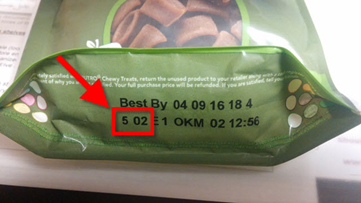
The recalled product comes individually shrink-wrapped in plastic with the UPC number 840243110087 printed on a sticker affixed to the product.
It has an expiration date of November 4, 2017 — printed as “exp 110417” on the shrink-wrap.
Consumers should look at the UPC Code and expiration date on the product package to determine if it is subject to the voluntary recall.
The voluntary recall is limited to the following product and production lot:
Cub Size Wilderness Wild Chews Bone
UPC Code: 840243110087
Expiration Date: November 4, 2017
Where Was It Distributed?
The product was distributed starting November 19, 2015 in PetSmart stores located in the following 9 states:
California
Kansas
Michigan
Minnesota
Montana
Nevada
Oregon
Utah
Washington
What Caused the Recall?
Routine testing at the manufacturing site revealed the presence of Salmonella in the product.
No illnesses have been reported to date and no other Blue Buffalo products are affected.
About Salmonella
Salmonella can affect animals eating the product and there is risk to humans from handling contaminated pet products, especially if they have not thoroughly washed their hands after having contact with the products or any surfaces exposed to these products.
Healthy people infected with Salmonella should monitor themselves for some or all of the following symptoms: nausea, vomiting, diarrhea or bloody diarrhea, abdominal cramping and fever.
Rarely, Salmonella can result in more serious ailments including arterial infections, endocarditis, arthritis, muscle pain, eye irritation and urinary tract symptoms.
Consumers exhibiting these signs after having contact with this product should contact their healthcare provider.
Pets with Salmonella infections may have decreased appetite, fever and abdominal pain. Other clinical signs may include lethargy, diarrhea or bloody diarrhea, and vomiting.
Infected but otherwise healthy pets can be carriers and infect other animals or humans.
If your pet has consumed the recalled product and has these symptoms, please contact your veterinarian.
What to Do?
Consumers who have purchased the product subject to this recall are urged to dispose of the product or return it to the place of purchase for full refund.
Consumers with questions may contact Blue Buffalo at: 888-641-9736 from 8 AM to 5 PM ET Monday through Friday and the weekend of November 28, 2015.
Or by email at Bluebuffalo4260@stericycle.com for more information.
U.S. citizens can report complaints about FDA-regulated pet food products by calling the consumer complaint coordinator in your area.
In view of all that’s been happening these last few weeks, this is perfect!
We are exactly one month away from Christmas Day! Not sure if that’s scary or satisfying. For years, I have always embraced mid-Winter’s Day on December 21st as the bottom of the slope; so to speak. Thus on that basis Christmas Day is satisfying.
Anyway, tomorrow is Thanksgiving Day in this fine, new country of ours and I was wondering what to write to recognise both the importance, current and historical, for Americans and, at a more parochial level, for yours truly. Because, for sure, at the start of this year I wouldn’t have imagined in my wildest dreams that by Thanksgiving Day I would have a book available on Amazon!
Then along comes the perfect answer to my pondering as to what to write. A gorgeous post written by Kate Johnston of 4am Writer‘s fame. Even better, Kate giving me permission to republish it in this place. So to all my readers and followers: Happy Thanksgiving.
ooOOoo
The Writers’ Tree
Kate Johnston
There once was a tree where writers could go and put down stories in the thin bark. Over time, the stories began to bleed into each other until the day came when the tree could take no more stories.
image courtesy of wordsareart.wordpress.com
The writers didn’t have any other place to go.
They tried to write in the sand dunes, but the wind just blew the words around into gibberish.
They tried to write in the sky, but the rains came and washed everything away.
They tried to write on the animals and birds but got bitten and clawed for their trouble.
One little girl missed writing too much. Her stories were piling up inside her like rotten apples on the ground, and she needed a place to write them. She went searching. Over the hills and behind some mist that beckoned with gauzy fingers.
She found a secret place where trees grew by the dozens, trees with papery bark that wanted to give stories. She told no one of her discovery, wanting to keep all the trees to herself. She spent day after day writing story after story upon tree after tree.
When she had scribed all her stories, she abandoned the secret place and never returned. She didn’t tell a single soul about the trees that gave stories, for fear that someone wouldn’t like what she wrote, would laugh at her, wouldn’t understand.
But while she was gone, attending to other things like school, friends, growing up and starting a family, her stories began to fade away. With no one to savor them, the tales began to disappear from the trees.
Stories cannot exist without readers. And writers cannot exist without stories.
The girl, now an old woman, returned to the secret place with her grandson, thinking he would appreciate the magic of the stories on the trees. Imagine her devastation when she saw that her words were destroyed, scabbed over by new bark and punctured by holes from insects and birds.
It was plain to the girl, now an old woman, the trees could no longer give to a writer who had stopped writing. She fell to her knees and wept. She couldn’t even start over. It’d been too long since she’d come to the secret place and had forgotten how to write at all.
image courtesy of socialmeems.com
Her grandson scraped away the new growth, traced his finger over the faintest of marks, trying to find the long-lost stories. It was no use, not by himself. He was young and couldn’t yet read.
They went back to the world where they found a baker, a postman, a teacher, an electrician, and a dancer, all of whom could read and longed to write stories. The old woman and her grandson brought their new friends to the secret place to find the lost stories, but still, it was no use.
The stories were gone forever.
It had been too long since the girl, now an old woman, had written them that she couldn’t even remember how they went, or what they were about, or why she wrote them at all.
All she knew was that when she wrote, she’d felt indescribable joy. She’d fooled herself into thinking that was enough. The girl not knowing then as the old woman knows now that you must tend to joy if you want joy to stay.
Together, the friends wrote anew, wrote stories into the bark like paper. They shared their ideas and questions and hopes. They took the time to feel and find meaning in all of the stories. They laughed and cried and debated over worlds they created. They left comments with hearts to show how much each story moved them. They talked about how they couldn’t wait to bring a husband or a mother or a friend to the writers’ trees to show them the stories that grew there.
The girl, now an old woman, watched her friends’ stories blossom and grow with each reader that visited the writers’ trees. She saw the joy on her friends’ faces, saw how the joy stayed because they kept doing the one thing they loved: writing.
She wondered if she dared try again, to bring a story to life here, even though she’d failed so miserably in the past.
Image courtesy of Paul W. Koester Photography
Her friends walked the old woman to a new tree. If you love it so, they said, if writing brings you joy, they said, then write you must and never give up, they said.
The old woman took to the tree and wrote.
Her stories live on.
Happy Writersgiving!
ooOOoo
Perfect!
Dear readers: I am going to take a break for one day, so my next post will be on Friday. You all have a wonderful time wherever you are in the world.
Yesterday, I wrote a post under the title of You couldn’t make it up! It featured a recent essay Pregnant Silence from George Monbiot about the consequences and implications of the widespread consumption of meat and dairy products.
Now look at this example of what nature does make up.
A Sunset with Searchlights
You know those glorious fingers of sunlight that sometimes burst out from behind clouds? They’re called ‘crepuscular rays’, they form when light and shadow are rendered visible by haze in the atmosphere and these photographed by Alli Bush over Fort Collins, Colorado, US, are the Cloud of the Month for November.
The haze giving rise to crepuscular rays can be due to the air being filled with fine particles such as sand, dust or pollen. Or it can result from a delicate mist of water droplets – plentiful enough to scatter the sunlight but too scarce to show up as a cloud. The scattering is the important bit. Since we only see light that shines directly into our eyes, rays of sunlight shining in other directions are not visible unless they encounter something that scatters light towards us. Think of shining a torch beam on a clear night. The light only appears where it strikes a surface such as the ground. But on a foggy night, the full torch beam shows up because some light is also scattered towards us by the droplets of fog in the air it passes through. This is why a hazy sky renders rays of sunlight visible.
The other requisite for crepuscular rays besides haze is something to cast the shadows. Most commonly it is a cloud blocking the sunlight that creates the regions of light and shadow we see in the sky. But the crepuscular rays in Alli’s photograph are cast not by clouds but by the peaks of the Rocky Mountains. The rays fan outwards because they are coming towards the camera. In fact, the Sun’s rays are actually pretty much parallel by the time they reach Earth. They only appear to spread out like this because of the effect of perspective. It is just like looking down the length of train tracks. Even though they are parallel, they appear to spread outwards the nearer they are. Only when the sun is high in the sky so that its rays are pointing more directly downwards do crespuscular rays look parallel.
The photograph comes from the website of The Cloud Appreciation Society of which I am a lowly member. Thus it was that in my in-box yesterday was their latest newsletter. In that newsletter there was the following stunning film, described thus:
This month, we were sent an amazing film of storms over Arizona, US. It was made by Davo Laninga, Cloud Appreciation Society Member No 1,095. You can learn a lot about how storms develop by watching time-lapse videos. Well done, Davo, for this stunning example, showing the monumental power that drives our atmosphere.
Do drop in to Dave’s website and admire his incredible photographs and videos.
In Chapter Eight, Behaviours and Relationships, I speak of how the development of humans has been, unsurprisingly, the result of our human behaviours. Adding that it is likely that our behaviours have been damaging, in varying degrees, to the survival of our species and countless others for a very long time. Continuing:
But 2,000 years ago, the global population of man was only 300 million persons[1]. It took 1,200 years for that global population to become 1 billion persons; in 1800. Now track the intervals as we come forward in time.
In 1927, just 127 years later, the two-billionth baby was born. In 1960, only 33 years on, came the birth of the three-billionth baby. Just 16 years later, in 1974, the four-billionth baby was born. In 1987, now only 13 years later, we have a population of five billion persons. Around October 1999, the sixth-billionth baby was born.
The growth rate of global population is slowing[2] but nevertheless it is trending to a billion additional persons every decade. In other words, a 100-million population growth every year, or about 270,000 more persons every single day.
Combine man’s behaviours rooted in times way back with this growth in population and we have the present situation. A totally unsustainable situation for one basic and fundamental reason. We all live on a finite planet.
[1] http://en.wikipedia.org/wiki/Population_growth
[2] According to UN’s 2010 revision to its population projections, world population will peak at 10.1bn in 2100 compared to 7bn in 2011. A 2014 paper by demographers from several universities and the United Nations Population Division forecast that the world’s population will reach about 10.9 billion in 2100 and continue growing thereafter. However, some experts dispute the UN’s forecast and have argued that birthrates will fall below replacement rate in the 2020s. According to these forecasters, population growth will be only sustained till the 2040s by rising longevity but will peak below 9bn by 2050.
A growth of about 270,000 more persons every single day!
I am sure that I am not alone in seeing this growth in our population as something that is both unsustainable and a critical component of long-term damage to our planet.
But George Monbiot in a recent essay, in true Monbiot style, highlights an aspect of our human population and the damage resulting that would have never previously occurred to me.
Read it and see if you don’t agree likewise. (Again, there are just too many links in George’s essay to reconstruct in this republishing and, as the other day, I have highlighted those phrases that are a link to other material in red. Go here if you wish to further investigate those links.)
ooOOoo
Pregnant Silence
19th November 2015
It’s about time we discussed the real population crisis.
By George Monbiot, published in the Guardian 18th November 2015
This column is about the population crisis. About the breeding that’s laying waste to the world’s living systems. But it’s probably not the population crisis you’re thinking of. This is about another one, that we seem to find almost impossible to discuss.
You’ll hear a lot about population in the next three weeks, as the Paris climate summit approaches. Across the airwaves and on the comment threads it will invariably be described as “the elephant in the room”. When people are not using their own words, it means they are not thinking their own thoughts. Ten thousand voices each ask why no one is talking about it. The growth in human numbers, they say, is our foremost environmental threat.
At their best, population campaigners seek to extend women’s reproductive choices. Some 225 million women have an unmet need for contraception. If this need were answered, the impact on population growth would be significant, though not decisive: the annual growth rate of 83 million would be reduced to 62m (1). But contraception is rarely limited only by the physical availability of contraceptives. In most cases, it’s about power: women are denied control of their wombs. The social transformations they need are wider and deeper than donations from the other side of the world are likely to achieve.
At their worst, they seek to shift the blame from their own environmental impacts. Perhaps it’s no coincidence that so many post-reproductive white men are obsessed with human population growth, as it’s about the only environmental problem of which they can wash their hands. Nor, I believe, is it a coincidence that of all such topics this is the least tractable. When there is almost nothing to be done, there is no requirement to act.
Such is the momentum behind population growth, an analysis in the Proceedings of the National Academy of Sciences discovered, that were every government to adopt the one-child policy China has just abandoned, there would still be as many people on Earth at the end of this century as there are today. If two billion people were wiped out by a catastrophe in mid-century, the planet would still hold a billion more by 2100 than it does now.
If we want to reduce our impacts this century, the paper concludes, it’s consumption we must address. Population growth is outpaced by the growth in our consumption of almost all resources. There is enough to meet everyone’s need, even in a world of 10 billion people. There is not enough to meet everyone’s greed, even in a world of 2 billion people.
So let’s turn to a population crisis over which we do have some influence. I’m talking about the growth in livestock numbers. Human numbers are rising at roughly 1.2% a year. Livestock numbers are rising at around 2.4% a year. By 2050, the world’s living systems will have to support about 120m tonnes of extra human, and 400m tonnes of extra farm animals(2).
Raising them already uses three quarters of the world’s agricultural land. One third of our cereal crops are used to feed them. This may rise to roughly half by 2050. More people will starve as a result, because the poor rely mainly on grain for their subsistence, and diverting it to livestock raises the price. Now the grain that farm animals eat is being supplemented by oil crops, particularly soya, for which the forests and savannahs of South America are being cleared at shocking rates.
This might seem counter-intuitive, but were we to eat soya, rather than meat, the clearance of natural vegetation required to supply us with the same amount of protein would decline by 94%. Producing protein from chickens requires three times as much land as protein from soybeans. Pork needs nine times, beef 32 times.
A recent paper in the journal Science of the Total Environment suggests that our consumption of meat is likely to be “the leading cause of modern species extinctions”. Not only is livestock farming the major reason for habitat destruction and the killing of predators, but its waste products are overwhelming the world’s capacity to absorb them. Factory farms in the US generate 13 times as much sewage as the human population. The dairy farms in Tulare county, California produce five times as much as New York City.
Freshwater life is being wiped out across the world by farm manure. In England, as I reported last week, the system designed to protect us from the tide of crap has comprehensively broken down. Dead zones now extend from many coasts, as farm sewage erases ocean life across thousands of square kilometres.
Livestock farming causes around 14% of the world’s greenhouse gas emissions: slightly more than the output of the world’s cars, lorries, buses, trains, ships and planes. If you eat soya, your emissions per unit of protein are 20 times lower than eating pork or chicken, and 150 times lower than eating beef.
So why is hardly anyone talking about the cow, pig, sheep and chicken in the room? Why are there no government campaigns to reduce the consumption of animal products, just as they sometimes discourage our excessive use of electricity? A survey by the Royal Institute of International Affairs found that people are not unwilling to change their diets, once they become aware of the problem, but that many have no idea that livestock farming damages the living world.
It’s not as if eating less meat and dairy will harm us. If we did as our doctors advise, our environmental impacts would decline in step with heart disease, strokes, diabetes and cancer. British people eat, on average, slightly more than their bodyweight in meat every year, while Americans consume another 50%: wildly more, in both cases, than is good for us or the rest of life on Earth.
But while plenty in the rich world are happy to discuss the dangers of brown people reproducing, the other population crisis scarcely crosses the threshold of perception. Livestock numbers present a direct moral challenge, as in this case we have agency. Hence the pregnant silence.
While the number of unintended pregnancies would fall by 52m (or 70%), this does not mean that the number of babies would fall by the same amount. The Guttmacher/UNFPA report breaks down the outcome thus: “21 million fewer unplanned births; 24 million fewer abortions; six million fewer miscarriages; and 0.6 million fewer stillbirths.”
Additional global meat consumption by this date is estimated to be roughly 200 million tonnes. Boned meat comprises roughly half the weight of a living animal. So total additional livestock biomass will be in the order of 400 million tonnes, or 400 billion kg. The average human weight is 52 kg and the anticipated rise in population by 2050 is 2.3 billion (the median estimate is 9.7 billion by that date). So the additional human weight is likely to be somewhere around 120 billion kg.
ooOOoo
Powerful reasons to turn vegetarian or vegan. And well done if you are already there. Well done, indeed!
When putting together yesterday’s post, based heavily on a recent article over on Mother Nature Network, I couldn’t help noticing a link on that MNN item to this: 13 photos of dogs that got invited to the wedding. Wanted to share some of the photographs with you for today’s picture parade.
Final picture for today is the one of Jean and me at our anniversary lunch taken at The Twisted Cork in Grants Pass on Friday. Not quite newly-weds but still not that long ago!
Those that read my post from yesterday will understand that it was both a busy and wonderful day. Topped off beautifully by arriving home to find four proof copies of The Book!
Four copies of The Book rather hastily assembled under my desk light.
So it was well after 5pm yesterday when I sat down to publish today’s post.
It seemed very appropriate to offer a recent item that appeared on Mother Nature Network and is republished here within MNN’s terms.
(Please note that I didn’t have the time to copy and insert the many interesting links in the original but have coloured the words or phrases to indicate that by going here you can access those links.)
ooOOoo
The science behind how dogs play
When dogs bow or let another dog ‘win’ the wrestling match, there’s a good reason.
By: Laura Moss, October 29, 2015.
If a dog plays too rough, other dogs may exclude him from play. (Photo: Brad Armentor/flickr)
Dogs play by chasing, tackling and nipping at each other, but there’s more to their lively antics than meets the eye. The way dogs interact with one another reveals that dogs have a language as well as a moral code, and they don’t engage in play simply to establish dominance.
Marc Bekoff, professor emeritus at the University of Colorado at Boulder, has been studying animal behavior for more than 40 years. After reviewing four years’ worth of footage of dogs, wolves and coyotes, he discovered that even dogs’ wild relatives play by chasing each other, rolling over and jumping on one another.
“Play is a major expenditure of energy, and it can be dangerous,” Bekoff told The Washington Post. “You can twist a shoulder or break a leg, and it can increase your chances of being preyed upon. So why do they do it? It has to feel good.”
Bekoff and other researchers have conducted numerous studies on how these animals play and what their actions mean. What they’ve found is that dogs’ behavior during play is a language all its own, and every shift of the eyes or wag of the tail is a form of communication.
Play even has a set of rules, and if a dog breaks them — by playing too rough, for example — that dog may be excluded from group play. Bekoff says this response suggests that dogs enforce moral conduct, which means they’re capable of experiencing a range of emotions and even of recognizing these emotions in other canines.
What exactly do their different play behaviors mean?
The bow is a signal for play to commence — but there’s more to it than that. (Photo: Mike McCune/flickr)
Play bow
When a dog lowers the front of its body in a bow-like stance, this is an invitation to play. If your dog often bows to other canines you meet while out on a walk, it’s a good indication that your pup would like a playmate.
However, this stance doesn’t only invite play. It also communicates to other dogs that the jump, nip or roughhousing that follows the bow isn’t an act of aggression. It’s simply a dog’s way of saying, “I’m just playing around.”
See my belly? That has meaning too. (Photo: Eric Sonstroem/flickr)
Rolling over
When a dog rolls over onto its back during play, it’s often considered a submissive gesture; however, research suggests it could mean something else entirely.
Earlier this year, scientists at the University of Lethbridge and the University of South Africa observed 33 play sessions between two dogs, and they also studied 20 YouTube videos of dogs playing together.
While not all the dogs rolled over during play, those that did weren’t necessarily the smaller or weaker of the two dogs, nor were the dogs that rolled over exhibiting submissive behaviors such as decreasing play.
In fact, smaller dogs were no more likely to roll over than larger ones, and the pups that did roll over used the position to evade a nip or to get into position to playfully bite the other dog.
The researchers found that none of the 248 rollovers were submissive during play and concluded that rolling over is actually meant to facilitate play.
There’s a lot of communication going on here — though to human watchers it may simply induce giggles. (Photo: WilleeCole Photography/Shutterstock)
Letting female puppies win
A 2008 study found that male puppies frequently let their female puppy playmates win during play, even when the males were bigger and stronger.
The male dogs would even put themselves in positions that left them vulnerable to attack. For example, the male puppies would occasionally lick their playmates’ muzzles, which provided the female puppies with an opportunity to easily bite in return.
Why? Researchers say the act of playing may be more important to the male dogs than winning.
“Perhaps males use self-handicapping with females in order to learn more about them and to form close relationships with them — relationships that might later help males to secure future mating opportunities,” Camille Ward, lead author of the study, told NBC News.
ooOOoo
How lucky we are in this modern world to read and share such interesting essays.
So if we are discussing feelings, as we are today, there is no better place to start than by me expressing my feelings of joy and love that I feel for, and still receive from, my gorgeous Jean. I know five years at our stage of life is far fewer than for many married couples but, nevertheless, they have been beautiful years and I wish for many more.
Diane Jackson, Bridesmaid, Jean and me, my mother and Dan Gomez, Best Man. November 20th, 2010
I had been pondering these last few days as to what I would write for today. For I wanted to celebrate our anniversary yet wanted a broader theme; so to speak.
There couldn’t have been a better answer to that ponder than a recent video that was presented by TED Talks. It was a talk by Carl Safina about what is going on inside the brains of animals: What are animals thinking and feeling? Or in the fuller words of that TED Talk page:
What’s going on inside the brains of animals? Can we know what, or if, they’re thinking and feeling? Carl Safina thinks we can. Using discoveries and anecdotes that span ecology, biology and behavioral science, he weaves together stories of whales, wolves, elephants and albatrosses to argue that just as we think, feel, use tools and express emotions, so too do the other creatures – and minds – that share the Earth with us.
Safina is very qualified to speak on the subject as his bio on that TED Talk page reveals. However, I couldn’t find a YouTube link for that TED Talk but could find two videos that are very good alternatives.
The first is a short video of Safina promoting his book Beyond Words: What Animals Think and Feel.
The second is a much longer video that is Safina’s presentation at the recent Ransom A. Myers Lecture. If you can spare the time, then do watch it. You will not be disappointed.
Published on Oct 9, 2015
8th Annual Ransom A. Myers Lecture in Science and Society. Thursday, October 1st 2015.
Title: Beyond Words: What animals think and feel
Presented by: Dr. Carl Safina, Marine Ecologist/Author, The Safina Centre
Finally, and please forgive my indulgences, I want to close today’s post with some photographs that for me have “feelings” stamped all over them!
Jeannie, Hazel and cat feeling trust for each other.
oooo
One of our local wild deer trusting Jeannie.
oooo
Oliver and Pedy adoring each other.
oooo
Last but not least! A photograph taken two days ago by yours truly reflecting my feelings of wonder at being alive in this world!