I thought after yesterday’s rather gloomy post, the republication of an essay from Patrice Ayme under the heading of Runaway Antarctica, we should be reminded of the goodness that is very much alive within humanity.
It was prompted by a comment left by Marg to that post. Here is a part of her comment:
It’s easy to get very despondent. However, I must say that probably the main thing in my life which lifts my spirits and gives me joy on a daily basis, even more than my family, are my pets, especially my No. 1 buddy, my Jack Russell cross.
That reminder came in the form of an item on yesterday’s Care2 selection, and is republished in full, as follows:
ooOOoo
Dog Gets Trapped in a Giant Tree Trunk, Firefighters Rescue Her.
We’ll never know exactly what species of animal “Jane Dog” was chasing through the woods when she got her head wedged inside the trunk of a tree, but for the sake of her pride, let’s just pretend it was a panther.
Credit: Port Orange Police Department/ Facebook
Last week a Port Orange, Fla., family was walking their own dog when they heard Jane Dog’s whimpers. They tracked the sound and were surprised to see a full-grown dog stuck in an opening at the base of a very large tree trunk.
Port Orange police and firefighters were called to the scene and were joined by Dr. Malensek from Ravenwood Veterinary Clinic.
An on-site health check immediately following the rescue does not reveal any serious health concerns.
Fortunately, Jane Dog is doing just fine and has been reunited with her family who, while amused by her temporary name, have gone back to calling her Sailor.
Police officers carry Jane Dog who’s true identity was later revealed to be Sailor.
Photos courtesy of Port Orange Police Department Facebook page.
Now one might argue that this has nothing whatsoever to do with Learning from Dogs but I would disagree. For as I declare in The Vision of this blog:
It seems to me that a Vision statement should encapsulate just why the owners of the enterprise are committed to that venture. The author of Learning from Dogs is committed to this project; here is the Vision.
Our children require a world that understands the importance of faith, integrity and honesty
Learning from Dogs will serve as a reminder of the values of life and the power of unconditional love – as so many, many dogs prove each and every day
Constantly trying to get to the truth …
The power of greater self-awareness and faith; faith that the only way forward for us is through the truth …
For in a very real and devastating way even a small rise in global sea level is going to cause tens of thousands of dogs, and their loving owners, to become homeless. We are long overdue a commitment from our global leaders and power-brokers to that, “.. faith, integrity and honesty.”
However, championing that greater self-awareness is what blogger Patrice Ayme does almost all of the time. With his kind permission, I republish his latest post on the state of the Antarctic Ice.
ooOOoo
Runaway Antarctica
I have written for years that a runaway Antarctica was certain, with half the icy continent melting rather spectacularly on an horizon of two centuries at most, and probably much less than that. This rested on the fact that half of Antarctica rests on nothing but bedrock at the bottom of the sea. At the bottom of what should naturally be the sea, in the present circumstances of significant greenhouse gas concentrations.
Visualize this: until sometimes in the Nineteenth Century, GreenHouse Gas (GHG) concentration was 280 ppm (280 parts per million), including the man-made sort. Now we are close to 500 ppm, using a variety of exotic gases we produce industrially, among them, CO2. In CO2 alone we are at: Week beginning on March 20, 2016: 405.62 ppm. Weekly value from 1 year ago: 401.43 ppm. Weekly value from 10 years ago: 382.76 ppm. So the CO2 alone is augmenting at a bit more than 1% a year. Thus we will be at an equivalent of 550 ppm in ten years (including the full panoply of all the other man-made greenhouse gases, not just CO2). There is evidence that, with just 400 ppm, disaster is guaranteed.
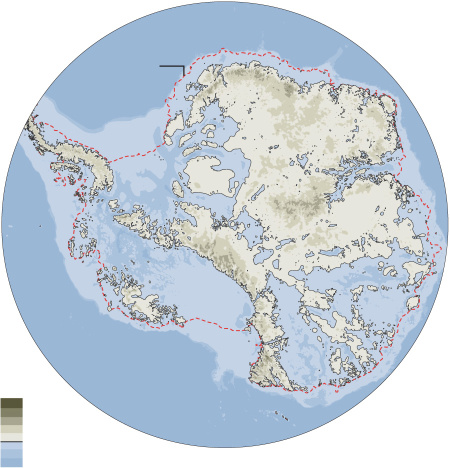
Now visualize this:
How Antarctica would appear if its ice melted: it’s half under the sea.
Why so watery? Because the enormous glaciers, up to nearly 5,000 meter thick, press down on the continent with their enormous weight. Since the end of the last glaciation, 10,000 years ago, Scandinavia has been rising, and is still rising (I long used a picture with a similar information about Antarctica’s bedrock.)
Polar temperatures over the last several million years have, at times, been slightly warmer than today, yet global mean sea level has been 6–9 metres higher as recently as the Last Interglacial (130,000 to 115,000 years ago) and possibly higher during the Pliocene epoch (about three million years ago). In both cases the Antarctic ice sheet has been implicated as the primary contributor, hinting at its future vulnerability. Here we use a model coupling ice sheet and climate dynamics—including previously underappreciated processes linking atmospheric warming with hydrofracturing of buttressing ice shelves and structural collapse of marine-terminating ice cliffs—that is calibrated against Pliocene and Last Interglacial sea-level estimates and applied to future greenhouse gas emission scenarios. Antarctica has the potential to contribute more than a metre of sea-level rise by 2100 and more than 15 metres by 2500, if emissions continue unabated. In this case atmospheric warming will soon become the dominant driver of ice loss, but prolonged ocean warming will delay its recovery for thousands of years.
Notice that the scenario evoked in the last sentence is different from my very old scenario, which is similar to the one advanced in November 2015 by the famous Hansen and Al. (I raised the alarm before Hansen, at least seven years ago). In my scenario, and Hansen’s the ice sheets melt from below, due to warm sea water intrusion.
The West Antarctic Ice Sheet is larger than Mexico.
Here is a taste of the paper (I have a Nature subscription):
“Reconstructions of the global mean sea level (GMSL) during past warm climate intervals including the Pliocene (about three million years ago)1 and late Pleistocene interglacials2,3,4,5 imply that the Antarctic ice sheet has considerable sensitivity. Pliocene atmospheric CO2 concentrations were comparable to today’s (~400 parts per million by volume, p.p.m.v.)6, but some sea-level reconstructions are 10–30 m higher1,7. In addition to the loss of the Greenland Ice Sheet and the West Antarctic Ice Sheet (WAIS)2, these high sea levels require the partial retreat of the East Antarctic Ice Sheet (EAIS), which is further supported by sedimentary evidence from the Antarctic margin8. During the more recent Last Interglacial (LIG, 130,000 to 115,000 years ago), GMSL was 6–9.3 m higher than it is today2,3,4, at a time when atmospheric CO2 concentrations were below 280 p.p.m.v. (ref.9) and global mean temperatures were only about 0–2 °C warmer10. This requires a substantial sea-level contribution from Antarctica of 3.6–7.4 m in addition to an estimated 1.5–2 m from Greenland11,12 and around 0.4 m from ocean steric effects10.”
So notice: when CO2 ppm per volume was at 280 130,000 to 115,000 years ago, sea level was up to ten meter higher than now. And now we are at 500 ppmv…
And notice again: When CO2 ppmv was at 400, sea level was up to 30 meters (100 feet) higher than today. And now we are at 500 ppm, and, in a blink, in ten years, at 550 ppm.
Here is another example from the paper. I said all of this before, but to have scientists paid to do research in this area write it black on white in the world’s most prestigious scientific magazine, will no doubt endow me with greater, and much desired, gravitas. So let me indulge, not so much for my greater glory, but because it should help taking what I have long said more seriously.
“Much of the WAIS sits on bedrock hundreds to thousands of metres below sea level (Fig. 1a)13. Today, extensive floating ice shelves in the Ross and Weddell Seas, and smaller ice shelves and ice tongues in the Amundsen and Bellingshausen seas (Fig. 1b) provide buttressing that impedes the seaward flow of ice and stabilizes marine grounding zones (Fig. 2a). Despite their thickness (typically about 1 km near the grounding line to a few hundred metres at the calving front), a warming ocean has the potential to quickly erode ice shelves from below, at rates exceeding 10 m yr−1 °C−1 (ref. 14). Ice-shelf thinning and reduced backstress enhance seaward ice flow, grounding-zone thinning, and retreat (Fig. 2b). Because the flux of ice across the grounding line increases strongly as a function of its thickness15, initial retreat onto a reverse-sloping bed (where the bed deepens and the ice thickens upstream) can trigger a runaway Marine Ice Sheet Instability (MISI; Fig. 2c)15, 16, 17. Many WAIS grounding zones sit precariously on the edge of such reverse-sloped beds, but the EAIS also contains deep subglacial basins with reverse-sloping, marine-terminating outlet troughs up to 1,500 m deep (Fig. 1). The ice above floatation in these East Antarctic basins is much thicker than in West Antarctica, with the potential to raise GMSL by around 20 m if the ice in those basins is lost13. Importantly, previous ice-sheet simulations accounting for migrating grounding lines and MISI dynamics have shown the potential for repeated WAIS retreats and readvances over the past few million years18, but could only account for GMSL rises of about 1 m during the LIG and 7 m in the warm Pliocene, which are substantially smaller than geological estimates.”
I said it before. Including the details. So the evidence was clear, and out there. The optimism (it will take 5 centuries for 50 feet of sea level rise) is not supported by evidence. Actually collapsing channels coming from inverted rivers running up on the bellies of ice sheets are now obvious on satellite pictures and collapse of major ice shelves is going to be a matter of years, not centuries.
But science is made by tribes and these tribes honor the gods (of plutocracy) who finance them, and their whims. So they don’t want to make their sponsors feel bad. So they say unsupported, optimistic stuff, contradicted by a first order analysis.
Science is good, metascience, better. Metascience includes the sociological reasons which explain why some scientists will take some “facts” for obvious (although, coming from another sociology, they are not).
Deep in the Nature paper, in the quote above, or in four drawings and graphs of future sea level rise, one can find projections according to what various models “predict”… 130,000 years ago (!) The “Old Physics” model predicts one meter rise of the sea (this is the official UN maximal prediction for 2100). The new model, again starting with the present conditions, predict more than a six meter rise (!) This is a case of metascience playing with sea level.
This way, the authors of the paper will be able to say, one day: we told you so. While at the same time not irritating their sponsors now (because to understand what they are really saying takes quite a while, and has to be understood as tongue in cheek, when they pretend to apply the analysis to 130,000 years ago… What they really mean is six meters now, not just one meter… Bye bye Wall Street. Punished by its own instruments…)
The question is not whether we will be able to avoid a twenty meter sea level rise: that’s, unbelievably, a given (barring unforeseeable, yet imaginable technological advances to extract quickly a lot of CO2 from the atmosphere). The question is whether we will avoid a 60 meter rise.
A stark warning from Institute researchers on the probability that ‘2°C capital stock’ will be reached in 2017
A new study from the Institute for New Economic Thinking at the Oxford Martin School and the Smith School for Enterprise and Environment, University of Oxford, shows that we are uncomfortably close to the point where the world’s energy system commits the planet to exceeding 2°C.
In the paper, to be published in the peer-reviewed journal Applied Energy, the authors calculate the Two degree capital stock – the global stock of electricity infrastructure from which future emissions have a 50% probability of staying within 2°C of warming. The researchers estimate that the world will reach Two degree capital stock next year, in 2017.
Yesterday, a visitor to this place left a comment to a post published in September, 2012. Simply, he wrote, “Some food for thought midst all the drivel and crap.” The post was under the heading of The Charles Schulz Philosophy. I had forgotten about it. I thought it would be nice to republish it today (or rather the essence of that post).
ooOOoo
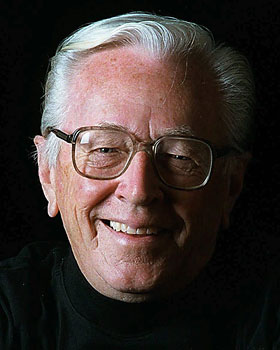
Charles Schulz
The following is the philosophy of Charles Schulz, the creator of the ‘Peanuts’ comic strip.
You don’t have to actually answer the questions. Just ponder on them. It will make very good sense!
Here’s A Little Quiz
You don’t have to actually answer the questions. Just read them straight through, ponder a tad, and you’ll get the point.
Name the five wealthiest people in the world.
Name the last five Heisman trophy winners.
Name the last five winners of the Miss America pageant.
Name ten people who have won the Nobel or Pulitzer Prize.
Name the last half dozen Academy Award winners for best actor and actress.
Name the last decade’s worth of World Series Winners.
How did you do?
The point is, none of us remember the headliners of yesterday. These are no second-rate achievers. They were the best in their fields.
But the applause dies. Awards tarnish over time. Achievements are forgotten and accolades and certificates are buried with their owners.
Here’s another quiz. See how you do on this one:
List a few teachers who aided your journey through school.
Name three friends who have helped you through a difficult time.
Name five people who have taught you something worthwhile.
Think of a few people who have made you feel appreciated and special!
Think of five people you enjoy spending time with.
Did you find that Easier? Of course you did!
So here’s the lesson!
The people who make a difference in your life are not the ones with the most credentials, or the most money…or the most awards…they simply are the ones who care the most.
It was after 3pm yesterday when I turned on my computer and wondered what today’s post was going to be; I wasn’t feeling especially creative!
But sitting in my ‘in-box’ was a link to the latest newsletter from The Smithsonian and within that newsletter was a perfect sequel to yesterday’s post What’s In A Name?
I’ll go straight to that article. (Apologies if you notice that there is a fair degree of overlap between the two articles.)
ooOOoo
Call a Dog a Pit Bull and He May Have Trouble Finding a Home
Dogs labeled as pit bulls at shelters may wait three times longer to be adopted—even when they aren’t actually pit bulls
An adorable shelter dog shouldn’t have a difficult time finding a home—but it might if it comes with the label “pit bull.” (LeticiaRose / iStock)
Regardless of a canine’s actual breed, simply labeling a dog a “pit bull” can condemn it to a significantly longer stay in a shelter and make it less attractive to potential adopters, concludes a new study in PLOS One.
Pit bulls are often stereotyped as aggressive and dangerous toward humans, though there is little evidence that those characteristics are inherent to the breed. The breed is popular among the dog fighting crowd, however, which contributes to its reputation for aggressiveness. To complicate matters, when attacks do occur, dogs may be labeled as pit bulls even when they are not. Indeed, in the United States, “pit bull” often serves as a catchall for a handful of breeds ranging from English bulldogs to American Staffordshire terriers; one person’s pit bull is another’s American bulldog mix.
This reputation follows the canines when they land in shelters. When potential adopters look at available dogs, they “don’t rate pit bulls any differently than look-alike dogs,” says the study’s lead author, Lisa Gunter, a graduate student in psychology at Arizona State University. “It’s only when we start attaching labels that people begin to perceive them more negatively.”
Most shelter dogs are of unknown origin, so employees often have to guess at an animal’s breed. Over a 10-year career working in shelters, Gunter noticed that she and her co-workers frequently arrived at different conclusions about a dog’s breed. And genetic studies have found significant discrepancies between descriptions of shelter dogs and their actual breed. One study found, for example, that half of the dogs that had been labeled as pit bulls at four Florida shelters had no pit bull ancestry in their DNA.
Gunter and her colleagues undertook a series of studies to find out how those potentially flawed labels might impact an animal’s chance of finding a home. They started by showing college students in California and users of the website Reddit photos of three dogs—a Labrador retriever, a pit bull-like dog and a border collie—without attached breed labels and asked questions about each, such as whether the dog looked smart or if the person would feel comfortable approaching it. The team found that participants ranked the pit bull-type dog as lowest on intelligence, friendliness, approachability and adoptability, and highest on aggressiveness and difficulty to train. When the pit bull appeared in a photo with an elderly woman or a child, however, it was rated more favorably.
Next, the researchers asked potential adopters at an Arizona shelter to rank dogs that appeared in photos and short videos on the animals’ approachability, intelligence, aggressiveness, friendliness, difficulty to train and adoptability. These scores were then summed to create an “attractiveness” composite for each pooch. To get around possible biases, such as apartment rules about animal sizes or bans on certain breeds, the team used phrases such as, “If circumstances allowed, I would consider adopting this dog,” to assess willingness to take a canine home.
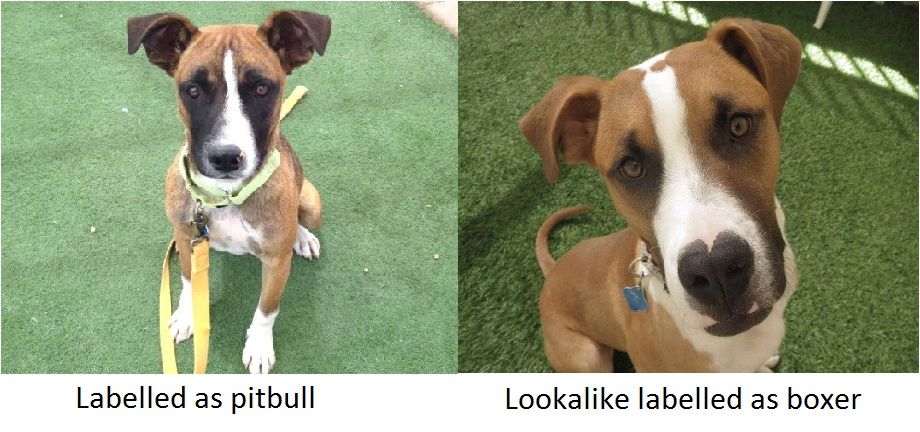
These two dogs may look similar, but the pit bull label could mean that the one on the left may wait a lot longer to find a home. (Arizona Animal Welfare League)
When the dogs were not labeled as any particular breed, participants ranked pit bulls and look-alikes (dogs that were the same size and color as the pit bulls) as equally attractive. Potential adopters even ranked the pit bulls in video recordings as more attractive than the non-pit bull matches. When the researchers introduced breed labels, however, that trend reversed, with participants ranking the same dog as significantly less attractive than similar dogs without the label.
The researchers also found that pit bulls at that shelter waited over three times as long to find a home as their matched counterparts.
Finally, the team analyzed a set of data from an animal shelter in Florida that recently removed breed descriptions altogether. When freed from the loaded label, pit bull-like dogs were much more likely to find a home. Adoptions of these dogs increased by more than 70 percent, compared with the prior year, and the shelter’s euthanasia rate for the same group dropped by 12 percent, probably because more of them were finding homes.
Taken together, these results “are very convincing that breed labels negatively impact any dog that is labeled as ‘pit bull,’” says Erica Feuerbacher, who studies dogs at Carroll College in Montana and was not involved in the study. “Furthermore, we know from other studies that humans are quite bad at correctly labeling breeds, so many dogs could be erroneously labeled pit bull—even though they are not—and by that label they become less adoptable.”
Eliminating breed labels, which people seem to be using as poor proxies for stereotyped traits, may be the key to banishing a significant amount of dog discrimination—and getting more dogs into homes, Feuerbacher and the other researchers argue. There is also a need to devise better means of measuring dogs’ true personalities, including their potential for aggression, and of ensuring those assessments are valid not just in the shelter environment but also in homes, Gunter notes.
“We want to drive the adoption conversation toward evaluating whether an individual dog, regardless of the breed, is a suitable candidate for adoption,” she says. “Then we can match-make between the personality of the dog and that of the person, instead of just relying on labels.”
ooOOoo
You can see why it so perfectly followed on from yesterday!
Not just my post but yesterday’s comments. Such as this from Tony:
Another example of form over substance. When will we learn?
So I know you will all cheer Erica Feuerbacher who is quoted towards the end of that Smithsonian essay and I will close with her words, in part: “We want to drive the adoption conversation toward evaluating whether an individual dog, regardless of the breed, is a suitable candidate for adoption. Then we can match-make between the personality of the dog and that of the person, instead of just relying on labels.”
“What’s in a name? That which we call a rose by any other name would smell as sweet”.
That very well-known quotation from Wm. Shakespeare was the obvious sub-title to today’s post.
You will be aware that I have written several times previously about Pit Bull dogs. But I would like to draw your attention to a post that was published here back in 2013. It was called In praise of Pit Bull dogs and featured a guest post from Noella Schink, in Portland, Maine, where she then lived and played with her 3-year-old pit bull mix, Addie, 8-year old shih-tzu, Brutus, and 2-year old hound, Lula. Apart from all of them being a little older I trust nothing else has changed.
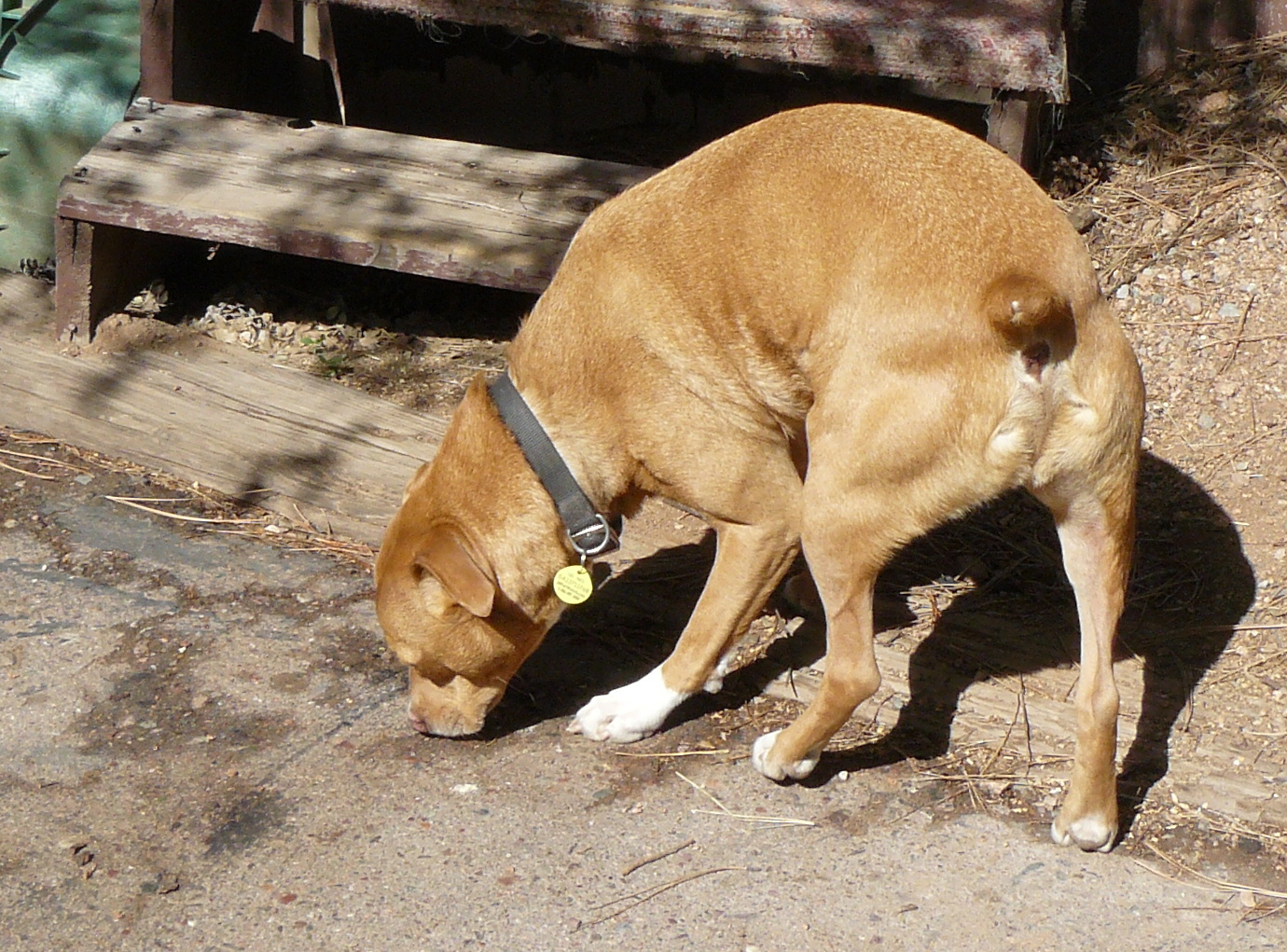
That post in 2013 also included a picture of our gorgeous Casey, as follows.
Casey doing what dogs do so well – picking up scents around his home.
Over on the Care2 petition site there was a compelling case being made for Pit Bulls to be given a different name. Read it and see if you are convinced of the need.
ooOOoo
How We Could Save More Dogs From Death Row by Changing One Thing
Whether we like it or not, labels matter — even for dogs. New research from Arizona State University published in PLOS ONE, suggests labels could even lead to a potential death sentence, if you’re a pit bull.
Pit Bulls Wait 3 Times as Long to be Adopted
The pit bull went from America’s darling dog to one of the most feared (and misunderstood) dogs today. Their fall from grace is evident in stories like Olive’s. Olive the Pit Bull was brought in as a stray and stayed in the shelter for approximately 11 years. Olive was lucky enough to find her forever home, but so many dogs like her aren’t — and our arbitrary labels aren’t helping their cause.
According to Science Daily, researchers from Arizona State University wanted to know if breed identification influences adoption. The researchers found that dogs labeled as “pit bulls” could wait three times as long to be adopted from shelters into their forever homes compared to their lookalikes without the label or labelled as another breed.
Compared to other breeds, like Labradors, pits were perceived as less friendly and more aggressive. They also were considered less “attractive” than their lookalikes. Weird, right?
Even the researchers were surprised by how much the pit bull label influences perception and, ultimately, adoption. As researcher Lisa Gunter from Arizona State University explains, “We were surprised how very similar looking dogs sometimes get labelled ‘pit bull’ and other times as something completely different. These dogs may look and act the same, but the pit bull label damns them to a much longer wait to adoption,” reports Science Daily.
Ultimately, the researchers recommend losing the pit bull label to stop inadvertently penalizing these dogs in the shelter setting.
Heartbreaking Pit Bull Statistics
If you thought that Olive’s story was sad, she’s actually one of the lucky ones — not only for getting adopted, but for staying in the shelter system for the 11 years that she did.
According to Pit Bull Rescue Central (PBCR) 200 pit bulls are euthanized in Los Angeles County animal shelters every single day.
PBCR emphasizes that “for homeless pit bulls the death sentence is almost always automatic.”
Villalobos Rescue Center (made popular by the TV show Pit Bulls and Parolees) had this to say about the pit bull plight in Los Angeles: “The pit bull population has now risen to 40% of all the dogs in 12 shelters in Los Angeles. That means that almost half of the entire Los Angeles dog population is pits or pit mixes! Most are strays, tossed out like dirty laundry. It’s heartbreaking.”
Sadly, the plight of pit bulls is not limited to Los Angeles County. A 2013 Nat Geo Wild infographic reveals that:
60 percent of the total dogs euthanized in U.S. shelters are pit bulls
30 percent of the total dogs admitted to shelters are labeled pit bulls
86.7 percent of pit bulls admitted to open admission shelters are euthanized
Do you know what the worst part of this sad situation is? There’s no such thing as a pit bull.
As Bark Post explains, the pit bull label is just “an umbrella term that most people use to refer to different types of dogs – the American Pit Bull Terrier, the American Staffordshire Terrier, the Staffordshire Bull Terrier, any mixes thereof, and any dog that vaguely resembles these dogs.”
The breed isn’t real, but the stigma has real consequences. And time and again pit bulls prove that they can be great dogs with the correct guidance and training when they get a second chance. Remember how Jericho the Pit Bull went from death row to being an amazing service dog?
Take Action!
Sign and share this petition urging animal rescuers to lose the stigmatizing pit bull label that unnecessarily penalizes innocent dogs. It’s a matter of life and death.
Only idiots believe that pit bulls are bad! When are some morons going to finally wake up and realize bad owners are responsible for bad dogs! BSL should be banned everywhere. We must never stop fighting to end the senseless killing of this breed.
These days there is plenty to sigh about. Whether it’s presidential politics this side of the Atlantic or immigration and ‘Brexit’ in Europe. However, today’s post is not about our, as in human, sighs but is about the sighs that our dogs make.
We sigh when we’re frustrated and when we’re happy. What about our four-legged friends? (Photo: sgilsdorf/flickr)
Every dog owner has experienced it at one time or another. Your dog lies down, often with his head on his front paws, and lets out a sigh. Is he sad? Content? Disappointed in his life?
“When the sigh is combined with half-closed eyes, it communicates pleasure; with fully open eyes, it communicates disappointment: ‘I guess you are not going to play with me.'”
Geez. Guilt trip, anyone?
A dog’s sigh is “a simple emotional signal that terminates an action,” writes Stanley Coren, Ph.D. in his book, “Understanding Your Dog for Dummies.”
“If the action has been rewarding, it signals contentment. Otherwise, it signals an end of effort.”
So if you and your dog just finished a fun romp in the yard or a great walk in the park, that sigh means, “I’m content and am going to settle down here awhile.” If your dog has begged at your side all during dinner without a payoff, that sigh signifies, “I’ll give up now and simply be depressed.”
Dog trainer Pat Engel agrees.
“My own unscientific observation is that dogs usually sigh while resting, or when they are what I call ‘resigned,'” she writes in the San Francisco Chronicle. “These sighs seem to mark a physiological transition into a deeper state of relaxation.”
If you feel like your dog sighs (or yawns or makes other noises excessively), it’s worth mentioning to your vet, Engel suggests. There’s always a chance that a health issue might be at the root of the sounds.
If a medical reason isn’t to blame, then concentrate on reading the cues your canine is sharing.
Massachusetts dog trainer Jody Epstein says a dog’s body language is definitely the key to interpreting the noise he’s making.
“If his body is relaxed, ears soft, head down on the bed in what we might call a ‘sleeping’ position, and he’s in perfect health otherwise, then I’d expect it’s just a sign of uber relaxation,” she writes in her All Experts advice column. “If he’s laying there, but sitting up watching you and doing it, then it’s more likely an active communication that you may wish to address.”
Like, hey, buddy, isn’t it time for a treat? Or when was the last time we played ball?
One dog may sigh because he’s frustrated; another may sigh because she’s comfortable and is ready for a nap. (Photo: Brent Schumacher/flickr)
Is a sigh always a sigh?
“Dogs make many vocalizations, and they mean different things depending on various factors such as context, experience, relationships, the individual dog, and much more,” says certified animal behaviorist and dog trainer Katenna Jones of Jones Animal Behavior, in Warwick, Rhode Island. “There is also human interpretation: One person’s sigh is another person’s huff, moan, groan or whine.”
And, Jones says, some breeds tend to make more or different sounds than others.
“The most important thing is to remember there is no one answer. It’s important to not apply human feelings to dogs because dogs are not humans!” she says. “Look at the context of situations in which your dog is sighing, take note, and see if you can identify why YOUR dog is sighing — because it may be different than why MY dog is sighing.”
Just because we don’t always know what our dogs are trying to say, doesn’t mean we should stop trying to figure things out.
The AKC points out: “Dogs make sounds both intentionally and unintentionally, and they all have certain meanings. Just because we do not understand the wonderful variety of sounds that dogs vocalize does not mean that dogs are not doing their best to communicate with us.”
ooOOoo
So come on, you dear readers, send in some examples of sighing and other wonderful sounds that your dogs make!
Here’s my contribution from YouTube. The sound of a German Shepherd deep asleep and a very familiar sound in this house when Pharaoh is sound asleep.
Published on Sep 5, 2014
At first I had no idea it was him. I thought maybe it was my husband (who was downstairs in the living room taking a nap) and the dogs and I were upstairs….but soon figured out it was him! This was the first time I had heard Jax snore. I especially love his little face when he was woken up by his brother. Which I think he did on purpose. Haha. It is hilarious!
Smallbatch Pets has announced it is voluntarily recalling a select lot of its Duckbatch Sliders frozen dog food because it may be contaminated with Salmonella and Listeria.
Smallbatch Pets Dog Food Recall of March 2016
March 26, 2016 — Smallbatch Pets Inc. is voluntarily recalling one lot of frozen dog Duckbatch Sliders due to their potential to be contaminated with Salmonella and Listeria monocytogenes.
The following image was copied in good faith by The Dog Food Advisor from Smallbatch Pets’ website and may not be a true representation of the recalled product.
What’s Recalled?
The affected products are sold frozen in 3 pound bags and can be identified with the following manufacturing codes:
Lot #: CO27
Best By Date: 01/27/2017
UPC: 713757339001
The “Best By” date is located on the back of the package below the seal.
Where Was the Product Sold?
Eighty cases of the affected lot of dog Duckbatch Sliders were sold between the dates of February 23, 2016 and March 10, 2016.
They were distributed to retail pet food stores in the following states:
California
Colorado
Oregon
Washington
About Salmonella and Listeria
Salmonella and Listeria can affect animals eating the products and there is risk to humans from handling contaminated pet products, especially if they have not thoroughly washed their hands after having contact with the products or any surfaces exposed to these products.
Healthy people infected with Salmonella and Listeria monocytogenes should monitor themselves for some or all of the following symptoms: nausea, vomiting, diarrhea or bloody diarrhea, abdominal cramping and fever.
Rarely, Salmonella and Listeria monocytogenes can result in more serious ailments, including arterial infections, endocarditis, arthritis, muscle pain, eye irritation, and urinary tract symptoms.
Consumers exhibiting these signs after having contact with this product should contact their healthcare providers.
Pets with Salmonella and Listeria monocytogenes infections may be lethargic and have diarrhea or bloody diarrhea, fever, and vomiting.
Some pets will have only decreased appetite, fever and abdominal pain.
Infected but otherwise healthy pets can be carriers and infect other animals or humans.
If your pet has consumed the recalled product and has these symptoms, please contact your veterinarian.
No pet or consumer illnesses from this product have been reported to date.
However, because of their commitment to safety and quality, Smallbatch Pets is conducting a voluntary recall of this product.
Consumers should also follow the Simple Handling Tips published on the Smallbatch Pets package, when disposing of the affected product.
What Caused the Recall?
This recall was initiated after routine testing by the Food and Drug Administration of a 3 pound bag of dog Duckbatch Sliders that was collected at a distributor revealed the presence of Salmonella and Listeria monocytogenes.
This recall is being made with the knowledge of the U.S. Food and Drug Administration.
What to Do?
Consumers who have purchased the above lots of dog duck sliders are urged to stop feeding them and return product to place of purchase for a full refund or dispose of them immediately.
Those with questions may call Smallbatch Pets at 888-507-2712, Monday through Friday, 9:00 AM to 4:00 PM PT. Or email the company at info@smallbatchpets.com
U.S. citizens can report complaints about FDA-regulated pet food products by calling the consumer complaint coordinator in your area.
The analogy with planting trees is very apt. For any clown can plant the tree but parenting that young tree into a mature forty-foot high beauty takes professional management.
That post had been inspired by a recent essay over at Patrice Ayme’s Thoughts regarding the observation by Andy Grove, the founder of Intel, that promoting start-ups without the commensurate focus on growing those start-ups into viable commercial concerns was strategically and politically incorrect. Back to that essay for a further extract:
However, American-based manufacturing is not on the agenda of Silicon Valley or the political agenda of the United States. Venture capitalists actually told me it was obsolete (before stepping in their private jets). That omission, according to Mr. Grove, is a result of another “unquestioned truism”: “that the free market is the best of all economic systems — the freer the better.” To Mr. Grove, or Mr. Trump, or yours truly, that belief is flawed.
Andy Grove: “Scaling used to work well in Silicon Valley. Entrepreneurs came up with an invention. Investors gave them money to build their business. If the founders and their investors were lucky, the company grew and had an initial public offering, which brought in money that financed further growth.”
The triumph of free-market principles over planned economies in the 20th century, Mr. Grove said, did not make those principles infallible or immutable. There was room for improvement, he argued, for what he called “job-centric” economics and politics. In a job-centric system, job creation would be the nation’s No. 1 objective, with the government setting priorities and arraying the forces necessary to achieve the goal, and with businesses operating not only in their immediate profit interest but also in the interests of “employees, and employees yet to be hired.”
As even the New York Times now admits, the situation has degenerated since 2010. Although the employment rate halved, in a slave state, everybody is employed. But neither the economy, nor the society, let alone progress and civilization are doing better.
“Insecure, low-paying, part-time and dead-end jobs are prevalent. On the campaign trail, large groups of Americans are motivated and manipulated on the basis of real and perceived social and economic inequities.
Conditions have worsened in other ways. In 2010, one of the arguments against Mr. Grove’s critique was that exporting jobs did not matter as long as much of the corporate profits stayed in the United States. But just as American companies have bolstered their profits by exporting jobs,many now do so byshifting profits overseas throughtax-avoidance maneuvers.
The result is a high-profit, low-prosperity nation. “All of us in business,” Mr. Grove wrote, “have a responsibility to maintain the industrial base on which we depend and the society whose adaptability — and stability — we may have taken for granted.” Silicon Valley and much of corporate America have yet to live up to that principle.”
If we return to that analogy of the tree, think how long and how much attention must be put into the conditions that will promote not only sustained growth of that young tree but growth to the point where it can propogate its own saplings.
As it is for young companies. The skills that company managers require to nurture that company to the point of self-sustaining maturity are many and varied. But they are underpinned by the need to be truthful and trustworthy, to be devoted to the employees of the company and to instill in all who work, and finance, that company to “love the customer”. Not just those customers that are the big spenders but also, and especially so, the many, many smaller clients that can make or break a company’s reputation.
So with that in mind let’s take a peek at USA LLC and UK Ltd.
Here are the closing paragraphs from Patrice’s essay:
Our corruption is not just an economic and social problem, a political problem, and a civilizational problem, as it was under Aristotle. It is a problem for the entire planet.
“We empowered a demagogue“, laments Mr. Kristof. His true calling, and that of the Main Stream Media, was to empower plutocrats, and their obsequious servants. How sad they are.
I like being outside the fray of party politics. I wasn’t born with a sufficient capacity for compromise to believe that any political party has all the answers to all questions. And yet, equally, I can admire those who can make the sacrifice to take part in this process. It is, for better or worse, at the heart of democratic politics.
That demands that it be done well. This requirement is predicated on three things. The first is a willingness to pretend you have the answer to all things. The second is a leadership that knows this is not true and which as a result respects its opponents. The third is an acute appreciation of the fact that compromise in pursuit of a higher goal, whilst saving face, is the ultimate political aim: nothing really happens without the accommodation of others.
He then closes his post:
Passion, dogma and steadfastness, come what may, are not what makes party politics.
Conviction based on wisdom, understanding and compassion does.
But these qualities remain in far too short supply, even if they’re not quite out of stock, yet.
And that’s the party political problem.
Many people both ‘sides of the pond’ would nod heads in agreement with that.
My final peek is into an essay that was recently published by the quarterly journal The Baffler. The essay was from David Graeber under the heading of Despair Fatigue. Opening:
Is it possible to become bored with hopelessness?
There is reason to believe something like that is beginning to happen in Great Britain. Call it despair fatigue.
For nearly half a century, British culture, particularly on the left, has made an art out of despair. This is the land where “No Future for You” became the motto of a generation, and then another generation, and then another. From the crumbling of its empire, to the crumbling of its industrial cities, to the current crumbling of its welfare state, the country seemed to be exploring every possible permutation of despair: despair as rage, despair as resignation, despair as humor, despair as pride or secret pleasure. It’s almost as if it’s finally run out.
and closing, thus:
Twenty-first century problems are likely to be entirely different: How, in a world of potentially skyrocketing productivity and decreasing demand for labor, will it be possible to maintain equitable distribution without at the same time destroying the earth? Might the United Kingdom become a pioneer for such a new economic dispensation? The new Labour leadership is making the initial moves: calling for new economic models (“socialism with an iPad”) and seeking potential allies in high-tech industry. If we really are moving toward a future of decentralized, small, high-tech, robotized production, it’s quite possible that the United Kingdom’s peculiar traditions of small-scale enterprise and amateur science—which never made it particularly amenable to the giant bureaucratized conglomerates that did so well in the United States and Germany, in either their capitalist or socialist manifestations—might prove unusually apt. It’s all a colossal gamble. But then, that’s what historical change is like.
In other words, it’s this!
One of the age-old maxims from professional company managers is:
It’s always a case of putting people before profits!
Putting people before profits should be in the front of the minds of all our leaders and masters; both sides of the ‘pond’.
Or in tree language investing in this:
An American Red Maple sapling.
to achieve this:
A mature American Red Maple tree.
Come on good people, we really do need healthy, mature trees in our 21st C. societies.
As regular followers of this place know (and a huge thank-you to you all) much of last Friday was spent planting trees in a grassy meadow just to the East of our house.
A part view of the area where the trees were planted: Kentucky Coffeetrees; Northern Catalpas; a Red Maple, Eastern Redcedars.
An hour before I sat down to write this post (now 13:30 PST yesterday) I didn’t have a clue as to what to write. Then I read Patrice Ayme’s latest essay and, wow, it punched me in the face. For it resonated so strongly with a few other recent readings.
“We empowered a demagogue” laments the New York Times ostensibly bleeding heart liberal, the kind Mr. Kristof, in his false “Mea Culpa” editorial, “My Shared Shame: How The Media Made Trump”. By this, Mr. Kristof means that Mr. Trump is a bad person. However, Mr. Kristof’s choice of the word “demagogue” is revealing. (Actually it’s not really his choice: “demagogue” is not Mr. Kristof’s invention: he just repeats like a parrot the most prominent slogan of the worldwide campaign of insults against Trump).
Trump a demagogue? Is Mr. Sanders a “demagogue”, too? (As much of the financial and right-wing press has it: for The Economist and the Financial Times, Trump and Sanders are both “demagogues” and that’s their main flaw.)
To understand fully the word “demagogue” one has to understand a bit of Greek, and a bigger bit of Greek history.
Then later on in that essay, Patrice goes on to quote Andy Grove:
A hard day may be coming for global plutocrats ruling as they do thanks to their globalization tricks. And I am not exactly naive. Andy Grove, founder of Intel, shared the general opinion that much of globalization was just theft & destitution fostering an ominous future (the Hungarian immigrant to the USA who was one of the founders of Intel). He pointed out, an essay he wrote in 2010 that Silicon Valley was squandering its competitive edge in innovation by neglecting strong job growth in the United States.
Mr. Grove observed that: …”it was cheaper and thus more profitable for companies to hire workers and build factories in Asia than in the United States. But… lower Asian costs masked the high price of offshoring as measured by lost jobs and lost expertise. Silicon Valley misjudged the severity of those losses, he wrote, because of a “misplaced faith in the power of start-ups to create U.S. jobs.”
Silicon Valley makes its money from start-ups. However, that phase of a business is different from the scale-up phase, when technology goes from prototypes to mass production. Both phases are important. Only scale-up is an engine for mass job growth — and scale-up is vanishing in the United States (especially with jobs connected to Silicon Valley). “Without scaling,” Mr. Grove wrote, “we don’t just lose jobs — we lose our hold on new technologies” and “ultimately damage our capacity to innovate…
The underlying problem isn’t simply lower Asian costs. It’s our own misplaced faith in the power of startups to create U.S. jobs. Americans love the idea of the guys in the garage inventing something that changes the world. New York Times columnist Thomas L. Friedman recently encapsulated this view in a piece called “Start-Ups, Not Bailouts.” His argument: Let tired old companies that do commodity manufacturing die if they have to. If Washington really wants to create jobs, he wrote, it should back startups.
Friedman is wrong. Startups are a wonderful thing, but they cannot by themselves increase tech employment.”
Spot on! For in my previous life I was the founder of two businesses. First up was Dataview Ltd, based in Colchester, that was formed in the late 1970s and soon became the global distributor of the word processing software Wordcraft, written by Englishman Pete Dowson. Dataview also initiated the ‘dongle’, a software/hardware security device to protect Wordcraft.
The Wordcraft dongle.
The second company founded by me was Aviation Briefing Ltd ‘AvBrief’ that is still going today, albeit with me no longer involved!
So I can reinforce, with hundreds of hours of lost sleep and tears, that growing a company and increasing employment, especially the employment of great technical people, is a very different matter to the start-up phase.
Frankly, regarding Dataview, it was only the luck of meeting Sid Newman that saved my bacon. For within 12 months of starting trading I was already sinking under the load of trying to be the number one salesman (that I was good at) and being the company general manager (that I was total crap at). Sid had years of experience at general management and very quickly let me get on with what I really loved – opening up Wordcraft distributorships all over the world.
The analogy with planting trees is very apt. For any clown can plant the tree but parenting that young tree into a mature forty-foot high beauty takes professional management.
Clown work! (This is a Red Maple, by the way!)
Tomorrow I will return and offer a viewpoint as to how we, as in society, are currently bereft of professional managers.
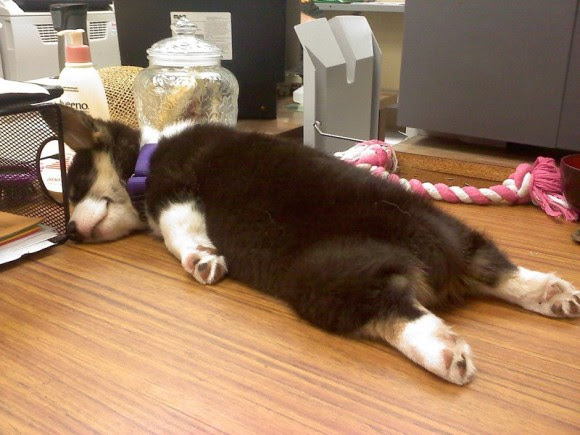
I have to thank our immediate neighbours, Larry and Janell, for sending on nearly thirty of these fantastic pictures under the general theme of Dog Tired! (Did you see yesterday’s picture?)
Dog Tired, selection one.
oooo
oooo
oooo
oooo
oooo
oooo
oooo
These pictures are making me yawn already and it’s only two in the afternoon!
 By: Laura S. April 3, 2016 About Laura














 Learning from Dogs