I opened my email box a couple of days ago and there was an email from Sarah.
It said:
Hi there!
I would be honored to be a guest writer for your blog and of course would reciprocate. I hope you don’t mind that I shared your link in my last post. I am not totally sure if blogging etiquette.
Sarah Kinneavy
MyAmazing2ndChapter.com
Of course I said yes!
Sarah’s background is sociology and she has a degree in the subject. Just as important she owns a dog walking business. I will let her finish her background:
I believe in living life to the fullest.
My daughter is a Cancer survivor- and as a result of that journey- It put my life into perspective. I learned to never take anything for granted- you never know what’s around the next corner. I am continuing to work on becoming the best version of me, while making the most of each and everyday.
Frankly, I do not really know what it is like to have a daughter, or a son come to it, go down with cancer. The nearest I have come to the disease was when I had just turned 12 and my father died of lung cancer.
So here’s her guest post.
ooOOoo
Start your day with music- not the News! Surviving the Coronavirus with mindfulness Day 2
By Sarah Kinneavy, March 28th, 2020
As I continue to try to stay calm with mass panic happening across the globe 🌎 with this pandemic. As I mentioned in yesterday’s post:
Yesterday one of my friends posted on Facebook to start the day off with music – rather than the news! What a great idea!!! So, yesterday, as I got ready for a job interview and I waited until it was late enough in Hawaii to do my daily well check on my daughter there (she is in isolation in a dorm room – I am not sure if she has the dreaded virus or not). I used music as the focal point of this mindfulness exercise. This 15 minutes of focusing on the music- listening to the rhythm helped keep me present. I wasn’t worrying about getting the job or how my daughter was doing. I was just in that moment of getting ready with the accompaniment of music. It was honestly 15 minutes of pure happiness. What a great way to start my day! One thing I have to add – I try to not let myself think about what the words of the songs mean to me, or when I first heard the song. I just listen and enjoy. Okay- I may have danced around my apartment a bit too!
I can tell you – I did not feel anxious going to my interview like I normally would. I didn’t panic about my daughter’s health – I was able to wait until after my interview to check in on her. Mindfulness does not keep me from ever worrying about my kiddo or the world around me. No – I still worry – but It isn’t swallowing me up whole. And this is key!
Heading to my job interview.
I can’t wait to talk to you again tomorrow . How are you coping with all the stress and anxiety?
ooOOoo
That’s a lovely guest post!
And the message is clear and powerful: “No – I still worry – but It isn’t swallowing me up whole. And this is key!“
Sometimes the most precious gift in the world is the simplest one.
So starts today’s republished essay.
I would slightly amend the saying by removing the word ‘Sometimes‘. It is a fact that the most precious gifts are the simplest ones.
This essay was on The Dodo just three days ago and is perfect!
ooOOoo
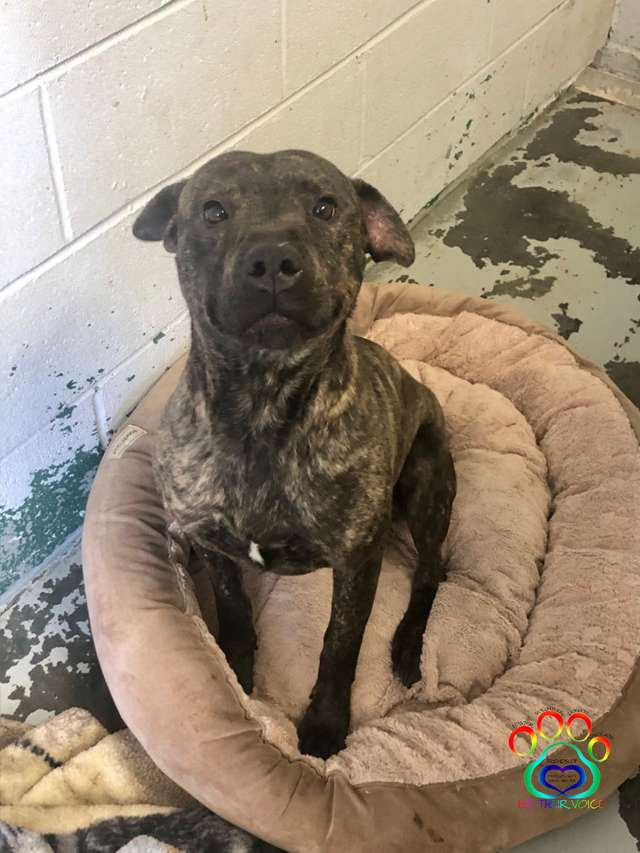
Shelter Pup Can’t Believe He Just Got His Very First Bed
March 25th, 2020
Photo Credit: Fairfield County Animal Shelter
Sometimes the most precious gift in the world is the simplest one.
For Ezra, a stray dog who spent his life on the streets, that was somewhere soft and warm to sleep. And the smile on his face when he received his very first bed said it all.
When Ezra first arrived at Fairfield County Animal Shelter in September, he wouldn’t look anyone in the eye. He lay in the back of his kennel, shaking and staring at the wall. Shelter staff knew he’d need to overcome his fear to have a chance at a better life, so they came up with a plan to win him over: hot dogs.
Photo Credit: Fairfield County Animal Shelter
“The hot dogs were the key to his heart,” Samira Yaghi, rescue coordinator at the shelter, told The Dodo. “We always had hot dogs when walking by Ezra’s kennel. What started with tossing the hot dogs slowly became him taking them gently out of our hands.”
As Ezra got more comfortable, he began to press his body up against the volunteers, allowing them to pet him.
Finally, five months after he arrived, the nervous dog went outside for his very first walk. “It’s been uphill ever since,” Yaghi said. “He is full of wiggles and bounce anytime he sees us approaching, eager to say ‘hello’ and eager to give us kisses.”
Photo Credit: Fairfield County Animal Shelter
It was after one of these walks that Ezra’s life changed forever. “We had several dog beds donated and they were still sitting by the entryway,” Yaghi wrote on Facebook. “On his way out for a walk, he [lay] on the bed [and] had to be coaxed off. On their way back in from the walk, he [lay] on the bed again.”
Seeing how attached Ezra was to the bed, the shelter staff put it in his kennel. He immediately sat in the bed, smiling from ear to ear. “Just look at how happy and proud he is to have that bed,” Yaghi wrote. “He sat nice and tall with a smile of gratitude on his face!”
The sweet photo of him smiling in his bed even caught the attention of the shelter’s northern rescue partner, S.N.A.R.R. Animal Rescue Northeast. Soon, Ezra and his beloved bed will be on their way to New York in search of a home, and his friends at the shelter couldn’t be more proud of how far he’s come.
ooOOoo
Of our 6 dogs only 1 is a non-rescue. Jean’s history with dogs goes right back to Mexico and her finding homes in the USA for homeless street dogs taken in by her. When I met her, back in 2007, she had well over 20 dogs and when we came up to America to be married, in 2010, we came across the border with 16 dogs. All with the necessary paperwork I will add. But the border officer, after calling out to a colleague in the next customs booth, “Hey Jake, there’s a guy here with 16 dogs!“, couldn’t go throw all the paperwork and simply passed them all; not that we had anything to hide!
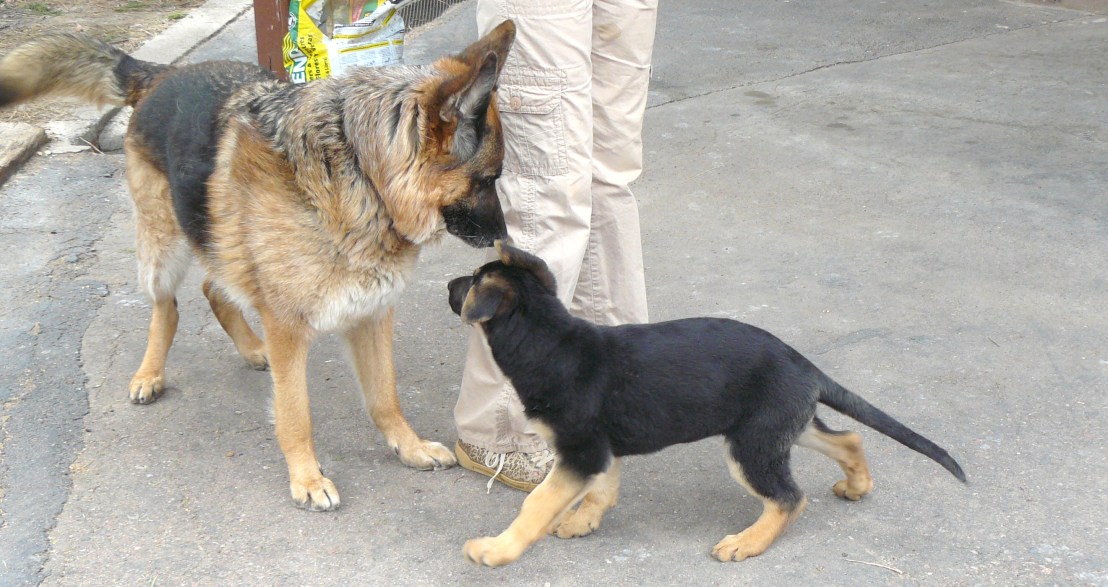
So Cleo was purchased to be companion to Pharaoh when Pharaoh was becoming an elderly dog.
First meeting between Pharaoh and Cleo; April 7th, 2012.
Pharaoh died on the 17th June, 2017 and he is still badly missed!
At the time of republishing this, as in March 27th, I am well over a month behind the news that Chica suffered an infection. But it was still a shock to read of Chica’s illness and, thank goodness, it wasn’t anything more than an infection.
For I have got used to Chica and Merlin walking GR7 and hadn’t thought of anything interrupting their progress.
ooOOoo
Day 22: El Robedal to Alhama de Granada (including emergency car ride) 10k
By Tom and Chica, 20th February, 2020
Written by Tom’s wife.
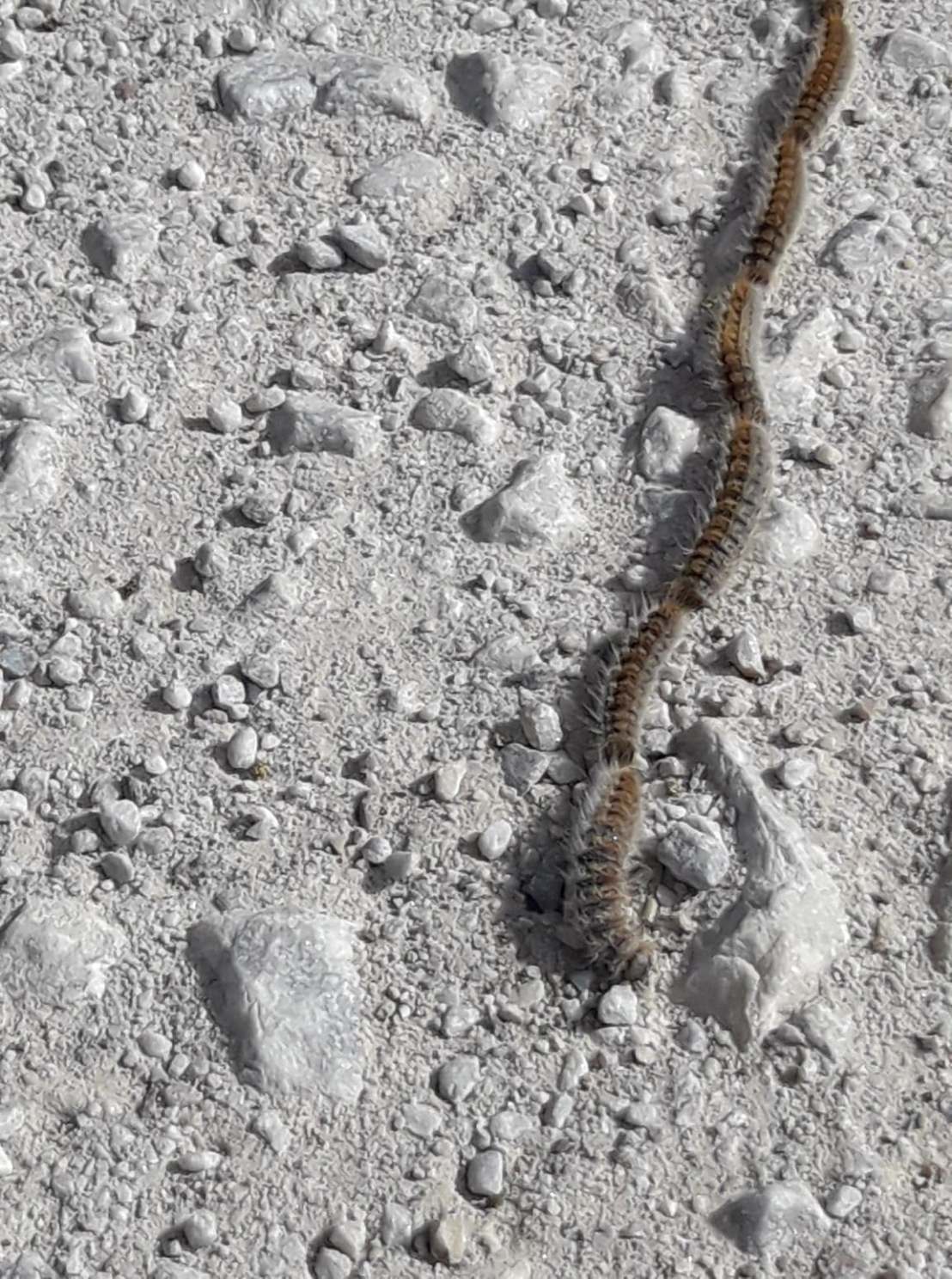
I woke as the sun hit the tent and Chica sat outside soaking up the warmth while I had a leisurely breakfast and packed up. It was 11ish before we set off up the track. More evidence of sap bleeding before we came across some processionary caterpillars on the march.
We know about these nasty critters from earlier in the trip and I avoid camping anywhere where the nests are evident but these appeared on the track. I was pretty sure Chica hadn’t got anywhere near them but when she started to slow down and look decidedly off colour, I got very worried indeed. They can cause serious injury to dogs. I stopped to try and decide what to do – I was the middle of nowhere and it looked like we might need a vet.
As if sent from the gods, Heidi (who was actually a London cockney) rocked up to walk her dog and offered a lift into Alhama de Granada. She was the first person I’d seen all day! I accepted very gratefully.
I found a vets and they were opening soon so we sat on the steps outside and waited. The vet was lovely, examining Chica thoroughly and to my relief saying it wasn’t anything to do with the caterpillars. She had a high temperature, however, and so it was probably an infection. He gave her an antibiotic injection and vitamins and asked me to bring her back in the morning. I then carried her, as well as my pack, to the nearest place I could camp and put her to bed wrapped in my fleece. She was instantly asleep.
Chica warming up.Pine forest and blue skies.More sap bleeding.Processionary caterpillars proceding across our path.Clinique Veterinario Alhama
Author’s note: Although her temperature had lowered, Chica was still poorly the following morning, so we decided it was best for me to go out and fetch them. They are now back at base in Jimera and we will take a break until she recovers. Many thanks to Clinque Veterinario Alhama for their exceptional care.
I love this slightly altered format of the posts from Gilliwolfe. Because the photographs are so, so beautiful.
Taken from here, as per usual, and republished for your delight with the approval of Tom and Gilliwolfe.
ooOOoo
Day 21: Ventas de Zaffaraya to El Robedal camping area 15k
By Tom and Chica, 20th February, 2020
Written by Tom’s wife
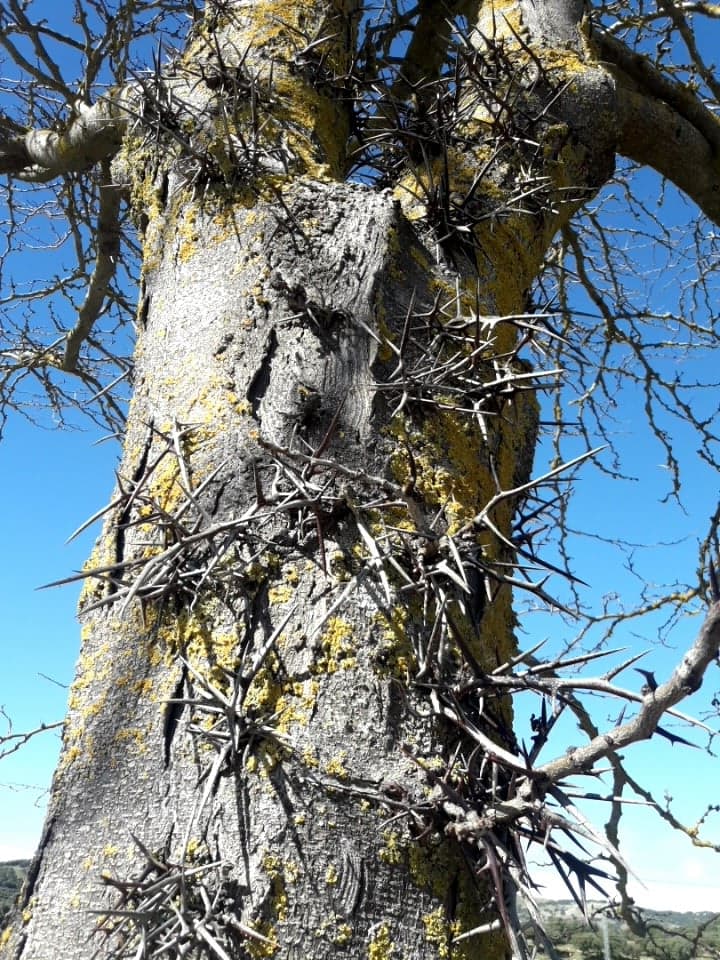
After a relaxing day off in Zaffaraya, Day 21 dawned fair and after breakfast of tostada and jam, we headed out of town on the dismantled railway track. This nice, level start was welcome before the climb up into the hills in holm oaks, later descending into farmland, mostly vegetable cultivation – artichokes and courgettes among others. As it began to heat up to around 25 deg, I passed a honey locust tree with the longest spines I’ve seen. These are related to the false acacia which I’ve had to trim for clients in the UK – a job to be done with extreme care and robust gloves.
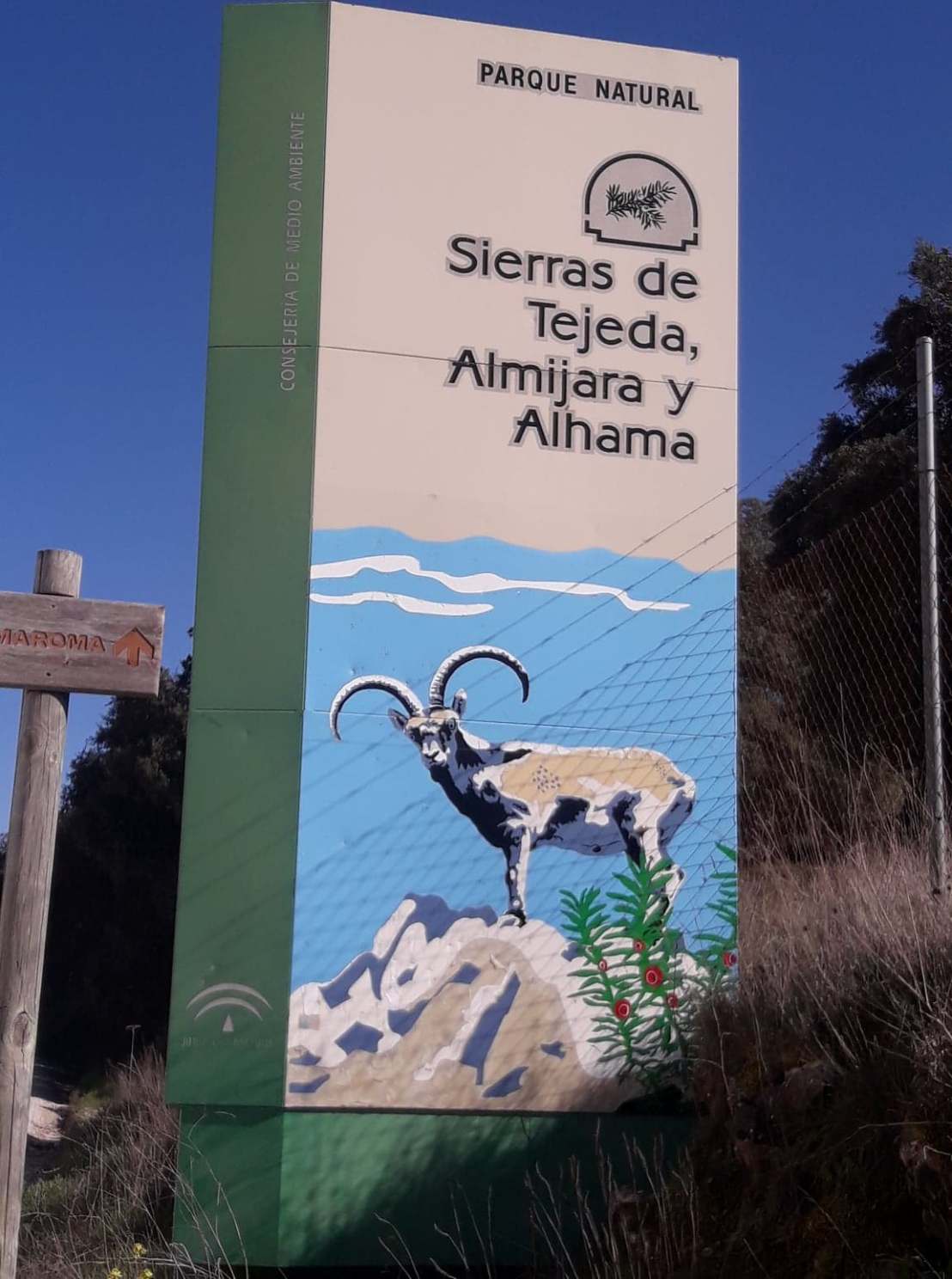
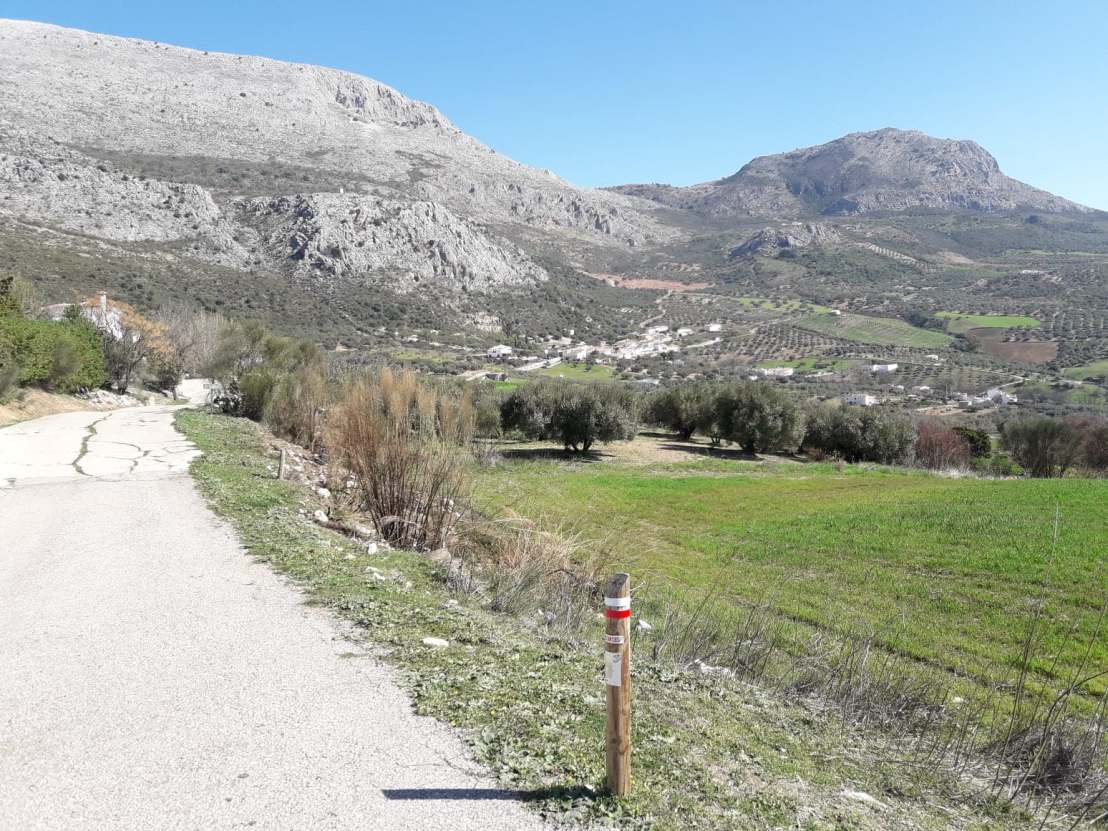
Lunch at around 2.30pm of scrambled eggs and asparagus, washed down with coffee and beer at Hotel Los Canos de la Alcaiceria. We then entered the National Park and enjoyed pleasant walking until 5pm when we reached the El Robedal recreative area. This is set in pine forest with views to the nearby snow-capped La Maroma mountain and offers free camping with a toilet block, running water and barbecue area. So after the tent was pitched, I lit a fire, ate a mediocre dehydrated meal and sat back to enjoy the fantastic night sky. Perfect!
Setting off …Ironic!Honey locust tree – a gentle name for a truly vicious tree!
No lack of information.Sap ‘bleeding’. The sap is used in turpentine productionHeading towards camp.El Robedal Area Recreative – free camping with toilets, running water and barbecue areas.
ooOOoo
I hope you good people are enjoying this walk as much as I am!
It is such a wonderful trip and they have been on their walk for very nearly three weeks!
Please make a note and share the details if you can.
ooOOoo
Icelandic Plus Dog and Cat Treats Recall
March 23, 2020 — IcelandicPlus LLC of Ft. Washington, PA, is recalling its Capelin Dog and Cat Treats because some of the fish have exceeded FDA guidelines for fish larger than 5 inches… which has the potential to cause botulism poisoning.
What’s Recalled?
The affected products are sold in a clear plastic package or tube… and marked Icelandic+ Capelin WHOLE FISH, PURE FISH TREATS FOR DOGS, or PURE FISH TREATS FOR CATS.
UPC codes include 8 5485400775 9; 8 5485400711 7; and 8 5485400757 5.
Related products are packaged in a 2.5 ounce tube or a 1.5 or 2.5 ounce bag (lot numbers 02/2020 to 02/2022).
What Caused the Recall?
The FDA has determined that salt-cured, dried, or fermented un-eviscerated fish larger than 5 inches have been linked to outbreaks of botulism poisoning in humans between 1981 and 1987 and again in 1991.
Since some IcelandicPlus Capelins are larger than 5 inches there is a possible health risk.
To date, no illnesses of dogs, cats, or persons are reported in connection with the treats. Nor have there been any positive test results for Clostridium botulinum from any IcelandicPlus Capelin.
However, because of the potential risk, the company has decided to announce this product recall.
About Botulism Poisoning
Clostridium botulinum toxin can cause severe clinical signs including death in both animals consuming the pet treat and humans handling the pet treat or coming in contact with contact areas that have been exposed to the product.
Common symptoms may include dizziness, blurred or double vision, trouble with speaking or swallowing, difficulty breathing, muscle weakness, abdominal distension, and constipation.
Consider that several of the listed symptoms, such as double vision, cannot be easily assessed in animals or conveyed by an animal.
Pets or persons experiencing these symptoms should seek immediate medical attention.
Where Was the Product Sold?
The affected product was shipped to distributors for sale to consumers by independent pet specialty stores throughout all U.S. states.
Message from the Company
IcelandicPlus is family owned and run by pet parents who take the safety and wellbeing of its consumers and clients with the utmost importance, as such we are conducting this voluntarily recall to further protect our customers.
Additionally, we are changing our Capelin supplier to ensure that the fish in our product are consistently less than 5 inches, or if larger, they will be completely eviscerated.
What to Do?
Distributors, retailers and consumers who have purchased IcelandicPlus Capelin can return it to the location where it was purchased for a refund.
Consumers with questions may contact the company at 857-246-9559, Monday through Friday, 8 am to 5 pm ET.
U.S. citizens can report complaints about FDA-regulated pet food products by calling the consumer complaint coordinator in your area.
Day 20: Alfarnatejo to Ventas de Zaffaraya 18k (inc deviation)
By Tom and Chica, 16th February, 2020
Written by Tom’s wife.
We had a very long but really enjoyable day today. Unfortunately, I took a wrong turn early on, which meant a lot more mileage and hill climbing to get back to where we should have been.
However, it was interesting and I got to meet lots of people including a chap from Derbyshire who gave me the right directions. Then a couple of old ladies at a fuente who confirmed that I was now going the right way. After that, a group of young Spanish women walking the other way who told me how far I had to go. Which was slightly deflating.
When I reached Ventas de Zaffaraya at 7pm, I decided the prudent thing to do was to go to the first bar I saw and rehydrate. This was Hotel/Bar Aqui te Queiro (I love you here??). I asked about places to stay as hostel next door appeared closed. The owner was located though, and she spoke English – always a relief at the end of the day when I can barely string a sentence together, even in my own language. Shower and comfy bed beckons. Joy!
Breaking campLeaving no traceI’m ready!Pomegranate.What a strange house.Early mists.Keeping the ear in the sun from burning. Trend setter?Tempting!Definitely on the right track now!These pilas (troughs) are so welcome.Late afternoon.Civilisation means a bar!Pooped squeaks.
My grandson, Morten, who had his birthday yesterday, he is now nine, took some photographs recently. They are fabulous and are republished here with Morten’s permission. Completely untouched by yours truly!
oooo
oooo
oooo
oooo
oooo
oooo
oooo
I think these are fabulous. Morten used the following camera.
During the political campaign season, Americans are deciding who has the characteristics, skills and temperament to be president. As a dog psychologist and founder of the Canine Science Collaboratory at Arizona State University, I spend my time studying the relationship between dogs and their people. I’d certainly be happy if a candidate’s attitude toward dogs could offer a simple way to evaluate a leader’s personality, cutting to the essence of a person’s character and clinching my vote without needing a detailed assessment of their policy proposals.
Is it enough just to follow the leash to choose a leader? There must be good people with bad dogs, or no dog at all, and some notoriously bad people who were loved by their dogs, no? But I want to believe that canine companionship can still shed lightonhumancharacter and help us pick a candidate.
Dogless in the White House
For the past three years, the pup-parazzi have been speculating on President Donald Trump’s dogless existence at the White House. It’s certainly most common for the president to have a dog – perhaps because, as someone reputedly said, “If you want a friend in Washington, get a dog.”
The only dog he has expressed any enthusiasm for while in office was the Belgian Malinois involved in the raid that resulted in the death of Islamic State group leader Abu Bakr al-Baghdadi. As for al-Baghdadi, Trump said he “died like a dog.”
Dog friends
Among the Democratic front-runners, Joe Biden shares his life with a German shepherd, Major. This may be a good move for the uniformed vote: German shepherds are a favored breed of military and police forces. Biden has always preferred German shepherds, but, for his latest – acquired in November 2018 – he softened the image by adopting a puppy that had been exposed to toxic chemicals and was being cared for by the Delaware Humane Society.
Biden might want to be careful of the historical baggage that comes with this popular large breed. The most famous German shepherd in politics must surely have been Blondi, the dog Adolf Hitler himself said was the only being that loved him.
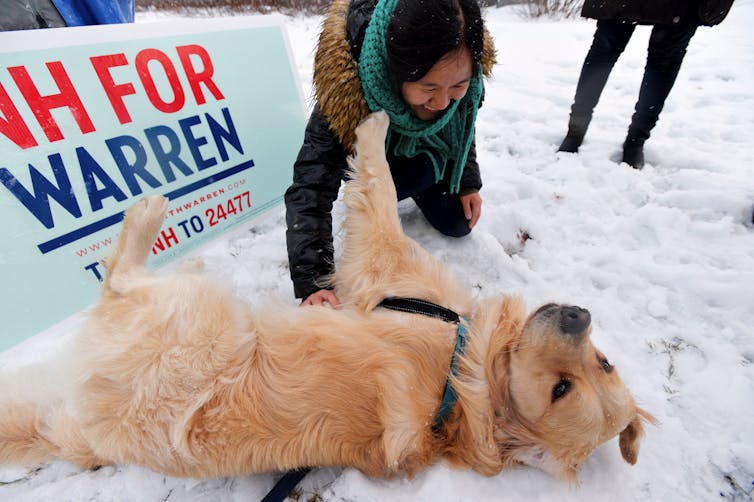
Elizabeth Warren’s dog, Bailey, gets a belly rub from a supporter. Joseph Prezioso/AFP via Getty Images
Elizabeth Warren has a dog with a gentler association. Warren’s stereotypically family-friendly golden retriever, Bailey, is named for George Bailey from the movie “It’s a Wonderful Life.” Warren said she named her dog for “a guy who was decent, determined and saw the best in people.” Warren’s Bailey is front and center in all her campaign activities.
Bailey features so prominently in his owner’s social media feeds that Warren might want to be careful not to be upstaged by her pooch. George H.W. Bush’s dog, Millie, published a memoir that outsold President Ronald Reagan’s contemporaneous “An American Life.”
Pete Buttigieg has suspended his campaign, effectively dropping out of the race. He and his husband Chasten already had a shelter mutt, Truman, when they added another – Buddy – to their household in December 2018. Marie Claire magazine considers Buddy and Truman “the cutest fur babies in all of politics.” Buddy is the ultimate underdog: rescued from a shelter, of no particular heritage. With only one eye, he peeks out from Instagram voicing droll commentary on the goings-on.
Dog-detached?
Other candidates either have no dog or are happy to keep their canine enthusiasms to themselves.
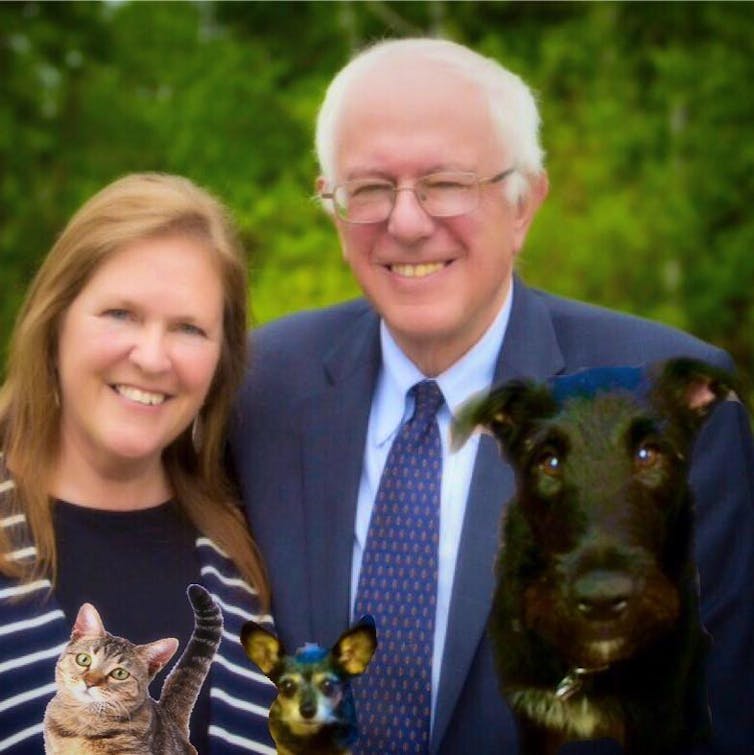
The Facebook group “Pet Lovers for Bernie Sanders” had to photo-edit dogs into an image of Sanders and his wife, who have no dog.
These pets do not actually belong to Bernie Sanders. Pet Lovers for Bernie Sanders Facebook group
Michael Bloomberg was in the “apparently dogless” camp until just the other week when he got into a spot of dog difficulty by shaking a pooch by its snout rather than engaging in one of the more customary forms of interspecies greeting. The dog looked unperturbed, but pet lovers on social media roasted Bloomberg for his maladroitness.
The billionaire’s campaign quickly stitched together a 30-second ad spot of dogs voiced to endorse their candidate – ending with a cute white Lab who “says,” “I’m Mike Bloomberg’s dog, and I approve this message.”
Canine character references
Of course, dogless people get elected all the time – they can always pick up a pooch later. The Obama family did not acquire their dog, Bo, until three months after the inauguration. Having originally indicated an interest in rescuing a shelter mutt, they ended up with a pedigree Portuguese water dog because of their daughter Malia’s allergies. Though often known as the “Big Dog,” Bill Clinton did not acquire a dog of his own, a chocolate Labrador retriever, until his second term.
On Trump’s doglessness, the memoirs of his ex-wife, Ivana, are often quoted: “Donald was not a dog fan. When I told him I was bringing Chappy with me to New York, he said, ‘No.’ ‘It’s me and Chappy or no one!’ I insisted, and that was that.” But two sentences farther on – and far less frequently cited – Ivana adds, “Donald never objected to Chappy’s sleeping on my side of the bed.”
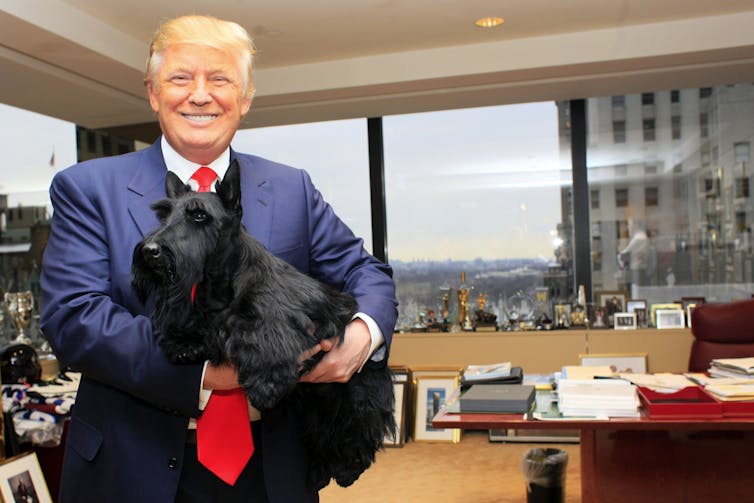
In fact, from 2010 to 2015, the Westminster Kennel Club had a tradition of sending the winner of its annual show to be photographed with Trump at his eponymous New York tower. Images fromthattime show Trump happily hugging the pooches.
Donald Trump poses with the winner of the Westminster Kennel Club Dog Show in 2010. AP Photo/Mary Altaffer
Witness accounts from these meetings, quoted by Snopes.com in an assessment of the claim that Trump hates dogs, recall Trump thoroughly enjoying himself cuddling the prize-winning canines. Snopes concluded that claims Trump considers dogs “disgusting” were just plain false.
Asked at a press conference in April 1947 what had become of the pup, Truman responded: “To what?” On receiving clarification, he lied, “Oh, he’s around.” In fact, Truman had already given Feller away to his physician, Brig. Gen. Wallace Graham.
Much as we might like dogs to tell us whom to vote for, the truth is, dogs are such forgiving assessors of human character that their appraisals need to be taken with more than a pinch of salt. We may just have to do the hard yards and learn about the candidate’s policies. It isn’t easy. Maybe not having to participate in a democracy is what keeps our dogs so happy.
ooOOoo
This is both a lovely and intelligent article. Professor Clive Wynne raises some important points but concludes that we shouldn’t take it too seriously. I, for one, would not trust a person who doesn’t like dogs!












 Learning from Dogs