As you may know, I run a rescue for pets of the homeless. Sheena had lived most of her life on the streets. For the last 4 years or so, she has been in either our house or with a foster.
Her current foster is moving out of the country and I need a new home for Sheena. My Shepard started attacking her out of the blue. 4 times over 8 months, so for safety reasons, I rehomed Sheena.
Our rescue, Tail Waggers Rescue, a non-profit, provides all food and needs for Sheena. We pay her veterinary expenses as well. She is on the cancer diet.
She is extremely sweet, about 13 years old, and is /has fighting cancer. We had the tumors removed a few months ago. She weighs approx 55 lbs. She is short-haired.
She is dog friendly, with dogs of all sizes. I am unsure about cats.
She is not used to being around children so a home with little kids would not be preferred. A quieter home is ideal.
She also does not like people who are intoxicated. She does lay on the furniture, after all, she is a Queen. She is mostly an indoor dog. She is house trained. She will run to the door to let the person know she is there. She is not a huge barker. She loves going on car rides and insists on the front seat.
If you have room in your home and heart, and a fenced yard, and are willing to put her meals together to the menu of the cancer diet, (I help you with this) please let me know. An application and home check are required.
We will supply all her food, bed, dining table, bowls, leashes. You may need to drive her to her vet from time to time in Phoenix.
She is NOT leashed trained but loves to go on walks.
Pictures of Sheena are below.
Please contact me at the store if you are interested in meeting Sheena and being her long term foster.
It is getting very good reviews and they can ship products to those that can’t make it to the store. And I have no direct interest in Maria’s business.
The idea for today’s post came to me from Amanda down in Australia.
We go back years and years and have stayed in contact with each other over that time.
In her latest email she wrote (my italics):
I started some classes at the beginning of the year, a family history research one and a writing one, which had to stop a couple of weeks short courtesy of the virus. The family history class was essentially finished, but the writing class (How to Read/Write a Biography) is an ongoing thing, with the tutor being a published author. I signed up for term two of the writing class as the tutor decided to trial conducting it on-line via Zoom. Many people in the class are either writing a biography or just writing about their lives for their children or grandchildren, so the tutor encouraged us all to write a short piece about this COVID-19 outbreak; observations, feelings, how it’s affected us, or whatever we wanted. There are only six of us in the class, but it was fascinating to hear the resulting six pieces, so utterly different in tone and content, but all really interesting.
I wonder if you could invite something similar from your readers? Imagine the different perspectives and experiences of your readers in their different parts of the world! Just a thought anyway .
So how have you and your dogs been affected. Your feelings, your observations, how it has affected you, and any other thoughts.
And I will close with a photograph that Amanda sent me years ago.
Well it is to me and Jean and, I suspect, it will be to many other people.
I am an atheist. So is Jean. We have been all our lives. I think that many of you who follow this blog know that. The love that we have for our dogs, and all our animals, plus the beauty that is all around us in nature is enough. (Now I am not naive enough to realise that there are many, literally millions, that don’t have the same fortune in their lives.)
The Conversation recently republished an essay by David Weintraub that was first published in 2014. It is at the core of our existence and I am delighted to have the permission to republish it for you.
Square away your personal philosophy now; proof of life beyond earth is coming. Stargazing image via http://www.shutterstock.com
How will humankind react after astronomers hand over rock-solid scientific evidence for the existence of life beyond the Earth? No more speculating. No more wondering. The moment scientists announce this discovery, everything will change. Not least of all, our philosophies and religions will need to incorporate the new information.
Having already found the physical planets, astronomers are now searching for our biological neighbors. Over the next fifty years, they will begin the tantalizing, detailed study of millions of planets, looking for evidence of the presence of life on or below the surfaces or in the atmospheres of those planets.
And it’s very likely that astronomers will find it. Despite the fact that more than one-third of Americans surveyed believe that aliens have already visited Earth, the first evidence of life beyond our planet probably won’t be radio signals, little green men or flying saucers. Instead, a 21st century Galileo, using an enormous, 50-meter-diameter telescope, will collect light from the atmospheres of distant planets, looking for the signatures of biologically significant molecules.
Astronomers filter that light from far away through spectrometers – high-tech prisms that tease the light apart into its many distinct wavelengths. They’re looking for the telltale fingerprints of molecules that would not exist in abundance in these atmospheres in the absence of living things. The spectroscopic data will tell whether a planet’s environment has been altered in ways that point to biological processes at work.
With the discovery in a distant planet’s light spectrum of a chemical that could only be produced by living creatures, humankind will have the opportunity to read a new page in the book of knowledge. We will no longer be speculating about whether other beings exist in the universe. We will know that we not alone.
An affirmative answer to the question “Does life exist anywhere else in the universe beyond Earth?” would raise immediate and profoundly important cosmotheological questions about our place in the universe. If extraterrestrial others exist, then my religion and my religious beliefs and practices might not be universal. If my religion is not universally applicable to all extraterrestrial others, perhaps my religion need not be offered to, let alone forced on, all terrestrial others. Ultimately, we might learn some important lessons applicable here at home just from considering the possibility of life beyond our planet.
In my book, I investigated the sacred writings of the world’s most widely practiced religions, asking what each religion has to say about the uniqueness or non-uniqueness of life on Earth, and how, or if, a particular religion would work on other planets in distant parts of the universe.
Extrasolar sinners?
Let’s examine a seemingly simple yet exceedingly complex theological question: could extraterrestrials be Christians? If Jesus died in order to redeem humanity from the state of sin into which humans are born, does the death and resurrection of Jesus, on Earth, also redeem other sentient beings from a similar state of sin? If so, why are the extraterrestrials sinful? Is sin built into the very fabric of the space and time of the universe? Or can life exist in parts of the universe without being in a state of sin and therefore without the need of redemption and thus without the need for Christianity? Many different solutions to these puzzles involving Christian theology have been put forward. None of them yet satisfy all Christians.
Mormon worlds
Mormon scripture clearly teaches that other inhabited worlds exist and that “the inhabitants thereof are begotten sons and daughters unto God” (Doctrines and Covenants 76:24). The Earth, however, is a favored world in Mormonism, because Jesus, as understood by Mormons, lived and was resurrected only on Earth. In addition, Mormon so-called intelligences can only achieve their own spiritual goals during their lives on Earth, not during lifetimes on other worlds. Thus, for Mormons, the Earth might not be the physical center of the universe but it is the most favored place in the universe. Such a view implies that all other worlds are, somehow, lesser worlds than Earth.
Bahá’í without bias
Members of the Bahá’í Faith have a view of the universe that has no bias for or against the Earth as a special place or for against humans as a special sentient species. The principles of the Bahá’í Faith – unifying society, abandoning prejudice, equalizing opportunities for all people, eliminating poverty – are about humans on Earth. The Bahá’í faithful would expect any creatures anywhere in the universe to worship the same God as do humans, but to do so according to their own, world-specific ways.
Light years from Mecca
The pillars of the faith for Muslims require the faithful to pray five times every day while facing Mecca. Because determining the direction of Mecca correctly could be extremely difficult on a quickly spinning planet millions of light years from Earth, practicing the same faith on another world might not make any sense. Yet the words of the Qu’ran tell us that “Whatever beings there are in the heavens and the earth do prostrate themselves to Allah” (13:15). Can terrestrial Muslims accept that the prophetically revealed religion of Muhammad is intended only for humans on earth and that other worlds would have their own prophets?
Astronomers as paradigm-shatterers
Philosophers and scientists have forced worldviews to adapt in the past.
At certain moments throughout history, astronomers’ discoveries have exerted an outsized influence on human culture. Ancient Greek astronomers unflattened the Earth – though many then chose to forget this knowledge. Renaissance scholars Copernicus and Galileo put the Earth in motion around the Sun and moved humans away from the center of the universe. In the 20th century, Edwin Hubble eliminated the very idea that the universe has any center at all. He demonstrated that what the universe has is a beginning in time and that, bizarrely, the universe, the very fabric of three-dimensional space, is expanding.
Clearly, when astronomers offer the world bold new ideas, they don’t mess around. Another such paradigm-shattering new idea may be in the light arriving at our telescopes now.
No matter which (a)theistic background informs your theology, you may have to wrestle with the data astronomers will be bringing to houses of worship in the very near future. You will need to ask: Is my God the God of the entire universe? Is my religion a terrestrial or a universal religion? As people work to reconcile the discovery of extrasolar life with their theological and philosophical worldviews, adapting to the news of life beyond Earth will be discomfiting and perhaps even disruptive.
ooOOoo
Now I don’t really want to open up the subject of religion but I will say that WikiPedia have a great entry about the subject. My own view is that a few hundred years ago, when life was a lot more mysterious and uncertain, believing in life after death made some sense.
But we know a lot better now despite death still being a certainty.








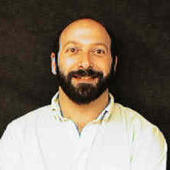 David Weintraub,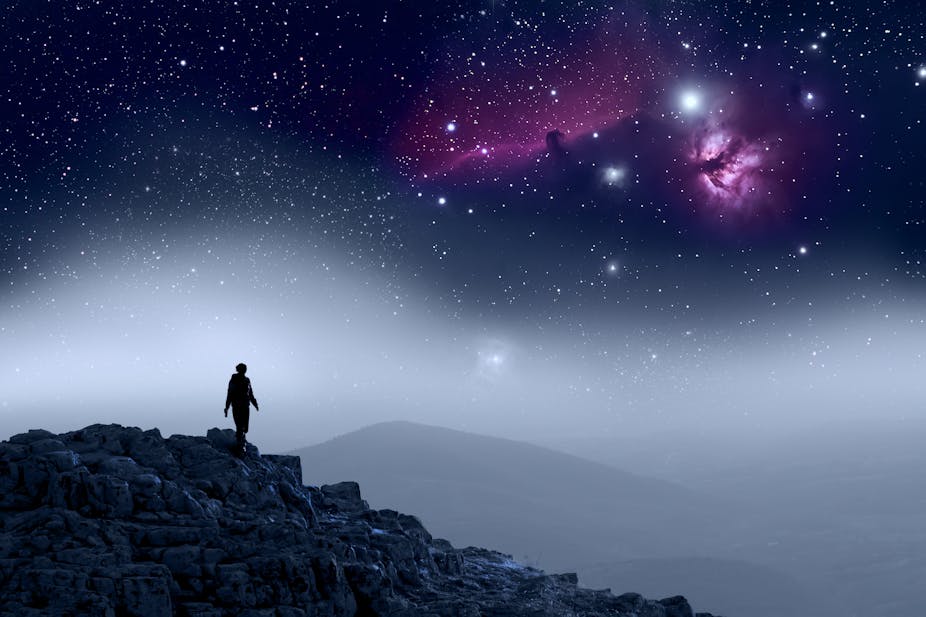



 Learning from Dogs