The two previous sets may be linked to via here. Bob D., who sent them to me, will be delighted with the number of comments and ‘Likes’. Fittingly, it’s dear Capt. Bob’s birthday today!
oooo
oooo
oooo
oooo
oooo
oooo
oooo
oooo
ooOOoo
Going to close today’s picture parade by adding a couple of pictures recently seen on Naked Capitalism. Each day Yves inserts an ‘antidote du jour’ and in the last week two of them were so wonderful that they just had to be shared with you.
An essay from George Monbiot that highlights a world most would rather not think about.
It was past 4pm when I realised that I didn’t have a post for tomorrow (today!). I went through my email folder that I devote for potential blog posts and came across this recent essay from George Monbiot. Some time ago George gave me a general permission to republish his essays here on Learning from Dogs.
The Monsanto/Cargill model of industrial agribusiness is heading toward its Waterloo. As oil and gas deplete, we will be left with sterile soils and farming organized at an unworkable scale. Many lives will depend on our ability to fix this. Farming will soon return much closer to the center of American economic life. It will necessarily have to be done more locally, at a smaller-and-finer scale, and will require more human labor. The value-added activities associated with farming — e.g. making products like cheese, wine, oils — will also have to be done much more locally. This situation presents excellent business and vocational opportunities for America’s young people (if they can unplug their iPods long enough to pay attention). It also presents huge problems in land-use reform. Not to mention the fact that the knowledge and skill for doing these things has to be painstakingly retrieved from the dumpster of history. Get busy.
When I read the full piece it made me feel angry that those in power both sides of ‘The Pond’ display no focus or interest in the future of modern societies over the next 25-years; well none that I can pick up! Yet when you speak to friends, neighbours and people one meets when out-and-about, almost without exception people are nervous about just where it’s all heading – and that’s even before Russia and the Ukraine comes up!
Read George’s essay and see what comes to your mind. Oh, and do leave a comment!
Follow the smoke trails!
ooOOoo
How the media gives Big Tobacco everything it wants.
By George Monbiot, published in the Guardian 18th March 2014
Almost everything is fake. The brave proverbs with which we were brought up – the truth will out, cheats never prosper, virtue will triumph – turn out to be unfounded. For the most part, our lives are run and our views are formed by chancers, cheats and charlatans. [Ed. my emphasis!]
They construct a labyrinth of falsehoods from which it is almost impossible to emerge without the help of people who devote their lives to navigating it. This is the role of the media. But the media drags us deeper into the labyrinth.
There are two kinds of corporate lobbyists in the UK. There are those who admit they are lobbyists but operate behind closed doors, and there are those who operate openly but deny they are lobbyists. Because David Cameron has broken his promise to shine “the light of transparency on lobbying in our country and … come clean about who is buying power and influence” we still “don’t know who is meeting whom. We don’t know whether any favours are being exchanged. We don’t know which outside interests are wielding unhealthy influence. … Commercial interests – not to mention government contracts – worth hundreds of billions of pounds are potentially at stake.” (All that was Cameron in 2010 by the way)(1). At the same time, the media is bustling with people working for thinktanks which refuse to say who is paying them, making arguments which favour big business and billionaires.
Perhaps the most prominent is the Institute of Economic Affairs. Like most groups of this kind, it refuses to disclose its funding. But there’s a trail of smoke. We now know that it has been taking substantial sums from British American Tobacco (BAT), Japan Tobacco International, Imperial Tobacco and Philip Morris International(2,3). BAT has funded the institute since 1963(4). By pure coincidence, the IEA has fiercely defended the tobacco companies from efforts to regulate their products.
In their indispensable new book A Quiet Word, Tamasin Cave and Andy Rowell explain why corporations want other people to front their campaigns. “The third party has the credibility of looking independent; seems to be motivated by something other than self-interest and profit; and therefore has a much greater chance of being believed. Credibility, authenticity and the impression of independence are key. It is about separating the message from the self-interested source.”(5) While many controversial companies use this tactic, it is particularly important for tobacco firms; first because no one trusts them; secondly because they are banned from seeking to influence public health policy, under the Convention on Tobacco Control, which the UK has ratified(6).
Last year a presentation made in 2012 by Philip Morris International (which sells Marlboro and other brands) was leaked(7). It explained how the company intended to fight the proposed plain packaging rules in the UK. Plain packaging is a misnomer: the packs show only horrible photographs of medical conditions caused by smoking. The evidence suggests that they’re a powerful deterrent(8). Philip Morris listed the arguments that should be made in the media to try to prevent the government from introducing plain packaging, identified the BBC as a key outlet, and named the Institute of Economic Affairs and the Tax Payers’ Alliance as potential “media messengers”(9).
So you might imagine that the media – and the BBC in particular – would exercise a certain amount of caution when interviewing think tanks funded by tobacco companies about the regulation of tobacco. Such as disclosing that they are, er, funded by tobacco companies. You would of course be wrong.
At the end of last year the BBC’s Today programme interviewed Mark Littlewood, the head of the Institute of Economic Affairs, about plain packaging(10). It failed to inform listeners that the IEA has received funding from tobacco companies. Mark Littlewood used two of the arguments recommended by Philip Morris in that leaked document: there’s no evidence that plain packaging affects the number of people who smoke, and it stimulates a black market in cigarettes.
I encouraged readers to complain, on the grounds that the BBC’s failure to disclose his interests in the issue he was discussing flatly contravenes three of its editorial guidelines. The BBC’s responses astonished me. First it claimed that it was not “appropriate or necessary” to include this information, on the grounds that the IEA doesn’t publish it(11). In other words, if you’re not candid about who funds you, you’re off the hook. Then, as the complaints continued, it maintained that “all we have to go on are newspaper reports. In the absence of any independent verification therefore, it remains an allegation”(12).
When the BBC was told that tobacco companies have admitted funding the IEA, the reasoning changed again. Now it argues that it would be wrong to assume “that an organisation adopts a particular position on an issue because it receives funding from an interested party”: it might have formed the position first and received the money as a consequence(13). That’s true, though it’s hard to see what difference it makes: if think tanks survive and prosper because their position just happens consistently to align with the grimmest of corporate interests, the politics of the relationship don’t change very much. In either case, surely listeners should be allowed to make up their own minds. Who would not wish to be told that an organisation whose spokesperson is defending Big Tobacco on the Today programme receives money from Big Tobacco? What kind of broadcaster does not see that as relevant information?
Since then, the IEA’s staff have been interviewed by the BBC about tobacco eight more times(14). In none of the interviews I have listened to are their interests declared. It’s all about to blow up again, as the government’s review of plain packaging reports at the end of this month, and the thinktanks will be trundling all over the media(15). The petition I published on change.org, calling on the BBC to disclose its contributors’ financial interests, has 11,000 signatures so far(16). If they reach 20,000, I’ll present it.
Stories like this remind me that much of life is a struggle against disappointment. Perhaps I’m an idiot, but I expected a world that was so much better. I still believe it’s possible. But getting there requires a daily struggle against those who would mislead us.
8. Crawford Moodie et al, no date give. Plain Tobacco Packaging: A Systematic Review. Report for the Department of Health by the Centre for Tobacco Control Research, University of Stirling. http://phrc.lshtm.ac.uk/papers/PHRC_006_Final_Report.pdf.
Won’t be the first time, nor the last time, that I mention the need, the critical need, for human society to learn the value of integrity: the quality that we see coming from our animals day-in; day-out!
Regular readers of Learning from Dogs will remember a post just over a month ago The lone Ranger. Essentially, that explained that we had visited Strawberry Mountain Mustangs in Roseburg, Oregon and, subject to their approval, had decided to adopt Ranger, a 15-year-old gelding.
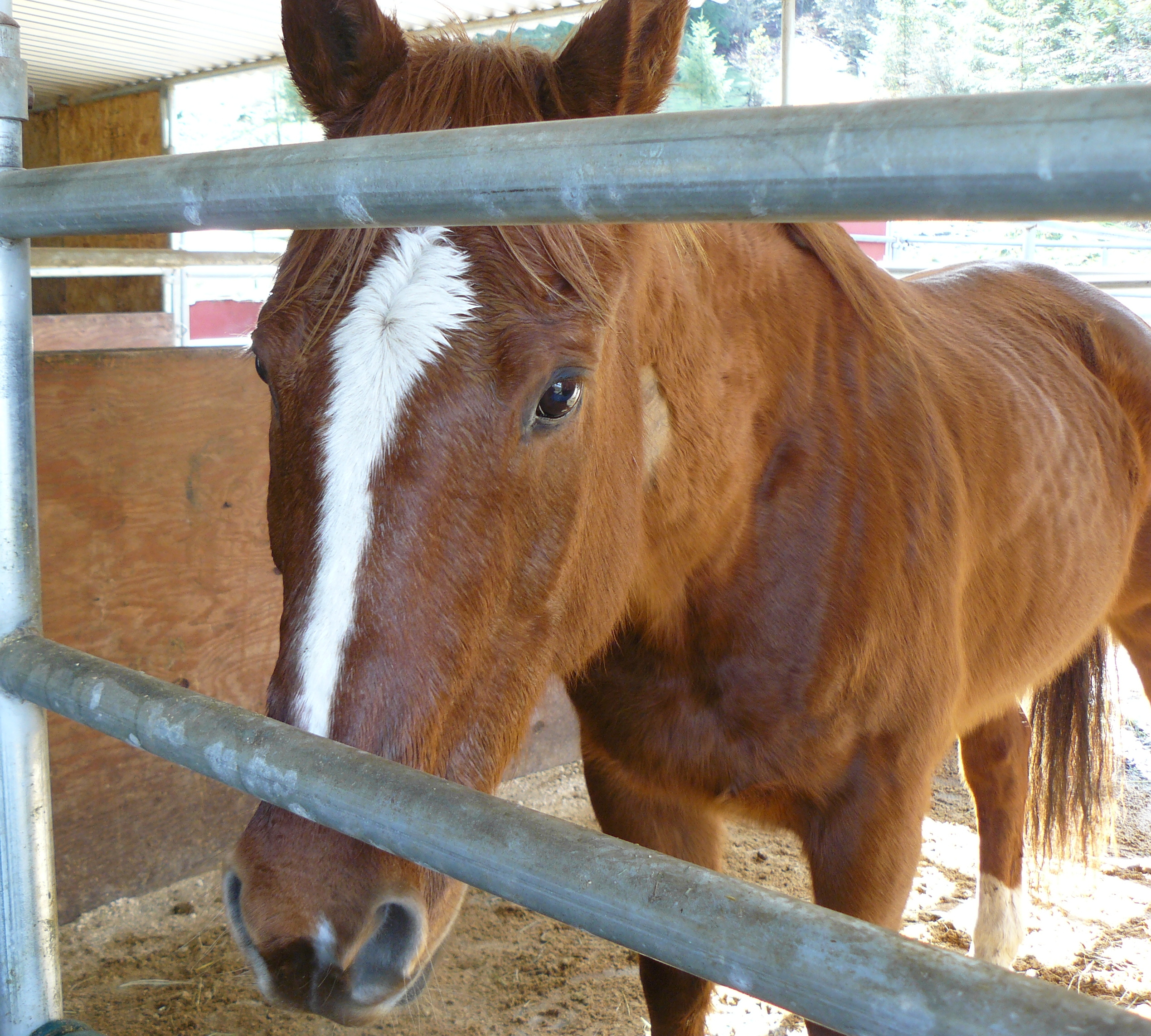
Ranger, when first seen in February.
Thus it proceeded to the point where two-days ago Darla, of Strawberry Mountain, ably assisted by Cody, brought Ranger and Ben to us here in Merlin. It’s been a wonderful twenty-four hours (at the time of writing this). Why Ben? Please read on.
Destination!
Darla and Cody making a safe and timely arrival a little before 10am last Tuesday.
Ben, our new foster, being coaxed out by Darla on the lead-line and Cody behind him.
Why did we take the two? Last October, Ben had been found starved and showing the signs of a great lack of confidence. He was ‘rescued’ on orders of Darla’s local sheriff because of Ben’s condition despite being in private ownership. Darla was certain that Ben had been physically beaten in recent times, hence him being very wary of strangers. Thus his relationship with Ranger was part of his journey of returning to a healthy, confident horse. Darla offered us the opportunity of fostering Ben because Ranger had become a good companion for him. Darla explained that Ben was a very wary horse, especially of sudden movements from men.
Jean leading Ranger; Darla leading Ben.
Another 100 yards and the start of a new life for these two gorgeous animals.
Hey Ranger, is this for real!!
In the those first few minutes after Jean and Darla led the horses to the grass paddock, Ben seemed to have an expression on his face that suggested it was all too difficult to believe! Ranger just got stuck into munching! But not to the extent of not enjoying a back-rub!
“I think I’m going to like this, Ben!”
In the afternoon, it was time to bring Ben and Ranger for an overnight in the top area where the stables, food and water were. Ben was very nervous at coming through the open gate and for a while there seemed to be a complication in that Ranger kept thrusting at Ben as if to keep him away from the fence line separating the horses from Allegra and Dancer, our miniature horses.
But in the morning, yesterday, things seemed much more relaxed. To the point that when Ben and Ranger went back out to the grass, Ben was much more relaxed towards Jean and me, as the following pictures reveal.
Jean offering Ben some treats.
oooo
Yours truly doing likewise.
OK, want to turn back to Darla.
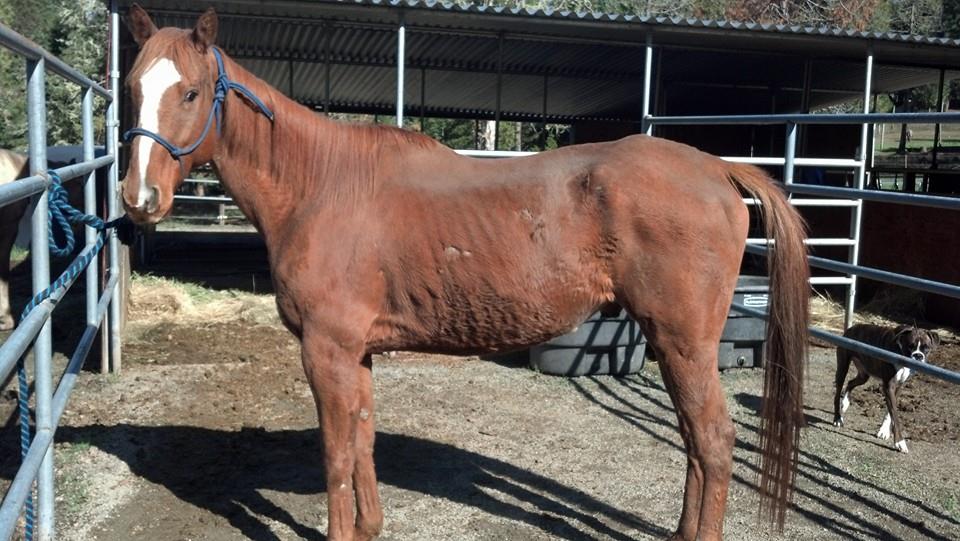
To give an insight into the awe-inspiring work of Darla and her team (and many others across the Nation) and to recognise the need of the authorities to have such outlets as Strawberry Mountain, here are two photographs of Ben shortly after he was removed from the people who had stopped loving and caring for him.
Ben as seen last October.
oooo
Ben close to starving.
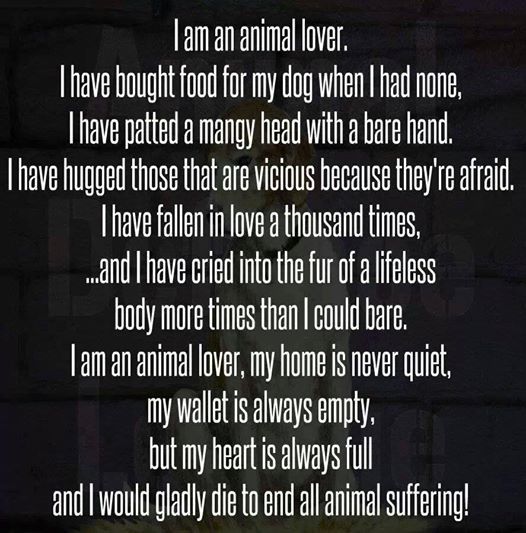
Strikes me as only one way to end this post is with the following as seen on Darla’s Facebook page.
Author unknown.
Thus this post is offered in dedication to the good people all over the world who know the value of the unconditional love we receive from animals and do not hesitate to return the same.
Darla, Cleo and Cody setting a wonderful example of unconditional love.
How about giving the nearest animal, or human, a big hug telling them at the same time how much you love them!
So today, I write about Cleo and then next week it will be the final ‘meet the dogs’, the dog that started this blog: Pharaoh.
ooOOoo
Cleo
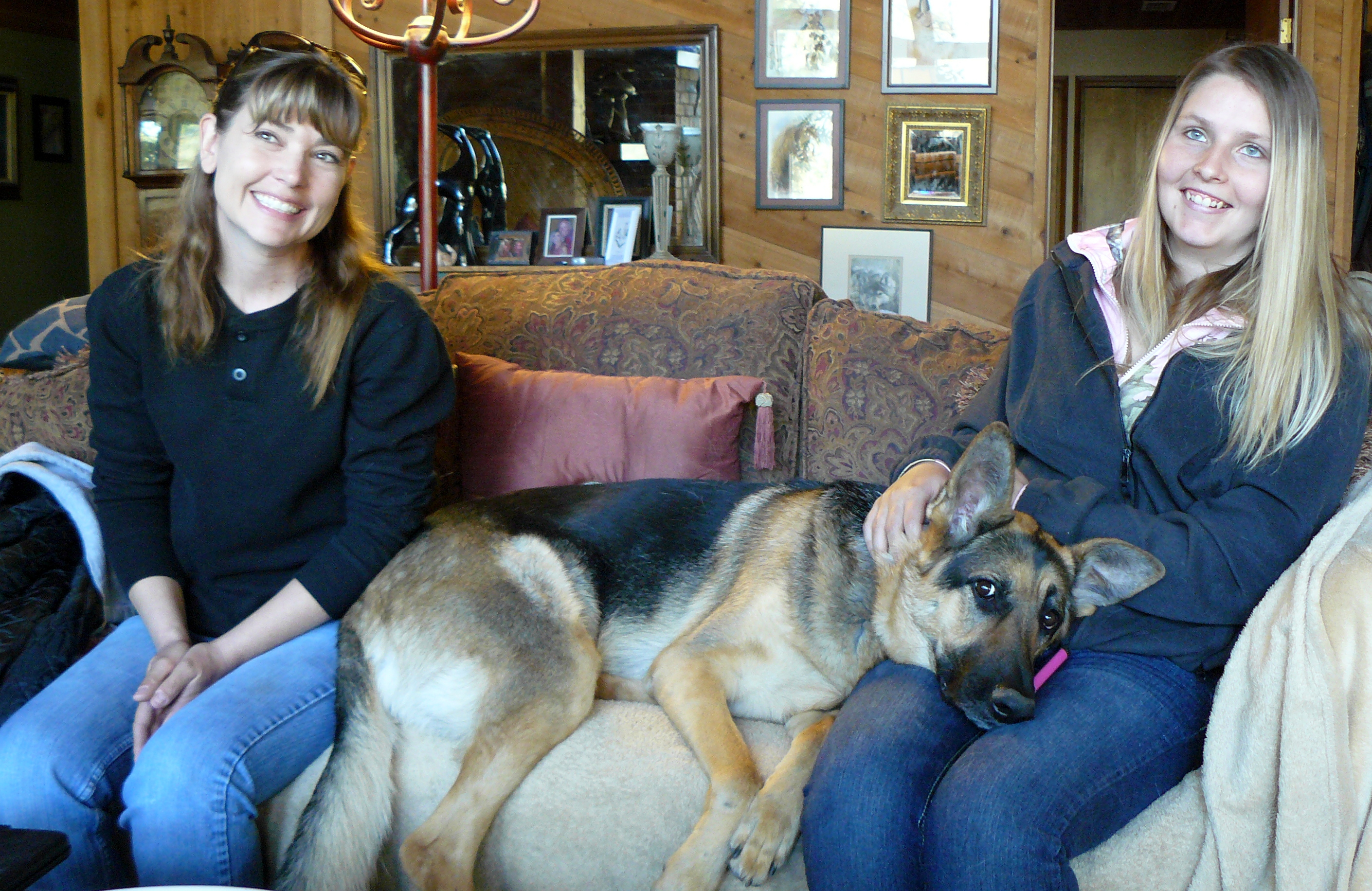
Cleo between guests Darla and Cody- picture taken yesterday.
(Come back tomorrow to learn why Darla and Cody were with us yesterday!)
Where to start? I guess by going back to the days I was living in Devon, England. That means going back to 2003, the year when it seemed the right time for me to get a dog. There was always only one breed to be considered; the German Shepherd dog. Thus that desire for a German Shepherd led me to Sandra Tucker not too many miles away who owned the GSD breeders Jutone. It was at Jutone’s where I saw the wonderful puppy dog who became my Pharaoh.
But Sandra did better than breed the dog that has meant more to me than words can ever describe, she gave me some fantastic advice. That being that when Pharaoh was getting on in life, then bring in a German Shepherd puppy. There were two solid reasons why this made sense. The first was that Pharaoh would teach the new puppy many of the skills and disciplines that Pharaoh had learnt as a young dog and, secondly, the puppy would keep Pharaoh active.
That puppy was Cleo.
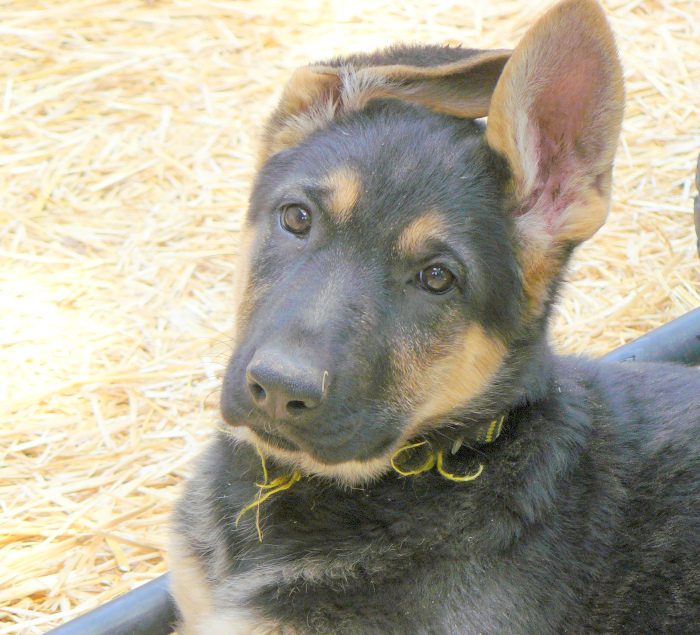
First picture of what was to be our puppy – 4th April, 2012, just two days before we brought her home.
oooo
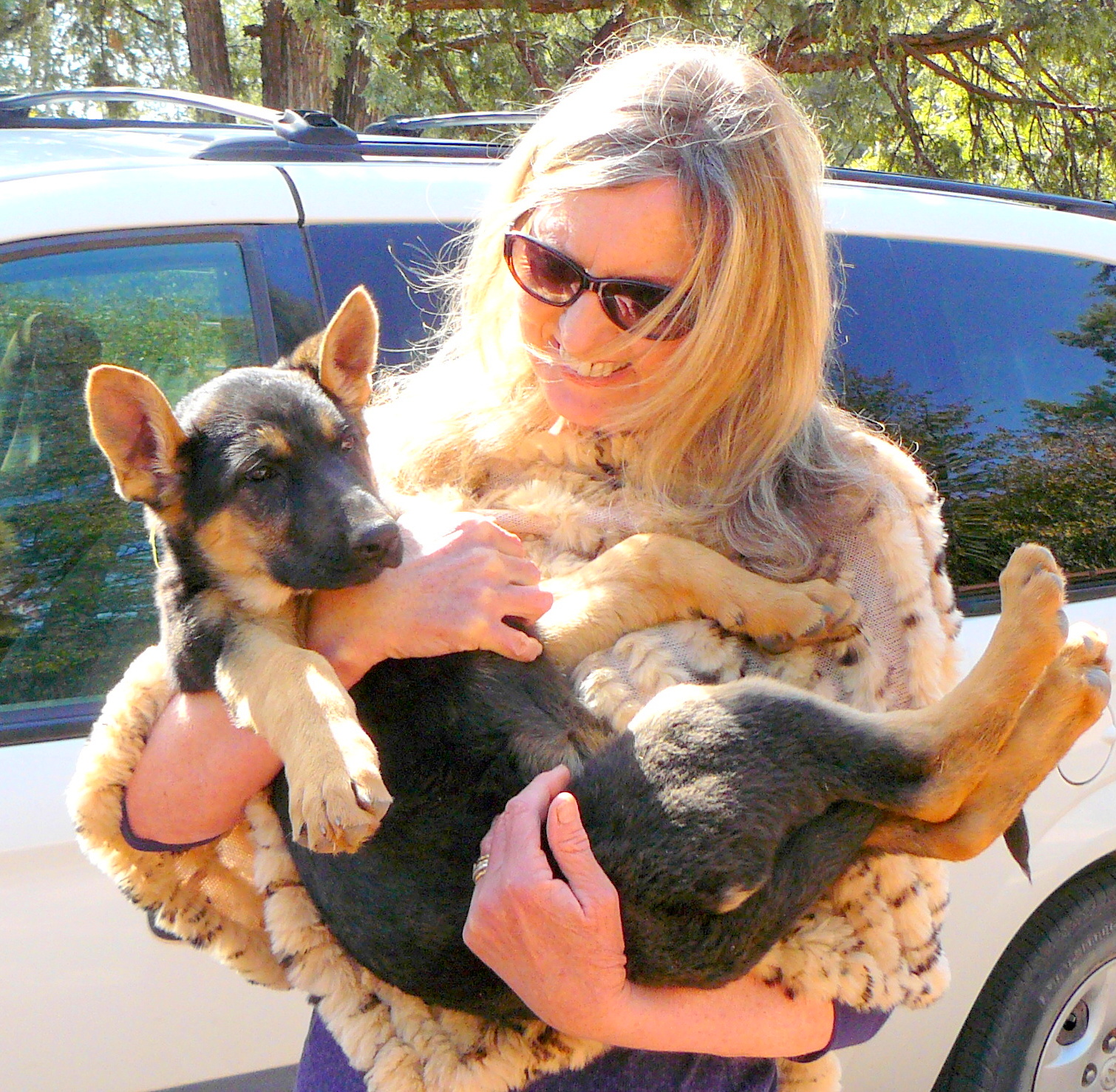
Puppy Cleo coming home – April 6th, 2012
Cleo was born on the 23rd January, 2012. At that time we were still living down in Payson, Arizona. Right from the start she was, and still is, the most joyful, loving dog one could imagine. That top photograph shows in her eyes the openness of her heart and soul.
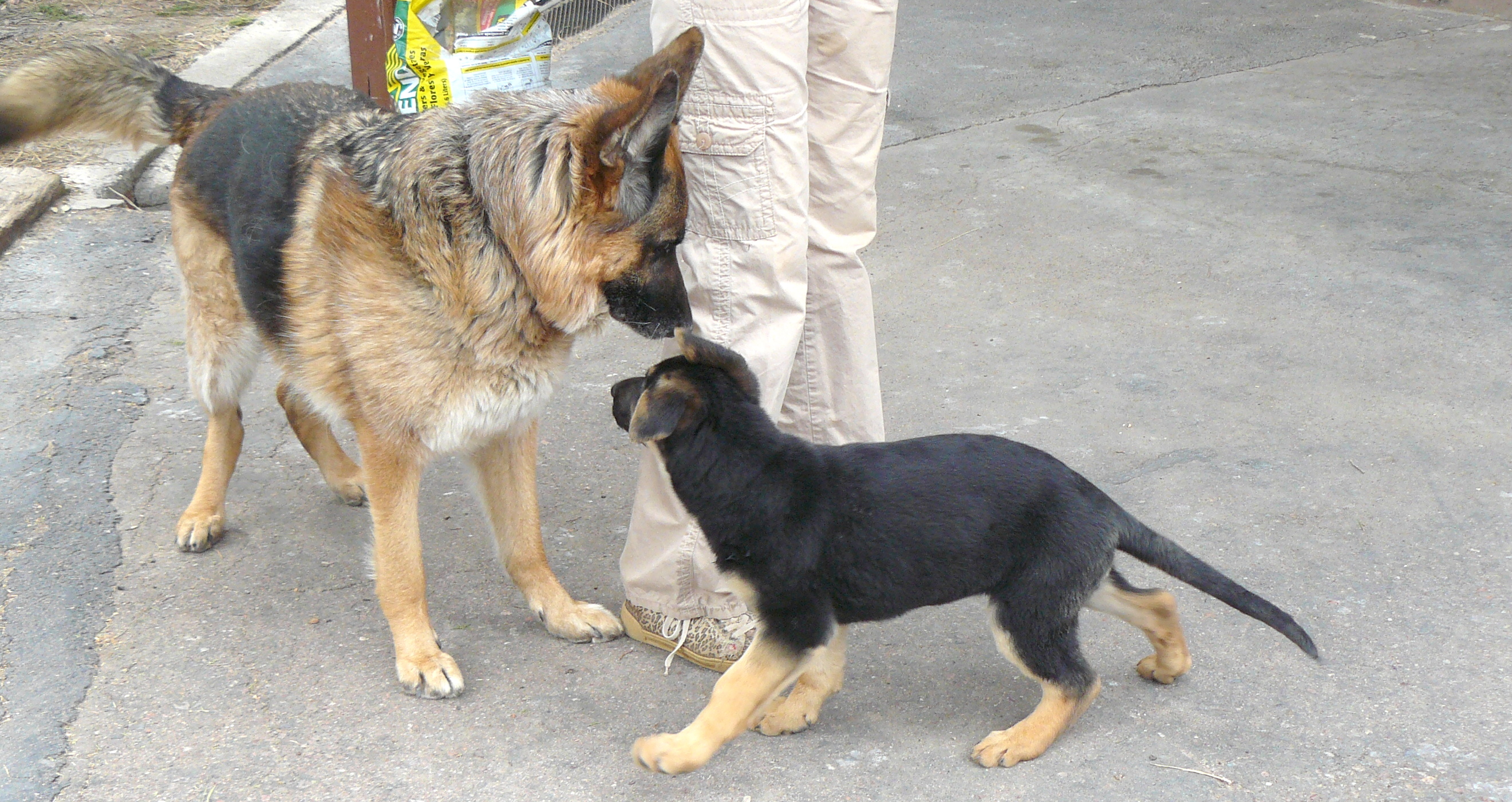
First meeting between Pharaoh and Cleo; April 7th, 2012.
So here we are coming rapidly up to the two-year anniversary of when Cleo entered our lives.
Cleo continues to be the most loving, gentle, sweet German Shepherd. As Sandra so correctly predicted, Pharaoh has ‘taught’ Cleo a number of commands such as Sit, Stay, Lie Down, Come, and more. Not a minute’s training of Cleo has come from Jean and me. Cleo is very fond of Pharaoh and it’s obvious that Pharaoh gets a huge amount from having Cleo around him.
Regular followers know that many of the items that get published here on Learning from Dogs are as a result of followers sending me stuff.
No less so than a recent item from Suzann where in a short email she included the link to a video.
Watch the video first.
I’m sure, like me, you were intrigued to find the background story. The YouTube page offers that background.
Elk vs. Photographer | Great Smoky Mountains National Park
Published on Nov 12, 2013
Update: I’ve been in contact with the photographer in the above video and we would both like to issue a statement regarding the news of the National Park Service’s decision to put the elk down. Vince M Camilo.
My statement:
I am deeply saddened by the fate of the elk. It has certainly pulled a black cloud over this whirlwind “viral video” experience.
I spoke to the reporter who broke the story and she assured me the decision was based on a pattern of aggressive behavior that began prior to the incident documented in this video. The behavior was the result of visitors feeding the elk and conditioning them to seek food from humans. This video only serves as an example of the elk’s dangerous behavior, not an impetus to it.
Again, it brings me great sadness to learn of this beautiful animal’s demise and the unfortunate circumstances surrounding it. I’m looking into a destination for proceeds from this video to help the NPS educate visitors on the dangers and consequences of feeding wildlife.
I also want to be clear that James, the photographer, was not complicit in a behavior that led to the elk’s demise, but rather was made an example of the result of such behaviors. The elk approached him from behind, likely looking for food as he was conditioned to do.
Statement from James (the photographer):
I love and respect animals and that’s why I photograph them and don’t hunt them. I am deeply hurt by the loss of such a beautiful creature that in its own way bonded with me. I looked forward to watching him grow to a mature bull as the years passed.
I’m truly heartbroken to know he is gone.
Original video description:
While photographing elk at sunrise in the Cataloochee Valley of Great Smoky Mountains National Park I turned around to see what appeared to be just a curious young bull sniffing a photographer’s camera. I snapped a few frames of the apparent harmless encounter.
But the elk became more interested in making trouble than simply the scent of a camera. He started physically harassing the photographer, escallating to full on head-butts.
I quickly switched the camera to video and let it roll (much of the time wondering when I should seriously consider intervening).
Most people who see this ask why the photographer seems to just take the abuse. I asked him in an email what was going through his head. This is his response:
“My first thoughts were “wow, he’s getting pretty damn close here.” But I’ve been up close before without incident. I hoped being still and passive would see him pass on. When he lowered his antlers to me, I wanted to keep my vitals protected and my head down. I felt that standing up would provoke him more and leave me more vulnerable to goring. I think that while protecting myself with my head down, having my head down was a signal that I was rutting with him. I was concerned at first, but when he started rearing back and lunging at me later on, I got scared and pissed off. That’s when I wagged my finger at him to cut that shit out. I was relieved to see the Ranger coming.
So I guess at some point if the Ranger hadn’t of pulled up, I would have had to disengage the best I could. I’ve joked with my friends that at least he took me for a buck and not a cow!”
This video is managed by Newsflare. To use this video for broadcast or in a commercial player email newsdesk@newsflare.com or call +44 (0)843 2895191.
“That’s why I photograph them and don’t hunt them.” Clearly, if I was to be objective in this post I would have to seek a explanation from the National Parks Service as to why the Ranger thought it necessary subsequently to kill the elk. You can tell that I am more than saddened by the outcome.
“Study nature, love nature, stay close to nature. It will never fail you.”Frank Lloyd Wright.
Until we learn that we are part of the natural order, that we don’t stand above it, then there is little hope for humanity.
Reason I state that is, as of yesterday morning, some 19,070,066 viewings of the following video had taken place.
But so what!
That number shows that despite the advertising insertions, despite the video promoting a commercial concern at the close, there are plenty of us who want to be reminded of the power of words.
Whatever words we utter should be chosen with care
for people will hear them and be influenced by them
for good or ill.
Buddha.
Footnote:
Jean and I were pottering around yesterday afternoon getting everything ready for Ranger’s arrival planned for Tuesday. In the back of my mind was some self-criticism for just sticking today’s post up in front of you, in the sense that it was just too easy. Not that the message isn’t powerful but does it relate to the essence of this blog – exploring what we can learn from dogs?
Then it struck me as blindingly obvious! Of all the things that dogs offer us humans, the one key aspect of their integrity is their unconditional love. The way that dogs love us acknowledges our existence at a ‘being-to-being’ level.
That’s the power of that short video. That the passing lady stopped and acknowledged the existence of the blind beggar-man.








 Learning from Dogs