The poetry of the young.
Last Saturday, I was going through my inbox and reading the new emails. I subscribe to The Conversation and in the articles of the 25th June was the following.
Now the article speaks of American youngsters but my guess is that in many other countries the young are similarly positive.
ooOOoo
I have spent the past 6 months reading hundreds of poems by young people – I was surprised to find hope, not despair
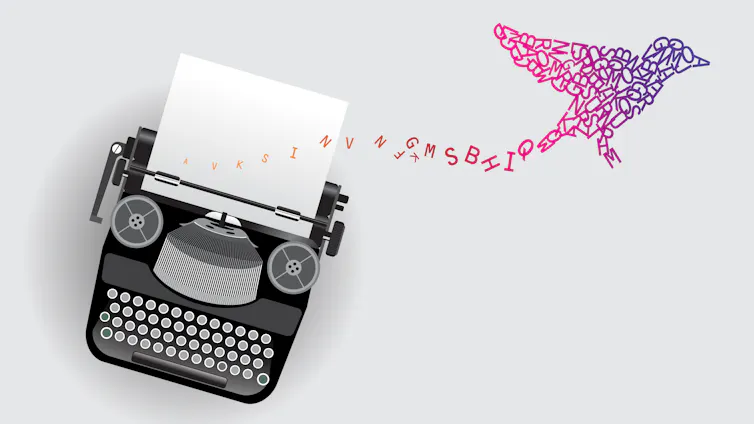
Sean Murphy, Shenandoah University
If you’ve read any commentary about younger people, none of the following statistics will surprise you.
Approximately 19% of Americans who are 12 to 19 years old are depressed – higher than any adult age group. Only about 58.5% of teens who are 12 to 17, meanwhile, say they consistently receive the emotional and social support they need. They often have little faith in institutions – be it the government or schools, or one another. And the average American child age 8 to 18 spends 7.5 hours a day watching or using screens.
On the one hand, these statistics are understandable: Young people are facing a future shaped by climate anxiety, political extremism, economic instability and chronic loneliness.
But those numbers may only be telling part of the story.
I have spent the past six months reading hundreds of poems submitted by young writers age 10 to 21. In June 2026, we will publish an anthology of writing from 177 of these young people in the “1455 Young Poets Anthology.”
More than 300 young people submitted their poems to a nonprofit I run, called 1455 Storytelling Arts. The poets mostly come from the U.S., but nine other countries are represented.
I continually found myself surprised, encouraged and inspired while reading their poetry. In a world that sometimes seems to reward the noisiest and the most aggressive, the wealthiest and the most selfish, these young poets understand something at once simple and profound that I think many adults have forgotten: Hope is not optimism. It’s endurance.

‘The only way through is through’
For the young writers whose work crossed my desk, hoping for a better future seems to be both a personal and collective act of accountability. It’s a refusal to accept a status quo in politics and other ways of life that might not work for some people.
Again and again, young people submitted poems that wrestled with loneliness, fractured families, violence, identity, anxiety, grief and uncertainty.
Layla Dwelle, age 15, confronts this tense atmosphere of information overload and anxiety, writing, “I’m tired of the cycle / I’m tired of evil / I’m tired of what is done / I’m tired of what isn’t.”
Yet many also revealed an unwillingness to surrender entirely to despair. Alicia Chow, age 14, writes, “I realize the only way through is through / So I keep moving as defiance of loss.”
These poems acknowledge pain, but identify tenderness in the darker corners of life. They describe a world that has a soundtrack set on two extremes: chaos and silence. They grapple with real fear and insist that bearing witness to the world gives purpose and meaning to people’s lives.
These writers, in short, are not giving up – they are looking to create a future that revises the dysfunctional present, which they see as a work in progress.
The titles of some poems speak volumes about the worlds and feelings these poems explore: “Self-Portrait as a Firefly,” “The Cost of Rain,” “The Ones Who Run,” “Prayer for a New Season,” “The Grass That Grows in the Cracks” and “Scars on Soul.”
Where reality meets urgency
What struck me most while editing this anthology was not the poets’ honesty or vulnerability, though both of those qualities were present.
Instead, it was their maturity that really stood out. There’s a focused seriousness present in their writing that combines political reality with a sense of urgency.
Here’s Emily Bennett, age 18, from her poem, “For the Love of the Sunk Cost Fallacy”:
Because,
nothing true aches forever.
And sometimes the bravest thing
you can do is simply open your hands.
Many of these young writers are trying to answer questions that adults themselves struggle with or avoid, including how to remain human in a culture that monetizes distraction.
This is an issue the American writer Jenny Odell compellingly addresses in her 2019 book, “How to Do Nothing: Resisting the Attention Economy.” Her thesis, simple yet radical, is that attention is people’s most vital resource, and all people are being bombarded, 24/7, with algorithmic strategies looking to distract and divide them. She astutely describes “the mindless traffic of information,” which, not so coincidentally, is something poetry has always stood in quiet defiance of.
The poems raise other questions. How do people care for one another without becoming uncomfortably numb to others’ pain and suffering? How do people imagine and create a future while they are constantly reminded of growing inequality within many countries, and with the world’s wealthiest people quickly growing richer?
The fact that so many young people are still turning to poetry feels, to me, significant, if not momentous.
Poetry is typically not a commercially rewarded art form. It obliges readers to slow down, sit with ambiguity and experience language in ways that plumb interior life.
If today’s algorithms reward speed, branding and certainty, poetry rewards reflection. This is the thesis of professor and Atlantic editor Walt Hunter’s illuminating – and quite encouraging – recent article, “Stop Meeting Students Where They Are,” which we recently discussed in detail on my podcast, “Some Things Considered.”
Young Americans may not have given up after all
Younger people are not oblivious about the world’s problems. The young poets I’ve been reading see empathy not as weakness, but as a bold imperative to help make the world a kinder, more just place.
I can hardly think of a better example than 16-year-old poet Dave Thompson’s provocatively titled “What if Jesus Was a Little Brown Boy in the USA”:
But you are here.
A little God walking to school,
still foolish enough
still holy enough
to believe love might mean
what it says.
As a podcaster and professor of storytelling, I can’t count how many times I’ve heard people my age or older lament that today’s generation doesn’t read or doesn’t care. This issue comes up at almost every panel discussion I’ve recently participated in.
I think these kinds of assertions about young people are both simplistic and unhelpful. In some ways, while mental health is a real concern for young people, they are doing better than their predecessors in other ways. Youth arrest rates have been declining since the 1990s in the U.S., for example, and American high school students are more likely than ever to graduate.
I think we should pay attention to some of the messages that these young poets are sending. We might even seek to emulate them.
Sean Murphy, Director, Center for Story, Shenandoah University
This article is republished from The Conversation under a Creative Commons license. Read the original article.
ooOOoo
Sean points out in this essay that: “The young poets I’ve been reading see empathy not as weakness, but as a bold imperative to help make the world a kinder, more just place.”
And then there is the poetry from Dave Thompson, presented above. Dave is sixteen, sixty-five years younger than me, but showing that age isn’t an issue. In his poem he writes: “… to believe love might mean what it says.”
Beautiful!


This is interesting and I think that this, social media, has contributed to the loneliness and anxiety of people around the world. The proposed banning of social media for young people under 16 in the UK is, I think, a good idea. It would mean that these children and young people would be able to find other pursuits outside of staring at a screen. Being able to speak to one another, to articulate a sentence or a feeling, having pursuits which don’t involve the internet or social media specifically, can only be better. Re-learning the declining art of handwriting (here I am typing 😬), reading an actual book made out of paper, following a recipe in a cookbook, asking someone for directions, swim, climb trees, walk, shop in an actual store… The list is endless.
The worst thing I saw was one comment from a “concerned” parent who merely said “what is my daughter going to do, stare at a wall for the seven hours a day she spends on Insta, FB and Twitter?”.
I do hope the world isn’t so lost.
LikeLike
I do agree with you when you say that social media has contributed to the issue. Plus, I share your hope that the world isn’t lost. I share that in spades!
LikeLike