Kingfishers have stout bodies, very short tails, short, rounded wings, large heads and long, dagger-like bills.
Their feet are very small, with the two outer toes partly fused together. They nest in holes tunnelled into earth banks. There is only one UK species, but many more worldwide, most of which are dry-land birds rather than waterside ones like the UK kingfisher.
Posted by Deborah Byrd in Astronomy Essentials | Earth|December 15, 2019
December solstice 2019 arrives on December 22 at 4:19 UTC.
That’s December 21 for much of North America. High summer for the Southern Hemisphere. For the Northern Hemisphere, the return of more sunlight!
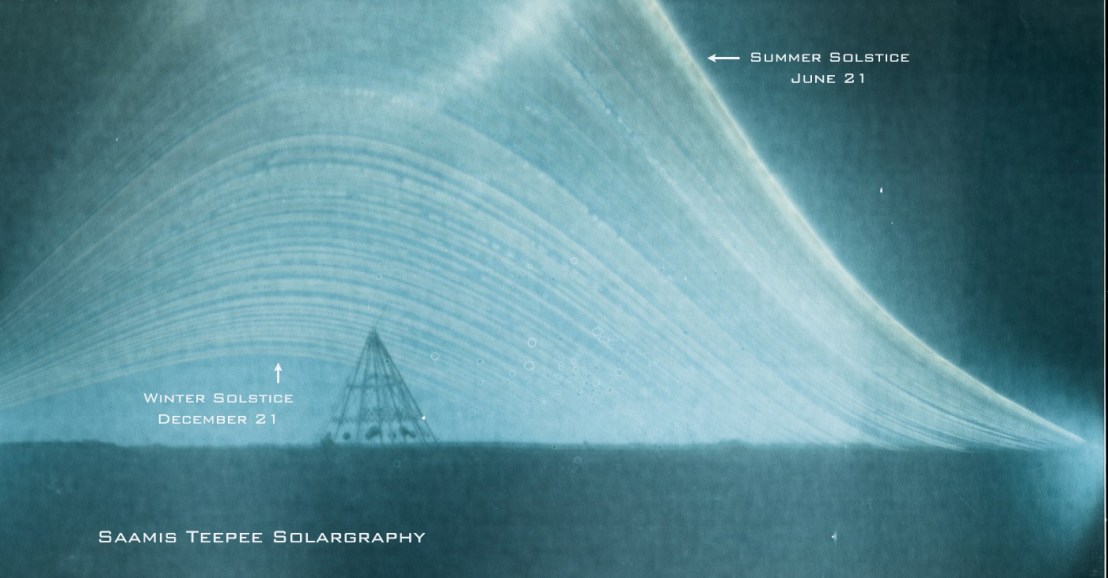
Ian Hennes in Medicine Hat, Alberta, Canada, created this solargraph between a June solstice and a December solstice. It shows the path of the sun during that time period.
Late dawn. Early sunset. Short day. Long night. For us in the Northern Hemisphere, the December solstice marks the longest night and shortest day of the year. Meanwhile, on the day of the December solstice, the Southern Hemisphere has its longest day and shortest night. The 2019 December solstice takes place on Sunday, December 22, at 04:19 UTC (That’s December 21 at 10:19 p.m. CST; translate UTC to your time).
No matter where you live on Earth’s globe, a solstice is your signal to celebrate.
When is the solstice? The solstice happens at the same instant for all of us, everywhere on Earth. In 2019, the December solstice comes on December 21 at 10:19 p.m. CST. That’s on December 22 at 04:19 Universal Time (UTC). It’s when the sun on our sky’s dome reaches its farthest southward point for the year. At this solstice, the Northern Hemisphere has its shortest day and longest night of the year.
Just remember: you’re translating from 04:19 UT on December 22. For example, if you live in Perth, Australia, you need to add 8 hours to Universal Time to find out that the solstice happens on Sunday, December 22, at 12:19 p.m. AWST (Australian Western Standard Time).
Day and night sides of Earth at the instant of the December 2019 solstice (December 22, 2019, at 04:19 UTC). Image via EarthView.
What is a solstice? The earliest people on Earth knew that the sun’s path across the sky, the length of daylight, and the location of the sunrise and sunset all shifted in a regular way throughout the year. They built monuments such as Stonehenge in England – or, for example, at Machu Picchu in Peru – to follow the sun’s yearly progress.
But we today see the solstice differently. We can picture it from the vantage point of space. Today, we know that the solstice is an astronomical event, caused by Earth’s tilt on its axis and its motion in orbit around the sun.
Because Earth doesn’t orbit upright, but is instead tilted on its axis by 23 1/2 degrees, Earth’s Northern and Southern Hemispheres trade places in receiving the sun’s light and warmth most directly. The tilt of the Earth – not our distance from the sun – is what causes winter and summer. At the December solstice, the Northern Hemisphere is leaning most away from the sun for the year.
At the December solstice, Earth is positioned in its orbit so that the sun stays below the North Pole horizon. As seen from 23 1/2 degrees south of the equator, at the imaginary line encircling the globe known as the Tropic of Capricorn, the sun shines directly overhead at noon. This is as far south as the sun ever gets. All locations south of the equator have day lengths greater than 12 hours at the December solstice. Meanwhile, all locations north of the equator have day lengths less than 12 hours.
For us on the northern part of Earth, the shortest day comes at the solstice. After the winter solstice, the days get longer, and the nights shorter. It’s a seasonal shift that nearly everyone notices.
Earth has seasons because our world is tilted on its axis with respect to our orbit around the sun. Image via NASA.
Where should I look to see signs of the solstice in nature? Everywhere.
For all of Earth’s creatures, nothing is so fundamental as the length of daylight. After all, the sun is the ultimate source of all light and warmth on Earth.
If you live in the Northern Hemisphere, you can notice the late dawns and early sunsets, and the low arc of the sun across the sky each day. You might notice how low the sun appears in the sky at local noon. And be sure to look at your noontime shadow. Around the time of the December solstice, it’s your longest noontime shadow of the year.
In the Southern Hemisphere, it’s opposite. Dawn comes early, and dusk comes late. The sun is high. It’s your shortest noontime shadow of the year.
Around the time of the winter solstice, watch for late dawns, early sunsets, and the low arc of the sun across the sky each day. Notice your noontime shadow, the longest of the year. Photo via Serge Arsenie on Flickr.Meanwhile, at the summer solstice, noontime shadows are short. Photo via the Slam Summer Beach Volleyball festival in Australia.
Why doesn’t the earliest sunset come on the shortest day? The December solstice marks the shortest day of the year in the Northern Hemisphere and longest day in the Southern Hemisphere. But the earliest sunset – or earliest sunrise if you’re south of the equator – happens before the December solstice. Many people notice this, and ask about it.
The key to understanding the earliest sunset is not to focus on the time of sunset or sunrise. The key is to focus on what is called true solar noon – the time of day that the sun reaches its highest point in its journey across your sky.
In early December, true solar noon comes nearly 10 minutes earlier by the clock than it does at the solstice around December 22. With true noon coming later on the solstice, so will the sunrise and sunset times.
It’s this discrepancy between clock time and sun time that causes the Northern Hemisphere’s earliest sunset and the Southern Hemisphere’s earliest sunrise to precede the December solstice.
The discrepancy occurs primarily because of the tilt of the Earth’s axis. A secondary but another contributing factor to this discrepancy between clock noon and sun noon comes from the Earth’s elliptical – oblong – orbit around the sun. The Earth’s orbit is not a perfect circle, and when we’re closest to the sun, our world moves fastest in orbit. Our closest point to the sun – or perihelion – comes in early January. So we are moving fastest in orbit around now, slightly faster than our average speed of about 18.5 miles per second (30 kilometers per second). The discrepancy between sun time and clock time is greater around the December solstice than the June solstice because we’re nearer the sun at this time of year.
Solstice sunsets, showing the sun’s position on the local horizon at December 2015 (left) and June 2016 (right) solstices from Mutare, Zimbabwe, via Peter Lowenstein.
The precise date of the earliest sunset depends on your latitude. At mid-northern latitudes, it comes in early December each year. At northern temperate latitudes farther north – such as in Canada and Alaska – the year’s earliest sunset comes around mid-December. Close to the Arctic Circle, the earliest sunset and the December solstice occur on or near the same day.
By the way, the latest sunrise doesn’t come on the solstice either. From mid-northern latitudes, the latest sunrise comes in early January.
The exact dates vary, but the sequence is always the same: earliest sunset in early December, shortest day on the solstice around December 22, latest sunrise in early January.
And so the cycle continues.
Solstice Pyrotechnics II by groovehouse on Flickr.
Bottom line: The 2019 December solstice takes place on Sunday, December 22, at 04:19 UTC (that’s December 21 at 10:19 p.m. CST; translate UTC to your time). It marks the Northern Hemisphere’s shortest day (first day of winter) and Southern Hemisphere’s longest day (first day of summer). Happy solstice, everyone!
ooOOoo
Well for many in the Northern Hemisphere the worst of the winter weather is yet to come.
A fascinating article on vegetarian diets for our dogs.
We are non-meat eaters here at home. Have been for a while. Our diet is essentially vegan most of the time with some fish thrown in as well. It seems to be doing us well!
But what does us good is not what does dogs good. Not at all!
You know that dogs need meat but there was a recent article on Mother Nature Network which went into details:
Experts say plant-based diets don’t always give dogs the nutrition they need. (Photo: Stickler/Shutterstock)
More people are forgoing meat in their diets for a whole spectrum of reasons — from environmental to philosophical — and now vegetarians are taking a second look at their dogs’ meat-based diets too. As a result, more owners are putting their dogs on a vegetarian or even vegan diet to bypass the health and ethical dilemmas that come with a side of beef, pork or chicken in their pet’s kibble.
“I’ve been vegan for more than two years now, and I don’t wish to contribute to the slaughterhouse or factory farm industry for my own food nor for my dogs’,” explains Debra Benfer, who together with her husband owns three vegan dogs. “If people really read what ingredients are put in dog food, I believe more people would understand why a vegetarian diet is the way to go.”
Some of those ingredients include meat from animals deemed unfit for human consumption, known in the pet food industry as the 4 Ds — dead, dying, diseased or disabled animals. In addition, many commercial pet foods contain “meat meal” or “byproducts,” which can include various animal parts and slaughterhouse waste that don’t exactly match the idyllic pictures of juicy meat chunks often seen on a bag or can of dog food. Much like commercial meat for humans, meat used in pet food can contain hormones, pesticides and antibiotics, a concern that has led many dog owners to seek alternative diets.
“If someone is saying it’s OK to give my dog these things, I would add a 5th ‘D’ to that equation and say ‘don’t,’” says Jill Howard Church, president of the Vegetarian Society of Georgia. “As a vegetarian, I know what’s in human meat and since the meat that falls below the human standard is what goes into pet food, it gives me cause for concern.”
Church’s two dogs were on a vegetarian diet for their entire lives and lived to be a healthy 15 and 19 years old. Church currently has a 3-year-old black Labrador retriever that’s also thriving on a vegetarian diet.
Church and Benfer’s positive experience with vegetarian dog diets is mirrored in hundreds of testimonials found on the internet from owners who have successfully switched their dogs to a vegetarian diet. Some owners have bypassed the dog food industry altogether by cooking their own wholesome vegetarian dog meals.
“People are taking control of their animals’ diet back into their own hands instead of relying on the pet food industry so much,” says Greg Martinez, author of “Dog Dish Diet: Sensible Nutrition for Your Dog’s Health“. “We’ve all been held hostage by industry a little bit.”
In addition to decreasing a dog’s carbon pawprint (meat production is a major contributor to greenhouse gas emissions), owners say that putting their dogs on a vegetarian diet has resulted in everything from longer life spans and shinier coats to decreased aggression.
‘It is truly unnatural for them’
It would be smart to consult with a veterinary nutritionist before switching to a vegetarian diet for your dog. (Photo: Rasulov/Shutterstock)
However, there are those who worry that vegetarian dogs may not be able to get adequate nutrition from a plant-based diet. Dogs, like humans, are omnivores, meaning they can survive on a diet of either plant or animal origin, but owners must be careful to ensure that their dogs are getting the proper nutrients from plant-based ingredients. (Cats, on the other hand, are strictly carnivores.)
According to the Association of American Feed Control Officials (AAFCO), a non-regulatory industry group that establishes pet food standards, dog food for an average adult dog should contain about 18% protein, an amount deemed necessary for good health and proper growth and development. But since every protein source contains different levels of amino acids, which are protein’s building blocks, all protein is not created equal. Some proteins are better for pets than others. For example, egg and cottage cheese are considered quality sources of protein for dogs.
“Vegetarian proteins tend not to have all the amino acids, so you have to do multiple combinations of varying types of sources of protein to get the right amino acids, which can get a little tricky to manage,” says Dr. Jessica Waldman, a veterinarian who operates a full-time pet rehabilitation clinic in Santa Monica, California. Waldman says she steers her clients away from vegetarian diets because she believes they are unnatural.
“Although I think it would be possible to put a dog on a vegetarian diet, it is truly unnatural for them,” says Waldman. “There are still dogs in the wild and they eat a vast majority of animal protein, so I think that keeping your pet’s diet as close to natural is best for limiting disease and promoting health.”
Other vets disagree, arguing that dogs can successfully be vegetarians as long as their diet is balanced and they are able to get proteins from varying sources.
Dr. Jennifer Larsen, a veterinary nutritionist at the University of California-Davis, says that both commercial and home-cooked vegetarian diets “can be used safely and can provide adequate nutrition if carefully and appropriately formulated” and as long as owners pay special attention to providing their dogs with the proper protein and amino acids.
Commercial vegetarian diets and home-cooked options are prescribed by veterinarians for dogs with specific diseases, but there currently isn’t much extensive research to prove or disprove their healthfulness. One survey conducted by PETA found that 82% of dogs that had been vegan for five years or more were in good to excellent health and that the longer a dog remained on a vegetarian or vegan diet, the greater the likelihood that the dog would have overall good to excellent health.
The study, however, also found that vegetarian dogs may be more prone to urinary tract infections as well as a form of heart disease known as dilated cardiomyopathy, which can be caused by a deficiency of the amino acids L-carnitine or taurine. But as the researchers pointed out, DCM isn’t just a problem for vegetarian dogs since L-carnitine and taurine also can be washed away in the processing of meat in commercial dog food.
To help bypass this problem, some commercial dog food companies like V-dog, a high protein vegan dog food, have added taurine and L-carnitine to their formulas to insure quality health that “exceeds the nutrient profiles established by the AAFCO,” says V-dog President David Middlesworth.
Though putting dogs on a vegetarian diet may remain controversial until further studies are conducted, veterinarians and vegetarian dog owners can agree that people considering putting their dog on a vegetarian diet should first do their own research to determine what’s best for their individual dog’s needs and/or consult their veterinarian.
Jennifer Adolphe, an animal nutritionist at the University of Saskatchewan, told The Washington Post that pet owners should do research. She advises pet owners to do “some homework to find out who is behind the company, if it employs a full-time qualified nutritionist, what kind of quality control measures do they use.”
“It just takes research and the willingness to stick by your reasons for having your dogs on a vegetarian diet,” says Benfer, who often makes homemade dog food for her three vegan dogs. “I get strange looks when I let people know my dogs are vegan, but it’s only because they aren’t educated about dogs being vegetarian and don’t realize how easy and possible it really is to do.”
Editor’s note: This story has been updated with new information since it was published in August 2010.
ooOOoo
Well not much to add from me. This article is completely clear to my mind.
“Susan Combs” has published this post for us, but I was wondering if we could have a new guest post and pay the fees for that post directly to you? We would ghostwrite this, so it would have to published under your name.
Do let me know what you think and what you would charge for this!<
David
I then replied:
David,
I write my blog purely for pleasure, there is no charge.
Having said that, I also try hard not to promote commercial concerns and I’m unsure whether or not this applies to your goodself, I suspect not.
Please give me some further details about your intended article plus some information about yourself.
Regards,
Paul
Well the article came through a couple of days ago and it is a commercial, profit-seeking, company. I’m also in the unknown as to whether there are others in the same vein out there.
But I decided to publish it anyway because, who knows, there may be some out there who are interested in the service.
ooOOoo
A company turns people and pet’s ashes and hair into diamonds
By Melodie Beattie, a motivational author.
These powerful words ring true for the staff at Heart in Diamond (HID), where they make the impossible happen by taking cremated ashes or hair from a loved one or pet and turning it into diamonds.
Heartache led Anita to work with Heart in Diamond to help others
In particular, there is one employee at Heart in Diamond that can personally attest to this quote, and that is Anita Bolton. In 2011, Anita suffered the loss of her beloved husband. She was completely devastated following his death and Central England Cooperative Funeral Care was there to help her make the necessary plans for a memorial service and cremation for him.
Not only did the organization take care of all the arrangements for her, but they also informed her about Heart in Diamond, which is a company that allows people to pay tribute to the deceased by having a diamond created from some of their cremated ashes or a lock of hair. Anita talks about her first introduction to HID:
“I went to collect the ashes and that was when I was given a Heart in Diamond leaflet. I thought it was a beautiful way for me to remember my husband. I had never heard of the process at all. I had a white diamond created and my young son had a blue diamond.”
Anita also said that the beautiful white diamond ring has filled her with love, happiness, and it has created an everlasting bond. She believes that clients who reach out to the company to have their very own cremation diamond made will look at it and be reminded of their eternal love and it will become a treasured keepsake for many generations to come.
The company made such a great impact on Anita, that she decided to work with Heart in Diamond and became the business operations manager. In this role, she actually works very closely with the good people at Central England Cooperative Funeral Care, who are the same ones who helped her in those very dark and dreary days in her life. When talking about the work she does for Heart in Diamond, Bolton says:
“I’m very proud that Heart in Diamond has given me the opportunity to share my experience in a product I truly believe in and work within a dedicated professional caring team.”
If you would like to learn more about Anita, feel free to visit her employee page at the Heart in Diamond website.
HID is committed to providing personalized service
With an incredible combination of genuine love for people and an unerring passion for doing a good job, the team of dedicated professionals at Heart in Diamond was formed in 2005 when it set out to provide an extraordinary experience to every client they serve. According to the company’s About Us page:
“We pride ourselves by offering a personal service for your commemorative diamond.”
All the individuals that make up the HID team share a common vision and passion to demonstrate real care and love, inherent in each and every diamond they create. Some of the guiding principles of the company include:
We treat all samples with respect
Every customer is an individual and not a number
We provide personal service to each customer
We are committed to delivering a product of the highest quality
We are committed to delivering the best price on the market
We are committed to providing the shortest production time
We guarantee a genuine product through our unique authentication program.
Creating everlasting bonds worldwide since 2005
Heart in Diamond is a UK-based company that is also recognized as a world-renowned manufacturer of laboratory diamonds. If you or a loved one is dealing with grief from the loss of a close friend, spouse, family member, or even a pet, Heart in Diamond can provide you with unique tribute gifts that last a lifetime.
Carbon is extracted from either the ashes or hair of pets or people. Then, it is exposed to a laboratory-controlled environment that mimics the natural processes deep within the earth in order to grow the sample into a diamond. Lab-grown diamonds from HID are identical to mined diamonds in terms of physical, chemical, and optical properties, but they cost 20 to 30 percent less on average and they are a more ethical choice than conflict diamonds.
When you buy a commemorative diamond from HID, you not only receive a high-quality gem, but your cremation jewelry also serves as a living memory you can pass on to generation after generation.
ooOOoo
I then went across to the website hoping to get some pictures to share with you but they are not clear enough to view here.
But there’s a great deal of information that you may want to consider.
And, to state the obvious, I did not receive any compensation for publishing this.
In terms of the Webformix internet cut-outs there has only been one noticeable break and that was yesterday early morning.
So I feel confident in posting this food recall notice that also came in yesterday.
ooOOoo
Dear Fellow Dog Lover,
I’m pleased to report there have been no dog food recalls since September 26.
However, for our many dog owners who also own a cat…
J. M. Smucker has recalled certain lots of Special Kitty canned cat food because the product contains ingredients that “do not meet the company’s quality and safety standards”.
Eating the affected food may cause nausea, vomiting or a host of other symptoms… some more severe… including death.
Some dog foods previously recalled may still be on store shelves… or in your own home. So, if you’ve missed any of the 11 recalls we’ve sent since July… be sure to visit our Dog Food Recalls page for full details.
9 Best Dog Food Lists Recently Updated
Over the last 60 days, The Dog Food Advisor has updated the following best dog food pages:
This notice came in from Webformix, our local internet service provider:
Webformix Client,
Webformix will be undergoing central network maintenance overnight on Monday, Tuesday, and Thursday of next week, the 16th through the 18th of December. Due to the nature of this work, outages can be expected between 12AM and 6AM each day though we’ll strive to keep this downtime to a minimum.
We apologize for any inconvenience, and thank you for your patience.
-Webformix Staff







 Learning from Dogs