The following glorious story, a true story I should have made clear, was sent to me recently by Cynthia, wife of my long-term Californian friend Dan Gomez. It’s a story that was broadcast by TV Globo, not a station I had previously heard of. Unsurprising really when a quick web search finds their details:
Rede Globo, or simply Globo, is a Brazilian television network, launched by media mogul Roberto Marinho on 26 April 1965. It is owned by media conglomerate Grupo Globo, being by far the largest of its holdings.
Here’s that story.
ooOOoo
The Bricklayer and the Penguin
This penguin swims 5,000 miles every year for a reunion with the man who saved his life.
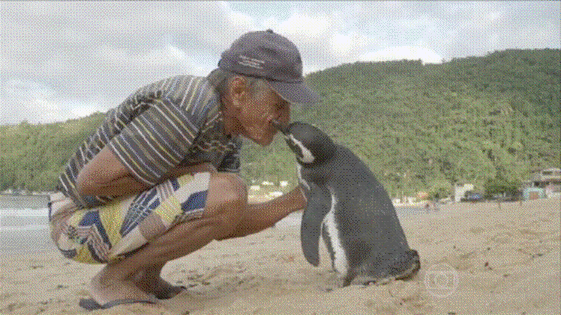
Best buds (Picture: TV Globo)
Todays most heartwarming story is brought to you from a beach in Brazil. The story of a South American Magellanic penguin who swims 5,000 miles each year to be reunited with the man who saved his life.
Retired bricklayer and part time fisherman Joao Pereira de Souza, 71, who lives in an island village just outside Rio de Janeiro , Brazil , found the tiny penguin, covered in oil and close to death, lying on rocks on his local beach in 2011. Joao cleaned the oil off the penguin’s feathers and fed him a daily diet of fish to build his strength. He named him Dindim.
The prodigal penguin returns (Picture: TV Globo)
After a week, he tried to release the penguin back into the sea. But, the bird wouldn’t leave.
He stayed with me for 11 months and then, just after he changed his coat with new feathers, he disappeared, Joao recalls. And, just a few months later, Dindim was back. The penguin spotted the fisherman on the beach one day and followed him home.
Look who’s back (Picture: TV Globo)
For the past five years, Dindim has spent eight months of the year with Joao and is believed to spend the rest of the time breeding off the coast of Argentina and Chile. It is thought he swims up to 5,000 miles each year to be reunited with the man who saved his life.
(Picture: Rio de Janeiro Federal University)
I love the penguin like it’s my own child and I believe the penguin loves me, Joao told Globo TV. No one else is allowed to touch him. He pecks them if they do. He lays on my lap, lets me give him showers, allows me to feed him sardines and to pick him up.
It’s thought Dindim believes the fisherman is also a penguin (Picture: TV Globo)
Everyone said he wouldn’t return but he has been coming back to visit me for the past four years. He arrives in June and leaves to go home in February and every year he becomes more affectionate as he appears even happier to see me.
(Picture: Rio de Janeiro Federal University)
Biologist Professor Krajewski, who interviewed the fisherman for Globo TV, told The Independent: “I have never seen anything like this before. I think the penguin believes Joao is part of his family and probably a penguin as well. When he sees him he wags his tail like a dog and honks with delight.”
And, just like that, the world seems a kinder place again.
ooOOoo
Unsurprisingly there are numerous videos of Joao and Dindim to be found on YouTube but I have selected the following one for you.
It’s wonderful how our worries about the nature of us humans can be swept away just as easily as an ocean wave breaking on a beach near an island village just outside Rio de Janeiro.
At all levels and in so many ways it is life-giving.
Animals must see touch as a natural way of living. We humans are less natural about touch especially with people that we don’t know so well. Not everyone, of course, but as a general statement it is probably not wrong.
The topic of touch has come to me today as a result of a recent item read over on The Conversation blogsite; specifically about the importance of touch between a doctor and his or her patient. Here it is republished within the terms of The Conversation:
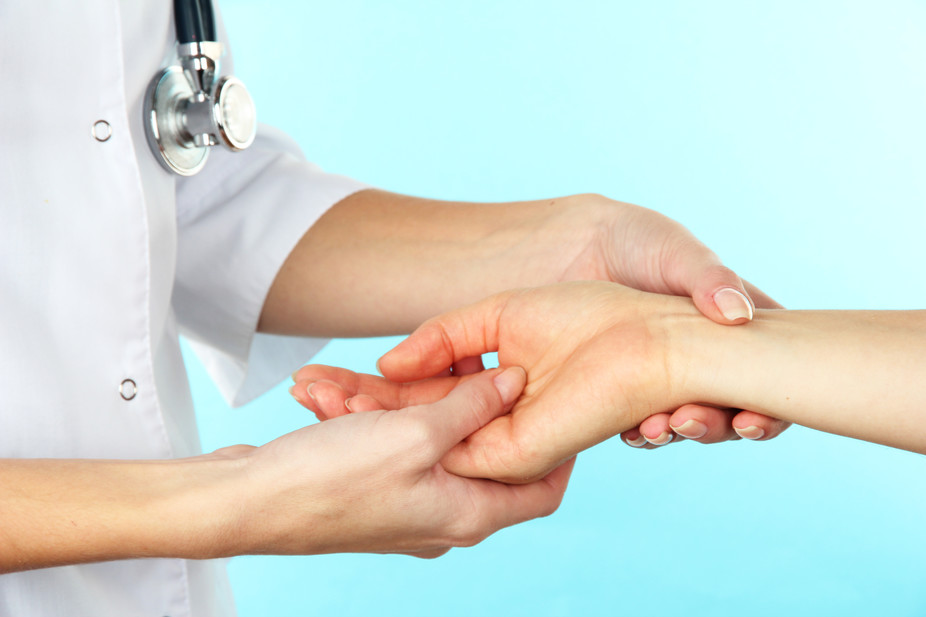
In contemporary health care, touch – contact between a doctor’s hand and a patient – appears to be on its way out. The expanding role of CT and MRI imaging is decreasing reliance on touch as a way of making diagnoses. Pressures to move patients through the system more quickly leave health professionals with fewer opportunities to make contact. Our experience suggests that when doctors spend fewer minutes with patients, less time is available for touch.
Yet despite the rise of scanners, robots and other new medical technologies, the physician’s hand remains one of medicine’s most valuable diagnostic tools. Touch creates a human bond that is particularly needed in this increasingly hands-off, impersonal age. Medical practice is replete with situations where touch does more than any words to comfort and reassure.
The USC psychologist Leo Buscaglia, whose habit of hugging those he met soon earned him the sobriquet “Doctor Love,” bemoaned our neglect of touch in his book, “Love,” in these terms:
Too often we underestimate the power of a touch, a smile, a kind word, a listening ear, an honest compliment, or the smallest act of caring, all of which have the potential to turn a life around.
For thousands of years, touch has been recognized as an essential part of the healing arts. Native American healers relied on touch to draw out sickness, and kings and queens were long believed to possess the “Royal Touch,” through which the mere laying on of hands could heal. The Bible contains numerous stories of the healing power of touch.
Touch is an essential part of our well-being
An indication of our need for touch can be found among our primate relatives. Psychologists have observed that many such species spend upwards of five hours of each day touching one another, partly through grooming. For many human beings, however, the daily dose of touching would be measured not in hours but minutes, perhaps even seconds.
Lack of touch can be hazardous to health. In experiments with primates some 60 years ago,
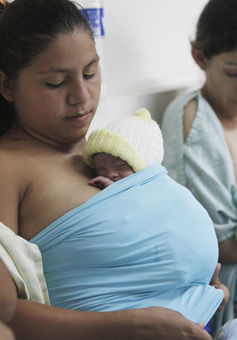
A young mother participates in a ‘Kangaroo Mother’ program at the National Maternity Hospital in El Salvador. Luis Galdamez/Reuters
researcher Harry Harlow demonstrated that young monkeys deprived of touch did not grow and develop normally. Mere food, water and shelter are not sufficient – to thrive, such creatures need to touch and be touched.
The same can be said for human beings. During the 20th century, wars landed many babies in orphanages, where their caretakers observed that no matter how well the infants were fed, they would fail to thrive unless they were held and cuddled on a frequent basis. Touch offers no vitamins or calories, yet it plays a vital role in sustaining life.
More recent studies have corroborated these findings. “Kangaroo care,” using papoose-like garments to keep babies close to their mothers, decreases the rate at which they develop blood infections. Touching also improves weight gain and decreases the amount of time that newborns need to remain in the hospital.
Touch creates a bond between doctor and patient
Novelist and physician Abraham Verghese has argued that touching is one of the most important features of the patient-physician interaction. When he examines a patient, he is not merely collecting information with which to formulate a diagnosis, but also establishing a bond that provides comfort and reassurance.
The notion that touch can reassure and comfort has a scientific basis. Ten years ago researchers used MRI scans to look at the brains of women undergoing painful stimuli. When subjects experience pain, certain areas of the brain tend to “light up.” The researchers studied subjects when they were alone, when they were holding a stranger’s hand, and when they were holding their husband’s hand.
They found the highest levels of pain activation when the women were alone. When they were holding a stranger’s hand, the pain response was decreased. And levels of activation were lowest of all when they were holding their husband’s hand. Interesting, the higher the quality of subjects’ marriages, the more pain responses were blunted.
Touch from parents helps kids in intensive care
We have been studying this phenomenon in our own institution, looking at the effect of touch not only on patients but on the parents of patients admitted to the pediatric intensive care unit.
The project, called ROSE (Reach Out, Soothe, and Embrace), sought to determine whether increasing opportunities to touch patients could promote parent well-being without compromising patient safety.
Instead of merely determining whether patients could be taken off the ventilator or fed, we also identified patients who could be safely touched and even held in their parents’ arms. When a patient was deemed safe to hold, a magnet bearing the image of a red rose embraced by two hands was placed on the door to the patient’s room.
While we are still analyzing the results and further study is needed to fully delineate the health benefits of touch, several findings are already clear.
First, increasing opportunities for touch does not compromise patient safety. Second, the subjective well-being of family members is enhanced when touching is encouraged. Third, promoting touch empowers family members to become more involved in their child’s care.
To be sure, inappropriate and unsafe touching can be harmful. But when touch is encouraged in the right ways and for the right reasons, it is good for patients, family, friends and health professionals alike. Touch is one of the most fundamental and effective ways to create a sense of connection and community among human beings.
In the words of the 20th-century theologian Henri Nouwen, who wrote in his book, “Out of Solitude”:
When we honestly ask ourselves which person in our lives means the most to us, we often find that it is those who, instead of giving advice, solutions, or cures, have chosen rather to share our pain and touch our wounds with a warm and tender hand.
So next time you find yourself confronted by a person in distress, remember the power of touch. Medicines and words both have healing power, but so does touch, and it is perhaps the most widely available, financially responsible and safest tool in the healing arts. When we touch, we connect, and when we connect, we create a healing bond for which there is simply no substitute.
ooOOoo
“When we touch, we connect, and when we connect, we create a healing bond for which there is simply no substitute.”
Jean with my mother back in July, 2014.
The healing touch!
Or to repeat the elegant words of Leo Buscaglia:
Too often we underestimate the power of a touch, a smile, a kind word, a listening ear, an honest compliment, or the smallest act of caring, all of which have the potential to turn a life around.
I wrote about this last Tuesday under the heading of Helping Hands and warned you that today and next Sunday would be picture parades of that event. For those that didn’t get to read that post here is how it opened:
The PetSmart Pet Adoption Event.
Over the days of the 13th to 15th May, in other words roughly a week-and-a-half ago, a number of pet adoption charities in Northern California and Southern Oregon came together courtesy of PetSmart in Medford, Oregon to find new homes for unadopted dogs and cats.
I came to hear about this from an email sent to me by Tammy Moore of the organisation Shelter Friends. Tammy also c.c.’d her email to Tana Mason who is Fundraising Coordinator for the charity. Tammy’s email was an invite for me, and Jean, to attend the event on the Saturday as the author of my book.
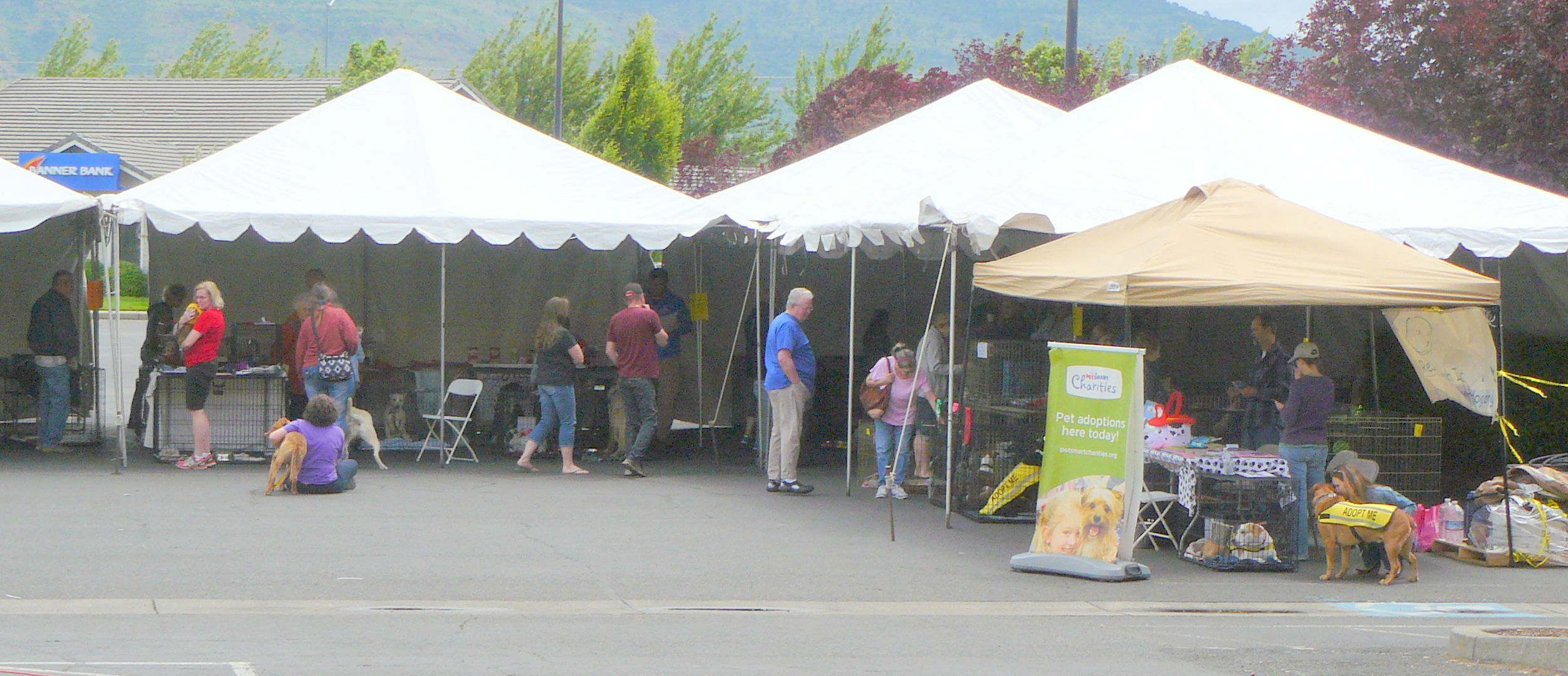
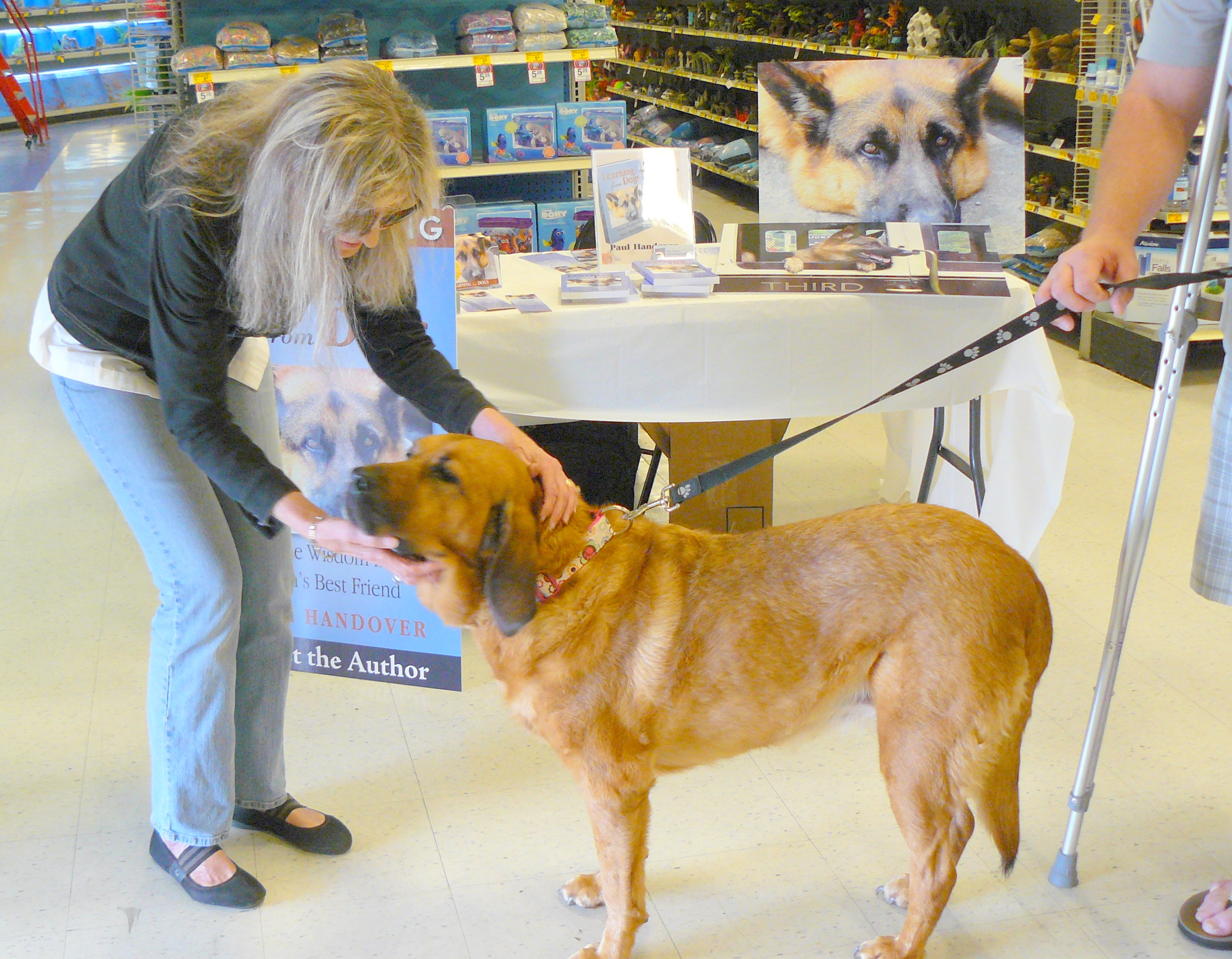
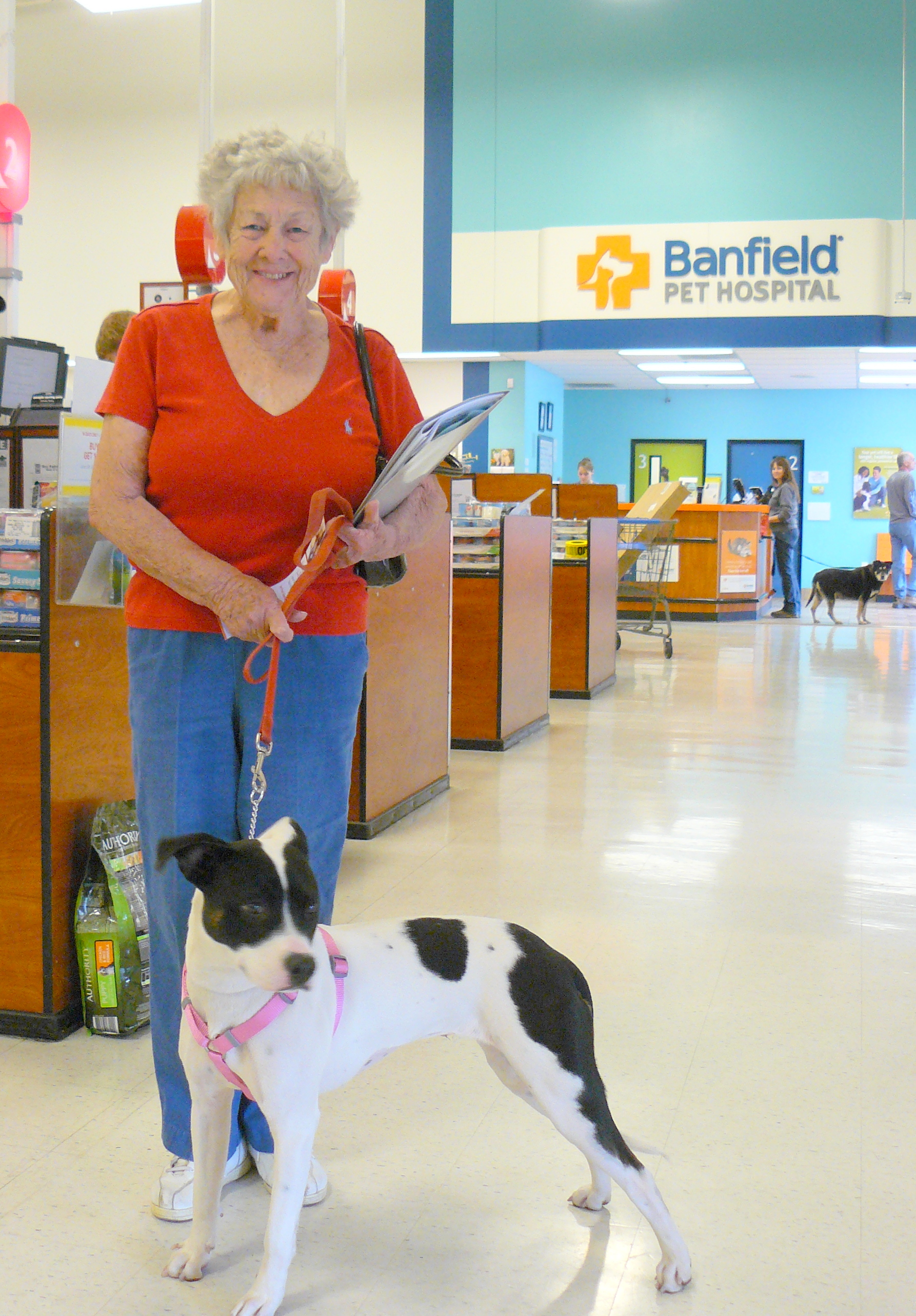
So, more pictures from the day (and my apologies for not noting names and details of each picture).
oooo
oooo
oooo
oooo
oooo
oooo
Do hope you can handle a further selection of these event photographs in a week’s time! My motivation is to give everyone concerned a bit of a special focus for they did so well.
In gratitude to Roger Davis, long-time friend from my UK days, who forwarded me the link to the following. (Caution, the video does contain some coarse language probably unsuitable for those below the age of 16.)
If you had to make a playlist of your life, what would be on it?
That intriguing sub-title comes from a video that Jean and I watched a couple of weeks ago.
But first I want to return to the matter of Parkinson’s Disease (PD) that was written about in a post dated the 24th February Personal Journeys. I wrote, in part,
Sue, and everyone else, we returned from seeing Dr. Lee, the neurologist, a little under two hours ago. Dr. Lee’s prognosis is that Jean is showing the very early signs of Parkinson’s disease, and Jean is comfortable with me mentioning this.
Everyone’s love and affection has meant more than you can imagine. I will write more about this next week once we have given the situation a few ‘coatings of thought’.
Jean sends her love to you all!
In recent weeks Jean has been experiencing increasing feelings of apathy, lack of motivation, lack of energy, all of which she summed up as a feeling of isolation. Plus the tremor in her hand has been slowly worsening.
Last week we decided that rather than waiting until August for the next planned appointment with Dr. Eric Lee, the neurologist, we should appraise Dr. Lee of the decline in Jean’s overall mood. That has now been done and Dr. Lee’s response is that Jean should start a trial course of the drug Sinamet® that a quick web search (see link on trade name) explains is:
SINEMET® (carbidopa-levodopa) is a combination of carbidopa and levodopa for the treatment of Parkinson’s disease and syndrome.
As before, Jean is happy for me to share this with you.
So back to the theme of playlists of our lives.
The Australian Broadcast Commission, ABC, have a YouTube channel ABCTVCatalyst that is full of great science programmes. As that website explains:
At Catalyst we know that science is a dynamic force for change. Each week Catalyst brings you stories from Australia and around the world. Our passion to meet scientists at the forefront of discovery is matched by our fascination with science breakthroughs however big or small. Science changes all our lives. For better or worse, we are committed to showing you what our future holds.
That is how Jean and I came across the following incredibly interesting talk about the role of music in our past lives assisting those with fading cognitive skills, as in my case, and including those with PD. It is just twenty-nine minutes long and something we should all watch, irrespective of our present age.
Published on Mar 8, 2016
If you had to make a playlist of your life, what would be on it? And if, toward the end of your life, your mind and memories were fading away, would this soundtrack help bring them back?
My final observation is that as a direct result of watching this programme I blew the dust off my iPod that I hadn’t used in many months. It was remarkable that despite me struggling at times to recall something I did just a few hours ago, I can hum along with tunes that are on my iPod that go back ten or twenty years.
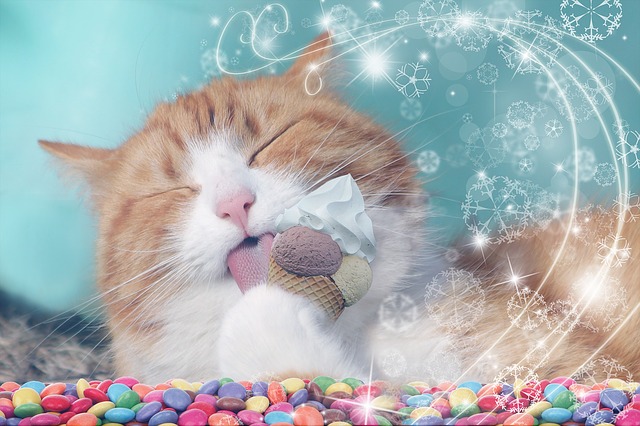
There are some foods that are potentially very dangerous for cats.
Over two years ago I published an article that had been written by a guest. His name is Rohit Agarwal and the article that he wrote for Learning from Dogs was called Dogs and Fences. As it is likely that some readers may not have recalled Rohit’s piece and my introduction, let me repeat a part of what I said in that introduction:
I had no foreknowledge of Rohit, who described himself thus:
Author Bio: Rohit is a dog lover and pet enthusiast; he owns two adorable and wonderful dogs that include a German shepherd and a Labrador retriever. As work keeps him away from home, concerns arise about the safety and comfort of his pet friends, which made him try out various products that facilitate the same. Recently he was worried about leaving his dogs in the yard of his house and tried the underground fence for dogs, which worked great.
Rohit also made clear that he is a contributor to Petstek.com, the company behind the link in the last sentence of his bio.
Rohit’s article was well received so when he recently offered a further guest piece I had no hesitation in saying yes. Here it is.
ooOOoo
Six Foods Cats Should Never, Ever Eat!
We all are guilty of sneaking our animal family members some human food. In the case of our felines, they often sneak their own tasty treats. It is all fun and most food is generally safe for cats to eat. Unfortunately, not all of our food is considered safe for cats to consume. Here are a few foods to avoid.
Raisins seem like a totally safe option for an animal, but unfortunately they are quite dangerous for felines. Scientists haven’t figured out the toxin, but consuming raisins can lead to sudden kidney failure in cats. This also means that grapes are off limits. If you notice that your cat has consumed either grapes or raisins, watch them closely for signs of toxicity. These signs include diarrhea, lack of appetite, lethargy, and abdominal pain. Usually, to cause death, large amounts have to be consumed, but even small amounts can lead to sickness.
Onions
Onions can potentially destroy a cat’s red blood cells which can cause a number of blood problems, such as anemia. This holds true for onions in any form, such as powdered, raw, and cooked. Onion powder can be in a multitude of food so be sure to read labels if you think you might give your feline friend a taste of dinner. Garlic is in the same family as onions, so therefore, all of this holds true for garlic in all forms. Garlic is less toxic.
Raw eggs
Humans are supposed to avoid eating raw eggs, so it make sense that our felines should avoid it as well. Eating a raw egg contains a risk of a bacterial infection which is called food poisoning. Your cat could potentially get salmonella or E.coli. Both of these infections could easily lead to death in such a small animal.
Alcohol
Now, this one might seem obvious, but cats are known for being sneaky and taking a lap of their owner’s drink. Consuming even small amounts of alcohol can lead to intoxication and alcohol poisoning. Because of their size, it can take as little as two teaspoons to do damage to their system or cause the cat to enter into a coma. More than two teaspoons can quickly lead to death.
Caffeine
Just like in canines, caffeine is not recommended for any breed of cats. In large quantities, caffeine is capable of being fatal. It is a diuretic that can lead to dehydration. Caffeine also overstimulates the heart and nervous system. If your cat consumes any, watch for signs of caffeine poisoning which includes restlessness, rapid breathing, heart palpitations, and tremors. Remember, caffeine isn’t just in coffee and soda; it is also found in tea, cold medicines and chocolate of all forms.
Chocolate is also lethal to cats, just as it is extremely dangerous for dogs. The agent in chocolate that leads to death is called theobromine. It can be found in all forms of chocolate, but it is especially dangerous in unsweetened baking chocolate. Eating chocolate can lead to tremors, an abnormal heart rhythm, seizures, and death.
Fat Trimmings and Bones
This one doesn’t seem so obvious; felines eat meat so one would assume fat trimmings would be safe. Consuming fat can lead to intestinal issues such as vomiting and diarrhea. It can also cause pancreatitis. Signs of pancreatitis include lethargy, dehydration, and loss of appetite. Sometimes, a cat can also run a fever. Avoiding bones does make more sense. Small bones can easily splinter which could cause lacerations in the stomach or choking.
If you believe that your cat has eaten any of these foods, you should watch them closely for any signs of illness. Contact your veterinarian if concerned. Prevention is key to keeping your feline friend safe.
Sully the Saint Bernard still hasn’t outgrown his love for mud.
I was working outside until late afternoon so wanted to find something quickly for today’s post.
Came across this video on YouTube from Rumble Viral – enjoy!
Published on May 19, 2016
At 4 years old Sully the Saint Bernard still hasn’t outgrown his love for mud. Here we find him playing with another dog as they run, jump and lay in a big pool of muddy water. If you’re wondering what pure happiness looks like, this is it!
One hopes these two happy dogs don’t go home and lay on the furniture.
Over the days of the 13th to 15th May, in other words roughly a week-and-a-half ago, a number of pet adoption charities in Northern California and Southern Oregon came together courtesy of PetSmart in Medford, Oregon to find new homes for unadopted dogs and cats.
I came to hear about this from an email sent to me by Tammy Moore of the organisation Shelter Friends. Tammy also c.c.’d her email to Tana Mason who is Fundraising Coordinator for the charity. Tammy’s email was an invite for me, and Jean, to attend the event on the Saturday as the author of my book.
(I would have written about the event before now but many of you will recall that was the weekend when my internet connection was down for a number of days.)
Anyway, that Saturday started off rather damp and grey but all the pet charities had previously been set up for the Friday.
But soon Jean and I had our own stand all ready for the opening time for the event and we were very grateful for being offered a table position just inside the main entrance door.
People soon started arriving and all were very friendly.
I shall continue with the photographs of the day over the next two picture parades.
But let me leave you with the results of all the fine people involved, both volunteers and the great staff at PetSmart.
In the words of Tana in answer to my question of how many animals were found homes:
I have the total for all three days, Friday, Saturday and Sunday: 9 puppies, 9 dogs and 14 cats!
I am not sure if this is a complete list of all the shelters that attended but certainly the following wonderful charities did:
Shelter Friends, Grants Pass, OR
Friends of Animals, Brookings, OR
Goliath Mountain Rescue, Yreka, CA
Rescue Ranch, Yreka, CA
Curry County Animal Shelter, Gold Beach, OR
“I believe in preventing cruelty to all living beings in any form.”
This quote from Morarji Desai, the former Prime Minister of India, is a very appropriate introduction to me republishing a post courtesy of Roughseasinthemed. It concerns the cruelty being meted out to some Spanish dogs. Or in her own words:
Thanks for picking up on the ‘dangerous’ dogs aspect. I think it is really important that dogs are not mislabelled, responsible dog owners have enough problems as it is. People are too quick to point fingers, and those of us who rescue dogs know what a difference food, water, a home, love and affection can make to a starving street animal. No dog asks to be thrown out. Or mistreated and abused. I’m currently trying to get some help and advice for a man who lives next to six Spanish hunting dogs that are chained up all day in a shed with a tin roof, where temps can go up to 50 degrees celsius, no food in their dishes and a floor covered in shit. Deplorable. These poor dogs must be traumatised.
Katherine later sent me a link to another blog with the details and some pictures. It is republished below, first in the original Spanish and then with an English translation.
ooOOoo
Perros de caza maltratados en Benissa:
Tenemos un “vecino” aquí en Benissa (Alicante), con 6 perros de caza encadenaros y estaban encerrados en una zona pequeña de 2 x 2m, un agujero tapado de placas de alumnio… las temperaturas en verano pueden subir a más de 50 grados, y los perros sufren terriblemente, lloran y ladran día y noche, viven y mueren en el infierno y sobre su propia “mierda”… Mi esposa y mi suegra están traumatizadas por esta crueldad, mandamos nuestra queja al Ayuntamiento y después de 8 meses respondieron que era lo que esperábamos por vivir en el campo… Tengo fotos tomadas de estos perros y su infames condiciones pero no estoy seguro de qué hacer con ellos porque aquí nadie parece querer saber nada…
We have a ‘neighbour’ here in Benissa, Alicante with six hunting dogs, chained up and imprisoned in a tiny hole of a place (agujero is a hole but it’s not a literal hole, or you could use hellhole, which would be my choice), two by two metres, covered with a tin roof.
The temperatures in summer get towards fifty degrees Celsius (122 deg F.), the dogs suffer terribly, they cry and bark day and night, and they live and die in the hell of their own ‘shit’.
My wife and my mother-in-law are traumatised by this cruelty, we’ve complained to the council and after eight months they’ve replied: ‘what do you expect when you live in the countryside?’
I’ve taken photos of these dogs and their suffering but I’m not sure what to do with them, because here, nobody seems to know what to do.
ooOOoo
In a response to Katherine I wrote that these dogs must be given better lives. She then added:
Fair enough Paul. We do too, so, easy to do. Sadly this man has contacted Seprona, which is the Guardia Civil section in charge of hunting, and they have washed their hands of it. But people are trying to help, coming up with suggestions, and that is the important thing.
When you read this please hold these dogs in your thoughts and hope that their terrible ordeal will soon come to an end. Also go to that blogsite that is carrying the story and leave your messages of support, in whatever language you choose! Every little bit helps, as this comment on that Spanish post illustrates:
Contact DeAnimals, a firm of lawyers in Murcia who work with the police, judges, vets etc on animal abuse cases. Also ACTIN in Murcia. They will tell you what to do.
“The ultimate tragedy is not the oppression and cruelty by the bad people but the silence over that by the good people.”Martin Luther King, Jr











 Learning from Dogs