Year: 2016

Picture parade one hundred and forty-four.

Now for something very different to the Dog Tired photographs.

I can’t recall how I came across the following photographs but they were seen on the website of Humbert & Shirley Fernandez and recommended for sharing with others. I agree and you will see why!


The Grand Canyon of Arizona

16gc

Welcome to awesome Photos of the Grand Canyon.

There is a Grand Canyon of Yellowstone which is nice, but no comparison to the beauty and Grandeur of the Grand Canyon of Arizona.
Following, are real photos taken by Professionals that most visitors are unable to capture with their cameras. The Photos were received in an email, too good to delete, should be shared with others. They are posted here for people to see and enjoy.

Pueblo-like dwellings over the Colorado River at Nankoweap Creek.

oooo

Horseshoe Bend
Horseshoe Bend

oooo

Canyon Walls as viewed from the Colorado River.

oooo

Grand Canyon Colors varies with the position of the Earth relative to the Sun.

oooo

Bright Angel Trail
Bright Angel Trail

oooo

7cgoooo

8gc0000

Cheyava Falls
Cheyava Falls

Another set of these stunning views of the Grand Canyon in a week’s time.

You all take care of yourselves and don’t stand too close to cliff edges!

Reaching out with love.

Giving back, in so many different ways, is fundamental to who we are, and to whom we must be!

I introduced yesterday’s Earth Day post with the sub-heading, “A fabulous example of how we reach out to others across the internet!” Today’s post is another fabulous example.

Not that long ago, Sue Dreamwalker, a great friend of this place, posted an article that she introduced, thus:

I just had to share this lovely post with you all from a beautiful friend. You have to explore her blog to see all the transformations she does when she gives a new lease of life to furniture. And her home.. What is even more remarkable, and I hope Lois will not mind me mentioning this is that Lois does all of this work from the confines of a wheelchair..

I hope you visit and see just how generous a nature she has ..
Love and Blessings

Sue

Curious, I went across to Lois’s blog Living in Denim and to the particular post that Sue had spoken about. Without hesitation I asked if I might republish that post here and share it with you all. Lois was delighted to offer me such permission.

Read it and you will see why I asked so quickly.

ooOOoo

Giving Back: A Yard Sale Redo for a Deserving Child

dresser5You must apply the paint in the same direction, with the grain of the “wood” for the best results. It took 2-3 coats of paint to get the desired effect. When the dresser was dry I added two coats of polycrylic to seal the finish, but I’m getting ahead of myself a bit.

I was told flowers were important to this child. As I sanded the dresser down I contemplated the best way to add flowers to the piece.  At first I thought maybe I’d sketch grass using green milk paint to the lower drawer then stems up the drawer fronts to use the knobs as the center of the flowers and sketch around them different colored flowers.  This didn’t feel right to me but still I played with the idea.

Then I realized I didn’t have enough colors of paint to do this.  I briefly considered heading to the store to purchase an assortment of different colored permanent markers, but again I dismissed this.  I worked until I lost daylight on Saturday and woke with an idea.

For months now my granddaughters and I have enjoyed coloring Patricia Zapata’s Flower Nook. Patricia is a well-known blogger at A Little Hut. I’ve already removed some of the completed pages to frame for the girl’s room upstairs, now I would remove more and use them on the dresser.

flower-nookI added three designs to the drawers and one to the top of the dresser.

Top of the dresser.
Top of the dresser.

These are the designs I used on the drawer fronts.

dresser-after2The most time consuming part of this was trimming the designs to remove the excess white paper.  I laid them out and when I was happy with the placement decoupaged them on and sealed the entire drawer fronts with polycrylic.

In questioning the little girl I learned she liked gold over silver so I headed to my hardware stash and pulled out all the heavy substantial gold knobs. I toyed around with using two knobs on the left with one pull on the right, the way the drawers were to begin with. In the end I didn’t have enough gold pulls I liked and decided to use only knobs.  I used wood filler to fill in the holes from the original pulls then drilled new holes.  I kept the distance from the side of the drawer for the new knobs the same as the existing knobs on the other side and then centered them on the fronts.

dresser-after
Once I took this photo I saw that I hadn’t painted the very bottom and did go back and paint them, if you were wondering.

The top drawer I simply used a permanent marker, I have a couple in the house, and a four inch stencil to add her first initial.

By Sunday at 3pm I called to let the family know the dresser was ready to pick up.  They arrived with the little girl and a friend of hers. I wish I could show you their faces, but I can’t.  The girls didn’t miss a thing. They spotted the little girl on the middle drawer, they loved the heavy gold knobs and the white washed paint effect.

dresser-comparisonI know a little about this foster parent, I know she adopted a previous foster child and raised him as her own even though she has very little disposable income. She herself is on disability. She loves these children and has given this little child so much love that when the question arose again as to how much they owed me, I informed her the child’s expression was well worth the work and I wanted to make this a gift from me to them. Thankfully, the family accepted my gift as long as I promised to call if there is ever anything they can do for me.

Tonight I am tired and even sore. I did get a bit of work done outside after all but while I thought getting more accomplished on the house would perk me up, in reality it was the dresser that made the weekend a success for me.

ooOOoo

Reaching out in love, indeed!

Environmentalism.

A second and supporting post for today: Earth Day 2016.

Eight days ago I received an email from Jordan Jaeger that included a link to a video that was just perfect for this Earth Day.

I so much wanted it to be shared with you today but at the same time I didn’t want to create a shadow over the lovely guest post from Mike Shannon that I published at midnight. Yet, at the same time, it so beautifully complemented Mike’s infographic.

Thus my solution was to offer you both Mike’s guest post and Jordan’s video this same day. You will love the video!

Published on Apr 6, 2016

This video was created as a Senior Civics class project. Enjoy!
Special thanks to the talented artists that made the music used in the video. -“Something Good Can Work” by The Two Door Cinema Club, and “Back to the Earth” by Jason Mraz.
Professional Hand Modeling By: Nicole & Ruby Mahr

Earth Day 2016

A fabulous example of how we reach out to others across the internet!

A week-and-a-half ago in came an email to me:

Hi Paul,

Just came across a post of yours for Earth Day 2014.

Absolutely love the fact that you’ve written about a “Green” topic!
In fact, I wanted to reach out and let you know that in honor of this year’s Earth Day (April 22), I just finished designing an infographic about 14 easy ways dog owners can become more environmentally friendly people.
Would it be okay with you if I passed it along? I’d love to hear your thoughts on it!
Best,
Mike

Mike was Mike Shannon, about which more at the bottom of this guest post. Of course, I was delighted to receive his lovely guest post and infographic. Over to Mike.

ooOOoo

In its 46th anniversary to date, Earth Day is bound to continue to do what it has always succeeded in doing, help raise awareness among† individuals from all across the globe about environmentally-friendly topics so they work together to make this† world a better place to live in for the future generations to come.

In honor of this year’s Earth Day, which happens to be on Friday, April the 22nd, Ultimate Home Life have designed an info-graphic† that explains the most important 14 steps you can take as of today to go green with your dog.

This topic is certainly nothing to be taken lightly, and most certainly nothing of the impossible. Just look at the statistic provided at the beginning of the info-graphic – nearly 50% of families in the United States alone have a dog at home, which makes for more than 70 million dogs!

Let’s kick off our “going green” mission this year by making our dogs greener, one dog at a time.

If you have any tips for going green with your dog, make yourself heard in the comments!

Infographic Courtesy Of Ultimate Home Life

Bio: Michael is the creator, editor, webmaster – alright, let’s just say he runs the show over at UltimateHomeLife.Com! He regularly blogs about anything and everything dog related, with an emphasis on trying to cover all questions that dog owners tend to worry about. So, hop over and give him a bark!

ooOOoo

What a fabulous and highly pertinent post for these times.

Happy Earth Day to all of us and our wonderful dogs right across this magnificent planet.

The latest on our beloved Hazel.

“Quick decisions are unsafe decisions.”

So said Sophocles. But too slow a decision, or no decision is, of course, a decision in its own right.
Last Tuesday in my update on Hazel Of art, and science I wrote:

It seemed to make sense that until we had confirmation of whether or not Hazel had a lung fungal infection, for which taking Fluconazole would be an excellent course of action, we should pause in her dose until the results were in.

At 08:45 this morning we had to take Brandy in to Lincoln Road Clinic for his neutering operation (that we heard a short time ago has gone well with no complications – he will be collected in about an hour). Dr. Codd asked after Hazel and we said that she was brighter but still not eating sufficient for her to be taking her medications.

Dr. Codd then made the eminently sensible observation that by not having Hazel on her meds we were, of course, letting the fungal infection continue its damage.

In response to the query as to why a fungal infection from either Mexico or Arizona had taken so long to appear, Dr. Codd added more sense to the situation. Namely, that there was evidence that fungal infections can lay dormat for quite long periods of time. Possibly in Hazel’s case the trigger for the infection becoming active was the additional stress on Hazel’s body systems from her recently contracting an Ehrlichia Infection from a local tick.

The final element for the argument of not delaying any longer Hazel’s healing medications was that the titre results would only be a result of one particular ‘brand’ of fungal infection. Dr. Codd said that it may well have been one of many other fungal infections that took hold of Hazel’s lungs.

So the decision was made to try Hazel on an oral anti-nausea med that would be much easier to administer. It is Ondansetron Orally. Also to cut down the dosage of the Fluconazole so that it doesn’t dampen Hazel’s appetite for food, a known side effect of Fluconazole, in quite such a dramatic fashion. (Note: Fluconazole is the least appetite suppressant compared to alternatives.)

So there we are.

We hang on to the fact that Hazel is still with us and coping with what is ailing her, albeit with a heightened stomach sensitivity that is complicating eating. Time is on our side.

A thousand thanks to all of you that have shown so much love and concern for our dear hazel.

Dear people, I must add this:
CAUTION: The following is offered by way of information reaching out to other loving dog owners. Please do not assume I have any specialist veterinarian knowledge and please do not take the following as a replacement for seeing your own vet.

Finally, Mike Shannon is my guest blogger with a lovely post for Earth Day 2016 that will be published in a little under 10 hours time. That is why this post has been published now.

Inner Thinking: Of dogs and humans.

We are what we think about most.

Today’s post was inspired by something yesterday I read, not for the first time, over on The People Workshop site. (As an aside, I know that many regulars of this place are familiar with the history of my friendship with Jon.) On the page that explains more of Jon Lavin’s approach to his work with clients, he writes:

“We can’t solve problems by using the same kind of thinking we used when we created them.”

Thus said Albert Einstein (1879-1955).

Intuitively, it strikes one as correct. However, reflect for a few moments on how you think and very quickly it becomes clear that how you think is based on deep-seated experiences and the learnings that flow from those experiences.

As it is for all of us.

Just as relevantly, perhaps more so, is that how we behave is based on those same deep-seated experiences and subsequent learnings. This offers a clue as to why bringing about lasting, behavioural change can often feel like pushing water uphill!

That prompted me to look up a previous time when I had written a post about feelings. It was last December when in a post called Feelings – Of Both Humans and Animals, I wrote this:

There couldn’t have been a better answer to that ponder than a recent video that was presented by TED Talks. It was a talk by Carl Safina about what is going on inside the brains of animals: What are animals thinking and feeling? Or in the fuller words of that TED Talk page:

What’s going on inside the brains of animals? Can we know what, or if, they’re thinking and feeling? Carl Safina thinks we can. Using discoveries and anecdotes that span ecology, biology and behavioral science, he weaves together stories of whales, wolves, elephants and albatrosses to argue that just as we think, feel, use tools and express emotions, so too do the other creatures – and minds – that share the Earth with us.

So back to what inspired today’s post. It was the challenge of really knowing why we behave the way we do, both humans and dogs. With dogs, however, we accept they cannot speak to us clearly. Or as Esme put it in a recent reply to an update on Hazel: “Well you’re getting there, half the battle is diagnosis with dogs because they can’t actually tell us how they feel.” (My emphasis.)

Back to humans. When Jon wrote on his site, “…. how you think  …… is based on deep-seated experiences ….”, what I heard is that for us humans there are many times when we cannot actually tell ourselves what we are feeling. That is why we need the counselling of someone who has the professional training and experience to expose those deep emotional and psychological drivers within us; those drivers that are normally out of sight from us.

In my own case, how my father’s death was managed by my mother back in December, 1956 left an emotional wound that was totally out of sight from my conscious mind for 50 years.  The emotional crisis that I went through back then was discovered by Jon to have its roots back in December, 1956. By a massive stroke of fortune Jon gave me the insight into that mental place of old and a year later I met Jean down in Mexico.

In other words, to return to Albert Einstein:

We can’t solve problems by using the same kind of thinking we used when we created them.

The challenge is having sufficient self-awareness to know when an aspect of our behaviour requires the support of the Jon Lavins of this world.

So what would we require from a counsellor, from a therapist, who was working with us to uncover those hidden aspects? In other words, in terms of assessing that therapist what’s the difference that would make the difference?

Naturally, I don’t have the skills to answer that question in any direct, professional manner. But if I look down at our dogs then a form of answer does ‘speak’ to me. Dogs are creatures of integrity, openness and trust. They relate to us humans and other known dogs around them through friendship and love; frequently unconditional love.

A therapist who embraces those values; nay, lives those values, would display that very quickly after meeting with the ‘client’. Any person seeing that in a therapist would be seeing the difference that makes the difference.

Good people, I’m not asking any of you who read this to divulge any personal stuff but, nonetheless, I would love to hear your thoughts on what I have written today!


Reflections on the internet.

An interesting item that recently crossed my ‘screen’.

I make no apologies for cutting corners for today’s post. Because the last few days of looking after, and worrying about, Hazel have soaked up so much of our time and energy that I just couldn’t find the creative impulse to do much more than ‘copy and paste’.

That’s not to downplay the great interest of this article that appeared over on The Conversation blogsite a few days ago.

ooOOoo

Why the Internet isn’t making us smarter – and how to fight back

April 15, 2016 5.58am EDT

Professor of Psychology, University of Michigan

Disclosure statement: David Dunning has received funding from the National Science Foundation, the National Institutes of Health, and the Templeton Foundation in the past.

In the hours since I first sat down to write this piece, my laptop tells me the National Basketball Association has had to deny that it threatened to cancel its 2017 All-Star Game over a new anti-LGBT law in North Carolina – a story repeated by many news sources including the Associated Press. The authenticity of that viral video of a bear chasing a female snowboarder in Japan has been called into question. And, no, Ted Cruz is not married to his third cousin. It’s just one among an onslaught of half-truths and even pants-on-fire lies coming as we rev up for the 2016 American election season.

The longer I study human psychology, the more impressed I am with the rich tapestry of knowledge each of us owns. We each have a brainy weave of facts, figures, rules and stories that allows us to address an astonishing range of everyday challenges. Contemporary research celebrates just how vast, organized, interconnected and durable that knowledge base is.

That’s the good news. The bad news is that our brains overdo it. Not only do they store helpful and essential information, they are also receptive to false belief and misinformation.

Just in biology alone, many people believe that spinach is a good source of iron (sorry, Popeye), that we use less than 10 percent of our brains (no, it’s too energy-guzzling to allow that), and that some people suffer hypersensitivity to electromagnetic radiation (for which there is no scientific evidence).

But here’s the more concerning news. Our access to information, both good and bad, has only increased as our fingertips have gotten into the act. With computer keyboards and smartphones, we now have access to an Internet containing a vast store of information much bigger than any individual brain can carry – and that’s not always a good thing.

Better access doesn’t mean better information

This access to the Internet’s far reaches should permit us to be smarter and better informed. People certainly assume it. A recent Yale study showed that Internet access causes people to hold inflated, illusory impressions of just how smart and well-informed they are.

But there’s a twofold problem with the Internet that compromises its limitless promise.

First, just like our brains, it is receptive to misinformation. In fact, the World Economic Forum lists “massive digital misinformation” as a main threat to society. A survey of 50 “weight loss” websites found that only three provided sound diet advice. Another of roughly 150 YouTube videos about vaccination found that only half explicitly supported the procedure.

Rumor-mongers, politicians, vested interests, a sensationalizing media and people with intellectual axes to grind all inject false information into the Internet.

So do a lot of well-intentioned but misinformed people. In fact, a study published in the January 2016 Proceedings of National Academy of Science documented just how quickly dubious conspiracy theories spread across the Internet. Specifically, the researchers compared how quickly these rumors spread across Facebook relative to stories on scientific discoveries. Both conspiracy theories and scientific news spread quickly, with the majority of diffusion via Facebook for both types of stories happening within a day.

Making matters worse, misinformation is hard to distinguish from accurate fact. It often has the exact look and feel as the truth. In a series of studies Elanor Williams, Justin Kruger and I published in the Journal of Personality and Social Psychology in 2013, we asked students to solve problems in intuitive physics, logic and finance. Those who consistently relied on false facts or principles – and thus gave the exact same wrong answer to every problem – expressed just as much confidence in their conclusions as those who answered every single problem right.

For example, those who always thought a ball would continue to follow a curved path after rolling out of a bent tube (not true) were virtually as certain as people who knew the right answer (the ball follows a straight path).

Defend yourself

So, how so we separate Internet truth from the false?

First, don’t assume misinformation is obviously distinguishable from true information. Be careful. If the matter is important, perhaps you can start your search with the Internet; just don’t end there. Consult and consider other sources of authority. There is a reason why your doctor suffered medical school, why your financial advisor studied to gain that license.

Second, don’t do what conspiracy theorists did in the Facebook study. They readily spread stories that already fit their worldview. As such, they practiced confirmation bias, giving credence to evidence supporting what they already believed. As a consequence, the conspiracy theories they endorsed burrowed themselves into like-minded Facebook communities who rarely questioned their authenticity.

Instead, be a skeptic. Psychological research shows that groups designating one or two of its members to play devil’s advocates – questioning whatever conclusion the group is leaning toward – make for better-reasoned decisions of greater quality.

If no one else is around, it pays to be your own devil’s advocate. Don’t just believe what the Internet has to say; question it. Practice a disconfirmation bias. If you’re looking up medical information about a health problem, don’t stop at the first diagnosis that looks right. Search for alternative possibilities.

Seeking evidence to the contrary

In addition, look for ways in which that diagnosis might be wrong. Research shows that “considering the opposite” – actively asking how a conclusion might be wrong – is a valuable exercise for reducing unwarranted faith in a conclusion.

After all, you should listen to Mark Twain, who, according to a dozen different websites, warned us, “Be careful about reading health books. You may die of a misprint.”

Wise words, except a little more investigation reveals more detailed and researched sources with evidence that it wasn’t Mark Twain, but German physician Markus Herz who said them. I’m not surprised; in my Internet experience, I’ve learned to be wary of Twain quotes (Will Rogers, too). He was a brilliant wit, but he gets much too much credit for quotable quips.

Misinformation and true information often look awfully alike. The key to an informed life may not require gathering information as much as it does challenging the ideas you already have or have recently encountered. This may be an unpleasant task, and an unending one, but it is the best way to ensure that your brainy intellectual tapestry sports only true colors.

ooOOoo

The way the world now communicates, for good and bad, using the internet is staggering. As the website Internet Live Stats reveals: (as of this moment today)

3,352,197,085 Internet Users in the world

1,016,623,500 Total number of Websites

2,060,120 Blog posts written today

So with that last figure in mind, I’ll send this for posting without delay! 😉

Of art, and science.

The learning and healing journey continues with Hazel.

The title to today’s post came from Dr. Jim Goodbrod, DVM. When he and I were taking a walk yesterday Jim mentioned that diagnosing exactly what an animal is suffering from is as much an art as it is a science.

Jim and Janet are close friends and neighbours who live a couple of roads away. Jim also attends the Lincoln Road Vet Clinic on a part-time basis. Off his own volition he has been speaking with Dr. Codd (Russ) about the situation with Hazel and the pair of them are showing incredible devotion to getting to the bottom of what is happening.

So, like yesterday’s post, today is being offered to you in the spirit of information. Forgive me if I repeat the caution from yesterday. (This is being written at 4pm on April 19th, 2016.)

CAUTION: The following is offered by way of information reaching out to other loving dog owners. Please do not assume I have any specialist veterinarian knowledge and please do not take the following as a replacement for seeing your own vet.

Late on Sunday afternoon Hazel was becoming so weak and lethargic that Jean and I feared that she wouldn’t make it through the night. So it was wonderful to see that she was alive and still connected to the world at 6am yesterday; Monday. Nonetheless, Hazel had not eaten since Saturday afternoon and was only drinking very small amounts of water. We made the decision to ring the Clinic as soon as they opened on Monday at 8am. They recommended that Hazel be brought in to go on to an IV drip to boost her anti-fungal intake and also to receive an anti-nausea intake to help her regain an appetite. But there was the question hanging over everyone that if this was a fungal infection, as in Coccidioidomycosis, that is not present in the Oregonian soil but is found in the drier parts of the USA and Mexico then why had it been such a long time before it brought Hazel down?

Jean also had this suspicion that Hazel might be suffering from a form of ‘Tick Fever’ that is very common in Mexico.

So off we went to the Clinic again. There were discussions about the whole situation.

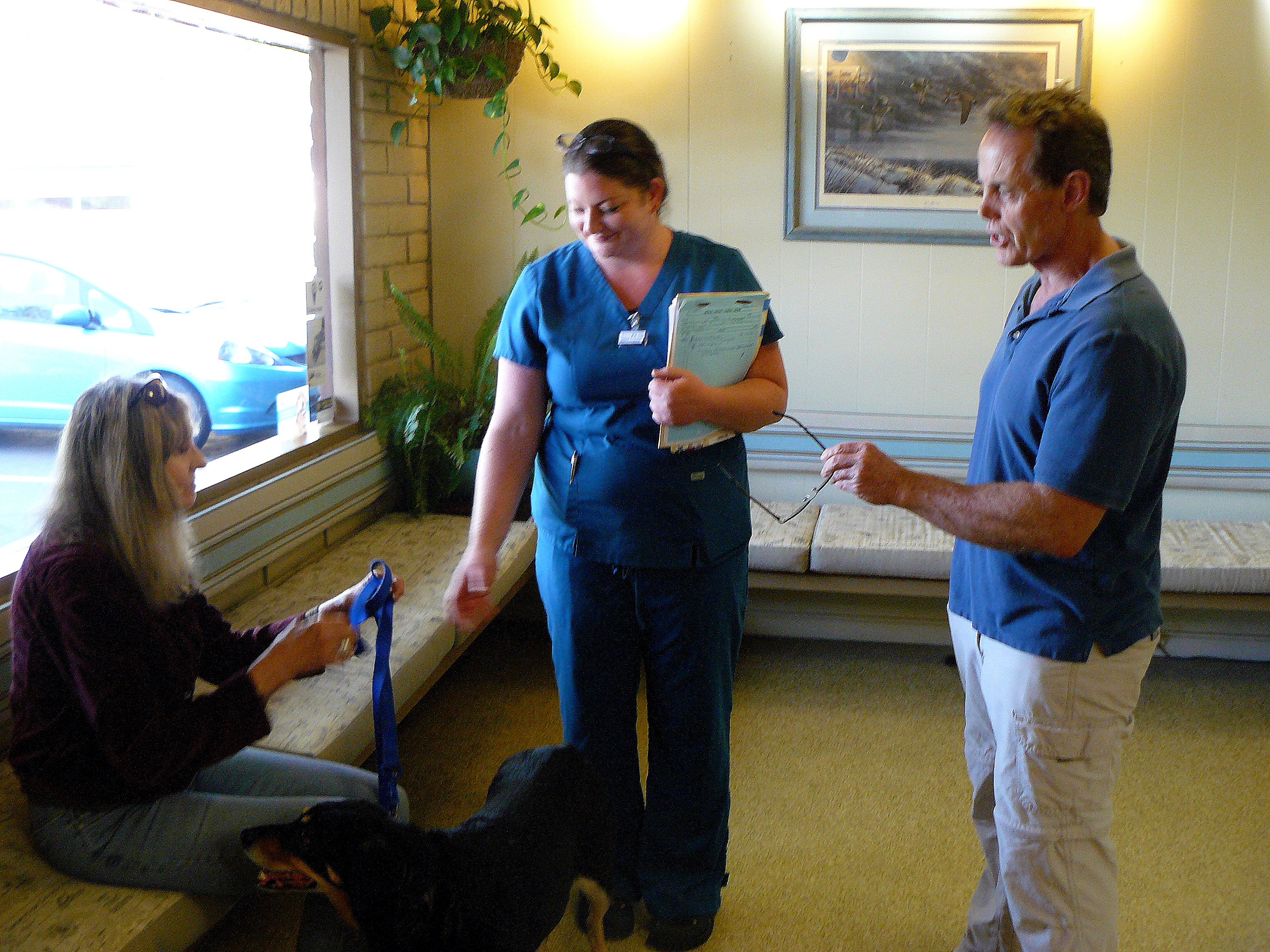
Dr. Codd (RHS) speaking with Jean at the Clinic.

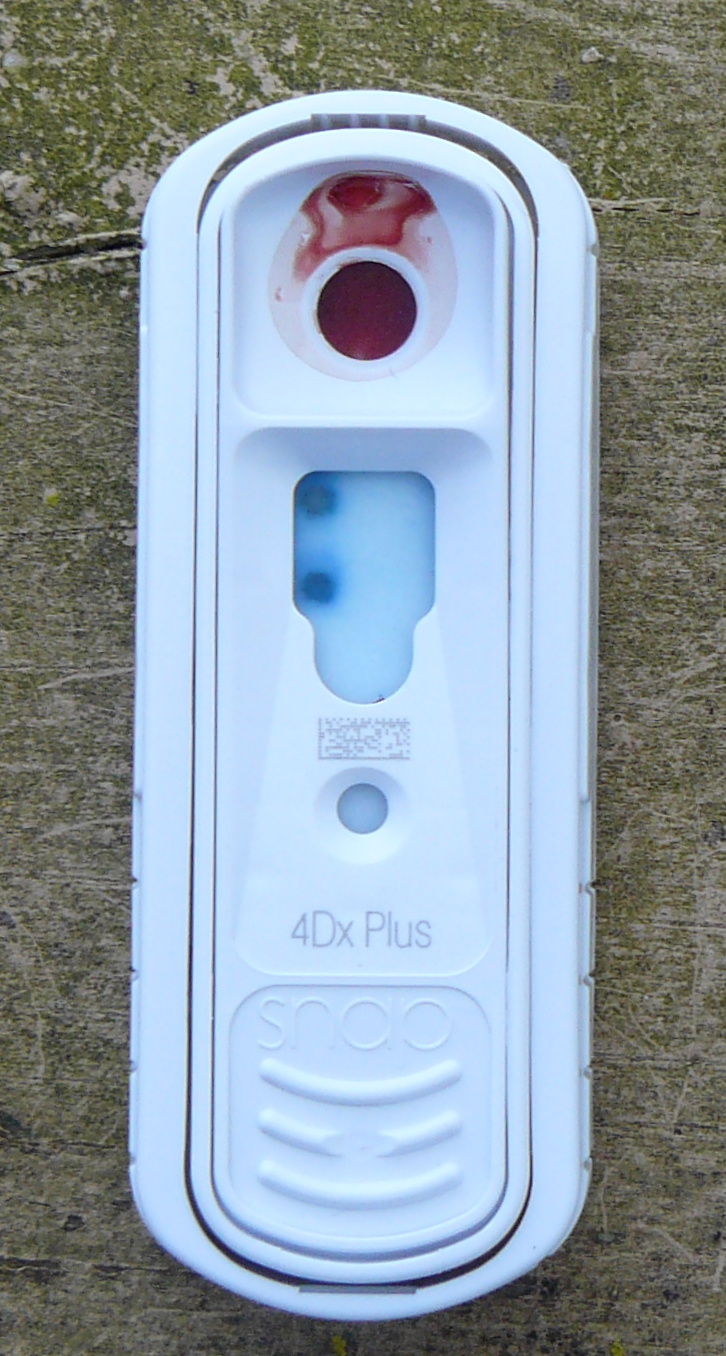
Dr. Codd took a quick blood test and, bingo, it revealed that Hazel was showing that she had, or had had in the past, an Ehrlichia Infection; a tick-borne infection.

The lower of the left-hand spots is the indicator of a past or present Ehrlichia Infection.

The cure for that was a course of Doxycycline.

So now we are looking at battling two separate diseases.

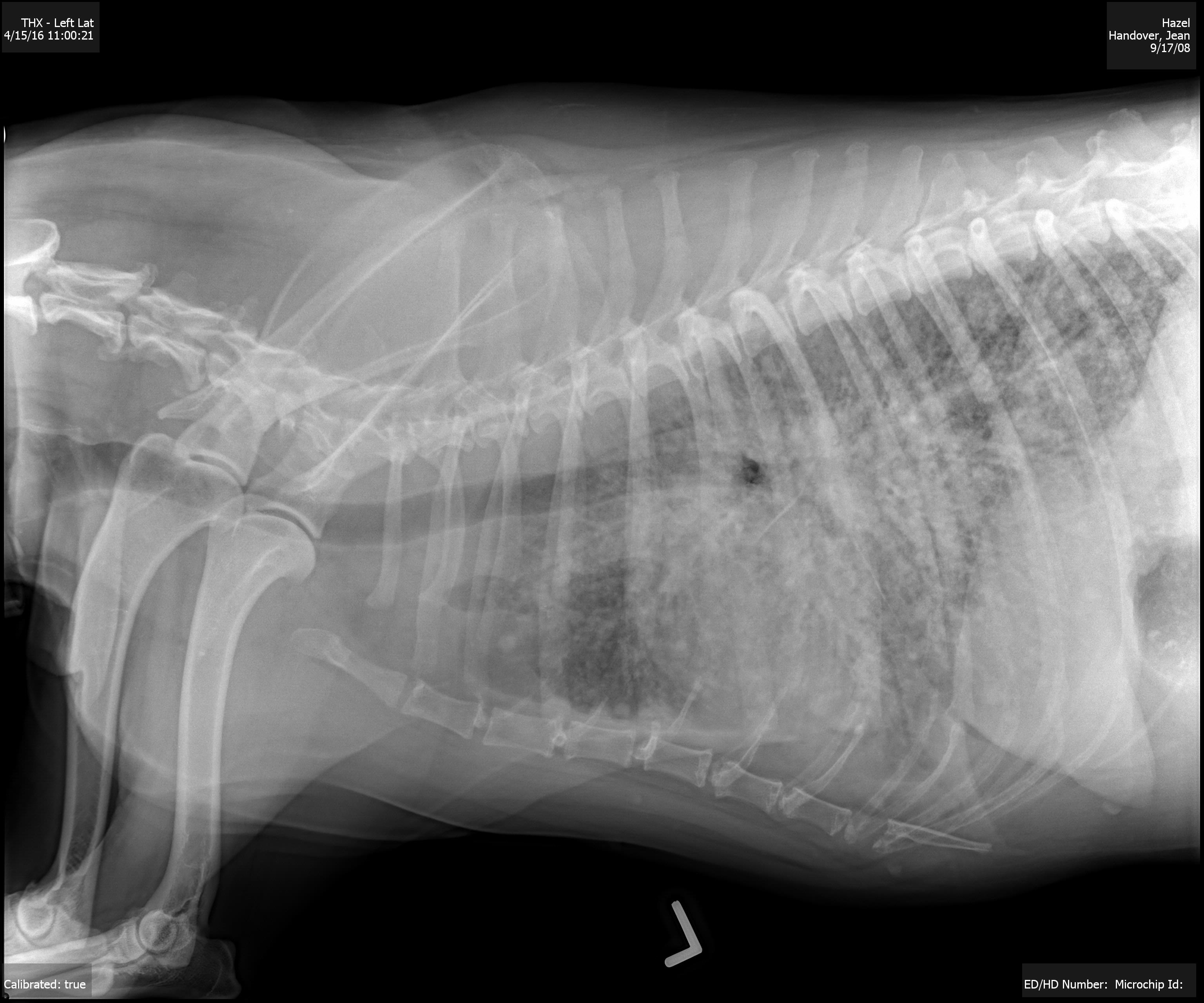
The blood that was taken from Hazel last Friday, when she also had radiographs taken of her lungs, had been sent for a ‘titre’ that would confirm one way or another if her lungs were suffering from a fungal infection. Those results will be available on Wednesday or Thursday of this week.

One of the radiographs taken of Hazel.

Back to Hazel’s lack of appetite. One of the side-effects of Fluconazole is that it depresses appetite. Getting Hazel eating again was becoming a priority. It seemed to make sense that until we had confirmation of whether or not Hazel had a lung fungal infection, for which taking Fluconazole would be an excellent course of action, we should pause in her dose until the results were in. To speed up the return of an appetite Dr. Jim prescribed a short course of Mirtazipine.

So that’s about it for the time being. Except for Jean and me to say how much we appreciate the art and the science that is being so skillfully offered by the Clinic. (As of 19:00 PDT yesterday Hazel was eating again! 🙂 )

Great team effort!
Great team effort!

Their “Special Love of Animals” comes over in spades!

Please keep Hazel in your thoughts.

Hazel has recently become rather ill.

CAUTION: The following is offered by way of information reaching out to other loving dog owners. Please do not assume I have any specialist veterinarian knowledge and please do not take the following as a replacement for seeing your own vet.

Hazel

Picture of Hazel taken in the last twenty-four hours.
Picture of Hazel taken in March, 2014.

The story of how this wonderful dog came into our lives was published over two years ago.

About three or four weeks ago we noticed that Hazel’s bark was changing, almost as though she had a sore throat. In every other way she continued being the happy, lively dog that she is.

Then very suddenly last Thursday she started sicking up white, foamy bile and went off her food. Hazel rapidly became lethargic and lacking any vigour. Last Friday we took Hazel to our local Lincoln Road Vet Clinic and she was seen by Dr. Russ Codd, DVM. He took xrays that showed that Hazel’s lungs were far from being as clear as they should be. Potentially, Dr. Codd said that we could be looking at one of three things:

  1. Some form of bronchial pnemonia,
  2. A fungal infection of the lungs,
  3. Cancer.

In view of the fact that Hazel hadn’t been coughing that ruled out 1.

Dr. Codd forwarded the xray pictures to a specialist. Later came the information that the spherules in her lungs, as seen on the xray pictures, were not as would be expected with a cancer diagnosis. Dr. Codd concluded that Hazel was indicating a fungal lung infection. Especially as this is commonly found in hot, drier parts of the USA and Mexico. Hazel was an ex-rescue from Mexico and for a couple of years we lived in Payson, Arizona.

The medical term for the disease is Coccidioidomycosis and I republish a little of what may be read over on the Pet MD website:

Coccidioidomycosis in Dogs

Mycosis is the medical term for any disorder caused by a fungus. Coccidioidomycosis comes from inhalation of a soil-borne fungus which normally affects the dog’s respiratory system. However, it is known (even likely) to spread out into other body systems.

The fungus spores begin in the lungs as round spherules, and live in a parasitic stage in the lungs until they grow large enough to rupture, releasing hundreds of endospores, which then begin a parasitic stage in the tissues, growing and rupturing, spreading out (disseminating) into the body perpetually. Endospores can also take a faster route through the body by way of the lymphatic and blood vessel systems, resulting in systemic infection — meaning the entire body will be affected. Coccidioidomycosis sets in from 7 to 20 days after exposure, though some dogs can develop immunity and never show any symptoms, especially younger dogs.

Dogs that are susceptible to the infection can become ill from only a small amount of the Coccidioides fungus, and fewer than 10 fungus spores are needed to cause the disorder. And though uncommon, Coccidioidomycosis is a deadly disease that originates mainly in the arid, hot regions of the western and southwestern regions of the U.S., and in several Central and South American countries. Coccidioidomycosis affects many different types of mammals, but tends to occur more commonly in dogs than cats. This infection is also known as valley fever, California fever, Cocci, and desert fever.

The condition or disease described in this medical article can affect both dogs and cats. If you would like to learn more about how this disease affects cats, please visit this page in the PetMD health library.

Dr. Codd recommended getting Hazel on a course of antibiotics with Fluconazole being his first choice. That commenced on Friday afternoon.

Early today (Monday) Dr. Codd will be seeking to narrow down the diagnosis with further analysis of Hazel’s blood being undertaken because while he was confident that it is a fungal infection he wanted to confirm precisely the nature of the infection.

I will publish more information as it comes to hand and close with these photographs taken yesterday afternoon.

Hazel taking a very slow walk outside.

oooo

But most of the time she just wanted to be left on her own in our bedroom.

We are holding Hazel very close to our hearts just now.