Year: 2015

Picture parade eighty-two

As I wrote last week:

Something a little different for this week. Mother Nature Network put out an email earlier in January that opened, thus:

Dear friend of Mother Nature, We all see the beauty in a sunset or in a gorgeous painting, but can you appreciate the art in bacteria, climate images or preserved animal remains? These beautiful examples show how for centuries, art and science have danced a well-choreographed routine. The result has been some breathtaking creativity.

The pictures were so wonderful that I have offered the first six for today and the balance in a week’s time.

So without further ado, here is the balance of those paintings.

Leonardo da Vinci

As if he wasn’t busy enough, Italian painter, architect, engineer, sculptor and inventor Leonardo da Vinci was also fascinated with anatomy. He was so intrigued by the human body that by the end of his life da Vinci claimed he had dissected more than 30 corpses. He filled pages and pages with incredibly detailed drawings of body parts, accompanied by thousands of explanatory notes. U.K. heart surgeon Frances Wells, author of “The Heart of Leonardo,” recalled seeing da Vinci’s drawings for the first time as a medical student, “I remember thinking that they were far better than anything we had in modern textbooks of anatomy,” he said. “They were beautiful, accurate, absorbing – and there was a liveliness to them that you just don’t find in modern anatomical drawings.”

oooo

sas

Earth as art

The Earth looks pretty darn cool from way, way up in the sky. Technically, NASA’s Landsat series of Earth observation satellites are critical for understanding scientific issues related to land use and natural resources. But really, they take some pretty remarkable images of mountains, valleys, islands and just general patterns in the forests and grasslands. Showing off this natural artistic sensibility, the U.S. Geological Survey created a series of “Earth as Art” images that are absolutely gorgeous. (And if you’re a fan, don’t miss NASA’s global maps, which are mesmerizing.)

oooo

asas

Climate science

Marco Tedesco, associate professor of earth and atmospheric sciences at City College of New York, sees the beauty in climate science. Coastal flooding. Cloud cover. Melting ice. To make climate work more attractive to the less weather-obsessed, he gathered colleagues from his school’s music, graphic design and video game design departments. The project, called Polarseeds, resulted in a multimedia art exhibit featuring photography, music and video, all centered on the beauty in climate science. Data on Greenland’s melting ice was transformed into music and the gallery featured photos of cracking ice.

oooo

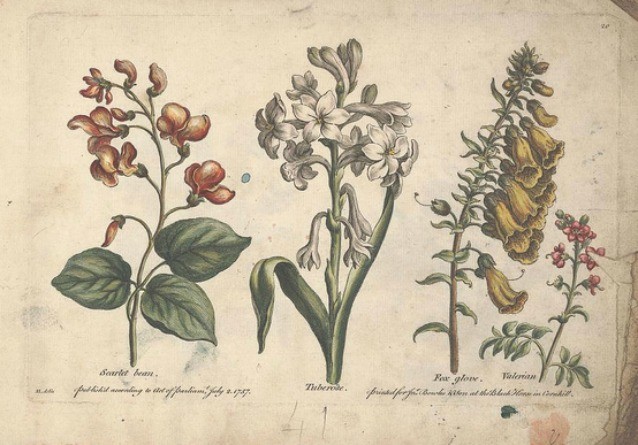
Botanical illustrations

Centuries ago, botanical drawings were key to helping people keep records of plants that had healing properties. The incredibly detailed illustrations of herbs and other plants were designed so that botanists and doctors could recognize the species for medicinal purposes. The oldest surviving example of botanical art, the Codex Vindebonensis, dates back to 512 A.D. The illustrations became more detailed and accurate as the centuries unfolded and now have taken on an artistic rather than medical purpose. There has been a recent resurgence in the art form through groups such as the American Society of Botanical Artists.

oooo

fgdfgdf

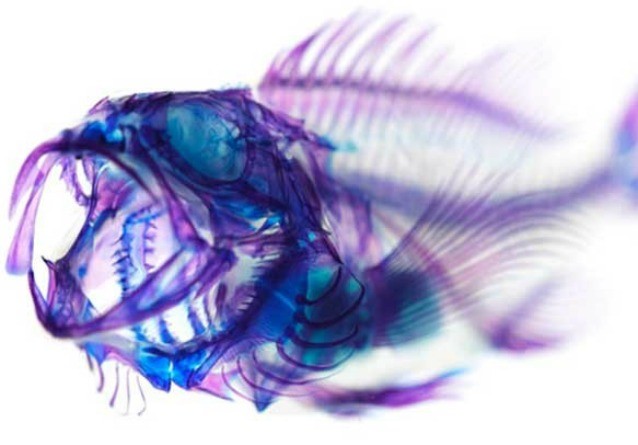
Preserved animal art

Japanese artist Iori Tomita sees beauty in death. He blends chemistry and art as he explores the natural beauty of the skeletal system in sea life. In his series “New World Transparent Specimens,” Tomita chemically bleaches and then dyes preserved animal bodies of fish, turtles, seahorses and other creatures. A chemical mix breaks down the protein and muscle, but leaves the collagen so the bodies keep their forms. Dyes then color the bones and tendons of the specimens, which are preserved in brightly lit glycerin.

oooo

bnmbnmbn

Pharaoh’s serpent

Mercury thiocyanate is an inorganic chemical compound that makes for some pretty dramatic moving art when it’s ignited. In the science world, mercury thiocyanate (typically present as a white powder) has several uses in chemical synthesis, but its real claim to fame is in pyrotechnics. When it’s lit, the compound produces a long spiraling column of ash and smoke that looks like a moving snake. These used to be sold in firework stores, but now you’re only likely to see them in a chemistry class because of claims of toxicity. The modern version is a nontoxic “black snake” that makes a less spectacular — albeit safer — presentation.

oooo

Back to wonderful photographs next Sunday.

Rain stops play.

Or, to be more precise, any form of post for today.

The weather forecast for Southern Oregon for yesterday included very significant rain.

They were not wrong.

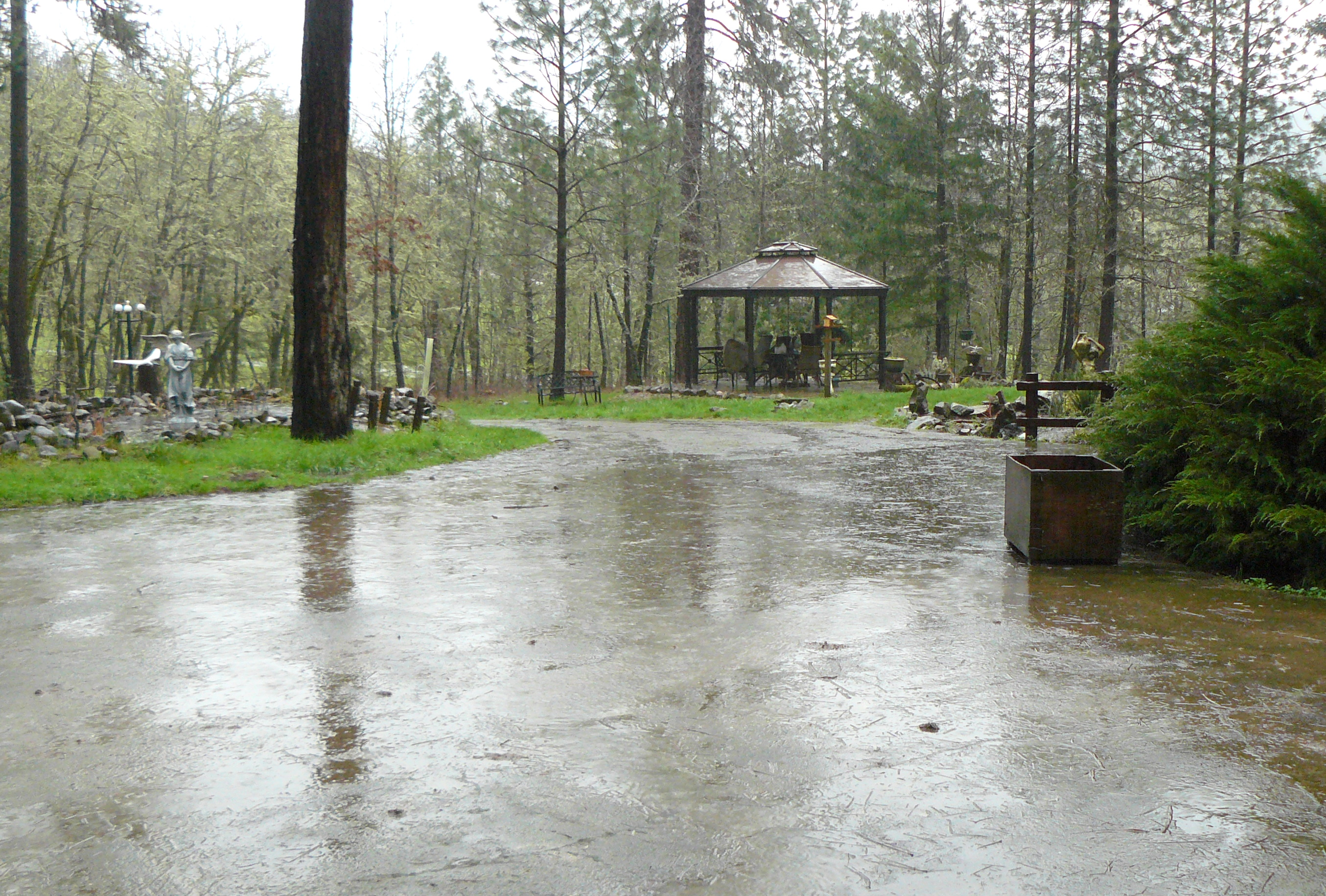
By the time I sat down to think about Saturday’s post, around 2pm, we had already had 3.2 inches of rain (8.1 cm) and our attention, understandably, was on more important matters, such as the integrity of our driveway bridge over Bummer Creek.

So if you will forgive me, I’ll just offer a few pictures and leave it at that.

Starting with a picture that Jean expressly said I couldn’t publish!

I shall probably be denied access to the bedroom after showing you all how my wife likes to dress up!

What lucky horses to have such a devoted ‘Mum’ that feeds them every morning; whatever the weather.

Only one way in or out: over the bridge!

Neighbours who have been here much longer than us say they haven’t seen so much rain fall in such a short time.

Bummer Creek in full flood - this photograph is of the Creek just 50 yards upstream of the bridge.
Bummer Creek in full flood – this photograph is of the Creek just 50 yards upstream of the bridge.

This is an old dam for irrigation purposes. One doesn’t want to reflect too long that a cubic yard of water weighs a ton!

Luckily the house and immediate surroundings are elevated.
Luckily the house (off picture to the right) and immediate surroundings are elevated.

So that’s it for today.

Another  picture parade for tomorrow assuming I haven’t been lynched by my lovely wife for showing that earlier photograph.

Oh, which reminds me! I took a couple!

She is rather cute, don't you think!
She is rather cute, don’t you think!

Animal healing

The power of our beautiful creatures to heal us.

Yet again, another example of a post almost writing itself.

Let me explain.

Yesterday, I published a post about being sensitive to the world around us.

Then this morning there was a new post from Sue Dreamwalker under the title of Fear of the Future. It was uncharacteristically downbeat for Sue.

Now most who follow me know I try to bring a positive touch within my posts… Yet to be quite honest with you all I am really struggling right now to lift myself from the doldrums of my own thoughts.

The key to conquering our fears lies in awareness. When we identify the irrational thoughts that frighten us and replace them with positive affirming ones.

Argh… all easier said than done..

You would think with my inner Knowing, and my Spiritual mind I should be the last person to take a nose dive into that Pit of depression.. Especially when I dredged its depth before and vowed that I had been there done that and worn the T-shirt and I refuse to wear it again.

I could blame it on my Fall which left me feeling bruised with aching, muscles which are still healing.. And I could blame it on grief as I lost a very beloved Aunt last week. I could blame my fatigue on me deciding to move a whole wall of books out the spare bedroom with wrists still recovering from the sprains of the fall.. And I could blame it on the weather being cold and miserable.. I could even blame it on the state of the world, or the Planets .. I have a whole host of excuses I could fall back upon to justify why I am feeling tired and jaded..

Many left comments including me. I spoke of the reward of hugging a dog. My words included:

I don’t have answers other than to feel what you are feeling. All I hang onto when I spend too much time thinking of my own mortality is that the answer, the answer to the moment, is to bury one’s face into the warm, soft fur of a dog. They seem to sense my need at these times. (And that isn’t meant to sound like me devaluing the love and affection that I receive from Jean!)

In other words, that contact with the warm dog holds me in the present and before long the reinforcement of living that present, loving moment puts the unknown future into perspective.

Another comment was left by blogger Rajagopal that included this wonderful tale:

The only thing that I have seen working in my life is to keep living, as much as possible, in the present. There is nothing to fear, either of the now or of the future.

In this context, wish to leave you with the story of the pregnant deer; in a forest, a pregnant deer is about to give birth. She finds a remote field near a strong-flowing river, that looks like a safe place, as she starts going into labour. At the same moment, dark clouds gather in the sky and streaks of lightning sets off a forest fire. The deer looks to her left and sees an approaching hunter with arrow pointed at her. To her right, the deer spots a hungry lion speeding towards her. What can the pregnant deer do? She is in labour! What will happen? Will the deer survive? Will she give birth to the fawn and will it survive? Or will everything be burnt by the forest fire? Or will she perish to the hunter’s arrow? Or does a horrible end await her at the hands of the hungry lion? Constrained by the fire on one side, the flowing river on the other and boxed in by her natural predators, the deer is apparently left with no option. What does she do? Well, she focuses on delivering and giving birth to a new life.

The sequence of events that follows is the Lightning strikes and blinds the hunter, who releases the arrow which zips past the deer and strikes the hungry lion. It starts to rain heavily and the forest fire is slowly doused by rain water. The deer gives birth to a healthy fawn….In our life too there are moments when we are confronted with negative thoughts and possibilities on all sides, so powerful as to overwhelm us. May be we can learn from the deer. The priority of the deer at that given moment was to give birth as safely as possible.

The rest was not in her hands and any change in her focus would have most likely impeded giving birth to the fawn. In the midst of the severest storm, we just have to maintain presence of mind and do what is in our control…the Cosmic power will take care of the rest…best wishes… Raj.

Finally, there was a recent new follower of this place. Her name is Emma and she writes the blog The Muse in the Mirror. Emma was kind enough to grant me permission to republish a post from last December about the healing power of Llamas. Enjoy!

ooOOoo

Llama Loving; The healing power of Llamas

emma1It’s official; I LOVE llamas. There, I said it, put out there for the world to know! I love their gentle, sensitive nature, friendly disposition and most of all their goofy, giggle-worthy expressions, which never fail to bring a smile to my face! Concerned that my llama loving status was bordering on obsession, I was beginning to question whether my love for these comical camelids was founded on anything other than sheer amusement! Thankfully as I researched further my findings confirmed that these beautiful animals are much more than a pretty (funny) face!!!

Llama Therapy

emma2
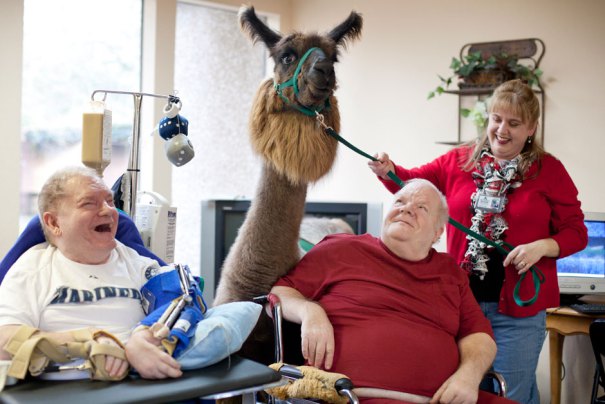
Llama Marisco visits patients at Bellingham Health and Rehabilitation Center in Washington, USA. © Jen Osborne Photography

I squealed in delight when Colours Magazine published the story about The Delta Society, a non-profit organization that licenses animals for therapy

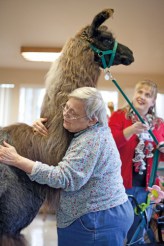
Holly Barto hugs a therapy llama at Bellingham Health and Rehabilitation Center, USA © Jen Osborne Photography

in USA. The adorable photo’s lay testament to the happiness that llama’s bring to residents at Bellingham Health and Rehabilitation Center in Washington, USA. Llama Marisco (pictured above), and Llama N.H. Flight of the Eagle (pictured right) are trained therapists, who spread comfort and joy as they stop at each bed to kiss the patients or have a hug. Resident Holly Barto remarked that…

It was heaven. Just emotionally – to be able to touch an animal and hold an animal close.

Another example of the profound healing benefits of llama’s can be seen in this adorable video below showing Rojo the therapy llama and Napoleon the therapy alpaca from Mtn Peaks Therapy Llamas & Alpacas, in Vancouver, WA USA. A non-profit corporation, which offers therapy teams to visit hospitals and schools in the area. The expressions on people’s faces are heart warming to say the least!

Who knew such fluffed-up, carrot munching mammals could bring so much joy.

Laughter is the best medicine.

emma4
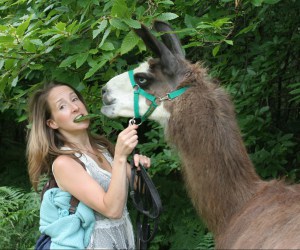
Llama Dave is disgruntled by the fact I was munching in on his dinner!

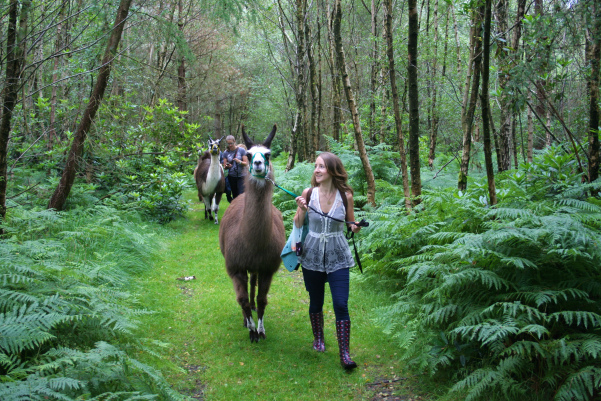
If I am having an off day, the first thing I reach for is a funny llama picture. Better still, a visit to the local llama park soon blasts my bad moon into infinity and beyond! A good giggle-fest at the Ashdown Forest Llama park, in East Sussex, dissolves the blues and confirms that laughter really is the best medicine! (See my picture gallery below to see me with some of the residents of the Ashdown Forest Llama park!).

There’s a very good reason behind the saying Laughter is the best medicine. Research suggests that people feel less pain after a good laugh, because it causes the body to release chemicals that act as a natural painkiller. ‘Professor Robin Dunbar of Oxford University, who led the research, believes that uncontrollable laughter releases chemicals called endorphins into the body which, as well as generating mild euphoria, also dull pain.’ (BBC)

It is common knowledge that animals in general make us happier and brighten our spirits. A growing body of scientific research now suggests that interacting with animals can make us not only happier, but healthier too. That helps explain the increasing use of animals for therapeutic purposes in hospitals, hospices, nursing homes, schools, jails and mental institutions.

The use of pets in medical settings actually dates back more than 150 years, says Aubrey Fine, a clinical psychologist and professor at California State Polytechnic University. Fine who has written several books on the human-animal bond says:

One could even look at Florence Nightingale recognizing that animals provided a level of social support in the institutional care of the mentally ill,”

So there you have it, next time you’re feeling blue, you know what to do! Head on out to your nearest llama park to insight those warm fuzzy feelings from a fluffy four legged llama! Check out my favourite selection of Llama and Alpaca pics below, guaranteed to bring a smile to any face!!

emma5

ooOOoo

Note: That last photograph above is only one of a wonderful collection of Llama photographs that Emma included in her blog post. Do drop across there and admire all the wonderful pictures.

The incredible healing power of hugging an animal.

Sensitivity to the world around us.

The more we give up, the more we ‘own’.

It is a very common, understandable trait of us humans to put our own lives first.  I mean that much more in the psychological sense than in the sense of our daily activities although what we think and feel, inevitably, influences how we behave. One of the fabulous qualities of our dogs is that they are so much more sensitive to the world around them than to their own internal thoughts and feelings. Right from the early years of having Pharaoh in my life I was aware that he ‘read’ my emotions easily and soon became an instinctive ‘friend’, especially when I was troubled.

Years later, all of the dogs love it when Jean and I are in happy, positive places and you can see how our human states of mind link so directly to the mood of our dogs.

All of which is my introduction to an essay recently read over on the Big Think blogsite. Specifically, one about living empathically. The essay is called: Let’s Make 2015 “The Year of Living Empathetically” and here are the opening paragraphs:

Let’s Make 2015 “The Year of Living Empathetically”

by JOAN COLE DUFFELL

I began the new year on a very positive – and inspiring – note after reading Eric Liu’s latest commentary on “Radical Empathy”.

The founder and CEO of Citizen University, Liu shows us that laying aside our egos – our need to be in the right – in favor of standing in the shoes of others, is key to addressing so many of the problems that we (once again) confronted in 2014.

This insight – without question – is a wake-up call to our country as 2015 unfolds.

That’s why I think we should resolve to make 2015 “The Year of Living Empathetically.”

We need to make the practice of empathy our New Year’s exercise regimen, our social-emotional diet for the next 365 days.

  • Let’s practice empathy at home, with our spouses and kids.
  • Let’s practice empathy in the workplace, as we give and receive feedback, and credit others’ contributions generously.
  • Let’s practice empathy in the classroom, especially when kids are struggling and need our support.
  • Let’s practice empathy in public service, as we encounter people who look different from us, and whose lives matter every bit as much as our own.
  • Let’s practice empathy as we encounter people on the street, who may be less fortunate, and are just as human.
  • Let’s practice empathy when resolving conflict, whether interpersonally or on a global-political level.
  • And let’s practice empathy in local and state governments, and in the halls of Congress, so that we might truly listen in order to solve real problems

If all this sounds like a tall order – you’re right; it is.

As Brene Brown, a research professor at the University of Houston Graduate College of Social Work, points out, empathy is a challenging personal choice that requires us to become vulnerable in an effort to connect with another person.

It is not a long essay, so do drop across to here and finish reading it.

As is the way of ideas, serendipity is always actively working ‘under the hood’.

Why do I say that?

Because as soon as I was clear about what I wanted to offer you for today, in to my ‘in-box’ came the latest TED Talk. A talk from Ben Ambridge entitled: 10 myths about psychology: Debunked. It so resonated with today’s theme and is offered below.

Published on Feb 4, 2015
How much of what you think about your brain is actually wrong? In this whistlestop tour of dis-proved science, Ben Ambridge walks through 10 popular ideas about psychology that have been proven wrong — and uncovers a few surprising truths about how our brains really work.

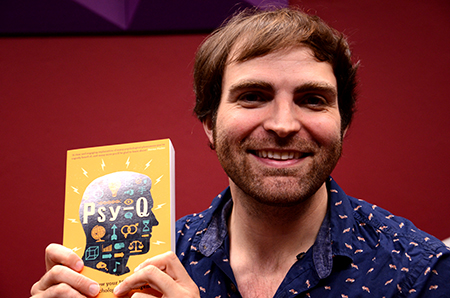
Ben Ambridge is the author of “Psy-Q,” a sparkling book debunking what we think we know about psychology.

Why you should listen?

Ben Ambridge is a senior lecturer in psychology at the University of Liverpool, where he researches children’s language development. He is the author of Psy-Q, which introduces readers to some of the major findings in psychology via interactive puzzles, games, quizzes and tests.

He also writes great newsy stories connecting psychology to current events. His article “Why Can’t We Talk to the Animals?” was shortlisted for the 2012 Guardian-Wellcome Science Writing Prize. Psy-Q is his first book for a general audience.

Dr. Ben Ambridge with his book: Psy xxx
Dr. Ben Ambridge with his book: Psy-Q.

If you want to learn more about the good Professor, here is his webpage on the University of Liverpool‘s website. And here is Ben Ambridge’s personal webpage that lists many, if not all, of his publications.

I honestly can’t find a better picture to close today’s post about sensitivity and empathy than this one below:

Empathy for another in its most beautiful shape.

Voting for hope.

Considered reflections to yesterday’s post.

Yesterday, I published Bitter Lake ripples, a post that, in turn, was my response to the fabulous comments left by readers of my earlier post Oil, money, banks, guns and blood.  The overall feeling I read in those comments was one of terrible uncertainty about these present times. Or in the words of Sue Dreamwalker in response to a comment left by Patrice Ayme.

I have to say Patrice.. I agree with your comment here… And yes people are not understanding the whole of what is going on.. The Truth of it would seem unbelievable..

Patrice, in a post published on Monday entitled Arm Ukraine, Disarm Bankers sent shivers down my spine with the suggestion, the strong suggestion, that Ukraine, if not handled properly by ‘the West’ could be a tipping point into another major war between Europe (and the USA?) and Russia.  Here’s an extract from Patrice’s post:

The way it was said, in conjunction with Putin’s recent admission that Russian “volunteers” were fighting in Ukraine, is basically a declaration of war. On top of this, the head of the Eastern Ukraine rebels declared that he was raising a 100,000 men army. This means he expect tens of thousands of Russian troops (Putin’s “volunteers”) to cross the border.

This is not contained. Putin is billowing out of control, all by himself. One has to see what the combination of Putin’s dictatorial powers, media control, psychology and sinking economy leads to. Let me spell it out.

Once Putin has conquered Ukraine, he will push for more: he is already partly occupying Moldavia, WEST of Ukraine. Putin is also messing up with Hungary: there were street demonstrations about this, just yesterday, in Budapest. Putin uses the fact that Hungary is extremely dependent upon Russia’s fossil fuels. Merkel, who desperately wants to avoid war with Putin, flew to Budapest in emergency, to sort the situation out.

Patrice continues the warning of possible terrible times ahead in a subsequent post: Mental Inertia, Evil’s Friend, published yesterday.

Just as it takes a long time to erect, or change a vast building, so it is with the brain. The brain has inertia. Thus psychological inertia.

This mental inertia is why human beings tend to go on with a task, or with an attitude, once they got launched into it (a Jihadist laden with explosives just flew by).

Once a force is applied to an object, for example a propaganda to a brain, it tends to gather momentum, and develop ever more inertia.

Putin of course creates his own propaganda, and then can listen to it, reinforcing his deviance, in a self-reflective way. It’s all the more efficient if others repeat his ideas, and he listens to them. Actually that’s not just a problem with Putin, but with all Great Leaders. (And that’s one reason why Great Leadership has to be discontinued, and replaced by Direct Democracy.)

This amplifies the inertia.

By not fiercely opposing Putin, one collaborates with him. It is not just a question of sanctions. Putin is a liar, and an aggressive one, he should be publicly called for what he is.

Thus in terms of my own personal ideas, I freely admit to struggling to see things clearly.  Simply because I find it very difficult to get to the heart of these international issues through not having access to clear, impartial commentators who know what they are speaking about. As Patrice infers much of the media is corrupted by self-serving agendas.

However, on balance, despite Patrice Ayme being a ‘nom-de-plume’ and me having no idea who the person behind the label really is, I do trust his (?) writings and believe that Patrice writes from a position of having very good access to the inner workings of the US Government. (I am not privy to anything to support my proposition; just my guess.)

The other commentator whose opinions and judgements are trusted by me in equal fashion is George Monbiot. Mr. Monbiot has been gracious to grant permission to me for his essays to be republished here on Learning from Dogs.

On the 28th January, Mr. Monbiot published an essay that in words better than I could write encapsulates my response to the comments left on my Bitter Lake ripples post. Here is that post from George Mobiot.

ooOOoo

The Lamps Are Coming On All Over Europe

28th January 2015

By George Monbiot, published in the Guardian 28th January 2015

Here is the first rule of politics: if you never vote for what you want, you never get it. We are told at every election to hold our noses, forget the deficiencies and betrayals and vote Labour yet again, for fear of something worse(1). And there will, of course, always be something worse. So at what point should we vote for what we want, rather than keep choosing between two versions of market fundamentalism? Sometime this century? Or in the next? Follow the advice of the noseholders and we will be lost forever in Labour’s Bermuda triangulation.

Perhaps there was a time when this counsel of despair made sense. No longer. The lamps are coming on all over Europe. As in South America, political shifts that seemed impossible a few years earlier are now shaking the continent. We knew that another world was possible. Now, it seems, another world is here: the sudden death of the neoliberal consensus. Any party that claims to belong to the left but does not grasp this is finished.

Syriza, Podemos, Sinn Fein, the SNP; now a bright light is shining in England too, as the Green party stokes the radical flame that Labour left to gutter. On Tuesday morning, its membership in England and Wales passed 50,000(2); a year ago it was less than 15,000. A survey by the website voteforpolicies.org.uk reports that in blind tests (the 500,000 people it has polled were unaware of which positions belong to which parties), the Green Party’s policies are more popular than those of any other. If people voted for what they want, the Greens would be the party of government.

There are many reasons for this surge, but one of them must be a sense of popular ownership. Green party policies are determined democratically. Emerging from debates led mostly by younger members(3), they feel made for their time, while those of the major parties appear trapped in the 1980s.

Let me give you a flavour of the political transformation the Green Party seeks. There would be no prime minister of the kind we have today, no secretaries of state. Instead, Parliament would elect policy committees which in turn appoint convenors(4). It would also elect a First Minister, to chair the convenors’ committee. Parliament, in other words, would be sovereign rather than subject to the royal prerogative prime ministers abuse, leaders would be elected by the whole body and its various parties would be obliged to work together, rather than engage in perennial willy-waving.

Local authorities would set the taxes they chose. Local currencies, which have proved elsewhere to have transformative effects in depressed areas (see Bernard Lietaer’s book The Future of Money(5)) would become legal tender(6). Private banks would no longer be permitted to create money(7) (at the moment they issue 97% of our money supply, in the form of debt). Workers in limited companies would have the legal right, following a successful ballot, to buy them out and create cooperatives(8), with funding from a national investment bank.

The hideously unfair council tax system would be replaced by land value taxation(9), through which everyone would benefit from the speculative gains now monopolised by a few. All citizens would receive, unconditionally, a basic income(10), putting an end to insecurity and fear and to the punitive conditions attached to benefits, which have reduced recipients almost to the status of slaves.

Compare this vision of hope to Labour’s politics of fear. Compare it to a party so mesmerised by the City and the Daily Mail that it has promised to sustain the Tory cuts for “decades ahead”(11) and to “finish that task on which [the Chancellor] has failed”: eradicating the deficit.

Far too late, a former Labour minister, Peter Hain, now recognises that, inasmuch as the books need balancing, it can be done through measures like a financial transaction tax and a reform of national insurance(12), rather than through endless cuts. These opportunities have been dangling in front of Labour’s nose since 2008(13), but because appeasing the banks and the corporate press was deemed more important than preventing pain and suffering for millions, they have not been taken. Hain appears belatedly to have realised that austerity is a con, a deliberate rewriting of the social contract to divert our common wealth to the elite. There’s no evidence that the frontbench is listening.

Whether it wins or loses the general election, Labour is probably finished. It would take a generation to replace the sycophants who let Blair and Brown rip their party’s values to shreds. By then it will be history. If Labour wins in May, it is likely to destroy itself faster and more surely than if it loses, through the continued implementation of austerity. That is the lesson from Europe.

Fearful voting shifts the whole polity to the right. Tony Blair’s obeisance to corporate power enabled the vicious and destructive policies the Coalition now pursues(14). The same legacy silences Labour in opposition, as it pioneered most of the policies it should oppose. It is because we held our noses before that there is a greater stink today. So do we keep voting for a diluted version of Tory politics, for fear of the concentrate? Or do we start to vote for what we want? Had the people of this nation heeded the noseholders a century ago, we would still be waiting for the Liberal Party to deliver universal healthcare and the welfare state.

Society moves from the margins, not the centre. Those who wish for change must think of themselves as the sacrificial margin: the pioneering movement that might not succeed immediately, but that will eventually deliver sweeping change. We cannot create a successful alternative to the parties that have betrayed us until we start voting for it. Do we start walking, or just keep talking about the journey we might one day take?

Power at the moment is lethal. Whichever major party wins this election, it is likely to destroy itself through the pursuit of policies that almost no one wants. Yes, it might mean five more years of pain, though I suspect in these fissiparous times it won’t last so long. And then it all opens up. This is what we must strive for; this is the process that begins in May by voting, regardless of tactical considerations, for parties offering a genuine alternative. Change arises from conviction. Stop voting in fear. Start voting for hope.

http://www.monbiot.com

References:

1. http://www.theguardian.com/commentisfree/2014/dec/09/labour-tories-vote-osborne

2. Green Party office, by email, 27th January 2015

3. http://bright-green.org/green-movement/how-the-green-party-changed-itself-to-make-the-greensurge-possible/

4. http://policy.greenparty.org.uk/pa.html

5. http://www.lietaer.com/writings/books/the-future-of-money/

6. http://policy.greenparty.org.uk/ec.html#EC678

7. http://policy.greenparty.org.uk/ec.html

8. http://policy.greenparty.org.uk/in.html

9. http://policy.greenparty.org.uk/ec.html

10. http://policy.greenparty.org.uk/ec.html

11. http://press.labour.org.uk/post/87284550049/long-termism-in-public-finance-speech-by-chris

12. http://www.theguardian.com/politics/2015/jan/22/labour-radical-counter-greens-peter-hain

13. I was not the first to propose these alternatives to austerity Peter Hain has just discovered, but even I had got there by 2011: http://www.theguardian.com/commentisfree/2011/mar/06/march-26-protest-aims-first-draft

14. http://www.monbiot.com/books/captive-state/

ooOOoo

I said that Mr. Monbiot’s words were much finer than my own. No better illustrated than by his closing three sentences:

“Change arises from conviction. Stop voting in fear. Start voting for hope.”

Bitter Lake ripples.

Reflections on last Thursday’s post.

Last Thursday, I published a post under the title of Oil, money, banks, guns and blood. It was such a departure from my normal style of blog post that I anticipated that it would slide by without any comment. Wrong! It had the highest readership of the week and attracted some powerful and insightful replies. So much so that I expressed the desire to reflect on those replies before responding. Thus, today’s post is my response to your comments and feelings.

First, Hariod Brawn of the blogsite Contentedness responded, in part:

Now, where are we? Val’s words are a good place to begin: “Nothing is what is seems, or will ever be the same again.” Nobody knows for sure, but piecing together fragments of world events, my instinct (fwiw) tells me that we are in the incipient stages of the collapse of the 20th.c. paradigm. Neoliberalism has failed; further than that, Capitalism has failed – we have no free markets where it counts; they’re all rigged. Politics has failed too, having been bought out by the corporates. [There are over 30,000 lobbyists in Washington alone] All that Western Governments have to offer is a doomed re-run of failed practices (same with Japan actually). Worse still, they have gone down on their knees and begged the financial sector to create a fix. The private banks have been given access to vast sums of QE cash at virtually zero interest in order to continue rigging markets (via their agents) all to their benefit whilst also creating huge market distortions in asset bubbles. Has the wealth they created trickled down? Has it hell. Whilst all this is going on, and as the film so clearly demonstrates, the Middle East looks like fulfilling its promise of the last century as being the flashpoint for warfare on a vast scale. And of course, if by some miracle we escape financial collapse, and world peace is not threatened by warfare, then the environment is going down the pan because – guess what? – our politicians have failed us once again. I have said enough on this.

Hariod then went on to recommend the films of Chris Hedges that will be featured on Learning from Dogs at a future date.

Then Val Boyco, her blogsite being Find Your Middle Ground, wrote a response before viewing the film:

Without being informed yet … my thinking is that the world we live in is so complex, stressful and fast that we can’t absorb everything that happens. We simplify and label, in order to make sense. We chop and segment in order to understand, but we miss the full story and many have lost the ability to grasp the bigger picture…. or are too fearful of going against the expectations of others and becoming one of “them” instead of one of “us”.

Then reinforced by her comment after watching the film:

I just watched the movie Paul. It is powerful and very disturbing. As you say, it undermines what we believe is real. It also reveals the complexity – misunderstanding – manipulation – corruption – opium, oil and the struggle for power – naivety – chaos.
In the dualistic fairy tale world of good vs evil it has created a nightmare of errors.
Nothing is what is seems.
Or will ever be the same again.

There was a comment from Patrice Ayme:

Giant American global corporations, the 200 largest ones, do 100 billion dollars of tax evasion through Luxembourg alone. Each year. Many are media companies. Wonder why stories make no sense?

Juncker directed that. Now he is head of the European Commission, and insist Greece shall pay every single penny.

As it happened, my dad was among a European group of geologists working for the Afghan government, who discovered Afghanistan’s riches… In the 1970s. All hell broke loose shortly thereafter.

I write about these sorts of things, day in, day out. But most people prefer the opium of feel-good…

Patrice then went further in offering a post over on his own blog that carried the specific title of Great Bitter Lake. Let me quote a little from that:

“Bitter Lake” is about the conspiracy between American plutocracy and Saudi plutocracy. Plutocrat Roosevelt was freshly flown from Yalta, to the Great Bitter Lake, on the Suez Canal. The idea was to steal the Maghreb, and the Middle East from the French and the British, by making a theocratic alliance.

At Yalta, Roosevelt had given half of Europe to his Comrade Stalin. (Plutocrats of the world naturally unite!)

Never mind that Poland had fought the Nazis courageously the Nazis, at a time when the USA was militarily and diplomatically collaborating… with the Nazis (or maybe, precisely, the Poles had to be punished!) Roosevelt had to be strict: the French had successfully escaped from the military occupation (AMGOT) he had set-up for them.

The movie “Bitter Lake” exposes (some) of the American plutocracy led conspiracies which led to the devastation, among other things, of Afghanistan, and other constituencies, thanks to the Wahhabist Islam it unleashed on the world.

Readers of this site will be familiar with the general ambiance.

One caveat: all what is in the documentary and makes American plutocrats (Roosevelt) and their servants (Reagan) look bad, is correct. However the real situation, the real badness is way worse. (For example the secret, official USA intervention in Afghanistan was under Carter, on July 3, 1979. However the real even more secret intervention, through the Pakistani ISI was even earlier and even more vicious.

So what is my response?

It is this:

In 1887, Oscar Wilde said, referring to the differences between the British and the Americans: “We have really everything in common with America nowadays, except, of course, language.

By way of example there is a saying back in my old country that when something is “… going to the dogs”, it means an irreversible decline in standards; the phrase usually aimed at an organisation or even a country.

Many, especially those of my age, might nod sagely and reflect that something ‘is going to the dogs‘ in terms of the wider Western world.

Let me be specific. There are destructive and dysfunctional issues in modern societies that I would list as: Selfishness; Power & Corruption; Short-termism; Materialism; Population growth; Greed, inequality and poverty. It’s not an exhaustive list!

Now many would argue the ‘whys’ and ‘wherefores’ about what precisely is wrong with Western societies in this 21st century but far fewer would argue with the underlying premise; that something is fundamentally wrong with today’s world.

Indeed, one of the things that is impossible to miss is the body language, the look on a face, the shrug of a shoulder, when one casually remarks that these are interesting times! From strangers and friends alike.

There is no question that what mankind has ‘enjoyed’ these last fifty years or so cannot be continued for very much longer. That the era since the 1960s of growth, materialism and consumption is running one very basic and fundamental resource dry. You know the one I am referring to: Planet Earth.

My hope is that the widely-felt feelings that something is fundamentally wrong with today, are the feelings man has always experienced, since time immemorial, when mankind has passed through the threshold between two eras.

My hope is that the new era, one that we quite possibly may now just be entering, a new era of sustainable living on this planet, of social and political changes to replace extreme levels of inequality, of stronger communities of like-minded persons, will be obvious to all, but especially obvious to our next generation, within the next ten years; possibly fewer than ten years.

One thing is for sure. The sharing of ideas and feelings as is the style of modern blogging is critical to the forming of the opinions that precede the changes that so many now see as unstoppable.

How NOT to sell beer!

Adding to the chorus of voices criticising Budweiser.

I’m going to republish in full what arrived in my ‘in-box’ yesterday from Howling For Justice.

But before I do that, let’s consider the ancient history of the wolf and the connection with our dogs of today. I shall do that by offering a small extract from something that I will be presenting at a meeting in Grants Pass on February, 10th.

Dogs are part of the Canidae species, a family including wolves, coyotes and foxes, thought to have evolved some sixty million years ago. There is no hard evidence as to when dogs and man came together but dogs were certainly around when man developed speech and set out from Africa; about fifty thousand years ago.

What is clear is that the dog represents man’s longest domesticated animal companion; by far. Some scientists believe that we have had the benefits of dogs in our lives for thirty thousand years. Indeed, some have proposed that the benefits of having tame wolves around us humans helped man be so successful a hunter and gatherer that it was instrumental, a mere ten thousand years ago, in humans first discovering how to cultivate crops and domesticate animals. Becoming the most significant single development in human history.

Because reflect that for a previous three million years Stone Age man, the hunter-gatherer, had engaged in activities as natural as the swoop of a hawk or the grazing of a horse.

ooOOoo

OK, on to that Budweiser advertisement.

Budweiser Takes Low Road – Demonizes Wolves To Sell Suds

thumbs-down

February 1, 2015

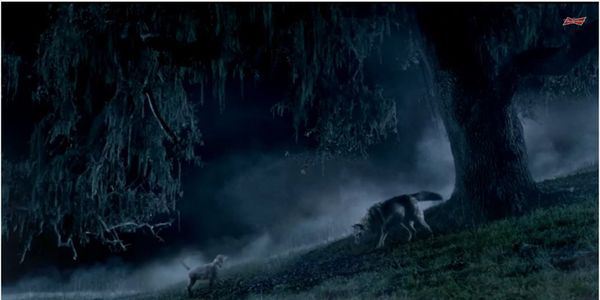
We all know about the Budweiser ad, a little lost puppy being threatened by a wolf. I won’t show the ad because it’s BS and I don’t want to give it any publicity but Budweiser should be ashamed. Are they that desperate to sell beer?

Get a grip Budweiser, very poorly played. Beer drinkers around the country should boycott Bud if the ad is not pulled. It’s a low blow to wolves, one of the most persecuted animals on the planet.

Please click the link below and sign the petition to tell Budweiser what you think of their blatant demonizing of wolves.

===

Tell Budweiser: Don’t Demonize Wolves to Sell Beer

872023-1422494607-wide

author: Center for Biological Diversity

target: Anheuser-Busch CEO, Thomas W. Sante

Purposefully demonizing an animal that is part of America’s natural heritage is no way to sell beer.

But that hasn’t stopped Budweiser from crafting a commercial for this year’s Superbowl that intentionally drums up anti-wolf sentiment to try and capitalize on our culture’s outsized fear of wolf attacks.

The ad pits a cute puppy against a snarling, evil-looking wolf. In the ad the puppy is saved from the vicious wolf by the arrival of a team of Clydesdale horses.

Here’s a reality check: 1.2 million dogs are euthanized in shelters in the United States each year while another 1.2 million dogs are hit and killed by cars on America’s roads.

By comparison, wolves are a virtually non-existent threat to our furry canine friends, only in very rare instances attacking dogs if they feel threatened or perceive them as competitors. The real threat to both dogs and wolves, as these numbers show and as Budweiser’s cynical attempt to boost sales indicates, is people.

Take action — tell Budweiser to pull its wolf-hating ad, demonizing an endangered species is no way to sell beer.

http://www.thepetitionsite.com/takeaction/872/023/837/

ooOOoo

Please feel free to share this post to spread the word that animal and nature lovers are not amused by this!