Continuing the review of Lester Brown’s book World on the Edge.
Regular readers will be aware that I have been summarising each chapter of this pivotal book. Chapters 2, 3 and 4 are part of the section that Lester Brown calls A Deteriorating Foundation. But I am aware that wall-to-wall gloom is often too much for people to take in so I wanted to let you know that the third section, The Response: Plan B, is very much a realistic and pragmatic approach to the alternative, a planet that will let countless future generations live in harmony and sustainably.
So please take in the dire situation that we are in by reading these summaries or, better still, buy the book!
Chapter Four, Rising Temperatures, Melting Ice, and Food Security.
- The Petermann Glacier calves an iceberg that covered 97 square miles on August 5th, 2010.
- Scientists for some years have been reporting that the Greenland ice sheet was melting at an accelerating rate.
- Richard Bates, from the University of St Andrews, part of a team monitoring Greenland ice melt, was reported as saying:
Dr Richard Bates, who is monitoring the ice alongside researchers from America, said the expedition had expected to find evidence of melting this year after “abnormally high” temperatures in the area. Climate change experts say that globally it has been the warmest six months globally since records began.
But he was “amazed to see an area of ice three times the size of Manhattan Island had broken off.
“It is not a freak event and is certainly a manifestation of warming. This year marks yet another record breaking melt year in Greenland; temperatures and melt across the entire ice sheet have exceeded those in 2007 and of historical records.”
- A temperate rise of between 2C and 7C would cause the entire Greenland ice mass to melt – raising sea-levels world-wide by 23 feet (7 metres)!
- In the United States last year saw record hot temperatures on the East Coast.
- On September 27th Los Angeles recorded an all-time high of 113 degrees F, then the official thermometer broke.
- A nearby thermometer survived to register a temperature of 119 degrees F, a record for the region.
- Crop ecologists use a rule of thumb that for each 1-degree-Celsius rise in temperature above the optimum during the growing season, we can expect a 10-percent decline in grain yields.
- Temperatures are rising much faster in the Arctic than elsewhere. Winter temperatures in the Arctic, including Alaska, western Canada and eastern Russia, have climbed by 4-7 degrees F. over the last half-century.
- This record rise in temperatures in the Arctic region could lead to changes in climate patterns that will affect the entire planet.
- Even a 3-foot rise in sea level would sharply reduce the rice harvest in Asia. It would inundate Bangladesh, a country of 164 million people, submerge part of the Mekong Delta ( a region that produces half of Viet Nam’s rice).
That’s enough from me, simply because although this chapter in the book continues with many more frightening facts, I can’t continue to list them in this particular Post. If the above doesn’t cause you to think and want to change, then a couple of dozen more facts aren’t going to do it either.
Just look at the photograph below and ponder on what we are leaving our children and our grand-children. Indeed, if you are, say 50 years or younger, ponder on what the next few decades could offer for you.
We have to break our addiction with our modern way of living – or Planet Earth will do it for us.
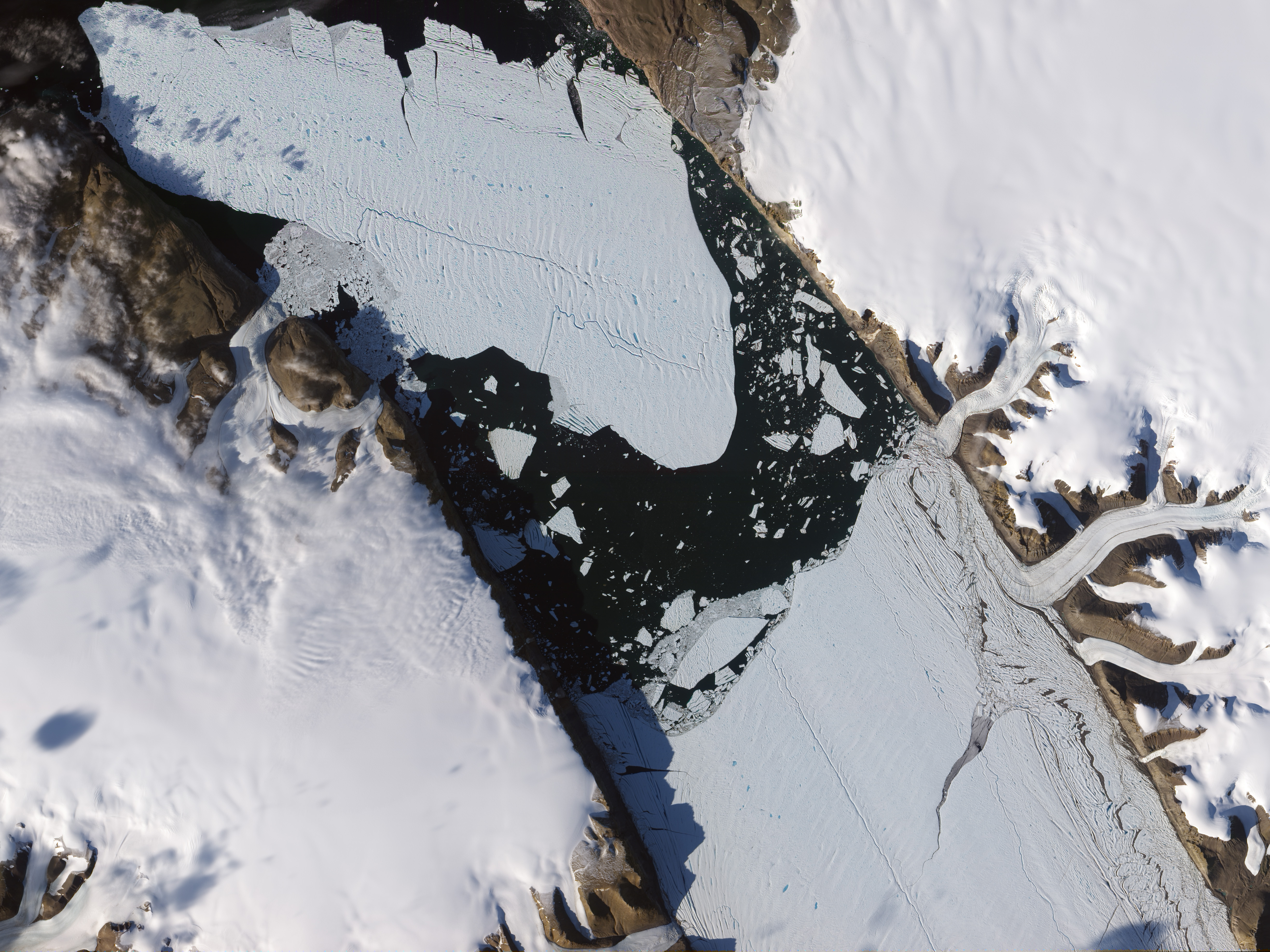
On Aug. 5, 2010, an enormous chunk of ice, roughly 97 square miles (251 square kilometers) in size, broke off the Petermann Glacier, along the northwestern coast of Greenland. The Canadian Ice Service detected the remote event within hours in near real-time data from the Moderate Resolution Imaging Spectroradiometer (MODIS) on NASA’s Aqua satellite. The Petermann Glacier lost about one-quarter of its 70-kilometer (40-mile) long floating ice shelf, said researchers who analyzed the satellite data at the University of Delaware. Taken from here.
 Learning from Dogs
One thought on “Total, utter madness, Pt 4”