Year: 2010

Dealing with the fear of the Known!

Can we ever conquer fear?

In a recent article I discussed the fear of the unknown, linked to the down-turn, redundancies, etc.

Per Kurowski, a great supporter of this Blog, posed the following question.

Great advice… but how do we remove the fear of what is known?

A simple, and slightly flipant answer would be,

“Develop a different relationship with it.”

What I’m saying is that when we are facing the known, and I’m assuming that it’s something unpleasant, our choices are limited. It’s going to happen, so the only thing we can do is change the way we view it.

This brings us back full circle to developing a different relationship with it.

Let’s take the word, ‘fear’.

All fear is an illusion, walk right through“. I heard Dr David Hawkins say on a CD. Granted, a great trick if you can do it!

Here’s another description of fear: Fear= False Evidence Appearing Real

Fear is generally future-based. We tend to use the past as a learning reference to inform us of what to be afraid of in the future. So human beings live their lives trying to predict and prepare for the future, limited by their past experiences.

Unfortunately, the only way to work with fear of the known is to live in the present! [Just like dogs! Ed.]

Our whole society is geared up to look into the future. We are forever worrying about or planning something for the future.

To begin focussing on the present, try this.

Simply, to start off, become aware of the breath and sensations in the body. This will slowly start to remind us to be present, or embodied, in our own body.

Fear

Problems, fear and spiral thinking, often at 3 or 4 in the morning, are generated in the mind.

Thoughts occur randomly, although we call them, “Our thoughts”, and refer to, “Our mind”.

By dropping out of the thought processes into awareness of the breath and body, the noise stops, even if only for a moment.

So very few people in the world will have even the slightest inkling what these words mean.

If more of us got used to coming out of the mind before making an important decision, and simply sat with the question for a while, the answer would probably present itself.

This will probably raise more questions than it answers but that’s not a bad thing.

By Jon Lavin

[If you have been affected by this Post and would like to contact Jon, he would be delighted to hear from you. Ed.]
Joke for Today

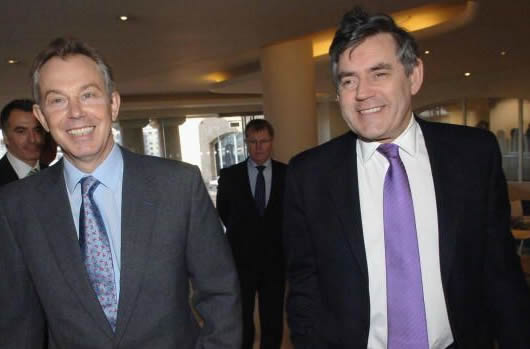
In the good old days, Tony Blair and Gordon Brown were watching a John Wayne western together when Blair said:

“Look. I bet you £10 (Ed: or in today’s money, £10 billion) that John Wayne is going to ride his horse over that cliff!”

Brown said: “You’re on. I bet he isn’t …”

Then Big John did ride his horse over the cliff ……

Brown held out a wad of notes to Blair … “Fair enough, ” he said. “You were right again.”

Blair replied: “Well, you’d better keep the money; I was playing a trick on you; I’ve seen the film before.”

Brown replied: “So have I. I just didn’t think he’d make the same mistake twice ……”

PS Yes, why kick a man who is down (and out), but the supposedly-clever former British Chancellor and then hapless Prime Minister Gordon Brown has left Britain with a £170 billion debt burden that will – according to the new government coalition – take a decade of pain to put right.

And his party STILL has the gall to complain about the danger of “cuts”. You couldn’t make it up. They just don’t get it. There is NO WAY to avoid a GREAT DEAL of SELF-INFLICTED pain.

By Chris Snuugs

Euro Soap Update

This is what Europe’s elite has reduced us to; hoping for a fall in the value of our currency “to boost exports.”

François Fillon, the French prime minister, said on Friday (June 4th) that the weakening currency was “good news” because it could boost European exports. His comments accelerated the currency’s slide and prompted selling of French government bonds.

This of course is the cunning ploy formerly used by weak, failing, uncompetitive countries such as Greece, Italy, Portugal and so on before they hitched their waggons on to the euro gravy-train led by the massive German engine. (Anyone remember the story of the over-burdened camel, by the way?)

For France’s Prime Minister, the falling euro is “good”. Well done, François. Thanks for the increased price of oil and everything else we import. How the Swiss must be quietly smirking as they watch this shambles of overspending and reckless financial profligacy.

And the news of Hungary’s tottering economy is helping to push the euro further down towards parity with the dollar. Wonderful. Perhaps we should hope that it falls to half the dollar! Think of how much that would boost exports! This policy is of course about as fatuous as France’s idea that cutting the working week to 35 hours would increase employment.

Of course, the Yanks could copy our example and help to push the dollar down, so that the USA and Europe end up in a deadly game of  spiral descendency (“Ha, Ha – our currency is weaker than yours!”) while the Russians, Chinese and Arabs quietly prepare to buy up all our increasingly-worthless assets.

We deserve better leaders.

P.S. Ireland?  The Forgotten Basket Case? Don’t worry – it won’t be forgotten for much longer:

Fears for Ireland’s financial stability also re-emerged after the minister of finance said that the country’s banks had to refinance more than €74 billion of debt by October 1. The sum is equivalent to more than half Ireland’s annual economic output.

P.P.S. The USA will save the world as usual? Maybe not!

by Chris Snuggs

The Oil Spill

A rather different view point.

This may not be very Politically Correct but I am getting a bit fed up for the following reasons with Obama’s constant bad-mouthing of BP :

  • If the regulatory procedures were not strong enough then that is the USA’s fault, not BP’s.
  • The USA is glad enough to extract oil from ecologically-dangerous places because it is hooked on oil. That isn’t BP’s fault either.
  • It is bleedin’ obvious that SOONER OR LATER (see previous comments on statistics) there was going to be an accident of this type, yet NO PROPER CONTINGENCY PLAN was in place. That is partly BP’s fault (over-confidence) but also the USA’s fault for not insisting on one.
  • BP is clearly doing all it can to put things right; constantly rubbishing it seems fairly pointless.
  • Nobody knows how much BP was to blame; there were other companies involved, including US ones.
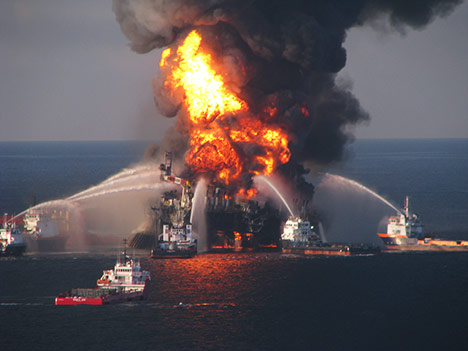
The burning BP Oil Rig

In general, the USA has long been too soft on oil companies because it needs the oil.

Now of course we are going to have a pendulum swing the other way, but rather than knee-jerk reactions why not consult and put in place an effective “doomsday scenario” plan? For example, a 20,000 ton concrete dome that could be lowered right over a fractured well to seal it off?

Of course, Obama’s ranting is political. He does NOT want this to be his “Katrina”. However, nobody in their right mind would blame him personally for this accident and now that it has happened it is pretty pathetic to rant about how evil BP is.

What’s done is done. Statistically, there was BOUND to be an accident of this kind one day. By allowing deep-sea drilling the USA MUST HAVE ACCEPTED the risk. If proper and regulatory contingency plans had been in place then the environmental damage might have been minimised.

In general one must say of the Human Race that we aren’t brilliant at anticipating risks and preparing for the worst. Witness carbon emissions and climate change. As a man-in-the-street, the ONLY change in long-held habits that I have seen to combat global warming is that you can no longer in Europe buy old-fashioned light bulbs. Otherwise life seems to go on pretty much as ever, with all governments desperately wishing for growth because of their idiotic over-spending.

STOP PRESS: Above all a President needs to stay calm and rational. There was no reason to stop all off-shore drilling pending the result of an enquiry. This has put thousands of Americans out of work. No, I am NOT minimising the damage; it is tragic and disastrous, but 80% of Louisiana’s economy depends on the oil business.

And we badly need perspective. This is – as I already said – a terrible disaster, but the record of off-shore drilling is in fact extremely good in ecological terms. One bad experience should not lead to the knee-jerk shut-down of the entire industry. Fascinating article in the UK Guardian newspaper.  That article concludes thus:

In an open letter to Obama published in Louisiana’s Thibodaux Daily Comet newspaper, local resident Stephen Morris vented fury at the drilling freeze: “If it was a knee-jerk response to everyone’s anger about the continued leak and possible annihilation of southern Louisiana’s way of life, you didn’t think it through or your advisers are smoking way too much crack.”

And this article in the UK Independent brilliantly sums up the way Obama is getting this all wrong for superficial, popularist reasons.  Here’s how that article starts:

The evidence is overwhelming. Any fair-minded person who examines the Gulf of Mexico oil spillage is compelled to two conclusions. First, that there is no evidence of wrongdoing by BP. Second, that the President of the United States has behaved disgracefully.

The vessels of the Los Angeles class, the pride of the US nuclear submarine fleet, will not operate below 950ft. If they were to dive to 1450ft, their hulls would implode. The Americans do have three subs which could function at 2,000ft. They cost $3bn each. It follows that drilling for oil below a 5,000ft seabed is a difficult business which involves risks. But it is essential.

By Chris Snuggs

A Way Forward?

Removing the fear of the unknown

I’ve been working with most of my clients recently through painful transformations brought about by the economic downturn.

An interesting metaphor really because since the first wave of uncertainty triggered panic, first noticed in the UK banking system, I have been picking up on that uncertainty that feels like it’s stalking the globe at the moment.

Interestingly, I, too, have been aware of an underlying fear that was difficult either to name or source.

It has been rather like a deep river in that whilst the surface feels slow moving, currents are moving things powerfully below.

So this ‘fear’ has caused a few household changes.

We now are the proud owners of 9 chickens. Our youngest son, Sami, and I have dug up the back lawn and planted vegetables and built a poly-tunnel.

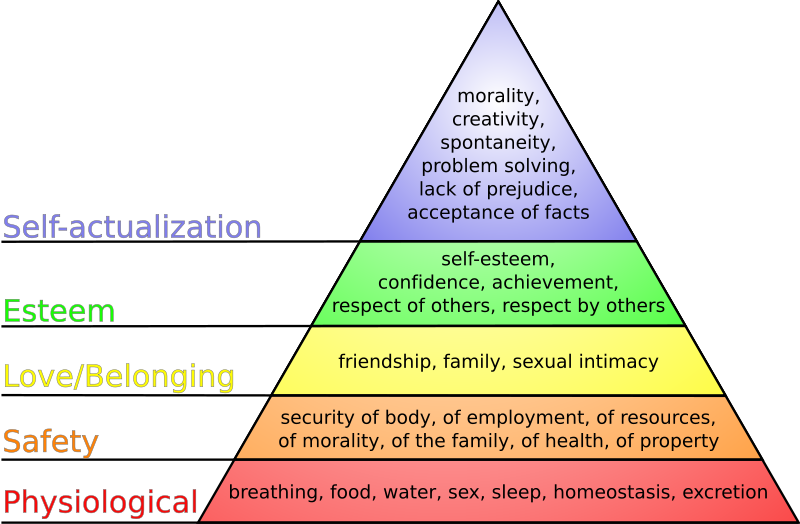
We have also installed a wood burning cooker. Right back down to the base of Maslow’s triangle really!

Maslow’s triangle of needs

These feelings have brought about such change everywhere and I wonder seriously whether we will ever return to what was; indeed would we want to?

I might not have mentioned it in previous blogs but as well as an engineering background, in latter years, I have focused on how interpersonal success in business is linked directly to relationships, integrity and vitally, self-awareness.

To inform this, some 7 years ago, I embarked on an MA in Core Process Psychotherapy, primarily to work on myself so that I could be the best I could be in my relationships, in and out of work.

The point I’m trying to make is that the same panic I notice in many of the companies I work in, and in me, is based on fear of the unknown and on a lack of trust in all its forms.  I’ve deliberately underlined that last phrase because it is so incredibly important.

The truth is that we get more of what we focus on.

So we can choose to focus on the constant news of more difficulties, hardship and redundancies, or we can focus on what is working.

In the workplace this positive focus has been pulling people together across functions and sites and pooling resources and ideas.

A farm evening

When we realise we’re not doing this alone it’s amazing how much lighter a load can feel and how much more inspired we feel.

I also notice how humour begins to flow and what a powerful antidote for doom and gloom that is.

Transformation is never easy but the rewards far exceed the effort put in ten fold.

So what is it going to be? Are we all going to bow down to the god of Doom & Gloom, fear and anxiety, heaping more and more gifts around it, or are we going to start noticing and focusing on the other neglected god – that of relationship, joy, trust, abundance and lightness?

Whatever the future holds for us all a belief in our inherent ability to adapt and change and focus on the greater good rather than fear, anxiety, greed and selfishness is the only sustainable way forward.

By Jon Lavin

[If you have been affected by this Post and would like to contact Jon, he would be delighted to hear from you. Ed.]
Israel and the Palestinians

ISRAEL – Can anyone tell me which of these statements is not true?

  • Fatah, long-time sworn enemy of Israel, no longer sponsors attacks on Israel.
  • Fatah poses no military danger to Israel.
  • Fatah has accepted the right of Israel to exist; threats to obliterate it from the map have come from Iran, but that is not Fatah’s fault.
  • Palestinians in general are among the best-educated and most democratic of Arabs.
  • A democratic Palestinian State trading freely with Israel would greatly increase prosperity in both states, but especially in Palestine.
  • Free, democratic and prosperous states do not in general cause conflict.
  • A free, democratic and prosperous Palestine would cause ordinary people in Gaza and elsewhere in the Arab world to wonder why the hell they were bothering to support extremists and “terrorists”.  Hamas, Hezbollah, Al Qaeda and Iran would have the ground cut totally from under them. The latter are terrified of anything free and democratic, so it is no wonder that their main aims are to foment disorder and chaos. Israel sometimes seems to play their game for them.

I believe all the above to be true, though am willing to stand corrected. And so the next question is, Why does Israel still occupy the West Bank and impose roadblocks on ordinary Palestinians trying to create some sort of normal and prosperous life for themselves?

West Bank and Gaza

It seems to me that Israel’s policy here is potty. In all walks of life, you encourage good behaviour (assuming you want progress, peace and prosperity). I am unclear how the good behaviour of Fatah in the last few years has been rewarded. On the contrary, there is endless talk as ever but little action on the ground.

One understands Israel’s existential fears, but the dangers no longer come from Fatah and Palestinians in the West Bank. They should and could become the allies of Israel.

Has Israel become so accustomed to battering its enemies with force that it cannot learn the humility of victory and take a longer vision?

The major sticking points?

  • Jerusalem? This has to become a shared city in some form. Israel has no right to claim it as its own. We all share the planet; I can see no fundamental problem with sharing a city.
  • The exiles? There has to be some sort of justice. We – I believe – empathize with Jews. We understand their fears for their existence. We support their right to exist. But they do not seem to empathize with those Arabs whose land was taken from them first in 1948 and then later by conquest. EMPATHY – this is sorely lacking in the current Israeli leadership.

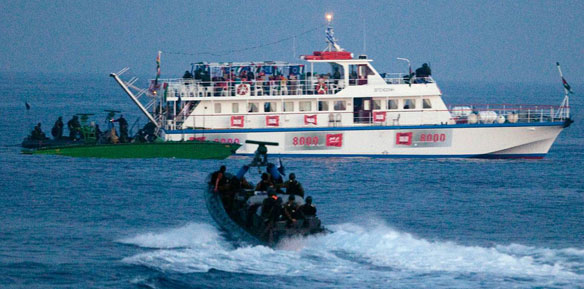
Israel Blockade Challenged

The Aid Ship Fiasco? Once again, Israel is its own worst enemy. The critical thing is to establish the truth, so if Israel has nothing to hide then why does it not permit an independent enquiry?

It seems pretty clear to me that the majority of activists on the first ship were peaceful but you only have to have a few prepared to use violence and this will cause big trouble, which seems to have been the case here. And everyone knows that if Israel or Israelis are attacked then they respond with overwhelming force.

But “winning hearts and minds” CANNOT be done without the truth being known, and nobody who matters (ordinary Arabs, Iranians and Turks in particular) is going to trust an enquiry carried out solely by the Israelis. This is so obvious that one wonders if – as often seems the case – Israel has taken leave of its senses.

by Chris Snuggs

Watch, and learn! Concluding parts

Growth is good?  Good for what?

[Apologies to our readers but a consistent error in all the links to previous posts within this and earlier posts has now been corrected.  You can view all the previous sections of his lecture by clicking the links in this Post. Ed.]

We live on a finite Earth.  But really understanding what that means is difficult.  I guess because most of us think that in our own little way we can’t really be doing any harm to the planet – I mean what’s another few grams of CO2?

Al Bartlet, University of Colorado

Well here’s Dr Albert Bartlett of the Department of Physics at the University of Colorado chatting about arithmetic!  And if you go to his website, you will come across this quote on the home page:

“Can you think of any problem in any area of human endeavor on any scale, from microscopic to global, whose long-term solution is in any demonstrable way aided, assisted, or advanced by further increases in population, locally, nationally, or globally?”

Want to sit in on his famous lecture, “Arithmetic, Population and Energy: Sustainability 101”?  Well you can.

The lecture is broken down into 8 10-minute videos, each of them on YouTube.  The first two instalments are here , Part Three and Four here

Parts Five and Six were in this post. These are the concluding two parts.

Part Seven

Part Eight

By Paul Handover

Laughing as you sink!

John Clarke and Bryan Dawe on the million dollar questions – courtesy of the Australian Broadcasting Corporation

This sketch is doing the rounds and deservedly so – it’s a very funny skit on Europe’s troubling financial situation.

As ex-Prime Minister, Margaret Thatcher, is reputed to have quoted, “The problem with socialism is eventually you run out of other peoples money.

By Paul Handover

Watch, and learn, Part Three

Growth is good?  Good for what?

We live on a finite Earth.  But really understanding what that means is difficult.  I guess because most of us think that in our own little way we can’t really be doing any harm to the planet – I mean what’s another few grams of CO2?

Al Bartlet, University of Colorado

Well here’s Dr Albert Bartlett of the Department of Physics at the University of Colorado chatting about arithmetic!  And if you go to his website, you will come across this quote on the home page:

“Can you think of any problem in any area of human endeavor on any scale, from microscopic to global, whose long-term solution is in any demonstrable way aided, assisted, or advanced by further increases in population, locally, nationally, or globally?”

Want to sit in on his famous lecture, “Arithmetic, Population and Energy: Sustainability 101”?  Well you can.

The lecture is broken down into 8 10-minute videos, each of them on YouTube.  The first two instalments are here , Part Three and Four here and Parts Five and Six in this post. The concluding two parts are tomorrow.
Part Five

Part Six

By Paul Handover

Watch, and learn, Part Two

Growth is good?  Good for what?

We live on a finite Earth.  But really understanding what that means is difficult.  I guess because most of us think that in our own little way we can’t really be doing any harm to the planet – I mean what’s another few grams of CO2?

Al Bartlet, University of Colorado

Well here’s Dr Albert Bartlett of the Department of Physics at the University of Colorado chatting about arithmetic!  And if you go to his website, you will come across this quote on the home page:

“Can you think of any problem in any area of human endeavor on any scale, from microscopic to global, whose long-term solution is in any demonstrable way aided, assisted, or advanced by further increases in population, locally, nationally, or globally?”

Want to sit in on his famous lecture, “Arithmetic, Population and Energy: Sustainability 101”?  Well you can.

The lecture is broken down into 8 10-minute videos, each of them on YouTube.  The first two instalments are here with Part Three and Four in this post. The remaining four parts over the next two days.

Part Three

Part Four

By Paul Handover