Last Sunday I went for my usual bike ride, ending up at Riffle’s Cafe, Merlin.
The conversation soon turned to helping cats and dogs, and Tami said that the local Rogue Valley Animal Shelter was in desparate need for food. They are better known as the Rogue Valley Humane Society.
Tami then offered to use the Cafe to raise funds for the Shelter. The funds could be money or food. Tami promised that anything donated to the animals would be sent to the Shelter.
Riffle Cafe
450 Merlin Road, Merlin, Oregon 97532, United States
I will admit that I have never been one for gambling. Perhaps a small bet between friends in my earlier English days. I do not know the cause of my resistance to ‘playing the odds’. My guess is that it is a product of being born in London in 1944 when life was pretty tight. I grew up being careful about my finances.
Thus, having a better obsession is not something that I understand.
However, this article about Brazil, published in The Conversation, was interesting enough to warrant me republishing it.
ooOOoo
The next World Cup won’t be only about passion for soccer. It will also be about betting obsession
For most of soccer’s history, fans all around the world cheered for goals and other skillful moves, but now online betting platforms have broken the game into hundreds of small financial bets, changing what soccer means emotionally for many of its fans. aniloracru/Unlimphotos
In a country where kids play soccer in the streets, the World Cup is one of the rare times when millions across the nation share in the same excitement. But the way many Brazilians experience that excitement has changed for one big reason: Betting.
For most of soccer’s history, fans all around the world cheered for goals, great saves, skillful moves, comebacks, and wins. Now, online betting platforms have broken the game into hundreds of small financial bets. Fans can bet on the final score, but also on yellow and red cards, corners, throw-ins, shots on goal, saves, fouls, and almost every stat the game produces.
This shift changes what soccer means emotionally for many of its fans. For example, someone might cheer for a corner kick against their own team if it helps their bet. They might hope a defender gets a yellow card, even if it’s bad for their side. Some care less about Brazil’s game style and more about how much stoppage time there is for another chance to win a bet.
This isn’t simply about adding more entertainment. It turns passion into a transaction. Soccer’s magic comes from everyone sharing the same hope for a goal. Betting breaks that bond. Now, a foul isn’t just a foul; it’s a chance to win money. A corner kick becomes a way to cash out.
Betting and social costs
This is especially important in Brazil, where online betting is now part of daily life. Fixed-odds betting became legal in 2018, but real rules came much later. Between 2018 and 2024, companies grew quickly in a regulatory gray area, filling soccer, social media, and ads with betting. By the time Brazil’s regulated market started in 2025, betting was already everywhere.
The social costs are clear. Nineteen percent of bettors, about 7.5 million people, said they spent money on gambling in a way that compromised their livelihood income. Forty-one percent gave up other purchases to bet. Seventeen percent skipped paying a bill to gamble. Twenty-nine percent ended up on bad-debt lists because of betting. The average monthly spend was R$ 187 (US$ 37.4), and for lower-income bettors, it was R$ 151.98 (US$ 30.4). For poor families, that money could have been better spent on food, transport, diapers, electricity, or rent.
In Brazil’s favelas, betting is rarely just a pastime, as I observed during two years of fieldwork in communities in the city of Vitória, capital of Espírito Santo state. People see it as hope — a way to stretch a little money when jobs don’t pay enough. One young man told me he started because a coworker told him an app “made money.” He put it simply: “Who doesn’t want to make money these days?”. Another pointed out that people only share their wins, not their losses. Many knew the odds were arranged against them. As one person said, “the ones who really win are the platform owners.”
Soccer betting is also tied to ideas about masculinity. Many young men I spoke with saw sports betting as a way to show their knowledge, control, and skill. Betting on soccer was proof that you understood teams, form, possession, rivalries, and odds. Barbershops and WhatsApp groups became places where men shared tips and advice. One person told me betting was more common among men because it’s about soccer; another said young men “go deeper”, risking more money for bigger wins.
It’s not that women don’t bet; they do. But soccer betting often carries a masculine image: the man as expert, strategist, and provider. When money is tight, betting tells young men they can turn soccer knowledge into cash, and cash into pride. Losing feels shameful, so wins are shown off, and losses are kept quiet. This show of control hides the fact that the platform is really in charge.
Stronger rules and regulations
The 2026 World Cup will make all of this even bigger. There will be daily matches, national pride, celebrity ads, influencer tips, betting links, instant money transfers, and live in-game markets. The tournament will be promoted as a soccer festival. For betting companies, it will also be a chance to profit.
It’s a harsh irony. Brazilians will pin their hopes on the national team, but many will also risk their rent, wages, and emergency funds on bets about cards, fouls, and corners. In this game, the real winners aren’t the fans; they’re the betting platforms.
This doesn’t mean Brazilians should stop loving soccer. It means they need to protect the game from turning into just another way to make money. Simply licensing companies and collecting taxes isn’t enough. Brazil needs strong rules on advertising, real limits on losses and deposits, restrictions on in-game micro-bets that make every foul a bet, and public health campaigns that don’t blame people for a system built to trap them.
The World Cup should remind us why soccer is important. Its beauty isn’t about how many bets you can place. It’s about the impossible goal, the common excitement, the joy of winning together, and the dignity of losing without losing the money you need to live.
I have never been to Brazil but I appreciate it is a very big country. It practically takes over South America (SA). I’m certain that it is the largest country in SA.
I have a follower of this blog who lives in SA and if John reads this post perhaps he will leave a comment. I hope so!
Like many other people, I am fascinated by the dark, clear, night sky. It appears to go on forever.
But this ‘foreverness’ is just our galaxy.
As is said in the following article: “…. if Earth were the size of a pea, the distance to Proxima Centauri would roughly equal the distance between New York and Sydney, Australia.”
The article shows how distant we are, how small we are, how irrelevant we are, in the vastness of the universe.
On May 22, 2026, the Pentagon released a second batch of previously classified photos and videos showing what appear to be unexplained flying objects. These file dumps were the culmination of a process that was set in motion back in July 2023, when a group of government whistleblowers testified before Congress that the U.S. government was secretly in possession of extraterrestrial spacecraft and suspected alien body parts.
That congressional hearing marked the beginning of a cultural shift in which UFO reports are increasingly treated as a matter for serious discussion, both within the government and the scientific community.
The Pentagon released over 200 previously classified UFO files in May 2026. Department of Defense
But is this newfound legitimacy deserved? As an aerospace scientist who studies aircraft and spacecraft design, I approach this question using math, physics and the principles of engineering. To assess the plausibility of alien visitors, it’s necessary to understand the obstacles that an extraterrestrial vessel would need to overcome to reach Earth.
The tyranny of distance
There is no evidence of intelligent alien life in our solar system. So any extraterrestrial visitors would likely have to come from another star system within our Milky Way galaxy.
Proxima Centauri, the star closest to our Sun, is located 4.25 light-years (about 25 trillion miles or 40 trillion kilometers) away.
For perspective, if Earth were the size of a pea, the distance to Proxima Centauri would roughly equal the distance between New York and Sydney, Australia.
Even the stars closest to Earth are incredibly far away.
Since only a fraction of stars are thought to host intelligent life, the nearest alien civilization – if one exists – is surely much farther away than Proxima.
A need for speed
Given the scale of interstellar distances, it’s inevitable that any alien voyage to Earth would span many years and possibly several centuries. But as the time spent in transit increases, so does the risk of catastrophic accidents or system malfunctions that could jeopardize the mission. So it’s important to avoid an overly lengthy journey by traveling as fast as possible.
No object can reach or exceed the speed of light (roughly 186,000 miles or 300,000 kilometers per second). But well before approaching that threshold, engineering constraints begin to assert themselves. Limited fuel availability and the potential for structural damage will restrict the spacecraft’s peak velocity.
There is no universally accepted upper limit on interstellar flight speeds, but studies tend to converge around 19,000 miles per second (30,000 km/s) – 10% of the speed of light – as a realistic cruise velocity. At this speed, a journey of 10 light-years will take approximately 100 years to complete.
Fueling the dream
Finding a way to accelerate the ship to its target cruise speed is the central challenge facing any would-be alien explorers.
Interstellar space is unforgivingly vast, but the emptiness has some advantages. The lack of atmosphere means there is no aerodynamic drag. So when the ship reaches its cruise speed, it can shut down its propulsion system and coast toward the final destination. Unfortunately, the lack of atmosphere also means there is nothing to slow the ship down prior to arrival. So ideally, the propulsion system would be used for both acceleration at the start of the trip and deceleration at the end.
One of the more exotic propulsion strategies employs high-powered laser beams to push the ship through space. The beam is projected from a stationary array near the travelers’ home planet and directed toward a thin reflective sail attached to the ship. The beam’s photons exert radiation pressure on the sail, propelling the ship forward.
This approach has a major advantage in that it requires no onboard fuel. But the amount of energy and infrastructure needed to operate the laser would be staggering. Also, beamed propulsion provides no mechanism for deceleration. At best, this method could be deployed as part of a hybrid strategy that uses a separate system for deceleration.
A more practical approach is to use rocket propulsion. Rockets generate propulsive force, also known as thrust, by expelling high-velocity exhaust in a rearward stream. By reversing the direction of the exhaust, rockets can also be used to slow the ship down.
Their main disadvantage is that rockets must carry their own fuel in addition to carrying the passengers, the habitat and other life-sustaining systems. The extra load necessitates even more fuel. In other words, you need fuel to transport your fuel. The result is a costly snowball effect that can cause the total fuel requirement to balloon to absurd proportions.
Rocket propulsion can be divided into three broad categories.
Chemical propulsion uses chemical reactions – typically combustion – to extract energy from the bonds between atoms. All human space missions thus far have used chemical propulsion. The problem with this method is that it accesses only a tiny fraction of the energy contained within the fuel.
Antimatter propulsion is theoretically the most efficient option. When antimatter comes into contact with ordinary matter, the two undergo mutual annihilation and 100% of their combined mass is converted into energy. This makes it possible to achieve the same cruise velocity – one-tenth the speed of light – with fuel accounting for less than a quarter of the ship’s total mass. This is science fiction-level fuel efficiency, which makes antimatter an attractive option for interstellar propulsion.
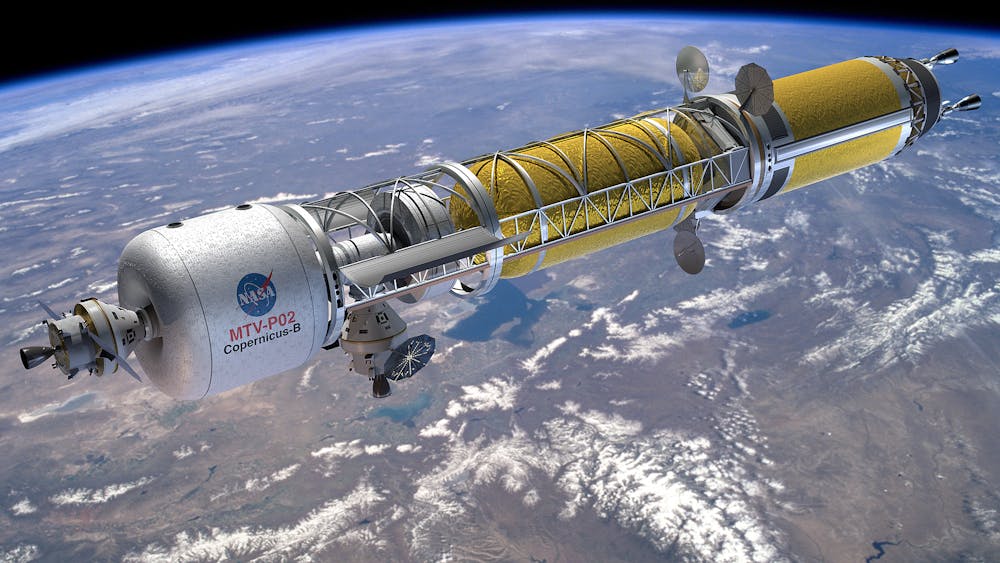
NASA has been working to develop nuclear propulsion. This artist’s impression shows what a nuclear-powered rocket could look like. John Frassanito & Associates/Wikipedia
These numbers assume that our extraterrestrial visitors have figured out how to efficiently convert the energy released by their reactor – whether nuclear fusion or antimatter – into thrust.
Just as importantly, they must be able to create optimized fuel tank structures that are ultra lightweight yet highly secure. Designing the structure of the ship, from the fuel tanks to the hull, would be one of the biggest engineering challenges of the entire mission.
Interstellar space contains a sparse smattering of hydrogen atoms and microscopic grains of cosmic dust. At 19,000 miles per second (30,000 km/s), dust particles would smash into the ship’s hull with the energy of a .22-caliber bullet. The bombardment of hydrogen atoms would produce a violent cascade of radiation that could erode even the most resilient engineering materials.
Surviving the onslaught would require no less than a flying fortress with complex magnetic shielding. This would increase the total mass of the ship, which further drives up the demand for fuel.
This example is just one of the hundreds of delicate design trade-offs that would plague any interstellar vessel. Each individual design requirement acts as a filter, reducing the number of feasible solutions.
Finding a single system that simultaneously satisfies all the requirements is analogous to shopping for a car online. With each new filter you apply – four-wheel drive, black exterior, less than 10,000 miles on the odometer – the number of available options dwindles.
When design requirements are in tension with one another – for example, requiring a structure that is lightweight but also supremely durable – the number of feasible solutions can drop to zero.
No single law of physics prohibits an interstellar voyage to Earth. But the combined effects of hundreds of extreme, often conflicting engineering requirements may render it physically infeasible.
It’s also possible that alien civilizations have discovered novel technologies that outperform anything currently known to humans. But like the examples discussed here, any such technology will inevitably encounter its own engineering hurdles.
The trillion-dollar question
Ultimately, engineering challenges are just some of the many barriers to interstellar travel. Any prospective alien visitors must also have sufficient cognitive ability, technological maturity, physical resources, collective desire and proximity to Earth.
That said, if the stars were to align and an alien vessel made it to Earth intact, it would trigger a torrent of burning questions: Where are they from? What do they want? What are they made of?
But the question that would go furthest in shedding light on the deeper mysteries of the universe is, “How on Earth did they get here?”
Kai James poses the unanswerable questions in the last two paragraphs. And how about this statement: “Consequently, using chemical propulsion on a spacecraft with a cruise velocity of 19,000 miles per second (30,000 km/s) would require more fuel that all the mass in the observable universe.“
The Emperor’s New Mind: Concerning Computers, Minds and The Laws of Physics
Book by Roger Penrose
Here is a summary of the book that is first, a very deep read, and, second, full of detailed mathematics that were beyond me. I just skipped those parts. However, it is an incredible book and one that has extended my knowledge in so many ways. I think that it isn’t going too far to say that it has amended my knowledge tremendously and I am so glad to have read it, even at the age of 81.
The Emperor’s New Mind (1989) by Roger Penrose argues that human consciousness involves non-computable processes, meaning a computer can never fully replicate the human mind, even if it can simulate its functions. Penrose uses Gödel’s incompleteness theorems and quantum mechanics to support his view, suggesting that consciousness arises from physical processes in the brain that are not algorithmic, and that a deeper understanding of physics, possibly involving quantum gravity, is needed to explain the mind. The book explores the “mind-body problem” and challenges the idea that all thinking is computation, proposing that human understanding can grasp truths that formal systems cannot.
Key arguments and concepts
Gödel’s Incompleteness Theorems: Penrose argues that human mathematicians can see the truth of certain mathematical statements that a formal system (like a computer program) cannot prove, demonstrating a non-computable aspect of human thought.
Non-computability: He posits that certain mental activities, like mathematical insight, are inherently non-algorithmic and cannot be simulated by a computer, even a powerful one.
Quantum mechanics and consciousness: Penrose suggests that consciousness is linked to quantum mechanical processes in the brain, specifically involving microtubules, a theory he later developed further in Shadows of the Mind.
Critique of Strong AI: The book challenges the “strong AI” hypothesis that a sufficiently complex computer can achieve genuine consciousness, arguing that it misunderstands the nature of human understanding.
Reception and legacy
The book won the 1990 Science Book Prize.
It sparked debate and collaboration, notably with Stuart Hameroff, leading to the “orchestrated objective reduction” (Orch OR) theory of consciousness.
It remains a significant work in the philosophy of mind, artificial intelligence, and the physics of consciousness, influencing discussions on the limits of computation and the nature of the mind.
And I am not going to let my words interfere. Just read this.
ooOOoo
Clear the Needle
Who is she, if she does not even know herself?
Trajectories confuse when forced into linear containers..
Like the cosmos — all spirals and orbits — we spin and dance,
sometimes skillfully, sometimes clumsily.
The vinyl record spinning, fine dust collecting on the diamond needle.
We must stop from time to time and clear it
so that we might perceive sound more accurately, truer to itself.
I have collected more than my share of detritus.
But I have never been granted the grace of someone or something clearing the needle for me.
It remains a reminder to pause.
Stop the music. Lift the arm. Clear the cartridge.
Begin again.
ooOOoo
Not only was Bela’s poem perfect so, too, was the comment left on Bela’s site from Shakti that I am going to share in full.
Hi Bela,
I found in the verse a striking metaphor for the human condition.
We spend so much of life assuming the music has changed, when often it is the dust on our own needle that has altered the sound. Memory, hurt, ego, assumptions, fatigue—each leaves its fine sediment, subtly distorting how we hear ourselves, others, and the world.
The most profound act, perhaps, is not to keep forcing the song forward, but to pause with enough honesty to ask: what in me is creating this static? The verse’s quiet power lies in rejecting rescue—no one may come to clear the needle for us. Self-awareness, then, becomes both responsibility and grace. To stop. To clean. To begin again—not as the same listener, but as a truer one
Shakti
“To begin again—not as the same listener, but as a truer one“
The right to repair one’s own technology products is under attack.
I hadn’t really thought of this before now. I am speaking of an article last Friday that was published by The Conversation.
A large part of me is very open to the ways that technology is helping me. I presume that I am far from being alone.
Here is that article that questions the way things are.
ooOOoo
Today’s bans on DIY repairs of everything from cell phones to tractors grew out of Hollywood’s fear of videotaping
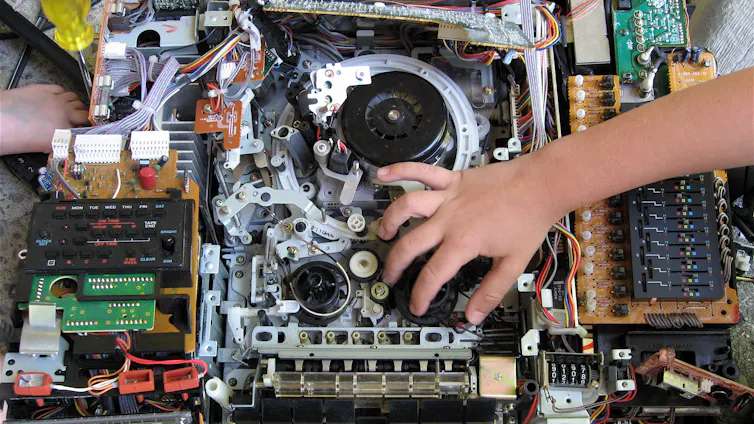
Betamax video recorders like this one helped set off a chain of events leading to bans on repairing your own devices. Steve Jurvetson/Wikimedia Commons, CC BY
If you have ever tried to repair something, realized that it was beyond your financial or technical means, and ended up buying a new one, you are not alone. Repairing electronics and household appliances has not been a real option in the United States for decades now, particularly for items that have proprietary software in them.
Absurd situations have proliferated. It can cost about the same to buy a new printer as it does to replace the ink cartridge. The U.S. Department of Defense cannot repair the weapons systems it purchases because the intellectual property rights remain with the manufacturer. John Deere, the farming equipment company, doesn’t allow farmers to access the software needed to repair their own combines and tractors because, while the purchase covers the physical machinery, it does not cover the software.
One consequence, in addition to cost and frustration for consumers, is environmental harm. The U.S. is the world’s second producer of electronic waste after China, to the tune of about 43 lbs (19.5 kg) of electronic waste annually per person. Only 25% of this e-waste is recycled.
The right-to-repair movement emerged in response, calling for people to be able to repair what they purchase, or have third parties do the repair work, without unnecessary financial, legal or technical barriers. Right to repair seems to be a rare area of bipartisanship in Congress. The Warrior Right to Repair Act – introduced in 2025 by a Democrat – and the Repair Act – introduced by a Republican – are two ongoing legislative initiatives to create a federal legal framework that would make it easy and cheap for American users to repair their devices. Both bills are fiercely opposed by industry groups.
As a scholar of American culture, I found through my research that the origins of the legal and technical obstacles to product repairs lie in debates in the 1980s over new media and copyright guardrails.
Hollywood and VCRs
The rapid rise and popularity of video cassette recorders, or VCRs, in the late 1970s transformed films and TV shows from transient experiences into tangible consumer goods. As I show in my book, “Videotape,” despite the potential for extra revenue, Hollywood was alarmed by the fact that users were now able to copy films on videotape, and tried to stop the technology. Today’s repair bans are part of that story.
The first U.S. copyright provisions were embedded in the 1790 Constitution. Over time, the law was amended to include new technologies, but at the core of future legal arrangements remained the initial intent: to protect the financial rights of creators while giving enough access to information for society as a whole to progress.
Until the second half of the 20th century, the American doctrine of fair use, which allows the unlicensed use of protected works under specific conditions, allowed judges to prevent copyright law from negatively affecting public interest. Organizations such as public libraries, book clubs, universities and news organizations benefited from this legal approach. The concept was codified into American law in the Copyright Act of 1976.
When the film studios took Sony to court to stop the production and sale of video recorders in 1976, they argued that Sony’s product encouraged copyright infringement. But the U.S. Supreme Court ruled in 1984 that taping TV content for personal use did not violate copyright law, expanding the understanding of fair use.
The industry then focused on finding a technological solution to the piracy problem and on securing stricter legal protections for its products.
They identified the digital versatile disc, or DVD, as a safer alternative to the VHS tape. Initially, the DVD was a read-only format. It took a few more years of engineering before affordable recording was possible. Even then, the process was far more complicated for users than videotape recording. In 1997, barely one year after the video disc was launched, all of the Motion Picture Association of America member studios joined the DVD Forum, collectively adopted the new format and started to phase out films released on videotape. https://www.youtube.com/embed/46RDkiy5h3U?wmode=transparent&start=0 Manufacturers use several tactics to block consumers and third-party repair shops from fixing their products.
Copyright and virtual locks
Then came digital rights management. Collectively, the term refers to the battery of technological tools that the industry developed in order to control user access to content. These include encryption software and various forms of authentication or enforcement software that limit which types of digital activities users can perform. For instance, some mechanisms block the option to download or share a digital file.
The Digital Millennium Copyright Act, or DMCA, signed into law by President Bill Clinton in 1998, provided the broad legal framework that allowed these technological locks to expand far beyond entertainment, including to software. The Digital Millennium Copyright Act reflected a new alignment in interests between the entertainment and software industries. It increased existing penalties for copyright infringement online and criminalized any technology used to bypass technological locks. The law was adopted although at the time – and since then – critics warned that it could stifle innovation and increase costs for consumers.
Since 1998, more and more consumer products, from toys to dishwashers, use microchips and proprietary software protected by copyright. Because of the Digital Millennium Copyright Act, third party repairers cannot alter or bypass the proprietary software. If they did so, they would be liable for infringing the manufacturer’s intellectual property rights, as is the case for John Deere farm equipment. Some electronics are even designed to make tampering with the product impossible.
Manufacturers maintain that only they or authorized personnel can and should repair their products. These repairs are often quite costly. When getting a product repaired becomes almost as expensive as buying a new one, many consumers will choose to buy and throw repairable items away.
Rising resentment over repair bans
Technology tends to outpace existing legal arrangements. With over 80% of Americans supporting the right to repair, it remains to be seen when or if American law will catch up with the unexpected consequences of a law meant to protect the intellectual rights of the creative industries, but which is now hurting consumers’ pocket books.
The end of that article points out that more than 80% of Americans support the right to repair and, I guess, that support extends far beyond the USA.
Indeed, a quick online search found that in the UK an organisation, Restart, had a website on the subject. Here is a little of what they said;
“The last few years have been really exciting for the Right to Repair in many countries outside the UK. Around the world we’ve seen people get access to more repairable and longer lasting products, cheaper repair options and better information about product repairability. As a result, repair is helping tackle climate change, reduce waste, lower living costs, support communities and create green skilled jobs in more places than ever.“
Then another search found out that the Eurpoean Commission had a Right to repair law in place. It was introduced in 2024. Here’s how it starts:
“The new rules reinforce the right to repair, aim to reduce waste and bolster the repair sector by making it easier and more cost-effective to repair goods.“
So, hopefully, Oana, the teaching professor at Miami University, can establish a new law that will give American consumers the right to replair their technology belongings.
A Passport is a very important document. I have both a British and an American passport.
For most of my life there has been no World Wide Web (WWW). And being the age I am I do not pretend to know all the lastest advances in the WWW field. But my grandson is an avid user and, presumably, so are millions of other teenagers across the world.
Thus the idea of an Internet Passport is smart, extremely useful, and brilliant.
ooOOoo
The INTERNET PASSPORT Will Advance Civilization, Promote Democracy, Reduce Censorship, Save The Children And Fight Crime. What is There Not To Like?
Question: How could an internet passport, where the identity of an individual would be displayed, not improve security, safety of children, advance civilization, and even promote democracy if associated with completely constitutionally protected free speech?
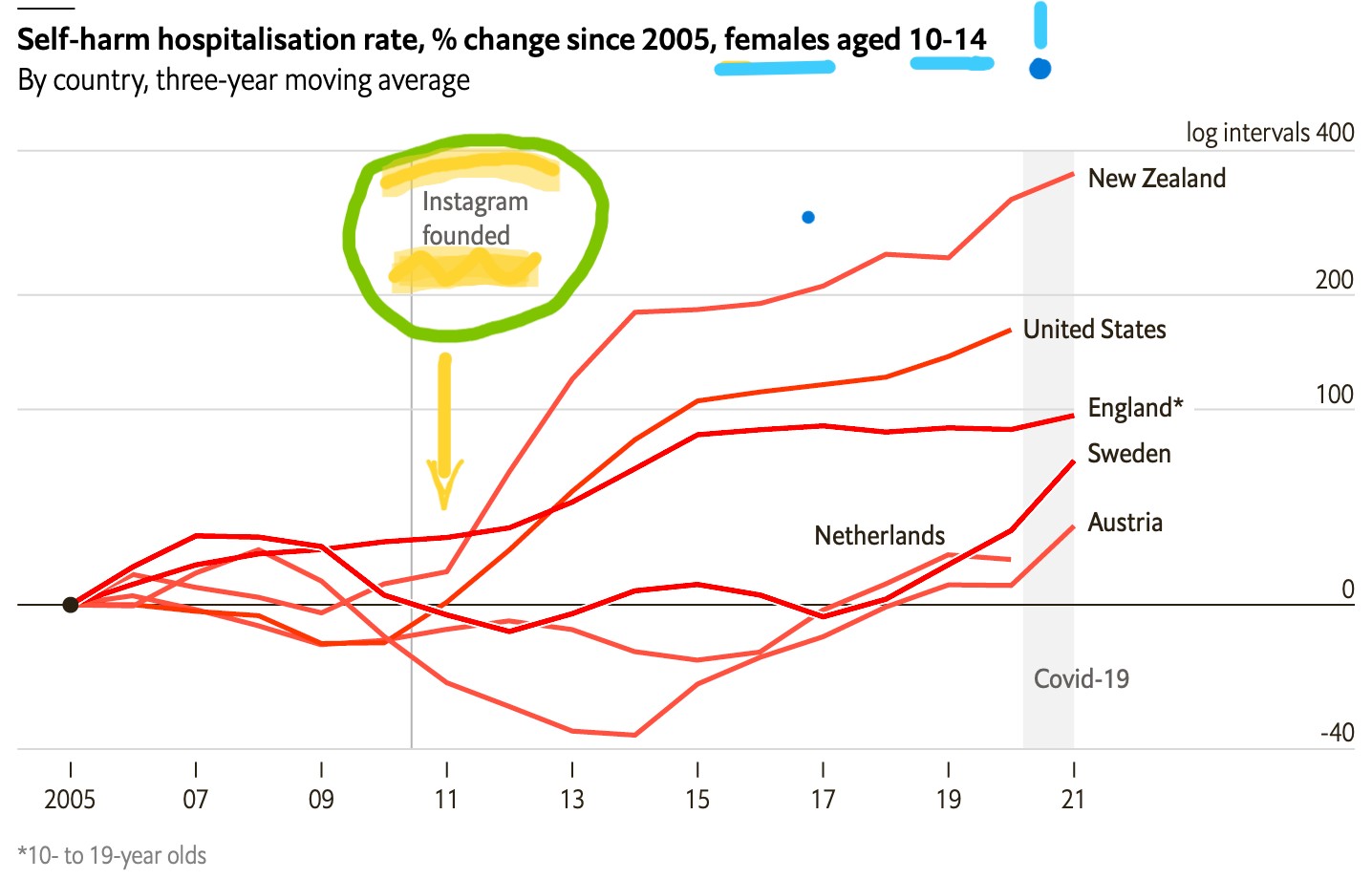
The INTERNET PASSPORT would enable to control the age and granular exposure of children to the INTERNET. Presumably, the more than doubling of the suicide rate of girls is related directly to WRONGFUL INTERNET EXPOSURE. Not acting on the Internet Passport would be tantamount to complicity in the abuse and deaths of millions of girls.
If one enters a country, one is required by the authorities to produce a document called a PASSPORT informing them of our identity. Otherwise NO entry. The controls are stiffer if a child is involved, as they should: child trafficking is as old as humanity (and was outlawed by the European Queen Bathilde in 657 CE). So why not the same sort of control of who is entering, when entering the Internet?
A huge problem with the Internet has been too much access by children and access to age inappropriate content. Another bad problem has been the usage of the Internet by Organized Crime.
A simple way to prevent ILLEGAL INTERNET USAGE is to deliver INTERNET PASSPORTS. A law passed worldwide would be impossible to access the Internet without an INTERNET PASSPORT The passports would have a degree of security and control comparable to that of a passport to pass physical ports. I am sure China would have to approve.
Organized Crime, which profits from adopting the latest Internet tech faster than anybody else, will protest (and some politicians on its payroll will listen). It may be objected by individuals who claim to be good citizens, that the instauration of an INTERNET PASSPORT would introduce a worldwide police state. On a personal basis, I am very much against police states… If the policing goes beyond the law enforcement necessary and sufficient to make sure the constitutional laws are respected. But only then. I firmly believe that a substantial population is kept in check only through the knowledge of potentially efficient police action (I have been a victim of serious crimes more than a few times).
Parrheisa and Isegoria basically ensure FREEDOM and EQUALITY of speech, not just by allowing them, and making them constitutional, but by making them CIVIC DUTIES.. Thus constitutional speech and expression and their dissemination would be protected…. Which is certainly NOT the case now.
The usual objections will be raised by the same ones who object to cameras: intrusion on private lives. But that is silly. My main outlet is wilderness exploration. If drones would follow me everywhere, I would feel safer. They can spy on me all day long, but I do nothing wrong, aside from calculated risk[1].
The argument, made for years by many of the world’s wealthiest individuals, like Meta’s Zuckenberg, has been a nebulous “People’s right to privacy”. There is no such a thing because the “Right to Privacy” gets ABROGATED BY THE RIGHT TO SURVIVAL (I learned the abrogation idea in my studies of Islamic law, ironically enough…) As the singularity technology evolves, so does the power of individuals: somebody evil could sneak in with, say, Ebola in a jar… But no doubt planning Mass Destruction would involve Internet usage and could be recognized by LAW ENFORCEMENT AI… As long as distinct sources can be identified.
***
Naturally this simple treatment of an Internet malady has not been suggested. Instead fake news media has insisted on applying censorship on sites they consider “violent”. But of course one of the main ways dictatorships achieve control is through censorship of (what they consider to be) “violence” (the coverup is that only the dictator can use violence to suppress what the dictator calls violence)..
Much of the “culture” that young people are exposed to today is violent and extremely divisive, instead of being informational and collaborative. Why? Well, the established plutocracy has always tried, for keeping in control, to divide (and conquer). The controlling plutocracy has always greater means to adopt the latest tech, as when Hitler adopted air travel and radio to get elected. So naturally, the plutocracy we enjoy adopted Internet control and directing it towards the children was particularly perverse.
Patrice Ayme
[1] One of my fears is an accident which would leave me crippled and rescue would not arrive in time (I have occasionally been in absolutely gigantic landscapes with no one or no sign of human activity in sight; once in Nevada, a billionaire crashed his plane. Neither he nor the plane were ever found… It’s called Nevada for a good reason… Last year I broke an arm in the mountain consecutive to rock failure and subsequent fall; I took the decision to go down the mountain, waiting for rescue would have meant death from exposure. Being able to tell a drone to fetch rescue, or more precisely blankets and shelter would have been safer. Helis couldn’t fly.)
***
[2] In 2026 CNN and other plutocratic serving media oligopolies pressured the UK government to shut down entire websites because those sites showed violence. Showing violence somehow causes violence according to CNN (does this theory make CNN into a terrorist organization?). Instead one should behave as if all was for the best in the best of all possible words.
Paradoxically, the Internet Passport will force much greater democracy, because it could not be an improvement without Isegoria and Parrhesia. Those two are needed because the US First Amendment protects only aspects of free speech addressed to the government (and the situation is even worse in all other countries)…
Patrice Ayme
ooOOoo
Whether or not, governments across the world will implement these changes, this response to the online world we now live in, is terribly uncertain.
You open a free app to do one simple thing. Before you even start, a full-screen message asks whether you want to try the paid version. The “Start free trial” button is large, bright and hard to miss. The option to keep using the free version is smaller, buried at the bottom. The same prompt appears again tomorrow. And the day after that.
A lot of people look at screens like that and think, “Surely this has to be illegal.” We even have a name for them, “dark patterns.” They feel pushy. They waste time. They seem designed to wear you down. But in most cases, they are perfectly lawful.
“Dark pattern” is not a legal term with a clear boundary. It is a broad label for digital designs that nudge, pressure, confuse or trap users. As a legal scholar who studies consumer protection and digital design, I think the most important thing for readers to understand is that the label “dark pattern” covers a broad spectrum.
Some of that spectrum is just annoying. Some of it is aggressive salesmanship. And some of it crosses the line into deception or coercion. Federal and state consumer protection laws are mostly aimed at that last category. They do not ban every design choice people dislike, only those that trick or coerce.
Annoying isn’t illegal
The ‘X’ in the upper right corner of this ad, for users to click to dismiss the ad, appears after the ad has been displayed for a moment. The ad also has an ‘X’ in the upper left corner, which is part of the image in the ad. Some users might click the ‘X’ on the left to dismiss the ad but instead be sent to the ad’s website. Possibly annoying but not illegal. Screen capture by Gregory Dickinson
That reality may sound unsatisfying, but it is not unusual. Offline life is full of things that are irritating but not unlawful. Think of the cashier who asks whether you want to sign up for the store credit card, then points out the discount you are turning down, then asks again. Most people know exactly what is happening. They roll their eyes, say no and try to shop somewhere else next time.
The same is true online. A repeated pop-up can be obnoxious. A guilt-inducing button can be tacky. But consumers recognize ordinary annoyance for what it is. In many cases, the market answer is simple: Close the app, ignore the pitch or take your business elsewhere.
Similarly, law does not ban persuasive sales pitches just because they are effective. A car salesperson who keeps steering you toward the upgraded model is trying to influence your choice. So is the airline clerk who offers travel insurance. So is the restaurant server who asks whether you want dessert. Salesmanship is nothing new. Digital design often borrows from familiar techniques.
That helps explain why lawmakers cannot simply outlaw “manipulation.” And so many interfaces are built to persuade, openly and lawfully.
What crosses the line
What the federal FTC Act and analogous state consumer-deception statutes usually care about is not whether a design is annoying. They focus on whether the design is likely to mislead a reasonable consumer. That is the core idea in modern consumer protection law.
So a design is likelier to be unlawful when it hides key facts, makes an optional choice look mandatory or tricks people about the effect of the button they are pressing. A fake countdown timer, a disguised ad, a misleading one-click purchase button or a cancellation path that looks finished when it is not are all different from ordinary hard selling. Those designs do not just pressure users; they can deceive them.
That is also why the app maker’s intent is not always the key question. In many consumer protection cases, a company does not get a free pass just because no one said, “Let’s trick people.” The legal question is often about effect: What would a reasonable user likely understand from this screen?
Research on dark patterns reinforces that concern. Even relatively mild designs can push people into choices they would not otherwise make. And regulators have increasingly focused on subscription flows, hidden fees and cancellation obstacles for exactly that reason.
The instructions for this web form and the pop-up box that appears when users click ‘Continue’ indicate that the form has required fields. The form uses the word ‘mandatory,’ which could lead some users to believe that the form itself is required in order to continue when it is instead optional. Possibly annoying but not illegal. Screen capture by Gregory Dickinson
Why it feels like dark patterns are everywhere
One reason people might think there are no laws against dark patterns is that they see them so often. But that frequency reflects that the term covers a wide range of conduct, from lawful nagging to outright deception.
It also reflects enforcement limits. Regulators cannot chase every irritating screen on every app and website. They have to prioritize the worst cases. That leaves a lot of borderline conduct in the wild, which makes the whole problem feel bigger and murkier to ordinary users.
So when people ask why there is not a law against dark patterns, the best answer is that there already is, but the law does not prohibit every annoying or high-pressure design. It targets lies, misleading cues and coercive obstacles.
That line can be fuzzy. But the fuzziness is not a mistake. It is what you get when the law tries to separate persuasion from deception in a world full of both.
Chances are, you think you do. It’s ubiquitous and iconic. How could you not know it?
But when tested, it turns out very few people can remember all the features of the logo. One study of 85 people found that only about half could pick the correct logo out of a lineup of similar ones. And only one person could correctly draw it.
This isn’t an isolated example. A classic study from 1979 found that people similarly couldn’t draw a penny accurately or pick out a correctly drawn penny from incorrect ones.
People aren’t just bad at remembering things they see all the time, but also in actually knowing how they work. In a 2006 study, many people made significant errors when drawing a bicycle, like putting the chain around the front wheel as well as the back wheel. More than just a forgotten detail, putting the chain around both wheels shows a deeper misunderstanding of how a bicycle works. A bicycle with a chain around both wheels wouldn’t be able to turn.
It turns out people’s knowledge of how the world works is often fragmented and sketchy at best. They systematically overestimate their understanding of everyday devices and natural phenomena. People will tend to give themselves high ratings on how well they understand something, such as how bicycles or zippers work. But when they’re asked to actually explain the mechanics of these objects, their ratings of their understanding typically drop.
Just like how your knowledge of the world around you is imperfect, your knowledge about your own knowledge – also called metaknowledge – is often flawed. My field of cognitive science has been uncovering various gaps in human metaknowledge for decades.
If people are systematically overconfident about how well they understand things, why don’t they notice when they don’t understand something? And what can people do to better recognize the limits of their own knowledge?
Why you think you know more than you do
Researchers have identified several factors behind people’s overconfidence in their knowledge.
One is that people confuse environmental support with understanding: The information is out in the world but not actually in your head. With a bicycle or a zipper, all of the parts are visible to you, and you may confuse this transparency for an internal understanding of how they work. But until you go to use that knowledge by attempting to explain how they work, you may not recognize that you don’t understand how those parts interact.
A second factor is confusing different levels of analysis. People can often describe how something works at a very high level. You know that the engine of a car makes the car go, and the brakes slow and stop the vehicle. But confidence in your high-level understanding of the car may bias you to think you also have a good grasp of the finer details, like how the engine pistons and brake pads work.
Additionally, people can be blind to the ways their knowledge shapes their own perception. In one study, researchers had participants tap out the tune to a popular song. On average, the tappers thought listeners would be able to identify the song about 50% of the time. But when listeners had to identify the tapped song, they actually could identify it only 2.5% of the time. The tappers didn’t realize how much their knowledge was making identifying the song seem easy to them.
This disconnect has consequences beyond whether someone else can understand your Morse code version of a song. When teaching people, whether in formal classroom settings or through casual mentorship, you can sometimes have an expert blind spot: the inability to recognize the difficulties beginners face when learning something you have expertise in.
Building expertise often involves internalizing knowledge to the point where it becomes invisible to you. You draw on knowledge you don’t realize you have, making it hard to relate to learners who lack this knowledge – and, of course, hard for learners to relate to your teaching. You might have experienced this when you’ve gotten partway through explaining something, only to realize you’ve been using jargon you forgot isn’t common knowledge and lost your listener.
How to address metaknowledge failures
Your metaknowledge can fail in two directions: You can think you know more than you do, and you can be blind to how much you’re relying on knowledge you do have. Each calls for a different response to correct it.
When you’re overconfident in your knowledge, the remedy is using that knowledge. You’ll quickly realize how much you actually understand and dial down your confidence. Challenging yourself to actually try to walk through how something works is a great exercise in intellectual humility – that is, recognizing that you may be wrong – and can keep you from getting out over your skis.
Building a greater appreciation for what you know is more difficult. You can’t simply unlearn what you’ve internalized. But what this challenge shows is that, to some extent, knowing a subject and knowing how to teach it are two separate skills. Some experts are great teachers, but not simply by virtue of being experts. Recognizing that you have to approach teaching with humility, and that your expertise doesn’t automatically make you a skilled teacher, can go a long way toward making you a better teacher and mentor.
These aren’t easy and quick fixes to failures of metaknowledge. Both require ongoing intellectual humility and a willingness to distrust your own confidence. But acknowledging the fallibility of your own metaknowledge is a good place to start.
This article is of particular interest for me. Because a few years ago, I had a biking accident at the local Merlin (OR) rail crossing. I banged my head badly and was unconscious for about eight minutes. Later on the surgeon who operated on my head said that I was lucky to be alive but that from here on my memory would be poor.
I work very hard to try and remember the items that I want to. And without my pocket book to write things down, I would be so much more forgetful.
It is my habit to listen to BBC Radio 4 in the early morning. Especially The World at One from 13:00 to 13:45 BST and then, usually, the 15-minute programme transmitted immediately afterwards.
Yesterday, that programme was the start of a new ten-part series called RINSED. Here’s how it is described on the website:
1. The Bridge
Rinsed.
Episode 1 of 13
After watching their local river grow murky and lifeless, two retired neighbours decide to take on the water industry and its regulators. The unlikely sleuths begin a ten-year battle to clean up our rivers.
On the banks of the River Windrush in Oxfordshire, Kate Lamble meets campaigners Ash Smith and Peter Hammond
Reported and presented by Kate Lamble Producer: Elle Scott Sound Design: Andy Fell Executive Producer: Joe Kent Commissioning Executive: Tracy Williams Commissioning Editor: Dan Clarke
Rinsed is a BBC Studios production for BBC Radio 4












 Learning from Dogs

.jpg)
.jpg)
.svg)