I am indebted to Merci O. who regularly comments on Learning from Dogs for sending me the first film, see below. In my efforts to find a YouTube link (there didn’t appear to be one) I came across the second film. Both are good for the soul.
So click here to watch the first film. The film is comprised of a series of slides melded together with a beautiful music track. Do watch and listen.
Then here is the YouTube video, Morcheeba’s Enjoy The Ride.
Have a peaceful day wherever you are in the world.
Over the last week we have watched all three 0ne-hour films made by the BBC, aired in 2011, under the title of the heading of this post, All Watched Over by Machines of Loving Grace. The films are available on the website Top Documentary Films, the direct link is here. As that website explains,
A series of films about how humans have been colonized by the machines they have built. Although we don’t realize it, the way we see everything in the world today is through the eyes of the computers. It claims that computers have failed to liberate us and instead have distorted and simplified our view of the world around us.
1. Love and Power. This is the story of the dream that rose up in the 1990s that computers could create a new kind of stable world. They would bring about a new kind global capitalism free of all risk and without the boom and bust of the past. They would also abolish political power and create a new kind of democracy through the Internet where millions of individuals would be connected as nodes in cybernetic systems – without hierarchy.
2. The Use and Abuse of Vegetational Concepts. This is the story of how our modern scientific idea of nature, the self-regulating ecosystem, is actually a machine fantasy. It has little to do with the real complexity of nature. It is based on cybernetic ideas that were projected on to nature in the 1950s by ambitious scientists. A static machine theory of order that sees humans, and everything else on the planet, as components – cogs – in a system.
3. The Monkey in the Machine and the Machine in the Monkey. This episode looks at why we humans find this machine vision so beguiling. The film argues it is because all political dreams of changing the world for the better seem to have failed – so we have retreated into machine-fantasies that say we have no control over our actions because they excuse our failure.
As was eluded, the three films are deeply thought-provoking. There is a ‘taster’ to the first film on YouTube, as below,
Adam Curtis, the film maker, has a blog site under the BBC Blogs umbrella. The entry on that blog-site by Adam in connection with these films is here, and makes interesting reading. It also includes a longer trailer than the one from YouTube, above.
Finally, there are comprehensive writings on all three films on the WikiPedia website here. To give you a taste, here’s what was written about the third film,
The Monkey In The Machine and the Machine in the Monkey
In 1960 Congo had become independent from Belgium, but governance promptly collapsed, and towns became battle grounds as soldiers fought for control of the mines. America and the Belgians organised a coup and the elected leader was assassinated, creating chaos. The Western mining operations were largely unaffected however.
Bill Hamilton was a solitary man, and he saw everything through the lens of Darwin’s theory of evolution. When he wanted to know why some ants and humans gave up their life for others, he went to Waterloo station and stared at humans for hours, and looked for patterns. In 1963 he realised that most of the behaviours of humans was due to genes, and looking at the humans from the genes’ point of view. Humans were machines that were only important for carrying genes, and that it made sense for a gene to sacrifice a human if it meant that another copy of the gene elsewhere would prosper.
In the 1930s Armand Denis made films that told the world about Africa. However, his documentary gave fanciful stories about Rwanda’s Tutsis being a noble ruling elite originally from Egypt, whereas the Hutus were a peasant race. In reality they were racially the same and the Belgian rulers had ruthlessly exploited the myth. But when it came to create independence, liberal Belgians felt guilty, and decided that the Hutus should overthrow the Tutsi rule. This led to a blood bath, as the Tutsis were then seen as aliens and were slaughtered.
So, all in all, this is a great personal recommendation and, it goes without saying, those of you that do watch the films and want to comment, would love to hear from you.
Maybe less is more is really at the heart of our thirst for something more
A number of disparate recent experiences seem to have an underlying common thread.
See if these strike you in a similar fashion.
Yesterday, Joelle Jordan wrote about joy, about the wonderful relationship that dogs have with the world around them. As Joelle wrote,
Joy is a difficult commodity to come by these days. I don’t mean entertainment, I don’t mean a good laugh, I mean pure joy, where, even just for a single moment, all worries and doubts, frustration and anger are lifted as though by Atlas.
Like so many other humans in our world, I often find myself in a constant state of stress. There always seems to be something to worry about, whether it’s money, job fulfilment, the state of my relationships, getting the house cleaned, finding time to get to the market, and more. If given the chance, I know we all could spend nearly all of our waking hours (and some of our sleeping hours, too) worrying about something. We spend so much time on the many things that inevitably work themselves out, and so little time on things that will create a memory and a crystal moment of joy.
My little dog Charlie spends his time in the completely opposite fashion; spending his waking hours seeking joy, and committing less time to things that worry him.
Charlie seems to exist normally in three states of being; content, happy and utterly joyful.
How many of us can echo Charlie’s existance in our own lives?
Then last Sunday, Father D’s sermon spoke about our tendency to develop habitual behaviours and rarely challenge the point of them.
The truth is that we get used to doing things a certain way and keep doing them without ever thinking of what we are doing. We say things in the liturgy without even thinking of what we are saying. I’m sure many people utter the words in the Book of Common Prayer without thinking of the theology behind the words, or the relationship between church and state that they express.
Later on,
There was a desire for “something more” but it was hard to put a finger on what it was. I realized from these conversations that we are involved today in a time of intense searching. Few of us are satisfied with what the church and society have served up.
The honest among us will readily admit we lead fractured lives – with a disembodied spirituality on one side, and a soulless daily existence on the other. We are desperate for something more, for a faith with the power to transform both ourselves and our world.
“…. we are involved today in a time of intense searching“! That smacked me right in the eye!
These are clearly challenging times with mankind facing increasing odds of an ecological disaster of Old Testament proportions, and much of the western world on the cusp of a long and difficult recession. It is so easy to go on “doing things a certain way and keep doing them without ever thinking of what we are doing” while we wait for the leaders of our societies to fix our problems.
The truth is that we have to be the first to change, to question what we do on a daily basis and amend it if it is not truly healthy for us and for the planet. As was said in that sermon, “It means bringing forth each day the fruits of the Spirit: Love, joy, patience, kindness, generosity, faithfulness, gentleness and self-control.”
Go back and read yesterday’s Post and reflect on how many of those ‘fruits’ are the ways of dogs.
My final connection with the theme of today’s essay is with a recent series from the BBC called ‘Status Anxiety’. The programmes are still on YouTube and the first 10 minutes is below,
Status Anxiety discusses the desire of people in many modern societies to “climb the social ladder” and the anxieties that result from a focus on how one is perceived by others. De Botton claims that chronic anxiety about status is an inevitable side effect of any democratic, ostensibly egalitarian society. De Botton lays out the causes of and solutions to status anxiety.
Or if you prefer, all 2 hours 23 minutes may be watched on Top Documentary Films, described thus,
De Botton's book
Why doesn’t money (usually) buy happiness? Alain de Botton breaks new ground for most of us, offering reasons for something our grandparents may well have told us, as children.
It is rare, and pleasing, to see a substantial philosophical argument sustained as well as it is in this documentary. De Botton claims that we are more anxious about our own importance and achievements than our grandparents were. This is status anxiety.
Alain quotes philosophical writings, such as Democracy in America, a report by Alexis de Tocqueville on his visit to the USA in 1831. De Tocqueville noted that American equality, notable in those times, was accompanied by a climate of envy.
We jump to present-day USA, and see what, to de Botton, are some awful examples ofThe American Way. A Christian preaches get rich. A steelworker tells of his insecure life in an industry being closed down through others’ love of money.
Our protagonist points out the advantage of high status: those with high status will enjoy the care and attention of the world. Then joins this advantage with the illusion, orattempt at meritocracy in the USA, mentioning Jefferson’s notion of an aristocracy of talent.
Some of the messages towards the end of the programme are very thought-provoking indeed. Let me draw this all together.
If you own a dog, or a cat, or any pet, stop a while today and see how their simplicity of life brings them so much more. Naturally, we can never live life in the same way that our pet does but there are strong metaphors that carry equally strong messages for us. Less is more.
Now watch the last part of Status Anxiety even if you didn’t watch the first segment above, Reason? Watch and it will become clear.
I must immediately volunteer the fact that the thrust of this article is the result of a programme that we watched last Thursday night. It was a programme originally featured on the UK BBC 4 channel in 2008. Called High Anxieties, The Mathematics of Chaos, it is a fascinating examination into the way that mathematicians have fundamentally adjusted their views, from the certainty of Newtonian principles to the certain uncertainty offered by mathematicians such as Henri Poincare and Alexander Lyapunov. The 60-minute documentary, directed by David Malone, is wonderfully interesting and much more relevant to the uncertainty surrounding all our lives than one might anticipate from any references to mathematicians! It puts the collapse of Lehman Brothers, some 2 years ago, last Thursday, into an interesting perspective.
Here’s the first 9 minutes as offered on YouTube, introduced thus,
David Malone http://golemxiv-credo.blogspot.com author of The Debt Generation, directs and presents this film, It is the first part of a documentary first shown on BBC4 Television in the UK in September 2008. The film was first broadcast 2 days after the collapse of Lehman brothers at the start of the financial crisis. It looks at the discoveries in mathematics during the 20th Century which have challenged the view that the world is an essentially knowable and therefore controllable place. The film focuses on the economy and the environment and suggests that ideas about unpredictability, the butterfly effect and tipping points, stemming from mathematics, are part of what underlie some modern anxieties about the world we live in.
If this first part grabs your attention then finding the other 8 parts is easy on YouTube. Alternatively, the complete set of videos is linked together as one film on Top Documentary Films, click High Anxieties: The Mathematics of Chaos. where it is described as follows,
The documentary looks at the modern advances in mathematics and how they affect our understanding of physics, economics, environmental issues and human psychology.
The film looks at how developments in 20th Century mathematics have affected our view of the world, and particularly how the financial economy and earth’s environment are now seen as inherently unpredictable.
The film looks at the influence the work of Henri Poincare and Alexander Lyapunov had on later developments in mathematics. It includes interviews with David Ruelle, about chaos theory and turbulence, the economist Paul Ormerod about the unpredictability of economic systems, and James Lovelock the founder of Gaia theory about climate change and tipping points in the environment.
As we approach tipping points in both the economy and the climate, the film examines the mathematics we have been reluctant to face up to and asks if, even now, we would rather bury our heads in the sand rather than face harsh truths.
Very, very interesting and rather puts the pictures of the Petermann Glacier shown here into context.
More on how dogs adapt to challenges in their lives.
(As readers picked up from my closing comment in yesterday’s part of this story, technology has rather interfered with events. ‘Touch wood’ things appear to be back to normal!)
Yesterday’s article (thanks to Paul Gilding for the link) was about the stray dogs in Moscow. Before musing on the more general nature of how dogs survive as strays, there is a video on YouTube about these Muscovite dogs. Just over 7 minutes long, it further underlines the amazing adaptability of the domesticated dog when thrust into self-survival.
As regular readers of Learning from Dogs will know, before Jean and I met, Jean had spent a large part of her life rescuing dogs in the San Carlos area of Mexico, much of that with Suzann (who was instrumental in Jean and me meeting!). Indeed, when Jean and I moved up to Payson in February, 2010 we had with us, much to the amusement of the American border staff at the Nogales crossing, 12 dogs and 6 cats, all rescues except my German Shepherd dog, Pharaoh.
So Jean has lots of stories about how the far-too-many stray dogs in San Carlos developed strategies for staying alive. Dhalia, see story below, shows her feral habits when we go out for a walk in the forest by constantly looking for food, despite the fact that she is a well-fed, happy and contented dog. Jean recounts finding Dhalia,
It was in 2005, about three months after Ben died (Jean’s husband). I was driving out to the small Mexican fishing port of La Manga where there were many stray dogs. The aim was to feed them on a regular basis and hope that they would become sufficiently comfortable with my presence so that they could be caught, so that they may be spayed or neutered and then offered for adoption.
On the way there, I drove past a couple of dogs running alongside the highway. Dogs frequently did this looking for ‘road-kill’ that they could feed on. I stopped the car wanting to put out some food and water.
One of the dogs was so feral that it immediately took off into the bush. I turned around and the other dog was standing about ten feet away. It was cadaverous and obviously suffering from mange but cautiously came up to the food, sniffed carefully and then started to eat. That dog allowed me to pick it up and then sat quietly with me on the front seat of the car while I continued to La Manga. It sense immediately that it was safe and from that day has remained with me. I named her Dhalia.
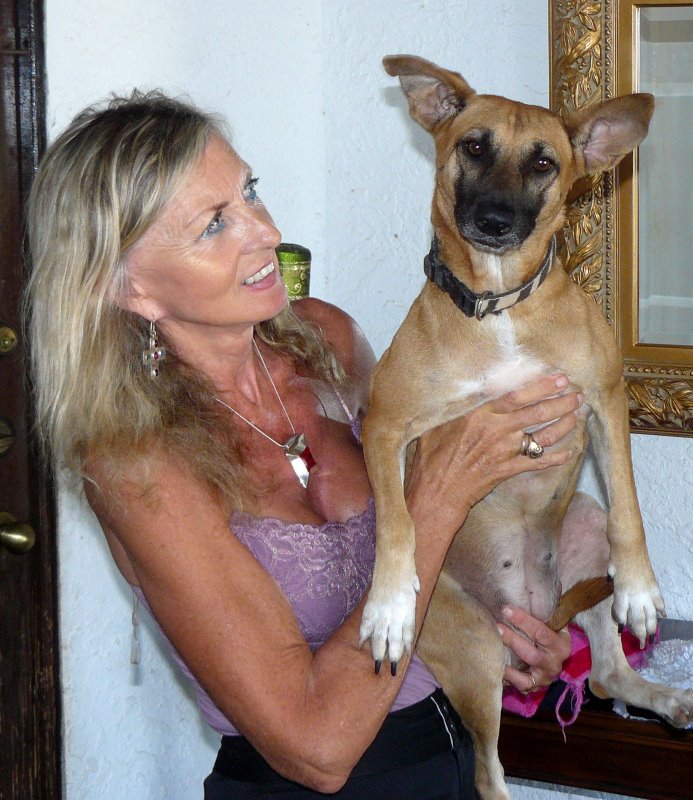
Dhalia in Jean's arms, November 2008
Fast forward to today. Dhalia is one of Pharaoh’s group of dogs and is a sweet and loving animal.
Finally, a couple of other stories to give you a feeling about these rescue dogs. One from August 2009 about a dog called Lucky Lucy. The other about Corrie, both stories from Suzann.
For a number of reasons, both private and public, I have not been feeling as creative as normal these last 24 hours. What I am conscious of is that events of this week, from the riots in the UK, the chaos of financial markets, right through to the death of our dog Tess have all contributed to a mental heaviness.
So I am taking a small creative short-cut, as it were, by writing about a film that we watched on Monday night; Fierce Light.
There is a trailer on YouTube. This is how it is presented,
A Feature Documentary By Velcrow Ripper
From the Director of Scared Sacred & The Producer of The Corporation
“Fierce Light” is a feature documentary that captures the exciting movement of Spiritual Activism that is exploding around the planet, and the powerful personalities that are igniting it.
Fueled by the belief that “another world is possible,” the film portrays stories of what Martin Luther King called “Love in Action,” and Gandhi called “Soul Force”; what Ripper is calling “Fierce Light.” Acclaimed filmmaker Velcrow Ripper (Scared Sacred) takes an insightful look at change motivated by love, featuring interviews with spiritual activists Thich Nhat Hanh, Desmond Tutu, Daryl Hannah, Julia Butterfly Hill, and more.
If you would like to sink a little deeper into the film and what the motivations are behind the making of it, then do go to the web site Fierce Light.
Jean and I found the film inspiring and beautifully presented. It came over as a film that seriously approached the topic of human consciousness and gave plenty of opportunity to reflect on some of the many forces within our societies at this present time.
Then you may like to watch this talk by the Director, Velcrow Ripper (actually born Steve Ripper in 1963), broken into two parts as follows,
The film and this talk by Mr. Ripper both date back to 2009 so, in the light of where we are in August 2011, they are proving to be extremely relevant.
A passing visit to the American biologist, E. O. Wilson
E O Wilson
Edward Osborne Wilson was born in June 1929 thus making him, at this time of writing, just into his 82 year. His biological specialty is myrmecology. Got that? Myrmecology. And if you, like me, didn’t have a clue as to what myrmecology is and had to look it up, it is the study of ants. Blow me down, there is even a myrmecology blogsite!
So where is this all heading?
One of the things that we do know about dogs, especially if we go way back into the dim and distant times when they behaved more like the grey wolf, from which the species ‘dog’ genetically originates 100,000 years ago, is that their social order, their pack behaviour, was highly stable. As an aside, when Jean was rescuing dogs in San Carlos, Mexico during the years that she lived there with her late husband she readily observed that the stray dogs, of which there were too many, had a natural propensity to group up into their historic pack formations. (And as an aside to my aside, Jean’s close friend of many years, Dan’s sister Suzann, today carries on the splendid work of looking after stray dogs from her San Carlos house!)
OK, back to the plot!
E O Wilson’s study of ants has revealed much about social order and organisation. The following YouTube video was from a PBS programme, aired in May, 2008, from which I quote (that is the PBS website),
Program Description
At age 78, E.O. Wilson is still going through his “little savage” phase of boyhood exploration of the natural world. In “Lord of the Ants,” NOVA profiles this soft-spoken Southerner and Harvard professor, who is an acclaimed advocate for ants, biological diversity, and the controversial extension of Darwinian ideas to human society.
Actor and environmentalist Harrison Ford narrates this engaging portrait of a ceaselessly active scientist and eloquent writer, who has accumulated two Pulitzer Prizes among his many other honors. Says fellow naturalist David Attenborough: “He will go down as the man who opened the eyes of millions ’round the world to the glories, the values, the importance of—to use his term—biodiversity.”
It’s a fascinating film, truly engaging, so do settle down for a relaxing 53 minutes and watch,
Now there’s more to this and I do want to continue with the theme of this Post tomorrow.
So for now, look in on the E O Wilson Biodiversity Foundation’s website and I’ll see you tomorrow.
Those of you who have come across Rupert Sheldrake and, in particular his book Dogs That Know When Their Owners Are Coming Home will really not be surprised at what is coming, in terms of the rest of this Post. Because most dog owners know, from countless observations, that dogs have an uncanny ability to see the world around them in a more deeper and intuitive manner than we can explain.
I wrote of Sheldrake’s book on the 1st June including touching on a report of Mason, a small terrier mix …
On April 27th, Mason was hiding in his garage in North Smithfield when the storm picked him up and blew him away. His owners couldn’t find him and had about given up when they came back Monday to sift through the debris, and found Mason waiting for them on the porch.
A few evenings ago, we watched a documentary from the website Top Documentary Films from the series Through The Wormhole. This particular documentary was entitled Is There a Sixth Sense? Here’s how that film was introduced,
Sight, hearing, smell, taste and touch are the tools most of us depend on to perceive the world. But some people say they also can perceive things that are outside the range of the conventional senses, through some other channel for which there is no anatomical or neurological explanation. Scientific researchers who study such abilities call them extrasensory perception (ESP), but lay people often refer to them as the sixth sense.
Either term really is a catch-all for a variety of different purported abilities that vary from person to person. Some people claim the power of telepathy – that is, the ability to perceive others’ thoughts, without having them communicated verbally or in writing. Others claim to have the power of clairvoyance, which is the ability to perceive events and objects that are hidden from view because of barriers or distance. Still others claim to be gifted with precognition, which enables them to look into the future and glimpse what hasn’t yet occurred.
The belief in ESP or the sixth sense dates back thousands of years. The Greek historian Herodotus wrote that Croesus, who ruled a kingdom in what is now Turkey in the sixth century B.C., consulted oracles – that is, groups of priests claimed to be able to predict the future — before he went to war. In ancient India, Hindu holy men were believed to possess the power to see and hear at a distance, and to communicate through telepathy.
In the late 1700s, the Viennese physician Franz Mesmer claimed that he could give people ESP powers by hypnotizing them. Just before his assassination in 1865, President Abraham Lincoln told friends that he’d dreamed of his own body lying in state in the White House. In the 20th century, Edgar Cayce and Jean Dixon attracted wide followings by claiming that they could foresee future events. During the Cold War, U.S. military and intelligence agencies, spurred by reports that the Soviets had psychics at their disposal, even tried to utilize clairvoyants who claimed remote-viewing powers for espionage purposes.
As well as watching it directly from the Top Documentary Films website, it is also available from YouTube. Here are the four links. It is a most fascinating review of the scientific findings in this area. If you have a dog with you when you watch the videos, don’t be surprised if he or she fall asleep! Nothing new for dogs in all this!


 Learning from Dogs