Tag: World War II

The Winston Churchill effect?

Forgive me for making this a much shorter contribution but the efforts of the previous two posts took rather a long time!

This is about the debt situation in the United States of America and, as always, Learning from Dogs trying to get to the underlying truth.

It’s from the BBC and it’s a radio programme that is included in this Post.

But why the headline referring to Churchill?  Well in the programme Justin Webb, of the BBC, reminds the world of a characteristic of the American Nation noted by Sir Winston Churchill, “Americans can always be counted on to do the right thing…after they have exhausted all other possibilities.”  (But caution about the precise wording of that quote – see here!)

Here’s the article that accompanied the BBC broadcast, the radio programme is after this article,

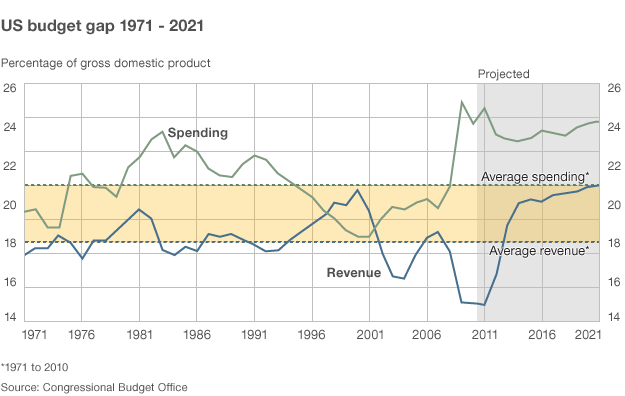
Is the US in denial over its $14tn debt?

Is America in denial about the extent of its financial problems, and therefore incapable of dealing with the gravest crisis the country has ever faced?

This is a story of debt, delusion and – potentially – disaster. For America and, if you happen to think that American influence is broadly a good thing, for the world.

The debt and the delusion are both all-American: $14 trillion (£8.75tn) of debt has been amassed and there is no cogent plan to reduce it.

The figure is impossible to comprehend: easier to focus on the fact that it grows at $40,000 (£25,000) a second. Getting out of Afghanistan will help but actually only at the margins. The problem is much bigger than any one area of expenditure.

The economist Jeffrey Sachs, director of Columbia University’s Earth Institute, is no rabid fiscal conservative but on the debt he is a hawk: “I’m worried. The debt is large. It should be brought under control. The longer we wait, the longer we suffer this kind of paralysis; the more America boxes itself into a corner and the more America’s constructive leadership in the world diminishes.”

The author and economist Diane Coyle agrees. And she makes the rather alarming point that the acknowledged deficit is not the whole story.

The current $14tn debt is bad enough, she argues, but the future commitments to the baby boomers, commitments for health care and for pensions, suggest that the debt burden is part of the fabric of society:

“You have promises implicit in the structure of welfare states and aging populations that mean there is an unacknowledged debt that will have to be paid for by future taxpayers, and that could double the published figures.”

Richard Haass of the Council on Foreign Relations acknowledges that this structural commitment to future debt is not unique to the United States.  All advanced democracies have more or less the same problem, he says, “but in the case of the States the figures are absolutely enormous”.

Mr Haass, a former senior US diplomat, is leading an academic push for America’s debt to be taken seriously by Americans and noticed as well by the rest of the world.

He uses the analogy of Suez and the pressure that was put on the UK by the US to withdraw from that adventure. The pressure was not, of course, military. It was economic.

Britain needed US economic help. In the future, if China chooses to flex its muscles abroad, it may not be Chinese admirals who pose the real threat, Mr Haass tells us. “Chinese bankers could do the job.”

Because of course Chinese bankers, if they withdrew their support for the US economy and their willingness to finance America’s spending, could have an almost overnight impact on every American life, forcing interest rates to sky high levels and torpedoing the world’s largest economy.

Not everyone accepts the debt-as-disaster thesis.

David Frum is a Republican intellectual and a former speech writer to President George W Bush.

He told me the problem, and the solution, were actually rather simple: “If I tell you you have a disease that will absolutely prostrate you and it could be prevented by taking a couple of aspirin and going for a walk, well I guess the situation isn’t apocalyptic is it?

“The things that America has to do to put its fiscal house in order are not anywhere near as extreme as what Europe has to do. The debt is not a financial problem, it is a political problem.”

Mr Frum believes that a future agreement to cut spending – he thinks America spends much too big a proportion of its GDP on health – and raise taxes, could very quickly bring the debt problem down to the level of quotidian normality.

‘Organised hypocrisy’

I am not so sure. What is the root cause of America’s failure to get to grips with its debt? It can be argued that the problem is not really economic or even political; it is a cultural inability to face up to hard choices, even to acknowledge that the choices are there.

I should make it clear that my reporting of the United States, in the years I was based there for the BBC, was governed by a sense that too much foreign media coverage of America is negative and jaundiced.

The nation is staggeringly successful and gloriously attractive. But it is also deeply dysfunctional in some respects.

Take Alaska. The author and serious student of America, Anne Applebaum makes the point that, as she puts it, “Alaska is a myth!”

People who live in Alaska – and people who aspire to live in Alaska – imagine it is the last frontier, she says, “the place where rugged individuals go out and dig for oil and shoot caribou, and make money the way people did 100 years ago”.

But in reality, Alaska is the most heavily subsidised state in the union. There is more social spending in Alaska than anywhere else.

To make it a place where decent lives can be lived, there is a huge transfer of money to Alaska from the US federal government which means of course from taxpayers in New York and Los Angeles and other places where less rugged folk live. Alaska is an organised hypocrisy.

Too many Americans behave like the Alaskans: they think of themselves as rugged individualists in no need of state help, but they take the money anyway in health care and pensions and all the other areas of American life where the federal government spends its cash.

The Tea Party movement talks of cuts in spending but when it comes to it, Americans always seem to be talking about cuts in spending that affect someone else, not them – and taxes that are levied on others too.

And nobody talks about raising taxes. Jeffrey Sachs has a theory about why this is.

America’s two main political parties are so desperate to raise money for the nation’s constant elections – remember the House of Representatives is elected every two years – that they can do nothing that upsets wealthy people and wealthy companies.

So they cannot touch taxes.

In all honesty, I am torn about the conclusions to be drawn. I find it difficult to believe that a nation historically so nimble and clever and open could succumb to disaster in this way.

But America, as well as being a place of hard work and ingenuity, is also no stranger to eating competitions in which gluttony is celebrated, and wilful ignorance, for instance regarding (as many Americans do) evolution as controversial.

The debt crisis is a fascinating crisis because it is about so much more than money. It is a test of a culture.

It is about waking up, as the Americans say, and smelling the coffee. And – I am thinking Texas here – saddling up too, and riding out with purpose.

NB: Copyright BBC © 2011 The BBC is not responsible for the content of external sites. Read more.
Here’s the 30 minute broadcast under the Analysis series from Radio 4 on the BBC.(Just click on this link) analysis_20110628-1024a

Earth Policy Release

Finding the right solutions for the 21st century and the next generation.

Just before presenting the release from the Earth Policy Institute that came out on the 20th, here’s a reminder about watching the film, Plan B, that I wrote about on the 4th April.  It’s a very good film from an excellent and creditable source.  You can watch it for FREE from PBS, BUT ONLY UNTIL THE END OF APRIL!

Here’s the link – Plan B, the film

Now to the release published in full on Learning from Dogs.

Earth Policy Release
World on the Edge
Book Byte
April 19, 2011

“LET NO MAN SAY IT CANNOT BE DONE”

www.earth-policy.org/book_bytes/2011/wotech13_ss5

By Lester R. Brown

We need an economy for the twenty-first century, one that is in sync with the earth and its natural support systems, not one that is destroying them. The fossil fuel-based, automobile-centered, throwaway economy that evolved in western industrial societies is no longer a viable model—not for the countries that shaped it or for those that are emulating them. In short, we need to build a new economy, one powered with carbon-free sources of energy—wind, solar, and geothermal—one that has a diversified transport system and that reuses and recycles everything. We can change course and move onto a path of sustainable progress, but it will take a massive mobilization—at wartime speed.

Whenever I begin to feel overwhelmed by the scale and urgency of the changes we need to make, I reread the economic history of U.S. involvement in World War II because it is such an inspiring study in rapid mobilization. Initially, the United States resisted involvement in the war and responded only after it was directly attacked at Pearl Harbor. But respond it did. After an all-out commitment, the U.S. engagement helped turn the tide of war, leading the Allied Forces to victory within three-and-a-half years.

In his State of the Union address on January 6, 1942, one month after the bombing of Pearl Harbor, President Franklin D. Roosevelt announced the country’s arms production goals. The United States, he said, was planning to produce 45,000 tanks, 60,000 planes, and several thousand ships. He added, “Let no man say it cannot be done.”

No one had ever seen such huge arms production numbers. Public skepticism abounded. But Roosevelt and his colleagues realized that the world’s largest concentration of industrial power was in the U.S. automobile industry. Even during the Depression, the United States was producing 3 million or more cars a year.

After his State of the Union address, Roosevelt met with auto industry leaders, indicating that the country would rely heavily on them to reach these arms production goals. Initially they expected to continue making cars and simply add on the production of armaments. What they did not yet know was that the sale of new cars would soon be banned. From early February 1942 through the end of 1944, nearly three years, essentially no cars were produced in the United States.

In addition to a ban on the sale of new cars, residential and highway construction was halted, and driving for pleasure was banned. Suddenly people were recycling and planting victory gardens. Strategic goods—including tires, gasoline, fuel oil, and sugar—were rationed beginning in 1942. Yet 1942 witnessed the greatest expansion of industrial output in the nation’s history—all for military use. Wartime aircraft needs were enormous. They included not only fighters, bombers, and reconnaissance planes, but also the troop and cargo transports needed to fight a war on distant fronts. From the beginning of 1942 through 1944, the United States far exceeded the initial goal of 60,000 planes, turning out a staggering 229,600 aircraft, a fleet so vast it is hard even today to visualize it. Equally impressive, by the end of the war more than 5,000 ships were added to the 1,000 or so that made up the American Merchant Fleet in 1939.

In her book No Ordinary Time, Doris Kearns Goodwin describes how various firms converted. A sparkplug factory switched to the production of machine guns. A manufacturer of stoves produced lifeboats. A merry-go-round factory made gun mounts; a toy company turned out compasses; a corset manufacturer produced grenade belts; and a pinball machine plant made armor-piercing shells.

In retrospect, the speed of this conversion from a peacetime to a wartime economy is stunning. The harnessing of U.S. industrial power tipped the scales decisively toward the Allied Forces, reversing the tide of war. Germany and Japan, already fully extended, could not counter this effort. British Prime Minister Winston Churchill often quoted his foreign secretary, Sir Edward Grey: “The United States is like a giant boiler. Once the fire is lighted under it, there is no limit to the power it can generate.”

The point is that it did not take decades to restructure the U.S. industrial economy. It did not take years. It was done in a matter of months. If we could restructure the U.S. industrial economy in months, then we can restructure the world energy economy during this decade.

With numerous U.S. automobile assembly lines currently idled, it would be a relatively simple matter to retool some of them to produce wind turbines, as the Ford Motor Company did in World War II with B-24 bombers, helping the world to quickly harness its vast wind energy resources. This would help the world see that the economy can be restructured quickly, profitably, and in a way that enhances global security.

The world now has the technologies and financial resources to stabilize climate, eradicate poverty, stabilize population, restore the economy’s natural support systems, and, above all, restore hope. The United States, the wealthiest society that has ever existed, has the resources and leadership to lead this effort.

One of the questions I hear most frequently is, What can I do? People often expect me to suggest lifestyle changes, such as recycling newspapers or changing light bulbs. These are essential, but they are not nearly enough. Restructuring the global economy means becoming politically active, working for the needed changes, as the grassroots campaign against coal-fired power plants is doing. Saving civilization is not a spectator sport.

Inform yourself. Read about the issues. Share the Earth Policy Institute’s publications with friends. Pick an issue that’s meaningful to you, such as tax restructuring to create an honest market, phasing out coal-fired power plants, or developing a world class-recycling system in your community. Or join a group that is working to provide family planning services to the 215 million women who want to plan their families but lack the means to do so. You might want to organize a small group of like-minded individuals to work on an issue that is of mutual concern. You can begin by talking with others to help select an issue to work on.

Once your group is informed and has a clearly defined goal, ask to meet with your elected representatives on the city council or the state or national legislature. Write or e-mail your elected representatives about the need to restructure taxes and eliminate fossil fuel subsidies. Remind them that leaving environmental costs off the books may offer a sense of prosperity in the short run, but it leads to collapse in the long run.

During World War II, the military draft asked millions of young men to risk the ultimate sacrifice. But we are called on only to be politically active and to make lifestyle changes. During World War II, President Roosevelt frequently asked Americans to adjust their lifestyles and Americans responded, working together for a common goal. What contributions can we each make today, in time, money, or reduced consumption, to help save civilization?

The choice is ours—yours and mine. We can stay with business as usual and preside over an economy that continues to destroy its natural support systems until it destroys itself, or we can be the generation that changes direction, moving the world onto a path of sustained progress. The choice will be made by our generation, but it will affect life on earth for all generations to come.

Adapted from Chapter 13, “Saving Civilization,” in Lester R. Brown, World on the Edge: How to Prevent Environmental and Economic Collapse (New York: W.W. Norton & Company, 2011), available online at www.earth-policy.org/books/wote

Additional data and information sources at www.earth-policy.org

All in the meaning, conclusion

Life is without meaning. You bring the meaning to it.

The meaning of life is whatever you ascribe it to be.

Being alive is the meaning.

It would be so easy to stay with this theme for a very long time, perhaps to the end of one’s mortal days.

Anyway, my topic has taken sufficient shape for me to conclude with this article and then leave these ideas with you, or just out there in the universe. The ‘shape’ being that whether the facts about the way we treat Planet Earth depress you, or whether taking a mystic, spiritual view is more your scene, it’s up to you.  Let’s recap.

The first article was to show that there are very strong and valid reasons to take an incredibly dim view of where it’s all heading.  In fact, those that stay with Learning from Dogs over the weeks, you hardy lot!, will know that the premise that we, as in mankind, are well and truly in the midst of a massive transition, unlike anything ever experienced before, is an idea that crops up here every so often.  This piece on the 22nd is just an example, and there are many more articles resonating around this theme on the Blog.

Then the second article was to show that a simple change of perspective can make all the difference to how we see the world. (Oh, and such a big thank-you to Sue Dreamwalker for that beautiful poem from her.)

OK, to the point of this article!

The BBC have been showing the most beautiful episodes in recent weeks from a massive production hosted by Professor Brian Cox- The Wonders of the Universe.  Here’s the BBC trailer.

Did you pick up on that key sentence?  “Ultimately, we are part of the universe.”

Here’s a recent piece from the British Guardian newspaper, I think written by Brian Cox, the presenter of the series.

The universe is amazing. You are amazing. I am amazing. For we are all one. Everything we are, everything that’s ever been and everything that will ever be was all forged in the same moment of creation 13.7bn years ago from an unimaginably hot and dense volume of matter less than the size of an atom. And that is amazing. [Understatement! Ed.] What happened before then in the Planck epoch is a matter of conjecture; we lack a theory of quantum gravity, though some believe the universe was formed from a collision of two pieces of space and time floating forever in an infinite space, but I feel I’m losing you at this point, which isn’t so amazing.

Read it in full here, but it concludes, almost poetically, as,

Time feels human, but we are only part of Cosmic Time and we can only ever measure its passing. As I stand in front of the great glacier that towers over Lake Argentino, time seems to almost stand still, yet as I explain the effects of entropy in the Namibian desert as sandcastles crumble around me, you can see that the transition from order to chaos can happen almost in the blink of an eye. One day, perhaps in 6bn years, our universe will stop expanding, the sun will cool and die, as all stars must, and everything will collapse in on itself, back into a black hole singularity. I leave you with this last thought: that we, too, will only really die when the universe dies, for everything within it is intrinsically the same.

Brian Cox takes an almost mystical perspective of the size of the universe and the almost unimaginable number of stars and planets it contains.

So, how many stars are out there?  From here, I quote,

It’s a great big Universe out there, with a huge numbers of stars. But how many stars are there, exactly? How many stars are there in the Universe? Of course it’s a difficult question to answer, because the Universe is a vast place and our telescopes can’t reach every corner to count the number of stars. But we can make some rough estimates. Almost all the stars in the Universe are collected together into galaxies. They can be small dwarf galaxies, with just 10 million or so stars, or they can be monstrous irregular galaxies with 10 trillion stars or more. Our own Milky Way galaxy seems to contain about 200 billion stars; and we’re actually about average number of stars.

So an average galaxy contains between 1011 and 1012 stars. In other words, galaxies, on average have between 100 billion and 1 trillion numbers of stars.

Now, how many galaxies are there? Astronomers estimate that there are approximately 100 billion to 1 trillion galaxies in the Universe. So if you multiply those two numbers together, you get between 1022 and 1024 stars in the Universe. How many stars? There are between 10 sextillion and 1 septillion stars in the Universe. That’s a large number of stars.

Even if one writes down in longhand the number, 1022 , as in 10,000,000,000,000,000,000,000 it still has no real meaning whatsover.  That, of course, does not even get close to estimating how many planets there are out there.

Let’s say, just as a muse, that each sun only had a single planet.  Let us also continue this musing and say that only one in a billion planets had life on it.  In other words, if we divide 1022 by a billion, we still get the eye-watering result of there being 1013 or, longhand, 10,000,000,000,000 planets with life forms. That’s 10 trillion, by the way!

OK, cut it down some more, and then some more, and even more.

But whichever way you cut it, the conclusion is inescapable, the universe must be teeming with life and much of that life intelligent and wise.

So let me leave you with this thought about the meaning of it all.  It’s this.

It is said that the world reflects back what we think about most.  As I hope to have shown, we can think our way into extinction, or we can think our way to more mystic and spiritual outcomes. The meaning of life is whatever you ascribe it to be.

In the end, if we screw up this planet as place for mankind to prosper and grow, it’s no big deal.  There will be many other humankinds out there in the universe who have taken a different route.

Sleep well tonight!

Facebook, 70 years ago.

A modern adaptation of World War II for the American teenager.

Hat tip George Foster on Facebook. The source is the website College Humor.

How it might have been reported

Rather neat!

By Paul Handover