We live just outside Merlin in Southern Oregon. We have 13 acres of which roughly half is wooded. With the year-on-year warming wildfires are never far from our minds during our Summer. Here’s a part of a message from OPB.
What’s happening
High temperatures are in the forecast along the Interstate 5 corridor, the Willamette Valley and in Central and Eastern Oregon. More than a quarter million acres across multiple counties in Eastern Oregon are ablaze with wildfires, and that could mean smoke and haze, especially in Central and northeastern Oregon.
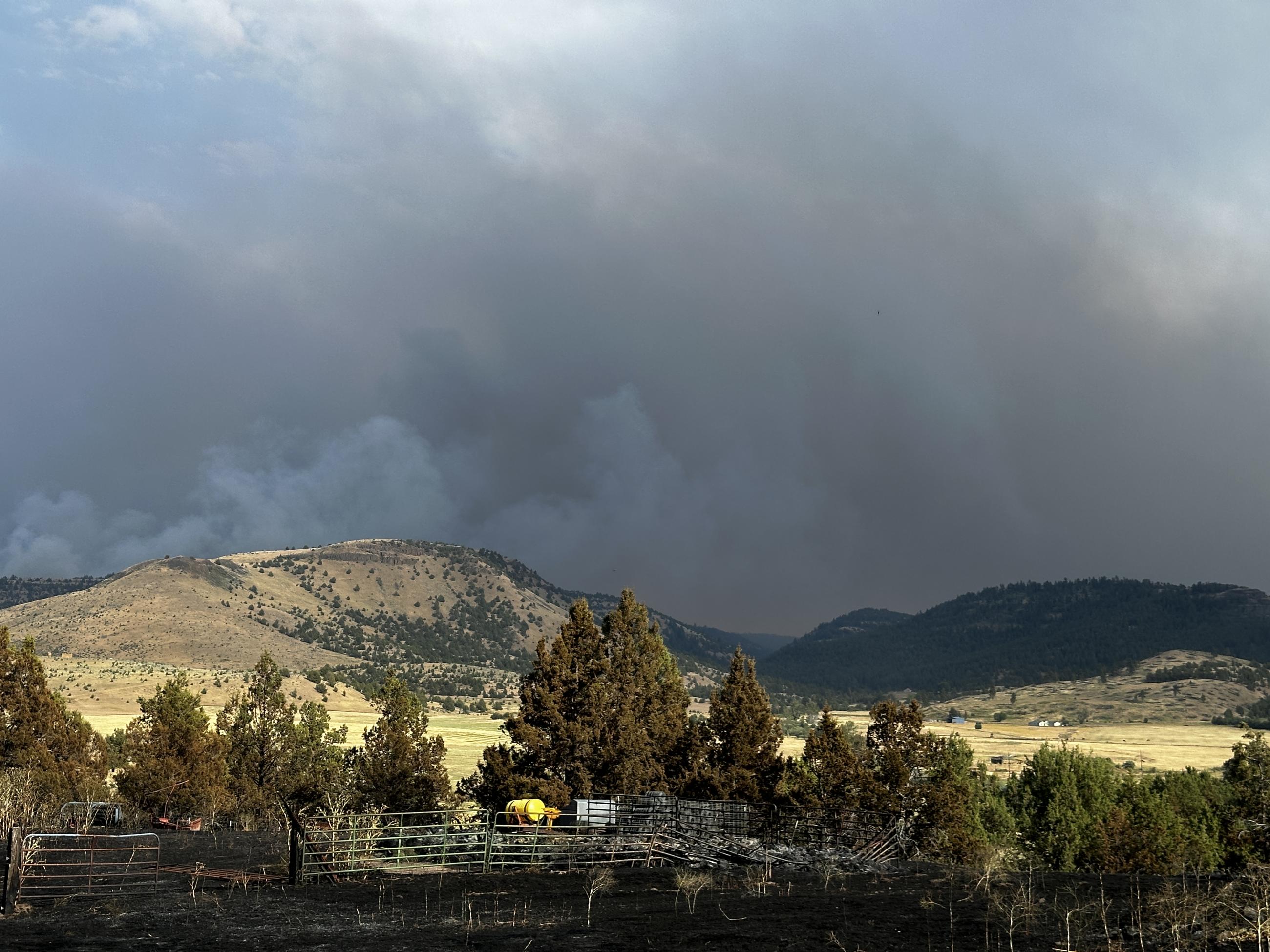
A view of the southern portion of the Lone Rock Fire in north-central Oregon on Wednesday, July 17, 2024.Courtesy InciWeb
Hot weather persists
The National Weather Service is anticipating a hot weekend across much of Oregon and Southwest Washington. The agency on Friday issued a heat advisory along the Interstate 5 corridor from Battle Ground, Washington to Cottage Grove, Oregon from 11 a.m. to 11 p.m. Saturday. Temperatures could reach the mid-90s.
From central Oregon east towards Burns a heat advisory is in place from 11 a.m. Saturday to 11 p.m. Monday. Harney County could see temperatures over 100 degrees over the weekend.
Which neatly serves as an introduction to an article from The Conversation about protecting one’s home.
ooOOoo
How to protect your home from wildfires – here’s what fire prevention experts say is most important
We research wildfire risk to homes and communities. Here’s what decades of research suggest homeowners in high-fire-risk areas can do to protect their properties.
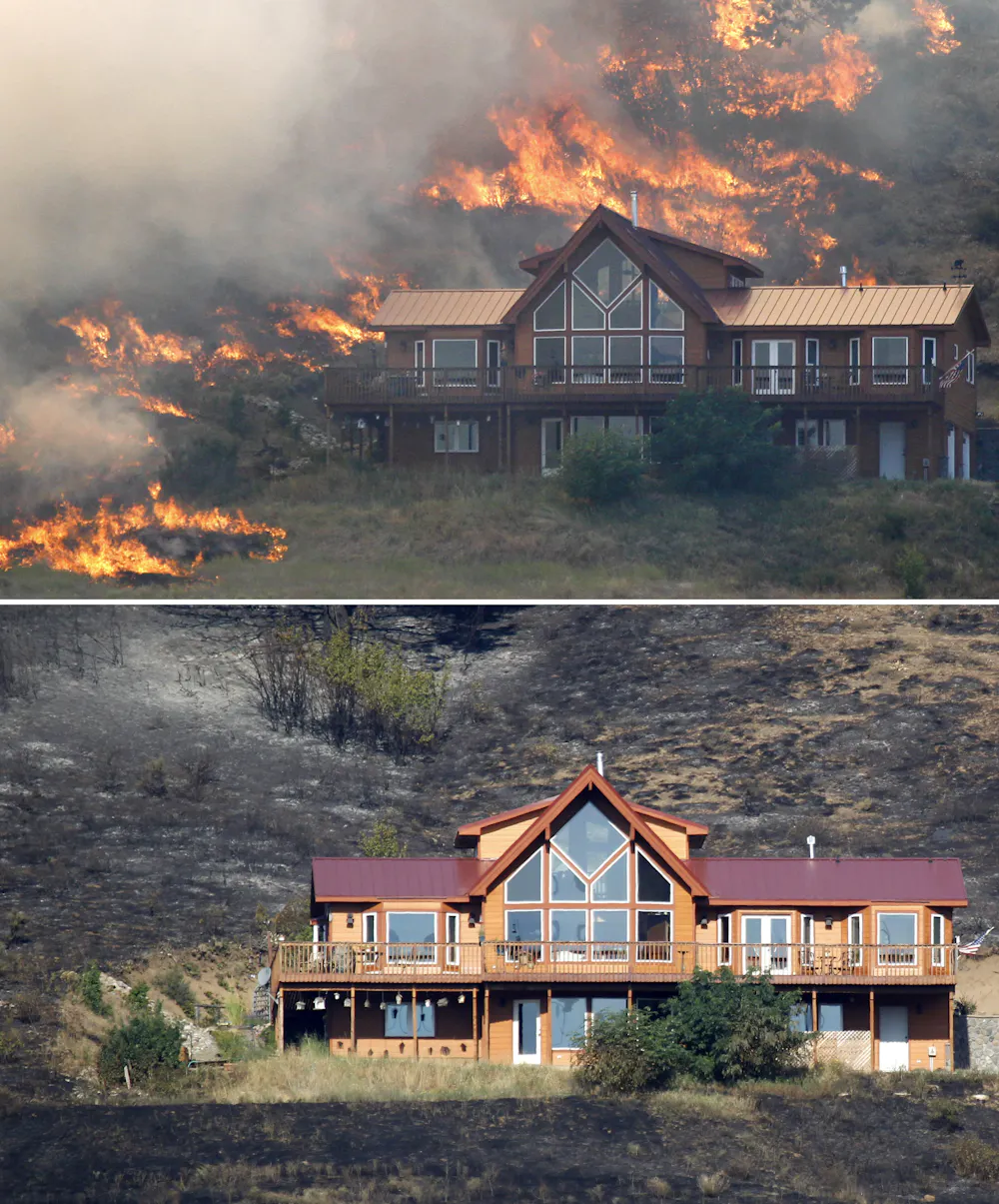
This house near Cle Elum, Wash., survived a 2012 wildfire because of the defensible space around the structure, including a lack of trees and brush close to the house, according to state officials. AP Photo/Elaine Thompson
Small improvements make big differences
A structure’s flammability depends on both the materials that were used to build it and the design of the building. In general, the vulnerability of a house is determined by its weakest point.
The roof, windows, siding and vents are all vulnerable points to pay attention to.
Roof: The roof provides a landing pad where airborne embers can accumulate like snowflakes. Roofs with lots of valleys can collect pine needles and leaves, which can be ignited by flying embers. This is why it’s important for the roof itself to be made of Class A non-flammable material like clay tiles or asphalt shingles, and why roof maintenance, including cleaning gutters, is important. Embers can easily find their way under peeling shingles, through gaps of clay tiles, or into gutters where pine needles and leaves can accumulate.
Windows: If windows are exposed to heat, they can shatter and allow fire inside the home, where curtains can easily ignite. Even double-paned windows can be shattered by the heat of a burning shed 30 feet away, unless the window glass is tempered, making it stronger. Fire-resistant shutters made of metal, if closed before a fire arrives, can offer additional protection. https://www.youtube.com/embed/HjA9yLP1icg?wmode=transparent&start=0 A life-size test with blowing embers at IBHS’s fire lab shows ways homes are at risk form a nearby fire.
Siding: Materials like stucco are non-flammable, while cedar shake siding will burn. Your exterior siding should be non-flammable, but the siding is only as strong as its weakest point. If there are holes in the siding, plug them with caulk to prevent embers from reaching the wooden frame in your walls. Ideally, there will be a 6- to 12-inch concrete foundation between the ground and the bottom of your siding material.
Vents: Reducing risk from vents is easy and affordable and can drastically reduce the flammability of your home. Make sure that one-eighth inch or finer metal mesh is installed over all vents to keep embers out of your attic and your home’s interior.
Controlling your home ignition zone
A home’s vulnerability also depends on the area around it, referred to as the home ignition zone.
The risk in your home ignition zone depends on things such as the slope of your land and the ecosystem surrounding your home. Here are a few guidelines the National Fire Protection Association recommends, both to reduce the chance of flames reaching your home and make it easier for firefighters to defend it.
Zone 1 – Within 5 feet
From the home’s exterior to 5 feet away, you want to prevent flames from coming in contact with windows, siding, vents and eaves. The gold standard is to have only non-flammable material in Zone 1.
The most common risks are having flammable mulch, plants, firewood, lawn furniture, decks and fences. These items have been a primary reason homes burned in many wildfires, including the 2018 Camp Fire that destroyed much of Paradise, California, and the 2012 Waldo Canyon Fire near Colorado Springs, Colorado.
Fire protection guidelines take into consideration the surrounding ecosystem. Here some examples based on the National Fire Protection Association’s guidelines. Bryce Young, CC BY
Replacing mulch with gravel or pavers and having only short, sparse plants that don’t touch the house can help reduce the risk.
Wooden decks and fences can burn even if they are well-maintained. Replacing them with non-flammable materials or installing a thin sheet of metal on the house where the siding touches a wooden deck or fence can help protect the home. Mesh screens can prevent the accumulation of debris and embers under the deck.
Zone 2 – 5 to 30 feet away
In the next ring, between 5 and 30 feet from the home, the lawn should be green and short. This is Zone 2.
Be sure to rake up pine needles and leaves and take care to prune the lowest tree branches at least 6 feet high.
There should be about 18 feet of space between trees on a flat slope, and the spacing should increase with slope because steeper terrain drives faster, more intense fires. Walks, pathways, patios, decks and firewood can be kept in this zone.
Zone 3 – 30 to 100 feet away
Beyond Zone 2 and out to about 100 feet from the home is Zone 3. In this area, be sure to give sheds and propane tanks their own defensible space, just like around the house, and prune all low branches to 6 feet.
You can contact your local emergency management office or community wildfire nonprofit to learn more about grant funding that can offset the costs of pruning and removing trees on a forested property.
Beyond 100 feet may extend past your property boundary, but the adjacent house can still be fuel for a wildfire. That’s why it’s smart to plan with your neighbors as you’re reinforcing your own home. Once one house catches fire, house-to-house fire spread is facilitated by closer distances between buildings.
Where we live is beautiful and earlier this year we had a great deal of rain. But the summers are dry; that is a function of the climate in this part of the world. So for July so far we have had no rain and that is normal. Also no rain in July in 2023.
The three zones, as described earlier in this post, are very helpful.
The challenge in deciding what is best for our forests.
As a great many of you already know, we live in a rural area in Southern Oregon. It is a beautiful place and we look out to the East upon Mount Sexton. But locally a great many houses are built on rural sites with the local forest just yards away.
In the U.S., wildland firefighters are able to stop about 98% of all wildfires before the fires have burned even 100 acres. That may seem comforting, but decades of quickly suppressing fires has had unintended consequences.
However, fuel accumulation isn’t the only consequence of fire suppression.
Fire suppression also disproportionately reduces certain types of fire. In a new study, my colleagues and I show how this effect, known as the suppression bias, compounds the impacts of fuel accumulation and climate change.
What happened to all the low-intensity fires?
Most wildfires are low-intensity. They ignite when conditions aren’t too dry or windy, and they can often be quickly extinguished.
The 2% of fires that escape suppression are those that are more extreme and much harder to fight. They account for about 98% of the burned area in a typical year.
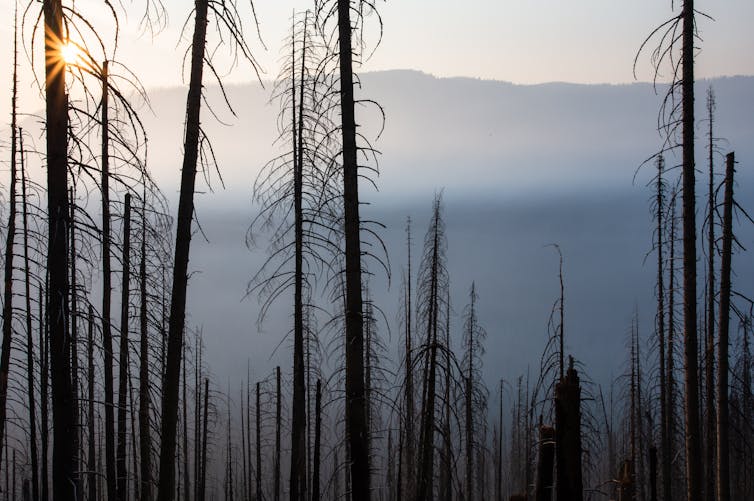
The author and colleagues discuss changing wildfire in Montana and Idaho’s Bitterroot Mountains. By Mark Kreider.
In our study, we used a fire modeling simulation to explore the effects of the fire suppression bias and see how they compared to the effects of global warming and fuel accumulation alone.
Fuel accumulation and global warming both inherently make fires more severe. But over thousands of simulated fires, we found that allowing forests to burn only under the very worst conditions increased fire severity by the same amount as more than a century’s worth of fuel accumulation or 21st-century climate change.
The suppression bias also changes the way plants and animals interact with fire.
By removing low-intensity fires, humans may be changing the course of evolution. Without exposure to low-intensity fires, species can lose traits crucial for surviving and recovering from such events.
In contrast, low-intensity fires free up space and resources for new growth, while still retaining living trees and other biological legacies that support seedlings in their vulnerable initial years.
By quickly putting out low-intensity fires and allowing only extreme fires to burn, conventional suppression reduces the opportunities for climate-adapted plants to establish and help ecosystems adjust to changes like global warming.
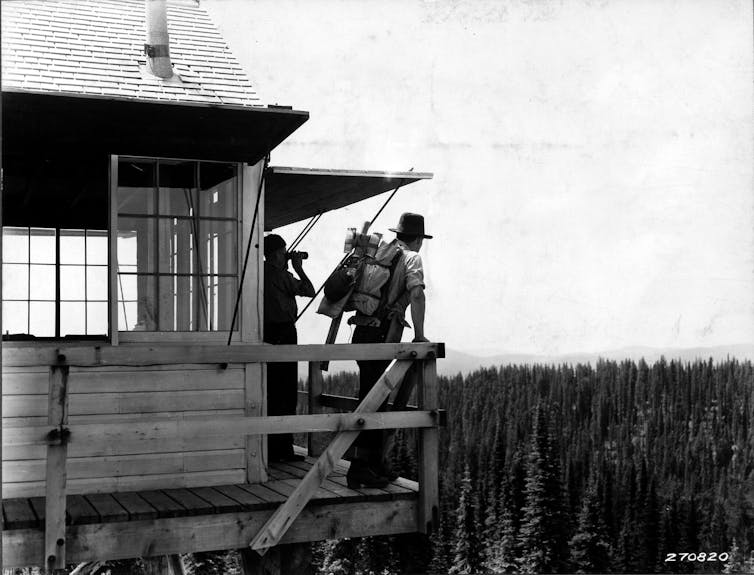
Firefighters keep watch for smoke from a fire tower in the Coeur d’Alene National Forest, Idaho, in 1932. Forest Service photo by K. D. Swan
Suppression makes burned area increase faster
As the climate becomes hotter and drier, more area is burning in wildfires. If suppression removes fire, it should help slow this increase, right?
In fact, we found it does just the opposite.
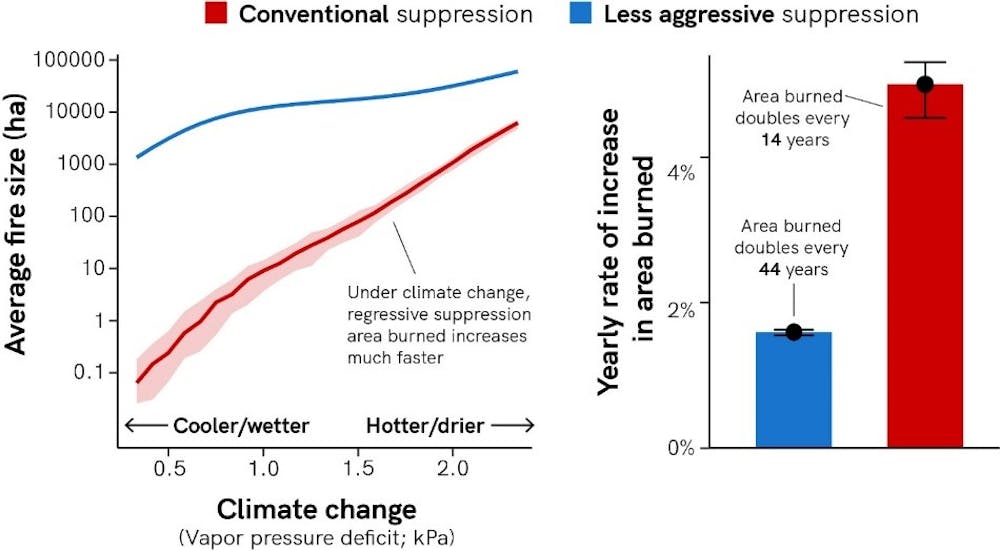
We found that while conventional suppression led to less total area burning, the yearly burned area increased more than three times faster under conventional suppression than under less aggressive suppression efforts. The amount of area burned doubled every 14 years with conventional fire suppression under simulated climate change, instead of every 44 years when low- and moderate-intensity fires were allowed to burn. That raises concerns for how quickly people and ecosystems will have to adapt to extreme fires in the future.
With conventional fire suppression, the average fire size will increase faster as the planet warms than it would under a less aggressive approach. Mark Kreider
The fact that the amount of area burned is increasing is undoubtedly driven by climate change. But our study shows that the rate of this increase may also be a result of conventional fire management.
The near total suppression of fires over the last century means that even a little additional fire in a more fire-prone future can create big changes. As climate change continues to fuel more fires, the relative increase in area burned will be much bigger.
To address the wildfire crisis, fire managers can be less aggressive in suppressing low- and moderate-intensity fires when it is safe to do so. They can also increase the use of prescribed fire and cultural burning to clear away brush and other fuel for fires.
These low-intensity fires will not only reduce the risk of future extreme fires, but they also will create conditions that favor the establishment of species better suited to the changing climate, thereby helping ecosystems adapt to global warming.
Coexisting with wildfire requires developing technologies and approaches that enable the safe management of wildfires under moderate burning conditions. Our study shows that this may be just as necessary as other interventions, such as reducing the number of fires unintentionally started by human activities and mitigating climate change.
The article makes a great deal of sense and presents a solution that may not be our first thought. But especially the message is fundamentally important, and please watch the video because it very clearly presents the benefits of the solution.
So we want more low-intensity fires! Please! Or to say it another way, we want more prescribed fires.
So here we are, 2024, and the year when I become 80! However, I still have eleven months before that happens. Like an amazing number of people, I do not really think long about this New Year but there are plenty that do.
Here is an article that explains much more. It is from The Conversation.
ooOOoo
What winter solstice rituals tell us about indigenous people
On the day of winter solstice, many Native American communities will hold religious ceremonies or community events.
The winter solstice is the day of the year when the Northern Hemisphere has the fewest hours of sunlight and the Southern Hemisphere has the most. For indigenous peoples, it has been a time to honor their ancient sun deity. They passed their knowledge down to successive generations through complex stories and ritual practices.
As a scholar of the environmental and Native American religion, I believe, there is much to learn from ancient religious practices.
Ancient architecture
For decades, scholarshave studied the astronomical observations that ancient indigenous people made and sought to understand their meaning.
One such place was at Cahokia, near the Mississippi River in what is now Illinois across from St. Louis.
In Cahokia, indigenous people built numerous temple pyramids or mounds, similar to the structures built by the Aztecs in Mexico, over a thousand years ago. Among their constructions, what most stands out is an intriguing structure made up of wooden posts arranged in a circle, known today as “Woodhenge.”
To understand the purpose of Woodhenge, scientists watched the sun rise from this structure on winter solstice. What they found was telling: The sun aligned with both Woodhenge and the top of a temple mound – a temple built on top of a pyramid with a flat top – in the distance. They also found that the sun aligns with a different temple mound on summer solstice.
Archaeological evidence suggests that the people of Cahokia venerated the sun as a deity. Scholars believe that ancient indigenous societies observed the solar system carefully and wove that knowledge into their architecture.
Scientists have speculated that the Cahokia held rituals to honor the sun as a giver of life and for the new agricultural year.
Complex understandings
Zuni Pueblo is a contemporary example of indigenous people with an agricultural society in western New Mexico. They grow corn, beans, squash, sunflowers and more. Each year they hold annual harvest festivals and numerous religious ceremonies, including at the winter solstice.
At the time of the winter solstice they hold a multiday celebration, known as the Shalako festival. The days for the celebration are selected by the religious leaders. The Zuni are intensely private, and most events are not for public viewing.
But what is shared with the public is near the end of the ceremony, when six Zuni men dress up and embody the spirit of giant bird deities. These men carry the Zuni prayers for rain “to all the corners of the earth.” The Zuni deities are believed to provide “blessings” and “balance” for the coming seasons and agricultural year.
As religion scholar Tisa Wenger writes, “The Zuni believe their ceremonies are necessary not just for the well-being of the tribe but for “the entire world.”
Winter games
Not all indigenous peoples ritualized the winter solstice with a ceremony. But that doesn’t mean they didn’t find other ways to celebrate.
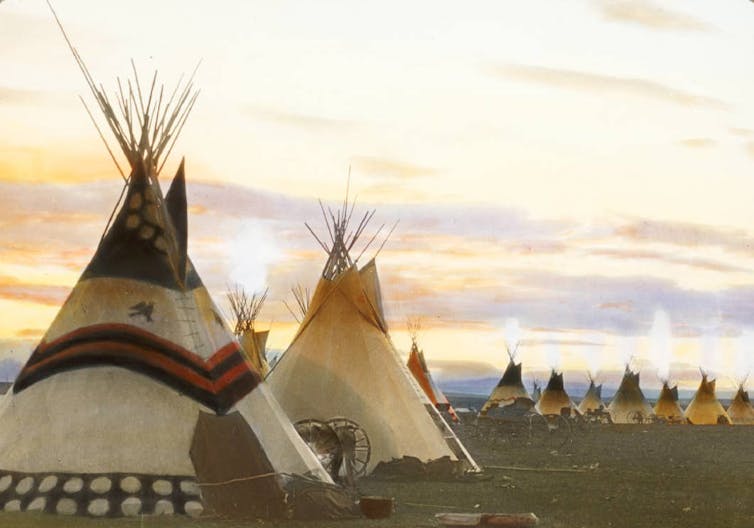
The Blackfeet tribe in Montana, where I am a member, historically kept a calendar of astronomical events. They marked the time of the winter solstice and the “return” of the sun or “Naatosi” on its annual journey. They also faced their tipis – or portable conical tents – east toward the rising sun.
They rarely held large religious gatherings in the winter. Instead the Blackfeet viewed the time of the winter solstice as a time for games and community dances. As a child, my grandmother enjoyed attending community dances at the time of the winter solstice. She remembered that each community held their own gatherings, with unique drumming, singing and dance styles.
Later, in my own research, I learned that the Blackfeet moved their dances and ceremonies during the early reservation years from times on their religious calendar to times acceptable to the U.S. government. The dances held at the time of the solstice were moved to Christmas Day or to New Year’s Eve.
Today, my family still spends the darkest days of winter playing card games and attending the local community dances, much like my grandmother did.
Although some winter solstice traditions have changed over time, they are still a reminder of indigenous peoples understanding of the intricate workings of the solar system. Or as the Zuni Pueblo’s rituals for all peoples of the earth demonstrate – of an ancient understanding of the interconnectedness of the world.
So many times a particular article from a website that allows republishing is not only a good and relevant article but also is a quick way of me publishing a post when, as I was yesterday, a bit pressed for time.
From sports to pop culture, there are few themes more appealing than a good comeback. They happen in nature, too. Even with the Earth losing species at a historic rate, some animals have defied the trend toward extinction and started refilling their old ecological niches.
I’m a philosopher based in Montana and specialize in environmental ethics. For my new book, “Tenacious Beasts: Wildlife Recoveries That Change How We Think About Animals,” I spent three years looking at wildlife comebacks across North America and Europe and considering the lessons they offer. In every case, whether the returnee is a bison, humpback whale, beaver, salmon, sea otter or wolf, the recovery has created an opportunity for humans to profoundly rethink how we live with these animals.
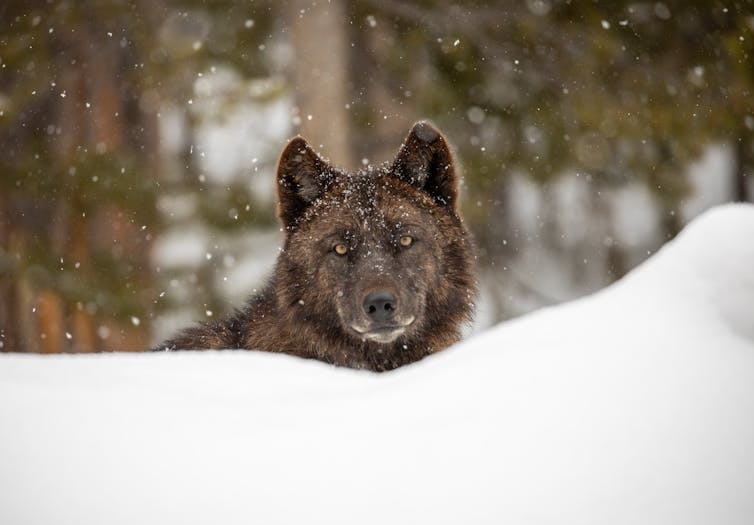
One place to see the rethink in action is Colorado, where voters approved a ballot measure in 2020 mandating the reintroduction of gray wolves west of the Continental Divide. Colorado’s Parks and Wildlife Agency has released a draft plan that calls for moving 30 to 50 gray wolves from other Rocky Mountain states into northwest Colorado over five years, starting in 2024.
Aldo Leopold, the famed conservationist and professor of game management at the University of Wisconsin, believed that moral beliefs evolve over time to become more inclusive of the natural world. And what’s happening in Colorado suggests Leopold was right. Human attitudes toward wolves have clearly evolved since the mid-1940s, when bounties, mass poisoning and trapping eradicated wolves from the state.
Recovering animals encounter a world that is markedly different from the one in which they declined, especially in terms of how people think about wildlife. Here are several reasons I see why societal attitudes toward wolves have changed. The importance of keystone species
Wolves released in northwest Colorado will wear GPS collars that enable wildlife managers to track them.
The idea that certain influential species, which ecologists call keystone species, can significantly alter the ecosystems around them first appeared in scientific literature in 1974. Bison, sea otters, beavers, elephants and wolves all exert this power. One way in which wolves wield influence is by preying on coyotes, which produces ripple effects across the system. Fewer coyotes means more rodents, which in turn means better hunting success for birds of prey.
Wolves also cause nervous behaviors among their prey. Some scientists believe that newly returned predators create a “landscape of fear” among prey species – a term that isn’t positive or negative, just descriptive. This idea has shifted thinking about predators. For example, elk avoid some areas when wolves are around, resulting in ecological changes that cascade down from the top. Vegetation can recover, which in turn may benefit other species.
Insights into pack dynamics
Animal behavioral science research has provided pointers for better wolf management. Studies show that wolf packs are less likely to prey on livestock if their social structure remains intact. This means that ranchers and wildlife managers should take care not to remove the pack’s breeding pair when problems occur. Doing so can fragment the pack and send dispersing wolves into new territories.
Wildlife agencies also have access to years of data from close observation of wolf behavior in places like Yellowstone National Park, where wolves were reintroduced starting in 1995. This research offers insights into the wolf’s intelligence and social complexity. All of this information helps to show how people can live successfully alongside them.
Predators provide economic value
Research has also demonstrated that wolves provide economic benefits to states and communities. Wisconsin researchers discovered that changes in deer behavior due to the presence of wolves have saved millions of dollars in avoided deer collisions with cars. These savings far exceed what it costs the state to manage wolves.
Wolf recovery has been shown to be a net economic benefit in areas of the U.S. West where they have returned. The dollars they attract from wolf-watchers, photographers and foreign visitors have provided a valuable new income stream in many communities.
Predators do kill livestock, but improved tracking has helped to put these losses in perspective. Montana Board of Livestock numbers show that wolves, grizzly bears and mountain lions caused the loss of 131 cattle and 137 sheep in the state in 2022. This is from a total of 2,200,000 cattle and 190,000 sheep. Of the 131 cattle, 36 were confirmed to be taken by wolves – 0.0016% of the statewide herd.
According to the U.S. Department of Agriculture, dogs, foxes and coyotes in Montana all killed more sheep and lambs than wolves did in 2020. Even eagles were three times more deadly to sheep and lambs than wolves were.
Actual costs to ranchers are certainly higher than these numbers suggest. The presence of wolves causes livestock to lose weight because the animals feed more nervously when wolves are around. Ranchers also lose sleep as they worry about wolves attacking their livestock and guard dogs. And clearly, low statewide kills are small comfort to a rancher who loses a dozen or more animals in one year. Margins are always tight in the livestock business.
t
A northern Colorado rancher discusses options for protecting his cattle from wolves, which already are naturally present in the state.
What’s more, predators’ economic impacts don’t end with ranching. In Colorado, for example, elk numbers are likely to decline after wolves are reintroduced. This may affect state wildlife agency budgets that rely on license fees from elk hunters. It may also affect hunting outfitters’ incomes.
In my view, voters who supported bringing wolves back to Colorado should remain deeply aware of the full distribution of costs and support proactive compensation schemes for losses. They should be mindful that support for wolf reintroduction varies drastically between urban and rural communities and should insist that effective mechanisms are in place ahead of time to ensure fair sharing of the economic burdens that wolves generate.
A new ethical playing field
Despite these complexities, the idea of the “big bad wolf” clearly no longer dominates Americans’ thinking. And the wolf is not alone. Social acceptance of many other wildlife species is also increasing. For example, a 2023 study found that between 80% and 90% of Montanans believed grizzly bears – which are recovering and expanding their presence there – have a right to exist.
Aldo Leopold famously claimed to have experienced an epiphany when he shot a wolf in New Mexico in the 1920s and saw “a fierce green fire” dying in her eyes. In reality, his attitude took several more decades to change. Humans may have an ingrained evolutionary disposition to fear carnivorous predators like wolves, but the change ended up being real for Leopold, and it lasted.
Leopold, who died in 1948, did not live to see many wildlife species recover, but I believe he would have regarded what’s happening now as an opportunity for Americans’ moral growth. Because Leopold knew that ethics, like animals, are always evolving.
Those last few paragraphs under the sub-heading of ‘A new ethical playing field’ show how many other wildlife species have gained a real advantage, a social acceptance as the article said. Long may it continue.
OK, not in the sense of weather because the worse is yet to come I’m sure. But in terms of the movement of the Planet Earth in its orbit around the Sun. And that’s what matters!
This is a really ancient moment as the following article published in The Conversation explains in much more detail.
ooOOoo
What winter solstice rituals tell us about indigenous people
By Rosalyn R. LaPier Associate Professor of Environmental Studies, The University of Montana
December 13th, 2018.
On the day of winter solstice, many Native American communities will hold religious ceremonies or community events.
The winter solstice is the day of the year when the Northern Hemisphere has the fewest hours of sunlight and the Southern Hemisphere has the most. For indigenous peoples, it has been a time to honor their ancient sun deity. They passed their knowledge down to successive generations through complex stories and ritual practices.
As a scholar of the environmental and Native American religion, I believe, there is much to learn from ancient religious practices.
Ancient architecture
For decades, scholarshave studied the astronomical observations that ancient indigenous people made and sought to understand their meaning.
One such place was at Cahokia, near the Mississippi River in what is now Illinois across from St. Louis.
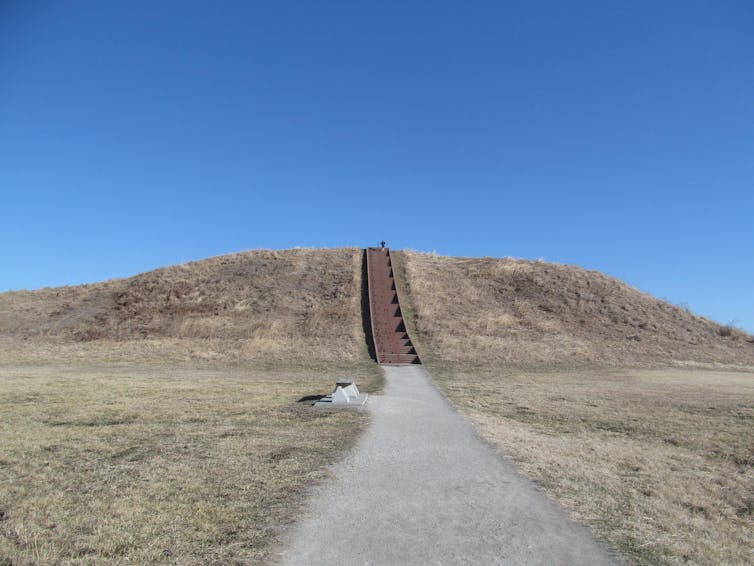
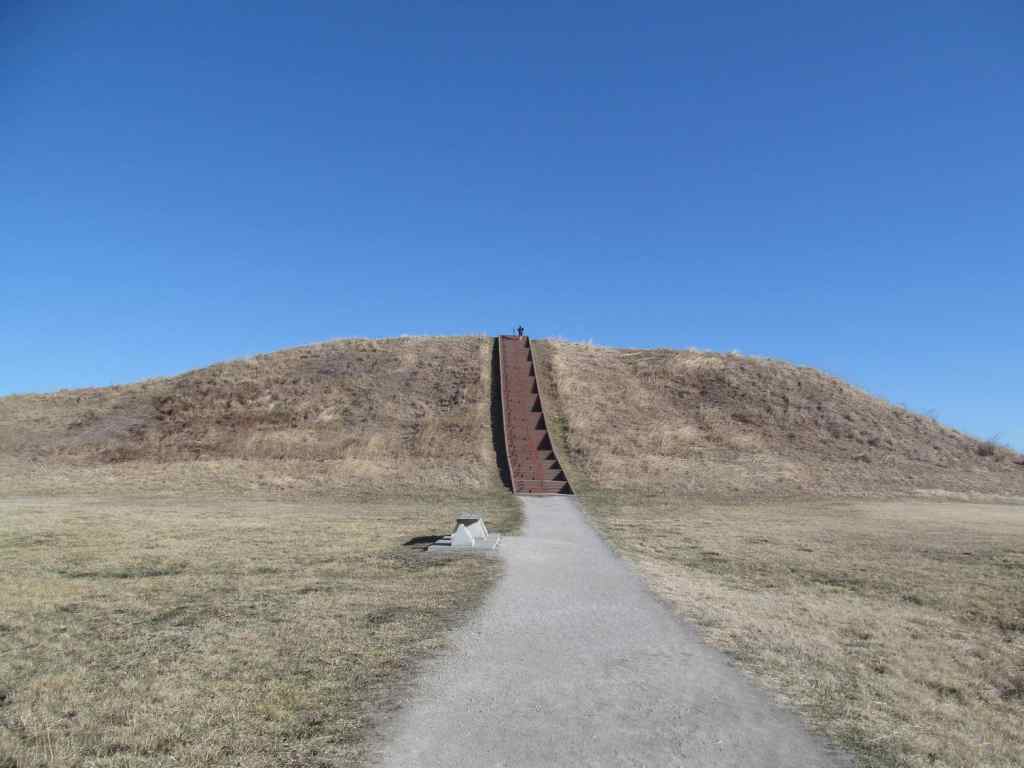
The Cahokia mounds. Doug Kerr, CC BY-SA
In Cahokia, indigenous people built numerous temple pyramids or mounds, similar to the structures built by the Aztecs in Mexico, over a thousand years ago. Among their constructions, what most stands out is an intriguing structure made up of wooden posts arranged in a circle, known today as “Woodhenge.”
To understand the purpose of Woodhenge, scientists watched the sun rise from this structure on winter solstice. What they found was telling: The sun aligned with both Woodhenge and the top of a temple mound – a temple built on top of a pyramid with a flat top – in the distance. They also found that the sun aligns with a different temple mound on summer solstice.
Archaeological evidence suggests that the people of Cahokia venerated the sun as a deity. Scholars believe that ancient indigenous societies observed the solar system carefully and wove that knowledge into their architecture.
Scientists have speculated that the Cahokia held rituals to honor the sun as a giver of life and for the new agricultural year.
Complex understandings
Zuni Pueblo is a contemporary example of indigenous people with an agricultural society in western New Mexico. They grow corn, beans, squash, sunflowers and more. Each year they hold annual harvest festivals and numerous religious ceremonies, including at the winter solstice.
At the time of the winter solstice they hold a multiday celebration, known as the Shalako festival. The days for the celebration are selected by the religious leaders. The Zuni are intensely private, and most events are not for public viewing.
But what is shared with the public is near the end of the ceremony, when six Zuni men dress up and embody the spirit of giant bird deities. These men carry the Zuni prayers for rain “to all the corners of the earth.” The Zuni deities are believed to provide “blessings” and “balance” for the coming seasons and agricultural year.
As religion scholar Tisa Wenger writes, “The Zuni believe their ceremonies are necessary not just for the well-being of the tribe but for “the entire world.”
Winter games
Not all indigenous peoples ritualized the winter solstice with a ceremony. But that doesn’t mean they didn’t find other ways to celebrate.
The Blackfeet tribe in Montana, where I am a member, historically kept a calendar of astronomical events. They marked the time of the winter solstice and the “return” of the sun or “Naatosi” on its annual journey. They also faced their tipis – or portable conical tents – east toward the rising sun.
They rarely held large religious gatherings in the winter. Instead the Blackfeet viewed the time of the winter solstice as a time for games and community dances. As a child, my grandmother enjoyed attending community dances at the time of the winter solstice. She remembered that each community held their own gatherings, with unique drumming, singing and dance styles.
Later, in my own research, I learned that the Blackfeet moved their dances and ceremonies during the early reservation years from times on their religious calendar to times acceptable to the U.S. government. The dances held at the time of the solstice were moved to Christmas Day or to New Year’s Eve.
The solstice. Divad, from Wikimedia Commons
Today, my family still spends the darkest days of winter playing card games and attending the local community dances, much like my grandmother did.
Although some winter solstice traditions have changed over time, they are still a reminder of indigenous peoples understanding of the intricate workings of the solar system. Or as the Zuni Pueblo’s rituals for all peoples of the earth demonstrate – of an ancient understanding of the interconnectedness of the world.
ooOOoo
Let me pick up on the last sentence: “Or as the Zuni Pueblo’s rituals for all peoples of the earth demonstrate – of an ancient understanding of the interconnectedness of the world.”
We are all of us interconnected across the world. We have been for a very long time.
The importance of understanding this, truly understanding this, is critical to our future.



 Learning from Dogs

