Tag: United States

The coming new year!

Be warned, one of my more reflective muses!

Tomorrow is the last day of the year 2011.

For reasons that I am not clear about, there is a mood of pessimism about my person.  Whether it is the scale of global issues that I see ahead that drags me down, whether the year of an American Presidential election will remind me of the loss of reason that afflicts so many modern democracies, whether the messages in Kunstler’s book The Long Emergency still resonate in my mind well, who knows?

But when one does look at the broader picture of modern society, there is much that troubles.

So forgive me if I provide a couple of examples of these troubles.  I do so on the grounds of communication – the more that understand the risks ahead of us, the more likely we, as in the peoples of this planet, will say to our leaders, “Enough of this!  For the sake of my children, my grandchildren and all of humanity we have to change our priorities, and soon!”

Here’s my first example.

The US National Resources Defense Council recently published an item about severe weather including an interactive Extreme Weather Map, introduced thus,

Climate change increases the risk of record-breaking extreme weather events that threaten communities across the country. In 2011, there were at least 2,941 monthly weather records broken by extreme events that struck communities in the US.

That was backed up by an article on the Onearth website that opened,

By many measures, 2011 was the most extreme weather year for the United States since reliable record-keeping began in the 19th century — and the costs have been enormous. According to the National Oceanic and Atmospheric Administration, 2011 set a record for the most billion-dollar disasters in a single year. There were 12, breaking the old record of nine set in 2009. The aggregate damage from these 12 events totals at least $52 billion, NOAA found.

And that just for the USA.  But will climate change be the Number One political issue in 2012?  And if not in 2012, when will it be?

Let me move on to my second example, very different from the one above but, in a sense, just as scary.  This is an interview that was in a recent article on the Food Freedom website ( brilliant website, by the way).  Dr. Joseph Mercola, the leading natural health practitioner, interviews Dr. Don M. Huber, one of the senior scientists in the U.S about the area of science that relates to genetically modified organisms (GMO). Here’s an extract from the article on Food Freedom,

Toxic botulism in animals linked to RoundUp

Dr Mercola recently interviewed Dr Don Huber, whose letter to the USDA warning that Monsanto’s RoundUp, a broad-spectrum “herbicide” that has been linked with spontaneous abortion in animals, continues to be ignored by food and environmental safety authorities. In this important hour-long discussion, Huber, a plant pathologist for over 50 years, explains how RoundUp is destroying our healthy soils by killing needed microorganisms.

Not only did his team discover a new soil pathogen, but he reports that animals are coming down with over 40 new diseases, like toxic botulism. Huber explains that before the widespread use of herbicides, pesticides and genetically modified food and feed, natural probiota would have kept Clostridium botulinum in check

The video, below, of the interview is included in the article.  Please don’t be put off by the length, the material covered is riveting and critical to our general knowledge about the threats to our society.

So that’s enough from me for one day!  On Monday, I shall include another video relating to the RoundUp issue that reveals, both directly and metaphorically, how the only solution to pessimism is to embrace the need to make change happen.  Be inspired by this poem by Sam Keen, included in the latest Sabbath Moment from Terry Hershey,

I Want to Surrender

God, I want to surrender
to the rhythm of music and sea,
to the seasons of ebb and flow,
to the tidal surge of love.

I am tired of being hard,
tight, controlled,
tensed against tenderness,
afraid of softness.
I am tired of directing my world,
making, doing, shaping.

Tension is ecstasy in chains.
The muscles are tightened to prevent trembling.
Nerves strain to prevent trust,
hope, relaxation….

Surrender is a risk no sane man may take.
Sanity never surrendered
is a burden no man may carry.

God give me madness
that does not destroy
wisdom,
responsibility,
love.

Sam Keen

Make a difference – now!

A plea to sign a global call not to delay action on global warming

How many of you in Europe watched the final episode of Sir Peter Attenborough’s Frozen Planet series, entitled On Thin Ice?

Did you watch the short video in last week’s post, The power of truth?  If not, it’s below.

Here’s a piece from a BBC news item from yesterday,

A hungry polar bear

It is an image that is sure to shock many people.

An adult polar bear is seen dragging the body of a cub that it has just killed across the Arctic sea ice.

Polar bears normally hunt seals but if these are not available, the big predators will seek out other sources of food – even their own kind.

The picture was taken by environmental photojournalist Jenny Ross in Olgastretet, a stretch of water in the Svalbard archipelago.

“This type of intraspecific predation has always occurred to some extent,” she told BBC News.

“However, there are increasing numbers of observations of it occurring, particularly on land where polar bears are trapped ashore, completely food-deprived for extended periods of time due to the loss of sea ice as a result of climate change.”

Re-read that last segment of that last sentence, “completely food-deprived for extended periods of time due to the loss of sea ice as a result of climate change.

So with all that in mind, please read on.

Friends,

What if someone told you we should abandon all hope for global climate action until 2020? Well, that’s exactly the proposal that the United States is pushing at the UN Climate Talks taking place this week in Durban, South Africa. The 2020 delay might well be the worst idea ever.

Waiting nine years for climate action isn’t just a delay, it’s a death sentence for communities on the front lines of the climate crisis — and it could slam the door on ever getting carbon pollution levels below the safe upper limit of 350 parts per million.

It’s not too late to stop this delay from going through. Over the next three days, our team of 350.org activists in Durban will be working with our partners at Avaaz and allies from around the world to isolate the United States — and build support for the African nations that are fighting for real climate action. But it will take a massive grassroots outcry to demonstrate that people everywhere are taking a stand to prevent the United States negotiators from signing away our future.

If we raise an international alarm before the talks end on Friday, we can convince the US to get out of way of progress and help unlock the global process that can lead to bold climate action all around the world.

Click here to add your voice to a global call to action we’re delivering in Durban: www.350.org/durban

The climate talks in South Africa end in just 48 hours, and it’s vital that we ramp up the pressure now. To make sure the US gets the message, our team on the ground here in Durban will deliver your messages directly to the US negotiating team at a high-impact event we’re helping to pull together on Friday. We can’t say much more about it now, but suffice to say our message will be unavoidable.

This year, the 350 network has shown that people power can truly move the planet in the right direction. We mobilized hundreds of thousands of people to push for climate action in nearly every country on earth. We beat back the Keystone XL pipeline when no one said it was possible. We took over the radio waves to spread a message of hope and action on the climate crisis. And through our actions, we helped keep the hope of saving our planet — and reaching 350 ppm — alive.

The UN Climate Talks here in Durban aren’t going to get us back to 350 by themselves, but they can keep the option open by making progress on a legally binding, international framework to help nations make serious cuts in carbon emissions. In 2012, we’re going to need to do all we can to challenge the fossil fuel companies that are the real obstacles to progress. Breaking their stranglehold on our governments is the only way to really unlock these negotiations.

But right now, the most important thing we can do is keep the possibility of a strong international climate deal alive by pushing back on the United States negotiating team. In recent months, President Obama has shown that he’ll stand up for the climate, but only if he’s got a movement to back him up. On the Keystone pipeline, he’s been doing the right thing by blocking Republican efforts to push it through — now we need him to do the right thing on the international stage.

There’s no guarantee that we’ll be successful, but we owe it to our allies across the planet — many of whom are already feeling the impacts of climate change — to resist the chorus of cynics and keep hope alive. As Nelson Mandela said, “It always seems impossible until it’s done.” The 350 network has pulled off the impossible before — now’s the time to step up the pressure again.

Please add your voice today: www.350.org/durban

Let’s do this,

Jamie Henn for the whole 350.org team

P.S. We have just 48 hours to build a huge groundswell of pressure. Please help make it go viral with a few clicks on Twitterand Facebook — tag your popular friends, and post it again and again.

William deBuys, The Parching of the West

Once again, a powerful essay from the TomDispatch blog.

Quick introduction.  Tom Engelhardt, of TomDispatch, has given me a blanket permission to reproduce his essays.  As always, I am indebted to his generosity.  This particular essay is extremely timely coming after my Post yesterday about extreme weather.

Tomgram: William deBuys, The Parching of the West

Posted by William deBuys at 6:02pm, December 4, 2011.

The good news? While 2010 tied for the warmest year on record, 2011 — according to the U.N.’s World Meteorological Organization (WMO) — is likely to come in 10th once November and December temperatures are tallied. In part, this is evidently due to an especially strong La Niña cooling event in the Pacific.  On the other hand, with 2011 in the top ten despite La Niña, 13 of the warmest years since such record-keeping began have occurred in the last 15 years.  Think of that as an uncomfortably hot cluster.

And other climate news is no better.  A recent study indicates that Arctic ice is now melting at rates unprecedented in the last 1,450 years (as far back, that is, as reasonably accurate reconstructions of such an environment can be modeled).  As the Arctic warms and temperatures rise in surrounding northern lands — someday, Finland may have to construct artificial ski trails and ice rinks for its future winter tourists — a report on yet another study is bringing more lousy news.  Appearing in the prestigious science journal Nature, it indicates that the melting permafrost of the tundra may soon begin releasing global-warming gases into the atmosphere in massive quantities.  We’re talking the equivalent of 300 billion metric tons of carbon over the next nine decades.

Recently, Fatih Birol, the chief economist for the International Energy Agency, suggested that, by century’s end, the planet’s temperature could rise by a staggering 6º Celsius (almost 11º Fahrenheit).  International climate-change negotiators had been trying to keep that rise to a “mere” 2º C.  “Everybody, even the schoolchildren, knows this is a catastrophe for all of us,” was the way Birol summed the situation up.  If only it were so, but here in the U.S., none of the above news was even considered front-page worthy.  Nor was the news that, in 2010, humans had pumped more carbon dioxide into the atmosphere than at any time since the industrial revolution began: 564 million more tons than in 2009 to be exact.  We’re living today with just less than a degree of those six degrees to come, and the results in extreme weather this year should have made us all stop and think.

If you want to focus in on damage here in the U.S., consider Rick Perry’s Texas, where, according to scientists, “daily temperatures averaged 86.7° in June through August — a staggering 5.4°F above normal.”  According to the WMO, that’s the highest such average “ever recorded for any American state.”  And still global politicians yammer on and do little; still, the U.S. shuffles its political feet, while Canada’s government has announced that it will make no new commitments and may even be preparing to withdraw from the Kyoto protocol, and countries with booming developing economies like China, India, and Brazil hedge their bets when it comes to action.

In the meantime, nature doesn’t care whether or not we do anything.  It’s on its own schedule.  And when it comes to the American Southwest, that schedule looks daunting indeed as William deBuys makes clear.  His new book, A Great Aridness: Climate Change and the Future of the American Southwest, is the definitive work on the subject of water and the West (and, as with all of his work, a pleasure to read). So get yourself a glass of water while you still can and settle in for a dose of the Age of Thirst. (To catch Timothy MacBain’s latest Tomcast audio interview in which deBuys discusses the water politics of the American West, click here or download it to your iPod here.) Tom

The Age of Thirst in the American West
Coming to a Theater Near You: The Greatest Water Crisis in the History of Civilization 

By William deBuys

Consider it a taste of the future: the fire, smoke, drought, dust, and heat that have made life unpleasant, if not dangerous, from Louisiana to Los Angeles. New records tell the tale: biggest wildfire ever recorded in Arizona (538,049 acres),biggest fire ever in New Mexico (156,600 acres), all-time worst fire year in Texas history (3,697,000 acres).

The fires were a function of drought.  As of summer’s end, 2011 was the driest year in 117 years of record keeping for New Mexico, Texas, and Louisiana, and the second driest for Oklahoma. Those fires also resulted from record heat.  It was the hottest summer ever recorded for New Mexico, Texas, Oklahoma, and Louisiana, as well as the hottest August ever for those states, plus Arizona and Colorado.

Virtually every city in the region experienced unprecedented temperatures, with Phoenix, as usual, leading the march toward unlivability. This past summer, the so-called Valley of the Sun set a new record of 33 days when the mercury reached a shoe-melting 110º F or higher. (The previous record of 32 days was set in 2007.)

And here’s the bad news in a nutshell: if you live in the Southwest or just about anywhere in the American West, you or your children and grandchildren could soon enough be facing the Age of Thirst, which may also prove to be the greatest water crisis in the history of civilization.  No kidding.

If that gets you down, here’s a little cheer-up note: the end is not yet nigh.

In fact, this year the weather elsewhere rode to the rescue, and the news for the Southwest was good where it really mattered.  Since January, the biggest reservoir in the United States, Lake Mead, backed up by the Hoover Dam and just 30 miles southwest of Las Vegas, has risen almost 40 feet. That lake is crucial when it comes to watering lawns or taking showers from Arizona to California.  And the near 40-foot surge of extra water offered a significant upward nudge to the Southwest’s water reserves.

The Colorado River, which the reservoir impounds, supplies all or part of the water on which nearly 30 million people depend, most of them living downstream of Lake Mead in Los Angeles, San Diego, Phoenix, Tucson, Tijuana, and scores of smaller communities in the United States and Mexico.

Back in 1999, the lake was full. Patricia Mulroy, who heads the water utility serving Las Vegas, rues the optimism of those bygone days.  “We had a fifty-year, reliable water supply,” she says. “By 2002, we had no water supply. We were out. We were done. I swore to myself we’d never do that again.”

In 2000, the lake began to fall — like a boulder off a cliff, bouncing a couple of times on the way down. Its water level dropped a staggering 130 feet, stopping less than seven feet above the stage that would have triggered reductions in downstream deliveries. Then — and here’s the good news, just in case you were wondering — last winter, it snowed prodigiously up north in Colorado, Utah, and Wyoming.

The spring and summer run-off from those snowpacks brought enormous relief. It renewed what we in the Southwest like to call the Hydro-Illogic cycle: when drought comes, everybody wrings their hands and promises to institute needed reform, if only it would rain a little. Then the drought breaks or eases and we all return to business as usual, until the cycle comes around to drought again.

So don’t be fooled.  One day, perhaps soon, Lake Mead will renew its downward plunge.  That’s a certainty, the experts tell us.  And here’s the thing: the next time, a sudden rescue by heavy snows in the northern Rockies might not come. If the snowpacks of the future are merely ordinary, let alone puny, then you’ll know that we really are entering a new age.

And climate change will be a major reason, but we’ll have done a good job of aiding and abetting it. The states of the so-called Lower Basin of the Colorado River — California, Arizona, and Nevada — have been living beyond their water means for years. Any departure from recent decades of hydrological abundance, even a return to long-term average flows in the Colorado River, would produce a painful reckoning for the Lower Basin states.  And even worse is surely on the way.

Just think of the coming Age of Thirst in the American Southwest and West as a three-act tragedy of Shakespearean dimensions.

The Age of Thirst: Act I

The curtain in this play would surely rise on the Colorado River Compact of 1922, which divided the river’s water equally between the Upper and Lower Basins, allocating to each annually 7.5 million acre-feet, also known by its acronym “maf.” (An acre-foot suffices to support three or four families for a year.) Unfortunately, the architects of the compact, drawing on data from an anomalously wet historical period, assumed the river’s average annual flow to be about 17 maf per year.  Based on reconstructions that now stretch back more than 1,000 years, the river’s long-term average is closer to 14.7 maf.  Factor in evaporation from reservoirs (1.5 maf per year) and our treaty obligation to Mexico (another 1.5 maf), and the math doesn’t favor a water-guzzling society.

Nonetheless, the states of the Lower Basin have been taking their allotment as if nothing were wrong and consequently overdrafting their account by up to 1.3 maf annually.  At this rate, even under unrealistically favorable scenarios, the Lower Basin will eventually drain Lake Mead and cutbacks will begin, possibly as soon as in the next few years.  And then things will get dicier because California, the water behemoth of the West, won’t have to absorb any of those cutbacks.

Here’s one of the screwiest quirks in western water law: to win Congressional approval for the building of a monumental aqueduct, the Central Arizona Project (CAP), which would bring Colorado River water to Phoenix and Tucson, Arizona agreed to subordinate its Colorado River water rights to California’s.  In that way, the $4 billion, 336-mile-long CAP was born, and for it Arizona paid a heavy price. The state obliged itself to absorb not just its own losses in a cutback situation, but California’s as well.

Worst case scenario: the CAP aqueduct, now a lifeline for millions, could become as dry as the desert it runs through, while California continues to bathe. Imagine Phoenix curling and cracking around the edges, while lawn sprinklers hiss in Malibu. The contrast will upset a lot of Arizonans.

Worse yet, the prospective schedule of cutbacks now in place for the coming bad times is too puny to save Lake Mead.

The Age of Thirst: Act II

While that Arizona-California relationship guarantees full employment for battalions of water lawyers, a far bigger problem looms: climate change. Models for the Southwest have been predicting a 4ºC (7.2ºF) increase in mean temperature by century’s end, and events seem to be outpacing the predictions.

We have already experienced close to 1º C of that increase, which accounts, at least in part, for last summer’s colossal fires and record-setting temperatures — and it’s now clear that we’re just getting started.

The simple rule of thumb for climate change is that wet places will get wetter and dry places drier. One reason the dry places will dry is that higher temperatures mean more evaporation. In other words, there will be ever less water in the rivers that keep the region’s cities (and much else) alive. Modeling already suggests that by mid-century surface stream-flow will decline by 10% to 30%.

Independent studies at the Scripps Oceanographic Institute in California and the University of Colorado evaluated the viability of Lake Mead and eventually arrived at similar conclusions: after about 2026, the risk of “failure” at Lake Mead, according to a member of the Colorado group, “just skyrockets.” Failure in this context would mean water levels lower than the dam’s lowest intake, no water heading downstream, and the lake becoming a “dead pool.”

If — perhaps “when” is the more appropriate word — that happens, California’s Colorado River Aqueduct, which supplies water to Los Angeles, San Diego, and the All-American Canal, which sustains the Imperial and Coachella Valleys, will go just as dry as the Central Arizona Project aqueduct. Meanwhile, if climate change is affecting the Colorado River’s watershed that harshly, it will undoubtedly also be hitting the Sierra Nevada mountain range.

The aptly named Lester Snow, a recent director of California’s Department of Water Resources, understood this. His future water planning assumed a 40% decline in runoff from the Sierras, which feeds the California Aqueduct. None of his contemplated scenarios were happy ones. The Colorado River Aqueduct and the California Aqueduct make the urban conglomerations of southern California possible. If both fail at once, the result will be, as promised, the greatest water crisis in the history of civilization.

Only Patricia Mulroy has an endgame strategy for the demise of Lake Mead. The Southern Nevada Water Authority is, even now, tunneling under the lake to install the equivalent of a bathtub drain at close to its lowest point. At a cost of more than $800 million, it will drain the dregs of Lake Mead for Las Vegas.

Admittedly, water quality will be a problem, as the dead pool will concentrate pollutants. The good news, according to the standard joke among those who chronicle Sin City’s improbable history, is that the hard-partying residents and over-stimulated tourists who sip from Lake Mead’s last waters will no longer need to purchase anti-depressants. They’ll get all the Zoloft and Xanax they need from their tap water.

And only now do we arrive at the third act of this expanding tragedy.

The Age of Thirst: Act III

Those who believe in American exceptionalism hold that the historical patterns shaping the fate of other empires and nations don’t apply to the United States. Be that as it may, we are certainly on track to test whether the U.S. is similarly inoculated against the patterns of environmental history.

Because tree rings record growing conditions year by year, the people who study them have been able to reconstruct climate over very long spans of time. One of their biggest discoveries is that droughts more severe and far longer than anything known in recent centuries have occurred repeatedly in the American Southwest. The droughts of the Dust Bowl in the 1930s, of the 1950s, and of the period from 1998 to 2004 are remembered in the region, yet none lasted a full decade.

By contrast, the drought that brought the civilization of the ancestral Puebloans, or Anasazi, centered at Chaco Canyon, to its knees in the twelfth century, by contrast,lasted more than 30 years. The one that finished off Mesa Verdean culture in the thirteenth century was similarly a “megadrought.”

Jonathan Overpeck, a climate scientist at the University of Arizona who played a major role in the Nobel-Prize-winning work of the Intergovernmental Panel on Climate Change, tells me that the prospect of 130° F days in Phoenix worries him far less than the prospect of decades of acute dryness. “If anything is scary, the scariest is that we could trip across a transition into a megadrought.” He adds, “You can probably bet your house that, unless we do something about these greenhouse gas emissions, the megadroughts of the future are going to be a lot hotter than the ones of the past.”

Other scientists believe that the Southwest is already making the transition to a“new climatology,” a new normal that will at least bring to mind the aridity of theDust Bowl years. Richard Seager of Columbia University, for instance, suggests that “the cycle of natural dry periods and wet periods will continue, but… around a mean that gets drier. So the depths — the dry parts of the naturally occurring droughts — will be drier than we’re used to, and the wet parts won’t be as wet.”

Drought affects people differently from other disasters. After something terrible happens — tornados, earthquakes, hurricanes — people regularly come together in memorable ways, rising above the things that divide them. In a drought, however, what is terrible is that nothing happens. By the time you know you’re in one, you’ve already had an extended opportunity to meditate on the shortcomings of your neighbors. You wait for what does not arrive. You thirst. You never experience the rush of compassion that helps you behave well. Drought brings out the worst in us.

After the Chacoan drought, corn-farming ancestral Puebloans still remained in the Four Corners area of the Southwest. They hung on, even if at lower population densities. After the Mesa Verdean drought, everybody left.

By the number of smashed crania and other broken bones in the ruins of the region’s beautiful stone villages, archaeologists judge that the aridifying world of the Mesa Verdeans was fatally afflicted by violence. Warfare and societal breakdown, evidently driven by the changing climate, helped end that culture.

So it matters what we do. Within the limits imposed by the environment, the history we make is contingent, not fated. But we are not exactly off to a good start in dealing with the challenges ahead. The problem of water consumption in the Southwest is remarkably similar to the problem of greenhouse gas pollution. First, people haggle to exhaustion over the need to take action; then, they haggle over inadequate and largely symbolic reductions. For a host of well-considered, eminently understandable, and ultimately erroneous reasons, inaction becomes the main achievement. For this drama, think Hamlet. Or if the lobbyists who argue for business as usual out west and in Congress spring to mind first, think Iago.

We know at least one big thing about how this particular tragedy will turn out: the so-called civilization of the Southwest will not survive the present century, not at its present scale anyway. The question yet to be answered is how much it will have to shrink, and at what cost. Stay tuned. It will be one of the greatest, if grimmest, shows on Earth.

William deBuys is the author of seven books, including the just published A Great Aridness: Climate Change and the Future of the American Southwest (a Pulitzer Prize finalist), and The Walk (an excerpt of which won a Pushcart Prize). He has long been involved in environmental affairs in the Southwest, including service as founding chairman of the Valles Caldera Trust, which administers the 87,000-acre Valles Caldera National Preserve in New Mexico. To listen to Timothy MacBain’s latest Tomcast audio interview in which deBuys discusses the water politics of the American West click here, or download it to your iPod here

Copyright 2011 William deBuys

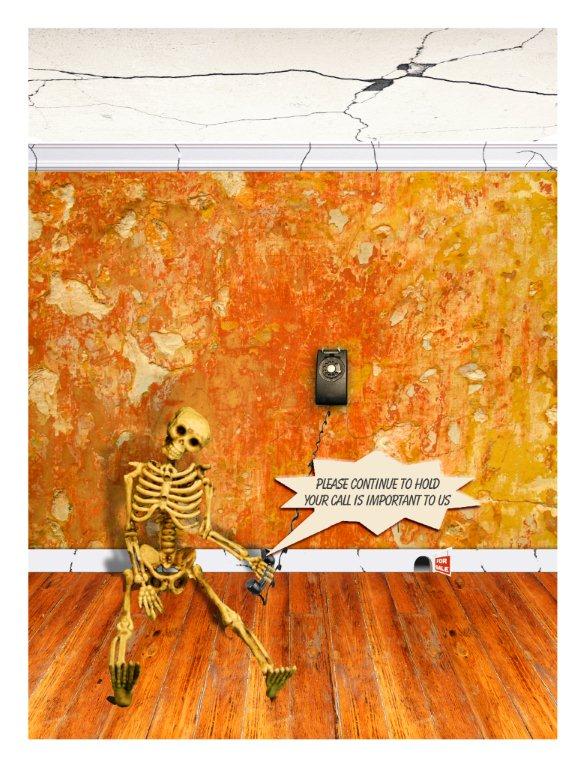
Your call is so, so important to us!

A delightful trawl by Neil Kelly through the call centre industry.

Picture by Neil Kelly

Are there any more annoying phrases in the English language than “your call is important to us“, or “we are experiencing particularly high call volumes“?

In 2007 companies worldwide spent some $280 billion on outsourced call-centre services, according to NASSCOM, a call-centre trade group in Delhi. Much of India’s call-centre industry, which employs roughly 300,000 agents, is located outside the ring road that encircles Bangalore, in a string of smart new business parks with tidy lawns and private security. Were it not for the stray dogs, a visitor could be forgiven for mistaking the area for Silicon Valley.

Meanwhile in Australia …

Meanwhile …… back in Wales in the United Kingdom … listen to this call centre handling a complaint from an ASDA customer – listen right to the end!

Thanks to David from neatorama.com I was able to put together a medley of hold music and without resorting to The Four Seasons!  Hope to have The Top Twenty Hold Music Songs out in time for Christmas.

Click on this link hold music medley to listen to that medley.

Finally, you may be interested in reading Your Call Is Important to Us: The Truth about Bullshit by Laura Penny which is available as a free eBook here.

The end of an era, part one.

A review of David Kauder’s recently published book, The Greatest Crash.

Details of the availability of the book are included at the end of both parts of my review, part two is published tomorrow.

Extracts from the book included are with grateful thanks to Sparkling Books.

Personal introduction.

Back in the late 90s, when I was living in England, I attempted to bolster my self-employed income by investing and trading in equities. It was a frustrating game, game being the right word! One day I was lamenting this to a close friend and he gave me the name of David Kauders at Kauders Portfolio Management and suggested I might like to contact him.

I followed my friend’s recommendation and met with David. What he outlined at that meeting all those years ago was mind-blowing, no other way of putting it. Essentially, David predicted a financial and economic crisis of huge proportions. He convinced me of the likelihood of that crisis and in November 2001 I became a fee-paying client. As the world now knows that prediction came to fruition. My anticipated residency in the USA meant continuing to be a client was not possible, and I ceased being a client of Kauders Portfolio Management in June 2010.

Thus not only am I deeply indebted to my friend for referring me to David but also unable to write this review from an unprejudiced point of view.

The Greatest Crash

The book, released in paperback in England in October 2011, published by Sparkling Books, is subtitled ‘How contradictory policies are sinking the global economy‘. Frankly, that subtitle doesn’t do much for me. A clearer message that comes from the book is this: the economic world has reached a ‘systems limit’. Indeed, the term systems limit is used widely throughout the book.

In his introduction to the book, Professor D. R. Myddelton, Chairman of the Institute of Economic Affairs, writes,

Adam Smith said ‘There’s a deal of ruin in a nation’, and it would be a mistake to despair. But one of the things we need now is new thinking on the fundamentals. That is what David Kauders provides in his book ‘The Greatest Crash’.

Without doubt, David achieves that.

Starting with the first sentence, David sets out the core problem;

This book argues that it is impossible to expand the financial system much further.

expanding this a few paragraphs later,

This is the financial system limit: lack of new borrowing plus excessive weight of debt obligations from past borrowing combine to slow economies down. This is the barrier whichever way policy makers turn. It is like the lid on a boiling kettle. Enough steam can lift it for a while but it always snaps back into place. The financial system limit is a roadblock preventing growth.

A few pages later in this opening chapter ‘The roadblock preventing growth‘ this limit is explained thus,

Policy contradictions also show us that the financial system has reached a roadblock. The glaring conflict between bailout and austerity is at the core. Each bailout or stimulus requires creation of more credit, leading to false financial speculation, and for a short while markets recover their poise. The threat of inflation returns. Later, bad debts rise, the markets tumble again and a new crisis emerges. Austerity, the alternative policy, cuts spending thereby cutting the immediate level of economic activity and bringing economic decline more quickly than the stimulus alternative. Whichever way they turn, the authorities are damned.

In the next chapter, ‘Evolution by trial and error‘, David writes about economic cycles and reminds his readers that the long economic cycle is often “beyond the practical experiences of our working lifetimes“.  Then later suggesting that because we have seen the greatest period of inflation ever since the end of World War Two, ergo “the unwelcome lesson from history is that the greatest deflation should follow.

In Chapter 4, ‘An Era of Wishful Thinking‘, the spotlight is put on the horrific policy errors that have been made for decades, try these three examples (there is a longer list in the book),

  • Policy makers believed that debt could expand indefinitely, at no cost.
  • Nobody realised that interest rate rises would make existing borrowing unaffordable and cause a wave of defaults.
  • The world was swamped with so many detailed requirements and standards that nobody could understand how they all fitted together. It was assumed that ‘transparency’, i.e. extensive detail, would solve the inability to comprehend how the parts made the whole.

Part Two of the review, continuing with Chapter 5 is tomorrow.

Want to buy The Greatest Crash?  The ebook was published in October worldwide, the  paperback published in the UK on the 1st November UK, the hardcover being released any day now in the UK.  For North America both the paperback and hardcover versions are being published on 1st February, 2012.

Full details from the Sparkling Books webpage here.

Copyright © 2011 Paul Handover

This is rocket science!

A timely video from the International Space Station (ISS)

Little did I realise when I posted yesterday’s item that a couple of subsequent actions would make today’s article easy to write (trust me it isn’t always this easy!).

Mike T., a flying buddy from my old days in England, sent me this link to a 5-minute video made up of a series of films shot from the ISS.  DO WATCH THE VIDEO IN FULL SCREEN MODE!

The details of how the film was taken and much more interesting information is at the very end of this article.

Then Martin Lack who writes the blog, Lack of Environment, submitted a comment with a link to a piece that he had written on the 19th August that I would like to re-publish in full.

Why are we still waiting for the EU to act?

What can we learn from the fact that the EU has still not stopped buying over 90% of Syria’s oil exports? If nothing else, it tells me that we need fossil fuel too much!

But I think the problem of wrong priorities goes much deeper than that… This is because the Limits to Growth argument (which underlies my concern over AGW) is, even though the protestor-in-the-street may not realise it, the root cause of all the problems we are now seeing in Afghanistan, Bahrain, Cairo, Damascus etc., etc… right through to Zimbabwe: Treating the symptoms of food shortages or corruption (or whatever they may be) will not succeed unless we address the root cause, which is the inevitable consequences of perpetual growth in consumption of resources and/or waste production on a finite planet [see E.F. Schumacher’s Small is Beautiful (1973)].

This 5 minute video makes sobering viewing, but it also perfectly summarises everything I have learnt in the last 12 months; and all I have posted on my oldMyTelegraph blog in the last 5 months!

It may not be rocket science, but can we reach Escape Velocity?

This stuff is not rocket science, but it is very unwelcome news to people with a vested interest in the continuance of “business as usual”. Unfortunately, we literally cannot go on the way we are; something has got to change…

The fact that AGW may suffer from issue fatigue, and the fact that I sometimes feel like an old-style street preacher being completely ignored by passers-by, does not change the fact that, on well above the balance of probability, we face an environmental catastrophe if we fail to take significant action within the next 5 years. Furthermore, every year we fail to act, makes taking effective action much, much harder. This is because it is the total (i.e. cumulative) amount of fossilised carbon that we (have and will) put into the atmosphere that will determine the temperature change we will see over the next 50 years or so.

Extract of paper presented by Dr Myles Allen at 4 Degrees and Beyond Conference (2009)

So a big thank you to Mike T. and Martin Lack for a number of lessons:

  • how clever man is in terms of space technology besides much more
  • the beauty of our planet – it’s all we have to live on
  • the amount of electric light that shines into outer space, as seen by the ISS.
  • how much of that lighting might be generated by coal and oil!
  • if we don’t learn to live in harmony, as in sustainably, with this planet of ours, the implications are going to be very serious.

Finally, as mentioned earlier the details of that video on Vimeo.

Time lapse sequences of photographs taken with a 4K-camera by Ron Garan fragileoasis.org/​bloggernauts/​Astro_Ron and the crew of expedition 28 & 29 onboard the International Space Station from August to October, 2011. All credit goes to them, who to my  knowledge shot these pictures at an altitude of around 350 km.  I intend to upload a FullHD-version presently.

HD, refurbished, smoothed, retimed, denoised, deflickered, cut, etc.  All in all I tried to keep the looks of the material as original as possible, avoided adjusting the colors and the like, since in my opinion the original footage itself already has an almost surreal and aestethical visual nature.

Music: Jan Jelinek | Do Dekor, faitiche back2001 w+p by Jan Jelinek, published by Betke Edition janjelinek.com | faitiche.de

Image Courtesy of the Image Science & Analysis Laboratory, NASA Johnson Space Center, The Gateway to Astronaut Photography of Earth eol.jsc.nasa.gov

Editing: Michael König | koenigm.com

Shooting locations in order of appearance:

1. Aurora Borealis Pass over the United States at Night
2. Aurora Borealis and eastern United States at Night
3. Aurora Australis from Madagascar to southwest of Australia
4. Aurora Australis south of Australia
5. Northwest coast of United States to Central South America at Night
6. Aurora Australis from the Southern to the Northern Pacific Ocean
7. Halfway around the World
8. Night Pass over Central Africa and the Middle East
9. Evening Pass over the Sahara Desert and the Middle East
10. Pass over Canada and Central United States at Night
11. Pass over Southern California to Hudson Bay
12. Islands in the Philippine Sea at Night
13. Pass over Eastern Asia to Philippine Sea and Guam
14. Views of the Mideast at Night
15. Night Pass over Mediterranean Sea
16. Aurora Borealis and the United States at Night
17. Aurora Australis over Indian Ocean
18. Eastern Europe to Southeastern Asia at Night

This is not ‘rocket science’!

We all live on one, finite, planet.  Full stop!

When putting together the short item for yesterday, Sunday, I was taken by the power of such simple concepts as beauty, harmony, love, the natural world.  Then I came across an article published by Tom Engelhardt, of TomDispatch fame, a little over two weeks ago.  It was a guest essay by Chip Ward and is reproduced below.

Learning from Dogs is about integrity.  In the sense that dogs, both literally and metaphorically, offer mankind an alternative, and more integrous, way of living.  As I wrote in one of the background items to Learning from Dogs, over two years ago,

Because of this closeness between dogs and man, we (as in man!) have the ability to observe the way they live.  Now I’m sure that scientists would cringe with the idea that the way that a dog lives his life sets an example for us humans, well cringe in the scientific sense.  But man seems to be at one of those defining stages in mankind’s evolution where the forces bearing down on the species homo sapiens have the potential to cause very great harm.  If the example of dogs can provide a beacon of hope, a incentive to change at a deep cultural level, then the quicker we ‘get the message’, the better it will be.

Dogs:

  • are integrous ( a score of 210) according to Dr David Hawkins
  • don’t cheat or lie
  • don’t have hidden agendas
  • are loyal and faithful
  • forgive
  • love unconditionally
  • value and cherish the ‘present’ in a way that humans dream of achieving
  • are, by eons of time, a more successful species than man.

So with those thoughts in mind, please read Chip’s essay as published on TomDispatch.  It is reproduced with the written permission of Tom Engelhardt

Someone Got Rich and Someone Got Sick
Nature Is the 99%, Too
By Chip Ward

What if rising sea levels are yet another measure of inequality? What if the degradation of our planet’s life-support systems — its atmosphere, oceans, and biosphere — goes hand in hand with the accumulation of wealth, power, and control by that corrupt and greedy 1% we are hearing about from Zuccotti Park?  What if the assault on America’s middle class and the assault on the environment are one and the same?

Money Rules: It’s not hard for me to understand how environmental quality and economic inequality came to be joined at the hip.  In all my years as a grassroots organizer dealing with the tragic impact of degraded environments on public health, it was always the same: someone got rich and someone got sick.

In the struggles that I was involved in to curb polluters and safeguard public health, those who wanted curbs, accountability, and precautions were always outspent several times over by those who wanted no restrictions on their effluents.  We dug into our own pockets for postage money, they had expense accounts.  We made flyers to slip under the windshield wipers of parked cars, they bought ads on television.  We took time off from jobs to visit legislators, only to discover that they had gone to lunch with fulltime lobbyists.

Naturally, the barons of the chemical and nuclear industries don’t live next to the radioactive or toxic-waste dumps that their corporations create; on the other hand, impoverished black and brown people often do live near such ecological sacrifice zones because they can’t afford better.  Similarly, the gated communities of the hyper-wealthy are not built next to cesspool rivers or skylines filled with fuming smokestacks, but the slums of the planet are. Don’t think, though, that it’s just a matter of property values or scenery.  It’s about health, about whether your kids have lead or dioxins running through their veins.  It’s a simple formula, in fact: wealth disparities become health disparities.

And here’s another formula: when there’s money to be made, both workers and the environment are expendable.  Just as jobs migrate if labor can be had cheaper overseas, I know workers who were tossed aside when they became ill from the foul air or poisonous chemicals they encountered on the job.

The fact is: we won’t free ourselves from a dysfunctional and unfair economic order until we begin to see ourselves as communities, not commodities.  That is one clear message from Zuccotti Park.

Polluters routinely walk away from the ground they poison and expect taxpayers to clean up after them.  By “externalizing” such costs, profits are increased.  Examples of land abuse and abandonment are too legion to list, but most of us can refer to a familiar “superfund site” in our own backyard.  Clearly, Mother Nature is among the disenfranchised, exploited, and struggling.

Democracy 101: The 99% pay for wealth disparity with lost jobs, foreclosed homes, weakening pensions, and slashed services, but Nature pays, too.  In the world the one-percenters have created, the needs of whole ecosystems are as easy to disregard as, say, the need the young have for debt-free educations and meaningful jobs.

Extreme disparity and deep inequality generate a double standard with profound consequences.  If you are a CEO who skims millions of dollars off other people’s labor, it’s called a “bonus.”  If you are a flood victim who breaks into a sporting goods store to grab a lifejacket, it’s called looting.  If you lose your job and fall behind on your mortgage, you get evicted.  If you are a banker-broker whodesigned flawed mortgages that caused a million people to lose their homes, you get a second-home vacation-mansion near a golf course.

If you drag heavy fishnets across the ocean floor and pulverize an entire ecosystem, ending thousands of years of dynamic evolution and depriving future generations of a healthy ocean, it’s called free enterprise.  But if, like Tim DeChristopher, you disrupt an auction of public land to oil and gas companies, it’s called a crime and you get two years in jail.

In campaigns to make polluting corporations accountable, my Utah neighbors and I learned this simple truth: decisions about what to allow into the air we breathe, the water we drink, and the food we eat are soon enough translated into flesh and blood, bone and nerve, and daily experience.  So it’s crucial that those decisions, involving environmental quality and public health, are made openly, inclusively, and accountably.  That’s Democracy 101.

The corporations that shred habitat and contaminate your air and water are anything but democratic.  Stand in line to get your 30 seconds in front of a microphone at a public hearing about the siting of a nuclear power plant, the effluent from a factory farm, or the removal of a mountaintop and you’ll get the picture quickly enough: the corporations that profit from such ecological destruction are distant, arrogant, secretive, and unresponsive.  The 1% are willing to spend billions impeding democratic initiatives, which is why every so-called environmental issue is also about building a democratic culture.

First Kill the EPA, Then Social Security: Beyond all the rhetoric about freedom from the new stars of the Republican Party, the strategy is simple enough: obstruct and misinform, then blame the resulting dysfunction on “government.”  It’s a great scam.  Tell the voters that government doesn’t work and then, when elected, prove it.  And first on the list of government outfits they want to sideline or kill is the Environmental Protection Agency, so they can do away with the already flimsy wall of regulation that stands between their toxins and your bloodstream.

Poll after poll shows that citizens understand the need for environmental rules and safeguards.  Mercury is never put into the bloodstreams of nursing mothers by consensus, nor are watersheds fracked until they are flammable by popular demand.  But the free market ideologues of the Republican Party are united in opposition to any rule or standard that impedes the “magic” of the marketplace and unchecked capital.

The same bottom-line quarterly-report fixation on profitability that accepts oil spills as inevitable also accepts unemployment as inevitable. Tearing apart wildlife habitat to make a profit and doing the same at a workplace are just considered the price of doing business. Clearcutting a forest and clearcutting a labor force are two sides of the same coin.

Beware of Growth: Getting the economy growing has been the refrain of the Obama administration and the justification for every bad deal, budget cut, and unbalanced compromise it’s made.  The desperate effort to grow the economy to solve our economic woes is what keeps Timothy Geithner at the helm of the Treasury and is what stalls the regulation of greenhouse gasses.  It’s why we are told we must sacrifice environmental quality for pipelines and why young men and women are sacrificed to protect access to oil, the lubricant for an acquisitive economic engine.  The financial empire of the one percenters and the political order it has shaped are predicated on easy and relentless growth.  How, we are asked, will there be enough for everyone if we don’t keep growing?

The fundamental contradiction of our time is this: we have built an all-encompassing economic engine that requires unending growth.  A contraction of even a percent or two is a crisis, and yet we are embedded in ecosystems that are reaching or have reached their limits.  This isn’t complicated: There’s only so much fertile soil or fresh water available, only so many fish in the ocean, only so much CO2 the planet can absorb and remain habitable.

Yes, you can get around this contradiction for a while by exploiting your neighbor’s habitat, using technological advances to extend your natural resources, and stealing from the future — that is, using up soil, minerals, and water your grandchildren (someday to be part of that same 99%) will need.  But the limits to those familiar and, in the past, largely successful strategies are becoming more evident all the time.

At some point, we’ll discover that you can’t exist for long beyond the boundaries of the natural world, that (as with every other species) if you overload the carrying capacity of your habitat, you crash.  Warming temperatures, chaotic weather patterns, extreme storms, monster wildfiresepic droughtsBiblical floods, anavalanche of species extinction… that collapse is upon us now.  In the human realm, it translates into hunger and violence, mass migrations and civil strife, failed states and resource wars.

Like so much else these days, the crash, as it happens, will not be suffered in equal measure by all of us.  The one percenters will be atop the hill, while the 99% will be in the flood lands below swimming for their lives, clinging to debris, or drowning. The Great Recession has previewed just how that will work.

An unsustainable economy is inherently unfair, and worse is to come.  After all, the car is heading for the cliff’s edge, the grandkids are in the backseat, and all we’re arguing about is who can best put the pedal to the metal.

Occupy Earth: Give credit where it’s due: it’s been the genius of the protesters in Zuccotti Park to shift public discourse to whether the distribution of economic burdens and rewards is just and whether the economic system makes us whole or reduces and divides us.  It’s hard to imagine how we’ll address our converging ecological crises without first addressing the way accumulating wealth and power has captured the political system.  As long as Washington is dominated and intimidated by giant oil companies, Wall Street speculators, and corporations that can buy influence and even write the rules that make buying influence possible, there’s no meaningful way to deal with our economy’s addiction to fossil fuels and its dire consequences.

Nature’s 99% is an amazingly diverse community of species.  They feed and share and recycle within a web of relationships so dynamic and complex that we have yet to fathom how it all fits together.  What we have excelled at so far is breaking things down into their parts and then reassembling them; that, after all, is how a barrel of crude oil becomes rocket fuel or a lawn chair.

When it comes to the more chaotic, less linear features of life like climate, ecosystems, immune systems, or fetal development, we are only beginning to understand thresholds and feedback loops, the way the whole becomes greaterthan the sum of its parts.  But we at least know that the parts matter deeply and that, before we even fully understand them, we’re losing them at an accelerating rate.  Forests are dying, fisheries are going, extinction is on steroids.

Degrading the planet’s operating systems to bolster the bottom line is foolish and reckless.  It hurts us all.  No less important, it’s unfair.  The 1% profit, while the rest of us cough and cope.

After Occupy Wall Street, isn’t it time for Occupy Earth?

Chip Ward co-founded and led Families Against Incinerator Risk and HEAL Utah. A TomDispatch regular, he wrote about campaigns to make polluters accountable in Canaries on the Rim: Living Downwind in the West and about visionary conservationists in Hope’s Horizon: Three Visions for Healing the American Land.

Copyright 2011 Chip Ward

The potential for the USA!

A powerful ‘good news’ story.

I am republishing in full a recent report from the Earth Policy Institute.  It underlines how wringing our hands in the face of so much doom and gloom, while perfectly understandable, can hide the fact that mankind can and does change, frequently for the better.  This EPI report is a tad ‘dry’ but still a great read.  As an incentive, let me show you the final sentence, “If so, the United States could become a world leader in cutting carbon emissions and stabilizing climate.

Here’s the full paper.
NOVEMBER 02, 2011
U.S. Carbon Emissions Down 7 Percent in Four Years: Even Bigger Drops Coming
Lester R. Brown


Between 2007 and 2011, carbon emissions from coal use in the United States dropped 10 percent. During the same period, emissions from oil use dropped 11 percent. In contrast, carbon emissions from natural gas use increased by 6 percent. The net effect of these trends was that U.S. carbon emissions dropped 7 percent in four years. And this is only the beginning.

The initial fall in coal and oil use was triggered by the economic downturn, but now powerful new forces are reducing the use of both. For coal, the dominant force is the Beyond Coal campaign, an impressive national effort coordinated by the Sierra Club involving hundreds of local groups that oppose coal because of its effects on human health.

U.S. Energy-Related Carbon Dioxide Emissions, 1950-2010, with Projection for 2011

In the first phase, the campaign actively opposed the building of new coal-fired power plants. This hugely successful initiative, which led to a near de facto moratorium on new coal plants, was powered by Americans’ dislike of coal. An Opinion Research Corporation poll found only 3 percent preferred coal as their electricity source—which is no surprise. Coal plant emissions are a leading cause of respiratory illnesses (such as asthma in children) and mercury contamination. Coal burning causes 13,200 American deaths each year, a loss of life that exceeds U.S. combat losses in 10 years of war in Afghanistan and Iraq.

The campaign’s second phase is dedicated to closing existing coal plants. Of the U.S. total of 492 coal-fired power plants, 68 are already slated to close. With current and forthcoming U.S. Environmental Protection Agency air quality regulations on emissions of mercury, sulfur, and ozone precursors requiring costly retrofits, many more of the older, dirtier plants will be closed

In August, the American Economic Review—the country’s most prestigious economics journal—published an article that can only be described as an epitaph for the coal industry. The authors conclude that the economic damage caused by air pollutants from coal burning exceeds the value of the electricity produced by coal-fired power plants. Coal fails the cost-benefit analysis even before the costs of climate change are tallied.

In July 2011, New York Mayor Michael Bloomberg announced a grant of $50 million to the Beyond Coal campaign. It is one thing when Michael Brune, head of the Sierra Club, says that coal has to go, but quite another when Michael Bloomberg, one of the most successful businessmen of his generation, says so.

The move to close coal plants comes at a time when electricity use for lighting will be falling fast as old-fashioned incandescent light bulbs are phased out. In compliance with the Energy Independence and Security Act of 2007, by January 2012 there will be no 100-watt incandescent light bulbs on store shelves. By January 2014, the 75-watt, 60-watt, and 40-watt incandescents will also disappear from shelves. As inefficient incandescents are replaced by compact fluorescents and LEDs, electricity use for lighting can drop by 80 percent. And much of the switch will occur within a few years.

The U.S. Department of Energy projects that residential electricity use per person will drop by 5 percent during this decade as light bulbs are replaced and as more-efficient refrigerators, water heaters, television sets, and other household appliances come to market.

Even as coal plants are closing, the use of wind, solar, and geothermally generated electricity is growing fast. Over the last four years, more than 400 wind farms—with a total generating capacity of 27,000 megawatts—have come online, enough to supply 8 million homes with electricity. (See data.) Nearly 300,000 megawatts of proposed wind projects are in the pipeline awaiting access to the grid.

Cumulative Installed Wind Power Capacity in the United States, 1980-2011

Texas, long the leading oil-producing state, is now the leading generator of electricity from wind. When the transmission lines linking the rich wind resources of west Texas and the Texas panhandle to the large cities in central and eastern Texas are completed, wind electric generation in the state will jump dramatically.

In installed wind-generating capacity, Texas is followed by Iowa, California, Minnesota, and Illinois. In the share of electricity generation in the state coming from wind, Iowa leads at 20 percent.

With electricity generated by solar panels, the United States has some 22,000 megawatts of utility-scale projects in the pipeline. And this does not include residential installations.

Closing coal plants also cuts oil use. With coal use falling, the near 40 percent of freight rail diesel fuel that is used to move coal from mines to power plants will also drop.

In fact, oil use has fallen fast in the United States over the last four years, thus reversing another long-term trend of rising consumption. The reasons for this include a shrinkage in the size of the national fleet, the rising fuel efficiency of new cars, and a reduction in the miles driven per vehicle.

Fleet size peaked at 250 million cars in 2008 just as the number of cars being scrapped eclipsed sales of new cars. Aside from economic conditions, car sales are down because many young people today are much less automobile-oriented than their parents.

In addition, the fuel efficiency of new cars, already rising, will soon increase sharply. The most recent efficiency standards mandate that new cars sold in 2025 use only half as much fuel as those sold in 2010. Thus with each passing year, the U.S. car fleet becomes more fuel-efficient, using less gasoline.

Miles driven per car are declining because of higher gasoline prices, the continuing recession, and the shift to public transit and bicycles. Bicycles are replacing cars as cities create cycling infrastructure by building bike paths, creating dedicated bike lanes, and installing sidewalk parking racks. Many U.S. cities, including Washington, D.C., Chicago, and New York, are introducing bike-sharing programs.

Furthermore, when people retire and no longer commute, miles driven drop by a third to a half. With so many baby boomers now retiring, this too will lower gasoline use.

As plug-in hybrid and all-electric cars come to market, electricity will replace gasoline. Ananalysis by Professor Michael McElroy of Harvard indicates that running a car on wind-generated electricity could cost the equivalent of 80-cent-a-gallon gasoline.

With emissions from coal burning heading for a free fall as plants are closed, and those from oil use also falling fast—both are falling faster than emissions from natural gas are ramping up—U.S. carbon emissions are falling.

We are now looking at a situation where the 7 percent decline in carbon emissions since the 2007 peak could expand to 20 percent by 2020, and possibly even to 30 percent. If so, the United States could become a world leader in cutting carbon emissions and stabilizing climate.

Lester R. Brown is president of the Earth Policy Institute and author of World on the Edge.

Copyright © 2011 Earth Policy Institute

The Changing Face of Society

A powerful and compelling essay from Tom Engelhardt

First, a preamble from me.

There have been a number of references to Tom Engelhardt’s writings on Learning from Dogs over the last 12 months; if you want to browse through them why not start with TomDispatch – The Great American Carbon Bomb.  Frequently, Tom writes an introductory piece to an essay from a guest author; Tom has generously given me written permission to republish any of his writings.

But his latest essay is 100% Tom and beautifully written.  My instinct is to agree with Tom’s conclusions entirely.  The reason you hear a slight hesitation in that last sentence is because I was not born an American, indeed only became a permanent USA resident this last April.  From the perspective of  a Londoner born in 1944, I suspect not too many years Tom’s senior, much of Tom’s essay really resonates with me.

OK, that’s enough from me.  Whoops, sorry, a few more words.  Tom’s essay is long, but so what!  Guess what I am saying is don’t be put off by the length, just make a mental note that if you haven’t got a quiet 15 minutes now, then wait until you have.  The essay will be compelling, I can guarantee it.  Especially if you are one of the many Learning from Dogs readers that is outside the USA – this provides very great insight into the Occupy Wall Street movement and the changes in society that are going to flow from that movement, flow around the globe.

Tomgram: Engelhardt, Wall Street by the Book Posted by Tom Engelhardt at 8:00pm, October 30, 2011.

OWS at Valley Forge
A (Self-)Graduation Speech for the Occupiers of Zuccotti Park 

By Tom Engelhardt

Once the Arab Spring broke loose, people began asking me why this country was still so quiet.  I would always point out that no one ever expects or predicts such events.  Nothing like this, I would say, happens until it happens, and only then do you try to make sense of it retrospectively.

Sounds smart enough, but here’s the truth of it: whatever I said, I wasn’t expecting you.  After this endless grim decade of war and debacle in America, I had no idea you were coming, not even after Madison.

You took me by surprise.  For all I know, you took yourself by surprise, the first of you who arrived at Zuccotti Park and, inspired by a bunch of Egyptian students, didn’t go home again.  And when the news of you penetrated my world, I didn’t pay much attention.  So I wasn’t among the best and brightest when it came to you.  But one thing’s for sure: you’ve had my attention these last weeks.  I already feel years younger thanks to you (even if my legs don’t).

Decades ago in the Neolithic age we now call “the Sixties,” I was, like you: outraged.  I was out in the streets (and in the library).  I was part of the anti-Vietnam War movement.  I turned in my draft card, joined a group called the Resistance, took part in the radical politics of the moment, researched the war, became a draft counselor, helped organize an anti-war Asian scholars group — I was at the time preparing to be a China scholar, before being swept away — began writing about (and against) the war, worked as an “underground” printer (there was nothing underground about us, but it sounded wonderful), and finally became an editor and journalist at an antiwar news service in San Francisco.

In that time of turmoil, I doubt I spent a moment pondering this irony: despite all those years in college and graduate school, the most crucial part of my education — learning about the nature of American power and how it was wielded — was largely self-taught in my off-hours.  And I wasn’t alone.  In those days, most of us found ourselves in a frenzy of teaching (each other), reading, writing — and acting.  That was how I first became an editor (without even knowing what an editor was): simply by having friends shove their essays at me and ask for help.

Those were heady years, as heady, I have no doubt, as this moment is for you.  But that doesn’t mean our moments were the same.  Not by a long shot.  Here’s one major difference: like so many of the young of that distant era, I was surfing the crest of a wave of American wealth and wellbeing.  We never thought about, but also never doubted, that if this moment ended, there would be perfectly normal jobs — good ones — awaiting us, should we want them.  It never crossed our minds that we couldn’t land on our feet in America, if we cared to.

In that sense, while we certainly talked about putting everything on the line, we didn’t; in truth, economically speaking, we couldn’t. Although you, the occupiers of Zuccotti Park and other encampments around the country, are a heterogeneous crew, many of you, I know, graduated from college in recent years.

Most of you were ushered off those leafy campuses (or their urban equivalents) with due pomp and ceremony, and plenty of what passes for inspiration.  I’m ready to bet, though, that in those ceremonies no one bothered to mention that you (and your parents) had essentially been conned, snookered out of tens of thousands of dollars on the implicit promise that such an “education” would usher you into a profession or at least a world of decent jobs.

As you know better than I, you got soaked by the educational equivalent of a subprime mortgage.  As a result, many of you were sent out of those gates and directly — as they say of houses that are worth less than what’s owed on their mortgages — underwater.

You essentially mortgaged your lives for an education and left college weighed down with so much debt — a veritable trillion-dollar bubble of it — that you may never straighten up, not if the 1% have their way.  Worse yet, you were sent into a world just then being stripped of its finery, where decent jobs were going the way of TVs with antennas and rotary telephones.

Lost Worlds and Utopia

Here’s a weakness of mine: graduation speeches.  I like their form, if not their everyday reality, and so from time to time give them unasked at TomDispatch.com, speeches for those of us already out in the world and seldom credited for never stopping learning.

In this case, though, don’t think of me as your graduation speaker.  Think of this as a self-graduation.  And this time, it’s positives all the way to the horizon.  After all, you haven’t incurred a cent of debt, because you and those around you in Zuccotti Park are giving the classes you took.  First, you began educating yourself in the realities of post-meltdown America, and then, miraculously enough, you went and educated many of the rest of us as well.

You really did change the conversation in this country in a heartbeat from, as Joshua Holland wroteat Alternet.org, “a relentless focus on the deficit to a discussion of the real issues facing Main Street: the lack of jobs… spiraling inequality, cash-strapped American families’ debt-loads, and the pernicious influence of money in politics that led us to this point” — and more amazingly yet, at no charge.

In other words, I’m not here, like the typical graduation speaker, to inspire you.  I’m here to tell you how you’ve inspired me.   In the four decades between the moment when I imagined I put everything on the line and the moment when you actually did, wealth and income inequalitiesexploded in ways unimaginable in the 1960s.  For ordinary Americans, the numbers that translated into daily troubles began heading downhill in the 1990s, the Clinton years, and only a fraudulent bubble in home values kept the good times rolling until 2008.

Then, of course, it burst big time.  But you know all this.  Who knows better than you the story of the financial and political flim-flam artists who brought this country to its knees, made out like bandits, and left the 99% in the dust?  Three years of stunned silence followed, as if Americans simply couldn’t believe it, couldn’t take it in — if, that is, you leave aside the Tea Party movement.

But give those aging, angry whites credit.  They were the first to cry out for a lost world (while denouncing some of the same bank bailouts and financial shenanigans you have).  That was before, in a political nano-second, the phrase “Tea Party” was essentially trademarked, occupied, and made the property of long-time Republican operatives, corporate cronies, and various billionaires.

That won’t happen to you.  Among your many strengths, the lack of a list of demands that so many of your elders have complained about, your inclusiveness, and your utopian streak — the urge to create a tiny, thoroughly democratic new society near the beating financial heart of the old one — will make you far harder to co-opt.  Add in the fact that, while any movement taking on inequity and unfairness is political, you are also, in the usual sense of the term, a strikingly apolitical movement.  Again, this is, to my mind, part of your strength.  It ensures that neither the Democratic Party nor left sects will find it easy to get a toehold in your environs.  Yes, in the long run, if you last and grow (as I suspect you will), a more traditional kind of politics may form around you, but it’s unlikely to abscond with you as those Republican operatives did with the Tea Party.

Actuarially, the Tea Party is a movement of the past in mourning for a lost world and the good life that went with it.  All you have to do is look at the sudden, post-2008 burst of poverty in the suburbs, that golden beacon of the post-World War II American dream, to know that something unprecedented is underway.

Once upon a time, no one imagined that an American world of home ownership and good jobs, of cheap gas and cheaper steaks, would ever end.  Nonetheless, it was kneecapped over the last few decades and it’s not coming back.  Not for you or your children, no matter what happens economically.

So don’t kid yourself: whether you know it or not, young as you are, you’re in mourning, too, or Occupy Wall Street wouldn’t exist. Unlike the Tea Party, however, you are young, which means that you’re also a movement of the unknown future, which is your strength.

Self-Education U.

Let me fess up here to my fondness for libraries (even though I find their silence unnerving).  As a child, I lived in the golden age of your lost world, but as something of an outsider.  The 1950s weren’t a golden age for my family, and they weren’t particularly happy years for me.  I was an only child, and my escape was into books.  Less than a block from where I lived was a local branch of the New York City public library and, in those days before adult problems had morphed into TV fare, I repaired there, like Harriet the Spy, to get the scoop on the mysterious world of grown-ups.  (The only question then was whether the librarian would let you out of the children’s section; mine did.)

I remembering hauling home piles of books, including John Toland’s But Not in Shame, Isaac Asimov’s space operas, and Désirée (a racy pop novel about a woman Napoleon loved), often with little idea what they were and no one to guide me.  On the shelves in my small room were yet more books, including most of the Harvard Five Foot Shelf, a collection of 51 classic volumes.  My set had been rescued from somebody’s flooded basement, their spines slightly warped and signs of mildew on some of them.  But I can still remember taking them off my shelf with a certain wonder: Dana’s Two Years Before the Mast (thrilling!), Darwin’s The Origins of the Species(impenetrable), Homer’s The Odyssey (Cyclops!), and so on.

Books — Johannes Gutenberg’s more than 500-year-old “technology” — were my companions, my siblings, and also my building blocks.  To while away the hours, I would pile them up to create the landscape — valleys and mountains — within which my toy soldiers fought their battles.  So libraries and self-education, that’s a program in my comfort zone.

Though my route seemed happenstantial at the time, it’s probably no accident that, 35 years ago, I ended up as a book editor on the periphery of mainstream publishing and stayed there.  After all, it was a paid excuse to retreat to my room with books (to-be) and, if not turn them into mountains and valleys, then at least transform them into a kind of eternal play and self-education.

All of which is why, on arriving for the first time at your encampment in Zuccotti Park and taking that tiny set of steps down from Broadway, I was moved to find myself in, of all things, an informal open-air library.  The People’s Library no less, even if books sorted by category in plastic bins on tables isn’t exactly the way I once imagined The Library.

Still, it couldn’t be more appropriate for Occupy Wall Street, with its long, open-air meetings, its invited speakers and experts, its visiting authors, its constant debates and arguments, that feeling when you’re there that you can talk to anyone.

Like the best of library systems, it’s a Self-Education U., or perhaps a modern version of theChautauqua adult education movement.  Your goal, it seems, is to educate yourselves and then the rest of us in the realities and inequities of twenty-first century American life.

Still, for the advanced guard of your electronic generation to commit itself so publicly to actual books, ones you can pick up, leaf through, hand to someone else — that took me by surprise.  Those books, all donations, are flowing in from publishers (including Metropolitan Books, where I work, and Haymarket Books, which publishes me), private bookstores, authors, and well, just about anyone.  As I stood talking with some of you, the librarians of Zuccotti Park, I watched people arriving, unzipping backpacks, and handing over books.

Of the thousands of volumes you now have, some, as in any library, are indeed taken out and returned, but some not. As Bill Scott, a librarian sitting in front of a makeshift “reference table” in muffler and jacket told me, “The books are donated to us and we donate them to others.”

A youthful-looking 42, Scott, an associate professor of English at the University of Pittsburgh, is spending his sabbatical semester camped out in the park.  His book, Troublemakers, is just about to be published and he’s bubbling with enthusiasm.  He’s ordered a couple of copies to donate himself.  “It’s my first book ever.  I’ve never even held it in my hands.  To shelve the first copy in the People’s Library, it’s like all the strands of my life coming together!”

Think of it: Yes, your peers in the park were texting and tweeting and streaming up a video storm.  They were social networking circles around the 1%, the mayor, the police, and whoever else got in their way.  Still, there you all were pushing a technology already relegated by many to the trash bin of cultural history.  You were betting your bottom dollar on the value to your movement of real books, the very things that kept me alive as a kid, that I’ve been editing, publishing, and even writingfor more than three decades.

“I Wanted Something Productive to Do”

That library — in fact, those libraries at Occupy Boston, Occupy Washington, Occupy San Francisco, and other encampments — may be the least commented upon part of your movement.  And yet, you set your library up not as an afterthought or a sideline, but almost as soon as you began imagining a society worth living in, a little world of your own.  You didn’t forget the books, which means you didn’t forget about education.  I mean, a real education.

This was both generous of you and, quite simply, inspiring.  Who would have expected that the old-fashioned, retro book would be at the heart of this country’s great protest movement of a tarnished new century?

When asked how the library began, librarian “Scales” (aka Sam Smith), an unemployed, 20-year-old blond dancer still in shorts on a chilly fall day, responded, “Nobody knows exactly who started it. It was like an immaculate conception.  It was just here.”  If the movement itself were a book, that might stand as its epigraph.  Even if Occupy Wall Street indeed did start somewhere (as did its library), the way it has exploded globally in a historical nanosecond, does give it exactly the feeling Scales described.

When asked why he himself was here, he simply said, “I wanted something productive to do.”

In an economy where “production” is gone with the wind, that makes the deepest sense to me.  Who doesn’t want to be productive in life?  Why should a generation that Wall Street and Washington seem perfectly happy to sideline not want to produce something of their own, as they now have?

I was no less touched, while listening in on a long meeting of the Library Working Group one Saturday afternoon amid the chaos of Zuccotti Park — crowd noise all around us, a band playing nearby — when the woman standing next to me interrupted your meeting.  She identified herself as an elected legislator from an upstate New York county who had driven down to see Occupy Wall Street for herself.  She just wanted you, the librarians, to know that she supported what you were doing and that, while her county was still funding its libraries, it was getting ever harder to do so, given strapped state and local budgets.

In other words, as education is priced out of the reach of so many Americans and in many communities library hours are cut back or local libraries shut down, you’ve opened for business.

Here are just a few things that you, the librarians of Zuccotti Park, said to me:

Bill Scott: “Part of the reason we’re down here is because we live in a society which promotes the idea that education should be bought and sold on the open market.  We want to establish it as a human right.  What the People’s Library proves is that books belong to the people, as does education.  People with student-loan debt find their freedom and options limited.  It severely limited my options.  I’m still crawling out from under a ton of debt.”

Zachary Loeb, who in what passes for real life is an actual librarian: “I’m working part time, so I wake up every morning and spend two hours sending out resumes, but the work isn’t out there.  My training’s in archiving, but nobody’s hiring.  I got a degree in library science, not philosophy, which I wanted to go into, to be on a job track.  Obviously, I’m not.  Lots of people are here because the work situation is abysmal.

“I’ve been an activist for a long time.  I read [the magazine] Adbusters and saw the call to occupy Wall Street.  I was down here on the first day.  I think we’ve changed the conversation in this country.  We’ve given people permission to stand up, to talk to each other, test their ideas out against each other, and consider decisions that shouldn’t simply be made by the powerful in Washington.”

Frances Mercanti-Anthony, out-of-work actress (“my last play closed in August”) and comic writer: “Knowledge is the greatest weapon we have.  What we’re doing is offering knowledge to people who have been disenfranchised.  Our online database of books [in the People’s Library] stands as a great symbol of the movement, of democracy, of knowledge, and sharing.”

Lighting Up the Landscape

Here’s what you’ve done: your anger and your thoughtfulness — what you don’t know and don’t mind not knowing, as well as what you do know — has lit up a previously dismal landscape.  And every move made by those who want to get rid of you has only spurred your growth.

I’m a pretty levelheaded guy, but call me a little starry-eyed right now and I don’t mind at all.  It’s something to feel this way for the first time in I don’t know how long, and whatever happens from now on, I can thank you for that — and for the sudden sense of possibility that goes with it.

Only six weeks into your movement, with so little known about where you’re going or what will happen, it’s undoubtedly early for graduation ceremonies.  Still, let’s face it, you’ve been growing up fast and, for all we know, these could have been the six weeks that changed the world.  Anyway, there’s no limit out here, where you can make your own traditions, on how often you can graduate yourself.

So I say, go for it.  Mark your progress thus far.  Self-graduate.  You don’t need me.   I’ll stay here and borrow a book from your library — and later, when I’m done, just as you suggest, I’ll donate it to someone else.

Shoulder your handmade signs.  Lift them high.  Chant your chants.  Let the drummers play as you march.  Head out toward Wall Street, toward the future, looking back over your shoulder, remembering exactly what your elders squandered, the world they left you, the debts they piled on you.  And the next time they start telling you what you should do with your movement, take it with a grain of salt.  The future, after all, is yours, not theirs.  It may be the only thing you have, exactly because it’s so beautifully unknown, so deeply unpredictable.  It’s your advantage over them because it’s one thing that Washington and Wall Street have no more way of controlling than you do.

In a world of increasing misery, you carry not just your debts, but ours too.  It’s a burden no one should shoulder, especially with winter bearing down, and that 1% of adults waiting for the cold to make tempers short, hoping you’ll begin to fall out, grow discouraged, and find life too miserable to bear, hoping that a New York winter will freeze you out of your own movement.

I take heart that last weekend, on a beautiful fall day, you, the librarians, were already discussing the need to buy “Alaska-style” sleeping bags and a generator which would give you heat; that you, like the mayor, are looking ahead and planning for winter.  This, after all, could be your Valley Forge.  As actress-librarian Mercanti-Anthony told me:  “We have the whole world behind us at this point.  We want to stand our ground for the long haul.  If we can make it through the winter, this occupation is here to stay.”

And she just might be right.  So head out now, and whatever you do, don’t go home.  It’s underwater anyway, and we need you.  We really do.  The world’s in a hell of a mess, but what a time for you to take it in your own hands and do your damnedest.

Tom Engelhardt, co-founder of the American Empire Project and the author of The American Way of War: How Bush’s Wars Became Obama’s as well as The End of Victory Culture, runs the Nation Institute’s TomDispatch.com. His latest book, The United States of Fear(Haymarket Books), will be published in November. To listen to Timothy MacBain’s latest Tomcast audio interview in which Engelhardt discusses the Occupy Wall Street movement and what hope means in our time click here, or download it to your iPod here.

Copyright 2011 Tom Engelhardt

Can modernisation be “ecological”?

Three guest posts from Martin Lack of Lack of Environment, today Part Two

As previously mentioned, Martin came to the attention of Learning from Dogs when making a comment to the second part of my Sceptical Voices essay.   This is the second part of an essay that Martin wrote that is worthy of deep consideration.  Part One can be read here; the concluding Part Three next Monday, the 10th.

————————-

Can modernisation be “ecological”? – Part 2

What is the problem with Modernity?
The problem is that the accumulation of personal wealth has become the sole objective of many people in modern society; and perpetual growth is posited as a means whereby even the poorest might achieve it. However, the New International Version of the Bible records the Apostle Paul as having written, “For the love of money is a root of all kinds of evil…” (1 Timothy 6:10); and economists and politicians have argued about this for centuries…

According to Jon Elster, it was Karl Marx that coined the term ‘money fetishism’ to describe the belief that money (and/or precious metals) have intrinsic (use) value rather than just instrumental (exchange) value, which Marx felt was as misguided as the religious practice of endowing inanimate objects with supernatural powers (Elster 1986: 56-7). However, the terms use value and exchange value were first put forward by Aristotle (384-322 BC) who, according to Daly, also recognised the danger of focusing on the latter (i.e. whereby the accumulation of wealth becomes an end in itself). Therefore, Daly suggests that the paperless economy (where no useable commodities actually change hands) is the ultimate destiny for money fetishism (Daly 1992: 186).

In 1987, the World Commission on the Environment and Development (WCED) was clearly keen to try and settle an argument and, therefore, made the following quite astonishing assertion: “Growth has no set limits in terms of population or resource use beyond which lies ecological disaster” (Brundtland et al 1987: 45). Instead, WCED gave us the much-touted – but ill-defined – concept of sustainable development (SD). However, in stark contrast to the WCED report, Carter much more recently observed that SD “…will require a fundamental transformation in attitudes to economic growth, consumption, production and work” (Carter 2007: 48). This appears to be a subtle acknowledgement of the legitimacy of Herman Daly’s insistence of the need for a move to a steady-state economy; precisely because infinite growth is impossible in a closed system.

A basic tenet of Daly’s thesis is that economic activity does not take place in a vacuum and that economic – not just ecological – collapse awaits us unless we recognise the limited capacity of the ecosystem within which we operate: “Of all the fields of study, economics is the last one that should seek to be ‘value-free’, lest it deserve Oscar Wilde’s remark that an economist ‘is a man that knows the price of everything and the value of nothing.’” (Daly 1992: 4).

On 22 December 2010, the BBC broadcast a Panorama programme entitled “What Price Cheap Food” containing the startling revelation that, in the two years between 1 November 2008 and 1 November 2010, town planners approved applications for at least 577 new supermarkets across the UK. The programme also revealed that so-called “mega farms” (i.e. factory farming of cows and pigs – “dairy-go-rounds” and “sty scrappers” respectively) will be the next ‘big idea’ imported from the USA. The potential mega farm operators argue that there is significant scope for recycling and energy from waste schemes to be incorporated, although environmentalists would question (1) the wisdom of concentrating potentially polluting activities; and (2) the ethics of factory farming (which undoubtedly goes against the grain of green consumerism). However, although the potential for economies of scale cannot be denied, this could all be seen as symptomatic of what Daly called “growthmania“.

Growthmania versus Limits to Growth
One of the world’s most famous deniers of Limits to Growth arguments is Julian Simon, who once famously won a bet with Paul Ehrlich that the price of any commodity would reduce with the passage of time. Nevertheless, how can anyone deny that the Earth’s resource base or its capacity to accommodate human beings is anything other than limited? Quite easily, apparently: In 1994, Simon claimed that “humanity now has the ability (or knowledge) to make it possible to feed, clothe, and supply energy to an ever-growing population for the next 7 billion years.”

However, the stupidity of such a dangerously fallacious argument was exposed 2 years later by Paul and Anna Ehrlich, who pointed out that at 1994 growth rates, “it would take only 774 years for the 1994 population of 5.6 billion to increase to the point where there were 10 human beings for each square meter of ice-free land on the planet!” Furthermore, they pointed out that if growth did not decline from 1994 levels, it would take only 1900 years for the mass of the human population to equal the mass of the Earth! (Ehrlich and Ehrlich 1996: 66).

Fortunately, the UN now believes (May 2011) that the human population on this planet will probably stabilise by the end of the current Century at somewhere between 10 and 15 billion. The only trouble with that is that, we may well have already exceeded the ecological carrying capacity of the planet, and are therefore causing extreme stress to the global ecosystem; of which the most obvious symptom is AGW.
—————-
References:
Daly, H. (1992), Steady State Economics (2nd ed), London: Earthscan.
Elster, J. (1986), An Introduction to Karl Marx, Cambridge: Cambridge University Press.
Ehrlich, P. and Ehrlich, A. (1996), Betrayal of Science and Reason, New York: Island Press.