Tag: Truth

Nothing but the truth!

Why should such an obvious concept, that of truth, be so very difficult to define?

Who in the world whose native tongue is English isn’t familiar with the words of the oath, “I swear to tell the truth, the whole truth and nothing but the truth,” often with the phrase, “so help me God.”  It is the fundamental foundation of a working justice system.  Probably the most famous of oaths is the American Presidential oath upon taking up office, “I do solemnly swear (or affirm) that I will faithfully execute the Office of President of the United States, and will to the best of my Ability, preserve, protect and defend the Constitution of the United States.”

Then just the other day I was exploring the blog Lack of Environment written by Martin Lack who made himself known to Learning from Dogs from a comment to the post Sceptical voices, part two, published on the 23rd.  Martin’s blog carried an article about scientific scepticism (outcome being very little) in global warming being caused by man.  There was reference to the book Climate Cover-Up written by James Hoggan and an extract from that book on the Desmogblog website, as follows,

Democracy is utterly dependent upon an electorate that is accurately informed. In promoting climate change denial (and often denying their responsibility for doing so) industry has done more than endanger the environment. It has undermined democracy. There is a vast difference between putting forth a point of view, honestly held, and intentionally sowing the seeds of confusion. Free speech does not include the right to deceive. Deception is not a point of view. And the right to disagree does not include a right to intentionally subvert the public awareness.

The sentence highlighted by me is fundamental to this essay.  Perhaps the crux of why it feels so difficult to determine the truth is that the vast 24-hour output of news and information, the 24-hour fear machine as John H. calls it, carries no means of distinguishing the reliability of the source, no details of any affiliations that the person offering the information to that particular media outlet may have, and so on and so on.  I wrote a piece on the 12th July called What Exactly is the Truth where I concluded that,

Despite my chest-beating on the subject of politicians and leaders deliberately lying in that recent piece about Juncker, there’s something much more fundamental.  What defines lying is really not that important.  It’s whether or not we trust that our leaders are doing their best for their constituents, to the best of their abilities.

Whether you support left-leaning or right-leaning policies is unimportant; indeed political differences and the ability to vote for one’s beliefs is at the heart of an open democracy.

But if we don’t trust that our leaders are doing their best for our country then that causes the destruction of faith.  If we do not have faith in those that lead us then the breakdown of a civilised social order becomes a very real risk.

So examining the essence of the word ‘truth’ creates a conflict, well it does in my mind.  A conflict between the idea that truth is a very simple concept and that peeling back the meaning of the word truth reveals many, many layers.  Let me quote from the Stanford Encyclopaedia of Philosophy,

Truth is one of the central subjects in philosophy. It is also one of the largest. Truth has been a topic of discussion in its own right for thousands of years. Moreover, a huge variety of issues in philosophy relate to truth, either by relying on theses about truth, or implying theses about truth.

It would be impossible to survey all there is to say about truth in any coherent way. Instead, this essay will concentrate on the main themes in the study of truth in the contemporary philosophical literature. It will attempt to survey the key problems and theories of current interest, and show how they relate to one-another. A number of other entries investigate many of these topics in greater depth. Generally, discussion of the principal arguments is left to them. The goal of this essay is only to provide an overview of the current theories.

The problem of truth is in a way easy to state: what truths are, and what (if anything) makes them true. But this simple statement masks a great deal of controversy. Whether there is a metaphysical problem of truth at all, and if there is, what kind of theory might address it, are all standing issues in the theory of truth. We will see a number of distinct ways of answering these questions.

Truth has been a topic of discussion in its own right for thousands of years.”  So I’m not the first and certainly won’t be the last to ponder on how one gets to know the truth.

Do I have any answers?  None!  Except, perhaps, to muse that if truth can be so difficult to pin down then adopting a rigid stance based on assumptions of truth will carry risk.  And, of course, to reflect that dogs don’t lie.

I’ll close with the quote from Oscar Wilde, “Truth is rarely pure and never simple.”  Quite so.

Clarity of thought

The power of clear visions.

Martin Luther King, (January 15, 1929-April 4, 1968)

One of the aspects of modern life that is deeply unsatisfactory is the way that politicians and leaders of democratic societies fudge the truth in the hope that trying to be all things to all men means wider acceptance of their messages.

Think of the quote from Martin Luther King, Jr., “A genuine leader is not a searcher for consensus but a molder of consensus. ”

These words serve as an introduction to some beautiful thoughts from a loyal American living here in Payson.  This is a man who is deeply spiritual, who has fought for his country, and who is soft and gentle to the core.  This is a man who is not afraid to offer a personal vision to the world.  I regard it as a real bonus that Jean and I have his friendship.

Here is the first of two contributions from John H.

The Passion of Enlightenment

Enlightenment includes deep grief and a passion to leave life a bit better than we found it. Enlightenment has little practical value in a growing and constantly consuming cultural demographic. Consumers tend to spiritually disconnect when faced by a need for change or when morality becomes inconvenient.

Is God truth?  What is the opposite of truth?  We’ve lost our way as a species.  Does God tell us to worship money? Does God tell us to ignore our finite earth?  Does God tell us to kill each other?  Does God tell us to ignore human history and the emerging network of scientific understandings?

Human wisdom has been far greater in the past than it is today.  God is not known through empirical knowledge.  Man is as limited as the finite planet which gave life to our species and sustains our existence. Matter and energy are interchangeable as fundamental forces.  God is experienced through our inner being and understood through the wisdom tradition of our species.

Sustainability includes the well-being of our planet and the life it supports.  Sustainability includes serving as caretakers rather than acting as owners.  Sustainability includes surrendering our addictions, our illusions and our delusions. Surrendering includes the courage to speak the truth and walk as we talk.  Surrendering assures our common well-being as a conscious component of God.  We have nothing to fear.

Consider world leadership.  Who are the aggressors?  Who are the oppressed?  Who serves God?  Who serves Mammon?  We each must search our heart, mind and soul to answer these questions honestly.  We need to face our shame and guilt in order to redeem ourselves and make a sustained effort to change.

The roots of wisdom in a constantly changing world are God, nature, history, and science.  We’ve come a long way since we first learned to use tools.  What have we forgotten in the process?  We can’t wait for the truth to become popular.  We each need to help make the truth popular.

an old lamplighter

Powerful words.  Thank you John.

Afghanistan and truth!

“But better to be hurt by the truth than comforted with a lie.”

The quote is from the film, The Kite Runner, which was based on the book  of the same name written by Khaled Hosseini.

This Post is not about taking a position, at any level, about the West’s involvement in the war in Afghanistan – far too dangerous territory!  But it is a reflection on what truth means.

At first that proposition might appear bizarre, of course we know what truth means. My Thesaurus offers three meanings: Correspondence with fact or truth; Freedom from deceit or falseness; The quality of being actual or factual.  Clear?  H’mmm not really in this instance.

OK, to the motivation behind this article.

Last Sunday two outwardly disconnected actions came together, as often seems to happen, to cause me to ponder on how my opinions are formed.  The actions concerned Afghanistan.

The first was that a friend from the congregation gave me his copy of TIME Magazine for January 17th.  In it was an article about a Black Hawk Medevac unit in Afghanistan.  From the TIME website:

The Birds Of Hope: With A Black Hawk Medevac Unit In Afghanistan

By James Nachtwey Monday, Jan. 17, 2011

General William Tecumseh Sherman got it right. War is hell. But even within the cruelty of war, there exists mercy.

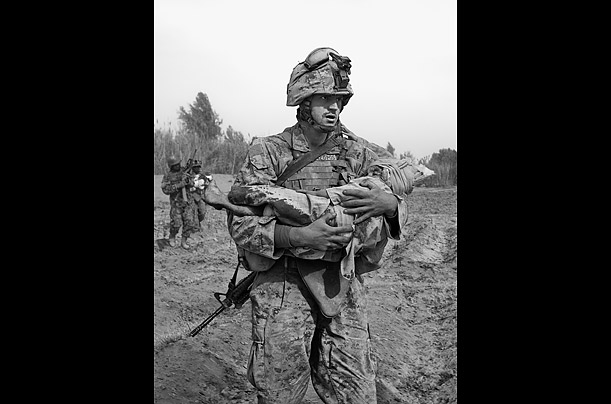
Across a dusty field, two U.S. Marines walk toward a helicopter, each carrying a bloodied and bandaged child. They hold the children as if they were their own. Although at this moment they appear as saviors, a few minutes earlier, they had called in air support in response to enemy fire. The shooter was among children, however (a fact that I have to believe was not known to the Marines), and two were seriously wounded by fragments from machine-gun rounds.

Innocent people are caught in the cross fire in all wars. That’s reality. The two Marines never signed up to hurt kids, and in the shock and confusion, their default reaction was to be protective of the children they indirectly had a hand in wounding. The kids were not left to die, as they might have been in another time and another place by other armies. Instead, a U.S. Army air-ambulance medevac crew was dispatched to fly them to the same medical facility that treats American casualties. If the shooter had survived, he too would have been helped.

Read more: http://www.time.com/time/magazine/article/0,9171,2041191,00.html#ixzz1Byu1S0xj

The article in TIME Magazine contained some emotionally powerful pictures, such as the one below.


A Marine carries an Afghan child.

The full description of the photograph, taken by James Nachtwey for TIME , is Helping Hand
A Marine carries an Afghan child, one of two wounded by coalition aircraft during an air support mission.

My reaction on reading the gruelling story was confused and difficult to articulate clearly but certainly not complimentary! Something along the lines of big and powerful nations, such as the USA, Russia and the United Kingdom, playing out their global strategies with no real insight into the pain and suffering caused by their big ‘war games’.

The second action was that Jean had returned a rental film to the local Blockbuster store and returned with another one that had caught her eye for us to watch on Sunday evening.  That film was The Kite Runner based on the book of the same name by Khaled Hosseini.

There’s a good summary of the plot of the film at WikiPedia.  Here’s a flavour.

In Kabul, prior to the Soviet invasion of Afghanistan, well-to-do young boy Amir and his loyal young Hazara servant Hassan are best of friends. Amir enjoys writing and literature, reading stories to the eager but illiterate Hassan. Amir’s Baba (father), is contemptuous of Amir’s writing and privately regards him as a weakling for letting Hassan protect him from bullies. Baba’s friend Rahim Khan demonstrates interest and encouragement to Amir. Assef, a bully with rancor towards Hazaras, and two accomplices confront Hassan and Amir, but Hassan prevents the attack with a slingshot, a birthday gift from Amir. Assef swears revenge, ridiculing their relationship as mere master and servant. .

Soon the Soviets invade Afghanistan; forcing Baba, a known anti-communist, to flee the country leaving Rahim Khan as property caretaker. En route to Pakistan, Baba bravely risks his life defending a female refugee from a Soviet soldier who demands to rape her in return for safe passage for all. Baba and Amir eventually reach the United States as humble refugees in Fremont, California. Baba tends a gas station while Amir attends community college and vends at a weekly flea market. There, Amir meets Soraya Taheri; Soraya is interested in Amir’s writing although her father, the ex-General Taheri, a proud traditional Pashtun, is contemptuous. Baba is stricken mortally ill but manages to obtain General Taheri’s permission for Amir to marry Soraya. Although Soraya feels bound to confess her previous relationships, they are happily married despite an inability to conceive children. As foreshadowed in the movie’s first scene, Amir’s debut novel is published, dedicated to Rahim Khan who encouraged his writing.

It was a fabulous film, one of the more thought-provoking films seen in many years.  If you haven’t seen it, do so.

So to the point of this article.

The film demonstrated to me that my rather black-and-white opinion of the West’s involvement in Afghanistan was based much more on my instincts that ‘war is bad’ and that the USA tends to throw its military weight around, than having a clue as to the enormous complexities, both at the level of a family and of the nation, that these conflicts entail.

The film showed a much more compassionate aspect to the activities of the USA, specifically in getting involved in Afghanistan and, more generally, in a policy of offering a new home and new hope to those from afar.

And for me, the realisation that while it may be said, ‘There is only one truth’, knowing what that truth is is something very much more challenging!

The first casualty when war comes is truth“. (Hiram W Johnson, senator for California, 1917)

Dogma, Lies and Truth ….

Humans are often both so funny and tragic at the same time  that one does not know whether to laugh or cry on hearing a particular news item. Thus it was for me when reading about Cuba’s apparent ideological U-turn.

The Cuban dogma of the last 50 years has been “State good; private bad.” This is familiar “Communist” territory, so Cubans have been born, grown up and died while being told that “capitalism” was evil, private ownership was bad and that the state was best suited to running everything.

This then was “the truth” for 50 years. But suddenly, amazingly, it seems that this was NOT the truth after all, since now entrepreneurship is to be encouraged in a bid to breathe life into the dinosauric Cuban economy. So, for 50 years Cuba was living a lie? And if so, will those responsible take the blame for these lies?

Errrrmmmm … the heirs and cronies of the apparent lie of over 50 years are the very same people (apart from the conveniently-sidelined Fidel himself, who can of course take the blame whether explicitly or implicitly) who are now proclaiming a new “truth”. So are they admitting their lie, or to be charitable – since XMAS is approaching – their total wrongness?

This is of course the big problem for those enforcing dogma. If there comes a time when the dogma is so manifestly absurd that it has to be changed then the long-time enforcers of the ridiculous are clearly seen to have been wrong for as long as the dogma has been enforced. And of course, the LONGER the dogma has gone on the MORE wrong the enforcers of same are seen to be. So for the dogma-enforcers there is every incentive to NEVER admit the nonsensicality of the dogma, whatever the evidence. Hence the ossification of dogma, when in the end enforcing the dogma is seen as more important than the actual dogma itself.

This is also one reason for the extraordinary conservatism that Humans are often “guilty” of. “Why do we do it that way?” -> “Errrmmmm … we’ve ALWAYS done it that way …”

Well, some credit has to go to the Cuban regime for admitting – tacitly or otherwise – that the last 50 years’ dogma was wrong. Kind as I am,  I do not use the word “idiotic”, though some would say that would be more appropriate …… Kind? Am I too kind in giving them any credit at all? After all, in a dictatorship, the only true definition of “truth” is “that which the leadership says is true.”

I haven’t worked out yet whether they are using the common ploy of dogma-changers, the only one in fact that gets them off the hook. This is to say: “Yes, we’ve always believed A was good and B was evil and now we believe the opposite. This is because CIRCUMSTANCES HAVE CHANGED.” Has anyone worked that out yet? The problem with the “Circumstances have changed” argument is of course that circumstances are ALWAYS changing and so dogma PER SE would seem to be a ludicrous way to manage our lives.

Well whatever, the latest pronouncements could have been made by the British centre-right Coalition Party rather than the old-style Cuban Communist Party:

“Our state cannot and should not continue maintaining companies, productive entities, services and budgeted sectors with bloated payrolls [and] losses that hurt the economy,” said the official Cuban labour federation, which announced the news.

George Osbourne, rightist British Chancellor of the Exchequer, would have been quite proud of that newsbite.

One has to wonder how this redefining of “the truth” will go down with the Cuban people. As has been argued, the main problem with changing the dogma is that you have to admit being wrong before, and often massively and for many years. And the longer-term ticking time-bomb is that once you allow questioning of the dogma then you open a door to the questioning of everything. This is why people who enforce dogma don’t really like any sort of questioning whatsoever. Encouraging it is like opening Pandora’s box; where will it all end? And the most hideous question of all of course is: “Don’t we deserve more say in our own government.” or – in the case of a “world-religion”, “Is the whole basis of our “beliefs” (for which we are prepared to kill people for) plain WRONG? Have we been living a LIE for over 1500 years? ” This question is a terrible one for individuals to face, so terrible that their leaders will do ANYTHING to prevent them ever facing it, including of course kill them if the questioning becomes too loud.

This is the real reason why dictatorships don’t like questioning of any kind; mindless sheep would be their preferred populace. A populace that asks too many questions is – frankly – to be avoided like the plague. They are currently plagued in Iran by sheep with very much a mind of their own, which is why oppression is great and increasing of course.

Anyway, I for one rejoice at the Cuban change of direction, even though one has often seen leaders tempted to open Pandora’s box only to violently slam it shut again when they see what starts to happen.

I always admired the Cuban revolution; chucking out a nauseating “Capitalist” mafiosi-style American-backed regime. The problem has been the extreme ossification of Cuban political and economic thought and development since the day Castro took over. Are better days ahead and will Cuba one day end up as a role-model for South America, much as Scandinavia is for the world in general?

The comic in all this? Listening to previous apologists for the former “lie” having to find linguistic justifications for their previous wrongness. This is marvellous for lovers of language as the arts of spin are brought fully into play justifying the previously unjustifiable.

The tragic? Knowing that the livers of the previous lie suffered both from living a lie and from the practical consequences of it, in Cuba’s case a quite unnecessarily high level of poverty in many areas even if there were some compensating factors. As Cuban apologists often say (said?) “The people may be poor but they are happy.” We might say (I assume): “Better to be much better-off and also happy ….”

PS Is the Pope watching all this (and the Islamic hierarchy come to that?) There is plenty of room for dogma change in the Vatican and Mecca …..

By Chris Snuggs

Feeling whole, like a dog!

A Guest Post from Daniela Caride. Daniela writes the Blog The Daily Tail

Something about being a dog dazzles me. Maybe it’s the freedom. Dogs don’t care what others think of them. They do whatever pleases them most without guilt or worries.

This morning, it became so clear to me. My walk around Fresh Pond Reservation in Cambridge didn’t feel very pleasant. I was worried about my mother’s persistent headache.

Today promised to be the hottest day of the summer, and the heat was not helping my mood. It was only 9 a.m., and I was already convinced something had changed in our constellation, and the sun was about to barbeque the Earth.

But my dogs, Frieda, Geppetto and Lola, were oblivious to anything going on outside Fresh Pond. They trotted happily to the doggie pond awaiting them less than a mile away, stopping only to sniff around and greet other dogs.

At the pond, they refreshed themselves in the water, not minding that the water gets dirtier as the summer wears on. They love that stinky pond, from the day the ice starts cracking and we can finally see our reflections in the moving water, to the beginning of winter when the water turns into ice again.

We completed our lap and approached my car, parked in front of a huge grassy area, where dogs are not allowed. One

Dog days!

of the landscaping employees was testing the park’s brand new lawn sprinklers. He turned them on and watched as half a dozen sprinklers soaked the grass.

Geppetto ran toward the spinning sprinklers, ignoring leash laws, of course. He was dying for a sip. The water flowed so strong that Geppetto had to close his eyes when trying to get the spray into his mouth again and again.

Frieda and Lola followed him, first exploring the artificial rain until they felt comfortable enough to play beneath it. Soon they were romping under the sun without feeling the effects of the boiling heat.

I watched the beauty of that canine dance with envy. My dogs were free, living the moment, unfettered of any concern. Then I asked myself why we humans don’t act more like them, especially in situations like this, in which no harm would be done.

Geppetto and Daniela

First, I went into one of the sprinklers, wetting my hair and face. Then another sprinkler surprised me, showering me head to toe with a refreshing jet. I raised my arms to let the water reach the rest of my body.

Park regulars watched their dogs and me from careful distance, not wanting to get wet. I didn’t care any more. I felt whole.

Whole like a dog.

By Daniela Caride

More bending!

More on those revised US GDP figures

On the 2nd August there was a Post that highlighted the way that officialdom was changing figures that painted a very different picture to that promoted at the time the figures were released.

I linked to a recent article from Karl Denninger showing how previous US GDP figures had been significantly revised downwards.

Well Karl has now published a smart chart showing what happened in a way that makes it very easy to understand.

The chart is below, but please support Karl by going to the article which is here.

Revised US GDP figures

Do read the original article at Karl’s Blog site simply because he sets out in his usual clear (and forthright) manner just what this all means.  And it isn’t just affecting the US – this ripples across the pond!

Finally, another perspective on this issue is here – with the same implications being presented.  It’s gloomy ahead!

By Paul Handover

The Verdict!

A nearly 30-year old film has real relevance for today!

Those of you that read yesterday’s Post right through to the end will have picked up on the fact that after completing that article last Friday, Jean and I watched the movie The Verdict.

Amazingly, this powerful film was released on the 8th December 1982.

So why the connection between the film and the Post written yesterday?

Well yesterday I wrote about two recent examples of, at best, a terrible lack of integrity, or, at worst, blatant examples of powerful institutions lying to us.  It troubled me greatly and I found no adequate way of closing the Post expressing my troubles in a succinct and fitting way.  Stay with me for a few moments.

In the film The Verdict, Paul Newman plays Frank Galvin – here’s the synopsis from the IMDb website:

Frank Galvin is a down-on-his luck lawyer, reduced to drinking and ambulance chasing. Former associate Mickey Morrissey reminds him of his obligations in a medical malpractice suit that he himself served to Galvin on a silver platter: all parties willing to settle out of court. Blundering his way through the preliminaries, he suddenly realizes that perhaps after all the case should go to court: to punish the guilty, to get a decent settlement for his clients, and to restore his standing as a lawyer.

As one might have guessed, Galvin wins the case against all the odds, which doesn’t in any way reduce the power of the film.  Newman was brilliant.

Tackling a medical malpractice case that could revive his once glorious career, attorney Frank Galvin (Paul Newman) questions a key witness, Dr. Thompson (Joe Seneca), in the compelling courtroom drama The Verdict.

At the end of the hearing Galvin rises to give his summation.  Technically the case appears utterly lost to his side.  Galvin slowly stands, hesitantly looks as his notes, cast the sheet aside and reluctantly addresses the jury.

You know, so much of the time we’re just lost.

We say, “Please, God, tell us what is right; tell us what is true.” And there is no justice: the rich win, the poor are powerless. We become tired of hearing people lie.

And after a time, we become dead… a little dead. We think of ourselves as victims… and we become victims. We become… we become weak. We doubt ourselves, we doubt our beliefs. We doubt our institutions. And we doubt the law.

But today you are the law. You ARE the law. Not some book… not the lawyers… not the, a marble statue… or the trappings of the court. See those are just symbols of our desire to be just. They are… they are, in fact, a prayer: a fervent and a frightened prayer. In my religion, they say, “Act as if ye had faith… and faith will be given to you.” IF… if we are to have faith in justice, we need only to believe in ourselves. And ACT with justice. See, I believe there is justice in our hearts.

Now go back and read my Post of yesterday.  Read of the Citi executives paying token fines for lying to investors.  Read of the allegation that the 2009 data set in the US GDP report was a “bald-faced lie”.

Now read again, aloud to yourself if you can, the first few sentences of Galvin’s summation.  Here they are again (my emphasis).

You know, so much of the time we’re just lost.

We say, “Please, God, tell us what is right; tell us what is true.” And there is no justice: the rich win, the poor are powerless. We become tired of hearing people lie.

And after a time, we become dead… a little dead. We think of ourselves as victims… and we become victims. We become… we become weak. We doubt ourselves, we doubt our beliefs. We doubt our institutions. And we doubt the law.

I firmly believe that this is where millions of ordinary, hard-working, caring citizens of many countries have arrived today because of the lack of integrity, the lack of honesty and the lack of grace shown by so many in positions of power and privilege.

But do not despair because if we do that, then all is lost.  No, believe in the power of good men.  Back to the summation from the film:

In my religion, they say, “Act as if ye had faith… and faith will be given to you.” IF… if we are to have faith in justice, we need only to believe in ourselves. And ACT with justice. See, I believe there is justice in our hearts.

Exactly!

By Paul Handover

Of the people, for the people – huh!

It’s enough to make one weep!

Gettysburg Address

Just a couple of items from disparate sources came together last Friday to demonstrate just how possibly corrupt it has been over the last so many years!  But there is a golden lining to this stuff.

That is the ever increasing spread and reach of all forms of digital communications, from the humble email through to Wikileaks, is making it increasingly difficult for those that wish to cheat and lie their way through their lives, at the expense of others, to do so without detection.

Anyway, back to the theme of the Post.

The first item is from here (thanks to Naked Capitalism for the link):

Under the article title of – The Wages of Sin: Former Citi Execs Pay Token Fines for Lying to Investors

A news story today provides further confirmation of the rule by the banking classes in the US, with only token gestures to the rule of law.
(and after an in-depth review closes with:)
The message seems pretty clear. Sarbox [Sarbanes-Oxley Act. Ed]was intended to curtail phony corporate accounting in the wake of Enron. But why resort to complicated transactions like the energy company’s famed Raptors when Citi shows that mere lying will produce the same results with much less fuss?

The second from Karl Denninger, from which closes with these words are offered: GDP Report: Liar Liar Pants on Fire:

All three years of the revision period were revised down. Again, if a mistake or inaccuracy (as opposed to intentional falsehood) is responsible for errors, one would expect them to be normally distributed – that is, some would be positive, some negative.  This is obviously not the case.

Is there any good news in the report?  Well, yes – there was a material uptick in non-residential fixed investment, centered around equipment and software.  How much of this is a normal replacement cycle (deferred last year) and how much signifies real expansion is an open question and one not easily answered.  However, I wouldn’t call this particularly “robust”, despite the pump monkey characterization this morning in the media.

The drops in some of the previously-published numbers were, however, simply stunning.  For example, PCE (personal consumption) was previously reported for Q1/2010 as 2.13.  The revision is 1.33, a thirty percent downward revision.  That’s not an error, it was a falsehood.

Worse was the services false report.  The previous reported number for Q1/2010 was 0.69.  Revised was 0.03, a downward revision of ninety-five percent.

The services revision backward was truly sickening – the entirety of 2009 was negative with the exception of the fourth quarter, where all but the first was previously reported positive, and the changes were ridiculous.  First quarter was revised down from -0.13% to -0.75%, second from +0.09% to -0.79%, and so on.  Again, that’s not an error, it’s a lie.

Needless to say when I get all my graph source data updated, it’s going to look worse than it did – including my “government ponzi support” graph, one of my favorites.

The futures are diving on the report, as well they should.  Not because it’s bad – but because the entirety of the 2009 data set was a bald-faced lie.

Frankly, I’m much less interested in what is happening to Western economies – my views have been regularly reported on Learning from Dogs.

What appals me is how far we seem from those famous words in the Gettysburg Address given by President Abraham Lincoln on the afternoon of Thursday, November 19, 1863 (my emphasis):

It is rather for us to be here dedicated to the great task remaining before us—that from these honored dead we take increased devotion to that cause for which they gave the last full measure of devotion—that we here highly resolve that these dead shall not have died in vain—that this nation, under God, shall have a new birth of freedom—and that government of the people, by the people, for the people, shall not perish from the earth.

Pres. Lincoln's words

P.S. As it happens, after finishing this article last Friday, Jean and I watched the film The Verdict in the evening.  The words used by the lawyer Frank Galvin (Paul Newman) in his summation struck me so powerfully that I have made them a separate Post for tomorrow.
By Paul Handover

Our economic outlook – where to?

The fundamentals always win, in the end!

Those that know me or have followed Learning from Dogs for the last year (and thank you!) know that I am pretty pessimistic about the economic future for North America and Europe (at least!).  I speak not as an economist, far from it, but as someone sufficiently old to think that many millions of individuals and their countries have been living on borrowed time for decades.

David Kauders

Twenty years ago I didn’t really do anything than feel uncomfortable when friends announced another new house with mortgages far in excess of the old ‘rule’ of 1.5 to 2.0 times one’s annual income.

Then I came across David Kauders of Kauders Portfolio Management who explained in fundamental ways why this was all going to end in tears, so to speak.  Wasn’t he right!

Thanks to David, I am moderately more well-off than I would have been – without a doubt.  Not only did David manage my private pension, he greatly influenced my modest personal investments outside his portfolio.

Where’s this heading?  This Blog is an attempt to show that integrity in all that we all do is not only the best personal strategy, it is the only viable course for mankind in bringing us back from the brink of global disaster.  So a couple of recent items about economic matters from people of great integrity underlined the value of mentioning them in this Blog.

The first is a talk given by Elizabeth Warren two years ago, in January 2008, entitled The Coming Collapse of the Middle Class.  It’s nearly an hour long but very well worth watching especially in the way that Ms. Warren shows how counter-intuitive is our understanding of how family costs have risen over the last 30 years.  Although it applies to the US, it certainly has relevance for British viewers.  Do watch it.

Here’s how the video is described:

Distinguished law scholar Elizabeth Warren teaches contract law, bankruptcy, and commercial law at Harvard Law School. She is an outspoken critic of America’s credit economy, which she has linked to the continuing rise in bankruptcy among the middle-class.

Next is that stalwart Karl Denninger.  How he finds the energy and enthusiasm for publishing his Market Ticker is beyond me.  He’s not subtle but his personal integrity is beyond reproach in my opinion.

Karl was recently interviewed by Bill Still (Bill produced the highly acclaimed film The Money Masters) and despite the videos being heavily edited Karl says “and for the most part accurately captures my views on the topics covered.”

Again these interviews are not short but, again, if you want to understand how dangerous the fundamentals still are – then watch them.

Karl Denninger, author of Market Ticker and winner of the 2008 Reed Irvine Accuracy in Media Award explains the roots of the current crisis and why real economic growth is impossible. He explains why the stock market rebounded in 2009 and why that can’t continue. He explains what needs to be done with the banks and predicts that all the big banks will fail.

Part One:

Part Two:

Finally back to David Kauders.  He also publishes an opinion website Contrary View. Here’s what David wrote in February 2010.

No. 73 22nd February 2010 Predicting lost decades

There is plenty of evidence from Japan about lost decades for investments. Japan has now lost two decades in equity and property investment, during which time only Government Bonds provided any sanctuary. All policy options failed, because none tackled the real problem, which is that there is already too much debt. What lessons can be drawn for Britain?

Shares here have certainly had a lost decade. On the Japanese evidence, they may well suffer another lost decade. Property has only hit minor bumps, so the Japanese experience suggests that property may suffer a long decline for two decades. In the UK, the Bank of England’s support for mortgages will be withdrawn over the next two years, which itself threatens prices. Why, though, the hysteria about Government debt?

It is questionable whether pundits appreciate the extent of the private sector debt problem, which explains why two groups of economists can offer totally contradictory remedies. In a world with no Gold standard and therefore no anchor to the monetary system, Government debt is relatively safe. The global economy is perched on a knife edge, with a permanent loss of output that must cause income loss and therefore restrict the capacity of households to service their debts. Seeing the commercial risks, banks are still restricting lending, which means there can be no sustained recovery.

There is a misconceived demographic argument being touted at present, which completely ignores the real driver of the post-1945 expansion, namely increased credit. That credit growth has simply gone too far and now brings its own problems. For those people who neither saw the credit crunch nor the long fall in interest rates and inflation coming, to now be credible in predicting a lost decade for bonds, is itself unbelievable.

You see how it all makes sense – the fundamentals are in charge, and always will be!

You be safe out there!

By Paul Handover

Follow up to The Four Divine States

“We can’t solve problems by using the same kind of thinking we used when we created them.” Albert Einstein

A few days ago, I published an article setting out the place of the Four Divine States in our daily lives.

A regular follower of Learning from Dogs, Patrice Ayme, posted a comment on the article.  This is what Patrice wrote.

No empathy survives contact with the enemy. This is the problem with the business of goodness, and how it ties up with evil.

The problem with goodness, or lack thereof, is that it is not how hatred and war are generated. More goodness does not a peace make. All it can very well do is reinforce the tribal instinct.

Understanding may start with the heart, but it survives only through the facts. Most humans have known and experienced love. To teach them love is to teach them water: the height of emotional arrogance. The truly good, instead, will teach the facts.

This is my attempt to shed more light on my approach, for followers of truth on the same path.

With great respect to Patrice, who is clearly a great thinker, I shall avoid justifying what I wrote previously or engaging in debate as the truth is non negotiable.

Take a look at the following chart. (Note: We inadvertently published the chart without the written permission of Veritas Publishing and upon being advised, immediately removed it.  The map of consciousness may be viewed on the Veritas Publishing web site and purchased for the small sum of $6.00.)


This ‘Map’ was developed by Dr David R Hawkins to show the logarithmic levels of human consciousness.  Here is how it is described on David Hawkins’ web site:

Over 250,000 kinesiological calibrations spanning 30 years of multiple research studies conducted by The Institute for Spiritual Research, Inc., have defined a range of values corresponding to well-recognized attitudes and emotions.

Important areas to look at occur at level 200, the doorway at which integrity is possible, and 500, where information is processed differently and we move out of a factual world, controlled by the intellect. The 400s is the world of science and the intellect, the 500’s, the beginning of the world of the non linear.

Patrice’s, or anybody else’s, great level of intellect is being used to explain something on a higher level – it just can’t be done! The Buddha, Christ and Krishna were all what the world calls avatars, i.e. on levels of 1000 or greater.

The Brahma Viharas where developed by the Buddha, a divine being at level 1000 or over.

By Jon Lavin