A retrospective muse about the present global challenges.
A few days back I posted an article by Tom Engelhardt called The Great American Carbon Bomb. It attracted a number of comments including a couple from Learning from Dogs supporter, Patrice Ayme. Here is one of those comments,
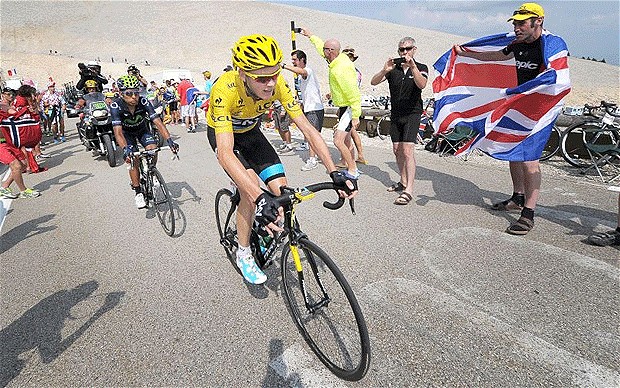
Dear Paul: There is a gentleman leading the Tour de France, right now. He was not given a chance, especially in the mountains. However, he has been going day by day, and has now worn the Yellow Jersey for more than a week, supported by his inferior, but dedicated team. His philosophy: humility, and do the job day by day, trying his best, although he strongly doubts that he is up to the task.
We, as humankind, or, rather, our hubristic leaders are doing the exact opposite. We are not doing our best, and it’s precisely because those leaders are not humble and not honest, and so very sure we are going to pull out OK, because that’s what we do best, and have always done, and thus will always do.
Verily all indicators are that of an unfolding catastrophe. All signals are loud and clear that way. So it’s really not the moment to say:”Oh, BTW, we are very resilient and totally great, so it’s just a matter of time before we put it all together OK. So now let’s all pull together, and it’s fine.”
In truth we are on the verge of an irreversible situation, as the CO2 poisoning will turn, within a decade or so, into a political, and then military issue.
PA
Patrice is an angry man (not a criticism by the way – so many of us are angry!) and anger is a great reason to find someone, something, anything, to blame! I suspect, wearing my cloak of an amateur psychologist, that a core reason why we feel anger is that, so often, the causes of our anger are our own errors. Anger at one’s self is much more difficult to deal with!
Anyway, back to the plot.
Like Patrice I also feel badly let down by our ‘leaders’. Especially with regard to the nightmare of economic and ecological issues fast approaching.
Then I read this in Paul Gilding’s book, The Great Disruption, that has been featured on this Blog a couple of times.
Our addiction to growth is a complex phenomenon, one that can’t be blamed on a single economic model or philosophy. It is not the fault of capitalism or Western democracy, and it is not a conspiracy of the global corporate sector or of the rich. It is not a bad idea that emerged in economics, and it is not the result of free market fundamentalism that emerged in the 1980s with globalization. While each of those factors is involved, it is too simple and convenient to blame any of them as the main driver. Growth goes to the core of the society we have built because it is the result of who we are and what we have decided to value. [Chapter 5, Addicted to Growth, p66]
That last half of that last sentence – ‘it is the result of who we are and what we have decided to value.‘ That strikes me as the core truth. It is the reason why Patrice, and me, and countless thousands of others across the globe, are so angry. At heart we all know that the circumstances we find ourselves in are, in great part and before we ‘saw the light’, the result of earlier personal values which we now know were not compatible with a sustainable relationship with the planet we all live on.
It is very good news. That anger is fuelling change. As Malcolm Gladwell writes in his book The Tipping Point societies change when something of the order of 18% of individuals emotionally commit to change.
 Learning from Dogs