Tag: The Guardian newspaper

Forgive the introspection, Part One

This is not some intellectual exercise; far from it!

As often happens, a number of seemingly disconnected articles and reports seem to have provided a common theme. A theme that has previously been aired on Learning from Dogs yet a theme that always needs to be in the front of our faces: integrity.

Here are some of those articles.

Firstly, I presented recently in this place an essay from George Monbiot that proposed (my italics):

The revelation that humanity’s dominant characteristic is, er, humanity will come as no surprise to those who have followed recent developments in behavioural and social sciences. People, these findings suggest, are basically and inherently nice.

Patrice Ayme, however, pointed out in a reply:

Saying that “people are good, while tolerating bad things” is an ineffective morality. The crux, indeed, is the moral nature of institutions, controlled by a few, not whether humans are kind or not.

That struck me as central to the theme: it is the terrible lack of integrity that we see in those who hold positions of power that totally overrides the premise that people are fundamentally good.

The next article read was an essay by Professor Michael Perelman published on Naked Capitalism. Perelman is a professor of economics at California State University. He also writes at Unsettling Economics.  Here is a little from that essay:

The architecture of inequality must be carefully constructed. As the founding fathers of the United States clearly understood, democracy must be kept in check. For this purpose, they invented the Electoral College to prevent the president from being elected by popular vote.

To ensure an effective electoral system, an obsequious media must be skilled in drowning the public with a flood of misinformation to maintain a constant level of fear to make them more likely to side with the CS (corporate system).

If there is ever one example of how that lack of integrity manifests itself in our world it is through inequality. Professor Perelman’s essay is clearly written “tongue-in-cheek” but that doesn’t lessen the impact of his essay. Try his closing paragraphs: (CES = a subset of CS; WEM = The Wondrous Efficiency of Markets)

Regulators are not the only ones to see the benefits of working with the CES. Politicians who resign or are defeated are almost inevitably destined to enjoy the benefits of their dedication to the WEM with the returns from taking a rewarding position with a major corporation, lobbying, or even a lucrative contract to write a book that virtually no one would want to read.

When done correctly, this system works magnificently, although it periodically it seems to fall apart until the detested government apparatus rescues it. In the meantime, huge amounts of wealth and income fall into the hands of the top 1%, the people of greatest importance, while the rest of the public can enjoy watching the spectacular performance of the CES, a reward worthy of their place in society especially because envy of the wealthy brethren will obviously make them work harder to succeed, adding to WEM.

All power to WEM!

Does this have anything to do with dogs?

Yes!

Let me steal a little from Chapter 16: Community from my forthcoming book:

When dogs lived in the wild, their natural pack size was about fifty animals and there were just three dogs that had pack status: the mentor, minder and nanny dogs, as described in Chapter 5. [Pharaoh: the Teaching Dog] As was explained in that chapter, all three dogs of status are born into their respective roles and their duties in their pack are instinctive. There was no such thing as competition for that role as all the other dogs in that natural pack grouping would be equal participants with no ambitions to be anything else.

Anyone who has had the privilege of living with a group of dogs will know beyond doubt that they develop a wonderful community strength. Let’s reflect on the lessons being offered for us in this regard by our dogs.

To reinforce the fact that this is not a new phenomena, at the time I was drafting my book last November, a new report was issued by the Center of Economic Policy Research (CEPR) on the latest (American) Survey of Consumer Finances. It painted a picture very familiar to many: the rich becoming richer while those with less wealth are falling further and further behind.

David Rosnick of the CEPR, and one of the report co-authors, made this important observation:

The decline in the position of typical households is even worse than the Consumer Finances survey indicates. In 1989, many workers had pensions. Far fewer do now. The value of pensions isn’t included in these surveys due to the difficulty of determining what they are worth on a current basis. But they clearly are significant assets that relatively few working age people have now.

Sharmini Peries, of The Real News Network, in an interview with David Rosnick, asked:

PERIES: David, just quickly explain to us what is the Consumer Finance Survey. I know it’s an important survey for economists, but why is it important to ordinary people? Why is it important to us?

ROSNICK: So, every three years, the Federal Reserve interviews a number of households to get an idea of what their finances are like, do they have a lot of wealth, how much are their house’s worth, how much they owe on their mortgages, how much they have in the bank account, how much stocks do wealthy people own. This gives us an idea of their situations, whether they’re going to be prepared for retirement. And we can see things like the effect of the housing and stock bubbles on people’s wealth, whether they’ve been preparing for eventual downfalls, how they’ve reacted to various economic circumstances, how they’re looking to the long term. So it’s a very useful survey in terms of finding out how households are prepared and what the distribution of wealth is like.

PERIES: So your report is an analysis of the report. And what are your key findings?

ROSNICK: So, largely over the last 24 years there’s been a considerable increase in wealth on average, but it’s been very maldistributed. Households in the bottom half of the distribution have actually seen their wealth fall, but the people at the very top have actually done very well. And so that means that a lot of people who are nearing retirement at this point in time are actually not well prepared at all for retirement and are going to be very dependent on Social Security in order to make it through their retirement years.

PERIES: So, David, address the gap. You said there’s a great gap between those that are very wealthy and those that are not. Has this gap widened over this period?

ROSNICK: It absolutely has. As, say, the top 5 percent in wealth, the average wealth for people in the top 5 percent is about 66 percent higher in 2013, the last survey that was completed, compared to 1989. By comparison, for the bottom 20 percent, their wealth has actually fallen 420 percent. They basically had very little to start with, and now they have less than little.

PERIES: So the poorer is getting poorer and the richer is getting extremely richer.

ROSNICK: Very much so.

To my way of thinking, if in the period 1989 through to 2013 “the average wealth for (American) people in the top 5 percent is about 66 percent higher” and “for the bottom 20 percent, their wealth has actually fallen 420 percent” it’s very difficult not to see the hands of greed at work and a consequential devastating increase in inequality.

In other words, the previous few paragraphs seemed to present, and present clearly, the widening gap between the ‘haves’ and the ‘have-nots’, comparatively speaking, and that it was now time for society to understand the trends, to reflect on where this is taking us, if left unchallenged, and to push back as hard as we can both politically and socially.

I wrote that shortly before another item appeared in my email ‘in-box’ in the middle of November (2014), a further report about inequality that, frankly, emotionally speaking, just smacked me in the face. It seemed a critical addition to the picture I was endeavouring to present.

Namely, on the 13th October, 2014, the US edition of The Guardian newspaper published a story entitled: US wealth inequality – top 0.1% worth as much as the bottom 90%. The sub-heading enlarged the headline: Not since the Great Depression has wealth inequality in the US been so acute, new in-depth study finds.

The study referred to was a paper released by the National Bureau of Economic Research, Cambridge, MA, based on research conducted by Emmanuel Saez and Gabriel Zucman. The paper’s bland title belied the reality of the research findings: Wealth Inequality in the United States since 1913.

As the Guardian reported:

Wealth inequality in the US is at near record levels according to a new study by academics. Over the past three decades, the share of household wealth owned by the top 0.1% has increased from 7% to 22%. For the bottom 90% of families, a combination of rising debt, the collapse of the value of their assets during the financial crisis, and stagnant real wages have led to the erosion of wealth. The share of wealth owned by the top 0.1% is almost the same as the bottom 90%.

The picture actually improved in the aftermath of the 1930s Great Depression, with wealth inequality falling through to the late 1970s. It then started to rise again, with the share of total household wealth owned by the top 0.1% rising to 22% in 2012 from 7% in the late 1970s. The top 0.1% includes 160,000 families with total net assets of more than $20m (£13m) in 2012.

In contrast, the share of total US wealth owned by the bottom 90% of families fell from a peak of 36% in the mid-1980s, to 23% in 2012 – just one percentage point above the top 0.1%.

The report was not exclusively about the USA. As the closing paragraphs in The Guardian’s article illustrated:

Among the nine G20 countries with sufficient data, the richest 1% of people (by income) have increased their income share significantly since 1980, according to Oxfam. In Australia, for example, the top 1% earned 4.8% of the country’s income in 1980. That had risen to more than 9% by 2010.

Oxfam says that in the time that Australia has held the G20 presidency (between 2013 and 2014) the total wealth in the G20 increased by $17tn but the richest 1% of people in the G20 captured $6.2tn of this wealth – 36% of the total increase.

I find it incredibly difficult to have any rational response to those figures. I am just aware that there is a flurry of mixed emotions inside me and, perhaps, that’s how I should leave it. Nonetheless, there’s one thing that I can’t keep to myself and that this isn’t the first time that such inequality has arisen; the period leading up the the Great Depression of the 1930s comes immediately to mind.

What on earth is coming down the road this time!

If only we truly could learn from our dogs!
Never stop fighting for a better world.

Protecting our right to breathe good, clean air.

robertgreeningersoll118442

Fundamentally, today’s post is not about dogs. But it is about the qualities that we can see in our dogs: trust, honesty, openness, and the core quality that inspires my writings about dogs: integrity.

I’m speaking of the disgusting news that has been headlined in the world’s media in recent days, no better summarised than by this extract from a current (1pm PDT yesterday)) BBC news report:

Volkswagen chief executive Martin Winterkorn has resigned following the revelation that the firm manipulated US diesel car emissions tests.

Mr Winterkorn said he was “shocked” by recent events and that the firm needed a “fresh start”.

He added that he was “not aware of any wrongdoing on my part” but was acting in the interest of the company.

VW has already said that it is setting aside €6.5bn (£4.7bn) to cover the costs of the scandal.

The world’s biggest carmaker admitted last week that it deceived US regulators in exhaust emissions tests by installing a device to give more positive results.

The company said later that it affected 11 million vehicles worldwide.

As ever, the voice of George Monbiot speaks a little clearer than most, and I am referring to his recent essay published both on his blog and in The Guardian newspaper.  I am very pleased to have Monbiot’s permission to republish his essay here on Learning from Dogs.

ooOOoo

Smoke and Mirrors

22nd September 2015

Pollution, as scandals on both sides of the Atlantic show, is a physical manifestation of corruption.
By George Monbiot, published in the Guardian 23 September 2015

In London, the latest figures suggest, it now kills more people than smoking. Worldwide, a new study estimates, it causes more deaths than malaria and HIV-Aids together. I’m talking about the neglected health crisis of this age, that we seldom discuss or even acknowledge. Air pollution.

Heart attacks, strokes, asthma, lung and bladder cancers, low birth weight, low verbal IQ, poor memory and attention among children, faster cognitive decline in older people and – recent studies suggest – a link with the earlier onset of dementia: all these are among the impacts of a problem that, many still believe, we solved decades ago. The smokestacks may have moved to China, but other sources, whose fumes are less visible, have taken their place. Among the worst are diesel engines, sold, even today, as the eco-friendly option, on the grounds that their greenhouse gas emissions tend to be lower than those of petrol engines. You begin to wonder whether any such claims can still be trusted.

Volkswagen’s rigging of its pollution tests is an assault on our lungs, our hearts, our brains. It is a classic example of externalisation: the dumping of costs that businesses should carry onto other people. The air that should have been filtered by its engines is filtered by our lungs instead. We have become the scrubbing devices it failed to install.

Who knows how many people have paid for this crime already, with their health or with their lives? In the USA, 200,000 deaths a year are attributed to air pollution. For how many of those might Volkswagen be responsible? Where else was the fraud perpetrated? Of what proportion of our health budgets has this company robbed us?

The fraud involves the detection of nitrogen oxides (NOx), of which diesel engines are the major source in many places. This month, for the first time in our history, the UK government estimated the impact of NOx emissions on public health, and discovered that they are likely almost to double the number of deaths from air pollution, adding 23,000 to the 29,000 attributed to particulates (tiny particles of soot).

The government released this discovery, alongside its useless proposals for dealing with the problem, on Saturday 12 September, a few minutes before Jeremy Corbyn’s election as Labour leader was announced. How many government press releases are published on a Saturday? How many are published on a Saturday during an event on which everyone is focused? In other words, as a Labour press officer once notoriously advised, this was “a good day to bury bad news”. Not only was the number of deaths buried by this means, but so was the government’s consultation on its feeble plans for reducing this pollution: a consultation to which it evidently wanted as few respondents as possible. Liz Truss, the environment secretary, has some explaining to do.

She has her reasons for keeping us in the dark. In April, the Supreme Court ruled that the UK is in breach of the European air quality directive, and insisted that the government draw up a plan for compliance by the end of this year. Instead, Truss produced a plan to shed responsibility. Local authorities, her consultation suggests, should create clean air zones in at least eight cities, in which diesel engines are restricted or banned. But she has given them neither new money nor new powers. Nor has she offered an explanation of how this non-plan is going to address the issue in the rest of the country, as the ruling demands.

Already, the UK has missed the European deadline by six years. Under Truss’s proposals, some places are likely still to be in breach by 2025: 16 years after the original deadline. I urge you to respond to the consultation she wanted you to miss, which closes on November 6.

The only concrete plan the government has produced so far is to intensify the problem, through a new programme of airport expansion. This means more nitrous oxides, more particulates, more greenhouse gas emissions.

Paradoxically, the Volkswagen scandal may succeed where all else has failed, by obliging the government to take the only action that will make a difference: legislating for a great reduction in the use of diesel engines. By the time this article is published, we might know whether the company’s scam has been perpetrated in Europe as well as North America: new revelations are dripping by the hour. But whether or not this particular deception was deployed here, plenty of others have been.

Last week the Guardian reported that nine out of ten new diesel cars break European limits on nitrous oxides – not by a little but by an average of sevenfold. Every manufacturer whose emissions were tested had cars in breach of the legal limit. They used a number of tricks to hotwire the tests: “stripping components from the car to reduce weight, using special lubricants, over-inflating tyres and using super-smooth test tracks.” In other words, the emissions scandal is not confined to Volkswagen, not confined to a single algorithm and not confined to North America: it looks, in all its clever variants, like a compound global swindle.

There are echoes here of the ploys used by the tobacco industry: grand deceptions smuggled past the public with the help of sophisticated marketing. Volkswagen sites advertising the virtues of “clean diesel” have been dropping offline all day. In 2009, the year in which its scam began, the TDI engine at the centre of the scandal won the Volkswagen Jetta 2.0 the green car of the year award. In 2010, it did the same for the Audi A3.

There’s plenty that’s wrong with corporate regulation in the United States, but at least the fines, when they occur, are big enough to make a corporation pause, and there’s a possibility of guilty executives ending up in prison. Here, where corruption, like pollution, is both omnipresent and invisible, major corporations can commit almost any white-collar crime and get away with it. Schemes of the kind that have scandalised America are, in this country, both commonplace and unremarked. How can such governments be trusted to defend our health?

www.monbiot.com

ooOOoo

I found myself having two emotional reactions to Monbiot’s essay. The first was that for many years, when I was living and working in England, I drove diesel-powered cars on the (now false) belief that they were better for the environment.

My second reaction was to Monbiot listing the likely impacts from air pollution,”Heart attacks, strokes, asthma, lung and bladder cancers, low birth weight, low verbal IQ, poor memory and attention among children, faster cognitive decline in older people and – recent studies suggest – a link with the earlier onset of dementia. . . “, for the reason that at the age of 70, I am already noticing the creeping onset of reduced verbal IQ, cognitive decline, and worry about the onset of dementia. To think that my earlier decisions about what cars to drive might be a factor in this is disturbing.

I am going to close this post by highlighting how fighting for what we want is important, critically so. By republishing an item that was posted on AmericaBlog just over a year ago, that fortuitously is a reward for living in the State of Oregon.

ooOOoo

Climate win: Appeals court in Oregon rules state court must decide if atmosphere is a “public trust”

6/16/14 10:00am by Gaius Publius

Two teenagers from Eugene, Ore. filed suit against Governor Kitzhaber and the State of Oregon for failing to protect the “atmosphere, state waters, and coast lines, as required under the public trust doctrine.”

They lost the first round, where the state court said that climate relief was not a judicial matter. But they won on appeal. The case goes back to the original court, which now has orders to decide the case on its merits and not defer to the executive or legislature.

The gist of the appeals court decision:

Their lawsuit asked the State to take action in restoring the atmosphere to 350 ppm of CO2 by the end of the century. The Oregon Court of Appeals rejected the defenses raised by the State, finding that the youth could obtain meaningful judicial relief in this case.

That’s quite a nice victory. Here’s the full story, from the Western Environmental Law Center (my emphasis throughout):

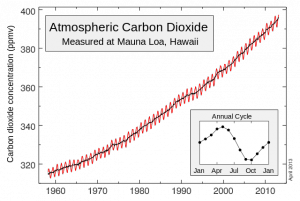
Keeling-curve_CO2_ppm_Mauna_Loa_Carbon_Dioxide_Apr2013.svg_-300x201

In a nationally significant decision in the case Chernaik v. Kitzhaber, the Oregon Court of Appeals ruled a trial court must decide whether the atmosphere is a public trust resource that the state of Oregon, as a trustee, has a duty to protect. Two youth plaintiffs were initially told they could not bring the case by the Lane County Circuit Court. The trial court had ruled that climate change should be left only to the legislative and executive branches. Today, the Oregon Court of Appeals overturned that decision.

Two teenagers from Eugene, Kelsey Juliana and Olivia Chernaik, filed the climate change lawsuit against Governor Kitzhaber and the State of Oregon for failing to protect essential natural resources, including the atmosphere, state waters, and coast lines, as required under the public trust doctrine. Their lawsuit asked the State to take action in restoring the atmosphere to 350 ppm of CO2 by the end of the century. The Oregon Court of Appeals rejected the defenses raised by the State, finding that the youth could obtain meaningful judicial relief in this case. …

In reversing the Lane County trial court, the Oregon Court of Appeals remanded the case ordering the trial court to make the judicial declaration it previously refused to make as to whether the State, as trustee, has a fiduciary obligation to protect the youth from the impacts of climate change, and if so, what the State must do to protect the atmosphere and other public trust resources.

The implications of this are broad, and similar cases are pending in other states, as the article describes.

Make no mistake; decisions like this matter. It places the court squarely in the mix as a power player in the climate war, the fight for “intergenerational justice” as James Hansen puts it — or the war against intergenerational betrayal, as I put it.

This is a cornerstone decision from the Oregon Court of Appeals in climate change jurisprudence. The court definitively ruled that the question of whether government has an obligation to protect the atmosphere from degradation leading to climate change is a question for the judiciary, and not for the legislative or executive branches. The Court did not opine as to how that question should be answered, only that it should be answered by the judiciary.

We can win this; it’s not over. If we reach 450 ppm and we’re still not stopping with the CO2, then it’s over and I become a novelist full-time. But we’re not there yet, and please don’t surrender as if we were.

The courts are now a powerful tool, as is divestment. James Hansen has a way to restore the atmosphere to 350 ppm CO2 in time to stop slow feedbacks from kicking in. It’s a doable plan, but we’ll need to use force. Using the courts, as with using divestment campaigns, counts as force. Stay tuned.

(Want to use force at the national level? Find a way to challenge Obama publicly to stop leasing federal land to coal companies. He’s a hypocrite until he stops federal coal from being mined and sold abroad. A simple and obvious challenge for him. You too can be the activist.)

GP

Twitter: @Gaius_Publius
Facebook: Gaius Publi

(Facebook note: To get the most from a Facebook recommendation, be sure to Share what you also Like. Thanks.)

ooOOoo

 Never forget that you, me and every other good-minded person on this planet can make a positive difference. Need inspiration? Gain it from our dogs! Let’s use the liberty we enjoy to make a difference.

More on that nose!

An article in The Guardian is worth highlighting.

I have long been an admirer of The Guardian newspaper way back before I became a US resident. Thus an article that appeared on the website of The Guardian US newspaper seemed perfect for a mention in this place. It was an article entitled Cadaver dogs: attending camp with the canines trained to smell death and written by Liz Lucking.  Here’s a tiny extract from the article:

A dog’s sense of smell is estimated to be somewhere between 100 and 1,000 times greater than a human’s, depending on the breed. But despite their formidable noses, these dogs still need assistance, direction and training to reach their full potential.

The Penn Vet Working Dog Center does exactly that. Founded in 2007 and part of the University of Pennsylvania, the training centre and research program is dedicated to helping advance the success of working dogs.

I then went across to the Penn Vet Working Dog Centre website that was full of interesting information, including details of their Internships, Externships & Fellowships. So if that strikes a chord with a reader then that’s great.

That Guardian article also mentioned the American Rescue Dog Association and their website is full of fabulous information, as this extract from their welcome page endorses:

The American Rescue Dog Association® (ARDA®) is comprised of highly skilled volunteer search and rescue units across the United States that operate in conjunction with local law enforcement or other applicable emergency services agencies to assist in the location of missing persons. ARDA units provide specially trained dogs to locate missing persons in wilderness, disaster, human remains and water search and rescue/recovery missions. Each member unit is required to adhere to the Association’s rigid standards and undergo a rigorous two-day field evaluation every three years to ensure these standards are being maintained.

Units are available 24-hours a day to respond to requests for services from applicable local, state or federal responsible agencies.

Our search and rescue canine teams deploy in many circumstances, at several levels, at no cost to Federal and Local departments. ARDA resources operate solely as volunteers, and rely on donations for our continued operations.

Finally, searching YouTube for ARDA produced the following.

Another day: Another example of what our fabulous dogs provide to humans.

We are what we eat!

Some aspects of our food that many of us would rather not know about!

Many readers will be used to me republishing the essays from George Monbiot. Admittedly, not every single one of them but especially those that seem to have a message that deserves a wider promulgation. Having Mr. Monbiot’s permission to so do is generous of him.

Yesterday, there was an essay written by him that was published both on his blog and in the UK’s Guardian Newspaper. At first reading, it seemed to apply predominantly to the United Kingdom. Then, upon a second reading, I was convinced that this was yet another ‘message’ that quite happily fits in here, on Learning from Dogs. Because it is another reminder that integrity is missing from so many aspects of our societies.

You be the judge!

ooOOoo

Fowl Deeds

19th May 2015

The astonishing, multiple crises caused by chicken farming.

By George Monbiot, published in the Guardian 20th May 2015

It’s the insouciance that baffles me. To participate in the killing of an animal: this is a significant decision. It spreads like a fungal mycelium into the heartwood of our lives. Yet many people eat meat sometimes two or three times a day, casually and hurriedly, often without even marking the fact.

I don’t mean to blame. Billions are spent, through advertising and marketing, to distract and mollify, to trivialise the weighty decisions we make, to ensure we don’t connect. Even as we search for meaning and purpose, we want to be told that our actions are inconsequential. We seek reassurance that we are significant, but that what we do is not.

It’s not blind spots we suffer from. We have vision spots, tiny illuminated patches of perception, around which everything else is blanked out. How often have I seen environmentalists gather to bemoan the state of the world, then repair to a restaurant in which they gorge on beef or salmon? The Guardian and Observer urge us to go green, then publish recipes for fish whose capture rips apart the life of the sea.

The television chefs who bravely sought to break this spell might have been talking to the furniture. Giant chicken factories are springing up throughout the west of England, the Welsh Marches and the lowlands of the east. I say factories for this is what they are: you would picture something quite different if I said farm; they are hellish places. You might retch if you entered one, yet you eat what they produce without thinking.

Two huge broiler units are now being planned to sit close to where the River Dore rises, at the head of the Golden Valley in Herefordshire, one of the most gorgeous landscapes in Britain. Each shed at Bage Court Farm – warehouses 90 metres long – is likely to house about 40,000 birds, that will be cleared out, killed and replaced every 40 days or so. It remains to be seen how high the standards of welfare, employment and environment will be.

The UK now has some 2,000 of these factories, to meet a demand for chicken that has doubled in 40 years [1]. Because everything is automated, they employ few people, and those in hideous jobs: picking up and binning the birds that drop dead every day, catching chickens for slaughter in a flurry of shit and feathers, then scraping out the warehouses before the next batch arrives.

The dust such operations raise is an exquisite compound of aerialised faeces, chicken dander, mites, bacteria, fungal spores, mycotoxins, endotoxins, veterinary medicines, pesticides, ammonia and hydrogen sulphide. It is listed as a substance hazardous to health, and helps explain why 15% of poultry workers suffer from chronic bronchitis. Yet, uniquely in Europe, the British government classifies unfiltered roof vents on poultry sheds as the “best available technology”. If this were any other industry, it would be obliged to build a factory chimney to disperse the dust and the stink. But farming, as ever, is protected by deference and vested interest, excused from the regulations, planning conditions and taxes other business must observe. Already, Herefordshire County Council has approved chicken factories close to schools, without surveying the likely extent of the dust plumes either before or after the business opens. Bage Court Farm is just upwind of the village of Dorstone.

Inside chicken factories are scenes of cruelty practised on such a scale that they almost lose their ability to shock. Bred to grow at phenomenal speeds, many birds collapse under their own weight, and lie in the ammoniacal litter, acquiring burns on their feet and legs and lesions on their breasts. After slaughter they are graded. Those classified as grade A can be sold whole. The others must have parts of the body removed, as they are disfigured by bruising, burning and necrosis. The remaining sections are cut up and sold as portions. Hungry yet?

Plagues spread fast through such factories, so broiler businesses often dose their birds with antibiotics. These require prescriptions but – amazingly – the government keeps no record of how many are issued. The profligate use of antibiotics on farms endangers human health, as it makes bacterial resistance more likely.

But Herefordshire, like other county councils in the region, scarcely seems to care. How many broiler units has it approved? Who knows? Searches by local people suggest 42 in the past 12 months. But in December the council claimed it has authorised 21 developments since 2000. [2] This week it told me it has granted permission to 31 since 2010. It admits that it “has not produced any specific strategy for managing broiler unit development” [3]. Nor has it assessed the cumulative impact of these factories. At Bage Court Farm, as elsewhere, it has decided that no environmental impact assessment is needed [4].

So how should chicken be produced? The obvious answer is free range, but this exchanges one set of problems for another. Chicken dung is rich in soluble reactive phosphate. Large outdoor flocks lay down a scorching carpet of droppings, from which phosphate can leach or flash into the nearest stream. Rivers like the Ithon, in Powys, are said to run white with chicken faeces after rainstorms. The River Wye, a special area of conservation, is blighted by algal blooms: manure stimulates the growth of green murks and green slimes that kill fish and insects when they rot. Nor does free range solve the feed problem: the birds are usually fed on soya, for which rainforests and cerrado on the other side of the world are wrecked.

There is no sensible way of producing the amount of chicken we eat. Reducing the impact means eating less meat – much less. I know that most people are not prepared to stop altogether, but is it too much to ask that we should eat meat as our grandparents did, as something rare and special, rather than as something we happen to be stuffing into our faces while reading our emails? To recognise that an animal has been sacrificed to serve our appetites, to observe the fact of its death, is this not the least we owe it?

Knowing what we do and what we induce others to do is a prerequisite for a life that is honest and meaningful. We owe something to ourselves as well: to overcome our disavowal, and connect.

http://www.monbiot.com

[1] Total purchases for household consumption (uncooked, pre-cooked and take-aways combined) rose from 126 grammes per person per week in 1974 to 259 grammes in 2013 (see the database marked UK – household purchases).

[2] BBC Hereford and Worcester, 15th December 2014

[3] Response to FoI request IAT 7856, 13th August 2014

[4] Herefordshire County Council, 22nd December 2014. Screening Determination of Bage Court Farm development, P143343/F

ooOOoo

Jean and I found a way to watch the BBC Panorama programme that was broadcast recently. It was screened under the title of Antibiotic Apocalypse. This is how the programme was introduced on the BBC website:

Panorama investigates the global advance of antibiotic-resistant superbugs and the threat they pose to modern medicine and millions of patients worldwide. Reporter Fergus Walsh travels to India and finds restricted, life-saving antibiotics on sale without prescription and talks to NHS patients whose recovery depends on them.

There is much in George Monbiot’s essay that resonates with the findings of that Panorama programme. Indeed, the Panorama programme showed the extent of the use of antibiotics in many animals over and beyond chickens.

It hardly needs to be said by me that the reason this is republished in a blog based in Southern Oregon, USA is because this is a problem that is not unique to the United Kingdom; far from it!

What a strange species we humans are!

OK, Time for Change!

George Monbiot’s devastating analysis of British politics.

Note to readers:

When you start reading the following introduction, ahead of George Monbiot’s essay, you may be excused for thinking I have lost the plot!  However, trust me there is a purpose. For this blog is called Learning from Dogs.

Introduction

We know that the relationship between Planet Earth and man, as in H. sapiens, goes back around 200,000 years.

We also know, indicated by DNA evidence, that the dog separated from the grey wolf about 100,000 years ago.

The relationship between dogs and man goes back thousands of years as well; “The going theory is that dogs were domesticated somewhere between 15,000 and 40,000 years ago.“[1]

Certainly, the dog was the first animal to be domesticated by man. In fact, some archaeologists speculate that without the dog man could not have been such a successful ‘hunter-gatherer’ allowing, in time, man to evolve into farming; the real start of modern man.

But what of today?

There is little doubt that many people, even with the minimum of awareness about the world that we live in, are deeply worried. On so many fronts there are forbidding and scary views. It feels as though all the certainty of past times has gone; as if all the trusted models of society are now broken. Whether we are talking politics, economics, employment or the environment, nothing seems to be working.

Why is this? What’s the cause?

It would be easy to condemn man’s drive for progress and an insatiable self-centredness as root causes. But it’s not the case, certainly not the whole case.

The root cause is clear. It is this. How mankind has developed is the result of mankind’s behaviours. All of us behave in many ways that are hugely damaging to the survival of our species upon this planet. It is likely that these behaviours are little unchanged over thousands of years.

But 2,000 years ago, the global population of man was only 300 million. It took 1,200 years for that global population to become 1 billion; in 1800. Now track the intervals as we come forward in time.

In 1927, just 127 years later, the two-billionth baby was born. In 1960, only 33 years on, the three-billionth baby. Just 16 years on, in 1974, the four-billionth baby was born. In 1987, 13 years later, five billion. Around October 1999, the sixth-billionth baby was born! It’s trending to a billion every decade. In other words, a 100-million population growth every year, or about 270,000 more persons every single day!

Combine man’s historic behaviours with this growth of population and we have the present situation. A totally unsustainable situation disconnected from the finite planet that supports us.

The only viable solution is to amend our behaviours. To tap into the powers of integrity, self-awareness and mindfulness and change our game.

We all have to work with the fundamental, primary relationships we have with each other and with the planet upon which we all depend. We need a level of consciousness with each other and with the living, breathing planet that will empower change. We need spiritual enlightenment. And we need it now!

That is why we have so much to learn from dogs. They are man’s best friend. They are man’s oldest friend. They have a relationship with us that is very special; possibly verging on the telepathic.[2]

They can show us how we need to live our lives. Now!

[1] The Origin of Dogs, Scientific American, August 20th, 2009
[2] Refer Dr Rupert Sheldrake best known for his theory of morphic fields and morphic resonance

The George Monbiot essay.

(I hope as you read his essay, you can now understand the reasoning behind my introduction.)

Republished with the very kind permission of Mr. George Monbiot.

ooOOoo

Code of Silence

Almost all the issues worth debating are left unmentioned in this election.

By George Monbiot, published in the Guardian 6th May 2015

Political coverage is never more trivial or evanescent than during an election. Where we might hope for enlightenment about the issues on which we will vote, we find gossip about the habits and style of political leaders, an obsession with statistically meaningless shifts in opinion polls and empty speculation about outcomes. (All this is now compounded by the birth of a royal baby, which means that our heads must simultaneously be dunked in a vat of sycophantic slobber). Anyone would think that the media didn’t want us to understand the choices confronting us.

While analysis of the issues dividing the political parties is often weak, coverage of those they have collectively overlooked is almost non-existent. The Conservatives, Labour, the Liberal Democrats and even the SNP might claim to be at each other’s throats, but they have often reached consensus about which issues are worthy of debate. This article will list a few of the omissions.

The first is so obvious that it should feature in every political discussion: the corrupt and broken system under which we will vote. The argument I’ve heard several Labour activists use – “vote for us because it’s the best we can hope for under first-past-the-post” – would carry more weight if Labour had any plans to change the system.

Where are the furious arguments about the UK’s unreformed political funding, that allows billionaires and corporations to buy the politics they want? Where is the debate about the use and abuse of royal prerogative by successive prime ministers? Where is there even a mention of the democratic black hole at the heart of Britain, into which hopes for financial and fiscal reform are sucked: the Corporation of the City of London, whose illegitimate powers pre-date the Magna Carta?

Here’s a fact with which politicans should be assailed every day: the poor in this country pay more tax than the rich. If you didn’t know this – and most people don’t* – it’s because you’ve been trained not to know it through relentless efforts by the corporate media. It distracts us by fixating on income tax, one of the few sources of revenue that’s unequivocally progressive. But this accounts for just 27% of total taxation. Overall, the richest tenth pay 35% of their income in tax, while the poorest tenth pay 43%, largely because of the regressive nature of VAT and council tax. The Equality Trust found that 96% of respondents to its survey would like a more progressive system. But where is the major party mobilising this desire, or even explaining the current injustice?

A comprehensive failure to tax land and property is a policy shared by the three major English parties, mansion tax notwithstanding. None of them seems to mind that this failure helps to replace the entrepreneurial society they claim to support with an economy based on rent and patrimonial capital. None of them seems to mind that their elaborate fiscal ringfencing of land and buildings clashes with their professed belief that capital should be used productively.

Nor will any of them mount an effective challenge to kleptoremuneration: executives siphoning off wealth they had no role in creating. None seek to modify a limited liability regime so generous that it allowed the multi-millionaire authors of the financial crisis, such as Fred Goodwin and Matt Ridley, to walk away from the pain they helped to inflict without forfeiting a penny.

Even these issues are trivial by comparison to the unacknowledged cloud that hangs over our politics: the impossibility of infinite growth on a finite planet. All major parties and media outlets are committed to never-ending economic growth, and use GDP as the primary measure of human progress. Even to question this is to place yourself outside the frame of rational political debate.

To service this impossible dream, we must work relentlessly, often in jobs that deliver no social utility and cause great harm. Who in politics is brave enough to propose that we work less and enjoy life more? Who will challenge working conditions characterised by ridiculous quotas and impossible demands, or reform a social security regime more draconian and intrusive than day release from prison? Who is prepared to wonder aloud what all this striving and punishment is for?

And how about some acknowledgement of the epidemic of loneliness, or the shocking rise in conditions such as self-harm, eating disorders, depression, performance anxiety and social phobia? Evidently, these are not fit and proper subjects for political discourse, which creates the impression that those who suffer them are not fit and proper electors.

How about some arguments over the loss of public space? Or a debate about what’s happening to children, confined as never before within four walls, both at school and at home? How about some recognition of the radical changes in transport demand, that are likely, in the age of peak car and peak plane, to render redundant the new roads and airports to which all the large parties are committed? Forget it.

The national and global collapse of biodiversity, the horrifying rate of soil loss, the conflict between aspirations to minimise climate change and maximise the production of fossil fuels: none of these are put before voters as issues of significant difference. All major parties tacitly agree to carry on as before.

Politicians will not break these silences voluntarily. They are enforced by a narrow and retentive public discourse, dominated by the corporate media and the BBC, that ignores or stifles new ideas, grovels to the elite and ostracises the excluded, keeping this nation in a state of arrested development.

After this election, we need to think again; to find new means of pushing neglected issues onto the political agenda. We might try to discover why the social media have so far mostly failed to fulfill their democratising promise. We might seek new ways of building political communities, using models as diverse as Podemos and evangelical Christianity. We might experiment with some of the Latin American techniques that have helped to transform politics from the bottom up. However we do it, we should never again permit democracy to be reduced to so narrow a choice.

www.monbiot.com

* 68% of respondents to the Equality Trust’s Survey believed that households in the highest 10% income group pay more of their income in tax than households in the lowest 10% income group.

ooOOoo

(Readers in other countries will easily be able to identify their country’s version of the issues that Mr. Monbiot speaks about.)

Conclusion

Sooner or later, and preferably sooner, each and every one of us must start looking at ourselves in the mirror, every morning, and say, “What behaviour will I change today to save this planet for all future generations?

Protecting the brain.

The joys of growing ever more old!

Last Saturday, in a humorous post called Cognitive Ageing, I wrote:

Or put another way: I can remember everything except the things I forget.

Like many others of my age, the short-term memory is not as sharp as it used to be (not that I can remember when that was! 😉 )

Today’s post is to pass on a recommendation for a programme called Lumosity. It was recommended to me by my local doctor and I signed up in February of this year. Clearly, it is impossible to know, in a scientific way, how much good it has done me but instinctively I feel it has made a strong, positive difference.  Let me quote from their website:

The Science Behind Lumosity

neuroplasticity-banner-77f6a688022811b36d894b9288bd49f3

Neuroplasticity: how the brain is capable of change

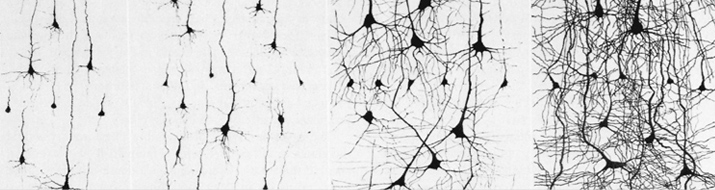
Scientists have historically believed that once a person reaches adulthood, their cognitive abilities are immutable. But beginning in the early twentieth century, that theory has been contested by evidence suggesting that the brain’s abilities are in fact malleable and plastic. According to this principle of neuroplasticity, the brain is constantly changing in response to various experiences. New behaviors, new learnings, and even environmental changes or physical injuries may all stimulate the brain to create new neural pathways or reorganize existing ones, fundamentally altering how information is processed.

One of the most dramatic examples of neuroplasticity at work comes from a 2000 brain scan study on London taxi drivers (Maguire et al., 2000). In order to earn a license, London taxi drivers typically spend about two years learning to navigate the city’s serpentine streets. What mark, the study’s researchers wondered, did this long, rigorous period of training leave on taxi drivers’ brains? Under the scrutiny of fMRI scans, 16 male taxi drivers in this study were revealed to have larger hippocampuses than a control group of 50 healthy males of similar ages. And the longer the time spent as a taxi driver, the larger the hippocampus tended to be. As a brain area involved in memory and navigation, the hippocampus likely changed in response to the taxi drivers’ experiences.

Most instances of neuroplasticity-based changes in the brain are much more subtle. But in recent decades, it’s cases like that of the London taxi drivers that have inspired certain members of the scientific community to pursue the next logical step in research: rather than passively waiting to see how the brain might respond to circumstances, is it possible to direct that capacity for change, targeting improvements in specific key abilities?

The science of cognitive training seeks to answer this question. In 2013 alone, 30 cognitive training studies were registered on the government database ClinicalTrials.gov. Lumosity scientists, with the help of outside collaborators, contribute to this research effort: so far, 7 peer reviewed studies have been published using Lumosity as a cognitive training tool for diverse populations, including healthy adults, cancer survivors, elderly people, and children with a genetic disorder.

Maguire, E. A., Gadian, D. G., Johnsrude, I. S., Good, C. D., Ashburner, J., Frackowiak, R. S. J., & Frith, C. D. (2000). Navigation-related structural change in the hippocampi of taxi drivers. Proceedings of the National Academy of Sciences of the United States of America, 97(8), 4398-4403.

Clearly, without trying it out yourself, it’s difficult for me to convey the nature of the ‘games’ that are provided.

What I can do is to republish a review that appeared on the website MD-Health.

Does Lumosity Work?

Lumosity was designed by several leading neuroscientists, which adds an air of credibility to this popular site, and combines the perks of social networking with brain training technology that supposedly makes your brain function at a higher level. But do these brain training games really work? There is plenty of evidence to support and contract the claims made by this popular gaming website, so it is important to look at the facts before making this determination.

What is Lumosity?

Lumosity is a webpage that features several different brain training games. Players are encouraged to create a profile that allows them to track their progress and play certain games that target mental flexibility, memory, problem solving, speed and attention. The idea is that performing these tasks regularly will help “train” your brain to function more effectively.

How Does Lumosity Work?

The web page explains that Lumosity is based on neuroplasticity, which treats the brain like a muscle that needs to adapt when it is presented with new challenges. The idea here is that if you present your brain with harder challenges, the portion of your brain meant to help solve them will grow larger and more functional. Previously it was believed that neuroplasticity was only available in children with brains that were still developing, but recent science leads researchers to believe that this skill is also available for adults.

Lumosity depends on two basic elements when users create their training program. First, users need to use the program regularly. This is similar to creating a daily routine at your local gym to work and tone your muscles. Your routine will not be as effective if you do not stick with it. The second part of this training program depends on users using many different types of games. There are 35 different games available on Lumosity in addition to many different skill levels within these games. Players should use a variety of different games and increase the difficulty level over time to help ensure that they are continuing to challenge the mind. Creating your initial profile gives the player an opportunity to see what weaknesses they have so they can create a routine that is ideal for their situation.

Is Lumosity Effective?

There are several scientific studies that lead scientists to believe that the brain training activities at Lumosity do have an effect on the brain. A study at the University of Michigan found that adults that used brain training games for a regular amount of time saw an improvement in test scores for dual attention asks and memory games in multiple tests. A similar study at Brown University also saw adults exceeding expectations in brain performance after using brain training games to aid in their work. These programs were found to boost the working memory which helps users keep track of tasks they are currently performing.

The thing to remember when analyzing these results is that they came from laboratory conditions. These adults used Lumosity games for hours every day for several months. Users that do not work on a similar schedule will not see these types of results. There is a great deal of evidence that supports the idea that brain training games can help grow and develop the mind, but not necessarily any evidence that Lumosity and the brain training games available here are more effective than other training games that are on the market elsewhere. In general, keeping the mind active and challenging your mind to learn more advanced tasks and ways of thinking are healthy and can help you perform tasks more effectively, and if Lumosity helps you accomplish this, then it can be seen as a positive asset.

There was a review published in The Guardian newspaper back in April, 2013 from which this extract is offered:

According to the website for Lumosity, which devised these games and is one of the best-known internet providers of brain training, setting aside a few minutes each day to complete the above tasks can make you feel “smarter, sharper, and brighter”. By factoring in a mental workout in the same way that we might go to the gym to exercise, we get cleverer and our IQ rockets.

That, at least, is the idea. And there are lots of people who buy it. In recent years, brain training has become a multimillion-pound business with companies such as Jungle Memory, Nintendo and CogniFit developing a wide range of user-friendly neuroscientific puzzles for the average punter. Lumosity itself has grown by 150% year-on-year since its launch in 2005 and now reaches more than 35 million people worldwide. In January alone, the company’s mobile app was downloaded nearly 50,000 times a day and its revenue hit $24m (£16m).

Co-founded by Michael Scanlon after he abandoned his neuroscience PhD at Stanford University, California, the business also has an extensive research programme that studies the effects of computerised cognitive training as well as conducting experiments over the web.

I can also republish another article from the Lumosity website:

The Science Behind Lumosity

study-results-banner-b03eee32c4b930e36629ef65d0eba902


The scientific roots of the Lumosity program

Research has found that certain types of activities may impact the brain more than others (Mechelli et al., 2004; Gaser and Schlaug, 2003; Draganski et al., 2006). It’s believed that as an activity is repeated, the brain tends to fall back on the same set of existing neural pathways. To continue changing, the brain must be exposed to novel, adaptive experiences that challenge it to work in new ways.

Drawing on this idea, Lumosity is designed to give each person a set of exercises that challenge their cognitive abilities.

Lumosity “games” are based on a combination of common neuropsychological and cognitive tasks, many of which have been used in research for decades, and new tasks designed by an in-house science team. Working with experienced game designers, Lumosity neuroscientists have transformed these tasks into over 40 challenging, adaptive games.

Lumosity’s game-based training program is designed to expose your brain to gradually increasing levels of challenges, adapting game difficulty to your individual ability level. As your scores increase, you may encounter new or more difficult games. Modelled from the concept of a physical personal trainer, Lumosity pushes you to operate at the limits of your abilities and stay challenged.

Gaser, C. & Schlaug, G. (2003). Brain structures differ between musicians and non-musicians. Journal of Neuroscience, 23(27), 9240-9245.

Draganski, B., Gaser, C., Kempermann, G., Kuhn, H. G., Winkler, J., Büchel, C., & May, A (2006). Temporal and spatial dynamics of brain structure changes during extensive learning. Journal of Neuroscience, 26(23), 6314-6317.

Mechelli, A., Crinion, J. T., Noppeney, U., O’Doherty, J., Ashburner, J., Frackowiak, R. S., & Price, C.J. (2004). Neurolinguistics: Structural plasticity in the bilingual brain. Nature, 431, 757.

Lumosity is not expensive and while it is impossible to be objective about the positive difference it is giving me I wouldn’t give up on it.

Now where did I leave my car keys???

Seeking intelligent life!

Continuing from yesterday with the essay from George Monbiot.

The title of today’s post comes from that very silly joke, oft repeated by yours truly, about why is it that Planet Earth has never been visited by aliens?

Answer: Because they have seen no signs of intelligent life!

(Yes, I know, it’s very corny!)

In yesterday’s post about Smart thinking (or the frequent lack of it) I referred to a recent essay from George Monbiot about the United Nations and climate change.  Mr. Monbiot’s essay offers both a startling and hard-to-believe account of the madness, in lieu of a more cruel word, of what could be one of the crucial assemblies for positive change, but isn’t!

I said that the essay would be published in full today and here it is, with the kind permission of Mr. Monbiot.

ooOOoo

Applauding Themselves to Death

10th March 2015

Why the UN climate talks have wasted 23 years, and how this can change.

By George Monbiot, published in the Guardian 11th March 2015

If you visit the website of the UN body that oversees the world’s climate negotiations(1), you will find dozens of pictures, taken across 20 years, of people clapping. These photos should be of interest to anthropologists and psychologists. For they show hundreds of intelligent, educated, well-paid and elegantly-dressed people wasting their lives.

The celebratory nature of the images testifies to the world of make-believe these people inhabit. They are surrounded by objectives, principles, commitments, instruments and protocols, which create a reassuring phantasm of progress while the ship on which they travel slowly founders. Leafing through these photos, I imagine I can almost hear what the delegates are saying through their expensive dentistry. “Darling you’ve re-arranged the deckchairs beautifully. It’s a breakthrough! We’ll have to invent a mechanism for holding them in place, as the deck has developed a bit of a tilt, but we’ll do that at the next conference.”

This process is futile because they have addressed the problem only from one end, and it happens to be the wrong end. They have sought to prevent climate breakdown by limiting the amount of greenhouse gases that are released; in other words, by constraining the consumption of fossil fuels. But, throughout the 23 years since the world’s governments decided to begin this process, the delegates have uttered not one coherent word about constraining production.

Compare this to any other treaty-making process. Imagine, for example, that the Biological Weapons Convention made no attempt to restrain the production or possession of weaponised smallpox and anthrax, but only to prohibit their use. How effective do you reckon it would be? (You don’t have to guess: look at the US gun laws, which prohibit the lethal use of guns but not their sale and carriage. You can see the results in the news every week). Imagine trying to protect elephants and rhinos only by banning the purchase of their tusks and horns, without limiting killing, export or sale. Imagine trying to bring slavery to an end not by stopping the transatlantic trade, but by seeking only to discourage people from buying slaves once they had arrived in the Americas. If you want to discourage a harmful trade, you must address it at both ends: production and consumption. Of the two, production is the most important.

The extraction of fossil fuels is a hard fact. The rules governments have developed to prevent their use are weak, inconsistent and negotiable. In other words, when coal, oil and gas are produced, they will be used. Continued production will overwhelm attempts to restrict consumption. Even if efforts to restrict consumption temporarily succeed, they are likely to be self-defeating. A reduction in demand when supply is unconstrained lowers the price, favouring carbon-intensive industry.

You can search through the UN’s website for any recognition of this issue, but you would be wasting your time. In its gushing catalogue of self-congratulation(2), at Kyoto, Doha, Bali, Copenhagen, Cancun, Durban, Lima and all stops en route, the phrase “fossil fuel” does not occur once. Nor do the words coal or oil. But gas: oh yes, there are plenty of mentions of gas. Not natural gas, of course, but of greenhouse gases, the sole topic of official interest.

The closest any of the 20 international conferences convened so far have come to acknowledging the problem is in the resolution adopted in Lima in December last year. It pledged “cooperation” in “the phasing down of high-carbon investments and fossil fuel subsidies”(3), but proposed no budget, timetable or any instrument or mechanism required to make it happen. It’s progress of a sort, I suppose, and perhaps, after just 23 years, we should be grateful.

There is nothing random about the pattern of silence that surrounds our lives. Silences occur where powerful interests are at risk of exposure. They protect these interests from democratic scrutiny. I’m not suggesting that the negotiators decided not to talk about fossil fuels, or signed a common accord to waste their lives. Far from it: they have gone to great lengths to invest their efforts with the appearance of meaning and purpose. Creating a silence requires only an instinct for avoiding conflict. It is a conditioned and unconscious reflex; part of the package of social skills that secures our survival. Don’t name the Devil for fear that you’ll summon him.

Breaking such silences requires a conscious and painful effort. I remember as if it were yesterday how I felt when I first raised this issue in the media(4). I had been working with a group of young activists in Wales, campaigning against opencast coal mines(5). Talking it over with them, it seemed so obvious, so overwhelming, that I couldn’t understand why it wasn’t on everyone’s lips. Before writing about it, I circled the topic like a dog investigating a suspicious carcass. Why, I wondered, is no one touching this? Is it toxic?

You cannot solve a problem without naming it. The absence of official recognition of the role of fossil fuel production in causing climate change – blitheringly obvious as it is – permits governments to pursue directly contradictory policies. While almost all governments claim to support the aim of preventing more than 2°C of global warming, they also seek to “maximise economic recovery” of their fossil fuel reserves. (Then they cross their fingers, walk three times widdershins around the office and pray that no one burns it). But few governments go as far as the UK has gone.

In the Infrastructure Act that received royal assent last month, maximising the economic recovery of petroleum from the UK’s continental shelf became a statutory duty(6). Future governments are now legally bound to squeeze every possible drop out of the ground.

The idea came from a government review conducted by Sir Ian Wood, the billionaire owner of an inherited company – the Wood Group – that provides services to the oil and gas industry. While Sir Ian says his recommendations “received overwhelming industry support”(7), his team interviewed no one outside either the oil business or government. It contains no sign that I can detect of any feedback from environment groups or scientists.

His review demanded government powers to enhance both the exploration of new reserves and the exploitation of existing ones. This, it insisted, “will help take us closer to the 24 billion [barrel] prize potentially still to come.” The government promised to implement his recommendations in full and without delay(8). In fact it went some way beyond them. It is prepared to be ruthlessly interventionist when promoting climate change, but not when restraining it.

During December’s climate talks in Lima, the UK’s energy secretary, Ed Davey, did something unwise. He broke the silence. He warned that if climate change policies meant that fossil fuel reserves could no longer be exploited, pension funds could be investing in “the sub-prime assets of the future”(9). Echoing the Bank of England and financial analysts such as the Carbon Tracker Initiative, Mr Davey suggested that if governments were serious about preventing climate breakdown, fossil fuel could become a stranded asset.

This provoked a furious response from the industry. The head of Oil and Gas UK wrote to express his confusion(10), pointing out that Mr Davey’s statements come “at a time when you, your Department and the Treasury are putting great effort into [making] the UK North Sea more attractive to investors in oil and gas, not less. I’m intrigued to understand how such opposing viewpoints can be reconciled.” He’s not the only one. Ed Davey quickly explained that his comments were not to be taken seriously, as “I did not offer any suggestions on what investors should choose to do.”(11)

Barack Obama has the same problem. During a television interview last year, he confessed that “We’re not going to be able to burn it all.”(12) So why, he was asked, has his government been encouraging ever more exploration and extraction of fossil fuels? His administration has opened up marine oil exploration from Florida to Delaware – in waters that were formally off-limits(13). It has increased the number of leases sold for drilling on federal lands and, most incongruously, rushed through the process that might, by the end of this month, enable Shell to prospect in the highly vulnerable Arctic waters of the Chukchi Sea(14).

Similar contradictions beset most governments with environmental pretentions. Norway, for example, intends to be “carbon neutral” by 2030. Perhaps it hopes to export its entire oil and gas output, while relying on wind farms at home(15). A motion put to the Norwegian parliament last year to halt new drilling because it is incompatible with Norway’s climate change policies was defeated by 95 votes to 3(16).

Obama explained that “I don’t always lead with the climate change issue because if you right now are worried about whether you’ve got a job or if you can pay the bills, the first thing you want to hear is how do I meet the immediate problem?”(17)

Money is certainly a problem, but not necessarily for the reasons Obama suggested. The bigger issue is the bankrolling of politics by big oil and big coal(18), and the tremendous lobbying power they purchase. These companies have, in the past, financed wars to protect their position(19); they will not surrender the bulk of their reserves without a monumental fight. This fight would test the very limits of state power; I wonder whether our nominal democracies would survive it. Fossil fuel companies have become glutted on silence: their power has grown as a result of numberless failures to challenge and expose them. It’s no wonder that the manicured negotiators at the UN conferences, so careful never to break a nail, have spent so long avoiding the issue.

I believe there are ways of resolving this problem, ways that might recruit other powerful interests against these corporations. For example, a global auction in pollution permits would mean that governments had to regulate just a few thousand oil refineries, coal washeries, gas pipelines and cement and fertiliser factories, rather than the activities of 7 billion people(20). It would create a fund from the sale of permits that’s likely to run into trillions: money that could be used for anything from renewable energy to healthcare. By reducing fluctations in the supply of energy, it would deliver more predictable prices, that many businesses would welcome. Most importantly, unlike the current framework for negotiations, it could work, producing a real possibility of averting climate breakdown.

Left to themselves, the negotiators will continue to avoid this issue until they have wasted everyone else’s lives as well as their own. They keep telling us that the conference in Paris in December is the make or break meeting (presumably they intend to unveil a radical new deckchair design). We should take them at their word, and demand that they start confronting the real problem.

With the help of George Marshall at the Climate Outreach and Information Network, I’ve drafted a paragraph of the kind that the Paris agreement should contain. It’s far from perfect, and I would love to see other people refining it. But, I hope, it’s a start:

“Scientific assessments of the carbon contained in existing fossil fuel reserves suggest that full exploitation of these reserves is incompatible with the agreed target of no more than 2°C of global warming. The unrestricted extraction of these reserves undermines attempts to limit greenhouse gas emissions. We will start negotiating a global budget for the extraction of fossil fuels from existing reserves, as well as a date for a moratorium on the exploration and development of new reserves. In line with the quantification of the fossil carbon that can be extracted without a high chance of exceeding 2°C of global warming, we will develop a timetable for annual reductions towards that budget. We will develop mechanisms for allocating production within this budget and for enforcement and monitoring.”

If something of that kind were to emerge from Paris, it will not have been a total waste of time, and the delegates would be able to congratulate themselves on a real achievement rather than yet another false one. Then, for once, they would deserve their own applause.

References:

1. http://unfccc.int/2860.php

2. See the section titled “Key Steps”.

3. http://unfccc.int/resource/docs/2014/cop20/eng/10a01.pdf

4. http://www.theguardian.com/commentisfree/2007/dec/11/comment.greenpolitics

5. http://www.theguardian.com/commentisfree/2007/dec/05/beartoherethetruthyouvespoken

6. http://www.legislation.gov.uk/ukpga/2015/7/part/6/crossheading/recovery-of-uk-petroleum/enacted

7. http://www.woodreview.co.uk/documents/UKCS%20Maximising%20Recovery%20Review%20FINAL%2072pp%20locked.pdf

8. https://www.gov.uk/government/groups/wood-review-implementation-team

9. http://www.telegraph.co.uk/finance/newsbysector/energy/11277546/Fossil-fuel-investing-a-risk-to-pension-funds-says-Ed-Davey.html

10. https://www.scribd.com/doc/256034152/Malcom-Webb-to-Secretary-of-State

11. https://www.scribd.com/doc/256034194/Secretary-of-State-to-Malcolm-Webb

12. http://www.nytimes.com/2014/06/08/opinion/sunday/friedman-obama-on-obama-on-climate.html?_r=1

13. http://www.motherjones.com/environment/2014/09/how-obama-became-oil-president-gas-fracking-drill

14. http://www.tomdispatch.com/post/175963/tomgram%3A_subhankar_banerjee%2C_arctic_nightmares/

15. http://www.newscientist.com/article/dn24299-ipcc-digested-just-leave-the-fossil-fuels-underground.html

16. https://stortinget.no/no/Saker-og-publikasjoner/Saker/Sak/?p=59412

17. http://www.nytimes.com/2014/06/08/opinion/sunday/friedman-obama-on-obama-on-climate.html?_r=1

18. http://www.theguardian.com/environment/georgemonbiot/2012/aug/02/climate-change-political-funding-us

19. http://en.mercopress.com/2008/06/15/formal-end-to-oil-companies-proxy-chaco-war-1932-35

20. http://www.kyoto2.org/

ooOOoo

What a funny lot we can be!

A breath of common-sense.

George Monbiot perfectly spells it out.

Regular readers of this place will know that it is a rare couple of weeks without a republication of a George Monbiot essay.  His voice seems so often to be a ray of common-sense shining into a dark cave of present-day madness. None more obvious than this essay that was published last Monday under the title of There Is An Alternative.

It’s a huge honour to be able to share this with you, dear readers.

ooOOoo

There Is An Alternative

December 8, 2014

The great political question of our age is what to do about corporate power. It’s time we answered it.
By George Monbiot, published in the Guardian 8th December 2014

Does this sometimes feel like a country under enemy occupation? Do you wonder why the demands of so much of the electorate seldom translate into policy? Why the Labour Party, like other former parties of the left, seems incapable of offering effective opposition to market fundamentalism, let alone proposing coherent alternatives? Do you wonder why those who want a kind and decent and just world, in which both human beings and other living creatures are protected, so often appear to find themselves confronting the entire political establishment?

If so, you have already encountered corporate power. It is the corrupting influence that prevents parties from connecting with the public, distorts spending and tax decisions and limits the scope of democracy. It helps to explain the otherwise inexplicable: the creeping privatisation of health and education, hated by almost all voters; the private finance initiative, which has left public services with unpayable debts(1,2); the replacement of the civil service with companies distinguished only by their incompetence(3); the failure to re-regulate the banks and to collect tax; the war on the natural world; the scrapping of the safeguards that protect us from exploitation; above all the severe limitation of political choice in a nation crying out for alternatives.

There are many ways in which it operates, but perhaps the most obvious is through our unreformed political funding system, which permits big business and multimillionaires effectively to buy political parties. Once a party is obliged to them, it needs little reminder of where its interests lie. Fear and favour rule.

And if they fail? Well, there are other means. Before the last election, a radical firebrand said this about the lobbying industry(4): “It is the next big scandal waiting to happen … an issue that exposes the far-too-cosy relationship between politics, government, business and money. … secret corporate lobbying, like the expenses scandal, goes to the heart of why people are so fed up with politics.” That, of course, was David Cameron, and he’s since ensured that the scandal continues. His lobbying act restricts the activities of charities and trade unions, but imposes no meaningful restraint on corporations(5).

Ministers and civil servants know that if they keep faith with corporations while in office they will be assured of lucrative directorships in retirement. Dave Hartnett, who, as head of the government’s tax collection agency HMRC, oversaw some highly controversial deals with companies like Vodafone and Goldman Sachs(6,7), apparently excusing them from much of the tax they seemed to owe, now works for Deloitte, which advises companies like Vodafone on their tax affairs(8). As head of HMRC he met one Deloitte partner 48 times(9).

Corporations have also been empowered by the globalisation of decision-making. As powers but not representation shift to the global level, multinational business and its lobbyists fill the political gap. When everything has been globalised except our consent, we are vulnerable to decisions made outside the democratic sphere.

The key political question of our age, by which you can judge the intent of all political parties, is what to do about corporate power. This is the question, perennially neglected within both politics and the media, that this week’s series of articles will attempt to address. I think there are some obvious first steps.

A sound political funding system would be based on membership fees. Each party would be able to charge the same fixed fee for annual membership (perhaps £30 or £50). It would receive matching funding from the state as a multiple of its membership receipts. No other sources of income would be permitted. As well as getting the dirty money out of politics, this would force political parties to reconnect with the people, to raise their membership. It will cost less than the money wasted on corporate welfare every day.

All lobbying should be transparent. Any meeting between those who are paid to influence opinion (this could include political commentators like myself) and ministers, advisers or civil servants in government should be recorded, and the transcript made publicly available. The corporate lobby groups that pose as thinktanks should be obliged to reveal who funds them before appearing on the broadcast media(10,11), and if the identity of one of their funders is relevant to the issue they are discussing, it should be mentioned on air.

Any company supplying public services would be subject to freedom of information laws (there would be an exception for matters deemed commercially confidential by the information commissioner). Gagging contracts would be made illegal, in the private as well as the public sector (with the same exemption for commercial confidentiality). Ministers and top officials should be forbidden from taking jobs in the sectors they were charged with regulating.

But we should also think of digging deeper. Is it not time we reviewed the remarkable gift we have granted to companies in the form of limited liability? It socialises the risks which would otherwise be carried by a company’s owners and directors, exempting them from the costs of the debts they incur or the disasters they cause, and encouraging them to engage in the kind of reckless behaviour that caused the financial crisis. Should the wealthy authors of the crisis, like Fred Goodwin or Matt Ridley, not have incurred a financial penalty of their own?

We should look at how we might democratise the undemocratic institutions of global governance, as I outlined in my book The Age of Consent(12). This could involve the dismantling of the World Bank and the IMF, which are governed without a semblance of democracy, and cause more crises than they solve, and their replacement with a body rather like the international clearing union designed by John Maynard Keynes in the 1940s, whose purpose was to prevent excessive trade surpluses and deficits from forming, and therefore international debt from accumulating.

Instead of treaties brokered in opaque meetings between diplomats and transnational capital (of the kind now working towards a Transatlantic Trade and Investment partnership), which threaten democracy, the sovereignty of parliaments and the principle of equality before the law, we should demand a set of global fair trade rules, to which multinational companies would be subject, losing their licence to trade if they break them. Above all perhaps, we need a directly elected world parliament, whose purpose would be to hold other global bodies to account. In other words, instead of only responding to an agenda set by corporations, we must propose an agenda of our own.

This is not only about politicians, it is also about us. Corporate power has shut down our imagination, persuading us that there is no alternative to market fundamentalism, and that “market” is a reasonable description of a state-endorsed corporate oligarchy. We have been persuaded that we have power only as consumers, that citizenship is an anachronism, that changing the world is either impossible or best effected by buying a different brand of biscuits.

Corporate power now lives within us. Confronting it means shaking off the manacles it has imposed on our minds.

www.monbiot.com

References:

1. http://www.dropnhsdebt.org.uk/

2. http://www.monbiot.com/2010/11/22/the-uks-odious-debts/

3. http://www.monbiot.com/2014/05/05/land-of-impunity-2/

4. https://tompride.wordpress.com/2014/10/13/lobbying-camerons-deleted-speech-and-his-jaw-dropping-hypocrisy/

5. http://www.lobbyingtransparency.org/

6. http://www.theguardian.com/commentisfree/2010/oct/22/vodafone-tax-case-leaves-sour-taste

7. http://www.theguardian.com/business/2011/oct/11/goldman-sachs-interest-tax-avoidance

8. http://www.theguardian.com/business/2013/may/27/deloitte-appoints-dave-hartnett-tax

9. http://www.theguardian.com/business/2013/may/27/deloitte-appoints-dave-hartnett-tax

10. http://www.monbiot.com/2013/11/29/hidden-interests/

11. http://www.monbiot.com/2011/10/17/show-me-the-money/

12. http://www.monbiot.com/books/the-age-of-consent/

A Vision for Nature

Another powerful essay from George Monbiot.

Despite this now being December and NaNoWriMo is behind me, all 53,376 words of it, the next few weeks are still going to be demanding.

I have three more chapters to write plus adding a guest preface and an overhaul of Part One of the book.  In other words, December is still a busy book month, albeit without the word-count pressures of NaNoWriMo.

All a long-winded way of me saying that I will present articles seen elsewhere if I think they are of interest to all of you readers.

Which brings me to another powerful essay from George Monbiot that he published a few days ago and is republished here with George’s very kind permission.

ooOOoo

A Vision for Nature

November 27, 2014

As governments tear down the rules that defend our wildlife from extinction, here’s a positive attempt to stop the wreckage.

By George Monbiot. posted on the Guardian’s website, 21st November 2014

One of the fears of those who seek to defend the natural world is that people won’t act until it is too late. Only when disasters strike will we understand how much damage we have done, and what the consequences might be.

I have some bad news: it’s worse than that. For his fascinating and transformative book, Don’t Even Think About It: why our brains are wired to ignore climate change, George Marshall visited Bastrop in Texas, which had suffered from a record drought followed by a record wildfire, and Sea Bright in New Jersey, which was devastated by Hurricane Sandy. These disasters are likely to have been caused or exacerbated by climate change. He interviewed plenty of people in both places, and in neither case – Republican Texas or Democratic New Jersey – could he find anyone who could recall a conversation about climate change as a potential cause of the catastrophe they had suffered. It simply had not arisen.

The editor of the Bastrop Advertiser told him “Sure, if climate change had a direct impact on us, we would definitely bring it in, but we are more centred around Bastrop County.” The mayor of Sea Bright told him “We just want to go home, and we will deal with all that lofty stuff some other day.” Marshall found that when people are dealing with the damage and rebuilding their lives they are even less inclined than they might otherwise be to talk about the underlying issues.

In his lectures, he makes another important point that – in retrospect – also seems obvious: people often react to crises in perverse and destructive ways. For example, immigrants, Jews, old women and other scapegoats have been blamed for scores of disasters they did not create. And sometimes people respond with behaviour that makes the disaster even worse: think, for instance, of the swing to UKIP, a party run by a former City broker and funded by a gruesome collection of tycoons and financiers, in response to an economic crisis caused by the banks.

I have seen many examples of this reactive denial at work, and I wonder now whether we are encountering another one.

The world’s wild creatures are in crisis. In the past 40 years the world has lost over 50% of its vertebrate wildlife. Hardly anywhere is spared this catastrophe. In the UK, for example, 60% of the 3,000 species whose fate has been studied have declined over the past 50 years. Our living wonders, which have persisted for millions of years, are disappearing in the course of decades.

You might expect governments and officials, faced with a bonfire of this magnitude, to rush to the scene with water and douse it. Instead they have rushed to the scene with cans of petrol.

Critical to the protection of the natural world are regulations: laws which restrain certain activities for the greater public good. Legal restrictions on destruction and pollution are often the only things that stand between species and their extinction.

Industrial interests often hate these laws, as they restrict their profits. The corporate media denigrates and demonises the very concept of regulation. Much of the effort of those who fund political parties is to remove the regulations that protect us and the living planet. Politicians and officials who seek to defend regulation will be taken down, through campaigns of unrelenting viciousness in the media. Everywhere the message has been received.

The European Commission has now ordered a “review” of the two main pillars of the protection of our wildlife: the Birds Directive and the Habitats Directive. It’s likely to be the kind of review conducted by a large tracked vehicle with a steel ball on the end of a chain. The problem, the Commission says, is that these directives could impede the “fitness” of business in Europe.

But do they? Not even Edmund Stoiber, the conservative former president of Bavaria who was appointed by the Commission to wage war on regulation, thinks so. He discovered that European environmental laws account for less than 1% of the costs of regulation to business: the lowest cost of any of the regulations he investigated. “However, businesses perceive the burden to be much higher in this area.” So if these crucial directives are vitiated or scrapped, it will not be because they impede business, but because they are wrongly perceived to impose much greater costs than they do.

The UK chancellor, George Osborne, claimed in 2011 that wildlife regulations were placing ridiculous costs on business. But a review by the environment secretary, Caroline Spelman, concluded the claim was unfounded.

In the United Kingdom, whose leading politicians, like those of Australia and Canada, appear to be little more than channels for corporate power, we are facing a full-spectrum assault on the laws protecting our living treasures.

The Small Business, Enterprise and Employment Bill, now passing through the House of Commons, would oblige future governments to keep deregulating on behalf of business, regardless of the cost to the rest of society. The government’s Red Tape Challenge at first insisted that no new regulation could be introduced unless an existing one is scrapped. Now two must be scrapped in exchange for any new one.

Cameron’s government has set up what it calls a “Star Chamber”, composed of corporate executives and officials from the business department, before which other government departments must appear. They must justify, in front of the sector they regulate, any of the rules these business people don’t like. If they are deemed insufficiently convincing, the rules are junked.

Usually, governments go to some lengths to disguise their intent, and to invent benign names for destructive policies. Not in this case. A Star Chamber perfectly captures the spirt of this enterprise. Here’s how a website about the history of the Tudors describes the original version (my emphasis):

“The power of the court of Star Chamber grew considerably under the Stuarts, and by the time of Charles I it had become a byword for misuse and abuse of power by the king and his circle. … Court sessions were held in secret, with no right of appeal, and punishment was swift and severe to any enemy of the crown. Charles I used the Court of Star Chamber as a sort of Parliamentary substitute during the years 1628-40, when he refused to call Parliament. Finally, in 1641 the Long Parliament abolished the hated Star Chamber, though its name survives still to designate arbitrary, secretive proceedings in opposition to personal rights and liberty.”

Yes, that is exactly what we’re looking at. I suspect the government gave its kangaroo court this name to signal its intent to its corporate funders: we are prepared to be perfectly unreasonable on your behalf, trampling justice, democracy and rational policy-making to give you what you want. We are putting you in charge. So please keep funding us, and please, dear owners of the corporate press, don’t destroy our chances of winning the next election by backing UKIP instead.

Then there’s the Deregulation Bill, which has now almost run its parliamentary course. Among the many ways in which it tilts the balance even further against defending the natural world is Clause 83, which states this:

“A person exercising a regulatory function to which this section applies must, in the exercise of the function, have regard to the desirability of promoting economic growth.”

So bodies such as the Environment Agency or Natural England must promote economic growth, even if it directly threatens the natural wonders they are charged with protecting. For example, companies could save money by tipping pollutants into a river, rather than processing them or disposing of them safely. That means more funds for investment, which could translate into more economic growth. So what should an agency do if it is supposed to prevent pollution and promote economic growth?

Not that the government needs to bother, for it has already stuffed the committees that oversee these bodies.

Look, for example, at the board of Natural England. Its chairman, Andrew Sells, is a housebuilder and major donor to the Conservative Party, who was treasurer of the thinktank Policy Exchange, which inveighs against regulation at every opportunity. Its deputy chairman, David Hill, is also chairman of a private company called the Environment Bank, whose purpose is ”to broker biodiversity offsetting agreements for both developers and landowners.” Biodiversity offsetting is a new means of making the destruction of precious natural places seem acceptable.

The government has recently appointed to this small board not one but two Cumbrian sheep farmers – Will Cockbain and Julia Aglionby – who, my encounters with them suggest, both appear to be fanatically devoted to keeping the uplands sheepwrecked and bare. There’s also a place for the chief executive of a group that I see as a greenwashing facility for the shooting industry, the Game and Wildlife Conservation Trust. And one for a former vice-president of Citibank. The board members with current or former interests in industries that often damage the natural world outnumber those who have devoted their lives to conservation and ecology.

So what do we do about this? You cannot fight assaults of this kind without producing a positive vision of your own.

This is what the RSPB and the Wildlife Trusts have done with the publication of their Nature and Wellbeing Green Paper. It’s a proposal for a new act of parliament modelled on the Climate Change Act 2008. It obliges future governments to protect and restore the living world. It proposes targets for the recovery of species and places, a government agency (the Office for Environmental Responsibility) whose role is to ensure that all departments help to defend wildlife, and Local Ecological Networks, which devolve power to communities to protect the places they love most.

I have problems with some aspects of this proposal, not least its enthusiastic embrace of the Natural Capital Agenda, which seeks to persuade us to value nature by putting a price on it. This strategy is, I believe, astonishingly naïve. To be effective, you must open up political space, not help to close it down by accepting the premises, the values and the framing of your opponents. But I can see what drove them to do it. If the government accepts only policies or regulations that contribute to economic growth, it’s tempting to try to prove that the financial value of wildlife and habits is greater than the financial value to be gained by destroying them, foolish and self-defeating as this exercise may be.

But I’ll put this aside, because their proposal is the most comprehensive attempt yet to douse the bonfire of destruction on which the government is toasting our wildlife like marshmallows. The Climate Change Act and its lasting commitments are just about the only measures that oblige this government to restrict greenhouse gases. It remains a yardstick against which the efforts of all governments can be judged. Should we not also have similar, sustained protection for wildlife and habitats? Only lasting safeguards, not subject to the whims and fads of passing governments, can defend them against extinction.

The Nature and Wellbeing Act is a good example of positive environmentalism, setting the agenda, rather than merely responding to the policies we don’t like. We must do both, but while those who love wildlife have often been effective opponents, we have tended to be less effective proponents.

It will be a struggle, as the times have changed radically. In 2008 the Climate Change Act was supported by the three main political parties. So far the Nature and Wellbeing Act has received the support of the Liberal Democrats (so after the election both their MPs will promote it in parliament) and the Green Party. The Conservatives, despite the green paper’s desperate attempts to speak their language, are unreachable. And where on earth is Labour? So far it has shown no interest at all.

If you care about what is happening to the living world, if you care about the assault on the enthralling and bewitching outcome of millions of years of evolution for the sake of immediate and ephemeral corporate profits, join the campaign and lobby your MPs. The Nature and Wellbeing Act will succeed only through a movement as big as the one that brought the Climate Change Act into existence. Please join it.

www.monbiot.com

ooOOoo

Sometimes, I wonder if such essays, as powerful and well-written as they are, are not just too terrible a commentary on how things are just now.  My justification for republishing them is simply from the point of view that the more the awareness of good ordinary people is enhanced as to these present times, the better the odds that there will be a sufficient social and political reaction to bring this madness to a halt.

The God of Growth.

A grim reminder of these mad times.

I am conscious that in thirty minutes, my latest draft chapter of the book of the same name as this blog is published. Published under the heading of Faith in goodness.

It seems entirely at odds with the theme of today’s post, the reposting of a recent essay from George Monbiot.  But in a sense the two posts are compatible. Because what George Monbiot writes about, so elegantly in my opinion, is a window into the lives of those in power, politics, and in money.  Whereas, down at street level, so to speak, down where ordinary people lead ordinary lives, one finds a huge gap between the ambitions of the ‘top table’ and decent, everyday folk who are basically good people.

So with that in mind, on to George Monbiot’s essay of the 18th November, published in this place with his kind permission.

ooOOoo

The Insatiable God

The blind pursuit of economic growth stokes a cycle of financial crisis, and wrecks our world.
By George Monbiot, published in the Guardian 19th November 2014

Another crash is coming. We all know it, now even David Cameron acknowledges it (1). The only questions are what the immediate catalyst will be, and when it begins.

You can take your pick. The Financial Times reports today that China now resembles the US in 2007 (2). Domestic bank loans have risen 40% since 2008, while “the ability to repay that debt has deteriorated dramatically”. Property prices are falling and the companies that run China’s shadow banking system provide “virtually no disclosure” of their liabilities. Just two days ago, the G20 leaders announced that growth in China “is robust and is becoming more sustainable” (3). You can judge the value of their assurances for yourself.

Housing bubbles in several countries, including Britain, could pop at any time. A report in September revealed that total world debt (public and private) has reached 212% of GDP (4). In 2008, when it helped to cause the last crash, it stood at 174%. The Telegraph notes that this threatens to cause “renewed financial crisis … and eventual mass default.” (5) Shadow banking has gone beserk, stocks appear to be wildly overvalued, the Eurozone is bust again. Which will blow first?

Or perhaps it’s inaccurate to describe this as another crash. Perhaps it’s a continuation of the last one, the latest phase in a permanent cycle of crisis, exacerbated by the measures (credit bubbles, deregulation, the curtailment of state spending) which were supposed to deliver uninterrupted growth. The system the world’s governments have sought to stabilise is inherently unstable, built on debt, fuelled by speculation, run by sharks.

If it goes down soon, as Cameron fears, in a world of empty coffers and hobbled public services, it will precipitate an ideological crisis graver than the blow to Keynesianism in 1970s. The problem that then arises – and which explains the longevity of the discredited ideology that caused the last crash – is that there is no alternative policy, accepted by mainstream political parties, with which to replace it. They will keep making the same mistakes while expecting a different outcome.

To try to stabilise this system, governments behave like soldiers billeted in an ancient manor, who burn the furniture, the panelling, the paintings and the stairs to keep themselves warm for a night. They are breaking up the post-war settlement, our public health services and social safety nets, above all the living world, to produce ephemeral spurts of growth. Magnificent habitats, the benign and fragile climate in which we have prospered, species that have lived on earth for millions of years, all are being stacked onto the fire, their protection characterised as an impediment to growth.

David Cameron boasted on Monday that he will revive the economy by “scrapping red tape” (6). This “red tape” consists in many cases of the safeguards defending both people and places from predatory corporations. Today, the Small Business, Enterprise and Employment Bill is passing through the House of Commons (7), spinelessly supported, as ever, by Labour. The bill seeks to pull down our protective rules to “reduce costs for business”, even if that means increasing costs for everyone else, while threatening our health and happiness. But why? As the government boasted last week, the UK already has “the least restrictive product market regulation and the most supportive regulatory and institutional environment for business across the G20.” (8) And it still doesn’t work. So let’s burn what remains.

This bonfire of regulation is accompanied by a reckless abandonment of democratic principles, not least of equality before the law. In the House of Commons on Monday, Cameron spoke for the first time about the Transatlantic Trade and Investment Partnership (9). If this treaty between the EU and the US goes ahead, it will grant corporations a separate legal system to which no one else has access, through which they can sue governments passing laws that might affect their profits. Cameron insisted that “it does not in any way have to affect our national health service” (10). (Note those words “have to”.) Pressed to explain this, he cited the former EU trade commissioner, who claimed that “public services are always exempted” (11).

But I have read the EU’s negotiating mandate(12), and it contains no such exemption, just plenty of waffle and ambiguity on this issue. When the Scottish government asked Cameron’s officials for an “unequivocal assurance” that the NHS would not be exposed to such litigation, they refused to provide it(13). This treaty could rip our public services to shreds for the sake of a short and (studies suggest (14,15)) insignificant fizzle of economic growth.

Is it not time to think again? To stop sacrificing our working lives, our prospects, our surroundings to an insatiable god (16)? To consider a different economic model, which does not demand endless pain while generating repeated crises?

Amazingly, this consideration begins on Thursday. For the first time in 170 years, parliament will debate one aspect of the problem: the creation of money (17). Few people know that 97% of our money supply is created not by the government (or the central bank), but by commercial banks in the form of the loans they issue (18). At no point was a democratic decision made to allow banks to do this. So why do we let it happen? This, as Martin Wolf has explained in the Financial Times (19), “is the source of much of the instability of our economies”. The parliamentary debate won’t stop the practice, but it represents the opening of a long-neglected question.

This, though, is just the beginning. Is it not also time for a government commission on post-growth economics? Drawing on the work of thinkers like Herman Daly, Tim Jackson, Peter Victor, Kate Raworth, Rob Dietz and Dan O’Neill, it would investigate the possibility of moving towards a steady state economy: one that seeks distribution rather than blind expansion; that does not demand infinite growth on a finite planet. It would ask the question that never gets asked: why?

Why are we wrecking the natural world and public services to generate growth when that growth is not delivering contentment, security or even, for most of us, greater prosperity? Why have we enthroned growth, regardless of its utility, above all over outcomes? Why, despite failures so great and so frequent, have we not changed the model? When the next crash comes, these questions will be inescapable.

http://www.monbiot.com

References:

1. http://www.theguardian.com/commentisfree/2014/nov/16/red-lights-global-economy-david-cameron

2. http://www.ft.com/cms/s/0/e13e2cf8-6e48-11e4-bffb-00144feabdc0.html#ixzz3JP5QF3et

3. G20, November 2014. Brisbane Action Plan. http://bit.ly/1xk6mLR

4. Luigi Buttiglione et al, September 2014. Deleveraging? What Deleveraging? Geneva Reports on the World Economy 16. http://www.voxeu.org/content/deleveraging-what-deleveraging-16th-geneva-report-world-economy

5. http://www.telegraph.co.uk/finance/economics/11129108/Mass-default-looms-as-world-sinks-beneath-a-sea-of-debt.html

6. http://www.theguardian.com/commentisfree/2014/nov/16/red-lights-global-economy-david-cameron

7. http://services.parliament.uk/bills/2014-15/smallbusinessenterpriseandemployment.html

8. G20, November 2014. Comprehensive Growth Strategy – United Kingdom. http://bit.ly/1yPuIv7

9. http://www.theguardian.com/commentisfree/2014/nov/04/british-government-leading-gunpowder-plot-democracy-eu-us-trade

10. http://www.publications.parliament.uk/pa/cm201415/cmhansrd/cm141117/debtext/141117-0001.htm#14111713000002

11. http://www.bbc.co.uk/news/health-29181332

12. http://bit.ly/1xYr3L6

13. http://www.scotsman.com/news/uk/scottish-government-demands-nhs-ttip-guarantees-1-3589393

14. http://www.theguardian.com/commentisfree/2013/jul/15/us-trade-deal-with-europe-hype

15. http://www.newscientist.com/article/mg22429932.800-ttip-beware-the-treatys-empty-economic-promises.html

16. http://pollystreaming.com/South-Park-Season-13-Episode-3-Margaritaville_v5905

17. http://www.positivemoney.org/2014/11/uk-parliament-debate-money-creation-first-time-170-years/

18. https://www.positivemoney.org/wp-content/uploads/2014/11/Backbench-Briefing-Note.pdf

19. http://www.ft.com/cms/s/0/7f000b18-ca44-11e3-bb92-00144feabdc0.html#ixzz2zsutuZis