Tag: The Guardian newspaper

Scotland’s day of decision.

Whatever the outcome, may it truly represent the wishes of the majority.

I have not hidden my feelings as to the outcome that I would welcome. My post of the 11th September was subtitled “My hope for a ‘yes’ vote for Scottish Independence.”  After my introduction to that post, I then republished an essay by George Monbiot that was published in the Guardian newspaper on the 3rd September 2014.  Mr. Monbiot has made it very clear as to where he stands on this matter.

George Monbiot then followed up that Guardian article with another one published in the Guardian yesterday. It offers cogent points and, with his permission, I am delighted to republish it.

ooOOoo

Remote Control

September 16, 2014

How the media shafted the people of Scotland.

By George Monbiot, published in the Guardian 17th September 2014

Perhaps the most arresting fact about the Scottish referendum is this: that there is no newspaper – local, regional or national, English or Scottish – which supports independence except the Sunday Herald. The Scots who will vote yes have been almost without representation in the media.

There is nothing unusual about this. Change in any direction except further over the brink of market fundamentalism and planetary destruction requires the defiance of almost the entire battery of salaried opinion. What distinguishes the independence campaign is that it has continued to prosper despite this assault.

In the coverage of the referendum we see most of the pathologies of the corporate media. Here, for example, you will find the unfounded generalisations with which less enlightened souls are characterised. In the Spectator, Simon Heffer mainatains that “addicted to welfare … Scots embraced the something for nothing society”, objecting to the poll tax “because many of them felt that paying taxes ought to be the responsibility of someone else.”(1)

Here is the condescension with which the dominant classes have always treated those they regard as inferior: their serfs, the poor, the Irish, Africans, anyone with whom they disagree. “What spoilt, selfish, childlike fools those Scots are … They simply don’t have a clue how lucky they are,” sneered Melanie Reid in the Times(2). Here is the chronic inability to distinguish between a cause and a person: the referendum is widely portrayed as a vote about Alex Salmond, who is then monstered beyond recognition (a Telegraph leader last week compared him to Robert Mugabe(3)).

The problem with the media is exemplified by Dominic Lawson’s column for the Daily Mail last week(4). He began with Scotland, comparing the “threat” of independence with the threat presented by Hitler (the article was helpfully illustrated with a picture of the Fuhrer, unaccompanied in this case by the Mail’s former proprietor). Then he turned to the momentous issue of how he almost said something wrong about David Attenborough, which was narrowly averted because “as it happens, last weekend we had staying with us another of the BBC’s great figures, its world affairs editor John Simpson”, who happily corrected Lawson’s mistake. This was just as well because “the next day I went to the Royal Albert Hall as one of a small number of guests invited by the Proms director for that night’s performance. And who should I see as soon as I entered the little room set aside for our group’s pre-concert drinks? Sir David Attenborough.”

Those who are supposed to hold power to account live in a rarified, self-referential world of power, circulating among people as exalted as themselves, the “small number of guests” who receive the most charming invitations. That a senior journalist at the BBC should be the house guest of a columnist for the Daily Mail surprises me not one iota.

In June the BBC’s economics editor Robert Peston complained that BBC news “is completely obsessed by the agenda set by newspapers … If we think the Mail and Telegraph will lead with this, we should. It’s part of the culture.”(5) This might help to explain why the BBC has attracted so many complaints of bias in favour of the No campaign(6,7).

Living within their tiny circle of light, most senior journalists seem unable to comprehend a desire for change. If they notice it at all, they perceive it as a mortal threat: comparable perhaps to Hitler. They know as little of the lives of the 64 million inhabiting the outer darkness as they do of the Andaman islanders. Yet, lecturing the poor from under the wisteria, they claim to speak for the nation.

As John Harris reports in the Guardian, both north and south of the border “politics as usual suddenly seems so lost as to look completely absurd.”(8) But to those within the circle, politics still begins and ends in Westminster. The opinions of no one beyond the gilded thousand with whom they associate are worthy of notice. Throughout the years I’ve spent working with protest movements and trying to bring neglected issues to light, one consistent theme has emerged: with a few notable exceptions, journalists are always among the last to twig that things have changed. It’s no wonder that the Scottish opinion polls took them by surprise.

One of the roles of the Guardian, which has no proprietor, is to represent the unrepresented – and it often does so to great effect. On Scottish independence I believe we have fallen short. Our leader on Saturday used the frames constructed by the rest of the press, inflating a couple of incidents into a “habit” by yes campaigners of “attacking the messenger and ignoring the message”, judging the long-term future of the nation by current SNP policy, confusing self-determination with nationalism(9).

If Westminster is locked into a paralysing neoliberal consensus it is partly because the corporate media, owned and staffed by its beneficiaries, demands it. Any party that challenges this worldview is ruthlessly disciplined. Any party that more noisily promotes corporate power is lauded and championed. UKIP, though it claims to be kicking against the establishment, owes much of its success to the corporate press.

For a moment, Rupert Murdoch appeared ready to offer one of his Faustian bargains to the Scottish National Party: my papers for your soul(10). That offer now seems to have been withdrawn, as he has decided that Salmond’s SNP is “not talking about independence, but more welfarism, expensive greenery, etc and passing sovereignty to Brussels”(11) and that it “must change course to prosper if he wins.”(12) It’s not an observation, it’s a warning: if you win independence and pursue this agenda, my newspapers will destroy you.

Despite the rise of the social media, the established media continues to define the scope of representative politics in Britain, to shape political demands and to punish and erase those who resist. It is one chamber of the corrupt heart of Britain, pumping fear, misinformation and hatred around the body politic.

That so many Scots, lambasted from all quarters as fools, frauds and ingrates, have refused to be bullied is itself a political triumph. If they vote for independence, they will do so in defiance not only of the Westminster consensus, but also of its enforcers: the detached, complacent people who claim to speak on their behalf.

www.monbiot.com

References:

1. http://www.spectator.co.uk/australia/australia-features/9226741/little-scotlanders/

2. http://www.thetimes.co.uk/tto/opinion/columnists/article4200523.ece

3. http://www.telegraph.co.uk/news/uknews/scottish-independence/11087226/Alex-Salmonds-stance-will-drag-Scotland-down.html

4. http://www.dailymail.co.uk/debate/article-2747291/New-Labour-s-war-British-identity-left-Salmond-open-goal.html

5. http://www.theguardian.com/media/2014/jun/06/bbc-obsessed-agenda-daily-mail-robert-peston-charles-wheeler

6. https://www.opendemocracy.net/ourkingdom/john-robertson/bbc-bias-and-scots-referendum-new-report

7. http://www.bbc.co.uk/news/uk-scotland-29196912

8. http://www.theguardian.com/commentisfree/2014/sep/11/not-just-scotland-politics-as-usual-finished-falkirk-clacton-disaffected

9. http://www.theguardian.com/commentisfree/2014/sep/12/guardian-view-scottish-independence

10. http://theconversation.com/how-rupert-murdoch-is-sticking-his-oar-into-scotlands-independence-referendum-31531

11. https://twitter.com/rupertmurdoch/status/511187972453314560

12. https://twitter.com/rupertmurdoch/status/511095777440313345

ooOOoo
Inspiring transformation everywhere.

The second of George Monbiot’s essays on Scotland.

In yesterday’s post Alba an Aigh or Scotland the Brave, I closed it by saying, “Since preparing this post, I see that George Monbiot has published a second essay on the subject of the Scottish referendum. I’m pondering republishing that second essay next Monday.”

Upon further reflection, it struck me that Mr. Monbiot’s second essay was better appreciated being republished in this place the following day; i.e. today.

Thus with no further ado, here it is.

ooOOoo

England the Brave

September 9, 2014

The rest of the UK doesn’t need to be rescued by Scottish votes: independence could inspire transformation everywhere.

By George Monbiot, published in the Guardian 9th September 2014

Of all the bad arguments urging the Scots to vote no – and there are plenty – perhaps the worst is the demand that Scotland should remain in the Union to save England from itself. Responses to last week’s column suggest that this wretched, snivelling, apron-strings argument has some traction among people who claim to belong to the left.

Consider what it entails: it asks a nation of 5.3 million to forgo independence to exempt a nation of 53 million from having to fight its own battles. In return for this self-denial, the five million must remain yoked to the dismal politics of cowardice and triangulation which have caused the problems from which we ask them to save us.

“A UK without Scotland would be much less likely to elect any government of a progressive hue”, the former Labour minister Brian Wilson claimed in the Guardian last week(1). We must combine against the “forces of privilege and reaction” (as he lines up with the Conservatives, UKIP, the LibDems, the banks, the corporations, almost all the rightwing columnists in Britain and every UK newspaper except the Sunday Herald) – in the cause of “solidarity”.

There’s another New Labour weasel word to add to its dreary lexicon (other examples include reform, which now means privatisation, and partnership, which means selling out to big business). Once solidarity meant making common cause with the exploited, the underpaid, the excluded. Now, to these cyborgs in suits, it means keeping faith with the banks, the corporate press, cuts, a tollbooth economy and market fundamentalism.

Here, to Wilson and his fellow flinchers, is what solidarity meant while they were in office. It meant voting for the Iraq war, for Trident, for identity cards, for 3,500 new criminal offences(2), including the criminalisation of most forms of peaceful protest(3). It meant being drafted in as political mercenaries to impose on the English policies to which the Scots were not subject, such as university top-up fees and foundation hospitals(4,5). It meant supporting every destructive and injust proposition advanced by their leaders: the brood parasites who hatched in the Labour nest then flicked its dearest principles over the edge. It’s no surprise that the more the Scots see of their former Labour ministers, the more inclined they are to vote for independence.

So now Better Together has brought in Gordon Brown, scattering bribes in a desperate, last-ditch effort at containment. They must hope the Scots have forgotten that he boasted of setting “the lowest rate in the history of British corporation tax, the lowest rate of any major country in Europe and the lowest rate of any major industrialised country anywhere”(6). That he pledged to the City of London “in budget after budget I want us to do even more to encourage the risk takers”(7). That, after 13 years of Labour government, the UK had higher levels of inequality than after 18 years of Tory government(8). That his government colluded in kidnapping and torture(9). That he helped cause the deaths of hundreds of thousands through his support for the illegal war on Iraq.

He roams through Scotland, still badged with blood, promising what he never delivered when he had the chance, this man who helped unravel the social safety net his predecessors wove; who marketised and dismembered public services; who enriched the wealthy and shafted the poor; who pledged money for Trident but failed to reverse the loss of social housing(10); whose private finance initiative planted a series of timebombs now exploding throughout the NHS and other public services(11); who greased and wheedled and slavered his way into the company of bankers and oligarchs while trampling over the working people he was elected to represent. This is the progressive Prester John who will ride to the rescue of the No campaign?

Where, in Scotland’s Labour party, are the Keir Hardies and Jimmy Reids of our time? Where is the vision, the inspiration, the hope? The shuffling, spineless little men with whom these titans have been replaced offer nothing but fear. Through fear they seek to shove Scotland back into its box, as its people rebel against the dreary, closed future mapped out for them – and the rest of us – by the three main Westminster parties.

Sure, if Scotland becomes independent, all else being equal, Labour would lose 41 seats at Westminster and Tory majorities would become more likely(12). But all else need not be equal. Scottish independence can galvanise progressive movements across the rest of the United Kingdom. We’ll watch as the Scots engage in the transformative process of writing a constitution. We’ll see that a nation of these islands can live and – I hope – flourish with a fully elected legislature (no House of Lords), with a fair electoral system (proportional representation), and with a parliament in which only representatives of that nation can vote (no cross-border mercenaries).

Already, the myth of political apathy has been scotched by the tumultuous movement north of the border. As soon as something is worth voting for, people will queue into the night to add their names to the register(13). The low turn-outs in Westminster elections reflect not an absence of interest but an absence of hope.

If Scotland becomes independent, it will be despite the efforts of almost the entire UK establishment. It will be because social media has defeated the corporate media. It will be a victory for citizens over the Westminster machine, for shoes over helicopters. It will show that a sufficiently inspiring idea can cut through bribes and blackmail, through threats and fearmongering. That hope, marginalised at first, can spread across a nation, defying all attempts to suppress it. That you can be hated by the Daily Mail and still have a chance of winning.

If Labour has any political nous, any remaining flicker of courage, it will understand what this moment means. Instead of suppressing the forces of hope and inspiration, it would mobilise them. It would, for example, pledge, in its manifesto, a referendum on drafting a written constitution for the rest of the United Kingdom.

It would understand that hope is the most dangerous of all political reagents. That it can transform what appears to be a fixed polity, a fixed outcome, into something entirely different. That it can summon up passion and purpose we never knew we possessed. If Scotland becomes independent, England – if only the potential were recognised – could also be transformed.

www.monbiot.com

References:

1. http://www.theguardian.com/commentisfree/2014/sep/04/scottish-independence-nationalism-progressive-george-monbiot-uk

2. http://www.dailymail.co.uk/debate/article-1205676/Paranoid-suspicion-obsessive-surveillance–land-liberty-destroyed-stealth.html

3. http://www.legislation.gov.uk/ukpga/2005/15/contents#pt4-pb1-l1g125

4. http://news.bbc.co.uk/1/hi/scotland/3432767.stm

5. http://news.bbc.co.uk/1/hi/scotland/3054562.stm

6. http://www.parliament.the-stationery-office.co.uk/pa/cm199899/cmhansrd/vo990309/debtext/90309-06.htm

7. http://www.theguardian.com/politics/2004/jun/17/economy.uk

8. http://www.poverty.org.uk/09/index.shtml

9. http://www.theguardian.com/politics/2013/dec/19/mi5-mi6-questions-torture-terrorism-rendition

10. http://data.gov.uk/dataset/house-building-dwellings-completed-total

11. http://www.theguardian.com/news/datablog/interactive/2012/jun/26/health-nhs-trusts-pfi-interactive-map

12. http://www.bbc.co.uk/news/uk-politics-27129813

13. http://www.bbc.co.uk/news/uk-scotland-scotland-politics-29024311

ooOOoo

By this day next week, we shall know the outcome.

Being proud to be a deviant!

A powerful essay from George Monbiot.

Many will be aware that on a fairly regular basis, I repost essays here from George Monbiot, the last being Monbiot Unmasked on the 6th August.

I do so because in a world where much of the media is ‘bought’, and do understand that I use the term loosely, solid and trustworthy correspondents are to be applauded and, in turn, their views shared.  Mr. Monbiot is a classic example of someone who adheres to a truthful perspective. I am more than grateful for the blanket permission given to me by GM for the republication of his essays.

Thus with no further ado, here is George Monbiot’s essay Deviant and Proud published in the UK’s Guardian newspaper on the 6th August, 2014.

ooOOoo

Deviant and Proud

August 5, 2014

Do you feel left out? Perhaps it’s because you refuse to succumb to the competition, envy and fear neoliberalism breeds.

By George Monbiot, published in the Guardian 6th August 2014

To be at peace with a troubled world: this is not a reasonable aim. It can be achieved only through a disavowal of what surrounds you. To be at peace with yourself within a troubled world: that, by contrast, is an honourable aspiration. This column is for those who feel at odds with life. It calls on you not to be ashamed.

I was prompted to write it by a remarkable book, just published in English, by a Belgian professor of psychoanalysis, Paul Verhaeghe (1). What About Me?: The Struggle for Identity in a Market-Based Society is one of those books that, by making connections between apparently distinct phenomena, permits sudden new insights into what is happening to us and why.

We are social animals, Verhaeghe argues, and our identity is shaped by the norms and values we absorb from other people. Every society defines and shapes its own normality – and its own abnormality – according to dominant narratives, and seeks either to make people comply or to exclude them if they don’t.

Today the dominant narrative is that of market fundamentalism, widely known in Europe as neoliberalism. The story it tells is that the market can resolve almost all social, economic and political problems. The less the state regulates and taxes us, the better off we will be. Public services should be privatised, public spending should be cut and business should be freed from social control. In countries such as the UK and the US, this story has shaped our norms and values for around 35 years: since Thatcher and Reagan came to power (2). It’s rapidly colonising the rest of the world.

Verhaeghe points out that neoliberalism draws on the ancient Greek idea that our ethics are innate (and governed by a state of nature it calls the market) and on the Christian idea that humankind is inherently selfish and acquisitive. Rather than seeking to suppress these characteristics, neoliberalism celebrates them: it claims that unrestricted competition, driven by self-interest, leads to innovation and economic growth, enhancing the welfare of all.

At the heart of this story is the notion of merit. Untrammelled competition rewards people who have talent, who work hard and who innovate. It breaks down hierarchies and creates a world of opportunity and mobility. The reality is rather different. Even at the beginning of the process, when markets are first deregulated, we do not start with equal opportunities. Some people are a long way down the track before the starting gun is fired. This is how the Russian oligarchs managed to acquire such wealth when the Soviet Union broke up. They weren’t, on the whole, the most talented, hard-working or innovative people, but those with the fewest scruples, the most thugs and the best contacts, often in the KGB.

Even when outcomes are based on talent and hard work, they don’t stay that way for long. Once the first generation of liberated entrepreneurs has made its money, the initial meritocracy is replaced by a new elite, which insulates its children from competition by inheritance and the best education money can buy. Where market fundamentalism has been most fiercely applied – in countries like the US and UK – social mobility has greatly declined (3).

If neoliberalism were anything other than a self-serving con, whose gurus and think tanks were financed from the beginning by some of the richest people on earth (the American tycoons Coors, Olin, Scaife, Pew and others) (4), its apostles would have demanded, as a precondition for a society based on merit, that no one should start life with the unfair advantage of inherited wealth or economically-determined education. But they never believed in their own doctrine. Enterprise, as a result, quickly gave way to rent.

All this is ignored, and success or failure in the market economy are ascribed solely to the efforts of the individual. The rich are the new righteous, the poor are the new deviants, who have failed both economically and morally, and are now classified as social parasites.

The market was meant to emancipate us, offering autonomy and freedom. Instead it has delivered atomisation and loneliness. The workplace has been overwhelmed by a mad, Kafka-esque infrastructure of assessments, monitoring, measuring, surveillance and audits, centrally directed and rigidly planned, whose purpose is to reward the winners and punish the losers. It destroys autonomy, enterprise, innovation and loyalty and breeds frustration, envy and fear. Through a magnificent paradox, it has led to the revival of a grand old Soviet tradition, known in Russian as tufta. It means the falsification of statistics to meet the diktats of unaccountable power.

The same forces afflict those who can’t find work. They must now contend, alongside the other humiliations of unemployment, with a whole new level of snooping and monitoring. All this, Verhaeghe points out, is fundamental to the neoliberal model, which everywhere insists on comparison, evaluation and quantification. We find ourselves technically free but powerless. Whether in work or out of work, we must live by the same rules or perish. All the major political parties promote them, so we have no political power either. In the name of autonomy and freedom we have ended up controlled by a grinding, faceless bureaucracy.

These shifts have been accompanied, Verhaeghe writes, by a spectacular rise in certain psychiatric conditions: self-harm, eating disorders, depression and personality disorders. Of the personality disorders, the most common are performance anxiety and social phobia; both of which reflect a fear of other people, who are perceived as both evaluators and competitors, the only roles for society that market fundamentalism admits. Depression and loneliness plague us. The infantilising diktats of the workplace destroy our self-respect. Those who end up at the bottom of the pile are assailed by guilt and shame. The self-attribution fallacy cuts both ways (5): just as we congratulate ourselves for our successes,we blame ourselves for our failures, even if we had little to do with it.

So if you don’t fit in; if you feel at odds with the world; if your identity is troubled and frayed; if you feel lost and ashamed, it could be because you have retained the human values you were supposed to have discarded. You are a deviant. Be proud.

www.monbiot.com

References:

1. Paul Verhaeghe, 2014. What About Me?: The struggle for identity in a market-based society. Scribe. Brunswick, Australia and London.

2. http://www.theguardian.com/commentisfree/2010/oct/18/conservative-financial-crisis-opportunity

3. http://www.theguardian.com/news/datablog/2012/may/22/social-mobility-data-charts

4. http://www.theguardian.com/commentisfree/2007/aug/28/comment.businesscomment

5. http://www.theguardian.com/commentisfree/2011/nov/07/one-per-cent-wealth-destroyers

ooOOoo

What powerful observations; what common-sense written by Paul Verhaeghe, and beautifully reported by Mr. Monbiot in an incredible essay.

You have probably guessed where I stand! 😉

A wolf’s journey.

Yet another positive sign.

Hot on the heels of yesterday’s post The power of hope comes this wonderful story about the increasing population of wolves in Europe.  I can’t recall what led me to the item in the UK’s Guardian newspaper but this is what I read:

Incredible journey: one wolf’s migration across Europe

Slavc is a wolf. In 2011, he began an epic 2,000 kilometre migration across Europe from Slovenia to Italy via the Austrian Alps. Several months earlier, he had been fitted with a collar that allowed his movements to be tracked in incredible detail. I talked to Hubert Potočnik, the biologist whose work made this possible.

Henry Nichollstheguardian.com, Friday 8 August 2014 02.05 EDT

It has been estimated that there are now around 10,000 wolves in Europe. Photograph: tbkmedia.de/Alamy

Every year, Hubert Potočnik and his colleagues at the University of Ljubljana in Slovenia capture and collar a number of wolves in order to get a handle on the movements of these much-misunderstood creatures. In July 2011, he collared a young male that became known as Slavc. In June, I spoke to Potočnik for a feature that appears in New Scientist this week and he told me about Slavc’s extraordinary journey across Europe. What follows is an edited transcript of the interview …

HN: After you captured and collared Slavc in July 2011, he stayed with his pack for several months. Then, on 19 December 2011, he began to move. How did you know?

HP: We knew something was different because the GPS points showed that he had crossed two large motorways far outside of his natural territory.

Tell me about these collars. How do they work?

The collar is equipped with three types of different technology. It has a GPS receiver, a GSM modem to send SMS and also with a VHF radio transmitter as a back-up. We programme all our wolves to send a GPS signal every three hours, so we get about seven locations a day to give us continuous location sampling data.

Hubert Potočnik fits Slavc with the collar in July 2011, a device that will reveal the wolf’s incredible 2000-km migration from Slovenia to Italy. Photograph: Nina Ražen

To read the rest of this fascinating article then you will need to go here.  Please do so as the article is breathtakingly interesting. It closes, thus:

HN: How would you sum up this experience?

There are lots of data about long-distance dispersal of wolves but there are very few cases where we have had the opportunity to follow an animal in such detail. Following Slavc across Europe offered a rare insight into the secret life of the wolf. It was one of the most amazing events in my life.

A quick web search came across this short but wonderful video; albeit without sound.

Published on Aug 26, 2013
Two wolf cubs were documented in Lessinia Regional Nature Park on August 7, 2013. At the end of the video it is possible to partially see an adult wolf, the mother of the cubs, that was recognized as Giulietta. Giulietta and Slavc became famous because they brought together two wolf populations that were separated for over 150 years. Wolf Slavc originates from the Dinaric-Balkan wolf population and was collared in Slovenia. He travelled over 1500km over Austria to Italy, where he met Giulietta, originating from the wolf population from the western Alps (Piemonte region).

source: Parco Naturale Regionalle Della Lessinia

Monbiot Unmasked

Another reposting of a Monbiot essay.

I’m preparing this post on Sunday; i.e. three days ago.  Reason is that my sister, Elizabeth, and friend, Merle, are arriving on Monday afternoon (as in two days ago) bringing us up to three guests in the house.  My mother leaves on tomorrow morning and then Elizabeth and Merle depart on Friday morning.  So for all the right reasons, Learning from Dogs is taking a backstage. Hence me doing as much as I can ahead of time.

In Monday’s post, The tracks we leave, towards the end I wrote, “The utter madness of mankind’s group blindness is beyond comprehension.” Many know that there is something very badly wrong with the way politics is operating today. Yet, at the same time, many intuitively know the political changes that mankind has to see if there is to be any chance of a sustainable future for mankind on this planet.

Thus George Monbiot’s essay published on the 29th July makes encouraging reading in the context of the growing confidence of the UK Green Party.  It is republished here with the kind permission of George Monbiot.

ooOOoo

Unmasked

July 29, 2014

The justifications for extreme inequality have collapsed. But only the Green Party is prepared to take the obvious step

By George Monbiot, published in the Guardian 30th July 2014

When inequality reaches extreme and destructive levels, most governments seek not to confront it but to accommodate it. Wherever wealth is absurdly concentrated, new laws arise to protect it.

In Britain, for example, successive governments have privatised any public asset which excites corporate greed. They have cut taxes on capital and high incomes. They have legalised new forms of tax avoidance (1). They have delivered exotic gifts like subsidised shotgun licences and the doubling of state support for grouse moors (2). And they have dug a legal moat around the charmed circle, criminalising, for example, the squatting of empty buildings (3) and most forms of peaceful protest (4). However grotesque inequality becomes, however closely the accumulation of inordinate wealth resembles legalised theft, political norms shift to defend it.

None of this should surprise you. The richer the elite becomes, and the more it has to lose, the greater the effort it makes to capture public discourse and the political system. It scarcely bothers to disguise its wholesale purchase of political parties, by means of an utterly corrupt and corrupting funding system (5,6). You can feel its grip not only on policy but also on the choice of parliamentary candidates and appointments to the cabinet. The very rich want people like themselves in power, which is why we have a government of millionaires (7).

But that describes only one corner of their influence. They fund lobby groups, thinktanks and economists to devise ever more elaborate justifications for their seizure of the nation’s wealth (8). These justifications are then amplified by the newspapers and broadcasters owned by the same elite.

Among the many good points Thomas Piketty makes in Capital in the 21st Century – his world-changing but surprisingly mild book – is that extreme inequality can be sustained politically only through an “apparatus of justification.” (9) If voters can be persuaded that insane levels of inequality are sane, reasonable and even necessary, then the concentration of income can keep growing. If they can’t, then either states are forced to act, or revolutions happen.

For the notion that inequalities must be justified sits at the heart of democracy. It is possible to accept that some can have much more than others if one of two conditions are met: either that they reached this position through the exercise of their unique and remarkable talent; or that this inequality is good for everyone. So the network of think tanks, economists and tame journalists must make these justifications plausible.

It’s a tough job. If wages reflect merit, why do they seem so arbitrary? Are the richest executives 50 or 100 times better at their jobs than their predecessors were in 1980? Are they 20 times more skilled and educated than the people immediately below them, even though they went to the same business schools? Are US executives several times as creative and dynamic as those in Germany? If so, why are their results so unremarkable?

It is, of course, all rubbish. What we see is not meritocracy at work at all, but a wealth grab by a nepotistic executive class which sets its own salaries, tests credulity with its ridiculous demands and discovers that credulity is an amenable customer. They must marvel at how they get away with it.

Moreover, as education and even (in the age of the intern) work becomes more expensive, the opportunities to enter the grabbers’ class diminish. The nations which pay the highest top salaries, such as the US and Britain, are also among the least socially mobile (10). Here, you inherit not only wealth but opportunity.

Aha, they say, but extreme wealth is good for all of us. All will be uplifted by their god’s invisible hand. Their creed is based on the Kuznet’s curve, the graph which appears to show that inequality automatically declines as capitalism advances, spreading wealth from the elite to the rest.

When Piketty took the trouble to update the curve, which was first proposed in 1955, he discovered that the redistribution it documented was an artefact of the peculiar circumstances of its time. Since then the concentration of wealth has reasserted itself with a vengeance (11). The reduction in inequality by 1955 was not an automatic and inherent feature of capitalism, but the result of two world wars, a great depression and the fierce response of governments to these disruptions.

For example, the top federal income tax rate in the US rose from 25% in 1932 to 94% in 1944. The average top rate throughout the years 1932 to 1980 was 81%. In the 1940s, the British government imposed a top income tax of 98% (12). The invisible hand? Hahaha. As these taxes were slashed by Reagan and Thatcher and the rest, inequality boomed once more, and is exploding today. This is why the neoliberals hate Piketty with such passion and poison: he has destroyed with data the two great arguments with which the apparatus of justification seeks to excuse the inexcusable.

So here we have a perfect opportunity for progressive parties: the moral and ideological collapse of the system of thought to which they were previously in thrall. What do they do? Avoid the opportunity like diphtheria. Cowed by the infrastructure of purchased argument, Labour fiddles and dithers (13).

But there is another party, which seems to have discovered the fire and passion that moved Labour so long ago: the Greens. Last week they revealed that their manifesto for the general election will propose a living wage, the renationalisation of the railways, a maximum pay ratio (no executive should receive more than 10 times the salary of the lowest paid worker), and, at the heart of their reforms, a wealth tax of the kind Piketty recommends (14).

Yes, it raises plenty of questions, but none of them are unanswerable, especially if this is seen as one step towards the ideal position: a global wealth tax, that treats capital equally, wherever it might lodge. Rough as this proposal is, it will start to challenge the political consensus and draw people who thought they had nowhere to turn. Expect the billionaires’ boot boys to start screaming, once they absorb the implications. And take their boos and jeers as confirmation that it’s onto something. You wanted a progressive alternative? You’ve got it.

www.monbiot.com

References:

1. http://www.theguardian.com/commentisfree/2014/jul/29/farcical-tax-system-cheating-billions-chase-avoiders

2. http://www.theguardian.com/commentisfree/2014/apr/28/britain-plutocrats-landed-gentry-shotgun-owners

3. Clause 144, Legal Aid, Sentencing and Punishment of Offenders Act 2012.

http://www.legislation.gov.uk/ukpga/2012/10/section/144/enacted

4. http://www.monbiot.com/2011/03/29/the-freedom-swindle/

5. http://www.theguardian.com/politics/2014/jul/01/-sp-tory-summer-party-drew-super-rich-supporters-with-total-wealth-of-11bn

6. http://www.theguardian.com/commentisfree/2012/oct/29/capitalism-bankrolls-politics-pay-price

7. http://www.dailymail.co.uk/news/election/article-1280554/The-coalition-millionaires-23-29-member-new-cabinet-worth-1m–Lib-Dems-just-wealthy-Tories.html

8. http://www.theguardian.com/commentisfree/2011/oct/17/millionaires-corporations-tax-breaks-sway-opinion

9. Thomas Piketty, 2014. Capital in the Twenty-First Century. Harvard University Press.

10. Thomas Piketty, as above.

11. Thomas Piketty, as above.

12. Thomas Piketty, as above.

13. http://www.theguardian.com/commentisfree/2014/jul/28/supine-labour-lets-tories-daub-lipstick-pig-austerity

14. http://greenparty.org.uk/assets/files/Wealth%20Tax%20briefing%20July%202014.pdf

ooOOoo

Want to know some more about the UK Green Party?  Their website is here.

Nature doing what nature does.

The more that man tries to interfere the more that man screws up.

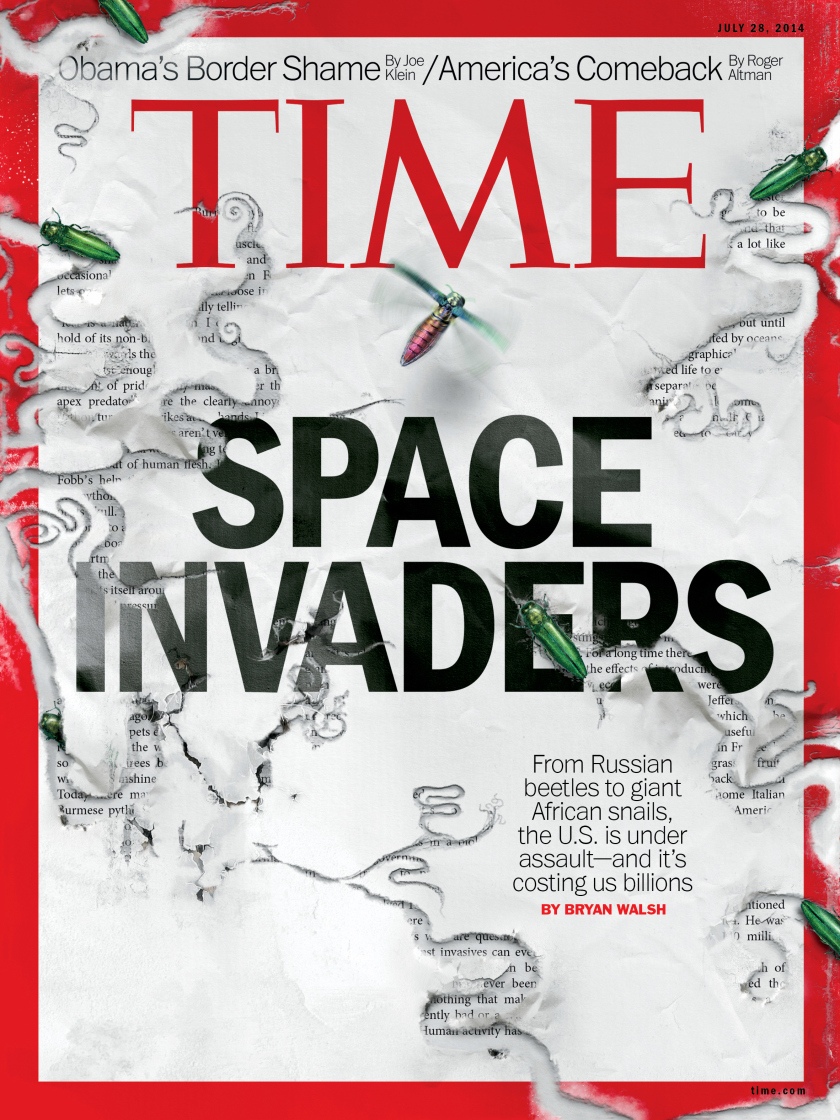
Jeannie and I subscribe to Time Magazine.  This week’s edition had a pretty eye-catching cover that required a second look.

Illustration by Justin Metz for Time. Photo reference for emerald ash borer courtesy of PDCNR—Forestry Archive, Bugwood.org

That cover referred to the lead article concerning invasive species, “From giant snails to Asian carp, alien wildlife is on the move.“, written by Bryan Walsh.  The essence of the article is that man’s global activities are responsible, albeit often unwittingly, for the movement of a wide range of species across national borders. My own reaction to the article was that it was typical of the many ‘scare’ stories the media present but that at the end of the day, nothing will change. However the last two paragraphs of the article did resonate with me.

Human beings have become the dominant force on the planet, so much so that many scientists believe we’ve entered an entirely new geological epoch: the Anthropocene.  We have already been shaping the planet unintentionally, through greenhouse-gas emissions and global trade and every other facet of modern existence. The challenge now is to take responsibility for that power over the planet and use it for the right ends – all the while knowing that there is no single correct answer, no lost state of grace we can beat back toward.

How we respond to the thickening invasions that we ourselves loosed will be part of that answer – which is only just. There is one species that can claim to be the most dominant invasive of all time. From its origins in Africa, this species has spread to every corner of the world and every kind of climate.  Everywhere it goes, it displaces natives, leaving extinction in its wake, altering habitat to suit its needs, with little regard for the ecological impact.  Its numbers have grown nearly a millionfold, and its spread shows no sign of stopping. If that invasive species sounds familiar, it should. It’s us.

Thus with that article from Time in mind, it was very pertinent to see the latest essay from George Monbiot.  It reinforces, in spades, the sentiment expressed by Bryan Walsh in those paragraphs above and is republished here on Learning from Dogs with the generous permission of George Monbiot.

ooOOoo

A One Way Street to Oblivion

As soon as an animal becomes extinct, a new bill proposes, it will be classified as “non-native”.

By George Monbiot, published on the Guardian’s website, 21st July 2014

Can any more destructive and regressive measures be crammed into one bill?

Already, the Infrastructure Bill, which, as time goes by, has ever less to do with infrastructure, looks like one of those US monstrosities into which a random collection of demands by corporate lobbyists are shoved, in the hope that no one notices.

So far it contains (or is due to contain) the following assaults on civilisation and the natural world:

– It exempts fracking companies from the trespass laws

– Brings in a legal requirement for the government to maximise the economic recovery of petroleum from the UK’s continental shelf. This is directly at odds with another legal requirement: to minimise the UK’s greenhouse gas emissions

Abandons the government’s commitment to make all new homes zero-carbon by 2016

– Introduces the possibility (through Clauses 21 and 22) of a backdoor route to selling off the public forest estate. When this was attempted before, it was thwarted by massive public protest.

– further deregulates the town and country planning system, making life even harder for those who wish to protect natural beauty and public amenities

– promotes new road building, even though the total volume of road traffic has flatlined since 2002.

Enough vandalism? Not at all. There’s yet another clause aimed at suppressing the natural world, which has, so far, scarcely been discussed outside parliament. If the Infrastructure Bill is passed in its current state, any animal species that “is not ordinarily resident in, or a regular visitor to, Great Britain in a wild state” will be classified as non-native and subject to potential “eradication or control”. What this is doing in an infrastructure bill is anyone’s guess.

At first wildlife groups believed it was just poor drafting, accidentally creating the impression that attempts to re-establish species which have become extinct here – such as short-haired bumblebees or red kites – would in future be stamped out. But the most recent Lords debate scotched that hope: it became clear that this a deliberate attempt to pre-empt democratic choice, in the face of rising public enthusiasm for the return of our lost and enchanting wildlife.

As Baroness Parminter, who argued unsuccessfully for changes to the bill, pointed out, it currently creates

“a one-way system for biodiversity loss, as once an animal ceases to appear in the wild, it ceases to be native.”

She also made the point that it’s not just extinct species which from now on will be treated as non-native, but, as the bill now stands, any species listed in Schedule 9 of the Wildlife and Countryside Act 1981.

Among those in Schedule 9 are six native species that have already been re-established in Britain (the capercaillie, the common crane, the red kite, the goshawk, the white-tailed eagle and the wild boar); two that are tentatively beginning to return (the night heron and the eagle owl); and four that have been here all along (the barn owl, the corncrake, the chough and the barnacle goose). All these, it seems, are now to be classified as non-native, and potentially subject to eradication or control.

After the usual orotund time-wasting by aristocratic layabouts (“my ancestor Sir Ewen Cameron of Lochiel, who was known as the great Sir Ewen … killed the last wolf in Scotland” etc), the minister promoting the bill, Baroness Kramer, made it clear that the drafting was no accident. All extinct species, it appears, are to be treated as non-native and potentially invasive. At no point did she mention any of the benefits their re-establishment might bring, such as restoring ecological function and bringing wonder and delight and enchantment back to this depleted land.

Here is a list, taken from Feral, of a few of the animals which have become extinct recently (in ecological terms) and which probably meet the bill’s new definition of non-native: “not ordinarily resident in, or a regular visitor to, Great Britain in a wild state”. Some would be widely welcomed; others not at all, but it’s clear that a debate about which species we might welcome back is one that many people in this country want to have, but that the government wants to terminate. There’s a longer list, with fuller explanations and a consideration of their suitability for re-establishment, in the book.

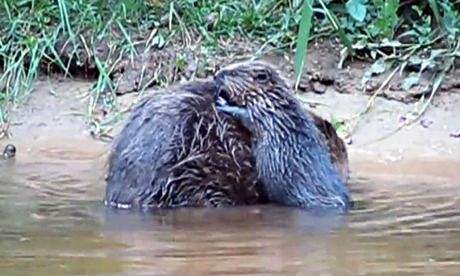
European Beaver: became extinct in Britain in the mid-18th Century, at the latest. Officially re-established in the Knapdale Forest, Argyll. Unofficially in the catchment of the River Tay and on the River Otter, in Devon.

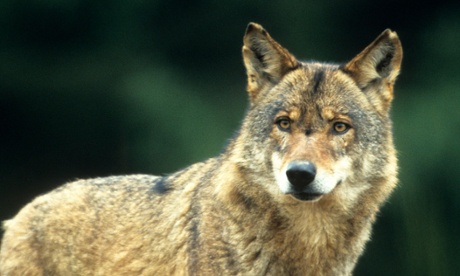
Wolf: The last clear record is 1621 (not 1743 as commonly supposed). It was killed in Sutherland. As far as I can determine, neither Sir Ewen Cameron nor any of the other blood-soaked lairds and congenital twits from whom Lord Cameron of Dillington is descended were involved.

Lynx: The last known fossil remains date from the 6th Century AD, but possible cultural records extend into the 9th Century.

Wild Boar: The last truly wild boar on record were killed on the orders of Henry III in the Forest of Dean, in 1260. Four small populations in southern England, established after escapes and releases from farms and collections.

Elk or Moose (Alces alces): The youngest bones found in Britain are 3,900 years old. Temporarily released in 2008 into a 450-acre enclosure on the Alladale Estate, Sutherland.

Reindeer: The most recent fossil evidence is 8,300 years old. A free-ranging herd grazes on and around Cairn Gorm in the Scottish Highlands.

Wild horse: The most recent clearly-established fossil is 9,300 years old. Animals belonging to the last surviving subspecies of wild horse, Przewalski’s (Equus ferus przewalskii), graze Eelmoor Marsh in Hampshire.

Forest bison, or wisent: Likely to have become extinct here soon before the peak of glaciation, between 15,000 and 25,000 years ago. A herd was temporarily established at Alladale in 2011.

Brown bear: probably exterminated around 2000 years ago.

Wolverine: survived here until roughly 8,000 years ago.

Lion: the last record of a lion in the region is a bone from an animal that lived in the Netherlands – then still connected to Britain – 10,700 years ago.

Spotted hyaena: around 11,000 years ago.

Hippopotamus: it was driven out of Britain by the last glaciation, around 115,000 years ago, and hunted to extinction elsewhere in Europe about 30,000 years ago.

Grey whale: the most recent palaentological remains, from Devon, belonged to a whale that died around 1610 AD.

Walrus: late Bronze Age, in the Shetland Islands.

European Sturgeon: possibly as recently as the 19th Century.

Blue stag beetle: probably 19th Century.

Eagle owl: the last certain record is from the Mesolithic, 9,000-10,000 years old . But a possible Iron Age bone has been found at Meare in Somerset. Now breeding in some places, after escaping from collections.

Goshawk: wiped out in the 19th Century. Unofficially re-established in the 20th Century, through a combination of deliberate releases and escapes from falconers.

Common crane: last evidence of breeding in Britain was in 1542. Cranes re-established themselves through migration in the Norfolk Broads in 1979, and have bred there since then. Now breeding in two other places in eastern England. Re-introduced in 2010 to the Somerset Levels.

White Stork: last recorded nesting in Edinburgh in 1416. In 2004 a pair tried to breed on an electricity pole in Yorkshire. In 2012 a lone bird built a nest on top of a restaurant in Nottinghamshire.

Spoonbill: the last breeding records are 1602 in Pembrokeshire and 1650 in East Anglia. In 2010 a breeding colony established itself at Holkham in Norfolk.

Night Heron: last bred here in either the 16th or 17th Century, at Greenwich. Today it is a scarce visitor.

Dalmatian Pelican: remains have been found from the Bronze Age in the Cambridgeshire Fens and from the Iron Age in the Somerset levels, close to Glastonbury. A single mediaeval bone has been found in the same place.

These and many others are now to be classified as officially non-native, unless this nonsense can be stopped.

Incidentally, determining what is and isn’t a native species, let alone what “should” or “should not” be living here, is a much more complicated business than you might imagine, as Ken Thompson’s interesting book, Where Do Camels Belong?, makes clear. He also points out that some species which are initially greeted with horror and considered an ecological menace soon settle down as local wildlife learns to prey on them or to avoid them. Sometimes they perform a useful ecological role by filling the gaps created by extinction. He overstates his case, and glosses over some real horror stories, but his book is an important counterweight to attempts to create a rigid distinction between native and non-native wildlife.

Many species introduced to this country by human beings are now cherished as honorary members of our native wildlife. Here are just a few I’ve come across. How many of you knew that they were all brought here by people?:

Brown hare

Little owl

Field poppy

Corncockle

Crack willow

Greater burdock

Pheasant’s eye

Cornflower

Wormwood

Mayweed

White campion

Isn’t this an interesting subject? Unfortunately government ministers seem to know to know nothing about it and to care even less. They are crashing through the middle of delicate interactions between people and the natural world like bulldozers in a rainforest.

www.monbiot.com

ooOOoo

I will close today’s post with another, very recent, story in The Guardian, that opens, thus:

Wild beaver kits born in Devon

Thursday 17 July 2014

One of the first wild beavers to be seen in England in centuries and due to be taken into captivity has given birth to three young.

Local retired environmentalist Tom Buckley captured the three young beavers climbing all over their mother. Photograph: Tom Buckley/Apex

A wild beaver due to be taken into captivity has given birth to at least three young.

The young, known as kits, were born to the family of two adult and one juvenile European beavers (Castor fiber) that were spotted living on the river Otter in Devon earlier this year, in what was believed to be the first sighting of the species in the wild in England in 500 years.

Do go and read the full article here.

All that is left for me to do is to quote a little from a recent letter from John Hurlburt.

 Our future depends on the air we breathe. Our lives depend upon rivers of living water. Our health requires the blessings of organic agriculture. Our energy streams through us from the cosmos.

We are warrior animals. Peace must come from within. Non-violence is our best choice.  We have the magnificent opportunity to wake up as an animal that is grateful and sings in harmony with the Earth.

The present is surrounded by the past and the future. We float on the wings of compassion and wisdom with a sacred responsibility for the Nature of all Creation.

Amen to that!