I am, of course, referring to the recent death of Stephen Hawking.
There’s no way that I can add anything to the widespread reporting of the very sad death of the theoretical physicist, cosmologist and author Professor Stephen Hawking.
Except, possibly, this interesting quirk of fate.
For this great man died yesterday: March 14th.
The very same day that another very famous man, the German-born Albert Einstein, was born. As in March 14th. Albeit, Stephen Hawking’s death being 139 years after the birth of the 1921 winner of the Nobel Prize in Physics.
Did you also know that Professor Hawking was a great dog lover!
I was very pleased that The Conversation blog site released a wonderful tribute to Stephen Hawking. The item opens, thus:
ooOOoo
Acclaimed British theoretical physicist, cosmologist and author Stephen Hawking has died aged 76. Hawking is best known for his work on black holes, which revolutionised our understanding of the universe.
Hawking passed away today peacefully at his home in Cambridge, his family confirmed in a statement:
We are deeply saddened that our beloved father passed away today. He was a great scientist and an extraordinary man whose work and legacy will live on for many years.
His courage and persistence with his brilliance and humour inspired people across the world. He once said, “It would not be much of a universe if it wasn’t home to the people you love.” We will miss him forever.
Hawking was born on January 8, 1942, in Oxford, England. In 1963 he was diagnosed with ALS, a form of Motor Neurone Disease, and later confined to a wheelchair and forced to communicate via a computerised voice. But he continued his theoretical work and was outspoken on many things over much of his life.
Tributes have been pouring in on social media for the scientist, who made complex science accessible to everyone in his 1988 bestselling book A Brief History of Time.
ooOOoo
Do read the rest of that article. I will take the tribute from Alice Gorman that closes The Conversation article to close today’s post.
ooOOoo
Alice Gorman, Senior Lecturer in archaeology and space studies, Flinders University
There are few scientists who reach as far into popular culture as Stephen Hawking did. His research tackled the biggest of big questions – the nature of time, space and the universe we live in.
Sometimes it feels like science is losing ground in the modern world, but people still look to the stars for answers about who we are and how we come to be here.
Hawking’s bestselling A Brief History of Time made cosmology accessible to people and brought black holes out of the shadows and into the public imagination.
Personally I’ll miss his appearances on The Big Bang Theory, where he could out-nerd the nerds, and also provide some often necessary common sense. It was always great to see a world-class scientist just having fun.
Completely overwhelmed by all you wonderful followers.
Yesterday, around mid-morning time, the number of good persons who are following this blog reached 3,000!
That is both wonderful and hugely generous of each and every one of you that ‘subscribes’ to this place.
I was going to publish another guest post but will delay that for twenty-four hours.
For as a mark of respect for all of you online people who have signed up to follow Learning from Dogs I want to republish a recent item that appeared on The Conversation site.
Here it is. Republished within the terms of The Conversation.
ooOOoo
Improve your internet safety: 4 essential reads
by Jeff Inglis, Science + Technology Editor, The Conversation US
On Feb. 6, technology companies, educators and others mark Safer Internet Day and urge people to improve their online safety. Many scholars and academic researchers around the U.S. are studying aspects of cybersecurity and have identified ways people can help themselves stay safe online. Here are a few highlights from their work.
1. Passwords are a weakness
With all the advice to make passwords long, complex and unique – and not reused from site to site – remembering passwords becomes a problem, but there’s help, writes Elon University computer scientist Megan Squire:
“The average internet user has 19 different passwords. … Software can help! The job of password management software is to take care of generating and remembering unique, hard-to-crack passwords for each website and application.”
That’s a good start.
2. Use a physical key
To add another layer of protection, keep your most important accounts locked with an actual physical key, writes Penn State-Altoona information sciences and technology professor Jungwoo Ryoo:
“A new, even more secure method is gaining popularity, and it’s a lot like an old-fashioned metal key. It’s a computer chip in a small portable physical form that makes it easy to carry around. The chip itself contains a method of authenticating itself.”
Just don’t leave your keys on the table at home.
3. Protect your data in the cloud
Many people store documents, photos and even sensitive private information in cloud services like Google Drive, Dropbox and iCloud. That’s not always the safest practice because of where the data’s encryption keys are stored, explains computer scientist Haibin Zhang at University of Maryland, Baltimore County:
“Just like regular keys, if someone else has them, they might be stolen or misused without the data owner knowing. And some services might have flaws in their security practices that leave users’ data vulnerable.”
So check with your provider, and consider where to best store your most important data.
“Attackers may find it very attractive to embed malicious software in the physical world, just waiting for unsuspecting people to scan it with a smartphone or a more specialized device. Hidden in plain sight, the malicious software becomes a sort of ‘sleeper agent’ that can avoid detection until it reaches its target.”
It’s a reminder that using the internet more safely isn’t just a one-day effort.
ooOOoo
So be safe all of you! It’s a very different world to that of twenty or more years ago!
I am referring to the result of the British election that was held last Thursday.
Now I am well aware that many readers will not have the same relationship with the outcomes of British elections as your faithful scribe. But I am also aware that we live in a very connected world. I am also acutely aware that for many, many years I was a devoted listener to the 15-minute weekly radio broadcast on the BBC by Alistair Cooke Letter from America.
So for me, and many others I don’t doubt, the views of America as to what goes on across the pond are just as fascinating today as they have always been.
But in the absence of dear Mr. Cooke (20 November 1908 – 30 March 2004) passing on his experienced assessment on what the outcomes of British elections mean for America then I turn to a recent item on The Conversation site and republished here within the terms of that site.
ooOOoo
How populism explains May’s stunning UK election upset: Experts react
June 9, 2017 6.04am EDT
Editor’s note: U.K. Prime Minister Theresa May’s election gamble failed badly as her Conservatives lost 12 seats, leaving them with 318, shy of a majority. It was a stunning loss for a party earlier projected to gain dozens of seats. Without a majority, the Conservatives will have to rely on another party to govern – known as a hung Parliament. If they’re unable to forge a coalition, rival Labour leader Jeremy Corbyn – whose party gained 31 seats – would be able to give it a go. We asked two experts to offer their insights on what Americans should make of the election and its results.
May had a bad night and may face a struggle over her party’s leadership
The results of this election show how similar, and yet how different, British politics are from what is happening in America.
As in the United States, there has been an explosion of populism in Britain, most recently evidenced by the Brexit referendum. This new political force is translating into less liberal policies from the major parties.
In continental Europe, the new populism is mostly embodied by the resurgent far right. But in Britain, as in America, it is being filtered through the existing two-party system – though the U.K.‘s smaller parties do complicate the electoral map.
To accommodate the political winds, May and her Conservatives decided to shift their electoral strategy away from Margaret Thatcher’s pro-market economic approach toward a greater focus on immigration, security and economic nationalism.
Labour leader Jeremy Corbyn, for his part, deserted the more centrist “New Labour” ideas of Tony Blair in favor of a more robust form of social democracy.
The American left, like its British counterpart, has also become increasingly skeptical of unbridled markets. But among Republicans, a traditional hostility to “big government” makes pro-worker redistributive policies, some of which the Tories have adopted to win votes, hard to stomach. For this reason, populism on the American right has mostly taken the form of protectionist and anti-immigrant policies, as embodied by Donald Trump.
Yesterday’s results were devastating for May and indicate that the Conservatives were ultimately unable to balance their new populist message with their traditional support for neo-liberal policies.
Corbyn, for his part, will use this unexpected victory (of sorts) to solidify his hold over the Labour Party and to move it further to the left.
It remains to be seen whether the election will result in a minority or a coalition government, or whether the parties will be well and truly deadlocked. Whatever happens, the British electorate, like its cousin across the pond, has shown itself to be highly polarized.
Still, at a minimum, Britain’s parliamentary structure, along with the ability of the Labour leadership to co-opt disillusioned voters, seems to have spared Britain the fate of America – the takeover of government by a populist insurgent.
Corbyn and his Labour Party had reasons to smile on election night. AP Photo/Frank Augstein
May took a calculated political risk and lost. While the market reaction has been severe, with the pound plunging, it’s nothing new to companies, which take calculated risks like that every day – some pay off and some do not.
So first of all, U.S. corporate executives will need to take a deep breath. Assuming a combination of other parties do not cobble together at least 322 seats – despite winning seven seats, Northern Ireland’s Sinn Fein will not send MPs to London – the Conservatives will dominate a coalition government and have considerable sway over policy.
This means a “hard Brexit,” as outlined by May in January, and as seen in the European Union’s tough negotiating guidelines, is unlikely to change. But this is what most U.S. companies have been planning for anyway since last June’s Brexit vote. Many companies, particularly banks and financial institutions, are already planning to move some of their U.K. operations to other EU countries to take advantage of the single market rules.
This process will continue no matter who’s in power, since only the low-polling Liberal Democrat and Green parties promised a Brexit revote.
Second, a weakened Conservative Party will need more foreign friends, and that includes U.S. companies. Since Brexit, some foreign businesses have threatened to downsize or close their U.K. operations as leverage for obtaining government subsidies. Expect more companies to use this strategy with a weaker U.K. government.
As I argue in my recent book, the business environment of Europe is much more than the U.K. market, and U.S. companies have become increasingly aware of this since Brexit.
In other words, it’s business as usual, and that means the continued segmenting of companies’ U.K. and EU strategies, regardless of who is governing in London.
ooOOoo
Expect things to continue to be interesting for some time. Or as more eloquently put by Tariq Ramadan “Times have changed; so must the lenses through which we see the political future.”
Back to Alistair Cooke. There are many of his broadcasts available on the BBC Radio website and on YouTube.
I’m closing with just a small part of Charlie Rose interviewing Alistair Cooke in May, 1996.
Uploaded on Sep 25, 2011
Tuesday, May 7, 1996
Charlie Rose: An interview with Alistair Cooke
Alistair Cooke celebrates the 50 year anniversary of his BBC broadcast, “Letter from America”, a 15-minute talk about life in America for British listeners.
Recorded some twenty-one years ago. Somethings don’t seem to change!
Will optimistic stories get people to care about nature?
By Diogo Veríssimo David H. Smith Conservation Research Fellow, Georgia State University
May 7, 2017
Nature doesn’t make the news often these days. When it does, the story usually revolves around wildlife on the brink, record-setting climate extremes or ruined landscapes. However, that is not the whole story. There is also good news, but it often receives little attention.
It is easy to see how bleak accounts of the state of the planet can overwhelm people and make them feel hopeless. What is the point of even trying if the world is going down the drain anyway?
To muster public and political support on a scale that matches our environmental challenges, research shows that negative messaging is not the most effective way forward. As a conservation scientist and social marketer, I believe that to make the environment a mainstream concern, conservation discussions should focus less on difficulties. Instead we should highlight the growing list of examples where conservation efforts have benefited species, ecosystems and people living alongside them.
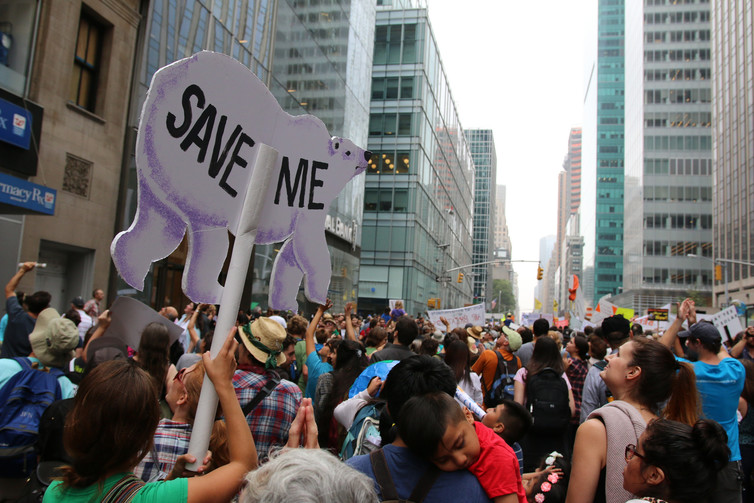
People’s Climate March, New York, New York, Sept. 21, 2014. CIFOR/Flickr, CC BY-NC-ND
The power of positive messages
This question is not new. Professionals in many fields have to consider how to frame their messages to maximize their impact. For example, public health agencies can make positive recommendations that emphasize benefits of being disease-free, or use negative messages that focus on the consequences of disease. A 2008 meta-analysis of 60 health communication studies concluded that messages focused on loss were less likely to be effective than positive messages.
Another study examined ads designed to persuade income support recipients to report their incomes. It concluded that messages focused on fear, shame or guilt could generate emotional backlash, in which people rationalized decisions to protect themselves from feeling ashamed of their behavior. This approach also caused emotional saturation that led people to “switch off” from the message because of its negativity.
Environmental advocates also confront this challenge. Much discussion has centered on the issue of climate change, where a number of scholars and advocates assert that doom-and-gloom messaging has not been effective. Yet until recently, we have not asked the same question about how we frame nature conservation.
Lost and found species
Today a growing number of scholars and activists are working to create a positive vision for protecting wildlife and wild places. One key effort started in 2014 with the launch of a marine conservation movement called Ocean Optimism, which works to “create a new narrative of hope for our oceans,” and by doing so, to help move towards “a sustainable future for our seas.”
In April 2017 the Earth Optimism Summit, organized by the Smithsonian Institution, brought together environmentalists, scientists, industry and the media to shift the global conservation movements focus away from problems and toward solutions. What started as a single event in Washington, D.C. soon turned into a truly global movement, with about 30 sister events in countries including Colombia, New Zealand and Hong Kong.
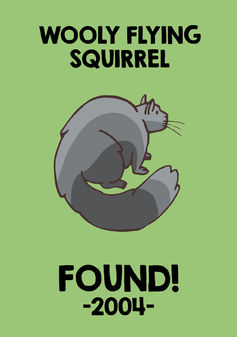
Lost & Found – Author provided
This effort has kick-started a range of initiatives that are all about communicating conservation bright spots to as many people as possible. One, which I co-founded, is the Lost & Found project, sponsored by the Society for Conservation Biology and the British Ecological Society. This online storytelling initiative focuses on a particularly inspiring kind of good news: rediscovering species that once were thought to be long extinct. After all, what can be more rousing than recovering something unique that you thought was lost forever?
Every year numerous species thought to have disappeared are rediscovered. Over the past century more than 300 species have been rediscovered, mostly in the tropics. On average, these species were missing for about 60 years before being rediscovered. Most rediscovered species have restricted ranges and small populations, which means they are usually highly threatened.
Lost & Found – Author provided
Our goal is not only to tell good stories, but also to showcase the dedication and determination of adventurers who lead these improbable quests and rewrite the history of species they care deeply about. While not every reader may be interested in a red-crested tree rat or a golden-fronted bower bird, all humans are curious about other people.
Lost & Found is making content available in various formats, including text, comics and soon, video animations. This helps make the stories more accessible to people who are not instinctively inclined to read about nature. Currently we have 13 stories freely available online that feature diverse species, from squirrels and toads to bats and birds. They cover a wide geographic range, from Latin America and Oceania to North America and Southeast Asia.
The response has been tremendously positive. More than 1,000 people from over 50 countries visited the website in its first 10 days. Some of our more popular stories, such as the Bulmer’s Fruit Bat and the Cave Splayfoot Salamander, are animals that would commonly not be considered particularly charismatic.
Getting these inspirational rediscoveries into the hands of as many people as possible is a first step toward creating a more positive vision for Earth’s future. The timeless principles of storytelling seem like the right place to start. After all, who doesn’t love a happy ending?
ooOOoo
Did you note the name of that website!!
Lost & Found. Go visit it and enjoy these wonderful happy endings!
The posts for the last two days have carried separate and very different stories of terrible cruelty to dogs, the second one involving terrible cruelty to a dog and a bull! As a tradition! Ouch!!
Readers of this place know what they feel about dogs. It is felt deep within their hearts. Those feelings are poured out when, either from me or someone else, there’s a post lamenting the loss of their dog.
Just as a tiny example of that love we all have for our dogs, here’s a response from Marina Kanavaki and, trust me, Marina is far from being alone in this regard.
Oh, no, Paul!!! I’m so sorry my friend! It is hard to believe and not so long ago, Casey. I know words can’t take away the pain but you have my thoughts and I’m sending you both my love and hugs.
So a recent essay published on The Conversation site is a must to share with you today. As usual, it is republished within the terms of The Conversation.
ooOOoo
Why losing a dog can be harder than losing a relative or friend
March 9, 2017 Frank T. McAndrew, Cornelia H. Dudley Professor of Psychology, Knox College.
Recently, my wife and I went through one of the more excruciating experiences of our lives – the euthanasia of our beloved dog, Murphy. I remember making eye contact with Murphy moments before she took her last breath – she flashed me a look that was an endearing blend of confusion and the reassurance that everyone was ok because we were both by her side.
When people who have never had a dog see their dog-owning friends mourn the loss of a pet, they probably think it’s all a bit of an overreaction; after all, it’s “just a dog.”
However, those who have loved a dog know the truth: Your own pet is never “just a dog.”
Many times, I’ve had friends guiltily confide to me that they grieved more over the loss of a dog than over the loss of friends or relatives. Research has confirmed that for most people, the loss of a dog is, in almost every way, comparable to the loss of a human loved one. Unfortunately, there’s little in our cultural playbook – no grief rituals, no obituary in the local newspaper, no religious service – to help us get through the loss of a pet, which can make us feel more than a bit embarrassed to show too much public grief over our dead dogs.
Perhaps if people realized just how strong and intense the bond is between people and their dogs, such grief would become more widely accepted. This would greatly help dog owners to integrate the death into their lives and help them move forward.
An interspecies bond like no other
What is it about dogs, exactly, that make humans bond so closely with them?
For starters, dogs have had to adapt to living with humans over the past 10,000 years. And they’ve done it very well: They’re the only animal to have evolved specifically to be our companions and friends. Anthropologist Brian Hare has developed the “Domestication Hypothesis” to explain how dogs morphed from their grey wolf ancestors into the socially skilled animals that we now interact with in very much the same way as we interact with other people.
Perhaps one reason our relationships with dogs can be even more satisfying than our human relationships is that dogs provide us with such unconditional, uncritical positive feedback. (As the old saying goes, “May I become the kind of person that my dog thinks I already am.”)
This is no accident. They have been selectively bred through generations to pay attention to people, and MRI scans show that dog brains respond to praise from their owners just as strongly as they do to food (and for some dogs, praise is an even more effective incentive than food). Dogs recognize people and can learn to interpret human emotional states from facial expression alone. Scientific studies also indicate that dogs can understand human intentions, try to help their owners and even avoid people who don’t cooperate with their owners or treat them well.
Our strong attachment to dogs was subtly revealed in a recent study of “misnaming.” Misnaming happens when you call someone by the wrong name, like when parents mistakenly calls one of their kids by a sibling’s name. It turns out that the name of the family dog also gets confused with human family members, indicating that the dog’s name is being pulled from the same cognitive pool that contains other members of the family. (Curiously, the same thing rarely happens with cat names.)
It’s no wonder dog owners miss them so much when they’re gone.
Psychologist Julie Axelrod has pointed out that the loss of a dog is so painful because owners aren’t just losing the pet. It could mean the loss of a source of unconditional love, a primary companion who provides security and comfort, and maybe even a protégé that’s been mentored like a child.
The loss of a dog can also seriously disrupt an owner’s daily routine more profoundly than the loss of most friends and relatives. For owners, their daily schedules – even their vacation plans – can revolve around the needs of their pets. Changes in lifestyle and routine are some of the primary sources of stress.
According to a recent survey, many bereaved pet owners will even mistakenly interpret ambiguous sights and sounds as the movements, pants and whimpers of the deceased pet. This is most likely to happen shortly after the death of the pet, especially among owners who had very high levels of attachment to their pets.
While the death of a dog is horrible, dog owners have become so accustomed to the reassuring and nonjudgmental presence of their canine companions that, more often than not, they’ll eventually get a new one.
So yes, I miss my dog. But I’m sure that I’ll be putting myself through this ordeal again in the years to come.
ooOOoo
Just let the messages of this essay reverberate around your heart. I’ll say no more!
Resolving the falsehoods may not be so straightforward as one thinks.
I’m going straight into this last post of my mini-series looking at the state of things. Namely a recent essay published by Professor Ronald Pies:
Professor of Psychiatry, Lecturer on Bioethics & Humanities at SUNY Upstate Medical University; and Clinical Professor of Psychiatry, Tufts University School of Medicine, Tufts University
I am a psychiatrist and ethicist affiliated with SUNY Upstate Medical University, Syracuse, NY; and Tufts University School of Medicine in Boston. I write on a variety of cross-disciplinary topics, ranging from mental health to philosophy of mind to spirituality. Most recently, I have authored the novella, “The Late Life Bloom of Rose Rabinowitz;” and the poetry chapbook, “The Myeloma Year.”
Here is that post, republished within the terms of The Conversation.
ooOOoo
‘Alternative facts’: A psychiatrist’s guide to twisted relationships to truth
March 1, 2017
The phrase “alternative facts” has recently made the news in a political context, but psychiatrists like me are already intimately acquainted with the concept – indeed, we hear various forms of alternate reality expressed almost every day.
All of us need to parse perceived from actual reality every day, in nearly every aspect of our lives. So how can we sort out claims and beliefs that strike most people as odd, unfounded, fantastical or just plain delusional?
Untruths aren’t always lies
First, we need to make a distinction often emphasized by ethicists and philosophers: that between a lie and a falsehood. Thus, someone who deliberately misrepresents what he or she knows to be true is lying – typically, to secure some personal advantage. In contrast, someone who voices a mistaken claim without any intent to deceive is not lying. That person may simply be unaware of the facts, or may refuse to believe the best available evidence. Rather than lying, he’s stating a falsehood.
Some people who voice falsehoods appear incapable of distinguishing real from unreal, or truth from fiction, yet are sincerely convinced their worldview is absolutely correct. And this is our entree into the psychiatric literature.
In clinical psychiatry, we see patients with a broad spectrum of ideas that many people would find eccentric, exaggerated or blatantly at odds with reality. The clinician’s job is, first, to listen empathically and try to understand these beliefs from the patient’s point of view, carefully taking into account the person’s cultural, ethnic and religious background.
Sometimes, clinicians can be wildly mistaken in their first impressions. A colleague of mine once described a severely agitated patient who was hospitalized because he insisted he was being stalked and harassed by the FBI. A few days into his hospitalization, FBI agents showed up on the unit to arrest the patient. As the old joke goes, just because you’re paranoid doesn’t mean they aren’t after you!
We can think of distortions of reality as falling along a continuum, ranging from mild to severe, based on how rigidly the belief is held and how impervious it is to factual information. On the milder end, we have what psychiatrists call over-valued ideas. These are very strongly held convictions that are at odds with what most people in the person’s culture believe, but which are not bizarre, incomprehensible or patently impossible. A passionately held belief that vaccinations cause autism might qualify as an over-valued idea: it’s not scientifically correct, but it’s not utterly beyond the realm of possibility.
On the severe end of the continuum are delusions. These are strongly held, completely inflexible beliefs that are not altered at all by factual information, and which are clearly false or impossible. Importantly, delusions are not explained by the person’s culture, religious beliefs or ethnicity. A patient who inflexibly believes that Vladimir Putin has personally implanted an electrode in his brain in order to control his thoughts would qualify as delusional. When the patient expresses this belief, he or she is not lying or trying to deceive the listener. It is a sincerely held belief, but still a falsehood.
Falsehoods of various kinds can be voiced by people with various neuropsychiatric disorders, but also by those who are perfectly “normal.” Within the range of normal falsehood are so-called false memories, which many of us experience quite often. For example, you are absolutely certain you sent that check to the power company, but in fact, you never did.
As social scientist Julia Shaw observes, false memories “have the same properties as any other memories, and are indistinguishable from memories of events that actually happened.” So when you insist to your spouse, “Of course I paid that electric bill!” you’re not lying – you are merely deceived by your own brain.
A much more serious type of false memory involves a process called confabulation: the spontaneous production of false memories, often of a very detailed nature. Some confabulated memories are mundane; others, quite bizarre. For example, the person may insist – and sincerely believe – that he had eggs Benedict at the Ritz for breakfast, even though this clearly wasn’t the case. Or, the person may insist she was abducted by terrorists and present a fairly elaborate account of the (fictional) ordeal. Confabulation is usually seen in the context of severe brain damage, such as may follow a stroke or the rupture of a blood vessel in the brain.
Lying as a default
Finally, there is falsification that many people would call pathological lying, and which goes by the extravagant scientific name of pseudologia fantastica (PF). Writing in the Psychiatric Annals, Drs. Rama Rao Gogeneni and Thomas Newmark list the following features of PF:
A marked tendency to lie, often as a defensive attempt to avoid consequences. The person may experience a “high” from this imaginative story-telling.
The lies are quite dazzling or fantastical, though they may contain truthful elements. Often, the lies may capture considerable public attention.
The lies tend to present the person in a positive light, and may be an expression of an underlying character trait, such as pathological narcissism. However, the lies in PF usually go beyond the more “believable” stories of persons with narcissistic traits.
Although the precise cause or causes of PF are not known, some data suggest abnormalities in the white matter of the brain – bundles of nerve fibers surrounded by an insulating sheath called myelin. On the other hand, the psychoanalyst Helene Deutsch argued that PF stems from psychological factors, such as the need to enhance one’s self-esteem, secure the admiration of others or to portray oneself as either a hero or a victim.
Who cares about facts anyway?
Of course, all of this presumes something like a consensus on what constitutes “reality” and “facts” and that most people have an interest in establishing the truth. But this presumption is looking increasingly doubtful, in the midst of what has come to be known as the “post-truth era.” Charles Lewis, the founder of the Center for Public Integrity, described ours as a period in which “up is down and down is up and everything is in question and nothing is real.”
Are lies becoming our rose-colored glasses? Christian Bucad, CC BY-NC-ND
Even more worrisome, the general public seems to have an appetite for falsehood. As writer Adam Kirsch recently argued, “more and more, people seem to want to be lied to.” The lie, Kirsch argues, is seductive: “It allows the liar and his audience to cooperate in changing the nature of reality itself, in a way that can appear almost magical.”
Psychiatrists are not in a position to comment on the mental health of public figures they have not personally evaluated or on the nature of falsehoods sometimes voiced by our political leaders. Indeed, the “Goldwater Rule” prohibits us from doing so. Nevertheless, psychiatrists are keenly aware of the all-too-human need to avoid or distort unpleasant truths. Many would likely nod in agreement with an observation often attributed to the psychoanalyst Carl Jung: “People cannot stand too much reality.”
ooOOoo
With Carl Jung’s words echoing in one’s mind the reaction that does come to me and, undoubtedly, to many others, is that the time for limiting what degree of reality we can take on board is rapidly coming to a close.
Or so much more elegantly conveyed by Maya Angelou.
Back to more gentle and soft ideas tomorrow – and that’s the Truth!
Or, more specifically, do we believe we have free will?
One of the endless benefits of this wired-up, digital world is how easy it is to have one’s mind opened and stretched a little.
Take this, for instance, as an intriguing start to a new day.
Do we have free will?
This isn’t a question I can answer, but what I am interested in is “what happens if we do (or do not) believe in free will?” In other words, does believing in free will matter in your daily life?
Just let one’s mind float around that idea, not only as it applies to us humans but also to the animals that share our human intuition, such as dogs and horses.
So what’s got me bubbling along today? Nothing less than an article that appeared on The Conversation blog-site back last September.
I found it fascinating and hope you do as well. It is republished within the terms of The Conversation site.
ooOOoo
Believing in free will makes you feel more like your true self
September 1, 2016
By Elizabeth Seto, Ph.D. Candidate in Social and Personality Psychology, Texas A&M University .
Do we have free will? This is a question that scholars have debated for centuries and will probably continue to debate for centuries to come.
This isn’t a question I can answer, but what I am interested in is “what happens if we do (or do not) believe in free will?” In other words, does believing in free will matter in your daily life?
My colleagues and I at the Existential Psychology Lab at Texas A&M University study the psychological outcomes of belief in free will. While contemplating my next research project, I realized at some point in our lives, we all want to understand who we are – it’s human nature. So, we decided to explore how believing in free will influences our sense of self and identity.
Free will is generally understood as the ability to freely choose our own actions and determine our own outcomes. For example, when you wake up in the morning, do you hit snooze? Do you put on your workout gear and go for a run? Do you grab a hot cup of coffee? While those are simple examples, if you believe in free will, you believe there are a limitless number of actions you can engage in when you wake up in the morning, and they are all within your control.
Believing in free will helps people exert control over their actions. This is particularly important in helping people make better decisions and behave more virtuously.
For instance, research has found that promoting the idea that a person doesn’t have free will makes people become more dishonest, behave aggressively and even conform to others’ thoughts and opinions. And how can we hold people morally responsible for their actions if we don’t believe they have the free will to act any differently? Belief in free will allows us to punish people for their immoral behaviors.
So, not only is there a value to believing in free will, but those beliefs have profound effects on our thoughts and behaviors. It stands to reason that believing in free will influences how we perceive ourselves.
You might be thinking, “Of course believing in free will influences how I feel about myself.” Even though this seems obvious, surprisingly little research has examined this question. So, I conducted two studies to suss out more about how believing in free will makes us feel.
What believing in free will makes us feel about ourselves
In the first study, I recruited 304 participants from Amazon Mechanical Turk and randomly assigned them to write about either personal experiences reflecting a high belief in free will, like changing career paths or resisting drugs or alcohol, or experiences reflecting a low belief in free will, such as growing up in poverty or working under an authoritative boss. Then, they were all asked to evaluate their sense of self.
Participants who wrote about experiences reflecting low belief in free will reported feeling less “in touch” with their true selves. In other words, they felt like they did not know themselves as well as the participants who wrote about experiences reflecting high belief in free will.
Then, I conducted a follow-up study testing one’s sense of authenticity, the feeling that one is behaving according to their own beliefs, desires and values.
I recruited another group of participants from Amazon Mechnical Turk, and like the first experiment, randomly assigned them to write about personal experiences demonstrating high belief in free will or low belief in free will. Then, they all completed a decision-making task where they had to make a series of choices about whether to donate money to charity or to keep the money for themselves.
Afterwards, participants were asked how authentic they felt while making their decisions. Participants in the low free will group reported feeling less authentic than participants in the high free will group.
Ultimately, when people feel they have little control over their actions and outcomes in life, they feel more distant from their true, authentic selves. They are less in touch with who they are and do not believe their actions reflect their core beliefs and values.
We believe this is because belief in free will is linked to feelings of agency, the sense that we are the authors of our actions and are actively engaged with the world. As you can imagine, this sense of agency is an important part of a person’s identity.
The importance of feeling like you are in charge of your life applies to significant actions like moving or getting a new job or pondering the big questions in life. But it also applies to the minor decisions we make throughout the day.
Here’s one simple, though relatable, decision I am faced with every morning. When I wake up in the morning and decide to put on my workout gear and go for a run instead of hitting snooze, I might feel like I am the primary decision-maker for this morning routine. Additionally, I am most likely acting on the part of me that values physical health.
But what if I wake up, and I feel like I can’t exercise because I have to go to work or some other external factor is making it difficult to go? I might feel as if someone or something else is controlling my behavior, and perhaps, less like my true self.
So, do you have free will? Do any of us? Remember, the question isn’t whether it exists or not, but whether you believe it does.
ooOOoo
Now thinking of dogs having their own free will might seem a little bizarre, but I do not intend it to be seen as such. Many of you will have dogs (and horses) that have ‘minds of their own’.
For our family here at home, if there’s one of our dogs that exhibits free will it is our Brandy.
Our Brandy is a Pyrenean Mastiff!
Without warning or any other indication, he will suddenly decide it is time to go ‘walk-about’. Mainly during the day but sometimes at night, whatever the weather, he will disappear. He will always return but can be wandering around our thirteen acres for up to an hour.
For those looking for answers to the crisis in liberal democracy, this may well be it.
In yesterday’s post Tensions abound in many societies I offered a viewpoint that the ‘left’ arguing with the ‘right’ in politics was utterly inappropriate. Simply for we, as in the people who live on this planet, have to start working together if we wish to have a future for mankind on Planet Earth.
Yesterday’s post also referred to Inductive and Deductive Reasoning with me proposing that the future had to be built on a universally acknowledged relationship between ’cause’ and ‘effect’. A relationship that was built on a clear axiom, or theorem; as we see all around us in both the physical and natural worlds.
This idea does take a little time to filter through and I would be the first to say that I had to spend quite a while reflecting on the idea to fully understand the difference, the power, of deductive reasoning. Plus how something that was a behaviourial ‘law’ could be seen as much as an axiom as is, for example, the calculation of the speed of light, or the relationship of gravity to mass.
His thesis is that there is a direct relationship between “… about how well dispersed economic decision-making power is and how much control and financial security people have over their lives.“
That relationship is the core message of his essay.
In other words, as I see it, there is an axiom, a theorem, that governs the relationship between the leadership process of a country and the degree to which that country’s society could be classed as a democratic society.
If 2016 brought Brexit, Donald Trump and a backlash against cosmopolitan visions of globalisation and society, the great fear for 2017 is further shocks from right-wing populists like Geert Wilders in Holland and Marine Le Pen in France. A new mood of intolerance, xenophobia and protectionist economics seems to be in the air.
In a world of zero-hour contracts, Uber, Deliveroo and the gig economy, access to decent work and a sustainable family income remains the main fault line between the winners and losers from globalisation. Drill into the voter data behind Brexit and Trump and they have much to do with economically marginalised voters in old industrial areas, from South Wales to Nord-Pas-de-Calais, from Tyneside to Ohio and Michigan.
These voters’ economic concerns about industrial closures, immigrants and businesses decamping to low-wage countries seemed ignored by a liberal elite espousing free trade, flexible labour and deregulation. They turned instead to populist “outsiders” with simplistic yet ultimately flawed political and economic narratives.
Much has been said about the crisis of liberal political democracy, but these trends look inextricably linked with what is sometimes referred to as economic democracy. This is about how well dispersed economic decision-making power is and how much control and financial security people have over their lives. I’ve been involved in a project to look at how this compares between different countries. The results say much about the point we have reached, and where we might be heading in future.
The index
Our economic democracy index looked at 32 countries in the OECD (omitting Turkey and Mexico, which had too much missing data). While economic democracy tends to focus on levels of trade union influence and the extent of cooperative ownership in a country, we wanted to take in other relevant factors.
We added three additional indicators: “workplace and employment rights”; “distribution of economic decision-making powers”, including everything from the strength of the financial sector to the extent to which tax powers are centralised; and “transparency and democratic engagement in macroeconomic decision-making”, which takes in corruption, accountability, central bank transparency and different social partners’ involvement in shaping policy.
What is striking is the basic difference between a more “social” model of northern European capitalism and the more market-driven Anglo-American model. Hence the Scandinavian countries score among the best, with their higher levels of social protection, employment rights and democratic participation in economic decision-making. The reverse is true of the more deregulated, concentrated and less democratic economies of the English-speaking world. The US ranks particularly low, with only Slovakia below it. The UK too is only 25th out of 32.
Economic Democracy Index, figures from 2013. Andrew Cumbers
Interestingly, France ranks relatively highly. This reflects its strong levels of job protection and employee involvement in corporate decision-making – the fact that the far right has been strong in France for a number of years indicates its popularity stems from race at least as much as economics.
Yet leading mainstream presidential candidates François Fillon and Emmanuel Macron are committed to reducing France’s protections. These are often blamed – without much real evidence – for the country’s sluggish job creation record. There is a clear danger both here and in the Netherlands that a continuing commitment to such neoliberal labour market policies might push working class voters further towards Le Pen and Wilders.
One other notable disparity in the index is between the scores of Austria and Germany, despite their relatively similar economic governance. Germany’s lower ranking reflects the growth of labour market insecurity and lower levels of job protection, particularly for part-time workers as part of the Hartz IV labour market reforms in the 1990s that followed reunification.
The index also highlights the comparatively poor levels of economic democracy in the “transition” economies of eastern Europe. The one very interesting exception is Slovenia, which merits further study. It might reflect both its relatively stable transition from communism and the civil war in the former Yugoslavia, and the continuing presence of active civil society elements in the trade union and cooperative movements. Southern European economies also tend to rank below northern European countries, as does Japan.
Poverty and inequality
The index provides strong evidence that xenophobic politics may be linked to changing levels of economic participation and empowerment – notwithstanding the French data. We found that the greater the poverty and inequality in a country, the lower the rates of economic democracy.
These findings suggest, for example, that the Anglo-American-led attack on trade unions and flexible labour policies may actually drive up poverty and inequality by cutting welfare benefits and driving up individual employment insecurity. While the OECD itself advocated these policies until recently, countries with high levels of economic democracy such as Norway, Denmark and Iceland have much lower levels of poverty than countries such as the US and UK.
Far right activists in Budapest, Hungary, February 2016. EPA
Far-right populism is on the march everywhere, including the Nordic countries. But Brexit, Trump and the more serious shift to the far right in Eastern Europe have been accompanied by diminishing economic security and rights at work, disenfranchised trade unions and cooperatives, and economic decision-making concentrated among financial, political and corporate elites.
We will monitor these scores in future to see what happens over time. It will be interesting to see how the correlations between economic democracy, poverty and voting patterns develop in the coming years. For those looking for answers to the crisis in liberal democracy, this may well be it.
ooOOoo
I shall be writing to Professor Cumbers asking if my analysis of that relationship is supported by his research.
For if it is then we do have a very clear axiom that few would disagree with. That is the political consensus this world needs now.
The philosophy of hunting in terms of it being ‘right’ or ‘wrong’.
Anyone who comes here for more than a couple of visits will know that both Jean and I are opposed to hunting completely. Period!
That’s not surprising as there have been a number of posts over the years describing how we feed the wild deer. Here’s three more photographs that haven’t previously been shared with you.
oooo
oooo
But, of course, the opinions of Jean and me are not, and should not be, the rule for the wider population of this part of Oregon.
All I would ask is that there is a proper, mature discussion as to the pros and cons of hunting wild animals in this, the twenty-first century.
Every year as daylight dwindles and trees go bare, debates arise over the morality of hunting. Hunters see the act of stalking and killing deer, ducks, moose and other quarry as humane, necessary and natural, and thus as ethical. Critics respond that hunting is a cruel and useless act that one should be ashamed to carry out.
As a nonhunter, I cannot say anything about what it feels like to shoot or trap an animal. But as a student of philosophy and ethics, I think philosophy can help us clarify, systematize and evaluate the arguments on both sides. And a better sense of the arguments can help us talk to people with whom we disagree.
Therapeutic hunting involves intentionally killing wild animals in order to conserve another species or an entire ecosystem. In one example, Project Isabella, conservation groups hired marksmen to eradicate thousands of feral goats from several Galapagos islands between 1997 and 2006. The goats were overgrazing the islands, threatening the survival of endangered Galapagos tortoises and other species.
Subsistence hunting is intentionally killing wild animals to supply nourishment and material resources for humans. Agreements that allow Native American tribes to hunt whales are justified, in part, by the subsistence value the animals have for the people who hunt them.
Crawford Patkotak, center, leads a prayer after his crew landed a bowhead whale near Barrow, Alaska. Both revered and hunted by the Inupiat, the bowhead whale serves a symbol of tradition, as well as a staple of food. AP Photo/Gregory Bull
In contrast, sport hunting refers to intentionally killing wild animals for enjoyment or fulfillment. Hunters who go after deer because they find the experience exhilarating, or because they want antlers to mount on the wall, are sport hunters.
These categories are not mutually exclusive. A hunter who stalks deer because he or she enjoys the experience and wants decorative antlers may also intend to consume the meat, make pants from the hide and help control local deer populations. The distinctions matter because objections to hunting can change depending on the type of hunting.
What bothers people about hunting: Harm, necessity and character
Critics often argue that hunting is immoral because it requires intentionally inflicting harm on innocent creatures. Even people who are not comfortable extending legal rights to beasts should acknowledge that many animals are sentient – that is, they have the capacity to suffer. If it is wrong to inflict unwanted pain and death on a sentient being, then it is wrong to hunt. I call this position “the objection from harm.”
If sound, the objection from harm would require advocates to oppose all three types of hunting, unless it can be shown that greater harm will befall the animal in question if it is not hunted – for example, if it will be doomed to slow winter starvation. Whether a hunter’s goal is a healthy ecosystem, a nutritious dinner or a personally fulfilling experience, the hunted animal experiences the same harm.
But if inflicting unwanted harm is necessarily wrong, then the source of the harm is irrelevant. Logically, anyone who commits to this position should also oppose predation among animals. When a lion kills a gazelle, it causes as much unwanted harm to the gazelle as any hunter would – far more, in fact.
Lions attack a water buffalo in Tanzania. Oliver Dodd/Wikipedia, CC BY
Few people are willing to go this far. Instead, many critics propose what I call the “objection from unnecessary harm”: it is bad when a hunter shoots a lion, but not when a lion mauls a gazelle, because the lion needs to kill to survive.
Today it is hard to argue that human hunting is strictly necessary in the same way that hunting is necessary for animals. The objection from necessary harm holds that hunting is morally permissible only if it is necessary for the hunter’s survival. “Necessary” could refer to nutritional or ecological need, which would provide moral cover for subsistence and therapeutic hunting. But sport hunting, almost by definition, cannot be defended this way.
Sport hunting also is vulnerable to another critique that I call “the objection from character.” This argument holds that an act is contemptible not only because of the harm it produces, but because of what it reveals about the actor. Many observers find the derivation of pleasure from hunting to be morally repugnant.
In 2015, American dentist Walter Palmer found this out after his African trophy hunt resulted in the death of Cecil the lion. Killing Cecil did no significant ecological damage, and even without human intervention, only one in eight male lions survives to adulthood. It would seem that disgust with Palmer was at least as much a reaction to the person he was perceived to be – someone who pays money to kill majestic creatures – as to the harm he had done.
The hunters I know don’t put much stock in “the objection from character.” First, they point out that one can kill without having hunted and hunt without having killed. Indeed, some unlucky hunters go season after season without taking an animal. Second, they tell me that when a kill does occur, they feel a somber union with and respect for the natural world, not pleasure. Nonetheless, on some level the sport hunter enjoys the experience, and this is the heart of the objection.
Is hunting natural?
In discussions about the morality of hunting, someone inevitably asserts that hunting is a natural activity since all preindustrial human societies engage in it to some degree, and therefore hunting can’t be immoral. But the concept of naturalness is unhelpful and ultimately irrelevant.
A very old moral idea, dating back to the Stoics of ancient Greece, urges us to strive to live in accordance with nature and do that which is natural. Belief in a connection between goodness and naturalness persists today in our use of the word “natural” to market products and lifestyles – often in highly misleading ways. Things that are natural are supposed to be good for us, but also morally good.
Setting aside the challenge of defining “nature” and “natural,” it is dangerous to assume that a thing is virtuous or morally permissible just because it is natural. HIV, earthquakes, Alzheimer’s disease and post-partum depression are all natural. And as The Onion has satirically noted, behaviors including rape, infanticide and the policy of might-makes-right are all present in the natural world.
Head-Smashed-In Buffalo Jump, a UNESCO World Heritage Site in Alberta, Canada, commemorates a place where indigenous peoples of the North American Plains killed buffalo for more than 6,000 years by driving them over a cliff.
Hard conversations
There are many other moral questions associated with hunting. Does it matter whether hunters use bullets, arrows or snares? Is preserving a cultural tradition enough to justify hunting? And is it possible to oppose hunting while still eating farm-raised meat?
As a starting point, though, if you find yourself having one of these debates, first identify what kind of hunting you’re discussing. If your interlocutor objects to hunting, try to discover the basis for their objection. And I believe you should keep nature out of it.
Finally, try to argue with someone who takes a fundamentally different view. Confirmation bias – the unintentional act of confirming the beliefs we already have – is hard to overcome. The only antidote I know of is rational discourse with people whose confirmation bias runs contrary to my own.
ooOOoo
This is a very important essay from Joshua. Well done, that man!
I will just leave you all with this further image.
Two young stags keeping it together. (Taken here at home in July, 2016.)
Best wishes to each of you; irrespective of your view on hunting!
In the run-up to the EU referendum by the UK this Brit was tempted several times to offer an opinion on what I thought was the best decision. But I resisted. (I was qualified to vote as an overseas voter and had voted for Remain.)
My resistance was because it seemed inappropriate to pass any form of opinion before the die had been cast, so to speak. I hadn’t been living in the country for over eight years and, inevitably, was out of touch with feelings.
The Conversation blogsite yesterday had a series of articles on the aftermath of the Brexit decision but the one that seemed most useful to share with you all was an article by Gavin Barrett, a Professor of European Constitutional and Economic Law at University College in Dublin. For many readers, including me, both within and without the UK this seemed a valuable primer.
ooOOoo
Britain votes to leave the EU, Cameron quits – here’s what happens next
June 23, 2016 11.41pm EDT
Leave ahead. Anthony Devlin / PA Wire
Author
Gavin Barrett Associate Professor, Jean Monnet Professor of European Constitutional and Economic Law, University College Dublin
Britain has voted to leave the European Union. This is having an immediate effect on markets. It is also having immediate political ramifications. David Cameron has announced he will not continue in his role as British prime minister.
Legally speaking, though, the process of actually leaving will take some time. Britain will now enter a kind of phoney Brexit period. It is still a member of the EU. The referendum vote is not as such legally binding. It is advisory only – but if it is out it creates a political imperative for the UK government to arrange its exit of the EU.
The law governing Brexit is found in Article 50 of the EU Treaty. This is a provision adopted by EU member states in 2009 to govern Brexit-like scenarios. It puts a two-year time limit on withdrawal negotiations. When the two years is up (or on the date any agreement reached before this enters into force) the UK is officially out of the EU.
Article 50 requires the UK to trigger the exit process by notifying its intention to withdraw. Not one, but rather a cascade of agreements, will follow this Brexit notification:
The Article 50 exit agreement
A separate treaty governing the UK’s future relationship with the EU – which could take many years to negotiate (and which, if it goes beyond trade, will require ratification by every single EU member state)
Trade agreements between the UK and up to 134 other WTO members
A tidying-up treaty between all the remaining EU states that removes all references to the UK from the EU treaties.
The initial main focus, however, will clearly be the Article 50 Brexit agreement.
How will it work?
The UK would be the first state to leave the EU but it is most likely that the European Commission, the executive arm of the EU, will do the negotiating on behalf of the remaining 27 member states. They will no doubt cast a watchful eye on proceedings, before voting on the deal.
That vote will be by a weighted majority, with bigger states like Germany, France and Italy having a more powerful voice than smaller members (although in practice, strong efforts are made to ensure every member state can live with a deal before a matter is approved). Above and beyond this, should the Article 50 Brexit agreement venture beyond trade matters, it will then need to be ratified by every EU member state.
The European Parliament has a veto option, making it an important player too. Article 50 negotiations will thus have a lot of players with powerful voices – and many not necessarily be inclined to give the UK a very favourable deal lest “exiters” in their own countries get any ideas.
Powerful voices at play. EPA/Patrick Seeger
Could the UK delay giving Article 50 notification?
Legally, yes, the UK could delay giving Article 50 notification or avoid it altogether. But other EU states will probably refuse to negotiate until they get the notification.
Brexit campaigners have suggested adopting a swath of domestic laws so that the UK can short-circuit Article 50. But such measures would violate EU law and probably won’t see the light of day. Enacting them would pointlessly violate EU and international law, alienate the UK’s future negotiating partners and jeopardise the UK’s future relationship with the EU.
Can the UK withdraw notification?
This might be attempted if, for instance, the UK doesn’t like the way negotiations are going. It is unclear if it is legally permissible. The EU Treaty certainly doesn’t prohibit it in so many words. Political misgivings would abound – but might possibly be met by having a second referendum to reject any Article 50 deal ultimately reached.
Ireland, after all, had referendum second thoughts on the Lisbon and Nice Treaties, Denmark had them on the Maastricht Treaty and France and Holland agreed to a Lisbon Treaty deal very similar to the 1994 Constitutional Treaty earlier rejected by both states in referendum.
What will the UK get from negotiations?
That depends on how (and who) conducts the negotiations for the UK, and what the other states are prepared to offer it. Even assuming they prove pleasantly amenable, the UK will be left with awkward choices.
Does it want continued access to the single market with its 500m consumers? If so, it is may have
On the outside. EPA/Laurent Dubrule
to make Norway-like concessions – including continued EU migration and cash payments for the privilege. Does it want to block out EU migrants? Then it may well have to say goodbye to single European market access.
No matter what the UK chooses, it will unavoidably find itself outside the corridors of power in the EU for the first time in over forty years.
Is there any way back in?
Article 50 does envisage the possibility of UK re-entry to the EU one day – but subject to a unanimous vote of member states. This pretty much guarantees it will only ever happen by the UK accepting the euro currency, participation in the Schengen area of free movement and no rebate.
Welcome to the brave new world of Brexitland.
ooOOoo
All I can say is that when I wrote up my post on comfort dogs I had no idea that matters Europe would be creating an enormous need for them. Better put in the words of Per and Val:
One dissatisfied member has soundly rejected club Europe’s management. It needs to radically improve before other leave. The managers must sure be in need of comfort dogs today.