Suzanne Simard’s compelling book, and compelling life.
I have just finished reading Suzanne’s book. It is Finding the Mother Tree.
The subtitle might be: This is not a book about how we can save the trees. This is a book about how the trees might save us.
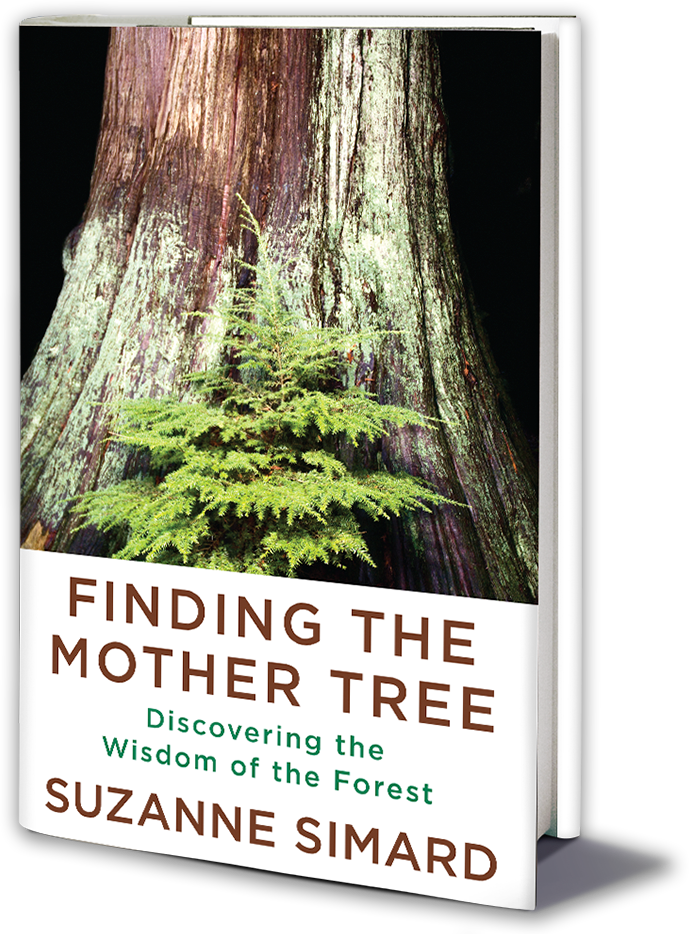
In her first book, Simard brings us into her world, the intimate world of the trees, in which she brilliantly illuminates the fascinating and vital truths – that trees are not simply the source of timber or pulp, but are a complex, interdependent circle of life; that forests are social, cooperative creatures connected through underground networks by which trees communicate their vitality and vulnerabilities with communal lives not that different from our own. Simard writes – in inspiring, illuminating, and accessible ways – how trees, living side by side for hundreds of years, have evolved, how they perceive one another, learn and adapt their behaviors, recognize neighbors, and remember the past; how they have agency about the future; elicit warnings and mount defenses, compete and cooperate with one another with sophistication, characteristics ascribed to human intelligence, traits that are the essence of civil societies – and at the center of it all, the Mother Trees: the mysterious, powerful forces that connect and sustain the others that surround them.
From Suzanne’s website
Luckily, you don’t have to wait for the book, you can learn about Suzanne and her precious scientific work by watching the following TED Talk.
Here are a couple of excerpts.
The first from page 277:
Our modern societies have made the assumption that trees don’t have the same capacities as humans. They don’t have nurturing instincts. They don’t cure one another, don’t administer care. But now we know Mother Trees can truly nurture their offspring. Douglas firs, it turns out, recognize their kin and distinguish them from other members of the community.
And the second from page 283:
I have come full circle to stumble onto some of the indigenous ideals: Diversity matters. And everything in the universe is connected – between the forests and the prairies, the land and the water, the sky and the soil, the spirits and the living, the people and all other creatures.
To say that I was amazed is an understatement. It is a book that will appeal to nature lovers all over the world. But more than that, the trees of the world have the ability to save humankind from accelerating climate change, if only enough people sign up to protecting trees, and soon. If you haven’t read it yet I implore you to read it now.
Finally, in Suzanne’s own words: Turning to the intelligence of nature itself is the key.
If you want to get involved then please go to The Mother Tree Project.
 Learning from Dogs